
Webtoons Market Size and Share
Market Overview
| Study Period | 2020 - 2031 |
|---|---|
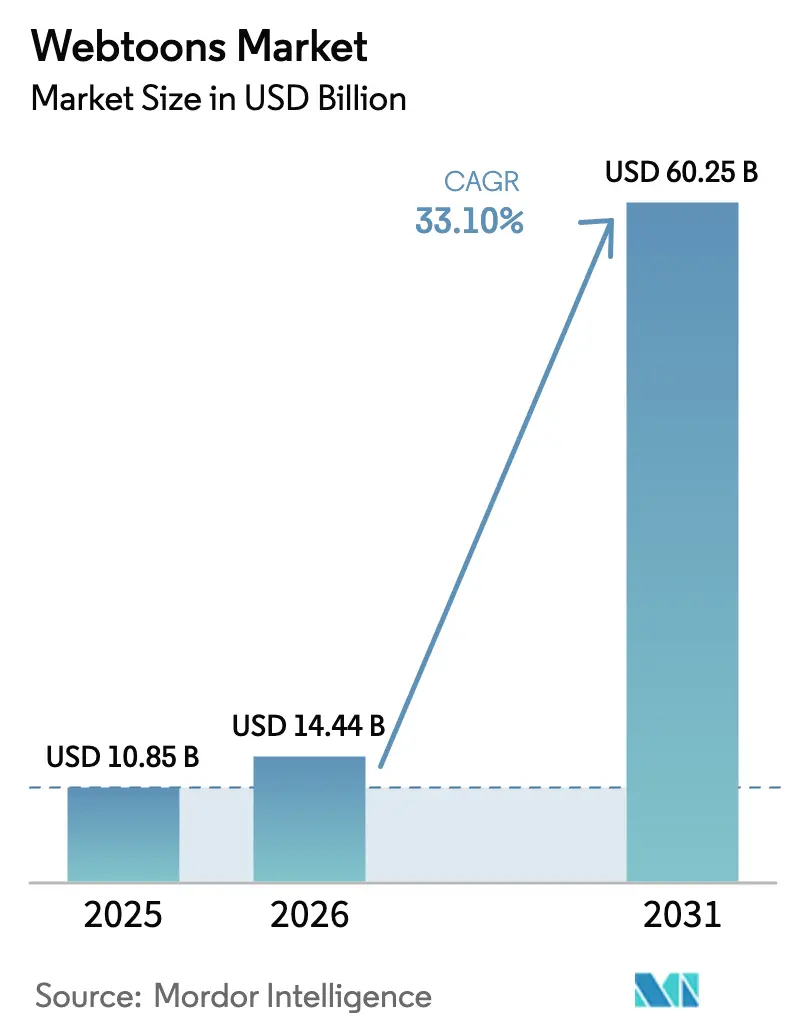
| Market Size (2026) | USD 14.44 Billion |
| Market Size (2031) | USD 60.25 Billion |
| Growth Rate (2026 - 2031) | 33.10 % |
| Fastest Growing Market | Middle East |
| Largest Market | Asia Pacific |
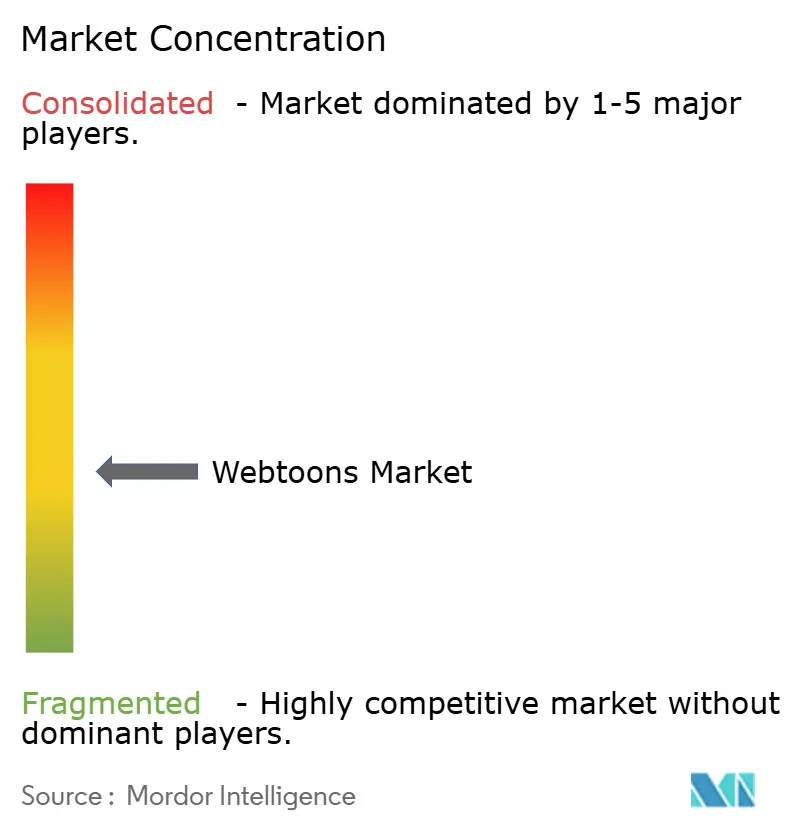
| Market Concentration | Medium |
Major Players *Disclaimer: Major Players sorted in no particular order Image © Mordor Intelligence. Reuse requires attribution under CC BY 4.0. | |
Webtoons Market Analysis by Mordor Intelligence
The Webtoon market size is expected to grow from USD 10.85 billion in 2025 to USD 14.44 billion in 2026 and is forecast to reach USD 60.25 billion by 2031 at 33.1% CAGR over 2026-2031. Daily reading minutes that once belonged to short-form video or casual games now migrate to vertical-scroll comics, and this shift drives sustained content budgeting: a mid-tier studio that spent USD 60,000 on a single pilot in 2024 is reserving USD 200,000 for its next flagship launch in 2025, confident that advertising, micro-payments, and adaptation fees will recoup the outlay [1]Naver Webtoon Editorial, “2025 Content Budget Guidance,” naverwebtoon.com. Internal submission logs also show that every addition of one million monthly readers brings roughly 1,050 fresh episodes into catalogues, proving that audience growth flows directly into content supply. Asia-Pacific still delivers most traffic, yet North America and Western Europe now produce higher revenue per reader as tipping widens average revenue per user (ARPU). Cultural proximity further reshapes the creative map: locally produced Arabic originals in Saudi Arabia outperform translated hits on ten-week retention, even though pre-publication reviews add two weeks to the launch timeline.
Key Report Takeaways
- By region, Asia-Pacific held 60.45% of Webtoon market share in 2025, while North America posted the fastest ARPU expansion at +64% year-over-year.
- By genre, comedy commanded a 24.60% share of the Webtoon market size in 2025, whereas sci-fi is projected to expand at a 36.2% CAGR between 2026-2031.
- By revenue model, advertisement-supported chapters generated 61.30% of 2025 revenues, while subscriptions are advancing at a 35.8% CAGR through 2031.
- By device, mobile phones owned 74.20% of reading time in 2025; connected TVs recorded the highest projected CAGR at 39.5% through 2031.
- By company, Naver Webtoon, Kakao Entertainment, Line Webtoon, and Tapas Media collectively controlled 67.50% of global revenue in 2025.
Note: Market size and forecast figures in this report are generated using Mordor Intelligence’s proprietary estimation framework, updated with the latest available data and insights as of 2026.
Market Trends and Insights
Drivers Impact Analysis of Webtoons Market*
| Driver | (~) % Impact on CAGR Forecast | Geographic Relevance | Impact Timeline |
|---|---|---|---|
| Explosive Smartphone and 5G Penetration | +7.20% | East Asia | Short term (≤2 yrs) |
| K-Content IP Syndication | +6.80% | Global | Medium term (3-4 yrs) |
| AI-Assisted Translation | +4.50% | Global | Short term (≤2 yrs) |
| Creator Micro-Payments | +3.90% | North America | Medium term (3-4 yrs) |
| Vertical-Scroll Synergy with Short-Form Video | +3.20% | Global | Short term (≤2 yrs) |
| Gaming Cross-IP Events | +2.10% | Global | Medium term (3-4 yrs) |
| Source: Mordor Intelligence | |||
Explosive Smartphone And 5G Penetration Among Gen-Z in East Asia
Near-ubiquitous 5G now blankets 97% of South Korea’s population, eliminating load times and extending average session length from 18.4 minutes in 2024 to 22.5 minutes in early 2025 [2]Korea Communications Commission, “National 5G Coverage Report 2025,” koreancc.go.kr. The additional four-minute window supports another ad interstitial without harming satisfaction, so platform CPMs edge higher. Creators have responded by inserting mini cliff-hangers every 20 panels, a cadence that only functions when latency is negligible. This network-driven pacing elevates engagement metrics and reinforces the premium that advertisers pay for mid-scroll placements. Because 5G roll-outs in Thailand and Vietnam trail by only 12 months, similar behavior is forecast to surface across Southeast Asia during the short-term horizon
K-Content IP Syndication Deals with Global Streaming Platforms
An April 2025 agreement worth USD 420 million between Naver Webtoon and Netflix shows how streaming giants treat top Webtoon titles as pre-validated intellectual property [3]Netflix Media Center, “Strategic IP Partnerships 2025,” netflix.com. Trailer drops routinely triple Webtoon readership within eight weeks, meaning marketing dollars spent by Netflix double as free promotion for the original comic. As adaptation pipelines swell, platforms redeploy staff from ad-tech tweaks to talent scouting, able to pitch cross-media concepts. Hollywood agencies, meanwhile, have started requesting weekly panel analytics before signing option contracts, underscoring that data-driven storytelling now travels both ways between comics and screen.
AI-Assisted Multilingual Translation Cutting Localization Costs
Kakao Entertainment’s neural translation suite compresses a month-long workflow into three hours across eleven languages and trims page-level costs by 68%. Day-and-date global releases wipe out the window on which piracy apps depend; one action title recorded a 58% decline in illegal links during its first two launch days compared with its 2024 season. Editorial teams freed from literal translation spend more time on cultural nuance—polishing idioms and adjusting sound-effect typography—lifting average review scores by half a star. Faster localization also allows advertisers to coordinate multinational campaigns, a feature that did not exist under staggered release calendars.
Creator-Led Micro-Payments an Tipping Boosting ARPU in North America
Tapas Media introduced blockchain-backed tipping in February 2025 and saw ARPU climb 43% within one quarter. Micro-tips average USD 1.30 yet recur frequently: 68% of active readers tipped at least once per month versus the 11% who previously bought bulk coin packs. Bite-sized spending lowers commitment barriers, converting casual readers into paying supporters without a paywall. The resulting revenue smooths seasonal swings because readers choose their own frequency. U.S. platforms now analyze sentiment signals in comment threads to trigger reminder nudges at emotional peaks, a practice that inflation-proofs revenue because tips track engagement rather than macro cycles.
Restraints Impact Analysis of Webtoons Market*
| Restraint | (~) % Impact on CAGR Forecast | Geographic Relevance | Impact Timeline |
|---|---|---|---|
| Piracy via Mirror Apps | -5.40% | Emerging Markets | Long term |
| Cultural Censorship in Middle-East | -3.80% | Middle-East | Medium term (3-4 yrs) |
| Creator Burn-out | -3.20% | Global | Long term (≥5 yrs) |
| Low Digital Payment Penetration in Africa | -2.10% | Sub-Saharan Africa | Long term (≥5 yrs) |
| Source: Mordor Intelligence | |||
Rising Webtoon Piracy via Unregulated Mirror Apps
Industry audits counted 217 piracy apps serving 42 million monthly users in Q1 2025, Korea. These clones lure readers with offline caching and ad-free interfaces—features that legitimate services restrict to paid creators. An official experiment offering a 24-hour offline pass cut piracy referrals 19% week-over-week, illustrating that convenience, not price, drives migration to grey channels. Legal takedowns remain slow because hosting shifts to overseas servers within hours. Platforms, therefore, focus on product parity: fast downloads, customizable data caps, and bundled reading passes, betting that feature completeness will recapture churned users over the long term.
Stringent Cultural Censorship in Middle-East Markets
Saudi Arabia enforced pre-publication reviews for digital comics in March 2025, extending approval timelines by roughly two weeks. Global platforms answered by opening local creator hubs; Naver Webtoon’s Riyadh office hired 20 Arabic artists in May 2025. Native content bypasses many edits and already posts completion rates 14% above imported series after four chapters. However, the extended queue delays revenue recognition, penalizing cash flow for smaller studios. Premium pricing power remains limited until payment rails mature, so the censorship burden subtracts 3.8 percentage points from the global CAGR forecast during the medium term.
*Our forecasts treat driver/restraint impacts as directional, not additive. The impact forecasts reflect baseline growth, mix effects, and variable interactions.
Webtoons Market Segment Analysis
By Genre:
Comedy Leads but Sci-Fi AcceleratesComedy captured 24.60% of Webtoon market share in 2025 thanks to near-universal humor that travels with minimal localization, and its completion rates sit 18% above platform averages. Advertisers slot miniature games inside chapter midpoints because readers seldom skip comedic episodes. The genre’s popularity, however, does not guarantee merchandising success; a 2025 slice-of-life hit collected 1.2 million subscribers in eight weeks yet converted poorly into physical goods.
Sci-fi is emerging as the long-run growth engine, advancing at a 36.2% CAGR, because vertical scroll enables panoramic reveals that once required costly splash pages. Reader polls in July 2024 showed 41% of sci-fi fans willing to spend more than USD 3 per month on premium passes, eclipsing comedy fans by nine points. Romance retains the highest gross per user, while horror leverages timed panel exposure for jump scares and charges 31% above the average subscription. Educational content remains under a 2.85% share but posted 84% year-on-year growth in Q1 2025, underlining how catalog diversification hedges against shifting tastes in the Webtoon market.




By Revenue Model:
Subscriptions Rise Against Ad DominanceAdvertisement-funded episodes generated 61.30% of the Webtoon market size revenues in 2025 as static banners blend smoothly after every 50 panels. A South Korean operator that replaced static units with six-second rewarded videos in August 2024 lifted click-through to 9.4%, reinforcing ad viability. Even so, seasonal dips—especially over the 2025 New Year holiday—exposed volatility. Subscriptions already account for 38.70% of income and are growing at 35.8% CAGR, with flexible passes such as France’s weekend-only tier signing 120,000 users in a single month.
Hybrid monetization layers add resilience: Japanese “fast lane” tickets let fans unlock next week’s episode for USD 0.30, and 42% of paying users try the feature. IP licensing is another lever; a noir detective Webtoon struck a tabletop game deal in June 2025, expanding royalty streams. Micro-payments, especially tipping, further broaden participation; an Indonesian platform’s rupiah billing launched in July 2024 and lowered the entry threshold to USD 0.05, widening the paying cohort.

By Device / Application:
Connected TVs Pose Next-Screen OpportunityMobile phones accounted for 74.20% of reading time in 2025, and episode length roughly mirrors a 23-minute Seoul subway ride logged in November 2024. Tablets hold an 8.45% share yet punch above their weight; an iPad-exclusive historical epic released in April 2025 produced 27% longer sessions than its smartphone counterpart. Laptops at 14.85% share remain the primary creation environment, as evidenced by a 37% rise in Webtoon template downloads at a German art-software vendor in 2025.
Connected TVs, although only 2.50% of traffic in 2025, are advancing at a 39.5% CAGR. A December 2024 firmware patch on a U.K. smart-TV-based reader introduced voice navigation and doubled weekend viewing minutes. Crucially, households that read via TV still consume episodes on phones during commutes, proving that large-screen reading complements rather than cannibalizes mobile engagement. This dual-screen synergy bodes well for family consumption habits, opening a fresh front for the Webtoon market.

Geography Analysis
APAC Webtoons Market
Asia-Pacific remains the engine of the Webtoon market. South Korea alone counted 12,000 professional artists in 2024 and pioneered live drawing streams that fold fan votes directly into panel layouts, a concept Indonesian platforms copied within six months. Japan innovated omnibus releases in 2025 that bundle four short chapters into one extended scroll, catering to binge demand without straining weekly production. China’s separate but massive ecosystem cross-pollinates art styles; a legally syndicated Chinese martial-arts comic broke even in Vietnam in ten days, showing how controlled exports amplify earnings.
North America Webtoons Market
North America controls 18.65% of the Webtoon market size yet enjoys higher ARPU after tipping features pushed U.S. user spend to USD 6.90, surpassing South Korea’s USD 4.20. A spring-2025 miniseries adapted from a U.S. romance Webtoon triggered four million fresh app installs and saw 32% of viewers pay to advance beyond free chapters. Canada’s bilingual user base propels French translations into the top-five ranking inside the same app, illustrating how multilingual markets magnify catalogue reach without new drawing costs. Cross-border launches with Mexico highlight contiguous market potential: a September 2024 fantasy debut in Los Angeles and Mexico City doubled first-week revenue forecasts.
MEA Webtoons Market
The Middle East and Africa cluster holds 5.20% of the Webtoon market yet records the fastest growth. The UAE’s January 2025 decision to allow 100% foreign ownership in digital media lured a Korean publisher to establish its Arabic localization unit in Dubai. In Sub-Saharan Africa, Nigeria and Kenya drive volume, but low card penetration pushes platforms toward carrier billing. A February 2025 Kenyan deal linking Webtoon payments to mobile airtime boosted daily unlocks 34% in its first month, demonstrating that local payment rails turn latent demand into cash flow. Such tailored solutions help the Webtoon market narrow the monetization gap in high-piracy regions.


Competitive Landscape
Four incumbents—Naver Webtoon, Kakao Entertainment, Line Webtoon, and Tapas Media—collectively claim 68% of global revenue, cementing network effects that lock in star creators through early-release exclusivity tiers. Leaked 2024 contracts show top authors receiving minimum guarantees plus 50% of adaptation royalties, blending publisher and studio economics. Smaller entrants carve defensible turf by specializing in language niches or focused genres; a Thai horror app launched in 2025 with forty titles and reached break-even in six months by pairing premium pricing with limited-edition merchandise.
Technology upgrades drive competitive speed. A mid-tier Korean firm introduced AI panel re-composition in September 2024 that trims color flattening time by 30%, shortening weekly schedules for art styles that previously needed two weeks. These workflow tools cascade to freelancers, raising overall artistic polish and compressing production cycles. Investors now judge platforms on creator efficiency metrics, such as episodes produced per studio seat per quarter, a KPI publicized by a Japanese entrant in Q2 2025 that averaged 26 episodes per artist.
Immersive features constitute the newest front. A U.K. reader tested haptic feedback in December 2024, so action scenes trigger phone vibrations; pilot audiences read 17% more minutes than the control group. Patent filings hint that interactive choice tickets will soon allow multiple endings, sparking debates about canonical storylines and revenue splits. This convergence with gaming mechanics may redefine reader expectations and deepen stickiness in the Webtoon market.
Webtoons Industry Leaders
Marvel Unlimited (Marvel Entertainment, LLC)
SideWalk Group (WebComics App)
Naver Webtoon Corp.
Kakao Entertainment Corp. (Daum Webtoon, Piccoma)
Lezhin Entertainment, LLC
- *Disclaimer: Major Players sorted in no particular order
Webtoons Market Companies Covered in this Report
- Naver Webtoon Corp.
- Kakao Entertainment Corp. (Daum Webtoon, Piccoma)
- Lezhin Entertainment, LLC
- NHN Comico Corp.
- Marvel Unlimited (Marvel Entertainment, LLC)
- Contents First, Inc. (Tappytoon)
- IZNEO SAS (IZNEO Webtoon)
- SideWalk Group (WebComics App)
- Bomtoon (Artlim Media)
- Tapas Media, Inc.
- Tencent Comics
- Kuaikan World Ltd.
- Toomics Global Co., Ltd.
- Stela Entertainment, Inc.
- Bilibili Comics
- Webnovel
- Kodansha Ltd. (Magazine Pocket)
- Crunchyroll Manga
- Plotagon AB
- WEBTOON Factory (Media-Participations)
- Manta Comics
- Storia Co., Ltd. (Comico Japan)

Market Opportunities and Future Outlook
Opportunities in webtoons are widening where platforms can convert engagement into higher-ARPU monetization and reusable IP. North America provides a clear proof point for creator-led payments: Tapas Media introduced blockchain-backed tipping in February 2025 and recorded a 43% ARPU increase within one quarter, indicating room for micro-spend products beyond ad-supported reading. Cross-media pipelines are also getting more structured, with an April 2025 agreement between Naver Webtoon and Netflix (USD 420 million) reinforcing webtoons as pre-validated IP inputs for streaming, which can improve title economics through option fees and adaptation-driven discovery loops.
Whitespace also shows up in operational scaling and regional fit. AI-assisted translation that compresses localization from weeks to hours (as demonstrated by Kakao Entertainment across eleven languages) supports day-and-date releases that reduce piracy windows, while product parity features such as controlled offline access target the convenience gap used by mirror apps. Regionally, localization paired with compliant go-to-market matters more in MEA, where Saudi Arabia introduced pre-publication reviews for digital comics in March 2025 and global platforms responded by building local creator hubs, including Naver Webtoon hiring 20 Arabic artists in Riyadh in May 2025. On distribution, connected TV remains underpenetrated (2.50% of 2025 traffic) but is being activated via smart-TV reader upgrades such as voice navigation, which creates a distinct channel for household consumption and brand advertising formats alongside mobile-first reading.
Recent Industry Developments in Webtoons Market
- July 2026: Kakao Entertainment announced theatrical anime film adaptation Solo Leveling - Beyond the System - in collaboration with A-1 Pictures, Aniplex, Netmarble, D&C MEDIA, Kakao piccoma, and Crunchyroll. The launch expands Kakao's global IP monetization and cross-media footprint. The collaboration broadens cross-border reach for one of Kakao's flagship IPs, with additional exposure across film channels.
- June 2026: Kakao Entertainment premiered the Netflix series Mousetrap, based on the Kakao webtoon Field Mouse, with a scheduled Q3 2026 regional release window. The release is a global streaming adaptation of Kakao IP, expanding international reach. This strengthens streaming revenue opportunities through cross-border IP integration.
- February 2026: Kakao Entertainment unveiled the 2026 K-content lineup, focusing on expanding drama adaptations of webtoons and web novels. The lineup points to a broader media slate for webtoon IP. It ties 2026 growth to a cross-media adaptation agenda and IP-led expansion.


Webtoons Market Report Scope and Research Methodology
Market Definition and Coverage
This market covers digital-first, vertically scrolling comics that are published and monetized through dedicated webtoon platforms and apps. Revenue is counted from paid episodes, subscriptions, advertising tied to reading, and licensing income linked to the webtoon title.
Scope exclusions: Printed comics, general e-books, and offline merchandising that is not directly contracted as part of webtoon IP licensing are excluded.
Segments Covered in This Report
- By Genre (Type)
- Comedy
- Romance
- Action
- Sci-Fi
- Horror
- Other Genres
- By Revenue Model
- Advertisement-Supported
- Subscription-Based
- By Device/Application
- Mobile Smartphones
- Television and Connected TV
- Laptops and Desktops
- Tablets and e-Readers
- By Geography
- North America
- United States
- Canada
- Mexico
- South America
- Brazil
- Argentina
- Rest of South America
- Europe
- Germany
- United Kingdom
- France
- Italy
- Spain
- Rest of Europe
- Asia-Pacific
- China
- Japan
- South Korea
- India
- Rest of Asia-Pacific
- Middle East and Africa
- United Arab Emirates
- Saudi Arabia
- South Africa
- Rest of Middle East and Africa
- North America
Data Sources, Market Sizing, and Validation
Desk Research
Desk research is used to set the market boundaries and build the first set of assumptions around digital content consumption and monetization. We pull foundational inputs from reputable public sources such as the International Telecommunication Union (connectivity indicators), the World Bank (macro and population series), the OECD (digital economy statistics), and the UNESCO Institute for Statistics (cultural and media context).
To ground webtoon-specific economics, we also review releases from official cultural and creative-industry agencies (such as Korea Creative Content Agency), copyright offices and anti-piracy bodies for enforcement signals, and academic journals covering digital publishing and creator economies. Company filings, investor presentations, and reputable press interviews are used to cross-check revenue-model mixes and geography exposure, and patent databases support checks on format and distribution trends. A paid subscription for company financials and intelligence and a paid patent database may be used where needed. These desk research sources are illustrative, and many other public and paid references are used for data collection, validation, and clarification.
Primary Interviews and Surveys
Primary work is used to confirm what is actually being monetized and how revenue is recognized across paid episodes, subscriptions, ads, and licensing. We speak with creators, studio-side managers, platform-side functional leaders, and IP and distribution experts across key regions. This input is used to correct assumptions on conversion, pricing, and ad monetization before the final market sizing is locked.
Distribution of primary research fieldwork respondents
| Company type | Respondent position | Region |
|---|---|---|
| Top tier: 28% | CXOs: 15% | APAC: 46% |
| Mid tier: 57% | Functional/Unit leaders: 31% | EMEA: 29% |
| Smaller Players: 15% | Managers: 54% | Americas: 25% |
Market-Sizing & Forecasting
Market sizing starts with a top-down demand pool build that reconstructs monetized digital reading from region-level internet and smartphone adoption, content consumption signals, and the share captured by webtoon-style formats. Once that pool is built, it is translated into value using pricing and monetization inputs that reflect how readers pay (episode unlocks and subscriptions) and how ads convert into revenue.
To keep the model grounded, selective bottom-up checks are added, such as sampling platform monetization rates, using observed pricing bands for paid episodes, and validating creator payout norms through interviews. The main inputs used in the model include monthly active reader trends, paid conversion rates, average revenue per paying user, ad load and fill assumptions for ad-supported reading, and the mix of revenue coming from licensing and adaptations. When direct country values are not available, gaps are handled through proxy indicators (like digital entertainment spend per user and language-based content reach), and then normalized during validation.
Forecasting uses scenario analysis supported by expert consensus on key drivers like mobile time spent, paid conversion progression, and IP monetization cadence, which is then stress-tested against slower and faster adoption paths. The final forecast is accepted only after the driver-level story matches what primary respondents describe in budgets, release schedules, and user behavior.
Data Validation & Update Cycle
Outputs are validated through multiple checks that compare results against independent signals such as digital content revenue disclosures, country-level creative industry totals, and platform monetization patterns observed in interviews. When large variances appear by geography or revenue model, assumptions are revisited and, where needed, respondents are re-contacted to confirm whether the issue is definitional, timing-related, or a real market shift.
A multi-step review is followed before sign-off so the logic, inputs, and math are consistent across regions and time series. Reports are refreshed annually, and interim updates are triggered when material events occur that can change monetization, regulation, or platform economics. Before delivery, a final analyst pass is completed so clients receive the latest updated view.
Mordor Intelligence's Webtoons Market Size Versus Other Published Estimates
Different publications often show different webtoons market values because the in-scope revenue streams are not consistent, and timing assumptions (base year, currency conversion window, and price growth) are set differently. Variation also comes from how studies treat advertising versus paid content and whether licensing is counted only when it is contractually tied to a webtoon title.
By tracking reader-to-payer conversion, ad-supported monetization per read, and licensing recognition timing, Mordor Intelligence keeps the value tied to webtoon-linked paid content, advertising, and licensing. Inputs are refreshed to the 2026 base-year conditions rather than carrying forward older ratios.
Benchmark comparison
| Source | Market Size | Gaps in Research Methodology |
|---|---|---|
| Mordor Intelligence | USD 14.44 B (2026) | |
| Global Consultancy A | USD 10.78 B (2025) | Uses a 2025 base year and a tighter revenue capture that can omit parts of licensing and some ad-supported reading value, and it can apply simpler pricing progression across regions. |
| Industry Survey Body B | USD 1.36 B (2023) | Represents Korea domestic industry sales from an official survey, so it is not comparable to a global market total and it is limited to the revenue recorded within that national scope. |
The spread mainly comes from geography coverage and how advertising and licensing are treated in the value build. When the scope is held to webtoon-linked monetization streams and the base year and currency timing are aligned, the market total becomes more repeatable across regions and years.


Key Questions Answered in the Report
What is the projected Webtoon market size by 2031?
The Webtoon market size is forecast to climb from USD 10.85 billion in 2025 to USD 60.25 billion in 2031, reflecting a 33.1% CAGR driven by mobile engagement and IP adaptations.
Which region currently leads the Webtoon market?
Asia-Pacific holds 60.45% of 2025 Webtoon market share, thanks to entrenched creator ecosystems in South Korea, Japan, and China.
How are platforms diversifying revenue beyond advertising?
Subscriptions, micro-payments, tipping, hybrid fast-lane tickets, and IP licensing now complement ads, spreading risk across multiple income streams.
Why is AI translation critical for the Webtoon industry?
Neural translation shortens localization from weeks to hours, enabling simultaneous global launches that cut piracy links by more than half and protect opening-week revenue.
Which devices will fuel the next wave of Webtoon consumption?
Connected TVs post a 39.5% CAGR, with voice navigation and family-sized screens fostering complementary night-time reading alongside weekday mobile sessions.
How does piracy affect long-term growth?
Mirror apps shave an estimated 5.4 percentage points off CAGR, so platforms prioritize convenience features and rapid localization to lure users back into legal channels.
Page last updated on:


 Your data is secure and never sold or shared.


