
WebRTC Market Size and Share
Market Overview
| Study Period | 2019 - 2030 |
|---|---|
| Market Size (2025) | USD 12.61 Billion |
| Market Size (2030) | USD 67.37 Billion |
| Growth Rate (2025 - 2030) | 39.81 % |
| Fastest Growing Market | Middle East and Africa |
| Largest Market | Europe |
| Market Concentration | Low |
Major Players *Disclaimer: Major Players sorted in no particular order Image © Mordor Intelligence. Reuse requires attribution under CC BY 4.0. | |
WebRTC Market Analysis by Mordor Intelligence
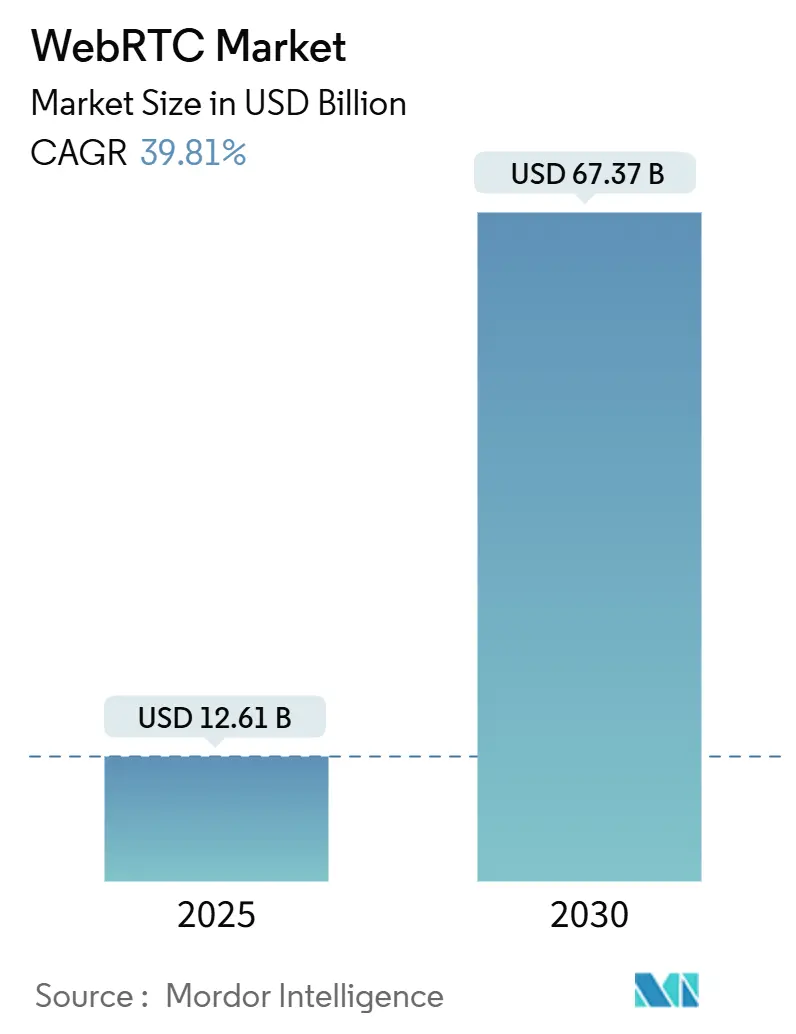
The WebRTC market size is valued at USD 12.61 billion in 2025 and is projected to reach USD 67.37 billion by 2030, advancing at a CAGR of 39.81%. Explosive demand for CPaaS and UCaaS platforms is expanding browser-native video capabilities across customer engagement, telehealth, and embedded collaboration workflows. Enterprises are shifting from on-premises gateways to managed WebRTC APIs that hide signaling and TURN relay complexity, reducing deployment time and infrastructure overhead. Europe’s stringent data-protection regime favors WebRTC’s end-to-end encryption, while 5G-driven latency improvements in Asia-Pacific and MEA are stimulating mobile-first real-time applications. Growing reliance on edge-optimized SFUs, AI-powered audio enhancement, and vertical-specific compliance tooling further reinforces the WebRTC market growth trajectory.
Key Report Takeaways
- By component, Services led with 41.23% WebRTC market share in 2024; Solutions are expanding at a 41.21% CAGR to 2030.
- By deployment model, Private Cloud held 37.89% of the WebRTC market size in 2024, whereas Public Cloud is forecast to grow at a 40.87% CAGR between 2025-2030.
- By device, PCs and Laptops captured 37.63% share of the WebRTC market in 2024; Smartphones and Tablets are advancing at a 39.81% CAGR through 2030.
- By industry vertical, Healthcare accounted for 21.34% of revenue in 2024, while Media and Entertainment is on track for a 39.89% CAGR to 2030.
- By organization size, SMEs represented 29.87% of value in 2024, and Large Enterprises are projected to rise at a 41.18% CAGR during 2025-2030
Note: Market size and forecast figures in this report are generated using Mordor Intelligence’s proprietary estimation framework, updated with the latest available data and insights as of January 2026.
Market Trends and Insights
Drivers Impact Analysis of WebRTC Market*
| Driver | (~) % Impact on CAGR Forecast | Geographic Relevance | Impact Timeline |
|---|---|---|---|
| Explosive growth of CPaaS and UCaaS demand | +8.2% | Global, led by North America and Europe | Medium term (2-4 years) |
| Remote and hybrid-work adoption boom | +7.8% | Global, strongest in developed markets | Short term (≤ 2 years) |
| Rapid mobile-internet and 5G penetration | +6.9% | Asia-Pacific core; spillover to MEA and Latin America | Long term (≥ 4 years) |
| Cost-efficient plugin-free browser comms | +5.4% | Global; high relevance for cost-sensitive SMEs | Medium term (2-4 years) |
| Edge-optimized SFU roll-outs | +4.7% | Early in North America and EU, expanding to Asia-Pacific | Long term (≥ 4 years) |
| Telehealth billing-code changes | +3.2% | North America and Europe | Short term (≤ 2 years) |
| Source: Mordor Intelligence | |||
Explosive Growth of CPaaS and UCaaS Demand
Twilio reported USD 1.02 billion Q3 2024 revenue, with WebRTC-enabled APIs driving a sizable share. API-first strategies embed video authentication, customer support, and co-browsing into core applications, eliminating context switches that plagued standalone conferencing tools. Financial institutions have compressed video KYC onboarding to minutes while maintaining encryption and audit logging. Healthcare providers integrate browser consultations directly with electronic health records to streamline clinical workflows. This convergence of contextual video and back-end data access underpins sustained CPaaS expansion and, in turn, WebRTC market growth.
Remote and Hybrid-Work Adoption Boom
Browser-native video removes client installs, enabling employees, contractors, and partners to join meetings from any managed or unmanaged device. [1]Contact Center Pipeline, “How WebRTC Addresses Real-World Challenges,” contactcenterpipeline.com Sub-500 ms latency fosters real-time document co-editing, whiteboarding, and live code reviews, which were cumbersome on legacy streaming protocols. Bring-your-own-device policies benefit from WebRTC’s built-in NAT traversal that sidesteps VPN configuration. Enterprises report lower help-desk tickets tied to conferencing plug-in failures, translating to direct support-cost savings. The remote-work tailwind, therefore, accelerates WebRTC market penetration across corporate functions.
Rapid Mobile-Internet and 5G Penetration
Sub-10 ms 5G latency combined with MEC offloads processing closer to users, improving video quality while containing bandwidth costs. [2]Singtel, “Advanced 5G Edge – Powering Content Streaming, Cloud Gaming, AR/VR,” singtel.com Live commerce apps in Southeast Asia now stream interactive sales demos with real-time customer feedback, unlocking new revenue channels for retailers. Adaptive bitrate ensures continuous playback despite fluctuating cellular conditions, widening user reach into tier-2 and tier-3 cities. Enterprises in manufacturing deploy WebRTC-enabled remote-assist solutions for equipment maintenance, leveraging 5G’s uplink capacity for HD video from handheld devices on factory floors. These scenarios reinforce regional momentum behind the WebRTC market.
Cost-Efficient Plugin-Free Browser Communications
Traditional conferencing suites incur per-seat licenses and manual software updates, whereas WebRTC operates inside standards-compliant browsers at zero client cost. [3]Wowza Media Systems, “What Is WebRTC?,” wowza.com SMEs, which hold 29.87% market share in 2024, avoid capital outlays for multipoint control units and maintenance contracts by adopting pay-as-you-grow cloud APIs. Development teams embed real-time video in e-commerce carts, help-desk widgets, and learning platforms using lightweight SDKs instead of building custom RTP stacks. Reduced IT burden and faster release cycles explain the 41.18% CAGR expected for SME adoption through 2030.
Restraints Impact Analysis of WebRTC Market*
| Restraint | (~) % Impact on CAGR Forecast | Geographic Relevance | Impact Timeline |
|---|---|---|---|
| Security and privacy vulnerabilities | −4.1% | Global, heightened in regulated sectors | Medium term (2-4 years) |
| Non-standardized signaling/interoperability | −3.8% | Global, multi-vendor enterprise deployments | Long term (≥ 4 years) |
| Bandwidth and QoS deficits in emerging markets | −2.9% | MEA, Latin America, rural Asia-Pacific | Long term (≥ 4 years) |
| Browser SDP deprecations | −2.3% | Global, legacy implementations | Short term (≤ 2 years) |
| Source: Mordor Intelligence | |||
Security and Privacy Vulnerabilities
Despite DTLS-SRTP encryption, peer-to-peer WebRTC can expose IP metadata that conflicts with zero-trust network policies in finance and healthcare. Firms mitigate risk by routing media through controlled relay clusters with enhanced intrusion detection, but that raises OPEX and may introduce latency. Regulatory frameworks such as HIPAA and GDPR drive demand for auditable logging, token-based access control, and geofenced data storage, nudging some deployments toward private cloud topologies. Balancing compliance and performance remains a decisive factor for enterprise buyers.
Non-Standardized Signaling/Interoperability Gaps
While SRTP and ICE are standardized, signaling varies across vendors, creating interoperability barriers for large enterprises running multiple CPaaS stacks. Custom gateway orchestration adds engineering overhead and delays deployment. Telecom operators face similar hurdles in integrating WebRTC traffic with IMS core networks. Lack of consensus on metadata schemas inhibits feature parity in screen-sharing, file-transfer, and recording workflows across products. Continued community efforts toward common event models and WebRTC-over-HTTP protocols are expected, yet the challenge persists during the forecast period.
*Our forecasts treat driver/restraint impacts as directional, not additive. The impact forecasts reflect baseline growth, mix effects, and variable interactions.
WebRTC Market Segment Analysis
By Component:
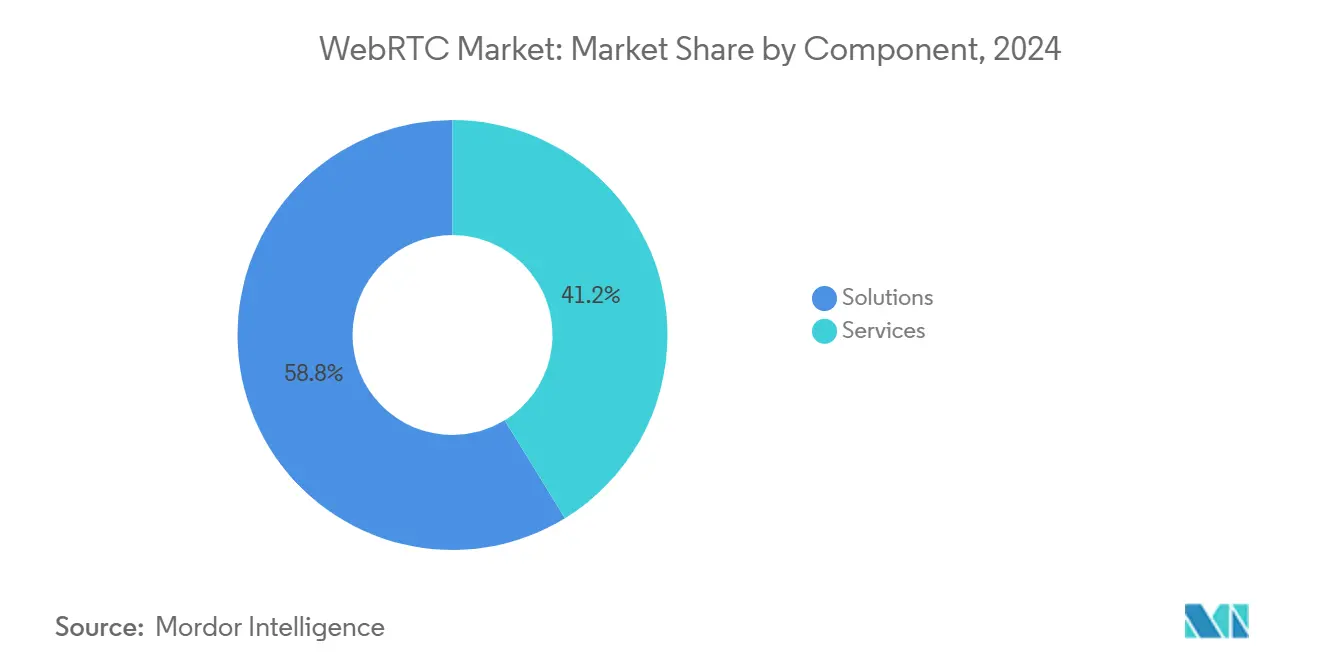
Services Retain Scale as Solutions AccelerateServices held 41.23% WebRTC market share in 2024, underscoring ongoing demand for system integration, signaling design, and 24/7 support. WebRTC market size for Services reflects complex enterprise rollouts that span TURN relay orchestration, edge-cache tuning, and compliance audits. Many banks and hospitals still rely on professional teams to integrate video flows with identity management and back-office systems. Adoption is steady across mature economies but plateauing as developer-friendly APIs proliferate.
Solutions, however, are advancing at a 41.21% CAGR, mirroring rising confidence in turnkey SDKs with point-and-click deployment. Packaged platforms offer auto-scaling SFUs, usage-based pricing, and JavaScript or Swift libraries that slash time-to-MVP from months to days. Integrated analytics dashboards, AI-powered transcription, and real-time QoS monitoring strengthen the value proposition. As more mid-market firms migrate to these cloud-native kits, Solutions are expected to narrow the gap with Services before 2030.


By Deployment Model:
Private Cloud Dominates while Public Cloud Scales FastPrivate Cloud commands 37.89% of the 2024 WebRTC market size thanks to stringent data residency mandates in banking, defense, and healthcare. Enterprises leverage dedicated clusters inside sovereign data centers to maintain key management control and meet local audit rules. Performance tuning on proprietary MPLS backbones further justifies on-premises investments.
Public Cloud, projected to post a 40.87% CAGR, resonates with startups and global brands seeking rapid elasticity. Hyperscalers provide globally distributed TURN gateways and CDN interconnects, shrinking first-frame latency for dispersed workforces. Coupled with pay-per-minute billing, this model lowers TCO relative to owning and operating hardware. Hybrid Cloud bridges the two, letting latency-sensitive or regulated traffic stay on-premises while burst workloads overflow to the public edge.
By WebRTC-Enabled Device:
Mobile Momentum Reshapes EngagementPCs and Laptops delivered 37.63% revenue in 2024, driven by corporate deskbound users and the education sectors that favor large displays for multitasking. They continue to anchor high-bandwidth boardroom and classroom sessions, especially where multi-stream video and expansive screen sharing are critical.
Smartphones and Tablets, expanding at a 39.81% CAGR, benefit from high-resolution cameras, 5G modems, and mobile-first UX habits. Retail associates use handheld devices for live shopping demos, while field technicians stream diagnostics from remote sites. The proliferation of front-facing depth cameras enables AR overlays during video calls. Other connected endpoints-smart displays, kiosks, and in-vehicle screens-remain nascent yet strategic, pointing toward omnichannel customer engagement scenarios by decade’s end.
By Industry Vertical:
Healthcare Leads, Media Ignites New GrowthHealthcare captured 21.34% of 2024 spend as telehealth codes became permanent and payers embraced reimbursable virtual visits. Providers embed browser video inside patient portals, drawing lab results and imaging alongside live consultation feeds to streamline decision-making. HIPAA-ready audit logs and automated session recording satisfy compliance.
Media and Entertainment, forecast for a 39.89% CAGR, is reinventing viewer participation through ultra-low-latency live shows, sports watch-parties, and interactive game streaming. Studios exploit WebRTC’s sub-second delay to sync real-time trivia or merchandise pop-ups with broadcast content. Retail, BFSI, and Education also integrate contextual video chat, but none match the momentum observed in live interactive media.


By Organisation Size:
SME Accessibility Pairs with Enterprise ScaleSMEs held 29.87% revenue share in 2024, attracted by out-of-the-box WebRTC widgets that bolt onto existing websites without specialist staff. Low-code visual builders empower non-developers to add appointment booking video or co-browse support, making real-time engagement financially viable.
Large Enterprises, growing at a 41.18% CAGR, embed video across CRM, ERP, and field-service applications. Multinational banks leverage encrypted video for wealth-management advisory, while manufacturers deploy internal live-stream inspections to reduce travel. Investment in AI-driven compliance, corporate single sign-on, and knowledge-base integration propels deeper specialization, lifting overall WebRTC market penetration within Fortune 500 firms.
Geography Analysis
Europe WebRTC Market
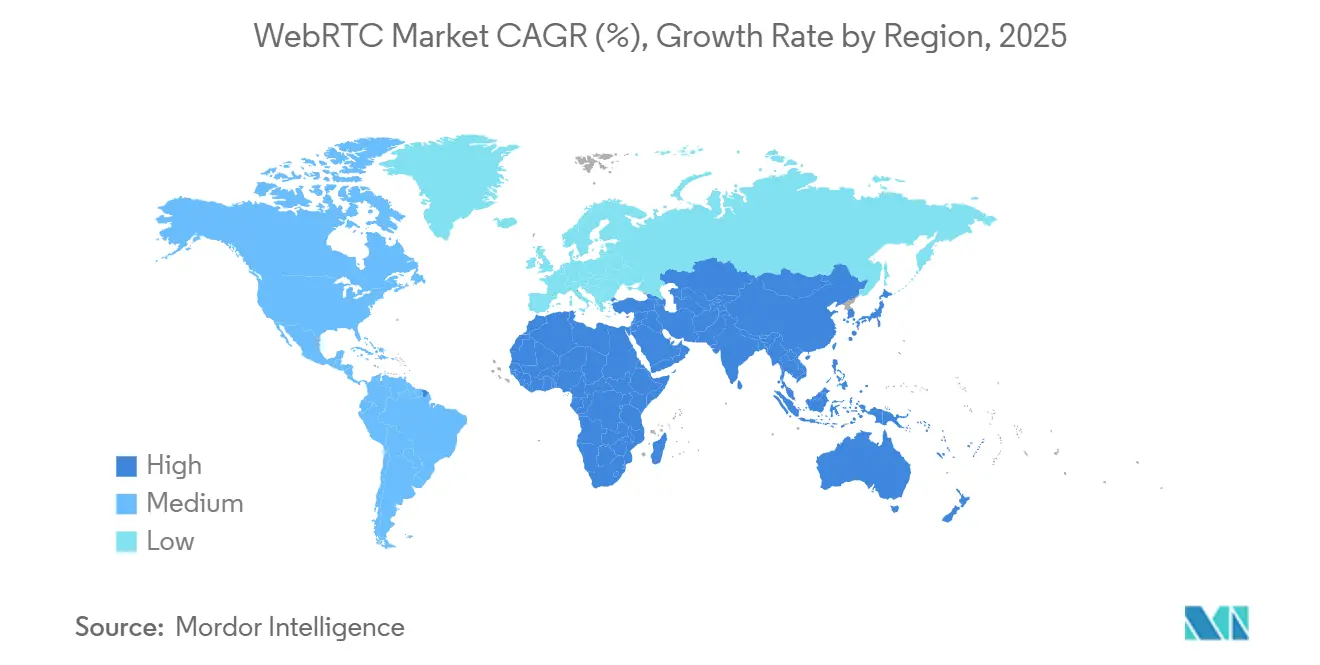
Europe leads with a 25.43% share, anchored by GDPR-aligned encryption and mature broadband coverage. Enterprises adopt compliance-ready SDKs that localize media paths and support European data-protection impact assessments. Telecommunications operators across Germany and France integrate browser voice into omni-channel contact centers to satisfy stringent customer-consent regulations.
North America WebRTC Market
North America remains a powerhouse thanks to an ecosystem of CPaaS pioneers and early public-cloud acceptance. Mega-scale edge zones across the United States trim latency for national telehealth programs and high-frequency trading platforms. Canadian healthcare authorities likewise validate browser video for cross-province specialist consultations as 5G densification proceeds.
MEA WebRTC Market
The Middle East and Africa exhibit the fastest 40.63% CAGR. Gulf smart-city initiatives deploy WebRTC-based citizen-service kiosks and emergency response consoles that capitalize on new 5G standalone cores. African ed-tech start-ups leverage low-cost smartphones to deliver interactive classrooms in bandwidth-challenged locales, boosting digital-inclusion goals.
APAC and South America WebRTC Market
Asia-Pacific witnesses rapid diffusion across China, Japan, India, and South Korea, where mobile operators bundle real-time SDKs into super-apps. Manufacturing giants use live video for remote factory acceptance tests, and government portals in India pilot browser-based grievance redressal hearings to eliminate travel wage loss for citizens. South America is a late but consistent adopter, with Brazil’s fintech scene embedding in-app video KYC to combat fraud.

Competitive Landscape
The WebRTC market demonstrates moderate concentration as full-stack platform providers vie with niche specialists. Twilio, Agora, and Vonage extend global POPs, per-minute billing, and AI analytics dashboards, appealing to developers needing rapid integration. Specialized vendors address healthcare HIPAA workflows, financial multi-factor authentication, or low-bandwidth adaptive codecs, maintaining relevance where one-size-fits-all APIs fall short.
Strategic moves include Twilio’s edge-container deployment to minimize media hops for multinational retailers, Agora’s AI noise-suppression SDK tailored for education, and Vonage’s WebRTC-to-SIP bridging for contact centers migrating from legacy PBXs. Partnerships with hyperscalers bolster reach; for instance, joint reference architectures with Azure ease hybrid cloud roll-outs. M&A activity is likely as incumbents seek AI transcription engines or compliance accelerators to enrich portfolios.
Open-source ecosystems such as Jitsi and Pion continue to democratize access, enabling SaaS entrants to prototype without licensing fees. However, sustained operation at scale, with guaranteed uptime and global TURN coverage, favors commercial offerings. The interplay of proprietary reliability and open-source flexibility defines competition over the forecast horizon.
WebRTC Industry Leaders
Twilio Inc.
Vonage Holdings Corp.
Agora Inc.
8x8, Inc.
Cisco Systems, Inc.
- *Disclaimer: Major Players sorted in no particular order

WebRTC Market Companies Covered in this Report
- Twilio Inc.
- Vonage Holdings Corp.
- Agora Inc.
- 8x8, Inc.
- Cisco Systems, Inc.
- Zoom Video Communications, Inc.
- RingCentral, Inc.
- Sinch AB
- Daily.co, Inc.
- SignalWire, Inc.
- Temasys Communications Pte Ltd.
- LiveSwitch Inc.
- Frozen Mountain Software Ltd.
- Pexip Holding ASA
- Digital Samba S.L.
- Quobis Solutions S.L.
- Plivo Inc.
- TokBox Inc.
- Kandy Communications, LLC
- Apidaze (Voxbone SA)

Recent Industry Developments in WebRTC Market
- March 2025: Cogniteq finalized a cross-platform WebRTC mobile app featuring AI transcription and sentiment analysis.
- January 2025: OpenAI launched WebRTC integration for its Realtime API, enabling browser voice interactions with sub-second latency.
- January 2025: Daily.co introduced Pipecat Cloud modular pricing for voice AI workloads.
- December 2024: Google released Gemini Multimodal Live sample with WebRTC transport.


Global WebRTC Market Report Scope
| Solutions (voice, video, messaging, others) |
| Services (integration, consulting, support) |
| Public Cloud |
| Private Cloud |
| Hybrid Cloud |
| Smartphones and Tablets |
| PCs and Laptops |
| Other WebRTC-enabled Device |
| IT and Telecom |
| Healthcare |
| BFSI |
| Retail and E-Commerce |
| Media and Entertainment |
| Public Sector and Education |
| Small and Medium Enterprises (SME) |
| Large Enterprises |
| North America | United States | |
| Canada | ||
| Mexico | ||
| Europe | Germany | |
| United Kingdom | ||
| France | ||
| Russia | ||
| Rest of Europe | ||
| Asia-Pacific | China | |
| Japan | ||
| India | ||
| South Korea | ||
| Australia | ||
| Rest of Asia-Pacific | ||
| Middle East and Africa | Middle East | Saudi Arabia |
| United Arab Emirates | ||
| Rest of Middle East | ||
| Africa | South Africa | |
| Egypt | ||
| Rest of Africa | ||
| South America | Brazil | |
| Argentina | ||
| Rest of South America | ||
| By Component | Solutions (voice, video, messaging, others) | ||
| Services (integration, consulting, support) | |||
| By Deployment Model | Public Cloud | ||
| Private Cloud | |||
| Hybrid Cloud | |||
| By WebRTC-enabled Device | Smartphones and Tablets | ||
| PCs and Laptops | |||
| Other WebRTC-enabled Device | |||
| By Industry Vertical | IT and Telecom | ||
| Healthcare | |||
| BFSI | |||
| Retail and E-Commerce | |||
| Media and Entertainment | |||
| Public Sector and Education | |||
| By Organisation Size | Small and Medium Enterprises (SME) | ||
| Large Enterprises | |||
| By Geography | North America | United States | |
| Canada | |||
| Mexico | |||
| Europe | Germany | ||
| United Kingdom | |||
| France | |||
| Russia | |||
| Rest of Europe | |||
| Asia-Pacific | China | ||
| Japan | |||
| India | |||
| South Korea | |||
| Australia | |||
| Rest of Asia-Pacific | |||
| Middle East and Africa | Middle East | Saudi Arabia | |
| United Arab Emirates | |||
| Rest of Middle East | |||
| Africa | South Africa | ||
| Egypt | |||
| Rest of Africa | |||
| South America | Brazil | ||
| Argentina | |||
| Rest of South America | |||


Key Questions Answered in the Report
What is the forecast value of the global WebRTC market by 2030?
The WebRTC market is expected to reach USD 67.37 billion by 2030.
Which segment is expanding fastest within WebRTC deployments?
Public Cloud deployments are projected to grow at a 40.87% CAGR from 2025-2030.
Why is Europe leading in WebRTC adoption?
GDPR-aligned encryption and mature broadband infrastructure position Europe at 25.43% share in 2024.
How fast are smartphones becoming a WebRTC access point?
The Smartphones and Tablets segment is advancing at a 39.81% CAGR through 2030.
Which vertical currently spends the most on WebRTC solutions?
Healthcare leads with 21.34% of 2024 revenue due to continued telehealth integration.
What major driver underpins WebRTC growth in enterprise workflows?
Explosive CPaaS and UCaaS demand embeds real-time video directly inside business applications.
Page last updated on:


 Your data is secure and never sold or shared.


