
Webcams Market Size and Share
Market Overview
| Study Period | 2020 - 2031 |
|---|---|
| Market Size (2026) | USD 10.57 Billion |
| Market Size (2031) | USD 13.92 Billion |
| Growth Rate (2026 - 2031) | 5.66 % |
| Fastest Growing Market | Middle East |
| Largest Market | Asia Pacific |
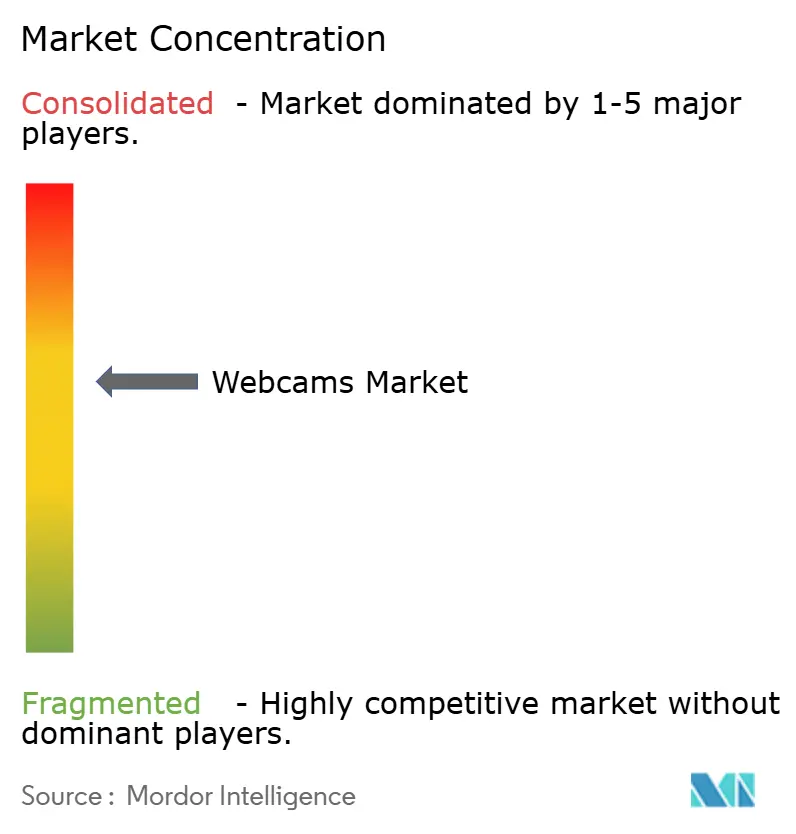
| Market Concentration | Medium |
Major Players *Disclaimer: Major Players sorted in no particular order Image © Mordor Intelligence. Reuse requires attribution under CC BY 4.0. | |
Webcams Market Analysis by Mordor Intelligence
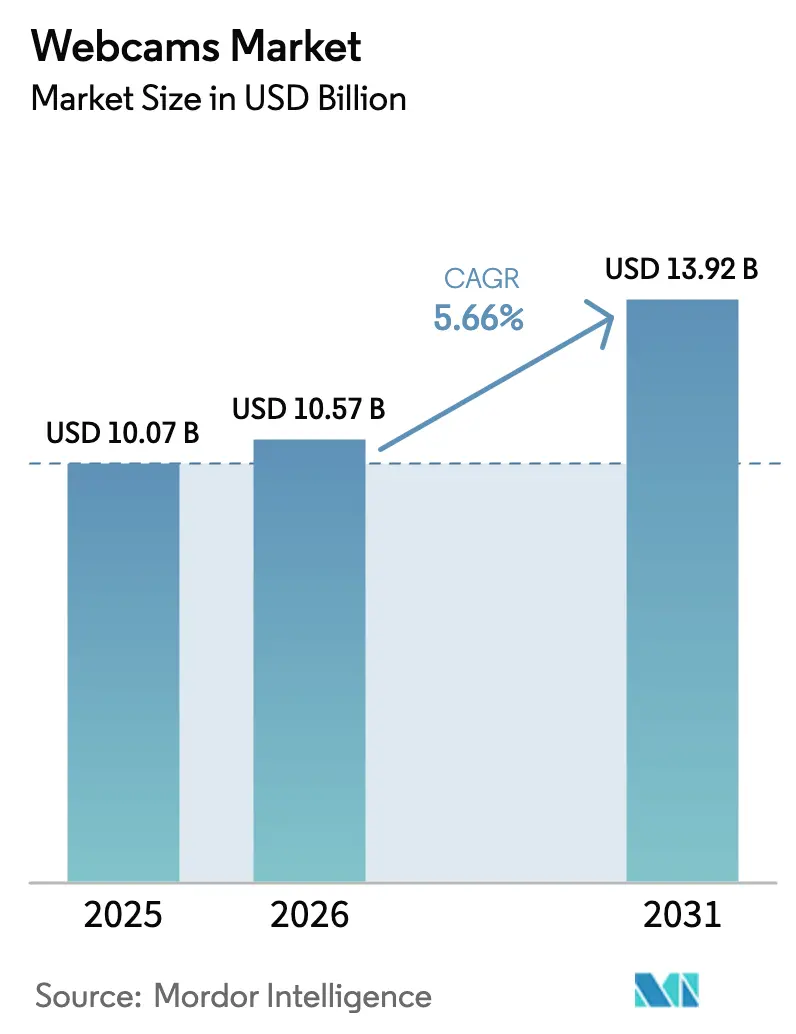
The webcams market size was valued at USD 10.07 billion in 2025 and is estimated to grow from USD 10.57 billion in 2026 to reach USD 13.92 billion by 2031, reflecting a 5.66% CAGR over the forecast period (2026-2031). Several converging forces drive this expansion, including corporate commitments to hybrid work, the surge in live streaming, falling average selling prices, and the rapid integration of AI-powered imaging features. Enterprise buyers now standardize on external 4K units for conference rooms and executive offices, while healthcare providers adopt diagnostic-grade cameras to support tele-medicine. At the same time, prosumer creators view high-resolution webcams as foundational studio tools, lifting volume demand even as margins compress. Component miniaturization and supply-chain normalization further reduce price barriers, enabling small and medium enterprises to refresh legacy 720p devices in bulk.
Key Report Takeaways
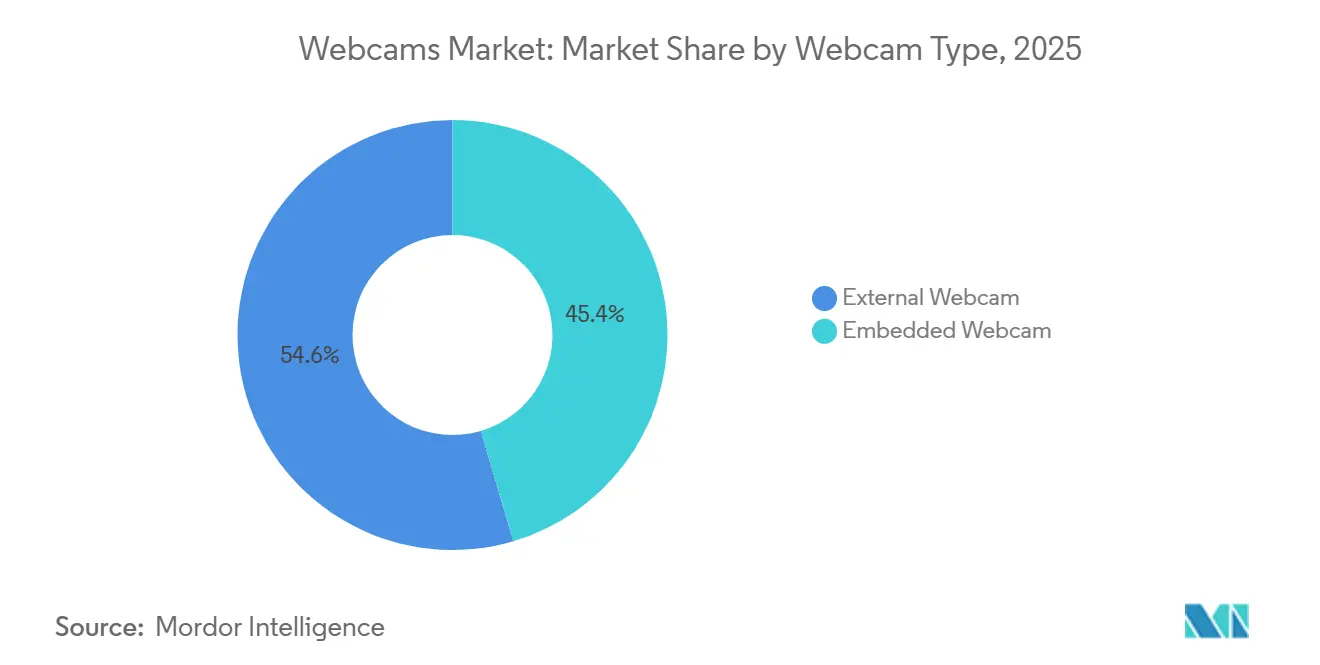
- By webcam type, external units led with 54.57% of the webcam market share in 2025, and the segment is forecast to expand at a 6.68% CAGR through 2031.
- By sensor resolution, Full HD commanded 45.72% of the webcam market size in 2025, while 4K UHD is advancing at a 6.02% CAGR through 2031.
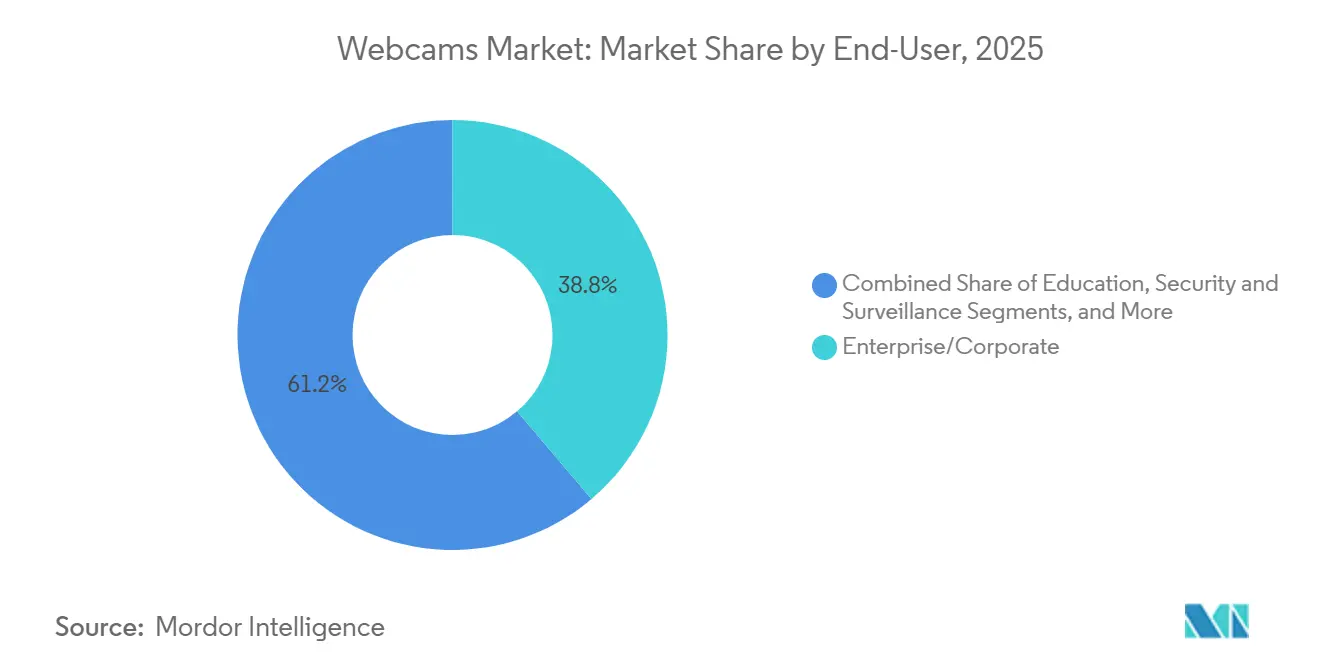
- By end-user, enterprise and corporate buyers held a 38.82% share in 2025, whereas the healthcare sector is growing fastest at a 5.91% CAGR to 2031.
- By distribution channel, online sales accounted for 55.47% of revenue in 2025 and are projected to grow at a 6.24% CAGR through 2031.
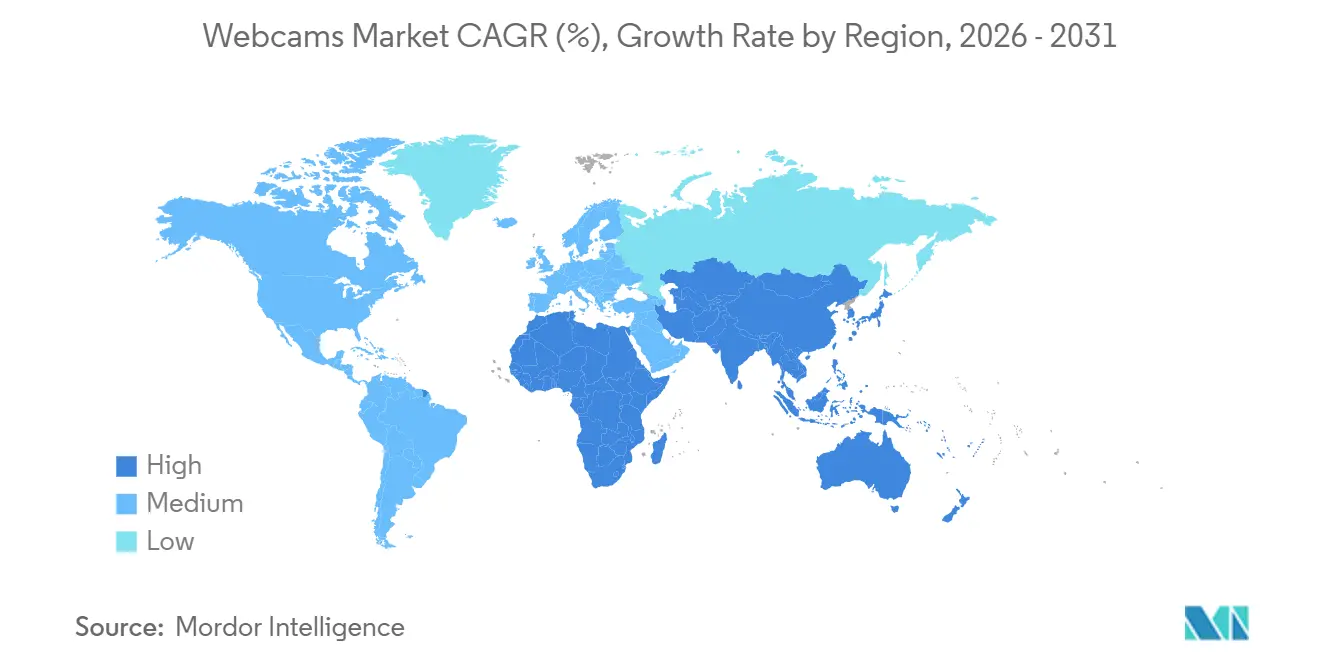
- By geography, the Asia-Pacific region accounted for 36.64% of 2025 revenue, while the Middle East will be the fastest-growing regions at a 6.12% CAGR through 2031.
Note: Market size and forecast figures in this report are generated using Mordor Intelligence’s proprietary estimation framework, updated with the latest available data and insights as of January 2026.
Market Trends and Insights
Drivers Impact Analysis of Webcams Market*
| Driver | (~)% Impact on CAGR Forecast | Geographic Relevance | Impact Timeline |
|---|---|---|---|
| Exploding adoption of enterprise video-conferencing solutions | +1.8% | Global, with concentration in North America, Europe, and Asia-Pacific urban centers | Medium term (2-4 years) |
| Hybrid and remote work models normalizing webcam usage | +1.5% | Global, led by North America and Europe, expanding to Asia-Pacific and Middle East | Long term (≥ 4 years) |
| Accelerating growth of live-streaming and content-creator economy | +1.2% | Global, with highest intensity in North America, Europe, and Asia-Pacific (Japan, South Korea) | Medium term (2-4 years) |
| Rapid decline in ASPs of HD and FHD webcams | +0.9% | Global, most pronounced in Asia-Pacific manufacturing hubs and emerging markets | Short term (≤ 2 years) |
| AI-enabled smart webcams fueling prosumer upgrade cycles | +1.4% | North America, Europe, and Asia-Pacific developed markets | Medium term (2-4 years) |
| Tele-health demand for 4K and 8K clinical-grade cameras | +0.7% | North America and Europe, with emerging adoption in Asia-Pacific and Middle East | Long term (≥ 4 years) |
| Source: Mordor Intelligence | |||
Exploding Adoption of Enterprise Video-Conferencing Solutions
Corporate video-conferencing suites transitioned from convenience tools to mission-critical infrastructure in 2025. Zoom reported 4,274 customers producing more than USD 100,000 in annual recurring revenue, a cohort that standardizes on external 4K webcams to ensure board-level image fidelity. Large employers upgraded 27%-35% of meeting spaces in 2025, replacing embedded laptop cameras that lack optical zoom and low-light prowess. Persistent meeting friction, averaging 6 minutes of lost productivity per session, accelerated these deployments, especially for Microsoft Teams Rooms and Zoom Rooms. The shift toward asynchronous video messaging further amplifies demand, as employees need dedicated webcams to record polished content. Collectively, these factors lift enterprise volume shipments and reinforce premium certification ecosystems.
Hybrid and Remote Work Models Normalizing Webcam Usage
Hybrid schedules hardened into the dominant employment pattern in 2025, with 28% of United States staff working partly from home and 9% fully remote. The Bureau of Labor Statistics counted 35.5 million U.S. teleworkers, a 5.1 million rise from 2024. Similar adoption is visible in the United Kingdom, where 45% of employees now split time between office and home, and in the Middle East, where 81% of professionals secured remote-work approval. Because technology quality ranks among the top five contributors to job satisfaction for 85% of hybrid workers, enterprises budget for professional-grade webcams across home offices. This structural shift elevates webcams from optional peripherals to essential productivity assets, anchoring long-run demand across regions.
AI-enabled Smart Webcams Fueling Prosumer Upgrade Cycles
Machine-learning features once exclusive to USD 1,000 conference systems now ship in sub-USD 200 consumer devices. Logitech’s MX Brio incorporates auto-framing, computational lighting, and an overhead document mode; Microsoft’s IntelliFrame dynamically centers meeting participants without manual pan-tilt-zoom. HP, Razer, and Dell add AI facial tracking and noise reduction, compressing the performance gap between webcams and interchangeable-lens cameras. Prosumer creators, remote executives, and online educators perceive these upgrades as productivity investments, triggering replacement cycles every two to three years. As AI feature parity spreads, differentiation shifts toward sensor size, optics, and software ecosystems.
Accelerating Growth of Live-Streaming and Content-Creator Economy
Advertising spend on creator channels reached USD 37.1 billion in 2025, up 26%, as brands used AI to find niche influencers.[2] Live-streaming platforms logged 29.7 billion hours watched in Q1 2025; YouTube Live captured roughly half that time, TikTok Live exceeded 8 billion hours, and Twitch maintained 140 million monthly active users. Creators demand 4K60 webcams capable of sustained bit-rates without thermal throttling or compression artifacts. Virtual events and hybrid conferences additionally require broadcast-grade video for panelists and keynote speakers. These cross-segment dynamics elevate the webcams market as a foundational layer of the global creator economy.
Restraints Impact Analysis of Webcams Market*
| Restraint | (~)% Impact on CAGR Forecast | Geographic Relevance | Impact Timeline |
|---|---|---|---|
| Widespread availability of embedded laptop and mobile cameras | -0.8% | Global, with highest penetration in developed markets (North America, Europe, Asia-Pacific) | Long term (≥ 4 years) |
| Persistent privacy and cyber-security concerns (webcam hacking) | -0.6% | Global, with heightened awareness in North America and Europe | Medium term (2-4 years) |
| CMOS sensor supply-chain volatility impacting inventories | -0.4% | Global, most acute in Asia-Pacific manufacturing hubs (China, Taiwan, South Korea) | Short term (≤ 2 years) |
| Compliance costs from stricter e-waste and RoHS regulations | -0.3% | Europe, North America, with expanding reach to Asia-Pacific and Middle East | Long term (≥ 4 years) |
| Source: Mordor Intelligence | |||
Persistent Privacy and Cyber-Security Concerns (Webcam Hacking)
Seventy-five percent of consumers worry about unauthorized camera access, and 61% physically cover webcams when idle. The FBI’s 2024 advisory cited malware that activates webcams without LED indicators, while high-severity vulnerabilities such as CVE-2024-5028 and CVE-2024-31320 affected flagship devices.[3] Live exploits at Pwn2Own reinforced the perception that manufacturers prioritize features over security audits. This mistrust dampens impulse purchases and elongates replacement intervals as buyers await clearer regulatory safeguards. The forthcoming EU Cyber Resilience Act could restore confidence but will add compliance costs for smaller brands.
CMOS Sensor Supply-Chain Volatility Impacting Inventories
Lead times for CMOS image sensors peaked at 26 weeks in 2022 before easing to 8-12 weeks by 2024, yet supplier concentration remains a critical risk. Sony maintains 42% share of global output, followed by ON Semi, Samsung, and OmniVision. Disruptions in any one fab cascade through webcam OEMs that rely on advanced 4K and 8K nodes. Smaller brands struggle to secure priority allocation, often carrying excess safety stock or absorbing stockouts. Dual-sourcing agreements and long-term purchase commitments mitigate but do not eliminate the threat, especially as automotive and smartphone segments compete for the same high-resolution wafers.
*Our forecasts treat driver/restraint impacts as directional, not additive. The impact forecasts reflect baseline growth, mix effects, and variable interactions.
Webcams Market Segment Analysis
By Webcam Type:
External Units Dominate Professional DeploymentsExternal models captured 54.57% revenue in 2025 and are projected to advance at a 6.68% CAGR through 2031, highlighting their dominance in professional deployments. This leadership reflects enterprise and healthcare users who require modular cameras with eye-level mounting, superior optics, and interchangeable lenses. External devices integrate seamlessly with conferencing platforms and allow straightforward cable management, boosting installation speed in huddle rooms and tele-medicine carts. Vendors increasingly bundle 4K sensors, beamforming microphones, and integrated speakers, reducing component sprawl and IT overhead. While embedded laptop cameras ship in 95% of new notebooks, their fixed angles and small sensors limit suitability for boardroom settings. As hybrid policies mature, many professionals add an external unit at home even when their laptops include 1080p webcams, ensuring consistent image quality across workspaces. Rapid price declines below USD 100 for Full HD and under USD 200 for 4K enable budget-constrained SMEs to adopt external solutions at scale, thereby reinforcing the dominance of this category within the webcams market.
Despite embedded cameras’ ubiquity, their revenue share trails units shipped because costs are subsumed into broader device bills of material. Consumer video calling, online education, and casual gaming continue to rely on embedded hardware, but these contexts rarely justify standalone purchases. In contrast, healthcare organizations specify external 4K cameras to satisfy diagnostic accuracy guidelines, and content creators favor flexible tripods and ring-light mounts that laptop lids cannot match. The balancing act between embedded convenience and external performance should continue, yet external unit innovation-such as AI-directed framing and optical zoom-positions the segment to preserve leadership within the webcams market across the forecast horizon.
By Sensor Resolution:
4K UHD Becomes the Aspirational StandardFull HD resolution accounted for 45.72% of 2025 revenue, benefiting from decade-long platform standardization and a sub-USD 100 price point. Nonetheless, 4K UHD is the fastest-growing tier, registering a 6.02% CAGR through 2031 as creators, clinicians, and executives upgrade. High pixel density enables lossless digital pan-tilt-zoom, critical for multi-person framing and tight crop shots during live streams, thereby linking resolution improvements to AI feature efficacy. Retail availability of 4K60 models, such as Elgato Facecam Pro and Logitech MX Brio, has lowered entry thresholds for prosumers who view visual quality as a competitive differentiator. Healthcare buyers adopt 4K cameras to future-proof against evolving telehealth guidelines, while 8K remains niche due to bandwidth constraints and limited platform support.
Looking forward, falling bit-rate demands from advanced codecs mean 4K adoption will accelerate even among bandwidth-restricted users. Content platforms such as YouTube and Twitch have enabled 4K streaming, incentivizing creators to migrate from 1080p. Enterprises experimenting with immersive collaboration solutions also benefit, as 4K webcams capture finer spatial detail for AR overlays. Although 1080p models will maintain relevance in budget segments, shipment mix will increasingly tilt toward 4K, cementing this resolution as the new baseline of the webcams market.
By End-User:
Healthcare Ascends as the Fastest-Growing VerticalCorporate and enterprise customers commanded 38.82% revenue in 2025, underpinned by global hybrid work policies and ongoing meeting-room upgrades. Yet healthcare providers represent the most dynamic opportunity, expanding at 5.91% CAGR through 2031. Regulatory endorsements for virtual diagnostics and reimbursable tele-medicine encourage hospitals and clinics to install 4K webcams that capture dermatological detail and nuanced patient cues. HIPAA-compliant devices with encrypted streams and physical shutters address privacy mandates, allowing providers to satisfy both clinical and security criteria. Meanwhile, consumer and residential users sustain steady but slower growth as embedded laptop cameras suffice for casual communication.
Educational institutions often procure rugged Full HD webcams in bulk to facilitate hybrid classrooms, whereas creators invest USD 200-400 in 4K units featuring large sensors and AI exposure control. Security and surveillance overlap remains limited because dedicated IP cameras offer specialized weatherproofing and power options. Still, as health systems integrate virtual care into standard practice, webcam vendors that tailor firmware, privacy features, and medical-grade certifications will capture this accelerating slice of the webcams market.

By Distribution Channel:
E-Commerce Consolidates Majority ShareOnline channels accounted for 55.47% of 2025 sales, rising on the back of vendor storefronts, marketplace platforms, and software-centric subscription bundles. Procurement teams favor e-commerce for transparent pricing, configuration flexibility, and rapid fulfillment, while creators rely on customer reviews and detailed spec sheets when selecting high-resolution models. Value-added resellers layer services such as installation and multi-year maintenance atop web-based portals, merging digital ordering convenience with on-site support. Subscription refresh programs dispatched through vendor dashboards further cement the digital route to market.
Brick-and-mortar retailers retain relevance for hands-on testing, impulse purchases, and immediate replacement needs, especially among consumers wary of counterfeit products. However, shrinking shelf space and the shift toward higher-margin product lines diminish in-store webcam assortments. Absent experiential demos or exclusive launches, offline share is expected to erode steadily. As a result, online dominance appears durable, ensuring that the e-commerce ecosystem remains a strategic battleground for differentiation within the webcams market.
Geography Analysis
APAC Webcams Market
Asia-Pacific accounted for 36.64% of global revenue in 2025, driven by China’s manufacturing scale, India’s IT services boom, and Japan’s early embrace of AI-enabled conference systems. Rapid urbanization and government digitization programs are accelerating corporate video adoption, while CMOS sensor clusters in Taiwan and South Korea are streamlining component logistics. Enterprises such as Japan Radio Company standardized 77 Logitech-equipped rooms within a single quarter, evidencing deployment velocity. Simultaneously, cultural comfort with camera-based identification- highlighted by Panasonic’s facial recognition rollout at Expo 2025 Osaka- reduces privacy-driven resistance, reinforcing regional demand.
Middle East Webcams Market
The Middle East is the fastest-rising region, with a 6.12% CAGR, propelled by multinational headquarters relocating to Dubai and Riyadh and by government mandates for digital service delivery. Broadband penetration surpasses 98% in the United Arab Emirates and approaches that level in Saudi Arabia, creating a digitally literate workforce. Survey results show that 81% of Middle Eastern professionals received their employer's approval for remote work, lifting per-capita webcam adoption.
The Americas and Europe Webcams Market
North America and Europe remain mature yet vibrant upgrade markets. The United States added 5.1 million teleworkers in 2025, and the United Kingdom reported 45% hybrid work penetration. Replacement cycles now pivot toward 4K60 capability and AI-enabled framing, sustaining mid-single-digit growth rates. Strict compliance regimes, such as the EU’s WEEE and RoHS directives, elevate operating costs for smaller brands, thereby consolidating share with established vendors. South American demand, led by Brazil and Argentina, skews value-oriented, focusing on prior-generation or refurbished models to offset import tariffs and currency volatility. Collectively, these regional dynamics ensure geographically diversified expansion for the webcams market.
Regulatory Landscape
Webcam vendors selling connected USB cameras operate under a patchwork of product safety, EMC, and radio rules (when wireless features are bundled), alongside privacy and emerging cybersecurity requirements that increasingly treat cameras as security-relevant endpoints. In the United States, FCC equipment authorization remains a key gate for peripherals that incorporate radio modules, and the Commission has also tightened scrutiny around the integrity of certification bodies and test labs, including rule updates in August 2025 that expanded restrictions on participation by entities deemed prohibited.
In 2026, several policy and standards actions sharpened compliance requirements that can affect webcam designs and go-to-market operations, particularly for models with onboard compute and network-like features. The European Commission published an implementing regulation in April 2026 supporting the Digital Product Passport registry under Regulation (EU) 2024/1781, while CEN-CENELEC issued 2026 standards to support DPP implementation. This direction pushes manufacturers and importers toward more structured product data and lifecycle traceability. Separately, country-specific cybersecurity mandates for cameras advanced in Asia, including South Korea's KATS making KS X 3007:2026 mandatory (May 2026) and Vietnam's Ministry of Public Security issuing Circular 48/2026/TT-BCA that brings QCVN 11:2026/BCA into effect from July 1, 2026 for IP camera cybersecurity. It reinforces a broader trend toward regional, model-level security conformity beyond baseline international standards such as IEC 62676-4:2025 (published October 2025).
Value Chain Analysis
The webcam value chain starts with upstream semiconductors and optical components, then moves through module integration, final assembly, distribution, and software or firmware support that increasingly shapes end-user experience. Critical inputs include CMOS image sensors (with high supplier concentration led by Sony alongside Samsung, ON Semi, and OmniVision), lenses and lens modules, USB controller ICs, plus supporting components such as microphones, LEDs, and mechanical shutters. For higher-end 4K and AI-enhanced devices, tighter tolerances, calibration, and alignment steps add complexity, and that generally translates into longer lead times than for standard 720p and 1080p models.
Manufacturing and assembly remain heavily concentrated in China, with major clusters in Guangdong (including Shenzhen and Dongguan) and Suzhou that serve both branded OEMs and white-label suppliers. Diversification efforts have expanded into Vietnam, Thailand, Malaysia, Taiwan, and Mexico to reduce tariff exposure and disruption risk. Logitech's China-plus-five execution illustrates how final assembly geography and outbound logistics have become competitive levers alongside component sourcing: by the end of December 2025, it reduced the share of US-bound finished goods manufactured in China to below 10%, from about 40% in April 2025. Downstream, online channels and vendor storefronts are central to sell-through, while enterprise deployments often flow through value-added resellers and collaboration-platform certification ecosystems that bundle device management, security policies, and room-system compatibility requirements.
Competitive Landscape
The webcam industry hosts a moderately concentrated field in which Logitech controls an estimated 30%-35% of shipments through its Rally, Brio, and MX lines. Microsoft, HP, Dell, and Lenovo leverage integrated hardware-software ecosystems to penetrate enterprise accounts, bundling certified devices with collaboration suites. Razer, Elgato, and Anker compete aggressively in the live-streaming niche, differentiating with large sensors, high frame rates, and streamer-oriented software overlays. Patent filings emphasize AI-driven framing, low-light enhancement, and background segmentation, underscoring a collective pivot toward computational imaging.
Component ownership influences competitive resilience. Logitech’s long-standing partnership with Sony for STARVIS sensors secures supply at advantaged pricing, while Razer experiments with sensor fusion to merge CMOS and depth data for green-screen-free background removal. Standards bodies such as the USB-IF and VESA establish a floor for 4K60 transmission bandwidth, compelling each vendor to meet increasingly stringent technical baselines. Smaller innovators, including Huddly and AVer, carve out huddle-room share with ultra-wide 150-degree fields of view and modular microphone arrays, though scale constraints limit their foothold. Ongoing AI feature parity threatens to commoditize mid-tier models, likely catalyzing consolidation or vertical integration plays as stakeholders seek unique defensible assets within the webcams market.
Webcams Industry Leaders
-
Logitech International S.A.
-
Microsoft Corporation
-
Lenovo Group Limited
-
HP Inc.
-
Dell Technologies Inc.
- *Disclaimer: Major Players sorted in no particular order
Webcams Market Companies Covered in this Report
- Logitech International S.A.
- Microsoft Corporation
- Lenovo Group Limited
- HP Inc.
- Dell Technologies Inc.
- Razer Inc.
- Creative Technology Ltd.
- Shenzhen Teng Wei Video Technology Co., Ltd.
- Ausdom Inc.
- Sakar International Inc. (Vivitar)
- A4Tech Co., Ltd.
- KYE Systers Corp. (Genius)
- Cisco Systems, Inc.
- Canon Inc.
- Sony Group Corporation
- GoPro, Inc.
- Anker Innovations Limited (AnkerWork)
- Corsair Gaming, Inc. (Elgato)
- Aver Information Inc.
- Huddly AS
- Lumens Digital Optics Inc.
- Hangzhou Hikvision Digital Technology Co., Ltd.
- Zhejiang Dahua Technology Co., Ltd
Market Opportunities and Future Outlook
Opportunities cluster around enterprise-grade manageability, security, and AI imaging moving into mainstream price bands, creating whitespace for peripherals that reduce IT friction and improve meeting outcomes across home and office endpoints. Dell's June 2026 launch of the Pro 7 Webcam 4K (WB726) and Pro 5 Webcam 2K (WB526), with AI imaging optimization and Windows Hello support, points to demand for cameras that pair quality upgrades with identity and access workflows in managed PC environments. As conferencing rooms upgrade and organizations standardize peripherals, vendors that align devices to Microsoft Teams Rooms and Zoom Rooms certification expectations, device management portals, and consistent firmware update cadences have clearer routes into repeatable, multi-site deployments.
Creator and prosumer segments also continue to reward differentiation in sensor performance and on-device intelligence, especially where 4K60 capture, autofocus, and exposure control improve production quality without adding complex camera rigs. Newer launches and showcases such as Arashi Vision (Insta360) introducing Link 2 Pro 4K AI webcams at CES 2026 and Tenveo demonstrating a 4K60 AI webcam at InfoComm 2026 reflect an upgrade cycle centered on computational imaging and easier setup. Across enterprise and creator channels, interoperability built around USB-IF USB Video Class (UVC) and the migration of AI processing onto camera hardware (rather than host-only software) opens roadmap room for vendors that can combine consistent cross-platform behavior with security features including physical shutters, biometric support, and tamper-resistant firmware practices aligned with tightening regional cybersecurity expectations for camera-class devices.
Recent Industry Developments in Webcams Market
- June 2026: Dell Technologies launched the Dell Pro Webcam portfolio, including the Pro 7 Webcam 4K (WB726) and Pro 5 Webcam 2K (WB526), positioned around AI-driven imaging and secure login with Windows Hello. The move targets enterprise-standardized peripherals where device quality, identity workflows, and manageability influence procurement decisions.
- January 2026: Logitech introduced the Rally AI Camera and Rally AI Camera Pro for larger conferencing spaces, extending its portfolio beyond individual desktop webcams into intelligent room-camera deployments. This broadens addressable demand tied to Microsoft Teams Rooms and Zoom Rooms rollouts where auto-framing and room coverage are prioritized.
- March 2024: Logitech released the MX Brio and MX Brio 705 for Business 4K webcams, adding AI image enhancement features aimed at hybrid work and streaming use cases. The launch reinforced the shift toward premium external webcams as an upgrade layer over embedded laptop cameras in professional and prosumer setups.
Webcams Market Report Scope and Research Methodology
Market Definition and Coverage
For this study, the webcams market covers revenue earned from selling camera devices that capture video for computers and connected setups, including built-in and external units, across consumer and business buying.
Scope exclusions: We do not count video conferencing software, general purpose smartphone cameras, or long range security CCTV systems that are sold and specified as full surveillance installations.
Segments Covered in This Report
- By Webcams Type
- External Webcams
- Embedded Webcams
- By Sensor Resolution
- HD (Greater than 720p)
- Full HD (1080p)
- 4K UHD
- 8K and Above
- By End-User
- Consumer/Residential
- Enterprise/Corporate
- Healthcare and Tele-Medicine
- Education
- Broadcasting and Content Creation
- Security and Surveillance
- By Distribution Channel
- Online (E-Commerce, Direct)
- Offline (Retail Chains, Value-Added Resellers)
- By Geography
- North America
- United States
- Canada
- Mexico
- South America
- Brazil
- Argentina
- Rest of South America
- Europe
- Germany
- United Kingdom
- France
- Italy
- Spain
- Rest of Europe
- Asia-Pacific
- China
- Japan
- India
- South Korea
- ASEAN
- Rest of Asia-Pacific
- Middle East
- Saudi Arabia
- United Arab Emirates
- Rest of Middle East
- Africa
- South Africa
- Nigeria
- Rest of Africa
- North America
Data Sources, Market Sizing, and Validation
Desk Research
Desk work starts with mapping what is being sold, where it is shipped, and which use cases are driving upgrades. For this, we referred to public sources such as ITU connectivity indicators, World Bank macro series, UN Comtrade trade statistics for camera related HS codes, U.S. Census and Eurostat retail and electronics indicators, and standards material from ISO and IEC that clarifies video and imaging definitions.
That base was then connected to supply and pricing signals through company annual reports, earnings call decks, product specification sheets, and reputable press coverage of new launches and channel trends. When needed, we used paid subscriptions for company financials and intelligence, news and financials tracking, and an import or export shipment level database to sanity check trade direction and timing. These examples are not exhaustive, and many other sources were reviewed to collect data, validate assumptions, and clarify open points.
Primary Interviews and Surveys
Primary work was used to stress test demand drivers and the sizing logic, especially where public data is published with delays or mixed product labeling. We spoke with a mix of OEM and component ecosystem contacts, distributors and online sellers, enterprise IT and procurement users, and service partners across APAC, EMEA, and the Americas, then reconciled differences through follow-up questions and simple scenario checks.
Distribution of primary research fieldwork respondents
| Company type | Respondent position | Region |
|---|---|---|
| Top tier: 38% | CXOs: 17% | APAC: 41% |
| Mid tier: 41% | Functional/Unit leaders: 23% | EMEA: 35% |
| Smaller Players: 21% | Managers: 60% | Americas: 24% |
Market-Sizing & Forecasting
Sizing is built using a top-down approach where device demand is reconstructed from PC installed base signals, work and learning usage intensity, and replacement cycles, then filtered through product mix and average selling price movement. To keep the totals realistic, we corroborate them with selective bottom-up checks such as sampled ASP times unit volumes by resolution band, channel checks on online versus offline share, and supplier and brand revenue roll-ups where disclosures allow.
Key inputs for webcams include penetration of external cameras versus embedded units, the shift from HD to Full HD and 4K, the attach rate tied to hybrid work and education, price steps for autofocus and other feature bundles, and trade flows for camera modules and finished units. Forecasts were developed using scenario analysis supported by expert consensus on refresh timing, price compression, and enterprise upgrade plans, then smoothed to avoid unrealistic one-year jumps. Where bottom-up pieces are missing for smaller geographies, gaps are handled using comparable country ratios on PC base, income levels, and channel maturity, then rechecked with interview feedback.
Data Validation & Update Cycle
Validation is done by comparing results against independent signals such as trade direction, reported category growth in consumer electronics, and visible pricing trends, then checking if implied units and ASPs remain within practical ranges. Outliers are reviewed in more than one step, and we re-contact sources when a variance looks tied to a scope mismatch or a sudden demand shift.
Reports are refreshed annually, and interim updates are made when major events materially change demand, supply, or pricing. Before delivery, the model and key assumptions are reviewed again so clients receive an updated view rather than an older snapshot.
Mordor Intelligence's Webcams Market Size Compared With Other Published Estimates
Published values for webcams often differ because the scope line can move between device-only counts versus broader camera categories, and because different teams select different base years and pricing paths. Variation also comes from how embedded units are treated, how online channel pricing is averaged, and how quickly post-launch price drops are reflected.
The table shows a noticeable spread across the current year estimates, and in Mordor Intelligence's model the market is limited to webcam devices with an explicit split for embedded versus external units, with pricing and mix checks tied to resolution bands and channel-level ASP movement rather than a single blended camera category.
Benchmark comparison
| Source | Market Size | Gaps in Research Methodology |
|---|---|---|
| Mordor Intelligence | USD 10.57 B (2026) | |
| Industry Publisher A | USD 9.17 B (2025) | Uses a different starting year and a longer forecast window, and the public summary does not clearly separate embedded webcams from broader camera device groupings, which can pull the near term value down. |
| Industry Publisher B | USD 8.60 B (2023) | Anchors the series on an earlier base year and reports a faster growth phase, so the current year level is not directly comparable without re basing for the 2024 to 2026 price mix and replacement cycle assumptions. |
Reading the three figures together, the main takeaway is that year selection and what gets counted as a webcam drive most of the difference. Our approach keeps the number traceable to simple demand pools, mix shifts, and ASP logic that can be repeated each year with clear checks.
Key Questions Answered in the Report
How large is the webcam market in 2026 and what growth is expected by 2031?
The webcams market size is USD 10.57 billion in 2026 and is projected to reach USD 13.92 billion by 2031, representing a 5.66% CAGR.
Which webcam type currently leads global revenue?
External units hold the lead, capturing 54.57% of 2025 revenue due to superior optics and flexible positioning.
Why is healthcare the fastest-growing vertical for webcams?
Tele-medicine reimbursement, diagnostic-grade 4K requirements, and HIPAA-compliant encryption drive a 5.91% CAGR for healthcare purchases.
What regions are forecast to post the highest growth rates?
The Middle East and Africa region is projected to expand at 6.12% CAGR through 2031, outpacing other geographies.
How are AI features reshaping webcam upgrades?
Auto-framing, speaker tracking, and computational lighting have migrated into sub-USD 200 models, prompting shorter replacement cycles among creators and remote executives.
Which companies dominate the competitive landscape?
Logitech leads with around one-third of shipments, while Microsoft, HP, Dell, Razer, and Elgato share the remainder of a moderately concentrated field.