
Web To Print Market Size and Share
Market Overview
| Study Period | 2020 - 2031 |
|---|---|
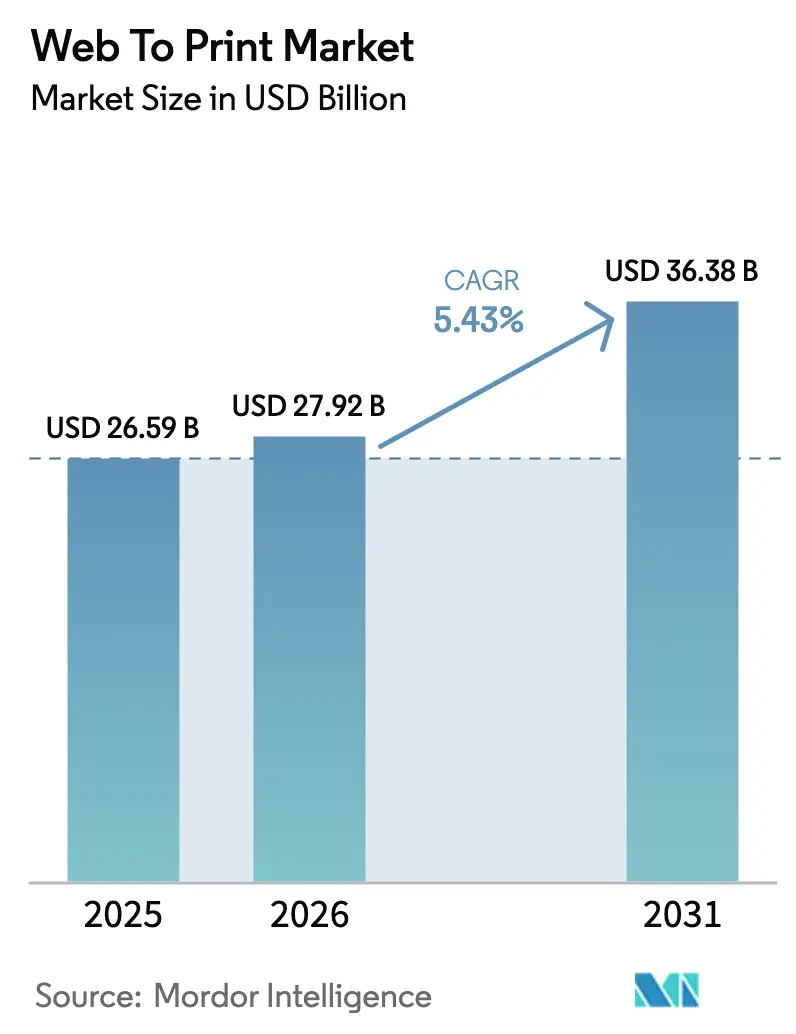
| Market Size (2026) | USD 27.92 Billion |
| Market Size (2031) | USD 36.38 Billion |
| Growth Rate (2026 - 2031) | 5.43 % |
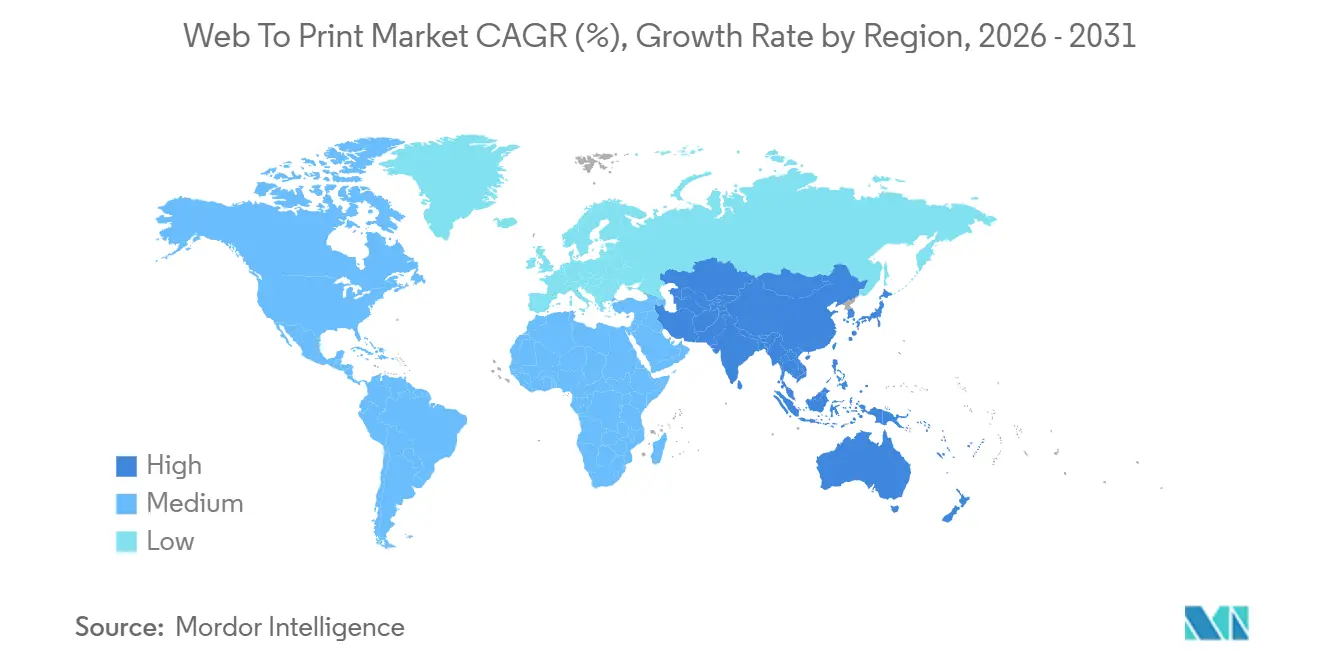
| Fastest Growing Market | Asia Pacific |
| Largest Market | North America |
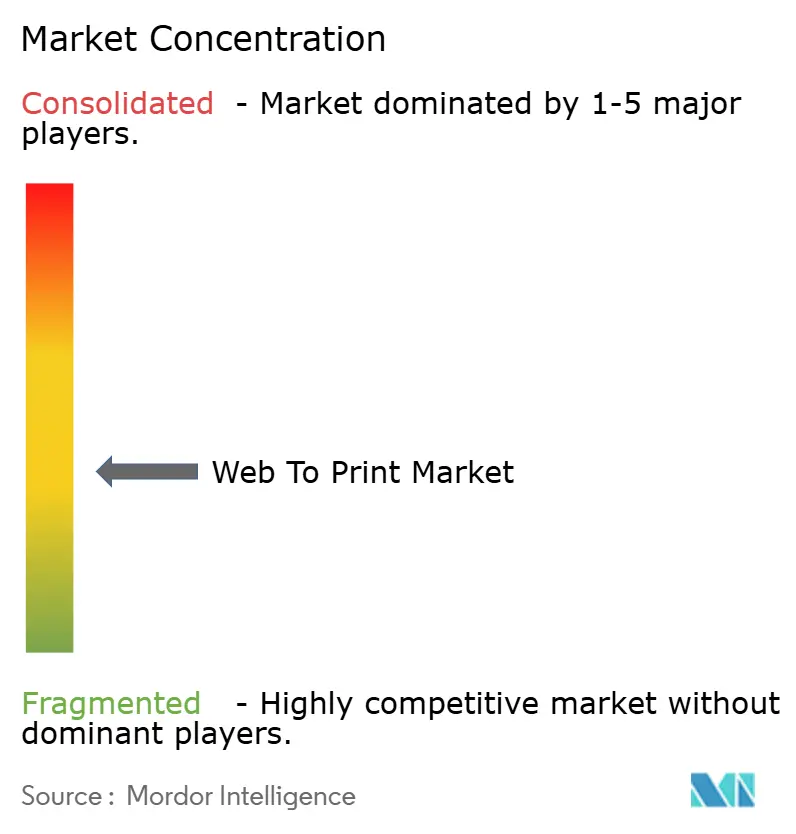
| Market Concentration | Medium |
Major Players *Disclaimer: Major Players sorted in no particular order Image © Mordor Intelligence. Reuse requires attribution under CC BY 4.0. | |
Web To Print Market Analysis by Mordor Intelligence
The web-to-print market size is expected to increase from USD 26.59 billion in 2025 to USD 27.92 billion in 2026 and reach USD 36.38 billion by 2031, growing at a CAGR of 5.43% over 2026-2031. Three structural forces underpin this trajectory; mainstream e-commerce platforms folding print-on-demand plug-ins straight into storefront checkouts, generative AI collapsing artwork cycles from days to minutes, and geographically distributed micro-fulfillment hubs removing the inventory risk that once tied brands to offset presses. Price-sensitive small businesses continue to favor template storefronts, yet enterprises are shifting toward bespoke workflows that command premium margins even as commodity templates proliferate. Regionally, North America remains the revenue anchor because of deep SaaS maturity, while Asia-Pacific is becoming the fastest compounder as India and Southeast Asia fuel mobile-first direct-to-consumer adoption. Competitive dynamics are intense, with Cimpress, Shutterfly, and Gelato competing on fulfillment speed, while niche providers differentiate through substrate variety and carbon-neutral pledges.
Key Report Takeaways
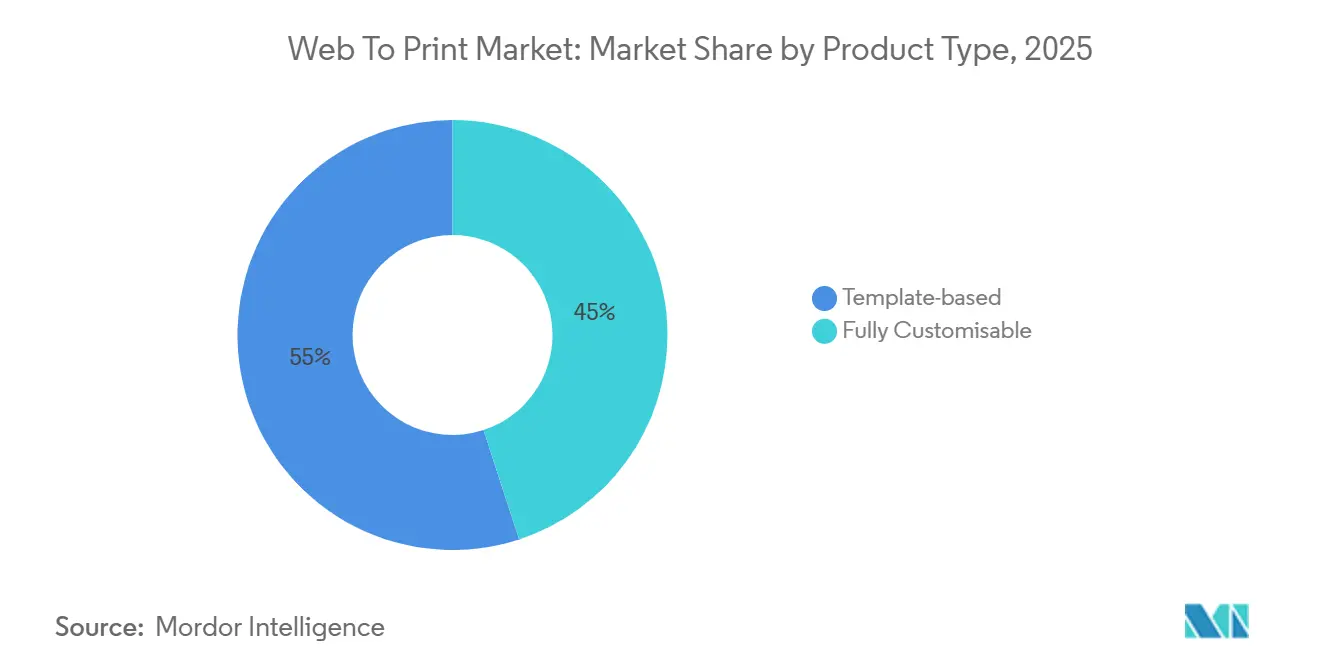
- By product type, template-based offerings held 55.02% of web-to-print market share in 2025, while fully customizable platforms are projected to advance at a 6.77% CAGR to 2031.
- By application, marketing materials led with 32.63% revenue share in 2025; labels and stickers are forecast to expand at a 6.96% CAGR through 2031.
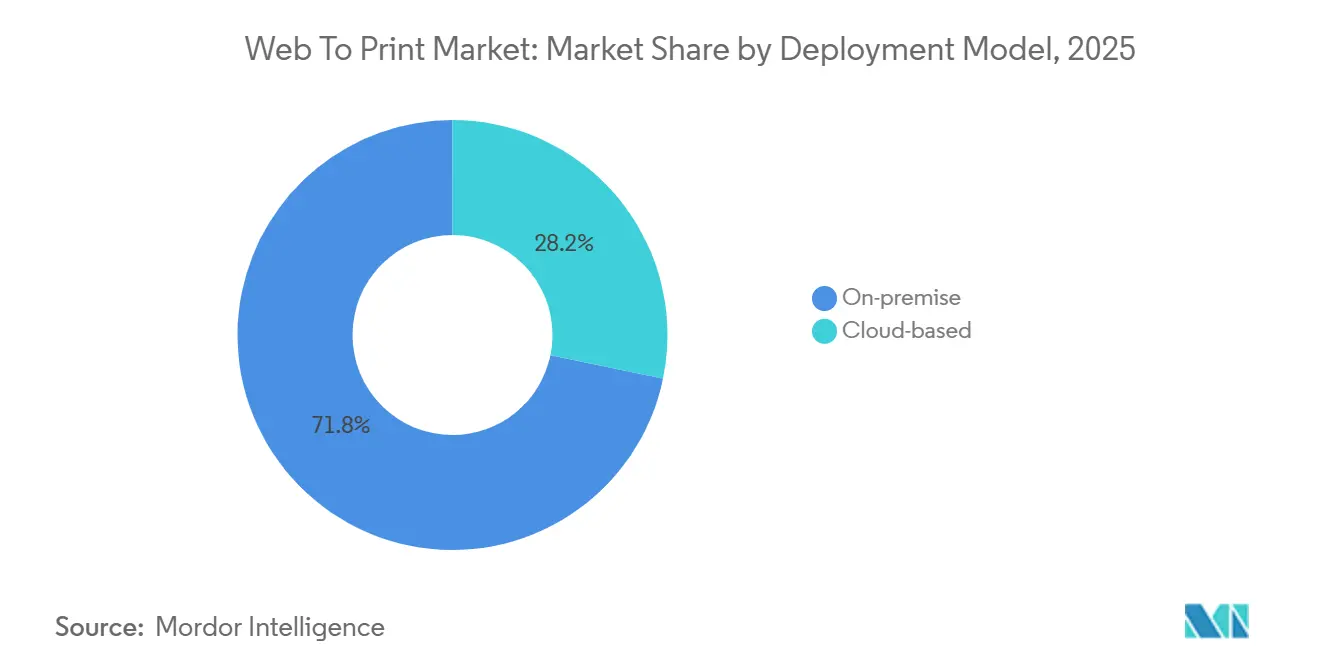
- By deployment model, on-premise installations retained 71.76% share of the web-to-print market size in 2025, whereas cloud platforms are growing at a 6.23% CAGR for the same horizon.
- By component, software generated 72.88% revenue in 2025, while services are projected to climb at a 6.17% CAGR through 2031.
- By geography, North America captured 40.21% revenue share in 2025, while Asia-Pacific records the highest regional CAGR at 6.89% between 2026 and 2031.
Note: Market size and forecast figures in this report are generated using Mordor Intelligence’s proprietary estimation framework, updated with the latest available data and insights as of 2026.
Market Trends and Insights
Drivers Impact Analysis of Web To Print Market*
| Driver | (~) % Impact on CAGR Forecast | Geographic Relevance | Impact Timeline |
|---|---|---|---|
| Explosive Growth of Global E-commerce Sellers | +1.5% | Global, concentration in North America and Asia-Pacific | Medium term (2-4 years) |
| AI-Driven Design-Automation Workflows | +1.2% | Global, early adoption in North America and Europe | Short term (≤ 2 years) |
| Rapid Advances in High-Speed Digital Presses | +1.0% | Global, hubs in North America, Europe, Asia-Pacific | Medium term (2-4 years) |
| Rising Demand for Mass-Customised Marketing Collateral | +0.8% | North America and Europe, emerging in Asia-Pacific | Medium term (2-4 years) |
| Sustainability Push for Just-in-Time Print-on-Demand | +0.6% | Europe and North America, expanding to Asia-Pacific | Long term (≥ 4 years) |
| Declining SaaS Subscription Costs for SMBs | +0.4% | Global, strongest in Asia-Pacific and South America | Short term (≤ 2 years) |
| Source: Mordor Intelligence | |||
Explosive Growth of Global E-commerce Sellers
E-commerce marketplaces now embed print-on-demand widgets directly inside merchant dashboards, eliminating the legacy gap between product ideation and storefront launch. Shopify hosts scores of connectors that synchronize inventory and fulfillment in real time, while Amazon’s Merch on Demand lets creators distribute designs across multiple categories without holding stock. Printful processes more than 1 million orders each month from 12 facilities on five continents, proving how distributed production removes inventory risk for sellers targeting micro-segments.[1]Printful Inc., “About Printful,” printful.com Southeast Asia and India exemplify the trend as mobile-first entrepreneurs adopt low-capital workflows that circumvent minimum-order quantities. The seamless blend of payments, shipping calculators, and artwork approvals is recasting the web-to-print market as core infrastructure for global digital commerce.
AI-Driven Design-Automation Workflows
Generative AI now compresses creative cycles from hours to seconds. Adobe Firefly within Creative Cloud converts text prompts into press-ready art, empowering non-designers to produce collateral that once required agencies.[2]Adobe Inc., “Adobe Firefly,” adobe.com Canva users generated 1 billion designs in 2024 by leveraging AI-suggested templates, brand-kit enforcement, and auto-layout algorithms that maintain visual coherence.[3]Canva Pty Ltd., “Canva Design Platform,” canva.com Machine-learning engines recommend color palettes and font pairings derived from market benchmarks, enabling brands to test multiple variants in parallel and optimize for conversion metrics. As AI codifies design expertise into software, traditional studios must pivot toward strategy consulting to remain relevant. The acceleration of iteration cycles is raising customer expectations for near-real-time personalization across channels.
Rapid Advances in High-Speed Digital Presses
Digital press vendors introduced platforms that rival offset quality at lower run lengths, shifting the economic break-even point. HP’s Indigo 200K reaches 4,600 sheets per hour and uses inline spectrophotometers for color fidelity across extended runs. Xerox, Canon, and others responded with comparable engines, escalating competition that drives down per-unit costs. Integration with job definition format and PDF/VT workflows allows automatic job ticketing, imposition, and quality checks, enabling single-copy orders to coexist with regional campaigns in the same production queue. The convergence blurs the once-rigid boundary between offset and digital, letting brands order localized, limited-edition packaging without prohibitive setup penalties.
Rising Demand for Mass-Customised Marketing Collateral
Marketing teams are migrating from uniform campaigns toward hyper-localized messaging enabled by variable-data printing. Business cards, mailers, and brochures now embed recipient-specific QR codes and personalized URLs, allowing offline media to feed first-party data pipelines. Financial services and retail sectors illustrate the shift as compliance-friendly personalization drives measurable response lifts. Web-to-print APIs integrate with omnichannel orchestration engines, letting marketers treat physical collateral as just another programmatic surface. Labels and stickers gain parallel momentum as brands add serialized codes for authentication and loyalty programs, transforming packaging into an engagement touchpoint rather than mere protection.
Restraints Impact Analysis of Web To Print Market*
| Restraint | (~) % Impact on CAGR Forecast | Geographic Relevance | Impact Timeline |
|---|---|---|---|
| Persisting Preference for Local Offset Printers | -0.9% | Global, strongest in Europe and North America | Medium term (2-4 years) |
| Cyber-Security and Data-Privacy Compliance Costs | -0.7% | North America and Europe, expanding to Asia-Pacific | Short term (≤ 2 years) |
| Environmental Regulations on Paper and Ink Usage | -0.5% | Europe and North America, emerging in Asia-Pacific | Long term (≥ 4 years) |
| Open-Source Template Commoditisation Squeezing Margins | -0.4% | Global | Short term (≤ 2 years) |
| Source: Mordor Intelligence | |||
Persisting Preference for Local Offset Printers
Many commercial buyers still choose offset lithography for runs above several-thousand units because per-sheet costs remain lower despite longer setup times. Relationships with local printers offer tactile press checks, rapid reprints, and substrate options such as metallic inks that digital systems struggle to match economically. Procurement teams in Europe and North America weigh vendor stability and contract continuity over the convenience of online ordering, reinforcing the inertia that slows the shift toward cloud-based workflows. The continuing role of offset presses therefore tempers the upside of the web-to-print market, particularly in regulated verticals with low risk tolerance.
Cyber-Security and Data-Privacy Compliance Costs
Web-to-print vendors store artwork, customer addresses, and payment details on cloud infrastructure, expanding the attack surface for data breaches. Compliance with General Data Protection Regulation and California Consumer Privacy Act demands encryption, audit trails, and breach reporting that inflate operating expenses. Smaller providers struggle with the capital outlay for SOC 2 attestations and cyber-insurance, while multinational clients run rigorous vendor assessments that lengthen sales cycles. Divergent data-localization rules further require local storage replicas, eroding the economies of scale that underpin SaaS pricing. These constraints collectively moderate near-term market growth despite underlying demand.
*Our forecasts treat driver/restraint impacts as directional, not additive. The impact forecasts reflect baseline growth, mix effects, and variable interactions.
Web To Print Market Segment Analysis
By Product Type:
Customization Depth Drives PremiumizationFully customizable platforms are forecast to grow at 6.77% during 2026-2031, overtaking the template segment that commanded 55.02% web-to-print market share in 2025. Buyers that invest in variable-data integration and multi-layer approval workflows value granular control over brand assets and are willing to absorb longer onboarding cycles to secure differentiation. In contrast, small businesses continue to adopt drag-and-drop templates that compress design time and reduce decision fatigue, a pattern illustrated by Canva’s billion-design milestone in 2024.
The divergence signals a two-tier market in which standardized templates democratize entry while bespoke solutions capture margin. Adobe’s Creative Cloud linkages allow designers to push files directly into production pipelines, protecting color profiles and brand libraries without manual file transfers. Service providers monetize this shift by offering training and custom workflow development, elevating web-to-print from commodity storefronts into managed solutions that embed deeper inside client ecosystems.


By Application:
Labels and Stickers Capitalize on Authentication and UnboxingMarketing materials retained 32.63% revenue in 2025, reflecting persistent demand for brochures, flyers, and business cards, yet growth is moderating as digital advertising absorbs more promotional budgets. Labels and stickers, however, are poised for a 6.96% CAGR through 2031 thanks to QR-code authentication mandates and the social-media value of branded unboxing. Serialized labels satisfy regulatory traceability while turning packaging into an interactive canvas, raising willingness to pay for short runs that traditional offset could not price efficiently.
Direct-to-consumer brands increasingly treat packaging as theater, adding custom stickers, thank-you inserts, and branded tape that appear in user-generated content. This behavioral shift elevates the web-to-print market size for packaging applications and blurs the boundary between product and marketing asset. Although other categories such as signage and promotional merchandise remain meaningful, they are more fragmented and thus contribute less to scalable growth opportunities.
By Deployment Model:
On-Premise Anchors Persist Despite Cloud MomentumOn-premise installations accounted for 71.76% of web-to-print market size in 2025, a legacy of stringent data-sovereignty rules in finance, healthcare, and public sectors. These organizations prefer the perceived control of internal servers even if capital outlays and maintenance overhead remain high. Legacy print-management systems integrated with enterprise resource planning platforms further entrench on-premise solutions, making migration complex and risky.
Cloud deployments are nonetheless advancing at a 6.23% CAGR as Microsoft Universal Print and similar services eliminate physical print servers, cut patch cycles, and align cost with usage. Small and medium-sized businesses and hybrid workplaces favor the flexibility to print from any location without VPN tunnels, propelling gradual re-platforming. Managed service providers capitalize by offering hybrid orchestration that bridges data-center assets and cloud queues.
By Component:
Services Layer Monetizes Orchestration ComplexitySoftware retained 72.88% revenue in 2025, dominated by license and SaaS subscriptions for design editors, workflow engines, and storefront builders. However, services are projected to rise at 6.17% during 2026-2031 as clients pay for white-label fulfillment, API support, and design assistance. Gelato’s network of 140-plus partners across 32 countries underscores the value of an orchestrated supply chain that delivers next-day shipping for 80% of orders without owning presses.
Printful’s twelve fulfillment sites and catalog of 430 SKUs illustrate the operational complexity hidden behind a single API endpoint. As enterprise expectations rise, platforms differentiate through uptime guarantees, proactive color calibration, and reverse-logistics handling. The widening services layer thus captures growing wallet share, even as pure software margins remain attractive.
Geography Analysis
North America Web to Print Market
North America generated 40.21% revenue in 2025, sustained by deep SaaS penetration and early adoption of AI-driven design automation. Market expansion is now driven more by upsell than by net-new adoption as most small businesses already use a web-to-print platform. Regulatory frameworks such as California Consumer Privacy Act raise compliance costs yet create entry barriers that favor incumbents with mature governance. Cimpress’s 2024 acquisition of BuildASign broadened its signage portfolio, signaling consolidation in saturated niches.
Europe Web to Print Market
Europe mirrors North America in digital maturity but faces stricter environmental and privacy mandates. The revised Packaging and Packaging Waste Directive pushes vendors to certify paper sourcing and ink composition, raising operational overhead that smaller providers find difficult to absorb. European buyers also retain a cultural preference for local printers, tempering migration from offset to digital for high-volume work. Nevertheless, rising labor costs and shorter campaign cycles are nudging large enterprises toward hybrid models that combine cloud workflows with regional fulfillment centers.
APAC Web to Print Market
Asia-Pacific is projected to post a 6.89% CAGR from 2026-2031, the fastest among regions. India’s segment is on track to rise from roughly USD 614 million in 2024 toward USD 899 million by decade’s end, while Southeast Asia’s mobile-first entrepreneurs adopt print-on-demand to test product ideas without inventory risk. China remains fragmented as domestic platforms navigate data-localization mandates that constrain foreign entrants. Higher labor costs in traditional printing are narrowing the offset-digital cost gap, accelerating web-to-print uptake among small and mid-sized converters.
MEA and South America Web to Print Market
South America, the Middle East and Africa contribute smaller but notable volumes. Brazil’s e-commerce boom and Argentina’s inflation-driven digital payments fuel demand for personalized merchandise, though customs duties on printing equipment elevate capital costs. Gulf Cooperation Council economies pursue government-led digitalization that lifts demand for customized signage in smart-city projects. African growth hinges on mobile money adoption and WhatsApp Business integrations, offering low-cost channels for micro-entrepreneurs to access print services despite patchy broadband.

Competitive Landscape
The web-to-print market remains moderately fragmented. Cimpress operates a multi-brand strategy, centralizing technology and production while allowing Vistaprint, National Pen, and BuildASign to target distinct customer segments. Its 2024 pledge to achieve carbon neutrality addresses enterprise procurement teams evaluating vendors on Scope 3 emissions. Shutterfly, backed by Apollo, leverages algorithmic photo selection to auto-assemble books, reducing friction for consumer users and expanding average order value.
Gelato employs an asset-light aggregator model, coordinating more than 140 production partners in 32 countries to slash shipping distances and delivery times. The platform’s emphasis on local sourcing aligns with sustainability narratives while avoiding the capital intensity of owned plants. Niche players such as MOO and Mixam differentiate through high-touch substrates and eco-friendly papers, illustrating that craftsmanship still commands loyalty even in a scale-driven arena.
Innovation paths cluster around AI-assisted design, blockchain provenance, and substrate R&D. Vendors file patents on variable-data workflows and inline finishing to secure defensible moats. Strategic partnerships, like Cimpress integrating with Salesforce Marketing Cloud or Adobe plugging Express into Shopify, embed print deeper into omnichannel stacks. The defensive playbook for incumbents therefore couples technology licensing with sustainability credentials and localized fulfillment, limiting pure-price competition.
Web To Print Industry Leaders
Cimpress plc
Shutterfly, LLC
Zazzle Inc.
Digital Room, LLC
Gelato ASA
- *Disclaimer: Major Players sorted in no particular order
Web To Print Market Companies Covered in this Report
- Cimpress plc
- Shutterfly LLC
- Zazzle Inc.
- Digital Room LLC
- Overnight Prints Inc.
- Gelato ASA
- MOO Print Ltd.
- CustomInk LLC
- Snapfish LLC
- CEWE Stiftung & Co. KGaA
- PrintPlace LLC
- Mixam Ltd.
- Redbubble Ltd.
- Infigo Software Ltd.
- Aleyant Systems LLC
- Design'N'Buy LLC
- Electronics for Imaging Inc.
- Agfa-Gevaert Group
- Xerox Holdings Corporation
- OnPrintShop (Radixweb)
- Vpress Ltd.

Recent Industry Developments in Web To Print Market
- February 2026: Xerox expanded the Iridesse Production Press line with enhanced metallic and specialty colors targeting luxury packaging brands.
- January 2026: Microsoft upgraded Universal Print with AI-driven job routing that predicts optimal printer selection by document type and user location.
- December 2025: Gelato extended its network to 150 facilities across 35 countries, adding Latin American and Southeast Asian capacity for next-day delivery.
- November 2025: Canon launched the imagePRESS V1000 series, achieving 100 pages per minute with inline color calibration for commercial printers.


Global Web To Print Market Report Scope
Web-to-print, also known as Web2Print, Web-to-print marketing, Remote publishing, Print e-commerce, or W2P, is a solution that streamlines the online ordering and customization process for print materials.
The Web-to-Print Market Report is Segmented by Product Type (Fully Customisable, and Template-based), Application (Apparel, Marketing Materials, Business Cards, Packaging, Photo Books and Albums, Labels and Stickers, and Other Applications), Deployment Model (On-premise, and Cloud-based), Component (Software, and Services), and Geography (North America, South America, Europe, Asia-Pacific, and Middle East and Africa). The Market Forecasts are Provided in Terms of Value (USD).
| Fully Customisable |
| Template-based |
| Apparel |
| Marketing Materials |
| Business Cards |
| Packaging |
| Photo Books and Albums |
| Labels and Stickers |
| Other Applications |
| On-premise |
| Cloud-based |
| Software |
| Services |
| North America | United States | |
| Canada | ||
| Mexico | ||
| South America | Brazil | |
| Argentina | ||
| Chile | ||
| Rest of South America | ||
| Europe | United Kingdom | |
| Germany | ||
| France | ||
| Spain | ||
| Italy | ||
| Rest of Europe | ||
| Asia-Pacific | China | |
| India | ||
| Japan | ||
| Australia | ||
| South Korea | ||
| Rest of Asia-Pacific | ||
| Middle East and Africa | Middle East | Saudi Arabia |
| United Arab Emirates | ||
| Turkey | ||
| Rest of Middle East | ||
| Africa | South Africa | |
| Nigeria | ||
| Egypt | ||
| Rest of Africa | ||
| By Product Type | Fully Customisable | ||
| Template-based | |||
| By Application | Apparel | ||
| Marketing Materials | |||
| Business Cards | |||
| Packaging | |||
| Photo Books and Albums | |||
| Labels and Stickers | |||
| Other Applications | |||
| By Deployment Model | On-premise | ||
| Cloud-based | |||
| By Component | Software | ||
| Services | |||
| By Geography | North America | United States | |
| Canada | |||
| Mexico | |||
| South America | Brazil | ||
| Argentina | |||
| Chile | |||
| Rest of South America | |||
| Europe | United Kingdom | ||
| Germany | |||
| France | |||
| Spain | |||
| Italy | |||
| Rest of Europe | |||
| Asia-Pacific | China | ||
| India | |||
| Japan | |||
| Australia | |||
| South Korea | |||
| Rest of Asia-Pacific | |||
| Middle East and Africa | Middle East | Saudi Arabia | |
| United Arab Emirates | |||
| Turkey | |||
| Rest of Middle East | |||
| Africa | South Africa | ||
| Nigeria | |||
| Egypt | |||
| Rest of Africa | |||


Key Questions Answered in the Report
What is the projected value of the web-to-print market in 2031?
It is forecast to reach USD 36.38 billion by 2031 based on the current CAGR trajectory.
Which region is expected to record the fastest growth?
Asia-Pacific is projected to register a 6.89% CAGR between 2026 and 2031, led by India and Southeast Asia.
Which application segment is growing the quickest?
Labels and stickers are advancing at a 6.96% CAGR as QR-code authentication and social-media unboxing gain traction.
Why do enterprises still prefer on-premise deployments?
Data-sovereignty rules, legacy workflow lock-in, and stricter compliance frameworks keep many regulated sectors on internal servers.
How are AI tools influencing market dynamics?
Generative AI compresses design cycles, democratizes creative production, and enables rapid multivariate testing, thereby accelerating platform adoption.
What strategic move did Cimpress make toward sustainability?
The company pledged carbon-neutral operations across its global production network, appealing to procurement teams focused on Scope 3 emissions.
Page last updated on:





