
Vietnam Tire Market Size and Share
Market Overview
| Study Period | 2019 - 2031 |
|---|---|
| Forecast Data Period | 2026 - 2031 |
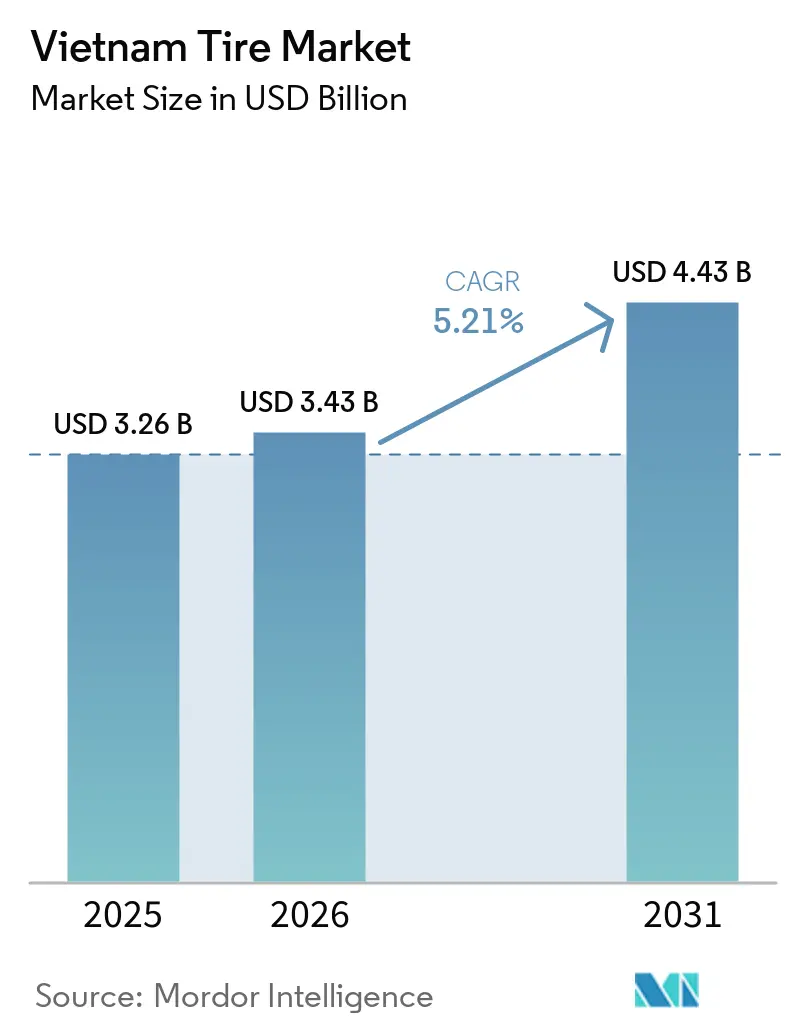
| Base Year Market Size (2025) | USD 3.26 Billion |
| Market Size (2026) | USD 3.43 Billion |
| Market Size (2031) | USD 4.43 Billion |
| Growth Rate (2026 - 2031) | 5.21 % |
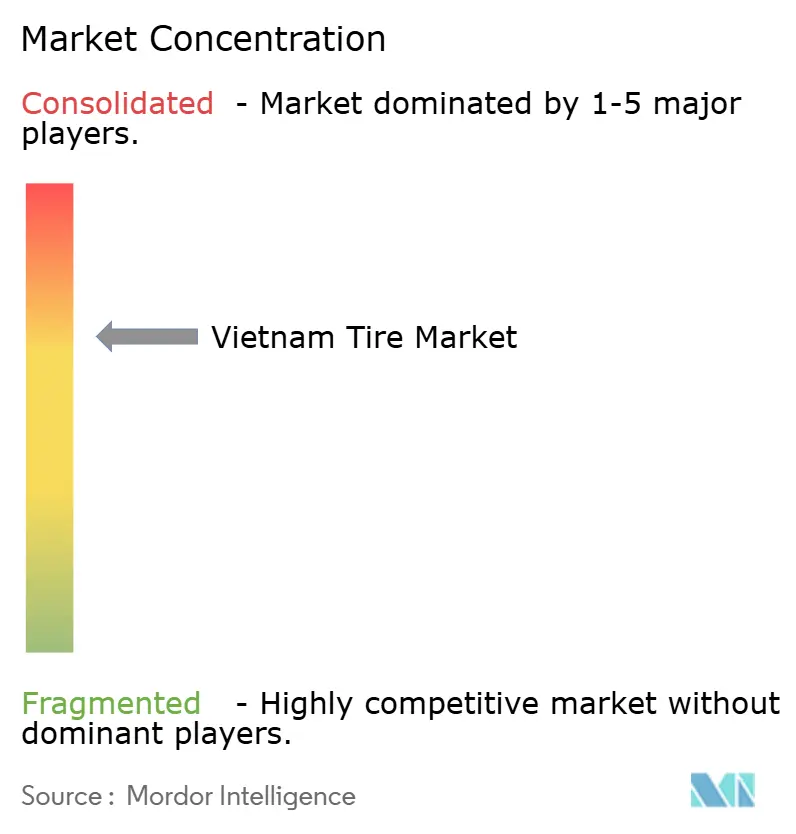
| Market Concentration | Medium |
Major Players *Disclaimer: Major Players sorted in no particular order Image © Mordor Intelligence. Reuse requires attribution under CC BY 4.0. | |
Vietnam Tire Market Analysis by Mordor Intelligence
The Vietnam tire market size was valued at USD 3.26 billion in 2025, is estimated at USD 3.43 billion in 2026, and is projected to reach USD 4.43 billion by 2031, registering a CAGR of 5.21% between 2026 and 2031. The trajectory observed in this Southeast Asian economy represents a rare confluence of factors. These include the rapid electrification of two-wheelers, the expansion of commercial vehicle fleets, the transformation of supply chains driven by domestic manufacturing incentives, and the enforcement of Extended Producer Responsibility mandates. These mandates are compelling established market players to reassess and adapt their strategies for managing end-of-life economics effectively.
Key Report Takeaways
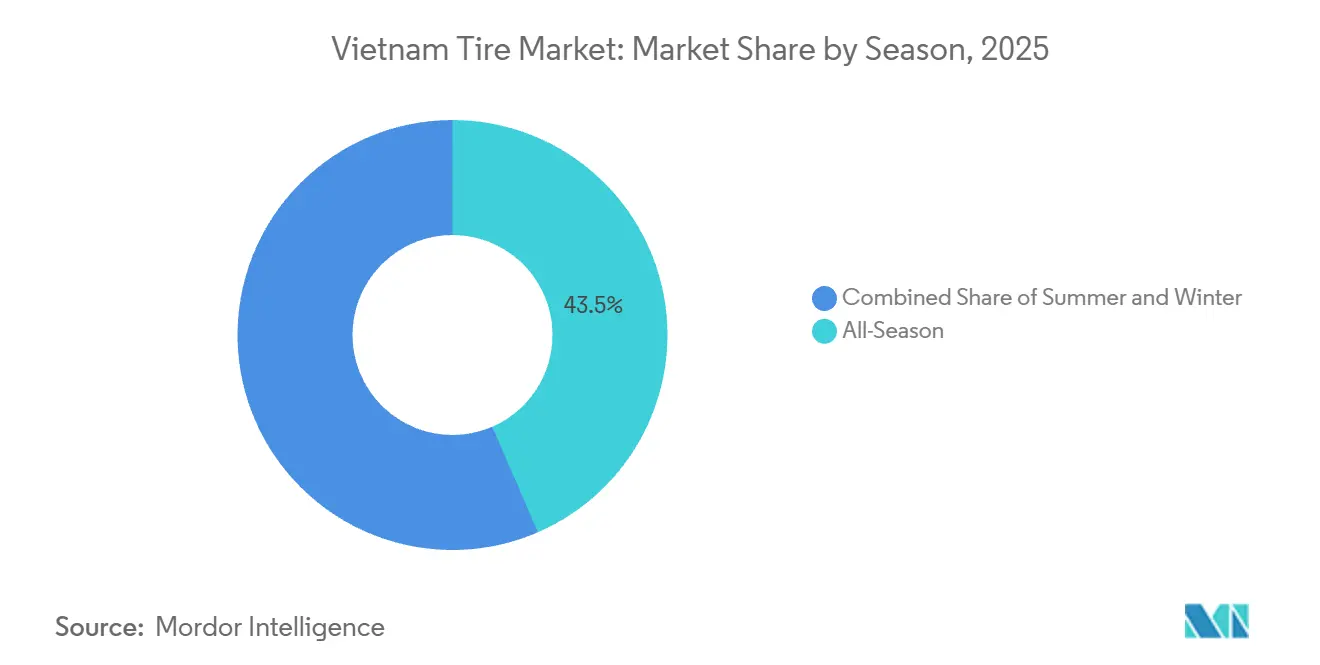
- By season, all-season tires led with 43.47% of Vietnam's market share in 2025, while summer tires are forecast to advance at a 5.23% CAGR through 2031.
- By tire design, radial construction commanded 89.73% of the Vietnam tire market size in 2025 and is set to grow at a 5.32% CAGR to 2031.
- By vehicle type, two-wheelers held 43.35% of the Vietnam tire market share in 2025, while passenger cars recorded the fastest CAGR at 5.27% through 2031.
- By application, on-road tires accounted for 83.12% of the Vietnam tire market size in 2025; off-road fitments are projected to grow at a 5.26% CAGR between 2025 and 2031.
- By end user, the aftermarket contributed 65.51% of the Vietnam tire market size in 2025, whereas OEM channels are projected to post a 5.24% CAGR through 2031.
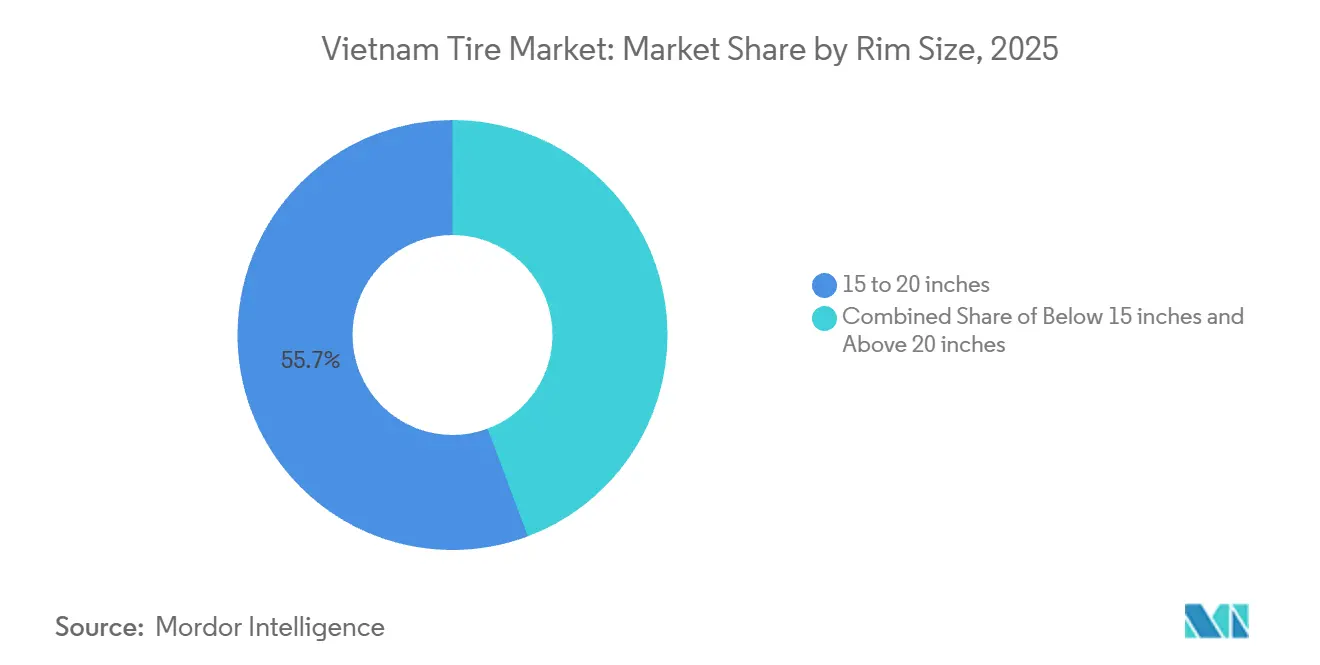
- By rim size, the 15–20-inch segment captured a 55.67% share of the Vietnam tire market in 2025; the above-20-inch category is forecast to expand at a 5.35% CAGR between 2025 and 2031.
- By propulsion, Internal-combustion vehicles had an 87.43% of the Vietnam tire market size in 2025, yet battery-electric fitments will register the highest growth at a 5.28% CAGR through 2031.
Note: Market size and forecast figures in this report are generated using Mordor Intelligence’s proprietary estimation framework, updated with the latest available data and insights as of January 2026.
Vietnam Tire Market Trends and Insights
Drivers Impact Analysis*
| Driver | (~) % Impact on CAGR Forecast | Geographic Relevance | Impact Timeline |
|---|---|---|---|
| Rising Vehicle PARC | +1.2% | National, concentrated in urban centers | Medium term (2-4 years) |
| Logistics and E-Commerce Boom | +0.9% | National, strongest in Mekong Delta and Red River Delta | Short term (≤ 2 years) |
| Government Incentives | +0.8% | National, focused on industrial zones | Long term (≥ 4 years) |
| Rapid Electrification of Two-Wheelers | +0.6% | Urban centers, expanding to rural areas | Medium term (2-4 years) |
| Green Public-Sector Procurement Targets | +0.4% | National, government fleet focus | Long term (≥ 4 years) |
| Truck and Bus Radialization Push | +0.3% | National highway corridors | Medium term (2-4 years) |
| Source: Mordor Intelligence | |||
Rising Vehicle PARC and Disposable Income Growth
In 2024, vehicle registrations experienced significant growth, contributing to an expanding installed base of vehicles that continues to drive consistent demand in the aftermarket segment. The annual GDP growth rate of nearly 10% has enhanced household purchasing power, resulting in shorter replacement cycles, particularly for premium-branded tires in key urban centers such as Hanoi and Ho Chi Minh City. While motorcycles remain the dominant choice for individuals entering the personal mobility market, the adoption of passenger cars is accelerating. This trend is supported by improved access to financing options and the ongoing expansion of urban road infrastructure. Increased vehicle utilization has led to higher tread wear, which in turn is generating a steady and predictable demand for high-quality replacement tires across dealership networks and quick-fit service outlets.[1]“Vehicle Registration Data 2024,” General Statistics Office, gso.gov.vn.
Logistics and E-Commerce Boom Increasing CV Tire Demand
Vietnam's e-commerce sector has experienced significant growth, driving substantial changes in the logistics and transportation landscape. This expansion has resulted in the proliferation of dense urban last-mile delivery fleets and the extension of intra-regional trunk routes. Delivery vans and refrigerated trucks, which operate with high daily mileage, are experiencing accelerated tire wear compared to private vehicles. Additionally, infrastructure developments, such as the North–South Expressway and ongoing highway projects connecting to border gates, are enhancing road accessibility. These improvements are encouraging operators to optimize fuel efficiency by leveraging the newly developed routes. In the seafood export segment, specialized cold-chain vehicles are increasingly utilizing high-load, low-temperature tread compounds, which are priced at a premium due to their advanced performance characteristics.
Government Incentives for Domestic Tire Manufacturing
Chinese and Korean investments in Vietnam are supported by preferential corporate income tax rates and import tariff exemptions on machinery, which will remain in effect until December 2027. The establishment of Guizhou Tire's semi-steel radial facility in Tien Giang, along with Kumho Tire's capacity expansion, exemplifies Vietnam's strategic efforts to position itself as a competitive and cost-efficient export hub. This approach is particularly significant amid the ongoing escalation of U.S.-China trade tensions[2]“FDI in Automotive Supporting Zones,” Ministry of Planning & Investment, mpi.gov.vn. Additionally, industrial parks such as Long Hau, Phuoc Dong, and VSIP benefit from streamlined permitting processes, which effectively reduce lead times for the development of greenfield plants. Furthermore, vocational training grants play a crucial role in ensuring the availability of a skilled workforce to support these industrial advancements.
Rapid Electrification of Two-Wheelers
VinFast's Klara and Feliz models are driving the increased adoption of electric scooters, supported by subsidized registration fees and the development of a robust battery-swap infrastructure. The instant torque characteristic of these scooters contributes to accelerated wear on rear tires. Furthermore, regenerative braking significantly alters the dynamics of the contact patch, prompting original equipment manufacturers (OEMs) to demand advanced tire compounds. These compounds, enriched with silica, are designed to provide low rolling resistance while meeting performance requirements. In parallel, ride-hailing and delivery fleets are increasingly transitioning to electric vehicles as part of their efforts to align with corporate environmental, social, and governance (ESG) commitments. This electrification trend has resulted in bulk ordering cycles at the fleet level, creating opportunities for vendors to capitalize on by offering tailored service programs that cater to the specific needs of these fleets.[3]“Electric Scooter Portfolio and Battery Swap Network,” VinFast, vinfastauto.com
Restraints Impact Analysis*
| Restraint | (~) % Impact on CAGR Forecast | Geographic Relevance | Impact Timeline |
|---|---|---|---|
| Natural Rubber Price Volatility | -0.7% | National, affecting all manufacturers | Short term (≤ 2 years) |
| Price Competition from Low-Cost Chinese Imports | -0.5% | National, concentrated in price-sensitive segments | Medium term (2-4 years) |
| Extended Producer Responsibility (EPR) Compliance Costs | -0.4% | National, with higher impact on smaller manufacturers | Medium term (2-4 years) |
| Rural Infrastructure Gaps Limiting Off-Take | -0.3% | Rural and remote areas, affecting distribution reach | Long term (≥ 4 years) |
| Source: Mordor Intelligence | |||
Natural Rubber Price Volatility
In 2024, Vietnam, despite maintaining its position as a leading global player, faced challenges stemming from aging plantations and unpredictable rainfall patterns, which resulted in a tightened supply of rubber. The Vietnam Rubber Group's estate proved insufficient in mitigating the impact of global price volatility, prompting tire manufacturers to adopt strategies such as hedging or diversifying their reliance on synthetic rubber inputs. The sharp increase in raw material costs significantly influenced consumer behavior, particularly in the rural motorcycle segment, where high price elasticity led to a noticeable delay in purchase decisions.
Price Competition from Low-Cost Chinese Imports
Chinese brands are leveraging vertical integration, lower labor costs, and export-rebate incentives to gain a competitive edge by undercutting local competitors. This trend is particularly prominent in the bias-ply truck segment and the budget passenger vehicle tier. Sailun Vietnam has established a significant presence, accounting for 40% of export shipments, while Jinyu Vietnam holds a substantial 20% share. These developments are exerting considerable pressure on the profit margins of domestic independent players. Additionally, the continuous expansion of production capacities within Vietnamese industrial parks is further complicating the differentiation of product origins. As a result, fleet owners are increasingly focusing on price as the most critical factor influencing their purchasing decisions.
*Our forecasts treat driver/restraint impacts as directional, not additive. The impact forecasts reflect baseline growth, mix effects, and variable interactions.
Segment Analysis
By Season: All-Season Dominance Reflects Climate Pragmatism
In 2025, all-season tires accounted for 43.47% of Vietnam's tire market share. Concurrently, summer tires are projected to experience steady growth, with a CAGR of 5.23% during the forecast period. Vietnam's relatively consistent temperature profile supports the preference for single-pattern tires, enabling motorists to reduce costs associated with storage and seasonal tire changes. Winter tire designs, however, remain niche, primarily serving specific applications such as mountain-pass buses and cold-storage forklifts, where temperatures occasionally fall below 10 °C. This climate uniformity provides manufacturers with the advantage of streamlining their compound portfolios and optimizing distribution inventory management.
Premium tire brands are actively conducting consumer education campaigns to highlight the superior hydroplaning resistance and braking performance of purpose-engineered summer tire patterns. These initiatives are gradually encouraging a shift among consumers from entry-level all-season stock-keeping units (SKUs) to more specialized options. Retailers in key regions such as Da Nang and Can Tho report increased opportunities for upselling, particularly through targeted safety messaging during the monsoon season. Furthermore, the expanding car-rental sector is increasingly favoring higher-speed-rated summer tires to meet the requirements of corporate fleet insurers. This trend is fostering the development of new business-to-business (B2B) channels, characterized by predictable ordering patterns and consistent demand cycles.



By Tire Design: Radial Technology Achieves Near-Universal Adoption
In 2025, radials accounted for 89.73% of Vietnam's tire market share and are anticipated to grow at a 5.32% CAGR by 2031. This growth is primarily attributed to the enforcement of low-emission truck standards. Fleet cost analyses emphasize the benefits of extended retread cycles and reduced fuel consumption, which justify the premium pricing of radials over bias alternatives. Furthermore, since 2023, OEMs have exclusively adopted radial fitments, driving a significant increase in aftermarket conversions as factory warranties expire.
Leading brands have introduced non-pneumatic prototypes targeting urban last-mile vans, where puncture-related downtimes result in substantial operational costs. However, the commercial viability of these prototypes is expected to take several years to materialize. Concurrently, Chinese manufacturers are launching advanced belt-package radials incorporating graphene and recycled rubber. These innovations not only enhance sustainability credentials but also align with the growing pressures of Extended Producer Responsibility (EPR) compliance. Such technological advancements are raising the competitive benchmark, presenting significant challenges for domestic second-tier producers aiming to penetrate the budget motorcycle segment.
By Vehicle Type: Two-Wheeler Legacy Meets Passenger-Car Ascendancy
In 2025, two-wheelers accounted for a significant 43.35% share of Vietnam's tire market, maintaining their dominance in the sector. Passenger cars, supported by aggressive dealer financing strategies and an expanding range of models from key players such as VinFast, Hyundai, and Toyota, exhibited a strong 5.27% CAGR. The tire market share for passenger cars is projected to exceed two-fifths by 2031, driven by the increasing prevalence of multi-car households, particularly in Vietnam's growing second-tier cities.
Light commercial vans and pickups, which play a critical role in sustaining the e-commerce sector, contributed to nearly one-fifth of tire sales in 2025. These vehicles are increasingly adopting all-terrain radial designs, which are well-suited for mixed-road conditions. Heavy trucks and buses are benefiting from infrastructure projects associated with the Belt and Road Initiative (BRI). However, the growth of ultra-heavy-spec vehicles remains constrained by axle-load restrictions. The specialty off-road tire segment, encompassing vehicles such as mining trucks and combine harvesters, is expanding from a relatively small base. This segment offers high-margin opportunities for domestic manufacturers, particularly those leveraging efficient and localized supply chains to meet the rapid demands of plantation clients.
By Application: On-Road Supremacy with Off-Road Opportunities
In 2025, on-road fitments accounted for 83.12% of the Vietnam tire market share, primarily driven by urban commuting requirements and inter-provincial haulage activities. The ongoing expansion of lanes on the Ho Chi Minh City–Long Thanh–Dau Giay route continues to bolster the demand for high-speed highway tread designs, particularly those incorporating low-noise patterning to enhance driving comfort. Although off-road applications represent a smaller segment of the market, they are anticipated to grow at a notable 5.26% CAGR, supported by mining concessions in Quang Ninh and large-scale construction initiatives such as the Long Thanh International Airport. Furthermore, the increasing mechanization of rice cultivation, along with the expansion of palm and rubber plantations in the Central Highlands, is driving the demand for specialized tire patterns, including flotation and paddy-friendly designs that offer resistance to stubble damage.
In the mining sector, tire manufacturers are reporting increased adoption of telematics sensors integrated with quarry dumpers, as mining contractors focus on reducing operational downtime. Similarly, civil-engineering contractors are increasingly utilizing radial OTR products, particularly those featuring cut-resistant compounds, to effectively manage the challenges posed by lateritic soils commonly encountered in infrastructure cut-and-fill operations. This trend is expanding value streams for suppliers, especially those capable of offering field-side service trucks to meet on-site requirements efficiently.
By End User: Aftermarket Strength Signals Mature Replacement Cycles
In 2025, aftermarket channels accounted for 65.51% of Vietnam's tire market share, highlighting the significant installed base of motorbikes and an aging truck fleet that necessitates frequent servicing. Independent tire retailers dominate the urban aftermarket landscape, offering a mix of budget tire options imported from China and Thailand alongside premium products from Japan and Europe. The sector continues to experience limited retail consolidation, which provides wholesalers with substantial leverage in price negotiations. Although the OEM share remains smaller, it is projected to grow at a 5.24% CAGR, supported by the increasing localization of vehicle assembly driven by tariff reductions under ASEAN trade agreements. Furthermore, factory-approved tire kits bundled with new vehicle sales ensure a consistent volume for manufacturers, particularly as VinFast accelerates its production of sedans and SUVs.
Extended Producer Responsibility (EPR) regulations are compelling both OEMs and replacement market participants to enhance collection logistics, leading to the establishment of joint-venture recycling hubs. Brands that introduce initiatives such as take-back credits or free fitment services are gaining consumer loyalty and encouraging repeat purchases. These strategies are particularly effective in strengthening brand retention within the premium market segment.
By Rim Size: Mid-Range Dominance with Premium Growth
In 2025, rims measuring between 15 and 20 inches accounted for 55.67% of Vietnam's tire market share, primarily driven by their application in B-segment sedans, C-segment SUVs, and light commercial vehicles (LCVs). The growth of this segment closely aligns with the expansion of passenger-car sales, maintaining a steady pace with the broader market CAGR. On the other hand, tires exceeding 20 inches, despite contributing minimally to overall revenue, are experiencing the fastest growth rate at a 5.35% CAGR. This growth is attributed to the increasing preference among affluent consumers for imported luxury SUVs and pickups, which typically require tire sizes ranging from 21 to 24 inches. The sub-15-inch segment, which predominantly caters to 150cc motorcycles and mini-cars, is anticipated to witness a gradual decline as consumer preferences shift towards larger vehicles.
Premium rims necessitate the use of low-profile ultra-high-performance (UHP) tires, which are designed with reinforced bead packs and noise-reduction ridges. This requirement creates high-margin opportunities for global manufacturers, who leverage their ability to import specialized molds to meet these demands. Concurrently, domestic manufacturers aiming to capture the growing luxury segment are making significant investments in multi-cavity presses. These presses enable them to efficiently handle smaller batch runs while maintaining production throughput, thereby positioning themselves competitively in the evolving market landscape.
By Propulsion: ICE Dominance Faces Electric Disruption
In 2025, internal combustion engine vehicles accounted for 87.43% of Vietnam's tire market share. However, this dominance is anticipated to decline, with the share expected to reduce to 80% by 2031 as electric vehicles continue to gain momentum. Battery-electric vehicles are projected to exhibit the highest growth, with a notable 5.28% CAGR. This growth is driven by favorable government policies, including duty exemptions on imported EV components, and collaborative efforts between state utilities and private entities to expand charging infrastructure. Tire manufacturers are responding to these shifts by developing products with extra-load ratings to support the increased weight of EV batteries and incorporating foam-inlay technology to address drivetrain noise. Although hybrid vehicle sales remain relatively limited, they provide transitional volumes, enabling consumers to become familiar with low-rolling-resistance tire technologies.
Hydrogen fuel-cell prototypes for intercity buses are currently in the experimental stage. Nevertheless, early trials conducted in Hai Phong port corridors indicate potential for future adoption, particularly in applications where long-range and rapid refueling capabilities are essential. Tire manufacturers that proactively engage in hydrogen-ready tire testing are likely to secure critical engine-OEM approvals, positioning themselves advantageously for commercialization as the technology matures.
Geography Analysis
Hanoi and Ho Chi Minh City dominate Vietnam's tire market, accounting for over 75% of e-commerce parcel volume. These cities also host most of the country's automotive assembly plants, tire manufacturing facilities, and aftermarket distribution hubs. Hai Phong City has emerged as a key tire production center, with Bridgestone's plant producing over 11,000 radial tires daily for domestic and export markets. In Binh Duong province, Kumho Tire is expanding its facility to increase production capacity to 17 million units annually by 2026, while Casumina's Tan Uyen plant produces over 10,000 tons of radial tires annually. Tay Ninh province houses Sailun Group's facility, which targets significant production volumes of semi-steel, all-steel, and off-the-road tires using locally sourced natural rubber. Dong Nai province further strengthens Vietnam's tire production capabilities with Cheng Shin Rubber and Kenda Rubber plants, which collectively produce over 29 million units annually.
Rural provinces face infrastructure challenges that limit tire distribution and sales. Lao Cai aims to pave over 80% of its 15,013 kilometers of rural roads by 2030, while Lang Son has allocated significant funding for road and bridge projects to improve connectivity. The government's expressway expansion plan, targeting 5,000 kilometers by 2030, is expected to boost demand for high-speed radial tires and reduce logistics costs, which currently account for a substantial portion of e-commerce supply-chain expenses. Da Nang serves as a central procurement hub, with facilities producing truck-and-bus radial tires and off-the-road tires. Additionally, a new greenfield plant in Ho Chi Minh City is set to produce millions of semi-steel radial tires annually by 2027, targeting export markets with competitive advantages from trade agreements.
The concentration of tire manufacturing in Vietnam's industrial zones offers logistical and supply chain benefits but also exposes the sector to risks such as reduced rubber yields from heatwaves and port congestion. Upcoming regulations, including Hanoi's internal-combustion engine ban in 2026 and Ho Chi Minh City's transition to electric ride-hailing vehicles by 2028, are driving demand for electric-vehicle tires. Manufacturers are adapting by upgrading existing facilities to support electric-vehicle tire production. Meanwhile, underserved regions like the Mekong Delta and Central Highlands present opportunities for domestic producers to leverage local knowledge and faster replenishment cycles to compete with multinational players in fragmented markets.
Geographic Market Expansion Assessment (Raw Score (1–5): 1 = Low, 5 = High. Weighted Score: Raw Score × assigned weight; reflects importance-adjusted impact. Interpretation: Higher Opportunity = more attractive market; higher Risk = greater challenges.)
| Province | Ease of Entry (Raw/Weighted) | Market Size (Raw/Weighted) | Solution Fit (Raw/Weighted) | Competition (Raw/Weighted) | Investment (Raw/Weighted) | Barriers (Raw/Weighted) |
|---|---|---|---|---|---|---|
| Ho Chi Minh City (HCM) | 4/1.2 | 5/1.5 | 5/1.5 | 2/0.6 | 2/0.6 | 2/0.6 |
| Ha Noi | 4/1.2 | 5/1.5 | 4/1.2 | 3/0.9 | 3/0.9 | 3/0.9 |
| Vung Tau | 3/0.9 | 3/0.9 | 4/1.2 | 4/1.2 | 4/1.2 | 3/0.9 |
| Quang Ninh | 5/1.5 | 3/0.9 | 3/0.9 | 4/1.2 | 5/1.5 | 4/1.2 |
| Binh Duong | 3/0.9 | 5/1.5 | 5/1.5 | 2/0.6 | 4/1.2 | 3/0.9 |
| Dong Nai | 4/1.2 | 5/1.5 | 4/1.2 | 3/0.9 | 5/1.5 | 4/1.2 |
| Bac Ninh | 3/0.9 | 4/1.2 | 5/1.5 | 3/0.9 | 5/1.5 | 3/0.9 |
| Da Nang | 5/1.5 | 3/0.9 | 4/1.2 | 4/1.2 | 3/0.9 | 5/1.5 |
| Thanh Hoa | 4/1.2 | 4/1.2 | 3/0.9 | 5/1.5 | 4/1.2 | 4/1.2 |
| Thai Nguyen | 3/0.9 | 3/0.9 | 4/1.2 | 4/1.2 | 4/1.2 | 5/1.5 |
| Vinh Phuc | 4/1.2 | 3/0.9 | 5/1.5 | 3/0.9 | 3/0.9 | 4/1.2 |
| Can Tho | 4/1.2 | 4/1.2 | 3/0.9 | 4/1.2 | 4/1.2 | 5/1.5 |
| Hung Yen | 5/1.5 | 3/0.9 | 3/0.9 | 5/1.5 | 3/0.9 | 4/1.2 |
| Phu Thọ | 3/0.9 | 3/0.9 | 3/0.9 | 5/1.5 | 3/0.9 | 5/1.5 |
| Ninh Binh | 5/1.5 | 3/0.9 | 3/0.9 | 4/1.2 | 4/1.2 | 5/1.5 |
| Hue | 5/1.5 | 2/0.6 | 3/0.9 | 5/1.5 | 3/0.9 | 5/1.5 |
| Others | 2/0.6 | 2/0.6 | 2/0.6 | 5/1.5 | 2/0.6 | 2/0.6 |
| Source: Mordor Intelligence | ||||||
Competitive Landscape
The Vietnam tire market demonstrates moderate concentration, with key exporters holding a significant share of outbound volumes. Leading players leverage economies of scale and advanced production capabilities to maintain their competitive edge. The market also benefits from strategic expansions that strengthen supply chains and support original-equipment supplies for domestic assembly plants.
Domestic manufacturers capitalize on their proximity to raw materials and reduced logistics costs, securing strong positions in motorcycle and agricultural segments. Investments in research and development focus on enhancing product adaptability to local road and climate conditions. Strategic clustering within industrial zones fosters supplier collaboration, while shared compliance initiatives help smaller players manage operational costs effectively.
Innovation in sustainable materials is gaining traction, with efforts directed toward integrating recycled components and adopting energy-efficient production techniques. Collaborations with partners in related industries aim to develop advanced tire compounds tailored for emerging vehicle technologies. As tariff structures evolve, exporters are diversifying their portfolios to reduce dependency on traditional markets and explore opportunities in new regions.
Vietnam Tire Industry Leaders
Bridgestone Corporation
Michelin SCA
Goodyear Tire & Rubber Company
Continental AG
Yokohama Rubber Co., Ltd.
- *Disclaimer: Major Players sorted in no particular order

Recent Industry Developments
- April 2026: Zhongce Rubber announced a USD 145 million investment to build a new tire manufacturing plant in Vietnam. The facility will produce approximately 5 million semi-steel radial tires annually, primarily for passenger vehicles. The investment aims to expand exports and mitigate global trade barriers, positioning Vietnam as a key production base.
- January 2025: Kolon Industries announced a USD 20.5 million investment to expand its tire cord production facility in Vietnam. The expansion will increase capacity from 36,000 tons to 57,000 tons annually, supporting tire manufacturers. Operations are expected to begin in 2027, enhancing regional supply chain resilience.


Vietnam Tire Market Report Scope
The Vietnam tire market is segmented by season, tire design, vehicle type, application, end user, rim size, and propulsion. By season, the market is segmented into summer, winter, and all-season tires. By tire design, the market is segmented into radial, bias, and non-pneumatic/airless tires. By vehicle type, the market is segmented into two-wheelers, passenger cars, light commercial vehicles, heavy commercial trucks and buses, and off-the-road and specialty vehicles, including OTR, agriculture, mining, and racing applications. By application, the market is segmented into on-road and off-road. By end user, the market is segmented into OEM and aftermarket. By rim size, the market is segmented into below 15 inches, 15 to 20 inches, and above 20 inches. By propulsion, the market is segmented into internal-combustion vehicles, battery-electric vehicles, and hybrid and fuel-cell vehicles. The report offers market size and forecasts in value (USD) and volume (Units) for all the above-mentioned segments.
| Summer |
| Winter |
| All-Season |
| Radial |
| Bias |
| Non-pneumatic/Airless |
| Two-Wheelers |
| Passenger Cars |
| Light Commercial Vehicles |
| Heavy Commercial Trucks and Buses |
| Off-the-Road and Specialty (OTR, Agriculture, Mining, Racing) |
| On-Road |
| Off-Road |
| OEM |
| Aftermarket |
| Below 15 inches |
| 15 to 20 inches |
| Above 20 inches |
| Internal-Combustion Vehicles |
| Battery-Electric Vehicles |
| Hybrid and Fuel-Cell Vehicles |
| By Season | Summer |
| Winter | |
| All-Season | |
| By Tire Design | Radial |
| Bias | |
| Non-pneumatic/Airless | |
| By Vehicle Type | Two-Wheelers |
| Passenger Cars | |
| Light Commercial Vehicles | |
| Heavy Commercial Trucks and Buses | |
| Off-the-Road and Specialty (OTR, Agriculture, Mining, Racing) | |
| By Application | On-Road |
| Off-Road | |
| By End User | OEM |
| Aftermarket | |
| By Rim Size | Below 15 inches |
| 15 to 20 inches | |
| Above 20 inches | |
| By Propulsion | Internal-Combustion Vehicles |
| Battery-Electric Vehicles | |
| Hybrid and Fuel-Cell Vehicles |


Key Questions Answered in the Report
How large is the Vietnamese tire market in 2025?
Vietnam's tire market reached USD 3.26 billion in 2025 and is projected to grow at a 5.21% CAGR by 2031.
Which vehicle segment is expanding faster due to tire demand?
Passenger-car fitments are rising at a 5.27% CAGR through 2031, the quickest among all vehicle types.
What share do radial tires hold in Vietnam?
Radial construction accounted for 89.73% of the Vietnam tire market share in 2025 and continues to edge higher as bias-ply replacement accelerates.
How do new EPR regulations affect manufacturers?
From January 2024, producers are mandated to recycle at least 5% of annual volumes, adding collection and processing costs but opening circular-economy business avenues.
Which region contributes the most to tire demand?
Southeast economic zones anchored by Ho Chi Minh City generate the highest sales, driven by the largest vehicle parc and dense logistics traffic.
What is driving growth in above 20-inch rim sizes?
Rising premium-SUV and luxury-pickup ownership among affluent households propels the above-20-inch category at a 5.35% CAGR.
Page last updated on:


 Your data is secure and never sold or shared.


