
Thailand Tire Market Size and Share
Market Overview
| Study Period | 2019 - 2031 |
|---|---|
| Forecast Data Period | 2026 - 2031 |
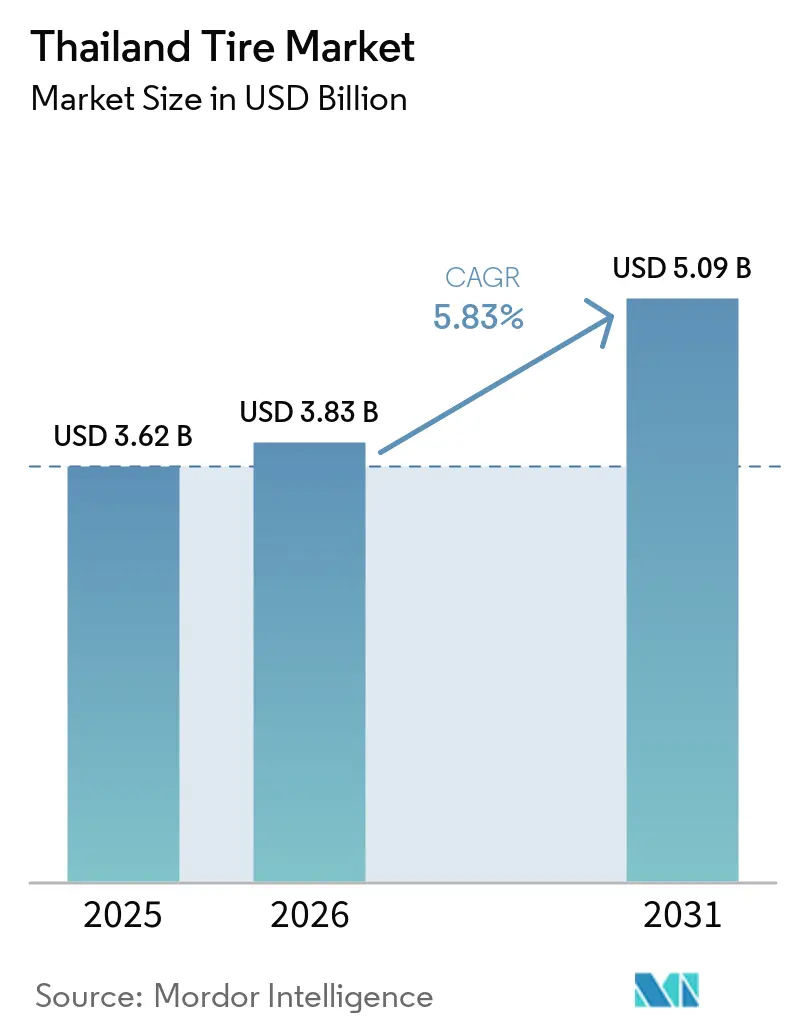
| Base Year Market Size (2025) | USD 3.62 Billion |
| Market Size (2026) | USD 3.83 Billion |
| Market Size (2031) | USD 5.09 Billion |
| Growth Rate (2026 - 2031) | 5.83 % |
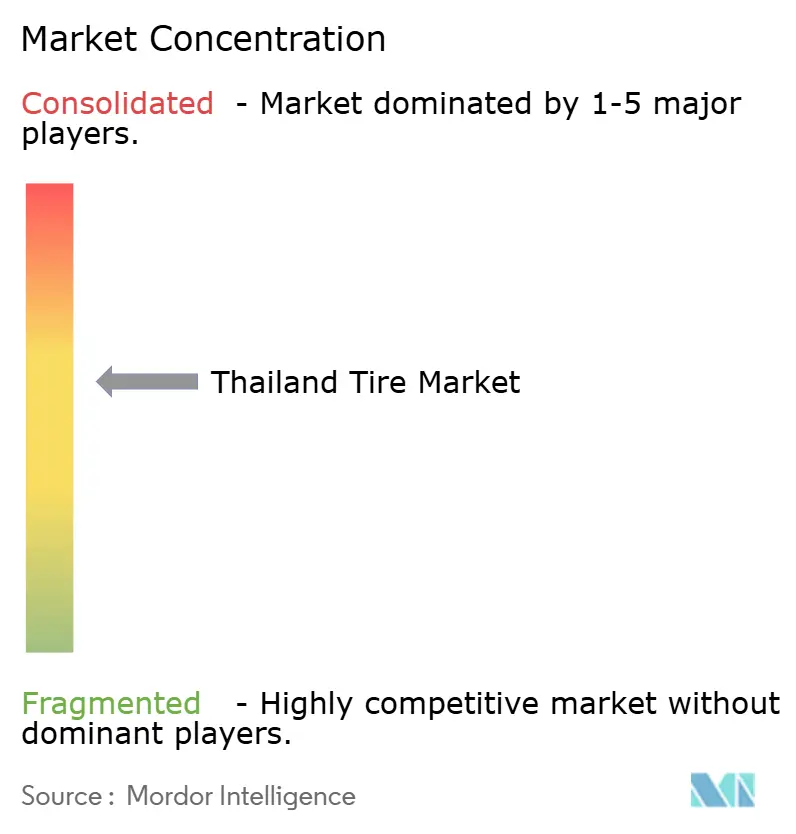
| Market Concentration | Medium |
Major Players *Disclaimer: Major Players sorted in no particular order Image © Mordor Intelligence. Reuse requires attribution under CC BY 4.0. | |
Thailand Tire Market Analysis by Mordor Intelligence
The Thailand tire market size was valued at USD 3.62 billion in 2025 and is estimated at USD 3.83 billion in 2026, and is projected to reach USD 5.09 billion by 2031, growing at a CAGR of 5.83% from 2026 to 2031. Thailand maintains its position as Southeast Asia's largest vehicle producer, the world's second-largest tire production hub, and a leading supplier of natural rubber, driving positive market momentum. Demand is supported by government-led electric vehicle (EV) incentives, strong export linkages to Europe and the United States, and a robust aftermarket sustained by an aging vehicle fleet. However, the market faces challenges such as elevated natural rubber prices, the implementation of new EU deforestation regulations, and the impact of counterfeit imports, which exert cost and margin pressures. Key growth opportunities are centered on EV-specific tires, larger rim sizes for pickups and SUVs, and premium radial technology aligned with mandatory tire-labeling regulations. Manufacturers are leveraging the Eastern Economic Corridor to achieve economies of scale, access deep-water ports, and benefit from preferential investment terms, while rapidly transitioning their portfolios toward battery-electric vehicles.
Key Report Takeaways
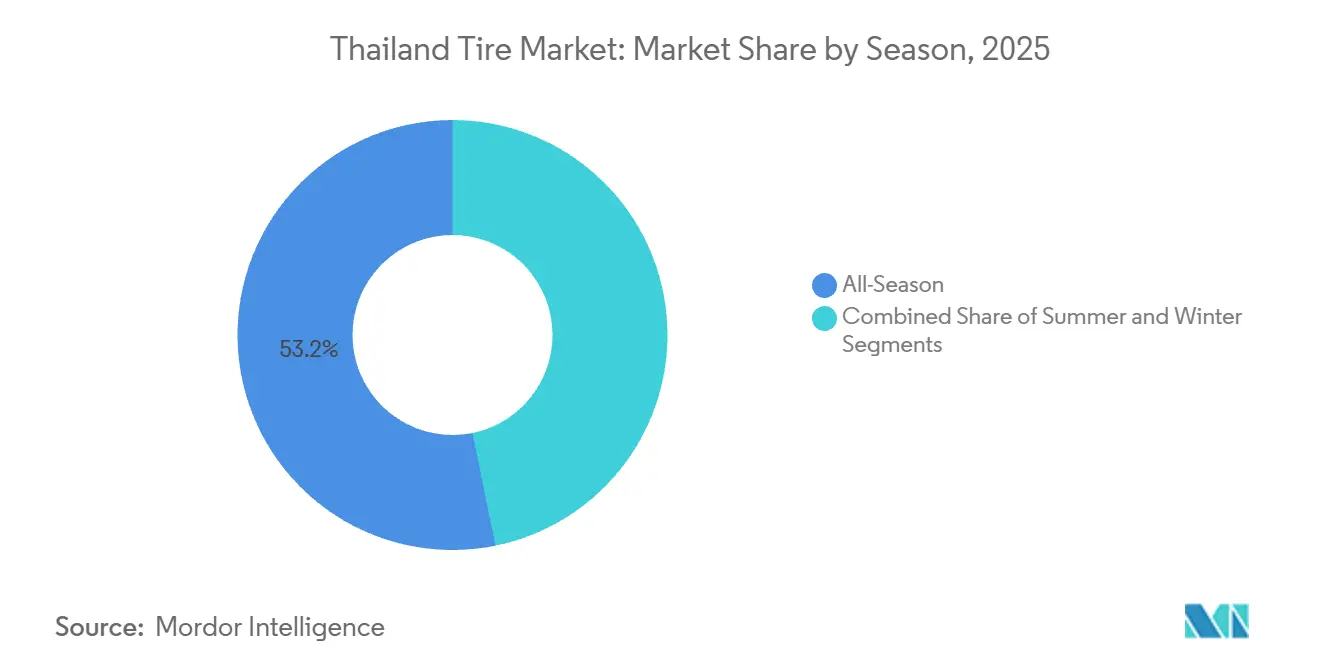
- By season, all-season tires captured 53.24% of the Thailand tire market share in 2025, while winter tires are projected to record the fastest growth at a 5.85% CAGR through 2031.
- By tire design, radial technology led with 87.65% of the Thailand tire market share in 2025, whereas Non-pneumatic / Airless is forecasted to grow at a CAGR of 5.87% through 2031.
- By vehicle type, passenger cars accounted for 45.54% of the Thailand tire market size in 2025 and are forecast to advance at a 5.91% CAGR through 2031.
- By application, on-road products held 83.21% of the Thailand tire market share in 2025; off-road tires are forecast to expand at a 5.93% CAGR through 2031.
- By end user, the aftermarket commanded 63.47% of the Thailand tire market share in 2025, and OEM is forecast to grow at a 5.94% CAGR through 2031.
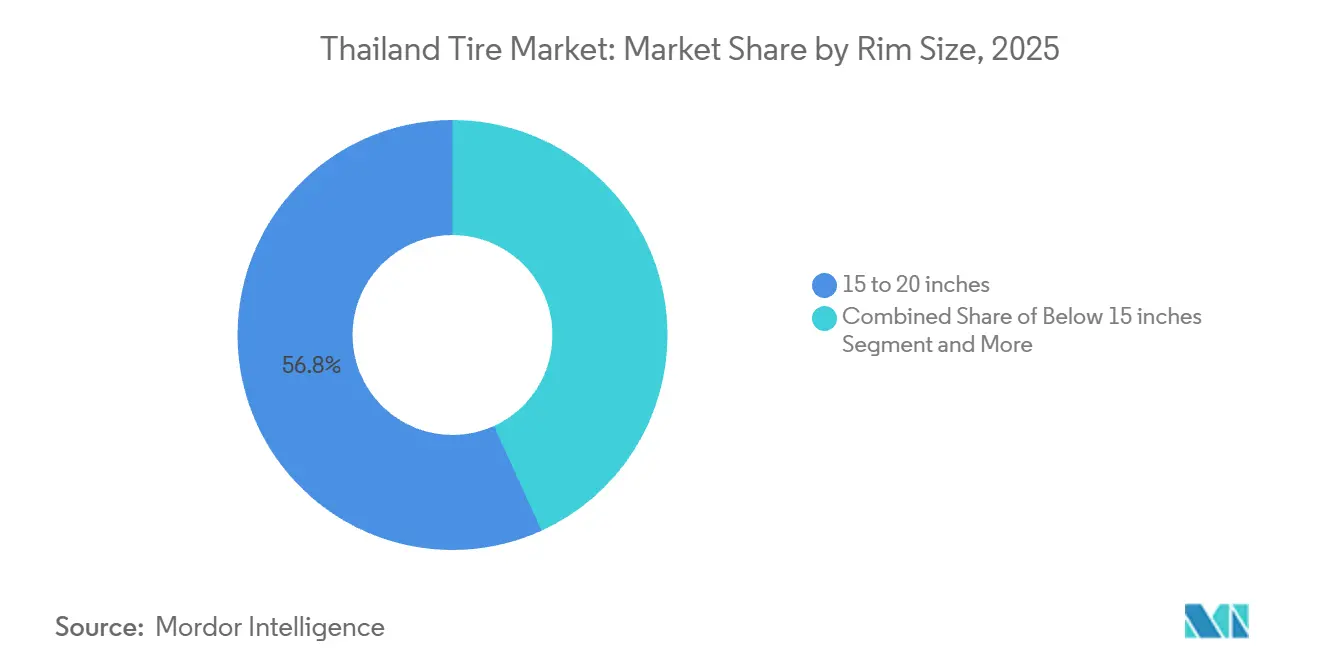
- By rim size, 15–20-inch products captured a 56.82% share of the Thailand tire market in 2025. The market for tires above 20 inches is forecasted to grow at a 5.89% CAGR through 2031.
- By propulsion, internal combustion vehicles led with an 86.71% share of the Thailand tire market in 2025, whereas battery-electric cars are set to post the fastest segment CAGR at 5.88% through 2031.
Note: Market size and forecast figures in this report are generated using Mordor Intelligence’s proprietary estimation framework, updated with the latest available data and insights as of January 2026.
Thailand Tire Market Trends and Insights
Drivers Impact Analysis*
| Driver | (~) % Impact on CAGR Forecast | Geographic Relevance | Impact Timeline |
|---|---|---|---|
| Government EV-Subsidy Program | +1.2% | National, concentrated in Bangkok and EEC provinces | Medium term (2-4 years) |
| Rapid E-Commerce Growth | +0.9% | Urban centers, expanding to provincial areas | Short term (≤ 2 years) |
| Tourism Rebound | +0.7% | Tourism hubs including Bangkok, Phuket, Chiang Mai | Short term (≤ 2 years) |
| OEM Shift to Larger Rim Sizes | +0.6% | National, aligned with production centers | Medium term (2-4 years) |
| Rise of Ride-Hailing Two-Wheeler Fleets | +0.5% | Urban areas with expanding service coverage | Short term (≤ 2 years) |
| Mandatory Tire-Labeling Regulations Favoring Premium Radials | +0.4% | National implementation | Medium term (2-4 years) |
| Source: Mordor Intelligence | |||
Government EV-Subsidy Program Boosting BEV Tire Demand
Thailand's EV 3.5 policy, which provides subsidies ranging from THB 50,000 (approximately USD 1,500) to THB 100,000 (approximately USD 3,000) and reduces excise taxes to their minimum levels, is anticipated to drive a 40% increase in EV registrations[1]“EV 3.5 Policy Summary,” Thailand Board of Investment, boi.go.th. The growing weight of battery packs has compelled automakers to adopt tires with a 40% higher load rating and ultra-low rolling resistance compounds to meet performance and efficiency requirements. Additionally, the local-assembly mandate, which stipulates that multiple vehicles must be manufactured domestically for every imported unit by December 2026, has attracted key players such as BYD and GAC Aion. These companies have collectively established a production capacity of nearly 200,000 units in Thailand. The concentration of production facilities in Chonburi and Rayong ensures a steady and predictable demand for nearby tire manufacturing plants. Furthermore, the ongoing expansion of public fast-charging infrastructure will be a critical factor in determining the extent of EV penetration beyond Bangkok, influencing the broader adoption of electric vehicles across the country.
Rapid E-Commerce Growth Driving Last-Mile LCV Tire Volumes
Thailand's e-commerce turnover continues to grow at double-digit rates, driving platforms such as Grab and Skootar to expand their operations by deploying motorcycles and small vans. These vehicles typically operate for 8–12 hours daily and cover an average of 43 kilometers in Bangkok's congested traffic conditions. This high level of utilization accelerates replacement cycles, thereby increasing demand for light commercial and two-wheeler tires. Fleet operators are progressively prioritizing high-durability tire compounds and extended mileage warranties to optimize operational efficiency. However, price sensitivity among operators limits the widespread adoption of ultra-premium tire options. As a result, urban logistics provides substantial growth opportunities for medium-tier radial tire manufacturers. Simultaneously, it enables premium tire brands to test fleet-service contracts, effectively demonstrating potential savings in total cost-of-ownership to fleet operators.
Tourism Rebound Accelerating Rental-Car Fleet Renewals
In 2025, international arrivals are projected to surpass pre-pandemic levels, driving a substantial increase in rental-car revenues. This growth is exemplified by Enterprise Mobility's strategic partnership with Thai Rent-A-Car, which manages an extensive fleet of over 8,000 vehicles. Rental cars typically require tire replacements after covering 40,000–60,000 kilometers, ensuring a steady and predictable demand in the automotive aftermarket. Tires with all-season tread patterns and superior wet-grip ratings are particularly well-suited for the coastal and mountainous routes frequently traveled by tourists. Furthermore, the pronounced seasonal tourism peaks in key destinations such as Phuket and Chiang Mai necessitate that distributors maintain adequate buffer inventories to mitigate the risk of stock-outs during periods of heightened demand.
OEM Shifts to Larger Rim Sizes for SUVs and Pickups
In 2025, prominent manufacturers Toyota, Isuzu, and Ford, operating in Thailand, initiated the integration of 15–20-inch rims into their mainstream pickup and SUV product lines. This strategic move enabled these companies to secure a substantial share of the country's tire market. The implementation of these lower-profile sidewalls necessitates the use of stronger bead packages and advanced carcass reinforcements, which play a critical role in reducing deformation on uneven road surfaces. As a result, the average selling prices of tires have increased, leading to a notable rise in revenue per unit for manufacturers. Additionally, while the incorporation of longer-lasting compounds marginally extends tire replacement intervals, it also elevates the risk of road damage, particularly on poorly maintained rural roads. This increased vulnerability is expected to drive higher demand for tire-insurance products and encourage original equipment manufacturers (OEMs) to collaborate on the development of more rigid and durable tire constructions to address these challenges effectively.
Restraints Impact Analysis*
| Restraint | (~) % Impact on CAGR Forecast | Geographic Relevance | Impact Timeline |
|---|---|---|---|
| Elevated Natural-Rubber Price Volatility | -0.8% | Global supply chain impact, concentrated in manufacturing regions | Short term (≤ 2 years) |
| Counterfeit and Grey-Market Tires Eroding Branded Sales | -0.6% | National, particularly in price-sensitive segments | Medium term (2-4 years) |
| High Import Duty | -0.4% | National, affecting mining and agricultural sectors | Medium term (2-4 years) |
| Slow Deployment of Public Fast-Charging | -0.3% | Urban centers with gradual expansion to provinces | Long term (≥ 4 years) |
| Source: Mordor Intelligence | |||
Elevated Natural-Rubber Price Volatility
In early 2025, benchmark RSS-3 rubber prices reached a 12-year high as producers accelerated efforts to comply with the European Union's deforestation regulations, which restrict imports sourced from newly cleared lands. Thai tire manufacturers benefit from their geographical proximity to rubber plantations; however, they continue to face elevated feedstock costs. This challenge arises because synthetic alternatives are unable to fully replace natural rubber, particularly in critical applications such as heavy-duty truck and aviation sectors. Leading premium brands mitigate these risks through long-term supply contracts and the implementation of advanced digital traceability tools. Despite these measures, margin pressures remain significant in price-sensitive domestic markets, where the ability to pass on increased costs to consumers is limited. Furthermore, currency fluctuations exacerbate market volatility, as a weakening baht inflates the cost of dollar-denominated raw material invoices, adding another layer of complexity to the supply chain dynamics.
Counterfeit and Grey-Market Tires Eroding Branded Sales
Customs seizures of relabeled imports underscore Thailand’s struggle with counterfeit tires that undercut authorized dealers by up to two-fifths[2]“Counterfeit Tire Seizure Report 2025,” Royal Thai Customs, customs.go.th . Such tires lack verifiable safety credentials, which not only tarnish the reputation of established brands but also distort fair market competition. Although enforcement efforts intensified in 2024, the issue persists due to the country's porous borders and the prevalence of thriving informal distribution channels that sustain the flow of illicit products. To combat this, premium tire manufacturers have implemented QR-code verification systems on tire sidewalls to enhance traceability. Additionally, they are collaborating with e-commerce platforms to identify and delist suspicious sellers. However, the continued presence of the grey market significantly constrains the pricing power of legitimate manufacturers. As a result, these manufacturers are compelled to introduce extended promotional campaigns, particularly in rural areas where consumers often prioritize cost over safety considerations.
*Our forecasts treat driver/restraint impacts as directional, not additive. The impact forecasts reflect baseline growth, mix effects, and variable interactions.
Segment Analysis
By Season: All-Season Dominance Reflects Climate Consistency
In 2025, all-season tires accounted for 53.24% of the Thailand tire market, driven by the country's consistent tropical climate, which eliminates the necessity for seasonal tire changes. Conversely, winter tire shipments are projected to grow at a CAGR of 5.85% through 2031. This growth is primarily attributed to export contracts targeting markets in Europe and North America. The increase in production not only contributes to the expansion of Thailand's tire market size but also enhances factory load factors and supports investments in advanced, specialized curing presses. Notably, Continental has expanded its Rayong facility, dedicating multiple curing lines to the production of studdable winter tire designs that comply with EU regulatory mandates.
Export-driven winter tire production highlights how Thai manufacturing facilities effectively leverage economies of scale, while domestic consumers continue to favor all-season tires. A niche segment comprising automotive enthusiasts and luxury import owners opts for summer performance tires, representing a small yet profitable market channel. Additionally, Thai all-season tires distinguish themselves with monsoon-grade compounds featuring high silica content, which deliver superior wet grip performance on oil-slick roads. This combination of stable domestic demand and export diversification underpins the resilience and efficient utilization of production capacity across various seasonal tire categories.



By Tire Design: Radial Technology Maintains Manufacturing Leadership
In 2025, radial casings accounted for 87.65% of Thailand's tire market, underscoring the country's robust infrastructure in steel belts, cord fabric, and precision molding. Non-pneumatic airless designs are anticipated to grow at a CAGR of 5.87% through 2031. Bridgestone has initiated pilot programs for airless bus tires on Bangkok's BRT routes, while Michelin is conducting tests on Tweel platforms for agricultural applications. Bias-ply formats continue to maintain relevance in niche agriculture and mining sectors, where cost-effectiveness and repairability remain more critical than high-speed performance.
Investments in high-strength aramid and eco-friendly resin matrices are positioning Thai manufacturing facilities to scale up production of next-generation airless tires, contingent on overcoming current commercialization barriers. Simultaneously, radial tire producers are focusing on developing lighter, environmentally friendly composites that can reduce rolling resistance by up to 15%, aligning with the carbon-reduction objectives of original equipment manufacturers (OEMs). Domestic R&D collaborations between universities and suppliers are emphasizing the development of bio-based elastomers derived from Thailand's latex exports. These initiatives aim to enhance supply chain independence while significantly reducing lifecycle emissions.
By Vehicle Type: Passenger Cars Lead Amid Production Rebound
In 2025, passenger-car fitments accounted for a significant 45.54% share of Thailand's tire market. The segment is projected to grow at a 5.91% CAGR through 2031, reinforcing its position as the primary contributor to the market's expansion. This segment has demonstrated notable resilience, even amidst a 20% decline in auto assemblies in 2024, driven by tightened credit policies from banks. The rise of e-commerce has significantly boosted demand for light commercial vehicles, while heavy trucks have benefited from the recovery of cross-border trade activities with Malaysia and Cambodia.
Motorcycle tires remain a critical segment, supported by Thailand's growing two-wheeler production, which is anticipated to experience exponential growth in 2025. The demand for off-the-road tires continues to align with commodity cycles; the mining recovery in Phichit and increased agricultural mechanization in Nakhon Sawan are sustaining growth in these specialty segments. Tire manufacturers are strategically refining their product portfolios, balancing high-volume passenger tire lines with higher-margin specialty products. This approach enables them to stabilize earnings and maintain profitability during periods of market downturns.
By Application: On-Road Dominance Mirrors Urban Mobility Needs
In 2025, on-road applications accounted for 83.21% of the Thailand tire market, highlighting the significant passenger and freight traffic across the country's expressway network. This segment's dominance reflects the critical role of on-road tires in supporting Thailand's transportation infrastructure. Meanwhile, off-road demand is anticipated to grow at a 5.93% CAGR, driven by the expansion of mining concessions in Loei and the continued mechanization of sugarcane farming operations. Urban road congestion is fostering a shift toward low-rolling-resistance tire compounds, which contribute to reduced fuel and electricity consumption. Conversely, rural transport operators prioritize durable tire casings designed to withstand the impact of potholes and challenging road conditions.
Government-led road-upgrade initiatives under the "Thailand 4.0" program are channeling substantial investments into secondary highways. These upgrades are expected to gradually increase speed limits, which may accelerate tread wear over time. In the off-road segment, buyers are increasingly demanding tires with cut-resistant sidewalls and deep lugs that perform effectively in wet soil conditions. These features not only enhance product lifecycles but also ensure reliability in harsh environments. This dual demand dynamic plays a crucial role in guiding plant scheduling strategies, ensuring that mold inventories are adequately stocked with both touring radials and aggressive lug patterns to meet diverse market requirements.
By End User: Aftermarket Replacement Drives Volume Growth
In 2025, replacement channels accounted for a significant 63.47% share of the Thailand tire market. This dominance was primarily driven by the average passenger car age reaching 11.2 years and challenging road conditions that reduced tire service life. Concurrently, the OEM pathway is projected to grow at a 5.94% CAGR, supported by automakers increasing electric vehicle (EV) assembly to comply with subsidy requirements. Replacement volumes remain a critical driver of cash flow, with sales distributed across more than 8,000 independent retailers nationwide, effectively minimizing dependence on any single customer. The fragmented nature of the replacement market provides stability by reducing reliance on large-scale buyers.
Retread operators continue to provide cost-effective solutions for truck tires; however, they face increasing competition from imported low-cost new tires, which are progressively narrowing the price differential. Additionally, digital fitment platforms are now connecting fleets with service centers, enabling predictive replacement scheduling and driving higher adoption rates of premium-tier products. These platforms are also enhancing operational efficiency for fleet operators by reducing downtime and optimizing maintenance schedules. On the OEM side, tire manufacturers are proactively securing vehicle-launch nominations several years in advance. This strategy not only ensures baseline production volumes but also facilitates technology-transfer agreements, which contribute to the enhancement of domestic technical expertise and support long-term industry growth.
By Rim Size: Mid-Range Sizes Reflect Market Preferences
In 2025, rims measuring 15–20 inches dominated Thailand's tire market, accounting for 56.82% of the market share. These rim sizes effectively cater to pickups, SUVs, and mid-size passenger cars, making them a critical segment. Meanwhile, products exceeding 20 inches are projected to grow at a CAGR of 5.89%, driven by the increasing import of premium vehicles and a growing focus on luxury vehicle assembly for export markets. Conversely, rims smaller than 15 inches remain a vital component for budget sedans and the extensive used-car market, where affordability continues to be a key consideration for vehicle owners.
The trend of increasing rim diameters has led to a rising demand for ultrahigh-tensile bead wires and aramid-reinforced sidewalls, which are essential for maintaining ride comfort on uneven terrains. Manufacturers are responding to this demand by investing in multi-stage bead-forming lines and advanced pressure-monitoring systems, both of which are integral to the production of larger wheels. This upsizing trend aligns with automakers' focus on enhancing vehicle aesthetics, thereby improving curb appeal. Additionally, it supports higher tire average selling prices (ASPs), contributing to revenue growth even if the overall unit volume stabilizes.
By Propulsion: ICE Vehicles Retain Scale as EV Tires Surge
In 2025, internal combustion platforms dominated sales, accounting for 86.71% of the market. However, the electric vehicle (EV) segment is experiencing significant growth, registering a CAGR of 5.88%. This upward trend is driving the development of innovative products, such as foam-lined acoustic tires, which are specifically designed to reduce noise generated by electric drivetrains. Plug-in hybrids continue to maintain their position as a solution to range anxiety, while fuel-cell vehicle trials remain in the early stages. Tire production for EVs emphasizes high-load index constructions and silica-rich treads, which effectively reduce rolling resistance by approximately 20%.
Manufacturing plants in Thailand have integrated automated visual-inspection stations into their operations. These systems play a critical role in detecting even minor uniformity issues that could exacerbate torque ripple in electric vehicles. Furthermore, battery-compatible tires enhance regenerative-braking efficiency, a feature that carmakers prominently highlight in showroom brochures to attract consumers. The simultaneous production of internal combustion engine (ICE) and EV tires has necessitated the adoption of flexible curing schedules in factories. These schedules enable rapid mold changes within hours, accommodating the diverse carcass widths and bead diameters required for different tire types.
Geography Analysis
The Eastern Economic Corridor provinces of Chachoengsao, Chonburi, and Rayong significantly contribute to Thailand's national output. These provinces host major tire manufacturing facilities, including those of Bridgestone, Continental, Sumitomo Rubber, and Prinx Chengshan, strategically clustered near Laem Chabang Port[3]“EEC Investment Incentives,” Thailand Board of Investment, boi.go.th . This industrial agglomeration benefits from SEZ tax holidays, shared logistics infrastructure, and a specialized vocational talent pool skilled in polymer science and precision engineering. Additionally, their proximity to Bangkok's metropolitan region supports consistent replacement demand, while deep-water berths at the port enable efficient global export operations. The tire market in this region is projected to grow at a steady CAGR during the forecast period, driven by these favorable factors.
Bangkok represents the largest share of Thailand's tire market demand, attributed to the country's highest vehicle density and a well-established ride-hailing ecosystem. The city's stop-and-go traffic conditions, coupled with high ambient temperatures, accelerate tread wear, prompting motorists to prefer value-oriented radial tires with extended mileage warranties. Fleet operators in Bangkok increasingly rely on digital platforms to centralize procurement, aggregating orders for taxis, delivery vans, and corporate sedans. This trend ensures a stable and predictable demand for tire manufacturers, maintaining urban warehouse facilities. The market in Bangkok is expected to exhibit a robust CAGR over the forecast period, supported by these dynamics.
In the northern provinces of Chiang Mai, Lampang, and Chiang Rai, tire demand arises from a diverse mix of tourism vans, agricultural pickups, and all-terrain motorcycles serving hillside farming operations. The seasonal nature of tourism in these regions compels distributors to strategically stage inventory months in advance to meet peak holiday demand. In contrast, southern coastal hubs such as Phuket, Surat Thani, and Songkhla face unique requirements. Vehicles like resort shuttle buses and fishing-industry trucks, frequently exposed to corrosive sea spray, necessitate the use of salt-resistant tire compounds. Furthermore, cross-border haulage into Malaysia contributes additional traffic, further increasing replacement cycles in these provinces. The tire market in both northern and southern regions is anticipated to grow at a moderate CAGR during the forecast period, driven by these region-specific factors.
Competitive Landscape
Global leaders Bridgestone, Continental, and Michelin continue to reinforce their technological leadership through integrated latex plantations, proprietary synthetic rubber production, and dedicated R&D centers designed to adapt compounds to Thailand’s tropical climate. Collectively, these companies hold a significant market share. However, Chinese competitors such as Prinx Chengshan and Zhongce Rubber are gradually gaining traction by offering cost-efficient radials with export-grade certifications. Thailand's moderate regulatory environment regarding foreign capital facilitates joint ventures, enabling the import of turnkey production lines and leveraging the country’s skilled labor force to drive production efficiency.
The market is increasingly focusing on the development of EV-specific tires and advancements in airless tire technology. Bridgestone has introduced its Enliten lightweight compounds, while Continental has deployed ContiSilent acoustic foams to minimize cabin noise in premium EV models. Local manufacturers are prioritizing investments in digital traceability systems to comply with EU anti-deforestation regulations. By utilizing blockchain technology to document latex provenance, these players are positioning themselves competitively against low-cost grey-market alternatives. The market is expected to witness a steady growth trajectory during the forecast period, with a notable CAGR.
Distribution networks within the market remain fragmented. Tier-one brands, such as Bridgestone’s Cockpit and Continental’s BestDrive, operate branded retail chains that ensure consistent service quality. Meanwhile, multibrand independent retailers dominate provincial markets, where price competition is particularly intense. The growing popularity of online marketplaces among younger consumers has prompted tire manufacturers to introduce click-and-install platforms, which integrate e-commerce sales with partner garages. Consequently, the competitive landscape balances technological innovation, channel diversification, and adherence to supply-chain compliance, shaping the market dynamics during the study period.
Thailand Tire Industry Leaders
Bridgestone Corporation
Michelin SCA
Goodyear Tire & Rubber Co.
Yokohama Rubber Co.
Continental AG
- *Disclaimer: Major Players sorted in no particular order

Recent Industry Developments
- May 2026: Continental inaugurated the expansion of its tire plant in Rayong, Thailand, attended by key partners, government representatives, and employees. The investment of more than 300 million euros (USD 349.22 million) increases the facility's production capacity by an additional 3 million passenger car and light truck tires per year, enabling Continental to meet growing demand across Thailand and the wider Asia-Pacific region.
- February 2025: Yanggu Huatai Chemical Co., Ltd. officially commenced construction of its Thailand manufacturing facility in the Rayong Province industrial zone, according to Tyrepress. The project is designed to serve local tyre manufacturers in Thailand and broader Southeast Asian OEM supply chains, reducing logistics lead times significantly.


Thailand Tire Market Report Scope
The Thailand tire market is segmented by season, tire design, vehicle type, application, end user, rim size, and propulsion. By season, the market is segmented into summer, winter, and all-season tires. By tire design, the market is segmented into radial, bias, and non-pneumatic/airless tires. By vehicle type, the market is segmented into two-wheelers, passenger cars, light commercial vehicles, heavy commercial trucks and buses, and off-the-road and specialty vehicles, including OTR, agriculture, mining, and racing applications. By application, the market is segmented into on-road and off-road. By end user, the market is segmented into OEM and aftermarket. By rim size, the market is segmented into below 15 inches, 15 to 20 inches, and above 20 inches. By propulsion, the market is segmented into internal-combustion vehicles, battery-electric vehicles, and hybrid and fuel-cell vehicles. The report offers market size and forecasts in value (USD) and volume (Units) for all the above-mentioned segments.
| Summer |
| Winter |
| All-Season |
| Radial |
| Bias |
| Non-pneumatic/Airless |
| Two-Wheelers |
| Passenger Cars |
| Light Commercial Vehicles |
| Heavy Commercial Trucks and Buses |
| Off-the-Road and Specialty (OTR, Agriculture, Mining, Racing) |
| On-Road |
| Off-Road |
| OEM |
| Aftermarket |
| Below 15 inches |
| 15 – 20 inches |
| Above 20 inches |
| Internal-Combustion Vehicles |
| Battery-Electric Vehicles |
| Hybrid and Fuel-Cell Vehicles |
| By Season | Summer |
| Winter | |
| All-Season | |
| By Tire Design | Radial |
| Bias | |
| Non-pneumatic/Airless | |
| By Vehicle Type | Two-Wheelers |
| Passenger Cars | |
| Light Commercial Vehicles | |
| Heavy Commercial Trucks and Buses | |
| Off-the-Road and Specialty (OTR, Agriculture, Mining, Racing) | |
| By Application | On-Road |
| Off-Road | |
| By End User | OEM |
| Aftermarket | |
| By Rim Size | Below 15 inches |
| 15 – 20 inches | |
| Above 20 inches | |
| By Propulsion | Internal-Combustion Vehicles |
| Battery-Electric Vehicles | |
| Hybrid and Fuel-Cell Vehicles |


Key Questions Answered in the Report
How significant is Thailand’s tire segment in 2025?
The segment is valued at USD 3.62 billion in 2025.
What annual growth rate is forecast for Thai tire sales to 2031?
Sales are projected to rise at a 5.83% CAGR through 2031.
Which tire type leads by design in Thailand?
Radial constructions dominate with 87.65% share of 2025 volumes.
What share do all-season tires hold in Thai demand?
All-season patterns accounted for 53.24% of 2025 shipments.
Which propulsion category is expanding fastest for Thai tire suppliers?
Battery-electric vehicle fitments are set to post a 5.88% CAGR to 2031.
Why is the Eastern Economic Corridor significant to tire producers?
The corridor hosts most major plants, offers port access, and supplies over two-thirds of national output.
Page last updated on:


 Your data is secure and never sold or shared.


