
Vietnam Paper Packaging Market Analysis by Mordor Intelligence
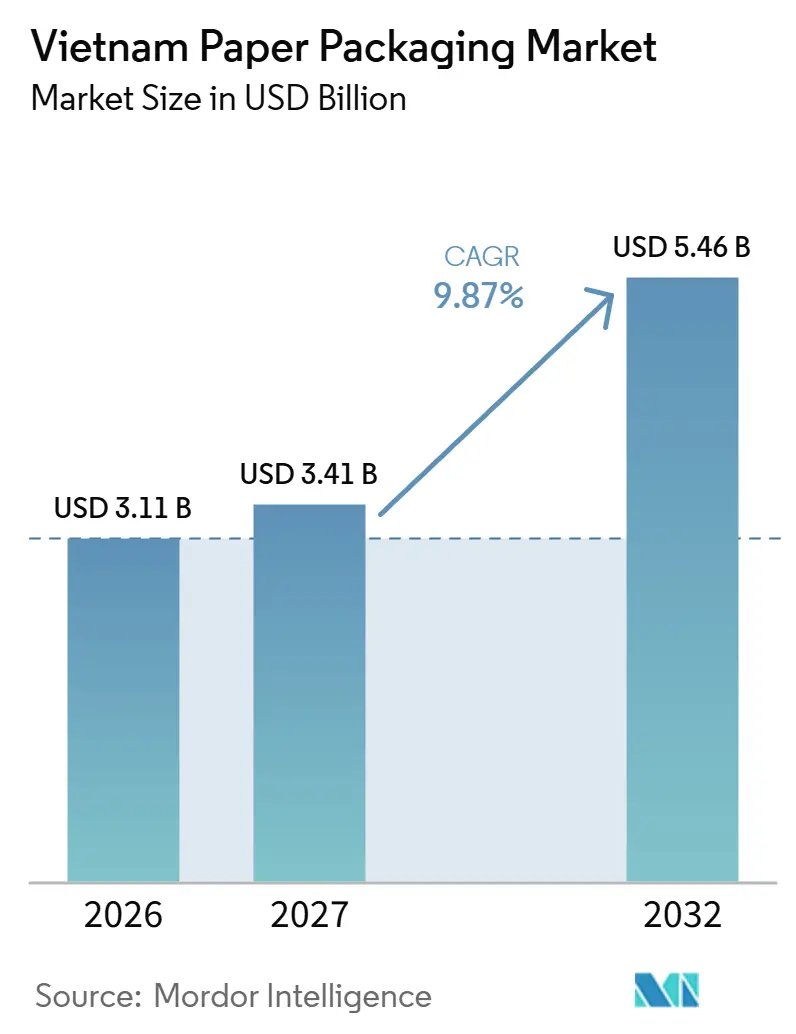
The Vietnam paper packaging market size was valued at USD 3.11 billion in 2026 and estimated to grow from USD 3.41 billion in 2027 to reach USD 5.46 billion by 2032, at a CAGR of 9.87% during the forecast period (2027-2032).
Expanding parcel and factory activity in Vietnam creates demand for protective cartons and for paper-based packaging used by food processors. Restrictions on single-use plastics and non-biodegradable packaging under Decree 08/2022 began in Vietnam in January 2026, opening selected retail and tourism applications for paper alternatives. Local carton-material supply for food and beverage producers and planned automation favor suppliers that combine paper supply with finished-pack execution. Fiber shortfalls and import-deposit obligations make the ability to supply and finance that production a constraint on capturing additional demand.
Key Report Takeaways
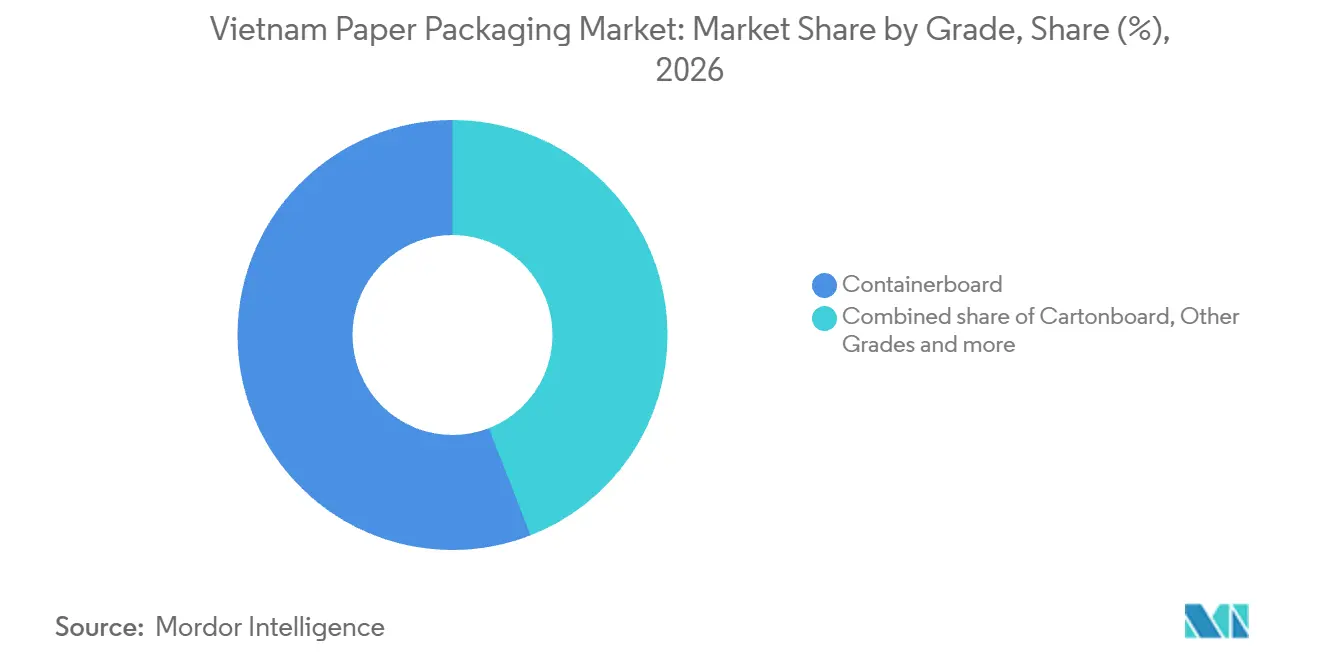
- By grade, containerboard held a 55.91% Vietnam paper packaging market share in 2026, while cartonboard is the fastest-growing segment at a CAGR of 11.37% during 2027-2032.
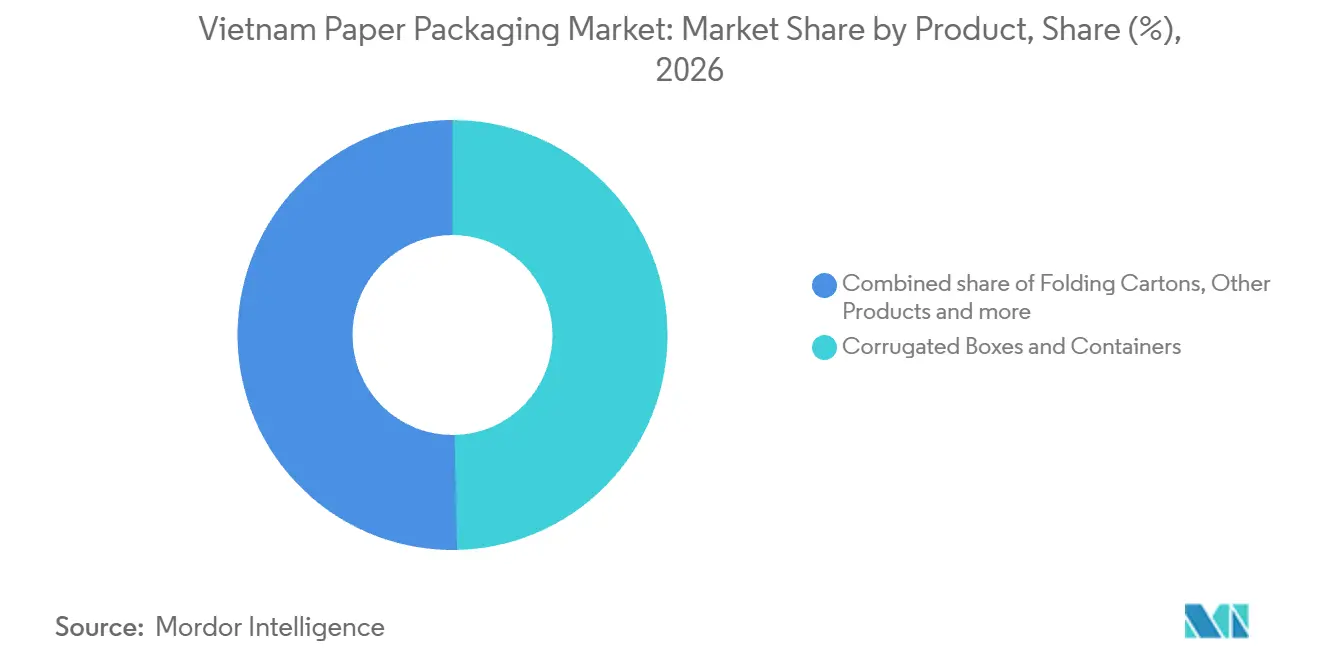
- Corrugated boxes and containers led the product mix with a 49.66% share of the Vietnam paper packaging market size in 2026, and folding cartons are forecast to grow fastest at a CAGR of 11.2% during 2027-2032.
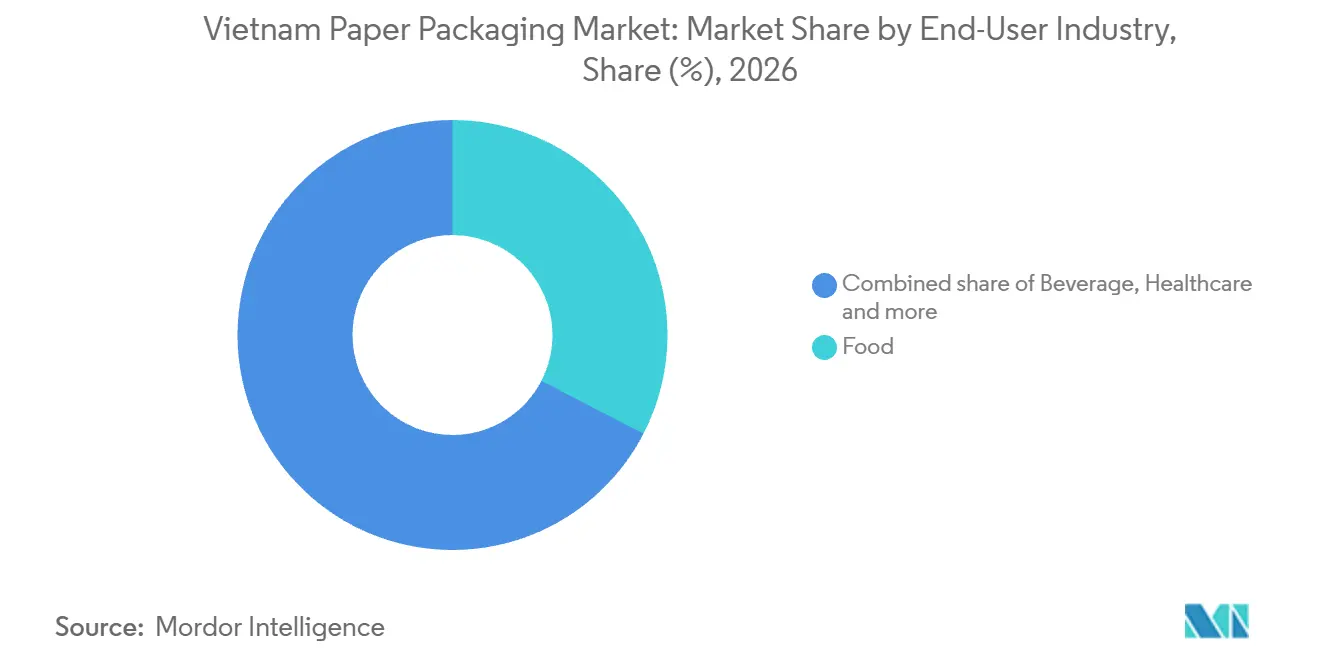
- Among end-user industries, food led with 32.59% of revenue in 2026, while healthcare is the fastest-growing segment at a CAGR of 10.3% during 2027-2032.
- By packaging format, rigid corrugated and solid board accounted for 50.31% of revenue in 2026, with molded fiber and pulp packaging products forecast to grow fastest at a CAGR of 12.05% during 2027-2032.
- Geographically, northern industrial parks surrounding Hanoi are the primary premium-kraft consumption hub, and Central Vietnam, led by Da Nang, forms a growth corridor.
Note: Market numbers in this report are based on Mordor Intelligence's proprietary estimation framework, which combines nine months of actuals with Q4 projections for base year 2026.
Market Trends and Insights
Drivers Impact Analysis of Vietnam Paper Packaging Market*
| Driver | (~) % Impact on CAGR Forecast | Geographic Relevance | Impact Timeline |
|---|---|---|---|
| Booming e-commerce parcel volumes | +4.6% | Nationwide | Short term (≤ 2 years) |
| Rapid FMCG and electronics off-shoring into Vietnam | +3.9% | Hai Phong and Tay Ninh manufacturing clusters | Medium term (2-4 years) |
| Plastic phase-out regulations | +2.5% | Nationwide | Short term (≤ 2 years) |
| Foreign brand owners’ Scope-3 carbon cuts push lightweight recycled board | +1% | Nationwide | Medium term (2-4 years) |
| Rise of social-commerce micro-fulfillment in tier-2 cities | +0.4% | Nationwide | Medium term (2-4 years) |
| Tax-incentivized investments in high-speed digital printing lines | +0.2% | Nationwide | Long term (≥ 4 years) |
| Source: Mordor Intelligence | |||
Booming e-commerce parcel volumes
Parcel growth gives paper converters a volume opportunity, while platform packing instructions help define the cartons that sellers need. Vietnam's postal-item volume rose from about 1 billion in 2020 to more than 4.2 billion in 2025, and goods parcels accounted for more than 90% of total postal volume.[1] TikTok Shop's August 21, 2026 Vietnam guidance directs sellers shipping specified general products, including soft goods and books, to wrap them, use suitable cartons, fill gaps, and seal the boxes. When products lack manufacturers' cartons, the guidance calls for strong cartons. These instructions connect a goods-dominated shipment flow with a defined packaging requirement, giving converters a route to repeat seller orders through cartons suited to the platform's protection requirements.
Rapid FMCG and electronics off-shoring into Vietnam
New production facilities enlarge the industrial buyer base for paper packaging, linking demand to factories as well as consumer spending. Vietnam's manufacturing industrial-production index was estimated to have risen 12.9% in January-September 2026 against the same period in 2025. LG Innotek's Vietnam subsidiary completed its V3 factory in Hai Phong and began operating it in September 2025, expanding camera-module capacity to more than twice its previous level. Coca-Cola Vietnam commissioned a USD 136 million beverage plant in Tay Ninh on July 11, 2025, with 5 filling and bottling lines and capacity of up to 1 billion liters annually. These operations create different opportunities for component protection and secondary beverage packaging. Converters earn that business by serving production-linked distribution flows, so packaging specifications and factory throughput determine how capacity expansion becomes orders.
Plastic phase-out regulations
Vietnam's January 2026 plastic-use restrictions under Decree 08/2022 create a specific substitution opening in retail and tourism. Provincial People's Committees must issue rules and implement restrictions on single-use plastic products and non-biodegradable plastic packaging at commercial centers, supermarkets, hotels, and tourist areas.[2] Products and goods with non-biodegradable plastic packaging are excepted from this venue restriction. The non-biodegradable packaging category includes plastic bags and foam food containers. With packaged goods excepted, the addressable substitution sits in the bags and foam food containers that venues hand out.
Foreign brand owners’ Scope-3 carbon cuts push lightweight recycled board
For foreign brand owners shipping electronics in corrugated boxes, Scope-3 reduction targets can shift packaging specifications toward lighter recycled board. That change would direct box orders toward converters able to combine reduced material use with the required protective structure. More orders for lightweight recycled boxes need not mean more fiber consumed per shipment, making demand for the finished packaging the relevant commercial opportunity.
Restraints Impact Analysis of Vietnam Paper Packaging Market*
| Restraint | (~) % Impact on CAGR Forecast | Geographic Relevance | Impact Timeline |
|---|---|---|---|
| Structural shortfall of domestic virgin fiber; import dependence | -1.3% | Nationwide | Long term (≥ 4 years) |
| Volatile recovered-paper import policy and quality controls | -0.9% | Nationwide | Medium term (2-4 years) |
| US/EU trade actions on wood products tighten pulpwood feedstock | -0.2% | Nationwide | Medium term (2-4 years) |
| Industrial power-tariff hikes squeeze SME corrugators | -0.3% | Nationwide | Short term (≤ 2 years) |
| Source: Mordor Intelligence | |||
Structural shortfall of domestic virgin fiber; import dependence
Virgin-fiber availability can constrain board expansion when downstream demand expands. In the first 9 months of 2025, Vietnam's paper industry produced 178,400 metric tons of virgin pulp against 653,491 metric tons consumed. Production fell 0.9% while consumption rose 30.9% year over year. This divergence exposes producers to external fiber supply when domestic output cannot meet their material requirements. In August 2026, VNT19 Joint Stock Company's Quang Ngai bleached-pulp project was over 95% complete, with annual design capacity of 350,000 metric tons and planned Q4 2026 operations, but a wastewater-outfall dispute impeded construction. The unfinished project leaves additional domestic fiber supply contingent on resolving construction obstacles, preserving the upstream constraint on board expansion.
Volatile recovered-paper import policy and quality controls
Import conditions constrain recycled-paper producers through both feedstock access and the cash committed before material becomes saleable packaging. From January 1, 2025, Vietnam limits facilities using imported scrap as production material to imports equal to at most 80% of designed capacity and requires the remaining 20% to be bought domestically. Companies importing waste paper for production must also deposit 15%, 18%, or 20% of shipment value, depending on category. Paper-industry businesses argued in July 2026 that lower deposits and shorter refund periods would improve cash flow. A mill cannot cover additional capacity with imported scrap alone, while deposits on eligible shipments reduce the funds available to finance the next increment of board supply.
*Our forecasts treat driver/restraint impacts as directional, not additive. The impact forecasts reflect baseline growth, mix effects, and variable interactions.
Vietnam Paper Packaging Market Segment Analysis
By Grade:
Recycled Fiber Anchors Containerboard ScaleContainerboard accounted for a 55.91% share of the Vietnam paper packaging market size in 2026, making it the largest segment. On August 6, 2025, Minhan Paper Joint Stock Company started up an ANDRITZ-supplied old corrugated container (OCC) line at its Van Lam mill in Hung Yen Province. The OCC line had a design capacity of 700 metric tons per day and processed American and local old corrugated containers for testliner and corrugated-medium production. That startup links the segment's production base to recovered-fiber preparation as well as the manufacture of defined board grades. Upstream board availability is the commercial gain, since testliner and corrugated medium feed corrugated converters' box-making.
Cartonboard is the fastest-growing segment, with a CAGR of 11.37% during 2027-2032. By July 2025, Tetra Pak's Binh Duong aseptic carton packaging-material factory had doubled capacity to over 30 billion units annually for Vietnam and regional markets. The local material supply gives Vietnamese food and beverage producers a domestic source for their aseptic-carton applications. Board demand follows the packaging those packers fill in Vietnam, which ties the opportunity to local filling operations rather than the factory's regional capacity.

By Product:
Automation and Retail Presentation Create Different OpportunitiesCorrugated boxes and containers represented a 49.66% Vietnam paper packaging market share in 2026, making them the largest segment. SCG Packaging Public Company Limited (SCGP) plans an expansion for corrugated packaging at Vina Kraft Paper Co., Ltd.'s Ho Chi Minh City facility. The project includes advanced automation, with commercial operations expected by September 2027. That automation emphasis makes production efficiency part of the segment's expansion case, alongside the availability of additional industrial boxes. The proposed facility would widen the local supply offering for buyers, while converters face an investment benchmark that combines box-making capacity with more automated execution.
Folding cartons are the fastest-growing segment, with a CAGR of 11.2% during 2027-2032. New Life Packaging Printing Company reports production capacity of 200,000 to 250,000 folding cartons per day in Vietnam. The product's growth case rests on the individual retail pack, where printed surfaces and a folded paperboard structure can contribute to product presentation. At that reported capacity scale, the opportunity extends beyond individual design jobs to repeated supplies of the same printed carton. Combining print and finishing within those runs offers converters a way to earn from pack execution as well as carton volume.
By End-User Industry:
Food Scale and Healthcare Packaging Shape DemandFood accounted for 32.59% of paper-packaging revenue in 2026, making it the largest segment. On July 2, 2025, Dong Giao Export Food Joint Stock Company, or Doveco, inaugurated Vietnam's first Swedish-technology paper-can line for fruit and vegetable processing in Son La.[3] The line had stated capacity of up to 6,000 cartons per hour and used paper-based packaging that extends shelf life without preservatives or refrigeration. For food processors, this makes packaging part of the preservation and distribution model, linking adoption to processed-product reach as well as the container itself. A processor's technology choice can extend paper packaging from outer shipping protection into the processed-product offering.
Healthcare is the fastest-growing segment, with a CAGR of 10.3% during 2027-2032. Vietnam's pharmaceutical market was about USD 7 billion in 2026, according to government reporting in August. SONG LAM Trading & Packaging Production Co., Ltd. (Song Lam Pack) manufactures paperboard folding cartons, cardboard boxes, leaflets, and labels for client categories that include medical and pharmaceutical brands in Vietnam. Supplying the carton and accompanying printed materials puts converters in a position to capture several components of each medicine's packaging order.
By Packaging Format:
Rigid Scale and Molded-Fiber Applications DivergeRigid packaging, including corrugated and solid board, held 50.31% of revenue in 2026, making it the largest segment. Ojitex (Vietnam) operates a corrugated-packaging plant network across Vietnam that includes the Long Thanh plant, giving the format a dedicated local production footprint. This installed infrastructure creates an industrial route from board to finished rigid packs, so challengers need converting capability in addition to access to paper materials. A multi-plant network offers buyers with several production locations a broader sourcing footprint than a single converting site.
Molded fiber and pulp packaging products are the fastest-growing segment, with a CAGR of 12.05% during 2027-2032. Stavian MP, a Stavian Pulp & Paper subsidiary, produces plant-based disposable tableware and food containers at its Hung Yen factory. Stavian Group lists annual capacity of 10,000 metric tons and commercial operation in 2024. Those food-container applications make the formed serving component the saleable product, placing the buyer's required shape at the center of the tooling decision. A repeatable food-container design defines an entrant's production commitment more precisely than access to pulp alone.
Geography Analysis
Northern industrial parks surrounding Hanoi Paper Packaging Market
Northern industrial parks surrounding Hanoi form the primary consumption hub for premium kraft grades, with proximity to the China border supporting component inflows. Capital Packaging, the trade name of Thu Do Packaging Joint Stock Company, has a rigid-box operation at Quang Minh Industrial Park in Hanoi. The buyer-side implication is an opportunity for protective packaging around component and industrial-goods flows, with material grade and finished-box execution forming related commercial tasks. The cluster offers separate commercial entry points for premium-board supply and finished boxes, allowing suppliers to develop each offering around its own buyer.
Central Vietnam Paper Packaging Market
Central Vietnam, led by Da Nang, represents a growth corridor as infrastructure connects north-south logistics routes. Bee Distribution Joint Stock Company opened a logistics center at Da Nang Hi-tech Park in March 2025, with designed annual throughput of 378,000 metric tons. The center provides cold storage, distribution facilities, and multipurpose warehousing, and its operator is a Bee Logistics Corporation subsidiary. Ojitex (Vietnam) separately operates a distribution branch in Central Vietnam as part of its corrugated-packaging network. An operating distribution presence gives paper converters a route to serve this corridor while warehousing and goods-handling infrastructure develops around its industrial users.
Elsewhere, regional positions reflect different combinations of paper production, box converting, and goods movement. In the Mekong Delta, Dong Hai Ben Tre produces industrial paper and carton packaging, while its Bao Bi Ben Tre subsidiary produces cartons in Giao Long, Vinh Long Province. Cai Mep General Port provides loading, unloading, storage, and transportation services through a multimodal chain serving the southern region. The Mekong Delta provides a production-and-conversion base, while Cai Mep serves goods movement, creating separate commercial roles in southern supply chains.
Regulatory Framework and Outlook
The comparison covers selected national and Hanoi rules from the perspective of a paper-packaging converter serving domestic commercial buyers. The Ministry of Agriculture and Environment administers national extended producer responsibility (EPR), while Hanoi's Department of Agriculture and Environment conducts environmental inspections. Decree 110/2026/NĐ-CP sets a minimum mass-based recycling rate of 20% for covered paper and carton commercial packaging of listed products, subject to statutory exemptions. These include specified export, temporary-import, re-export, research, education, testing, low-revenue, and qualifying same-producer recovery-and-reuse arrangements, making the buyer's regulated application important to the converter's offer.
Regulatory Table of Vietnam Paper Packaging Market
| Decision factor | Vietnam | Hanoi |
|---|---|---|
| Primary authority | Ministry of Agriculture and Environment for national EPR | Ministry of Agriculture and Environment for national EPR; Hanoi Department of Agriculture and Environment for environmental inspections |
| Key instruments or direction | Decree 110/2026/NĐ-CP for covered paper and carton commercial packaging | National EPR framework; Resolution 22/2025/NQ-HĐND's scheduled online-seller plastic measures |
| Commercial effect | Responsible producers and importers arrange recycling for covered packaging, subject to exemptions | From January 1, 2027, online sellers must reduce plastic packaging and cushioning or use take-back schemes |
| Current policy attractiveness | Medium | Medium |
| Future direction of policy attractiveness | Hardening | Hardening |
| Source: Mordor Intelligence | ||
Vietnam receives a Medium rating because the minimum recycling duty adds compliance work for responsible parties, while statutory exemptions bound its reach. Hanoi also rates Medium because its adopted January 1, 2027 measure requires online sellers to reduce plastic packaging and cushioning or use take-back schemes, creating a potential paper-substitution opening alongside other responses. Both directions are Hardening because national rates are scheduled to increase every 3 years from 2029, with each increase capped at 10%, while Hanoi adds its earlier buyer-side plastic measure.
Value Chain Stages
The value chain compares paper production, conversion, and final packing or distribution through their distinct sources of supplier revenue. Vina Kraft Paper Co., Ltd. supplies containerboard in linerboard and corrugated-medium grades, placing material specification at the start of this chain. Converting and finishing then create a different commercial proposition by turning board into a completed package. The distinction matters because material performance, print execution, and delivery handoffs place different demands on each supplier.
Value Chain Analysis Table of Vietnam Paper Packaging Market
| Primary activity | Key participants | Value capture | Bottleneck | Resilience response |
|---|---|---|---|---|
| Packaging-paper production | Containerboard producers such as Vina Kraft Paper Co., Ltd.; paper groups with Vietnam plants such as Lee & Man Paper Manufacturing Ltd. | Sales of packaging-paper grades | Matching board properties to converting requirements | Qualify alternative board specifications against the required performance |
| Printing, converting, and finishing | Corrugated converters such as Ojitex Vietnam; folding-carton printers and finishers such as MM Packaging Vidon | Converted-box and printed-carton sales; finishing services | Coordinating print and finishing steps | Qualify printing and finishing together before commercial runs |
| Contract packing and customer distribution | Contract packers such as Song Lam Pack; producers distributing their own packaging such as Ojitex Vietnam | Contract-packaging service fees; sales of converters' own packaging | Handoffs between finished packaging, packing, and delivery | Align packing release with the converter's delivery arrangement |
| Source: Mordor Intelligence | ||||
Material suppliers such as Vina Kraft earn from containerboard grades, while printing and finishing providers such as MM Packaging Vidon can capture revenue from completing the carton. Song Lam Pack's contract-packaging services extend that offering to the packing task, moving responsibility for the completed package further downstream. Combining these services lets a converter compete for a larger part of the finished-pack order, making execution across stages the basis for value capture beyond board sales.
Competitive Landscape
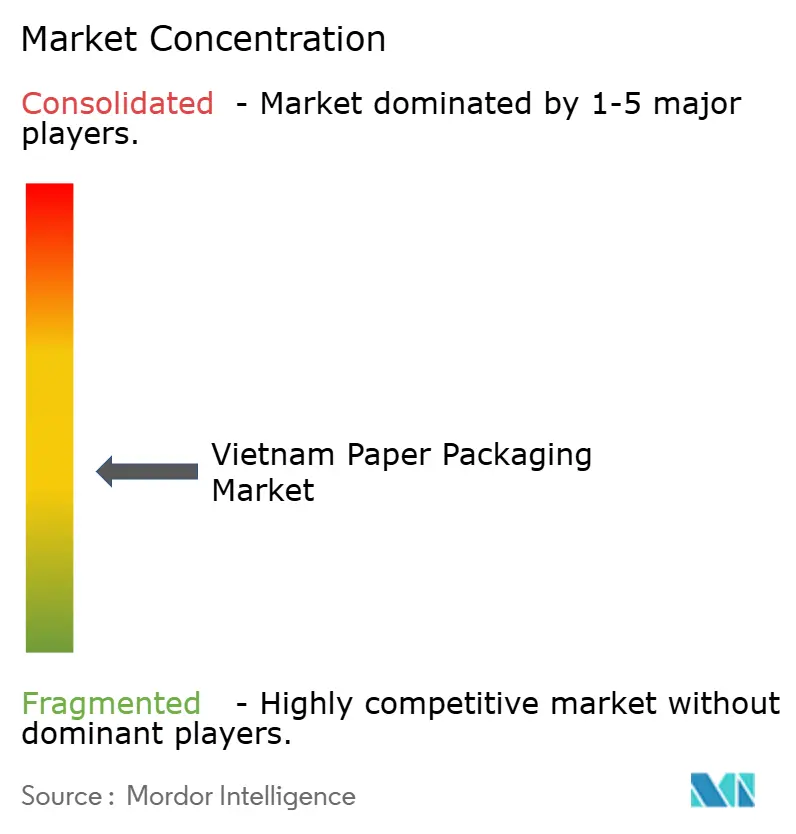
The moderately fragmented industry includes Starprint Vietnam Joint Stock Company, which supplies folding cartons and other paper packaging. Tetra Pak International S.A. is active in Vietnam through Tetra Pak Vietnam, which operates an aseptic-carton packaging-material factory in Binh Duong that supplies food and beverage producers. SCG Packaging Public Company Limited, Lee & Man Paper Manufacturing Ltd., and Oji Interpack Vietnam Co., Ltd. are also leading participants. In 2025, SCGP held 70% of Starprint Vietnam, linking 2 of these leading names through majority ownership. That link reduces the number of independent supplier groups represented by the leading names, tempering the fragmentation suggested by separate company identities.
Lee & Man Paper Manufacturing Ltd. pairs a paper plant in Hau Giang with a group range that includes kraft linerboard, coated duplex board, and corrugated paperboard. The group reported FY2025 group-wide packaging-paper sales volume of 6.46 million metric tons. Oji Interpack Vietnam Co., Ltd. supplies heavy-duty 3-layer cartons and has a fabricating operation in Hanoi. These roles separate potential upstream supply relationships from competition for the finished protective pack, and fabrication adds a commercial task beyond material provision for any converter that buys board and sells boxes.
Oji Liquid Pak, a project entity within OJI Group, broke ground for an aseptic-carton material plant in Dong Nai Province on October 10, 2026. The plant is under construction with planned capacity of up to 8 billion packs annually and first customer deliveries expected in the first half of 2028. The planned addition would broaden OJI Group's prospective Vietnam offering into aseptic-carton packaging material. Separately, under Decree 110/2026, effective May 25, 2026, the ordering party has recycling responsibility when a producer processes covered packaging for it. The expected 2028 delivery start places the new aseptic-material option beyond immediate supply decisions for food and beverage packers.
Vietnam Paper Packaging Industry Leaders
-
Starprint Vietnam Joint Stock Company
-
Tetra Pak International S.A.
-
SCG Packaging Public Company Limited
-
Lee & Man Paper Manufacturing Ltd.
-
Oji Interpack Vietnam Co., Ltd
- *Disclaimer: Major Players sorted in no particular order
Vietnam Paper Packaging Market Companies Covered in this Report
- SONG LAM Trading & Packaging Production CO., Ltd
- Asia Pulp & Paper Group (APP)
- Tetra Pak International S.A.
- Oji Interpack Vietnam Co., Ltd
- Khang Thanh Manufacturing CO., LTD
- Hanh Packaging Co. Ltd
- SCG Packaging Public Company Limited
- BINH MINH P.A.T CO.,LTD
- Kraft of Asia Paperboard & Packaging Co., Ltd.
- HC Packaging Vietnam Company Limited
- Starprint Vietnam Joint Stock Company
- Nippon Paper Industries Co., Ltd.
- Box-Pak (Malaysia) Bhd.
- Lee & Man Paper Manufacturing Ltd.
- Sai Gon Paper Corporation
- Dong Hai Ben Tre Joint Stock Company
- Nine Dragons Paper (Holdings) Limited
- Rengo Co., Ltd
Key Opportunities for Market Participants
The opportunities compare finished boxes, cartons, and paperboard inserts for electronics manufacturers using packaging in Vietnam. Murata Manufacturing Vietnam completed a Dong Nai production building for consumer-equipment and automotive coils in October 2026, with production-system setup and sequential operation to follow. Ninh Binh GDT Joint Stock Company broke ground on an electronic-equipment packaging-paper plant on June 7, 2026, with planned annual capacity of 360,000 tons for domestic and export markets. Its planned June 2028 operation would add a potential board-supply option for converters serving local electronics factories.
Market Opportunities Table of Vietnam Paper Packaging Market
| Opportunity | Why now | Buyer / lead segment | Recommended play | Main barrier | Likely beneficiaries |
|---|---|---|---|---|---|
| Domestic packaging-paper supply | Planned domestic supply from the Ninh Binh project | Domestic corrugated converters | Build direct material-sales relationships around the planned paper grades | Mill commissioning and acceptance of the new material | Ninh Binh GDT and domestic converters |
| Electronics-focused finished boxes | The planned paper supply explicitly targets electronic-equipment packaging | Electronic-equipment manufacturers | Pair paper production with a converter offering finished-box solutions | Adding converting capability to material supply | Converters serving electronics buyers |
| Export sales of packaging paper | The planned mill also targets export markets | Overseas packaging-paper converters | Develop an export customer channel for the planned grades | Export customer acceptance and dependence on commissioning | Ninh Binh GDT and export-oriented packaging suppliers |
| Source: Mordor Intelligence | |||||
Finished protective packaging for electronics factories is the central buyer opening, with the package sold into a Vietnamese packing operation. Converters can address that need independently of whether a future mill supplies their board. Linking the finished box to the component being packed makes application development the immediate commercial task, while the mill's planned commissioning limits when its materials could become available.
Recent Industry Developments in Vietnam Paper Packaging Market
- Oct 2026: Oji Liquid Pak broke ground for its aseptic-carton plant at Long Thanh High-tech Industrial Park in Dong Nai on October 10, with first customer deliveries expected in the first half of 2028.
- May 2026: SCG Packaging Public Company Limited announced a planned corrugated-container production base at Vina Kraft Paper Co., Ltd.'s Ho Chi Minh City site, with commercial operations expected in September 2027.
Vietnam Paper Packaging Market Report Scope and Research Methodology
Market Definition and Coverage
The Vietnam paper packaging market measures annual spending on paper and paperboard packaging products sold for use in Vietnam. These sales are classified by board grade, product, end-user industry, and packaging format.
Scope exclusions: Plastic, metal, and glass packaging, separately sold pulp, recovered paper, and other fiber or paper inputs, equipment and services used to manufacture packaging, and packaged goods and their sales are excluded.
Segments Covered in This Report
- By Grade
- Cartonboard
- Solid Bleached Sulphate (SBS)
- Solid Unbleached Sulphate (SUS)
- Folding Boxboard (FBB)
- Coated Recycled Board (CRB)
- Uncoated Recycled Board (URB)
- Other Cartonboard Grades
- Containerboard
- White-top Kraftliner
- Other Kraftliners
- White-top Testliner
- Other Testliners
- Semi-chemical Fluting
- Recycled Fluting
- Other Grades
- Cartonboard
- By Product
- Folding Cartons
- Corrugated Boxes and Containers
- Other Products
- By End-User Industry
- Food
- Beverage
- Healthcare
- Personal Care
- Household Care
- Electrical and Electronics
- Other End-User Industries
- By Packaging Format
- Rigid (Corrugated, Solid Board)
- Semi-rigid (Folding Cartons excluding Solid Board Boxes)
- Flexible Paper (Sachets, Wraps)
- Molded Fiber and Pulp Packaging Products
Data Sources, Market Sizing, and Validation
Desk Research
Desk research uses sources such as the Vietnam National Statistics Office's industry and trade releases to track manufacturing activity and price conditions, the Ministry of Industry and Trade's national e-commerce plan to frame parcel-related demand, the Vietnam Pulp and Paper Association's industry presentation to assess paper output, fiber supply and capacity, and the Ministry of Agriculture and Environment's report on Doveco's paper-can line to identify format and end-use developments. These sources support checks on packaging demand, product mix and upstream material availability within Vietnam.
Company annual reports and filings, investor materials, reputable business press and publicly documented plant announcements add producer-level evidence on sales, capacity, investment and customer applications, and these records are cross-checked against official activity and trade indicators before they inform the market view. These named sources are illustrative and are not exhaustive, and further sources inform collection, validation and clarification.
Primary Interviews and Surveys
Primary research consults Vietnam-based packaging producers, paperboard suppliers, converters, packaging buyers and industry specialists across company sizes and seniority. Interviews and structured questionnaires test secondary evidence on selling prices, product mix, utilization, material sourcing and buyer demand, while analysts reconcile divergent answers with company disclosures and national indicators. Analysts record and bound unresolved gaps with comparable company, channel and production evidence rather than filling them with unsupported assumptions.
Distribution of primary research fieldwork respondents
| Company type | Respondent position | Region |
|---|---|---|
| Top tier: 35% | CXOs: 20% | |
| Mid tier: 40% | Functional/Unit leaders: 35% | |
| Smaller Players: 25% | Managers: 45% |
Market-Sizing & Forecasting
A top-down estimate starts with annual producer revenue from paper and paperboard packaging sold for use in Vietnam, then checks the national total through selective roll-ups of supplier and converter activity and sampled selling price times volume. Key indicators include manufacturing output and shipments, online retail and parcel activity, packaging-paper and board production, recovered-fiber availability, and announced packaging capacity. Each helps explain demand, material supply, realized pricing or near-term production limits. Historical totals and observed segment mixes anchor shares by grade, product, buyer industry and format, with company product disclosures and application evidence used to allocate revenue among categories and a residual retained only where evidence does not support a finer split. Multivariate regression or scenario analysis can project demand against these drivers, with alternative cases for fiber constraints, investment timing and format substitution. Where local series or supplier coverage are incomplete, analysts use the closest Vietnam-specific official or company evidence, bound selective roll-ups and show the effect through bounded assumptions. Primary respondents review the choice and direction of forecast variables, pricing and capacity assumptions at the variable level, and analysts reconcile any disagreement to documented evidence.
Data Validation & Update Cycle
Analysts triangulate company disclosures, Vietnam production and trade signals, buyer demand indicators and the selective supplier roll-ups, then investigate inconsistencies in coverage, units, timing, price and volume before sign-off. A second review checks segment shares against the national total, tests unusual movements against independent market signals and returns material gaps or contradictory evidence for analyst review. Respondents are re-contacted when an answer changes the estimate materially or cannot be reconciled. The dataset is refreshed annually, updated between cycles after material policy, capacity or supply events, and given a fresh pre-delivery review.
Mordor Intelligence's Vietnam Paper Packaging Market Size Versus Other Published Estimates
The Vietnam paper packaging market measures annual spending on paper and paperboard packaging products sold for use in Vietnam. Key indicators include manufacturing output and shipments, online retail and parcel activity, packaging-paper and board production, recovered-fiber availability, and announced packaging capacity.
Key Gap Drivers are addressed through a consistent transaction boundary, market-specific demand inputs and cross-checks across the study. Analysts triangulate company disclosures, Vietnam production and trade signals, buyer demand indicators and the selective supplier roll-ups, then investigate inconsistencies in coverage, units, timing, price and volume before sign-off.
Benchmark comparison
| Source | Market Size | Gaps in Research Methodology |
|---|---|---|
| Mordor Intelligence | USD 3.41 B (2027) | |
| Global Consultancy A | USD 2.1 B (2025) | At its 2025 base, this estimate is 38.4% below this report's 2027 value of USD 3.4 B, 2 years later. |
| Regional Consultancy B | USD 2.65 B (2025) | At its 2025 base, this estimate is 22.3% below this report's 2027 value of USD 3.4 B, 2 years later. |
Mordor Intelligence ties the estimate to the study’s defined coverage and demand model. Analysts triangulate company disclosures, Vietnam production and trade signals, buyer demand indicators and the selective supplier roll-ups, then investigate inconsistencies in coverage, units, timing, price and volume before sign-off.
Key Questions Answered in the Report
What is the Vietnam paper packaging market size and growth outlook?
The size was USD 3.11 billion in 2026 and is estimated to grow from USD 3.41 billion in 2027 to USD 5.46 billion by 2032, at a CAGR of 9.87% during 2027-2032.
What is driving demand for paper packaging in Vietnam?
Vietnam's postal volume exceeded 4.2 billion items in 2025, with goods parcels accounting for more than 90% of the total. Factory expansion and January 2026 plastic-use restrictions also support demand.
Which product type leads the paper-packaging industry?
Corrugated boxes and containers led with 49.66% of revenue in 2026. Folding cartons are forecast to grow fastest at a CAGR of 11.2% during 2027-2032.
Which companies compete in Vietnam's paper-packaging sector?
Leading participants include Starprint Vietnam Joint Stock Company, Tetra Pak International S.A., SCG Packaging Public Company Limited, Lee & Man Paper Manufacturing Ltd., and Oji Interpack Vietnam Co., Ltd.
What is the main supply challenge for paper-packaging producers?
Vietnam's paper industry produced 178,400 metric tons of virgin pulp against 653,491 metric tons consumed in the first 9 months of 2025, exposing board producers to an upstream domestic-fiber imbalance.
Where are the principal paper-packaging opportunities within Vietnam?
Northern industrial parks surrounding Hanoi are the primary consumption hub for premium kraft grades. Central Vietnam, led by Da Nang, forms a growth corridor.