
Pecan Market Size and Share
Pecan Market Analysis by Mordor Intelligence
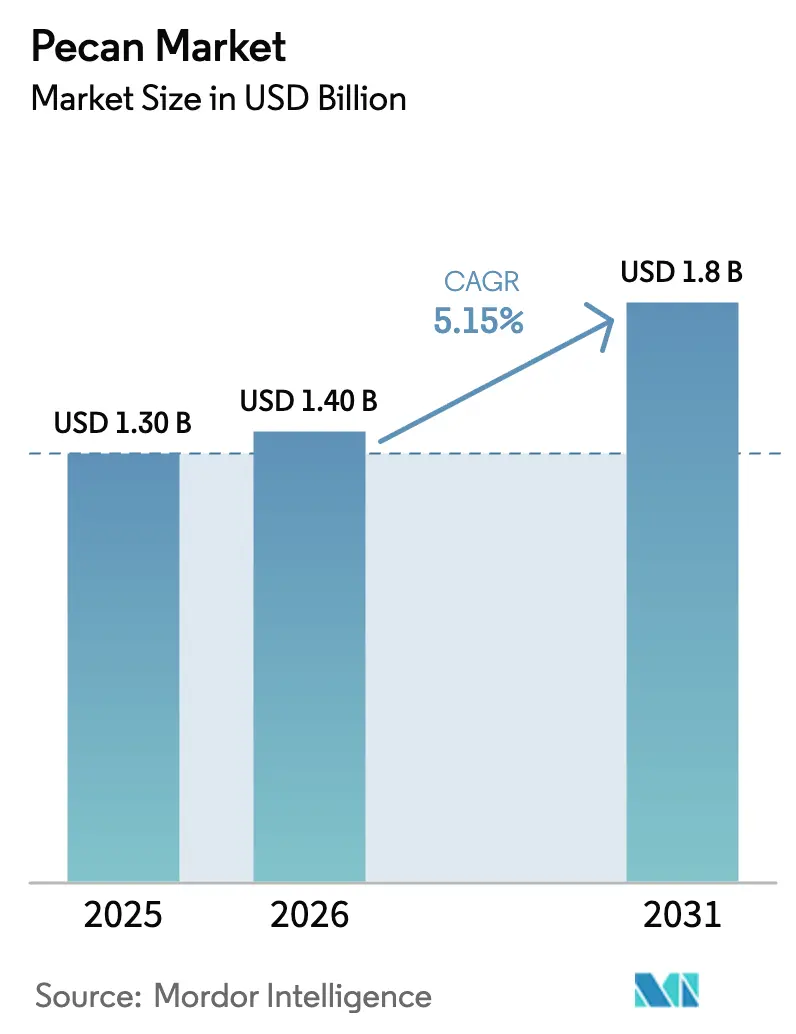
The pecan market size was valued at USD 1.3 billion in 2025 and estimated to grow from USD 1.4 billion in 2026 to reach USD 1.8 billion by 2031, at a CAGR of 5.15% during the forecast period (2026-2031). Demand momentum is driven by four key factors, including the growing adoption of plant-based proteins, strong foodservice growth in the Asia-Pacific region, noticeable changes in global trade routes, and continuous innovation in value-added applications. Production swings tied to alternate-bearing cycles are prompting processors to secure multi-year contracts during bumper seasons, a strategy that can lock in raw material costs and stabilize downstream pricing. Buyers in China, India, and Japan are increasingly valuing year-round supply assurance over traditional country-of-origin loyalty, creating opportunities for counter-seasonal harvests from countries such as South Africa and Australia to capture market share. The 2025 Dietary Guidelines Advisory Committee has prioritized nuts and seeds as a key component of protein recommendations. This development is projected to impact institutional foodservice procurement and retail assortment decisions, supported by favorable regulatory guidance.
Key Report Takeaways
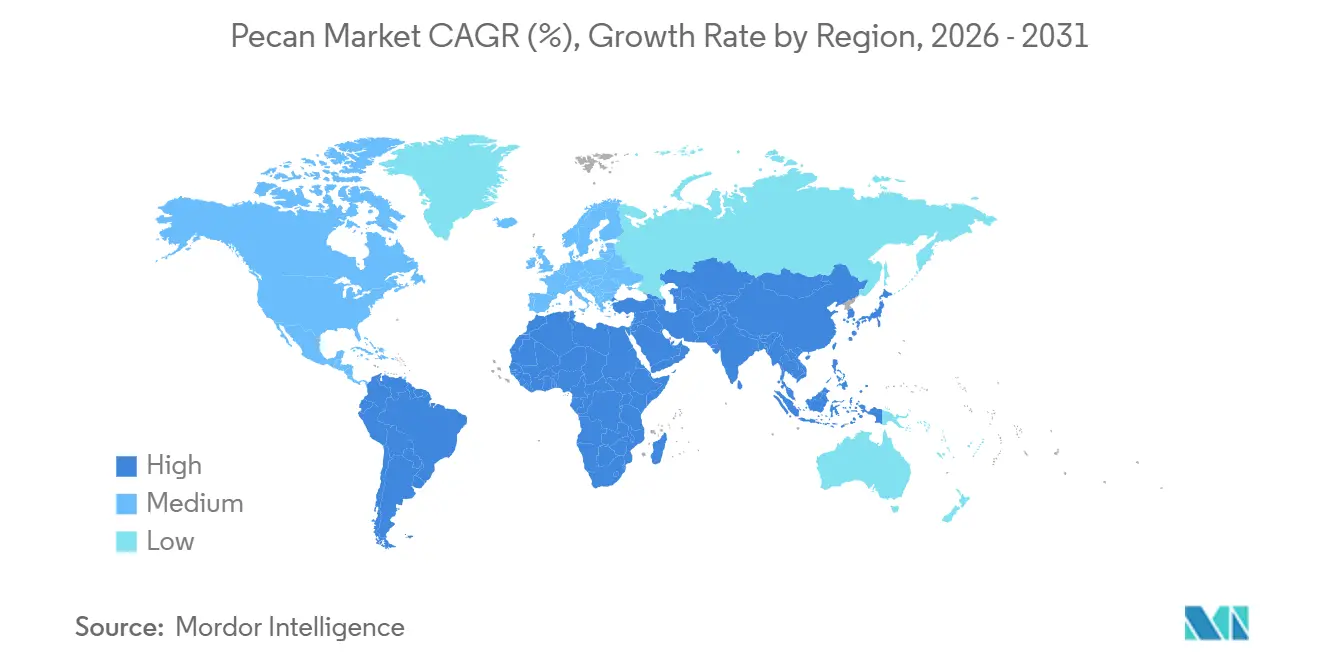
- By geography, North America led with a 53% pecan market share in 2025, while the Asia-Pacific region is forecast to expand at a 7.8% CAGR through 2031.
Note: Market size and forecast figures in this report are generated using Mordor Intelligence’s proprietary estimation framework, updated with the latest available data and insights as of January 2026.
Market Trends and Insights
Drivers Impact Analysis of Pecan Market*
| Driver | (~) % Impact on CAGR Forecast | Geographic Relevance | Impact Timeline |
|---|---|---|---|
| Rising health-driven snacking and protein demand | +1.2% | Global, with strongest uptake in North America and Asia-Pacific urban centers | Medium term (2-4 years) |
| Growing use in bakery and confectionery applications | +0.9% | North America and Europe, expanding into Asia-Pacific premium segments | Short term (≤ 2 years) |
| Surge in plant-based dairy and snack launches | +0.8% | North America and Europe core markets, with Asia-Pacific emerging adoption | Medium term (2-4 years) |
| Expanding consumption in Asia-Pacific foodservice chains | +1.3% | Asia-Pacific core, with spillover into Middle East hospitality sectors | Long term (≥ 4 years) |
| Up-cycling of pecan press-cake into high-protein inputs | +0.4% | North America production hubs, with export potential to Europe and Asia | Long term (≥ 4 years) |
| Carbon-credit potential of pecan agro-forestry orchards | +0.3% | Global, with early adoption in United States, Australia, and South Africa | Long term (≥ 4 years) |
| Source: Mordor Intelligence | |||


Rising Health-Driven Snacking and Protein Demand
Protein-centric snacking has moved firmly into the mainstream, and the pecan market benefits because a 28-gram serving delivers 2.6 grams of protein and 3 grams of fiber while maintaining a favorable unsaturated fat profile. The 2025 Dietary Guidelines Advisory Committee elevated nuts within protein food groups, which directly shapes school lunch menus, hospital contracts, and corporate wellness programs [1]Source: United States Department of Agriculture, “Dietary Guidelines for Americans, 2025,” USDA.gov. Institutional volume commitments offer a steadier demand base than retail promotions, which tend to spike during holiday gift-giving periods. The challenge remains low consumer top-of-mind awareness relative to almonds, which underscores the need for broader category marketing backed by consistent supply.
Growing Use in Bakery and Confectionery Applications
Moisture retention and high oil content enable pecans to maintain a desirable mouthfeel in cookies and brownies, allowing formulators to reduce added fats. The July 2024 United States Department of Agriculture grade standard update introduced granular size specifications that enable bakers to source exact kernel dimensions, thereby minimizing processing waste and supporting premium positioning [2]Source: United States Department of Agriculture, Agricultural Marketing Service, “United States Standards for Grades of Pecans in the Shell,” AMS.USDA.gov. Yet production volatility creates procurement risk, so large food manufacturers hedge with futures contracts or blend formulations with almonds during tight supply seasons.
Surge in Plant-Based Dairy and Snack Launches
Pecan milk and pecan-based cream cheese offer a rich flavor without the use of stabilizer gums, addressing taste concerns that have hindered the development of other nut-based beverages. Water-use comparisons favor pecans over almonds, reinforcing sustainability claims. Retail trial rates remain modest, so brands lean on joint promotions with pecan industry associations to secure shelf placements. Investment flows continue because pecan protein concentrates offer a clean-label path to enhance nutrition panels in bars and smoothies without imparting soy or pea-like taste notes.
Expanding Consumption in Asia-Pacific Foodservice Chains
Premium bakeries and coffee shops across China, India, and Japan now feature pecans as indicators of Western indulgence. American Pecan Council trade data confirm that Chinese importers shifted roughly 75% of 2024 procurement to South African origins, underscoring a supply-first rather than loyalty-first mindset. Foodservice exposure builds consumer familiarity, which then pulls retail volume, cementing the pecan market in the region.
Restraints Impact Analysis of Pecan Market*
| Restraint | (~) % Impact on CAGR Forecast | Geographic Relevance | Impact Timeline |
|---|---|---|---|
| Weather-driven price volatility | -0.7% | Global, with acute impacts in United States Gulf Coast and Mexico production zones | Short term (≤ 2 years) |
| Marketing spend gap versus almonds and walnuts | -0.5% | Global, most pronounced in Asia-Pacific and Europe where brand awareness lags | Medium term (2-4 years) |
| Skilled-labor shortages at peak harvest | -0.4% | North America and Australia, with mechanization adoption lagging in smaller orchards | Short term (≤ 2 years) |
| Fungicide-resistant pecan-scab outbreaks | -0.3% | Southeastern United States and humid subtropical growing regions | Medium term (2-4 years) |
| Source: Mordor Intelligence | |||
Weather-Driven Price Volatility
The United States Department of Agriculture (USDA) forecasts indicate that production is projected to increase from 500.3 thousand metric tons in 2024 to 1,088.6 thousand metric tons in 2025, exemplifying the alternate-bearing cycle. Such surges depress prices and test cold-storage capacity, while adverse events, such as hurricanes, can cut output in half the following season. Buyers react by diversifying supply across hemispheres and using short-term contracts, which fragments producer relationships.
Marketing Spend Gap Versus Almonds and Walnuts
The Almond Board of California and California Walnut Commission operate multimillion-dollar advertising programs. By comparison, fragmented pecan growers lack a unified fund, so category share of voice remains thin on social media, in nutrition research sponsorships, and at retail merchandising. Limited consumer exposure restricts trial and repeat purchases, especially in Europe and Asia-Pacific, where nuts other than almonds remain niche.
*Our forecasts treat driver/restraint impacts as directional, not additive. The impact forecasts reflect baseline growth, mix effects, and variable interactions.
Geography Analysis
North America Pecan Market
North America retained 53% of the pecan market share in 2025, anchored by the United States and Mexico, yet producers face heightened production volatility and higher labor costs. Data from the United States Department of Agriculture (USDA) indicate that the pecan market size in the region can double during on-years and decrease during off-years, creating challenges for inventory planning. Mexico augments supply with counter-cyclical bearing in northern orchards, but both countries lost share in China as importers shifted toward South African origin.
APAC and Europe Pecan Market
Asia-Pacific is the fastest-expanding region, registering a 7.8% CAGR through 2031. China remains the primary demand engine, even after shifting 75% of its 2024 purchases to South African suppliers. Australia’s expanding orchards are positioned to satisfy rising demand in nearby Asian markets, where premium bakery chains and specialty cafes showcase pecans as aspirational ingredients. India and Japan follow, driven by urban middle-class consumers experimenting with Western desserts. Europe sustains steady usage, concentrated in Germany, France, Spain, and Italy, where pecans serve as inclusions in bakery and confectionery products. Importers favor certified organic and sustainability-audited shipments to satisfy retailer requirements.
MEA and South America Pecan Market
South Africa’s competitive prices gained footing in 2024 and 2025, challenging long-established North American supply dominance. Brazil and Argentina have seen higher bakery incorporation, but tariffs and currency volatility limit large-scale imports. The Middle East, led by the United Arab Emirates and Saudi Arabia, leverages hospitality demand in five-star hotels. South Africa plays a dual role as both producer and exporter, channeling its output into Asia while domestic uptake remains limited.

Regulatory Landscape
Regulation affecting pecans is centered on quality grading, federal and state marketing orders, and food safety controls across processing and export. In the United States, USDA Agricultural Marketing Service (AMS) updated the voluntary U.S. Grade Standards for pecans effective July 26, 2024, introducing revised grade definitions, including U.S. Extra Fancy, U.S. Fancy, U.S. Choice, and U.S. Standard, along with more granular specifications that help standardize trade and buyer contracts for bakery and confectionery use.
Industry governance and market facilitation also run through marketing orders and buyer-driven compliance. The federal Marketing Order 986 (administered via the American Pecan Council and overseen by USDA) provides authority for handling regulations and minimum quality tolerances, while exporters commonly rely on USDA Foreign Agricultural Service (FAS) FAIRS/GAIN resources to manage destination-market requirements such as MRLs and certification. On food safety, FDA FSMA remains the primary US framework, with produce-safety rule nuances for commodities deemed rarely consumed raw. That shifts more reliance to third-party audits, such as SQF and Primus, to meet retailer and food manufacturer requirements.
Value Chain Analysis
The pecan value chain runs from orchard establishment and crop inputs (nursery trees, fertilizers, irrigation systems, and crop protection) through cultivation and harvest, then primary handling, in-shell cleaning, shelling and cracking, sizing and optical sorting, cold storage, packaging, and distribution into retail, food manufacturing, and foodservice channels. Processor-handlers anchor throughput and quality consistency, with APC-registered handlers including integrated operators such as South Georgia Pecan Company and National Pecan Company, alongside cooperatives and farm-based handlers that feed regional processors.
Bottlenecks cluster around harvest labor, processing capacity, and weather-related disruption, which can damage orchards and local logistics and strain cold storage during high-crop years. The US and Mexico form a tightly linked supply chain, with Mexico serving as an important shelling hub for US pecans, supported by proximity and labor economics, before product moves back into US distribution and manufacturing. Volatility tied to alternate-bearing cycles and tighter uncommitted stocks in late 2025 have reinforced multi-year contracting between growers and processors. Partnerships such as the April 2024 Pecan Nation and South Georgia Pecan Company alliance also point to tighter integration to secure supply, meet updated grade and defect tolerances, and expand value-added snacking formats.
Competitive Landscape
Pecan processors control global throughput. South Georgia Pecan Company, National Pecan, and Golden Kernel run fully integrated systems that span orchards, cracking, shelling, and distribution, enabling continuous investment in optical sorting, cold storage, and traceability technology. Their scale advantage became apparent in April 2024, when Pecan Nation partnered with South Georgia Pecan Company to secure a long-term supply and expand branded snacking lines to 15,000 retail outlets [3]Source: Pecan Nation, “Partnership Announcement with South Georgia Pecan Company,” PecanNation.com. Integrated players also leverage multi-year grower contracts that stabilize farm income and ensure a steady supply of kernels during off-crop years. These strategies allow leading firms to absorb weather-driven volume shocks while defending shelf space against lower-cost imports.
Smaller shellers often depend on manual grading, which limits both throughput and consistency in quality. In 2024, the United States Department of Agriculture introduced stricter defect tolerances in its grade update, compelling processors to adopt precision optical scanners to meet the demands of bakery and confectionery buyers requiring precise kernel dimensions. Access to capital has become a critical factor for mid-tier companies to comply with these standards, driving mergers that consolidate orchards and processing operations into larger, integrated supply chains. In March 2024, several United States processors announced the installation of new automated cracking lines, indicating a consolidation trend favoring companies capable of spreading equipment costs over higher production volumes.
Southern Hemisphere entrants are rewriting trade dynamics. South African exporters deliver counter-seasonal supplies that help Asian buyers smooth their inventory, and Australia follows a similar model on a smaller scale, focusing on premium bakery chains in Japan and Singapore. Large ingredient purchasers now issue annual tenders that blend Northern and Southern Hemisphere origins, cutting the risk of weather-related gaps while pressuring North American incumbents on price. In response, integrated processors in the United States extend grower contracts beyond five years and expand cold storage, allowing excess crops to move into off-season windows, which helps them retain key accounts despite rising import competition.
Market Opportunities and Future Outlook
Opportunities center on shifting pecans from seasonal holiday demand toward year-round, value-added consumption, and on building more resilient, specification-driven supply for Asia-Pacific importers. Branded innovation and broader retail placement provide concrete whitespace signals, including Diamond of California launching dedicated pecan snacking with Snack Pecans (June 2025) and Pecana expanding pecan-milk distribution to nearly 4,500 stores (November 2025), supported by ongoing product development such as PKN JOY Barista pecanmilk (November 2024). These moves track the market shift toward snack-ready kernels, plant-based dairy, and ingredient formats designed for repeat purchase.
On the supply side, the 2024 USDA AMS grade-standard update has raised the value of consistent sizing, defect control, and traceability, accelerating adoption of optical sorting and investment in cold storage to manage alternate-bearing swings and improve export timing. Southern Hemisphere growth provides another pathway for steadier supply windows, with South Africa expanding its role in Asian procurement and China redirecting a large share of sourcing toward South African origin in 2024, reinforcing demand for counter-seasonal availability and blended-origin tenders. Processing and R&D capacity improvements also create execution avenues, including industry expansion projects, for example, Mascot Inc. adding space and per-shift capacity in Georgia in June 2026, and applied research, including the University of Georgia College of Engineering collaboration with USDA-ARS and Fort Valley State University (February 2026), aimed at using AI in shelling to improve kernel yields.
Recent Industry Developments in Pecan Market
- July 2026: The Creel Family announced a USD 50 million plan for a 70,000-square-foot pecan shelling and distribution facility in Colorado Springs, Colorado. The project broadens US processing geography beyond traditional pecan belts and adds a new logistics node aimed at value-added throughput and distribution scale.
- November 2025: Pecana Milk expanded national retail distribution to nearly 4,500 stores, including Walmart, Sprouts, and Natural Grocers. The rollout strengthens pecan utilization in plant-based beverages and supports more consistent, year-round demand beyond seasonal baking cycles.
- April 2024: Pecan Nation partnered with South Georgia Pecan Company to secure long-term supply and expand branded pecan snacking distribution to 15,000 retail outlets. The arrangement tightens vertical coordination between processing scale and brand commercialization, supporting quality consistency and supply assurance during off-crop years.


Pecan Market Report Scope and Research Methodology
Market Definition and Coverage
For this methodology, the pecan market covers the value of pecans sold for consumption across in-shell and shelled formats, moving through food manufacturing, retail, and foodservice channels in major producing and importing regions.
Scope exclusions: We do not count pecan-derived oils or flours, and we also exclude blended nut mixes where pecan is not the main ingredient.
Segments Covered in This Report
- By Geography
- North America
- United States
- Production Analysis (Area Harvested, Yield, and Production Volume)
- Consumption Analysis (Consumption Value and Volume)
- Import Market Analysis (Import Value, Volume, and Key Supplying Markets)
- Export Market Analysis (Export Value, Volume, and Key Destination Markets)
- Wholesale Price Trend Analysis and Forecast
- Regulatory Framework
- List of Key Players
- Logistics and Infrastructure
- Seasonality Analysis
- Canada
- Production Analysis (Area Harvested, Yield, and Production Volume)
- Consumption Analysis (Consumption Value and Volume)
- Import Market Analysis (Import Value, Volume, and Key Supplying Markets)
- Export Market Analysis (Export Value, Volume, and Key Destination Markets)
- Wholesale Price Trend Analysis and Forecast
- Regulatory Framework
- List of Key Players
- Logistic and Infrastructure
- Seasonality Analysis
- Mexico
- Production Analysis (Area Harvested, Yield, and Production Volume)
- Consumption Analysis (Consumption Value and Volume)
- Import Market Analysis (Import Value, Volume, and Key Supplying Markets)
- Export Market Analysis (Export Value, Volume, and Key Destination Markets)
- Wholesale Price Trend Analysis and Forecast
- Regulatory Framework
- List of Key Players
- Logistic and Infrastructure
- Seasonality Analysis
- United States
- Europe
- Russia
- Production Analysis (Area Harvested, Yield, and Production Volume)
- Consumption Analysis (Consumption Value and Volume)
- Import Market Analysis (Import Value, Volume, and Key Supplying Markets)
- Export Market Analysis (Export Value, Volume, and Key Destination Markets)
- Wholesale Price Trend Analysis and Forecast
- Regulatory Framework
- List of Key Players
- Logistic and Infrastructure
- Seasonality Analysis
- Germany
- Production Analysis (Area Harvested, Yield, and Production Volume)
- Consumption Analysis (Consumption Value and Volume)
- Import Market Analysis (Import Value, Volume, and Key Supplying Markets)
- Export Market Analysis (Export Value, Volume, and Key Destination Markets)
- Wholesale Price Trend Analysis and Forecast
- Regulatory Framework
- List of Key Players
- Logistic and Infrastructure
- Seasonality Analysis
- Italy
- Production Analysis (Area Harvested, Yield, and Production Volume)
- Consumption Analysis (Consumption Value and Volume)
- Import Market Analysis (Import Value, Volume, and Key Supplying Markets)
- Export Market Analysis (Export Value, Volume, and Key Destination Markets)
- Wholesale Price Trend Analysis and Forecast
- Regulatory Framework
- List of Key Players
- Logistic and Infrastructure
- Seasonality Analysis
- Spain
- Production Analysis (Area Harvested, Yield, and Production Volume)
- Consumption Analysis (Consumption Value and Volume)
- Import Market Analysis (Import Value, Volume, and Key Supplying Markets)
- Export Market Analysis (Export Value, Volume, and Key Destination Markets)
- Wholesale Price Trend Analysis and Forecast
- Regulatory Framework
- List of Key Players
- Logistic and Infrastructure
- Seasonality Analysis
- France
- Production Analysis (Area Harvested, Yield, and Production Volume)
- Consumption Analysis (Consumption Value and Volume)
- Import Market Analysis (Import Value, Volume, and Key Supplying Markets)
- Export Market Analysis (Export Value, Volume, and Key Destination Markets)
- Wholesale Price Trend Analysis and Forecast
- Regulatory Framework
- List of Key Players
- Logistic and Infrastructure
- Seasonality Analysis
- Russia
- Asia-Pacific
- China
- Production Analysis (Area Harvested, Yield, and Production Volume)
- Consumption Analysis (Consumption Value and Volume)
- Import Market Analysis (Import Value, Volume, and Key Supplying Markets)
- Export Market Analysis (Export Value, Volume, and Key Destination Markets)
- Wholesale Price Trend Analysis and Forecast
- Regulatory Framework
- List of Key Players
- Logistic and Infrastructure
- Seasonality Analysis
- India
- Production Analysis (Area Harvested, Yield, and Production Volume)
- Consumption Analysis (Consumption Value and Volume)
- Import Market Analysis (Import Value, Volume, and Key Supplying Markets)
- Export Market Analysis (Export Value, Volume, and Key Destination Markets)
- Wholesale Price Trend Analysis and Forecast
- Regulatory Framework
- List of Key Players
- Logistic and Infrastructure
- Seasonality Analysis
- Japan
- Production Analysis (Area Harvested, Yield, and Production Volume)
- Consumption Analysis (Consumption Value and Volume)
- Import Market Analysis (Import Value, Volume, and Key Supplying Markets)
- Export Market Analysis (Export Value, Volume, and Key Destination Markets)
- Wholesale Price Trend Analysis and Forecast
- Regulatory Framework
- List of Key Players
- Logistics and Infrastructure
- Seasonality Analysis
- Australia
- Production Analysis (Area Harvested, Yield, and Production Volume)
- Consumption Analysis (Consumption Value and Volume)
- Import Market Analysis (Import Value, Volume, and Key Supplying Markets)
- Export Market Analysis (Export Value, Volume, and Key Destination Markets)
- Wholesale Price Trend Analysis and Forecast
- Regulatory Framework
- List of Key Players
- Logistics and Infrastructure
- Seasonality Analysis
- China
- South America
- Brazil
- Production Analysis (Area Harvested, Yield, and Production Volume)
- Consumption Analysis (Consumption Value and Volume)
- Import Market Analysis (Import Value, Volume, and Key Supplying Markets)
- Export Market Analysis (Export Value, Volume, and Key Destination Markets)
- Wholesale Price Trend Analysis and Forecast
- Regulatory Framework
- List of Key Players
- Logistics and Infrastructure
- Seasonality Analysis
- Argentina
- Production Analysis (Area Harvested, Yield, and Production Volume)
- Consumption Analysis (Consumption Value and Volume)
- Import Market Analysis (Import Value, Volume, and Key Supplying Markets)
- Export Market Analysis (Export Value, Volume, and Key Destination Markets)
- Wholesale Price Trend Analysis and Forecast
- Regulatory Framework
- List of Key Players
- Logistics and Infrastructure
- Seasonality Analysis
- Brazil
- Middle East
- Israel
- Production Analysis (Area Harvested, Yield, and Production Volume)
- Consumption Analysis (Consumption Value and Volume)
- Import Market Analysis (Import Value, Volume, and Key Supplying Markets)
- Export Market Analysis (Export Value, Volume, and Key Destination Markets)
- Wholesale Price Trend Analysis and Forecast
- Regulatory Framework
- List of Key Players
- Logistics and Infrastructure
- Seasonality Analysis
- Saudi Arabia
- Production Analysis (Area Harvested, Yield, and Production Volume)
- Consumption Analysis (Consumption Value and Volume)
- Import Market Analysis (Import Value, Volume, and Key Supplying Markets)
- Export Market Analysis (Export Value, Volume, and Key Destination Markets)
- Wholesale Price Trend Analysis and Forecast
- Regulatory Framework
- List of Key Players
- Logistics and Infrastructure
- Seasonality Analysis
- United Arab Emirates
- Production Analysis (Area Harvested, Yield, and Production Volume)
- Consumption Analysis (Consumption Value and Volume)
- Import Market Analysis (Import Value, Volume, and Key Supplying Markets)
- Export Market Analysis (Export Value, Volume, and Key Destination Markets)
- Wholesale Price Trend Analysis and Forecast
- Regulatory Framework
- List of Key Players
- Logistics and Infrastructure
- Seasonality Analysis
- Israel
- Africa
- South Africa
- Production Analysis (Area Harvested, Yield, and Production Volume)
- Consumption Analysis (Consumption Value and Volume)
- Import Market Analysis (Import Value, Volume, and Key Supplying Markets)
- Export Market Analysis (Export Value, Volume, and Key Destination Markets)
- Wholesale Price Trend Analysis and Forecast
- Regulatory Framework
- List of Key Players
- Logistics and Infrastructure
- Seasonality Analysis
- Egypt
- Production Analysis (Area Harvested, Yield, and Production Volume)
- Consumption Analysis (Consumption Value and Volume)
- Import Market Analysis (Import Value, Volume, and Key Supplying Markets)
- Export Market Analysis (Export Value, Volume, and Key Destination Markets)
- Wholesale Price Trend Analysis and Forecast
- Regulatory Framework
- List of Key Players
- Logistics and Infrastructure
- Seasonality Analysis
- South Africa
- North America
Data Sources, Market Sizing, and Validation
Desk Research
Desk work starts by building the supply and trade picture, since pecans are a crop with visible production seasonality and export flows. We referenced public sources such as USDA National Agricultural Statistics Service and USDA Foreign Agricultural Service, plus UN Comtrade for trade patterns and HS-code direction checks.
To avoid over-relying on one dataset, we cross-checked directionally with sources such as FAOSTAT, U.S. Census Bureau trade releases, and food and agriculture publications from universities and extension programs that track orchard yields and pest pressure. Company annual reports, investor decks, and credible press were used to understand capacity additions, pricing commentary, and channel mix (retail packs versus ingredient demand). Where needed, we also used paid subscriptions for company financial intelligence, shipment-level import and export checks, and patent databases to validate processing and product innovation activity. The sources listed here are illustrative only, and many other public documents were also used for data collection, validation, and clarification.
Primary Interviews and Surveys
Primary work was used to tighten the conversion from crop and trade signals into market value, especially where grades, shelling yields, and contract pricing can change realized revenue. Interviews covered growers, processors, traders, ingredient buyers, and retail channel participants across key producing and consuming regions. The takeaways were then used to confirm assumptions and adjust outliers observed in desk-based data.
Distribution of primary research fieldwork respondents
| Company type | Respondent position | Region |
|---|---|---|
| Top tier: 29% | CXOs: 16% | APAC: 47% |
| Mid tier: 51% | Functional/Unit leaders: 28% | EMEA: 33% |
| Smaller Players: 20% | Managers: 56% | Americas: 20% |
Market-Sizing & Forecasting
The core model uses a top-down build where production, trade, and apparent consumption are reconstructed by region, and then converted into market value through form-level price ladders (in-shell versus shelled) and typical shelling yield relationships. Since not every country reports the same depth of pecan statistics each year, totals are corroborated with selective bottom-up approximations, such as processor and exporter revenue roll-ups, channel checks on pack sizes, and sampled price per pound multiplied by observed volumes.
For pecans, a few inputs were tracked carefully because they explain most year-to-year movement. These include harvested area and yield per acre, alternate-bearing driven swings, import and export volumes, kernel recovery rates after shelling, and pricing differences by form and grade during tight and bumper seasons. When data gaps appear, proxies are applied transparently. For example, we use stable yield or conversion ratios from similar producing states, then confirm the direction through interviews.
For forecasting, scenario analysis was used so supply shocks and trade policy shifts can be reflected without overfitting the history. Growth assumptions were stress-tested against orchard expansion signals, expected production cycles, and buyer feedback on substitution with other tree nuts, before the final set of projections was locked.
Data Validation & Update Cycle
Model outputs are checked against independent signals so a single noisy series does not drive the conclusion. We compare implied consumption against production plus net trade, review price and volume movements for unusual spikes, and then re-check the drivers that could explain the change, such as yield issues or inventory tightening.
Before sign-off, variance checks are run at the region level and by major form, and then results go through multi-step analyst review to ensure assumptions are consistent and traceable. Reports are refreshed annually, with interim updates when material events occur, such as sharp crop shortfalls, major tariff changes, or unusual price resets. Right before delivery, a final pass is completed so clients receive the latest updated view.
Mordor Intelligence's Pecan Market Size Compared Against Other Published Estimates
Published pecan market numbers often differ because researchers start from different measurement points, and then they apply different price and conversion assumptions. The spread usually comes from what is counted as pecans, which forms are included, and whether the value is closer to farmgate, wholesale, or end-market pricing.
The main gap comes from whether pecan oils, flours, and broad nut-based products are folded into the total. Mordor Intelligence counts pecans only when the nut itself is the main ingredient across in-shell and shelled consumption uses. Differences also show up when a study uses a single global average price even though grade and shelling yields change realized value by season, and when older assumptions are not refreshed after a strong or weak harvest year.
Benchmark comparison
| Source | Market Size | Gaps in Research Methodology |
|---|---|---|
| Mordor Intelligence | USD 1.40 B (2026) | |
| Trade Publisher A | USD 5.77 B (2024) | Uses a wider definition that explicitly includes pecan oil and pecan flour in the total, which inflates value versus a nut-only consumption scope, and it anchors to an earlier year with different pricing conditions. |
| Press Release B | USD 0.83 B (2024) | Likely reflects a narrower cut of the market, often closer to a specific channel or form, and it does not state how in-shell versus shelled conversions or grade-based pricing are handled. |
Across the three figures, the biggest driver is scope, followed by how price and conversion steps are treated. By keeping the model tied to observable supply, trade, and form-level pricing signals, the estimate stays explainable and easier to replicate when assumptions are updated each year.


Key Questions Answered in the Report
What is the projected value of the pecan market in 2031?
The pecan market is projected to reach USD 1.80 billion by 2031.
Which region will grow fastest through 2031?
Asia-Pacific is forecast to post a 7.8% CAGR through 2031, owing to rising foodservice uptake and higher disposable incomes.
How did Chinese import patterns change in 2024?
Chinese buyers redirected about 75% of pecan procurement to South Africa, reducing imports from the United States and Mexico by 66%.
Why is production volatility a major concern?
Alternate-bearing cycles and weather events can double or halve output year to year, driving large price swings that complicate supply contracts.
Page last updated on:


 Your data is secure and never sold or shared.


