
Power Supply Units (PSU) Market Size and Share
Market Overview
| Study Period | 2020 - 2031 |
|---|---|
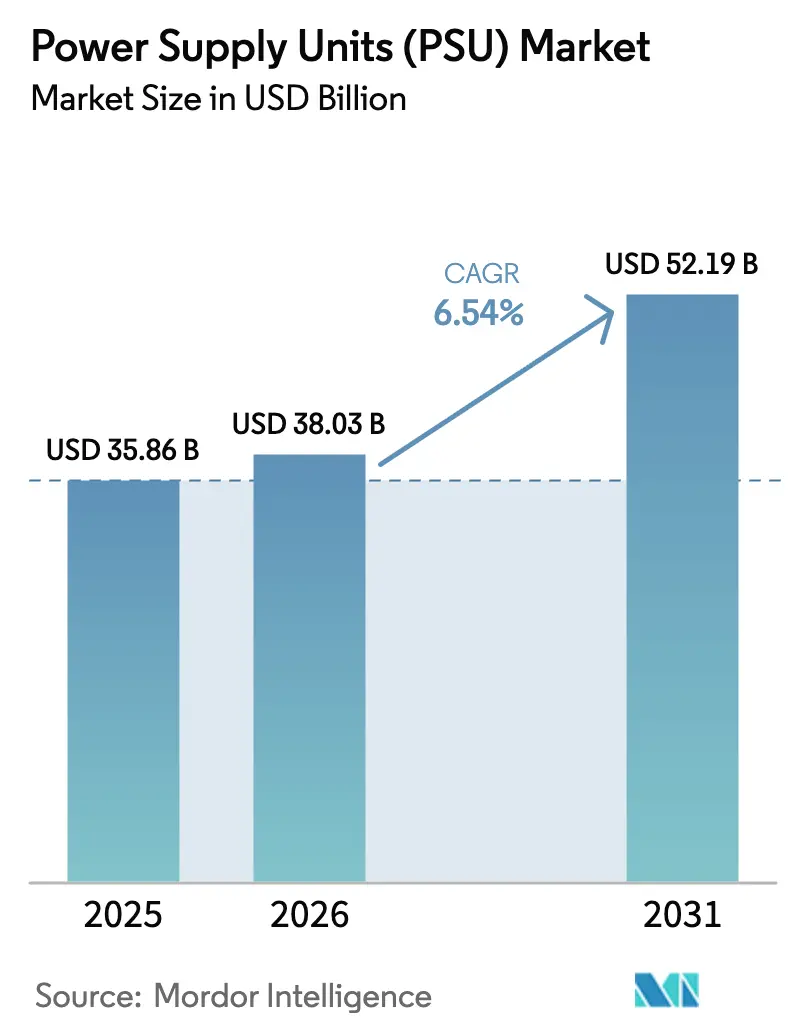
| Market Size (2026) | USD 38.03 Billion |
| Market Size (2031) | USD 52.19 Billion |
| Growth Rate (2026 - 2031) | 6.54 % |
| Fastest Growing Market | Asia Pacific |
| Largest Market | North America |
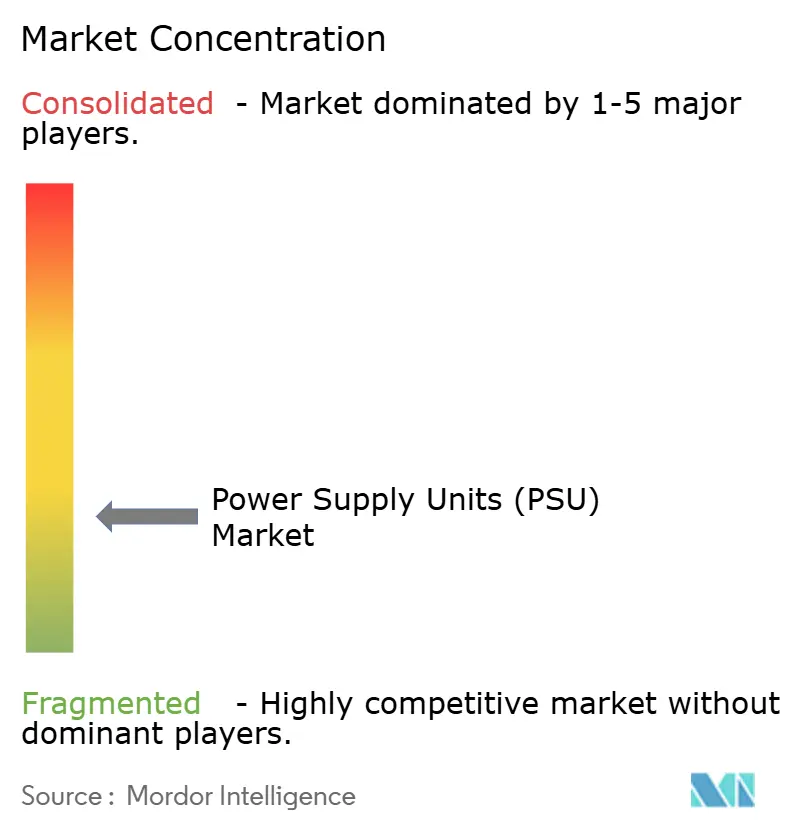
| Market Concentration | Low |
Major Players *Disclaimer: Major Players sorted in no particular order Image © Mordor Intelligence. Reuse requires attribution under CC BY 4.0. | |
Power Supply Units (PSU) Market Analysis by Mordor Intelligence
The power supply units (PSU) market size is projected to expand from USD 35.86 billion in 2025 and USD 38.03 billion in 2026 to USD 52.19 billion by 2031, registering a CAGR of 6.54% between 2026 to 2031. Demand is shifting from high-volume commoditized bricks toward value-added topologies that meet hyperscale data-center density targets and electrification mandates. Tightened no-load efficiency limits under the European Ecodesign Directive and California’s Title 20 are accelerating adoption of digital control loops and synchronous rectification. At the same time, Intel’s ATX 3.0 specification has upended the gaming segment, forcing vendors to redesign transient-response circuitry for GPUs that exceed 600 W draw. Raw-material volatility in ferrite cores and silicon carbide wafers is widening the cost gap between vertically integrated incumbents and fab-less challengers.
Key Report Takeaways
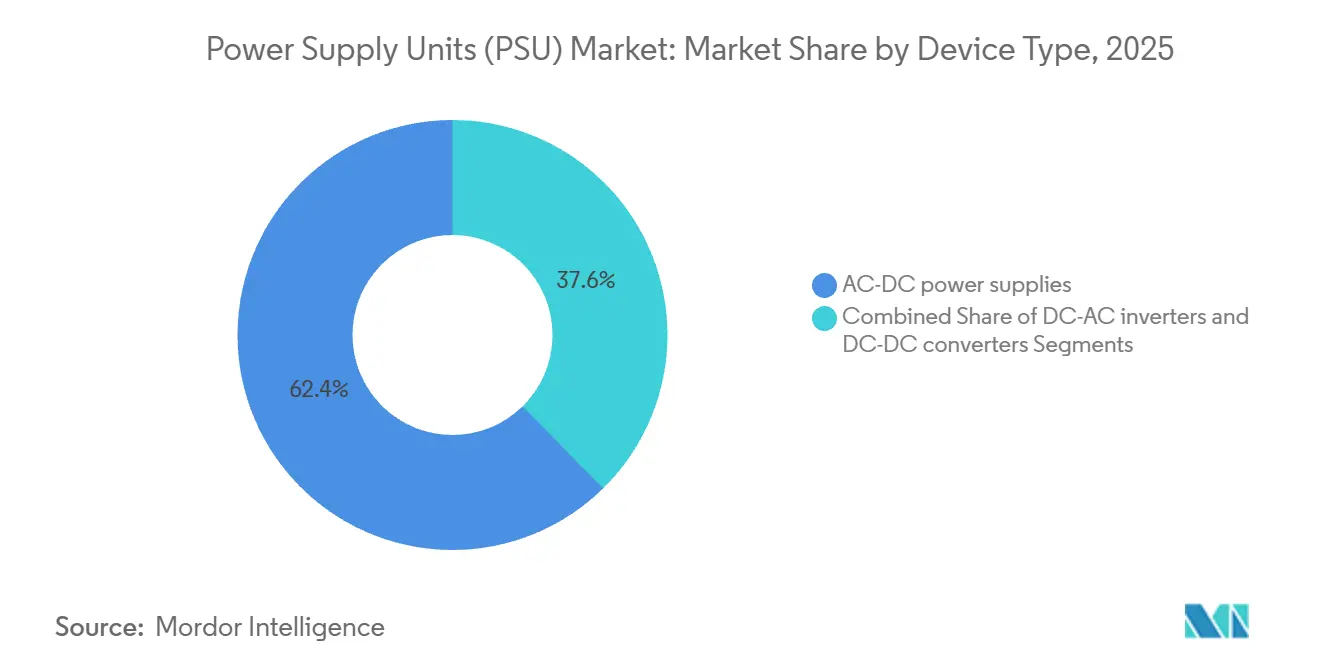
- By device type, AC-DC units led with 62.35% of power supply units market share in 2025 while DC-AC inverters are projected to advance at a 7.83% CAGR through 2031.
- By end-user, industrial automation accounted for 33.49% of the power supply units market in 2025, and data centers are forecast to grow at an 8.31% CAGR through 2031.
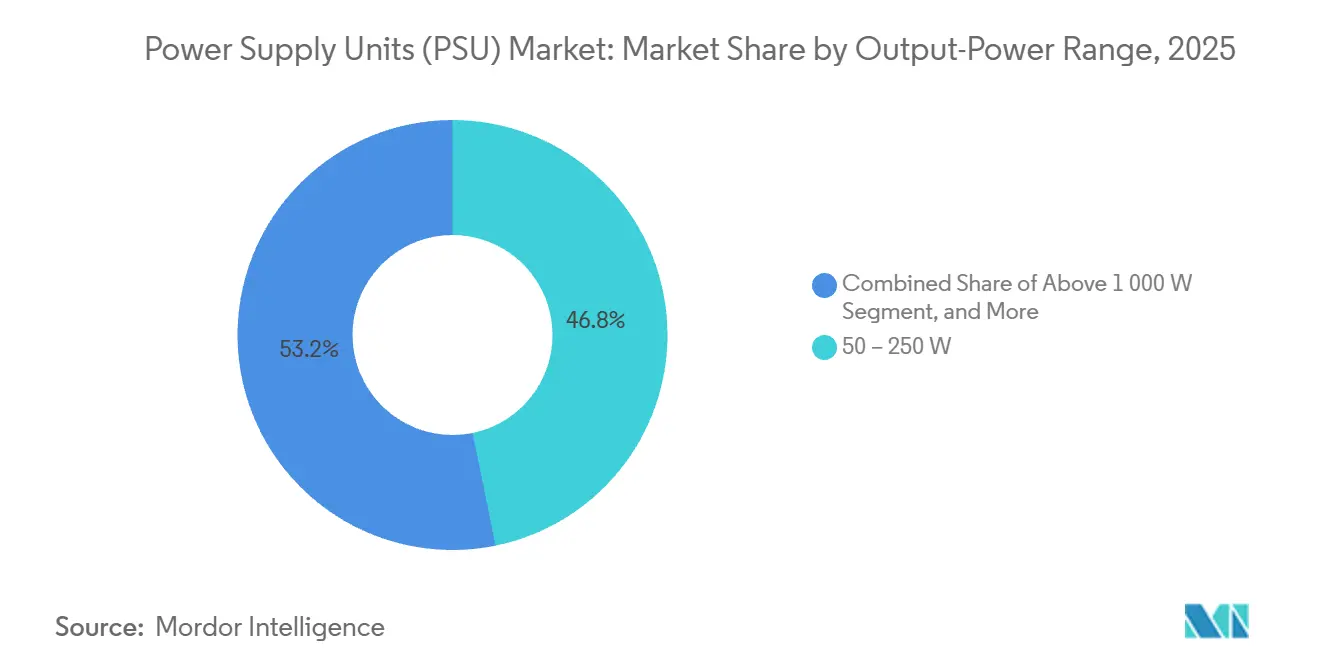
- By output power range, 50-250 W captured 46.78% of the power supply units market in 2025; modules above 1,000 W are expected to expand at a 7.57% CAGR.
- By form factor, enclosed chassis products accounted for 34.67% of the market in 2025, whereas rack-mount and modular designs posted the fastest 7.13% CAGR.
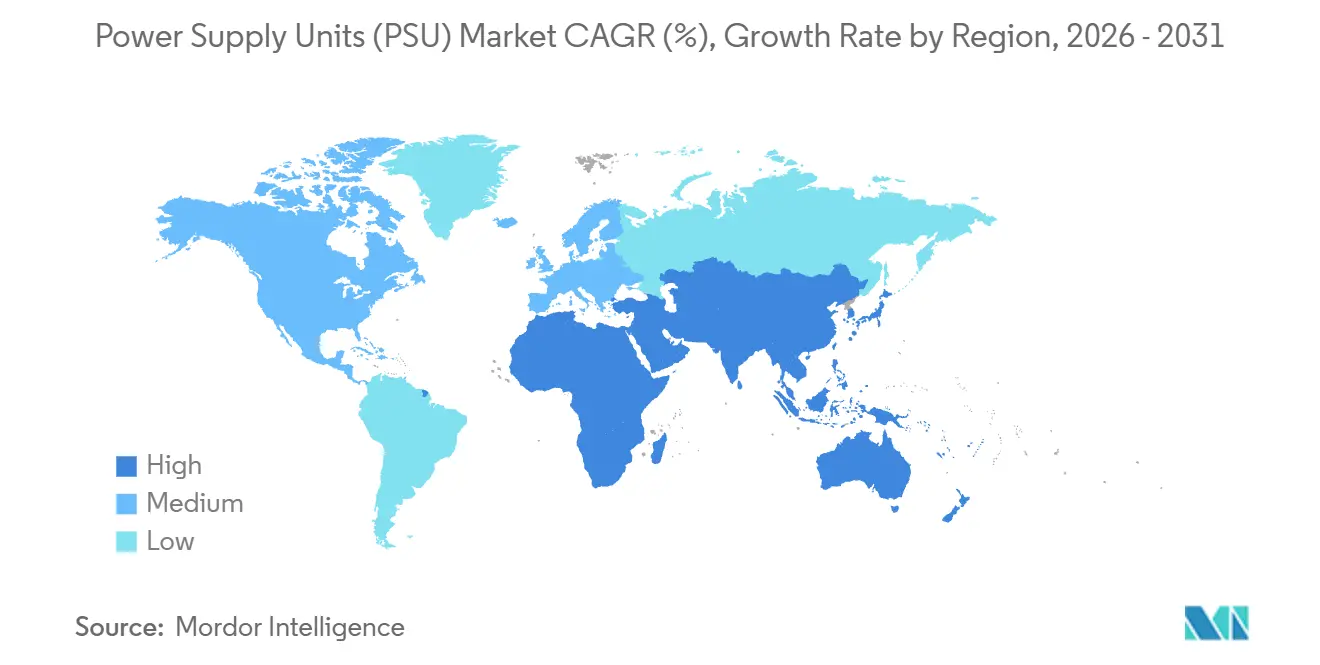
- By geography, North America held 38.87% of market share in 2025, and Asia-Pacific is on track for the highest 8.09% CAGR through 2031.
Note: Market size and forecast figures in this report are generated using Mordor Intelligence’s proprietary estimation framework, updated with the latest available data and insights as of January 2026.
Market Trends and Insights
Drivers Impact Analysis of Power Supply Units (PSU) Market*
| Driver | (~) % Impact on CAGR Forecast | Geographic Relevance | Impact Timeline |
|---|---|---|---|
| Rapid Expansion of Hyperscale and Edge Data Centers | +1.8% | Global, with concentration in North America, China, and India | Medium term (2-4 years) |
| ATX 3.0 and PCIe 5.1 Upgrade Cycle in Gaming and Workstation PCs | +1.2% | North America, Europe, and Asia-Pacific gaming hubs | Short term (≤ 2 years) |
| Growing Demand for 80 PLUS-Certified Energy-Efficient PSUs | +0.9% | Global, led by Europe and North America | Medium term (2-4 years) |
| Shift Toward 48 V Direct-To-Rack Architectures in Next-Gen Data Centers | +0.7% | North America and Europe hyperscale operators | Long term (≥ 4 years) |
| Proliferation of IoT and Smart-Home Electronics | +0.6% | Asia-Pacific core, with spillover to North America and Europe | Medium term (2-4 years) |
| Government e-Waste Directives Driving Modular, Recyclable PSU Designs | +0.4% | Europe, with emerging adoption in China and California | Long term (≥ 4 years) |
| Source: Mordor Intelligence | |||
Rapid Expansion of Hyperscale and Edge Data Centers
Hyperscale operators announced more than USD 6 billion of new facilities during 2025, each requiring PSUs that deliver 96% efficiency at 50% load and hot-swap modularity to meet five-minute repair windows.[1] Edge deployments compound demand because 5G base stations need compact units that survive −40 °C to +70 °C ambient ranges.[2] Liquid-cooled racks drive interest in 54 V bus architectures that cut resistive losses, although pilots at Amazon Web Services and Meta remain in validation. Suppliers with digital telemetry and predictive maintenance in their racks report higher design-win rates as operators monetize uptime. Consequently, the power supply units market is tilting toward high-density, data-center-specific platforms that command premium margins.
ATX 3.0 and PCIe 5.1 Upgrade Cycle in Gaming and Workstation PCs
The ATX 3.0 guide introduced the 12VHPWR connector with 200% transient tolerance, reshaping the enthusiast PC ecosystem. NVIDIA’s RTX 50-series launch made compliance mandatory, and Corsair noted that ATX 3.0-ready units counted for over 70% of its Q4 2025 shipments.[3] Workstation builders targeting AI rendering embrace dual-rail 12 V outputs that balance multi-GPU loads without breaching UL 62368-1 limits. OEMs willing to absorb redesign costs gain early-mover recognition among gamers and content creators. This refresh cycle bolsters average selling prices, lifting the power supply units market even as unit volumes stay flat.
Growing Demand for 80 PLUS-Certified Energy-Efficient PSUs
Titanium-rated devices rose from 8% of certified models in 2023 to 18% in 2025 as enterprises hunted for lower power-usage-effectiveness scores. A Lawrence Berkeley National Laboratory study calculated annual electricity savings of USD 180,000 for a 10 MW facility migrating from Gold to Titanium PSUs. Policy tightening under Europe’s ErP Lot 9 now enforces 88% averaged efficiency across four load points, pushing legacy flyback designs toward obsolescence. Suppliers offering digital, resonant topologies secure procurement preference because they simplify regulatory filings and rebate eligibility. Energy-centric purchasing is forecast to sustain price premiums in the power supply units market through 2031.
Shift Toward 48 V Direct-to-Rack Architectures in Next-Gen Data Centers
The Open Compute Project’s 48 V rack spec trims component count and lifts bus efficiencies to 98%, according to Vicor’s 2025 brief. Google’s Finland and Taiwan sites pilot racks that cut copper weight by 15% and boost power density by one-fifth. Still, migration faces inertia because most installed motherboards run 12 V planes and require intermediate buses for backward compatibility. Vendors supplying hybrid 12 V-48 V solutions gain a bridge-market advantage. Over time, wide-bandgap semiconductor adoption should unlock cost parity, positioning 48 V as the long-term mainstream within the power supply units market.
Restraints Impact Analysis of Power Supply Units (PSU) Market*
| Restraint | (~) % Impact on CAGR Forecast | Geographic Relevance | Impact Timeline |
|---|---|---|---|
| Raw-Material Price Volatility for Magnetics and Semiconductors | -0.8% | Global, with acute impact in Asia-Pacific manufacturing hubs | Short term (≤ 2 years) |
| Rising Adoption of Native-DC Facilities Reducing AC-DC PSU Volumes | -0.6% | North America and Europe hyperscale operators | Long term (≥ 4 years) |
| Stricter Global EMI and Safety Certification Costs | -0.4% | Global, with stringent requirements in Europe and North America | Medium term (2-4 years) |
| Fragmented Regional Eco-Design and EPS Efficiency Labeling | -0.3% | Global, with divergence between EU, U.S., and China standards | Medium term (2-4 years) |
| Source: Mordor Intelligence | |||
Raw-Material Price Volatility for Magnetics and Semiconductors
Ferrite core prices surged 22% year-over-year in Q1 2025 because of supply disruptions at Asian producers. Silicon-carbide MOSFET average selling prices remain three to four times higher than silicon, with lead times extending beyond 26 weeks as of January 2026. Copper foil inflation, tied to EV battery demand, forces redesigns of printed-circuit-board trace widths to maintain bill-of-materials ceilings. Larger firms hedge through multi-year supply agreements, but smaller ODMs face margin compression that slows new-product introduction. Such volatility erodes profitability across the power supply units market, especially in mid-tier consumer segments where pass-through pricing is limited.
Rising Adoption of Native-DC Facilities Reducing AC-DC PSU Volumes
Native-DC architecture, showcased in Microsoft’s Arizona campus, routes 380 V DC from on-site solar arrays straight to racks and reaches 96% end-to-end efficiency. Eliminating rectifier stages lowers cooling and capital costs, tempting hyperscalers planning greenfield expansions. Although retrofit barriers keep penetration low today, each new native-DC site displaces thousands of conventional switch-mode supplies. Component vendors seeking relevance pivot toward high-voltage DC-DC modules and battery interface converters. Over the long run, this trend caps upside for traditional AC-input SKUs in the power supply units market.
*Our forecasts treat driver/restraint impacts as directional, not additive. The impact forecasts reflect baseline growth, mix effects, and variable interactions.
Power Supply Units (PSU) Market Segment Analysis
By Device Type:
AC-DC Leadership and Inverter UpswingAC-DC products retained 62.35% of the power supply units (PSU) market in 2025 as their galvanic isolation meets safety codes in telecom, industrial, and consumer gear. The power supply units market size for these bricks remains stable because every grid-connected device still needs a primary conversion stage. DC-DC converters populate battery-powered systems where 95% efficiency and sub-15 mm heights are mandatory; their niche role provides margin insulation for specialist vendors. DC-AC inverters are on a 7.83% CAGR trajectory, fueled by rooftop solar feed-in tariffs and UPS deployments in emerging economies.
Wide-bandgap semiconductors are rewriting cost-performance curves. GaN-based laptop adapters show 30% volume shrink at comparable wattage, a selling point for OEMs chasing portability. SiC diodes inside DC-DC converters cut switching losses at 100 kHz, letting designers raise power density without larger heat sinks. Inverter suppliers for electric-vehicle chargers adopt three-level bridge topologies to satisfy strict harmonic limits. Together, these shifts increase average selling prices, supporting healthy margins even as commoditization pressure grows within the power supply units market.

By Form Factor:
Modularity Gains GroundEnclosed chassis units delivered 34.67% of the power supply units (PSU) market in 2025, thanks to IP-rated shells that protect against dust and fluids in harsh industrial lines. The power supply units market share for rack-mount and modular systems, however, is expanding as hyperscale operators enforce N+1 redundancy to drive five-nines availability. Rack-mount and modular designs are expected to have the fastest CAGR of 7.13%. Open-frame designs still dominate the mass market, where cost outstrips maintainability. DIN-rail products, although small in volume, remain vital in building automation because clip-in installation reduces labor.
Standardization is accelerating the pivot to modularity. The Open Rack V3 spec introduced tool-less latches and front-access power bays, a boon for hot-aisle containment strategies. PMBus and I²C telemetry embedded in rack-mount SKUs give operators live readings of ripple and thermal stress, essential for AI-driven facility management. Enclosed supplies now ship with interleaved boost power-factor correction, letting medical OEMs pass IEC 61000-3-2 harmonic limits without bulky filters. These engineering advances keep the power supply units market aligned with serviceability and regulatory trends.
By Output-Power Range:
Mid-Range Stability, High-Power SurgeThe 50-250 W bracket held 46.78% of the power supply units (PSU) market in 2025, anchored by smartphones, routers and LED drivers that prioritize small footprints. Units under 50 W migrate to USB-C Power Delivery, enabling multi-device charging consolidation. The 250-1,000 W tier supports gaming rigs and small servers, while modules over 1,000 W are forecast for a 7.57% CAGR because AI accelerators and EV chargers require multi-kilowatt rails.
High-power designs move from hard-switched bridges to LLC resonant converters, achieving zero-voltage switching across wide load bands and reducing heat by 35%. Tesla’s European Supercharger V4 splits 350 kW cabinets into redundant 50 kW cartridges, proving modularity at megawatt scale. Silicon carbide MOSFETs push efficiency past 99% in three-phase rectifiers, but cost parity with IGBTs is years away. The power supply units market thus gains a premium high-wattage lane that lifts blended margins.
By End-User Industry:
Industrial Anchors, Data-Center MomentumIndustrial automation retained 33.49% of the power supply units (PSU) market in 2025, owing to installations that require −25 °C to +70 °C ranges and voltage-sag immunity per IEC 61000-4-11. The power supply units market size for data centers is pacing an 8.31% CAGR as generative AI stacks demand multi-kW GPU cages with sub-1 ms transient response. Telecom continues to specify 48 V bricks for 5G radios, whereas consumer electronics flock to GaN chargers delivering 140 W inside shirt-pocket envelopes.
Automotive electrification adds a new pull as DC-DC down-converters step traction packs down to 12 V infotainment rails while meeting ISO 26262 functional safety. Rail, avionics and marine follow with shock and altitude certifications, rewarding firms that invest in ruggedization. Medical OEMs require dual means of patient protection and leakage below 100 µA, so suppliers charge premium pricing. Each vertical’s specialized compliance keeps cross-segment substitution low, stabilizing revenue diversity inside the power supply units market.
Geography Analysis
North America Power Supply Units (PSU) Market
North America contributed 38.87% of 2025 revenue, steered by hyperscale campus construction in Virginia, Oregon and Texas. Amazon Web Services disclosed an USD 11 billion Ohio expansion that alone demands roughly 200 MW of redundant rails. Canada’s solar-plus-storage boom feeds inverter demand, yet early pilots of native-DC data centers temper long-term volume for AC-input designs. Component makers benefit from rigorous UL and FCC certifications that act as non-tariff barriers, preserving higher average selling prices in the region’s power supply units market.
APAC Power Supply Units (PSU) Market
Asia-Pacific is on track for the fastest 8.09% CAGR through 2031. China’s CNY 50 billion (USD 7 billion) subsidy package has begun localizing GaN and SiC fabrication, trimming lead times for domestic PSU assemblers. India’s PLI scheme lowered PSU imports 18% in 2025 as Chennai factories scaled to telecom and data-center orders. South Korea’s 1,200 ultra-fast EV chargers raise demand for 350 kW cabinets, while Vietnam and Thailand pick up assembly overflow from China. This regional re-balancing intensifies competition and compresses price tiers inside the power supply units market.
EMEA Power Supply Units (PSU) Market
Europe remains efficiency-driven, with the revised Ecodesign Directive linking reparability scores to market access by 2027. Germany saw a 12% rise in industrial PSU orders, propelled by automotive electrification rollouts. The United Kingdom upgraded grid infrastructure, pushing utilities to specify smart-grid-compatible inverters. France’s nuclear retrofits ask for radiation-hardened supplies, creating a niche premium tier. Meanwhile, Middle East and Africa investments in hyperscale campuses and off-grid solar spark need for high-temperature, dust-protected modules. Geographic divergence in standards complicates portfolio planning, but also shields incumbents who maintain multiple certified variants, reinforcing pricing power in the global power supply units market.
Competitive Landscape
The power supply units (PSU) market exhibits fragmentation. Vertical integration provides insulation; Delta Electronics fabricates ferrites and packages semiconductors, while TDK-Lambda winds planar transformers in-house, letting both absorb material price spikes. Strategy bifurcates between high-volume commodity suppliers and niche-oriented specialists targeting medical or military certifications. White-space persists in GaN USB-PD adapters above 140 W, 48 V rack modules with digital telemetry and automotive 800 V architectures, areas where legacy players move slower.
Disruptors leverage wide-bandgap devices and AI control. Navitas Semiconductor’s GaNFast ICs trimmed laptop chargers by 30%, capturing marquee OEM sockets. Vicor filed 14 factorized-power patents in 2025, shielding its high-density data-center offerings. Advanced Energy embeds machine-learning diagnostics that predict capacitor end-of-life 90 days out, slashing unplanned downtime for chip-fab customers. Compliance is turning into a moat; firms maintaining in-house UL, IEC and ISO test labs pull ahead as certification cycles lengthen. The resulting dynamics sustain differentiated pricing inside the power supply units market, despite lingering commoditization in low-wattage SKUs.
Vertical integration is no longer the sole differentiator software and analytics now shape procurement decisions almost as much as hardware. Vendors embedding digital twins of their PSUs into data-center management platforms allow operators to simulate fault scenarios and schedule maintenance without live testing, an approach pioneered by Schneider Electric’s EcoStruxure suite. Partnerships across the silicon stack are tightening; Delta Electronics and Texas Instruments co-developed firmware libraries that optimize GaN gate driving for peak efficiency, while TDK-Lambda collaborates with Infineon to co-package SiC MOSFETs with planar transformers in medical-grade modules. Mergers remain selective and technology-driven: ABB’s 2025 minority investment in a Swedish GaN start-up signals that incumbents prefer strategic stakes over full takeovers to hedge against rapid device-level innovation. As compliance regimes widen, the cost of maintaining multi-regional certifications will likely catalyze further collaboration, nudging the power supply units market toward a partnership-centric, ecosystem model rather than outright consolidation.
Power Supply Units (PSU) Industry Leaders
-
Delta Electronics Inc.
-
Lite-On Technology Corporation
-
TDK-Lambda Corporation (TDK Corporation)
-
MEAN WELL Enterprises Co., Ltd.
-
Emerson Electric Co.
- *Disclaimer: Major Players sorted in no particular order
Power Supply Units (PSU) Market Companies Covered in this Report
- Delta Electronics Inc.
- Lite-On Technology Corporation
- TDK-Lambda Corporation
- MEAN WELL Enterprises Co., Ltd.
- Emerson Electric Co.
- ABB Ltd.
- Schneider Electric SE
- Siemens AG
- XP Power Limited
- Advanced Energy Industries, Inc.
- AcBel Polytech Inc.
- Murata Manufacturing Co., Ltd.
- CUI Inc.
- Artesyn Embedded Technologies
- Vicor Corporation
- Sea Sonic Electronics Co., Ltd.
- Thermaltake Technology Co., Ltd.
- Micro-Star International Co., Ltd.
- COSEL Co., Ltd.
- Bel Fuse Inc.
- FSP Technology Inc.
Recent Industry Developments in Power Supply Units (PSU) Market
- January 2026: Delta Electronics announced a USD 150 million expansion of its Taoyuan, Taiwan facility to add 2 million square feet of PSU capacity with AI-driven optical inspection, slated for Q3 2027 start.
- December 2025: Schneider Electric partnered with Microsoft to co-develop 48 V rack distribution for Azure data centers, backed by a USD 25 million R and D budget over three years.
- November 2025: Lite-On Technology introduced a GaN 240 W USB-C PD3.1 adapter delivering 96% efficiency and 40% volume reduction.
- October 2025: Vicor Corporation won an USD 80 million contract supplying modular DC-DC converters for an 800 V EV platform using factorized power architecture.
- September 2025: MEAN WELL opened a 500,000 square-foot Guadalajara, Mexico plant focused on industrial automation and renewables.
Global Power Supply Units (PSU) Market Report Scope
A power supply is an electrical device that provides electric power to an electrical load. The primary objective of a power supply is to transform electric current from a source into the appropriate voltage, current, and frequency required to energize the load. The power may originate from various sources, including the electric power grid (an electrical outlet), energy storage devices like batteries or fuel cells, generators or alternators, solar power converters, and other power supplies.
The Power Supply Units (PSU) Market Report is Segmented by Device Type (AC-DC power supplies, DC-DC converters, and DC-AC inverters), Form Factor (Open-frame, Enclosed/chassis, DIN-rail, Brick, and Rack-mount/modular), Output-Power Range (Less than 50 W, 50-250 W, 250-1,000 W, and Above 1,000 W), End-user Industry (Industrial Automation and Machinery, Communications and Telecom, Consumer Electronics and Mobile, Automotive, Transportation, Medical Devices and Healthcare, LED and Lighting, Data Centers and Servers, and Defense and Aerospace), and Geography (North America, South America, Europe, Asia-Pacific, and Middle East and Africa). The Market Forecasts are Provided in Terms of Value (USD).
Segmentation Overview
| AC-DC power supplies |
| DC-DC converters |
| DC-AC inverters |
| Open-frame |
| Enclosed / chassis |
| DIN-rail |
| Brick |
| Rack-mount / modular |
| Less than 50 W |
| 50 - 250 W |
| 250 - 1 000 W |
| Above 1 000 W |
| Industrial Automation and Machinery |
| Communications and Telecom |
| Consumer Electronics and Mobile |
| Automotive (ICE and EV) |
| Transportation (Rail, Avionics, Marine) |
| Medical Devices and Healthcare |
| LED And Lighting |
| Data Centers and Servers |
| Defense and Aerospace |
| North America | United States | |
| Canada | ||
| Mexico | ||
| South America | Brazil | |
| Argentina | ||
| Rest of South America | ||
| Europe | Germany | |
| United Kingdom | ||
| France | ||
| Italy | ||
| Spain | ||
| Rest of Europe | ||
| Asia-Pacific | China | |
| Japan | ||
| South Korea | ||
| India | ||
| Southeast Asia | ||
| Rest of Asia-Pacific | ||
| Middle East and Africa | Middle East | United Arab Emirates |
| Saudi Arabia | ||
| Turkey | ||
| Rest of Middle East | ||
| Africa | South Africa | |
| Egypt | ||
| Rest of Africa | ||
| By Device Type | AC-DC power supplies | ||
| DC-DC converters | |||
| DC-AC inverters | |||
| By Form Factor | Open-frame | ||
| Enclosed / chassis | |||
| DIN-rail | |||
| Brick | |||
| Rack-mount / modular | |||
| By Output-Power Range | Less than 50 W | ||
| 50 - 250 W | |||
| 250 - 1 000 W | |||
| Above 1 000 W | |||
| By End-user Industry | Industrial Automation and Machinery | ||
| Communications and Telecom | |||
| Consumer Electronics and Mobile | |||
| Automotive (ICE and EV) | |||
| Transportation (Rail, Avionics, Marine) | |||
| Medical Devices and Healthcare | |||
| LED And Lighting | |||
| Data Centers and Servers | |||
| Defense and Aerospace | |||
| By Geography | North America | United States | |
| Canada | |||
| Mexico | |||
| South America | Brazil | ||
| Argentina | |||
| Rest of South America | |||
| Europe | Germany | ||
| United Kingdom | |||
| France | |||
| Italy | |||
| Spain | |||
| Rest of Europe | |||
| Asia-Pacific | China | ||
| Japan | |||
| South Korea | |||
| India | |||
| Southeast Asia | |||
| Rest of Asia-Pacific | |||
| Middle East and Africa | Middle East | United Arab Emirates | |
| Saudi Arabia | |||
| Turkey | |||
| Rest of Middle East | |||
| Africa | South Africa | ||
| Egypt | |||
| Rest of Africa | |||
Key Questions Answered in the Report
How fast is the power supply units market expected to grow between 2026 and 2031?
It is projected to advance at a 6.54% CAGR, moving from USD 38.03 billion in 2026 to USD 52.19 billion by 2031.
Which device type currently dominates sales?
AC-DC supplies led with 62.35% 2025 revenue because nearly every grid-connected product needs primary conversion.
What segment is expanding the quickest?
DC-AC inverters show the fastest 7.83% CAGR outlook thanks to renewable-energy integration and UPS adoption.
Why are rack-mount and modular PSUs gaining traction?
Data-center operators favor N+1 redundancy and hot-swap serviceability, driving a 7.13% CAGR for these form factors.
Which region offers the strongest growth prospects?
Asia-Pacific is forecast for an 8.09% CAGR through 2031 on the back of semiconductor fab expansion and smart-manufacturing initiatives.