
Market Overview
| Study Period | 2021 - 2031 |
|---|---|
| Forecast Data Period | 2026 - 2031 |
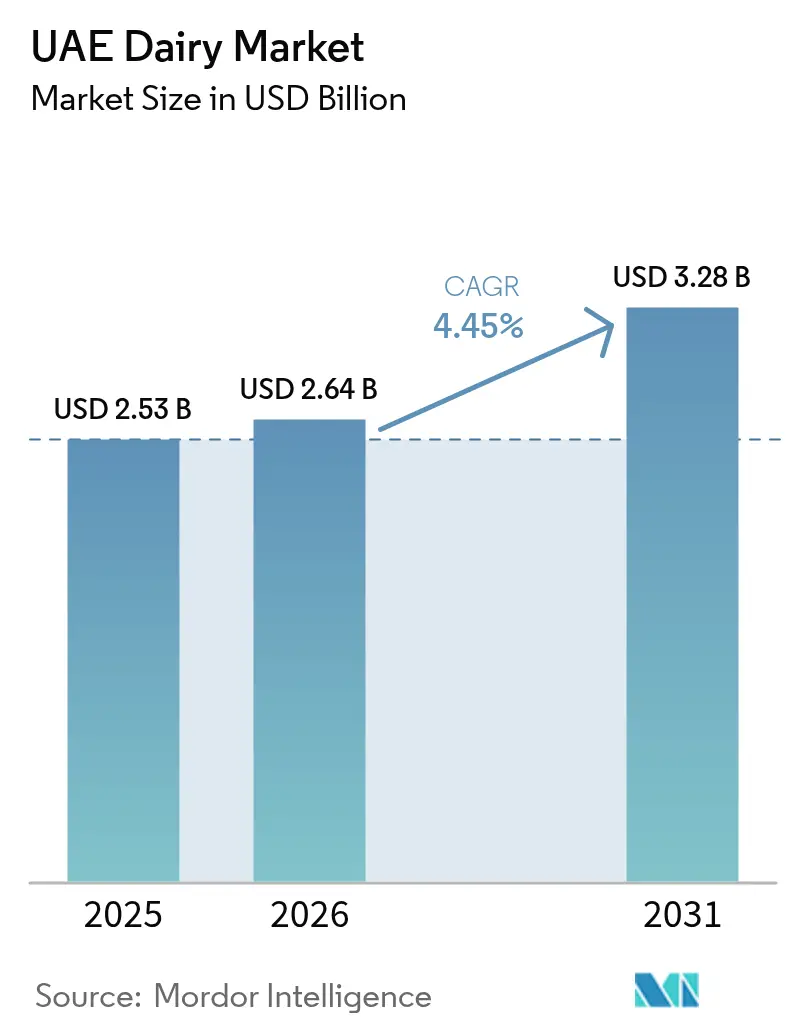
| Base Year Market Size (2025) | USD 2.53 Billion |
| Market Size (2026) | USD 2.64 Billion |
| Market Size (2031) | USD 3.28 Billion |
| Growth Rate (2026 - 2031) | 4.45 % |
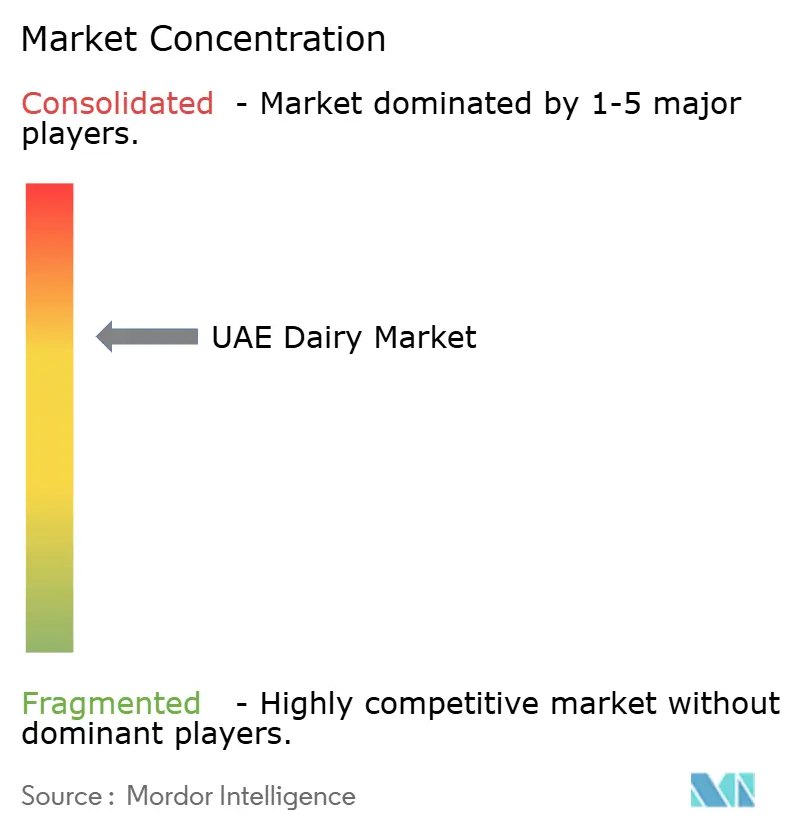
| Market Concentration | Medium |
Major Players
*Disclaimer: Major Players sorted in no particular order Image © Mordor Intelligence. Reuse requires attribution under CC BY 4.0. |
|
UAE Dairy Market Analysis by Mordor Intelligence
The United Arab Emirates (UAE) dairy market size is expected to grow from USD 2.53 billion in 2025 to USD 2.64 billion in 2026 and is forecast to reach USD 3.28 billion by 2031 at 4.45% CAGR over 2026-2031. This growth trajectory reflects the Emirates' strategic positioning as a regional food hub while addressing domestic consumption demands driven by a diverse expatriate population and robust tourism recovery. The market's expansion aligns with the National Food Security Strategy 2051, which aims to reduce food import dependency from 90% to 50% [1]Source: United Arab Emirates Government, "National Food Security Strategy 2051", u.ae. Growth springs from population gains, tourism momentum, and the National Food Security Strategy 2051 that encourages local production and technological investment. Dubai’s dominance, premiumization trends, and packaging advances reinforce steady value expansion. A moderate concentration of leading suppliers spurs innovation while sustaining competitive pricing. Resilient supply networks, diversified consumer bases, and government-backed industrial financing programs anchor confidence in the UAE dairy products market over the next five years.
Key Report Takeaways
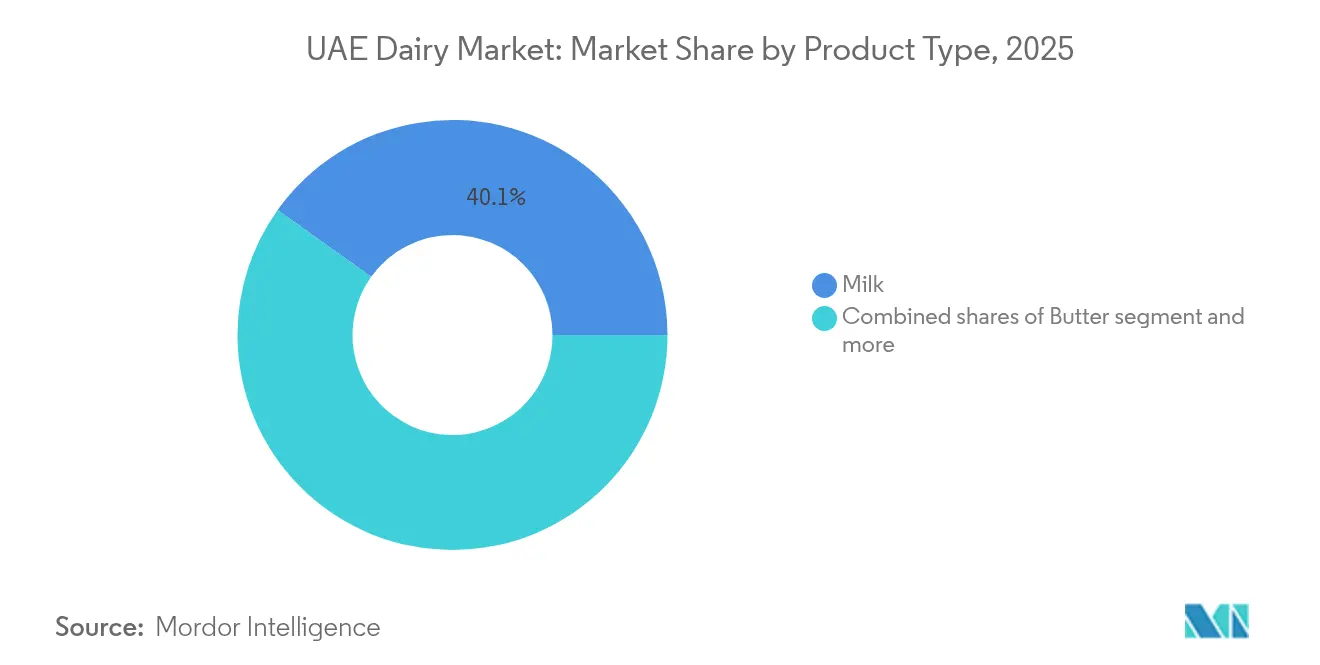
- By product type, milk captured 40.12% of the UAE dairy products market share in 2025; yogurt is forecast to expand at a 5.82% CAGR through 2031.
- By nature, conventional items held 97.41% of the UAE dairy products market share in 2025, while organic products are on track for a 5.39% CAGR to 2031.
- By packaging, cartons/Tetra Pak accounted for 50.08% of the UAE dairy products market size in 2025; pouches are projected to post the fastest 5.92% CAGR by 2031.
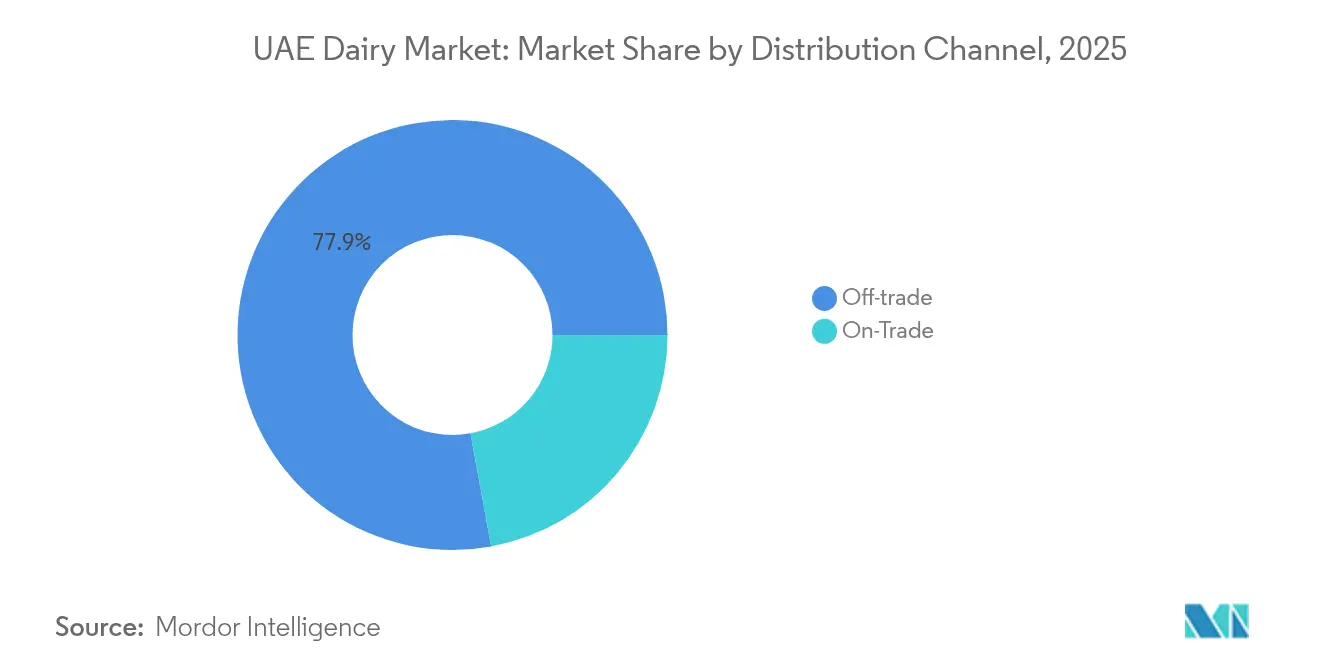
- By distribution channel, off-trade outlets represented 77.88% of the UAE dairy products market share in 2025, whereas on-trade sales are forecast at a 5.08% CAGR as hospitality rebounds.
- By geography, Dubai led with 40.21% of the UAE dairy products market share in 2025 and is advancing at a 5.04% CAGR through 2031.
Note: Market size and forecast figures in this report are generated using Mordor Intelligence’s proprietary estimation framework, updated with the latest available data and insights as of 2026.
UAE Dairy Market Trends and Insights
Drivers Impact Analysis*
| Driver | (~) % Impact on CAGR Forecast | Geographic Relevance | Impact Timeline |
|---|---|---|---|
| Health and Wellness Awareness | +1.2% | UAE-wide, strongest in Dubai and Abu Dhabi | Medium term (2-4 years) |
| Product Innovation | +0.9% | National, with early adoption in urban centers | Short term (≤ 2 years) |
| Cultural Diversity and Culinary Trends | +0.8% | Dubai, Abu Dhabi, with spillover to other emirates | Long term (≥ 4 years) |
| Branding and Marketing | +0.6% | UAE-wide, concentrated in major retail hubs | Short term (≤ 2 years) |
| Modern Retail Development | +0.7% | National, accelerated in Dubai and Abu Dhabi | Medium term (2-4 years) |
| Sustainable and Technological Advances | +0.5% | National, led by government initiatives | Long term (≥ 4 years) |
| Source: Mordor Intelligence | |||
Health and Wellness Awareness
Rising health consciousness among UAE residents drives premium dairy segment expansion, particularly benefiting organic and functional dairy products. Consumer surveys indicate over 60% of Middle East consumers prioritize fresh produce and express concerns about ultra-processed foods, creating opportunities for locally produced, minimally processed dairy alternatives. This trend gains momentum through government health initiatives targeting childhood nutrition and obesity prevention. The emergence of A2A2 protein milk production at facilities like Mleiha Dairy Farm demonstrates industry response to digestive health concerns, addressing the 11% lactose-intolerant population while positioning premium products for health-conscious consumers. Regulatory influence from the Abu Dhabi Agriculture and Food Safety Authority ensures product quality standards that support consumer confidence in health-focused dairy innovations.
Sustainable and Technological Advances
Environmental sustainability initiatives reshape production practices and consumer preferences, driving the adoption of eco-friendly packaging and resource-efficient farming methods. Tetra Pak's recognition as "Sustainable Company of the Decade" at Gulfood Manufacturing 2024 highlights industry commitment to circular economy principles and waste reduction. Advanced farming technologies, including IoT sensors for livestock monitoring and automated feeding systems, improve operational efficiency while reducing environmental impact. Solar energy adoption in dairy farming operations aligns with the UAE's renewable energy goals while reducing operational costs. Water conservation technologies become essential given regional scarcity, with farms implementing recycling systems and drought-resistant feed crops. These advances support the UAE's broader sustainability commitments while creating competitive advantages for early adopters.
Cultural Diversity and Culinary Trends
The UAE's multicultural population creates diverse dairy consumption patterns that drive product variety and specialized offerings. Expatriate communities, comprising the majority of the population, maintain dietary preferences from their home countries while adapting to local availability and climate considerations. This cultural mosaic generates demand for region-specific dairy products, from European-style cheeses to South Asian yogurt varieties and Middle Eastern dairy desserts. Tourism recovery amplifies this effect, with hospitality sectors requiring diverse dairy ingredients to cater to international guests' culinary expectations. The interplay between traditional Emirati cuisine and international influences creates opportunities for fusion products that blend local ingredients with global dairy applications. Cultural celebrations and religious observances, particularly Ramadan, create seasonal demand spikes that influence production planning and inventory management across the sector.
Branding and Marketing
Strategic brand positioning becomes increasingly critical as market competition intensifies and consumer sophistication grows. Companies invest heavily in digital marketing channels, with Agthia Group reporting 64% of total sales through digital channels in H1 2024, demonstrating the effectiveness of omni-channel strategies. Brand differentiation focuses on origin stories, production methods, and health benefits, with local producers emphasizing freshness and regional authenticity while international brands leverage global reputation and innovation capabilities. Marketing campaigns increasingly target health-conscious consumers through educational content about nutritional benefits and sustainable production practices. The rise of social media influence and food blogging culture amplifies brand messaging, particularly for premium and artisanal dairy products that benefit from visual storytelling and lifestyle association.
Restraints Impact Analysis*
| Restraint | (~) % Impact on CAGR Forecast | Geographic Relevance | Impact Timeline |
|---|---|---|---|
| Short Shelf Life of Fresh Dairy | -0.8% | UAE-wide, particularly affecting rural distribution | Short term (≤ 2 years) |
| Consumer Shift to Plant-Based | -0.6% | Urban centers, strongest in Dubai and Abu Dhabi | Medium term (2-4 years) |
| Limited Local Production Capacity | -0.9% | National, with capacity constraints in all emirates | Long term (≥ 4 years) |
| Supply Chain Vulnerability | -0.7% | National, with particular impact on import-dependent segments | Medium term (2-4 years) |
| Source: Mordor Intelligence | |||
Short Shelf Life of Fresh Dairy
Fresh dairy products' inherent perishability constrains market expansion and increases operational complexity across the value chain. The UAE's extreme climate conditions accelerate spoilage rates, requiring sophisticated cold chain infrastructure that increases distribution costs and limits geographic reach. Rural and remote areas face challenges accessing fresh dairy products, creating market segmentation between urban centers with robust cold storage facilities and peripheral regions relying on shelf-stable alternatives. This constraint drives investment in ultra-high temperature processing and extended shelf-life technologies, though these solutions often compromise taste and nutritional profiles that consumers increasingly value. The challenge intensifies during summer months when ambient temperatures exceed 45°C, straining refrigeration systems and increasing energy costs throughout the supply chain.
Limited Local Production Capacity
Domestic dairy production constraints force continued reliance on imports, exposing the market to currency fluctuations and international supply disruptions. The UAE imports approximately 80% of its agricultural products, including USD 1.92 billion in dairy products in 2023, highlighting the scale of import dependency [2]Source: U.S. Department of Agriculture, "Exporter Guide Annual", apps.fas.usda.gov. Climate limitations and water scarcity restrict large-scale dairy farming expansion, despite government initiatives like the AGRIX Accelerator program supporting agricultural innovation. Investment requirements for modern dairy facilities are substantial, with projects like Mleiha Dairy Farm requiring Dh600 million for 5,000-cow capacity, creating barriers for smaller operators. The constraint becomes more acute as population growth and tourism recovery increase demand faster than local production capacity can expand.
*Our forecasts treat driver/restraint impacts as directional, not additive. The impact forecasts reflect baseline growth, mix effects, and variable interactions.
Segment Analysis
By Product Type: Milk Dominance Drives Market Growth
Milk commands 40.12% market share in 2025 while simultaneously leading growth projections with 5.78% CAGR through 2031, reflecting both established consumption patterns and emerging premium product adoption. The segment benefits from diverse applications spanning direct consumption, food service, and industrial processing, with fresh milk maintaining preference despite shelf-life challenges. Cheese represents the second-largest category, driven by expanding food service sectors and growing consumer sophistication regarding artisanal varieties, while processed cheese gains traction in quick-service restaurants and convenience applications. Yogurt segments experience robust growth through health positioning and probiotic awareness, with spoonable varieties dominating traditional consumption while drinkable formats capture on-the-go occasions.
Dairy desserts emerge as a high-value segment, capitalizing on tourism recovery and celebration culture, with ice cream and frozen desserts performing particularly well during extended summer seasons. Cream products serve specialized culinary applications, with double cream and whipping varieties supporting the expanding bakery and confectionery sectors. The others category, encompassing spreads and fermented products, demonstrates innovation potential as manufacturers develop culturally-adapted products for diverse expatriate communities. Federal Law No. 10 of 2015 ensures quality standards across all product categories, supporting consumer confidence in both imported and locally-produced varieties .



By Nature: Organic Growth Accelerates Premium Positioning
Conventional dairy products maintain overwhelming market dominance at 97.41% share in 2025, reflecting established supply chains and price sensitivity among mainstream consumers. However, organic alternatives demonstrate the fastest growth trajectory at 5.39% CAGR through 2031, driven by health consciousness and premium positioning strategies. This growth differential suggests a gradual but persistent market evolution toward higher-value products, supported by increasing consumer education about production methods and nutritional benefits. The organic segment benefits from government initiatives promoting sustainable agriculture, including the Plant the Emirates program that encourages organic farming practices.
Local organic production receives support through projects like Mleiha Dairy Farm, which emphasizes chemical-free feeding and natural production methods to create A2A2 protein organic milk. The premium pricing of organic products creates attractive margins for producers while limiting market penetration among price-conscious consumers. Import regulations for organic certification add complexity but ensure quality standards that support consumer trust. The segment's growth trajectory indicates potential for market share expansion as organic supply chains mature and economies of scale reduce price premiums.
By Packaging: Innovation Drives Format Evolution
Cartons/Tetra Pak packaging dominates with 50.08% market share in 2025, benefiting from superior shelf stability and environmental positioning, while pouches emerge as the fastest-growing format at 5.92% CAGR through 2031. This growth pattern reflects consumer preferences for convenience and sustainability, with pouches offering portion control and reduced packaging waste. Bottles/Jars maintain a significant presence in premium segments, particularly for specialty products like organic milk and artisanal yogurts, where glass packaging conveys quality perception and product integrity. The "Others" category encompasses a diverse range of formats, including sachets for single-serve applications and plastic tubs for dairy desserts.
Packaging innovation focuses on sustainability and functionality, with Tetra Pak's recognition of sustainable practices highlighting the industry's commitment to environmental responsibility. Advanced packaging technologies extend shelf life while maintaining nutritional quality, addressing the UAE's climate challenges and distribution requirements. Regulatory compliance factors influence packaging choices, with food safety standards requiring specific barrier properties and labeling requirements. The shift toward e-commerce creates demand for packaging formats optimized for shipping and handling, driving innovation in protective and sustainable materials.
By Distribution Channel: Off-Trade Dominance with On-Trade Growth
Off-trade channels command 77.88% market share in 2025, reflecting consumer preference for grocery shopping and home consumption, while on-trade segments show promising 5.08% growth through 2031 as hospitality sectors recover. Supermarkets/Hypermarkets dominate off-trade distribution, benefiting from extensive product ranges and competitive pricing, while convenience stores capture impulse purchases and emergency needs. Online retail experiences rapid expansion, accelerated by pandemic-driven behavioral changes and improved delivery infrastructure, though current penetration remains modest compared to traditional formats.
The on-trade recovery reflects tourism sector rehabilitation and expanding food service operations, with hotels, restaurants, and cafes increasing dairy procurement as occupancy rates and dining frequency normalize. Convenience stores benefit from urbanization trends and busy lifestyles, offering extended hours and strategic locations that support impulse dairy purchases. E-commerce growth receives support from improved cold chain logistics and consumer comfort with online grocery shopping, though fresh dairy products face delivery challenges that favor shelf-stable alternatives. Distribution channel evolution reflects broader retail transformation trends while accommodating the unique requirements of perishable dairy products.
Geography Analysis
Dubai's market dominance stems from its unique position as a global city with over 85% expatriate population, creating diverse dairy consumption patterns that drive both volume and premium product adoption. The emirate's dominance reflects superior retail infrastructure, including extensive hypermarket networks and modern food service sectors that cater to international tastes and dietary requirements. Tourism recovery amplifies consumption through hotel and restaurant channels, while the emirate's role as a regional business hub generates consistent demand from corporate catering and events sectors. Dubai's growth trajectory at 5.04% CAGR through 2031 benefits from continued economic diversification, infrastructure development, and population growth that sustains dairy market expansion. The emirate serves as a testing ground for new products and formats, with consumer acceptance often predicting broader UAE market trends.
Abu Dhabi's market position reflects its role as the political and cultural capital, with government sector employment providing stable income levels that support premium dairy consumption. The emirate hosts major food production facilities and agricultural research initiatives, including the Abu Dhabi Agriculture and Food Safety Authority's innovation programs that advance local production capabilities. Strategic investments in food security infrastructure, including the AGRIX Accelerator program, position Abu Dhabi as a hub for agricultural technology development and sustainable farming practices. The emirate's cultural institutions and international events create demand for diverse dairy products, while its proximity to agricultural regions supports fresh product distribution.
Sharjah and the remaining emirates demonstrate growth potential through industrial development and targeted agricultural investments, with the Mleiha Dairy Farm project exemplifying local production enhancement strategies. These regions benefit from lower operational costs and available land for agricultural development, while maintaining access to Dubai's distribution networks and consumer markets. The northern emirates show promise in organic and specialty dairy production, leveraging climate advantages and government support for sustainable agriculture. Regional development initiatives ensure balanced growth while recognizing each emirate's unique strengths and market positioning within the broader UAE dairy ecosystem.
Value Chain Analysis
The UAE dairy value chain connects imported and domestic inputs (notably feed and genetics), farming, collection and chilling, processing across fresh and UHT lines (as well as cultured products, cheese and desserts), packaging, and multi-channel distribution. Import dependency for agricultural commodities and dairy ingredients remains a structural feature, while local-scale strengthening is increasingly visible through integrated operators and new capacity in Sharjah, including the Mleiha dairy project (EKTIFA) that runs A2A2 cattle and distributes across emirates including Sharjah and Dubai.
Cold chain performance is a key determinant of cost, waste, and service levels in a market with high ambient temperatures and a short shelf life for fresh dairy. This drives investment in route density, reliable refrigerated transport, and robust warehousing. Procurement and processing economics are also being reshaped by consolidation, including the formation of Al Ain Farms Group (AAFG) and its three-year partnership with Al Dahra Group to secure dedicated local raw milk supply for end-to-end dairy production, strengthening upstream availability while supporting downstream fulfillment against supply shocks.
Competitive Landscape
The UAE dairy market exhibits moderate consolidation, reflecting established player dominance while maintaining space for innovation and market entry. Local champions like Al Rawabi Dairy and Al Ain Farms leverage regional expertise and fresh product positioning against international giants, including Almarai, Danone, and Nestlé, creating competitive dynamics that benefit consumers through product diversity and competitive pricing.
Strategic consolidation accelerates through acquisitions like Ghitha Holding's USD 65.3 million purchase of Arabian Farms, indicating industry maturation and scale-building initiatives. Technology adoption becomes a key differentiator, with companies investing in IoT-enabled livestock monitoring, automated processing systems, and sustainable packaging solutions to improve efficiency and meet evolving consumer expectations.
Opportunities emerge in premium segments, including organic dairy, camel milk products, and culturally adapted specialty items that serve the UAE's diverse population. Emerging disruptors focus on direct-to-consumer models, plant-based alternatives, and innovative packaging formats that address sustainability concerns and convenience preferences. The competitive landscape benefits from government initiatives like Operation 300bn, which provides AED 30 billion in financing support for priority sectors including food security, enabling both established players and new entrants to expand production capabilities. Regulatory compliance factors create barriers to entry while ensuring product quality, with Federal Law No. 10 of 2015 establishing comprehensive food safety standards that all market participants must meet.
UAE Dairy Industry Leaders
-
Emirates Rawabi
-
Arla Foods amba
-
Danone
-
Fonterra Co-operative Group Limited
-
FrieslandCampina
- *Disclaimer: Major Players sorted in no particular order

Market Opportunities and Future Outlook
An opportunity sits at the intersection of national food-security priorities and dairy capacity expansion aimed at lowering import exposure. This aligns with the National Food Security Strategy 2051 target of reducing food import dependency from 90% to 50%. Sharjahs Mleiha Dairy Factory and Farm under EKTIFA (operational from late 2025) adds large-scale local output, and the May 2026 expansion plan to deliver Meliha Milk across GCC markets provides a concrete route for UAE-made dairy brands to extend beyond domestic retail and foodservice channels.
Technology-led product and process upgrades also create room for higher-protein and clean-label dairy formats, alongside hybrid portfolios that integrate plant-based lines into the same manufacturing footprint. In June 2025, Al Ain Farms Group partnered with Finland-based FoodIQ to implement Multi-Layer Cooker (MLC) technology for industrial-scale production of high-protein, clean-label dairy and plant-based products, pointing to investments that support flexible processing. Separately, the June 2026 shift of Nutri-Mark to a digital, QR-enabled format via the TAMM app improves formulation, labeling readiness, and data-enabled packaging execution for brands competing in modern retail.
Recent Industry Developments
- July 2026: Camelicious announced plans to introduce several new camel milk products within the next three months to broaden daily-use consumption and reach new consumer segments. The announcement supports category expansion beyond niche positioning and increases competitive pressure on differentiated, high-value dairy offerings in the UAE.
- October 2025: Al Ain Farms Group signed a three-year agreement with Al Dahra Group to secure a dedicated local supply of premium raw milk for its facilities, including Marmum Dairy. The partnership strengthens upstream supply reliability and tightens integration between raw milk sourcing and domestic processing capacity.
- November 2024: EKTIFA outlined an expansion plan for the Mleiha Dairy Farm in Sharjah, targeting a ramp-up to 20,000 cows within three years. This scale-up highlights the countrys push to add domestic production capacity and improve resilience in fresh dairy supply amid ongoing import dependence.


Research Methodology Framework and Report Scope
Market Definition and Coverage
In this methodology, the UAE dairy market is counted as the sales value generated from dairy products sold for consumption in the United Arab Emirates, across retail and foodservice, for a given year.
Scope exclusions: We exclude non-dairy plant-based alternatives and dairy processing equipment because these do not reflect dairy product consumption value.
Segmentation Overview
-
By Product Type
-
Butter
- Cultured Butter
- Uncultured Butter
-
Cheese
- Natural Cheese
- Processed Cheese
-
Cream
- Double Cream
- Single Cream
- Whipping Cream
- Others
-
Dairy Desserts
- Cheesecakes
- Frozen Desserts
- Ice Cream
- Mousses
- Others
-
Milk
- Condensed milk
- Flavored Milk
- Fresh Milk
- Powdered Milk
- UHT Milk
-
Yogurt
- Spoonable Yogurt
- Drinkable yogurt
- Others
-
Butter
-
By Nature
- Organic
- Conventional
-
By Packaging
- Cartons/Tetra Pak
- Bottles/Jars
- Pouches
- Others
-
By Distribution Channel
-
Off-trade
- Supermarkets/Hypermarkets
- Convenience Stores
- Online Retail Stores
- Other Distribution Channel
- On-trade
-
Off-trade
-
By Region
- Dubai
- Abu Dhabi
- Sharjah
- Rest of the United Arab Emirates
Data Sources, Market Sizing, and Validation
Desk Research
Desk work started with public and official statistics to understand the UAE demand pool and supply constraints, and then to set guardrails for volume and pricing. We referred to sources such as UAE Federal Competitiveness and Statistics Centre publications, Ministry of Climate Change and Environment updates, and UN Comtrade trade tables to track dairy import reliance and mix changes.
To keep the model grounded in real purchase behavior, we also used FAOSTAT dairy balance sheets for wider context and compared them with Gulf standards and food safety documentation from bodies such as ESMA and Codex Alimentarius. Company annual reports, audited financial statements, investor presentations, and credible local business press were reviewed to map product portfolios, packaging shifts, and route-to-market changes. Where needed, a paid subscription for company financials and a shipment-level import or export database were used to cross-check supplier presence and value per ton assumptions. These sources are illustrative, and many additional publications and databases were also used to collect data, validate it, and clarify open questions.
Primary Interviews and Surveys
Primary work focused on filling gaps that public data does not answer cleanly, such as realized pricing, channel margins, and how demand differs between Dubai and other emirates. We spoke with a mix of dairy processors, importers and distributors, modern trade stakeholders, and foodservice buyers so assumptions around product mix, packaging, and promotion intensity could be tested in plain terms.
Distribution of primary research fieldwork respondents
| Company type | Respondent position |
|---|---|
| Top tier: 38% | CXOs: 12% |
| Mid tier: 41% | Functional/Unit leaders: 28% |
| Smaller Players: 21% | Managers: 60% |
Market-Sizing & Forecasting
Sizing is built using a top-down approach where import and local production signals are reconstructed into an apparent consumption pool, which is then valued using category level prices that reflect UAE retail and foodservice realities. The totals are corroborated with selective bottom-up checks, such as sampled brand and pack price ladders by channel, plus supplier roll-ups from public financial disclosures where the UAE exposure can be reasonably isolated.
A few practical inputs drive the model, including import volumes by key dairy lines, the split between off-trade and on-trade sales, typical packaging mix (cartons, bottles or jars, pouches), and how organic versus conventional products are priced. We also track the product mix across milk, yogurt, cheese, butter, and dairy desserts because even small share shifts can move the total value noticeably in a high promotion market. When direct data is missing for a smaller category, we bridge the gap using price-per-ton proxies from trade data and then calibrate those with interview feedback on realized prices.
Forecasts are produced using scenario analysis supported by short time-series smoothing, where demand growth, import dependency, inflation pass-through, and premiumization trends are adjusted based on what channel and supply-side experts expect over the next few years. The final forecast is kept traceable, since each change is tied back to a small set of variables rather than a long list of hard-to-repeat assumptions.
Data Validation & Update Cycle
Outputs are validated through triangulation across trade statistics, category consumption signals, and price ladders observed in the market, and then checked for year-to-year jumps that do not match what stakeholders report. If variance shows up, we revisit the drivers, re-check key calculations, and re-contact select respondents to confirm whether it is a real shift or a data artifact.
Before sign-off, the model and assumptions go through a multi-step internal review so definition boundaries and arithmetic are aligned across sections. Reports are refreshed annually, and an interim update is triggered when major events occur, such as tariff changes, supply shocks, or sharp price moves. Right before delivery, we do a final pass to ensure the latest public releases and market signals are reflected in the numbers.
Mordor Intelligence's United Arab Emirates Dairy Market Size Versus Other Published Estimates
Published market sizes for UAE dairy can look different across sources, even when they use similar words, because the underlying choices on what gets counted are not always the same. Differences often come from whether on-trade sales are included, how imports are valued versus retail selling prices, and whether the geography is treated as only Dubai or the whole UAE.
By tracking import value-per-ton trends, pack-level price ladders, and annual scope refreshes, Mordor Intelligence keeps the UAE dairy total aligned to what is actually sold into off-trade and on-trade channels, rather than mixing in adjacent food categories or using a single price assumption for all products. The spread also grows when a source uses an aggressive premiumization path for cheese and dairy desserts, or when currency timing and inflation pass-through are applied at a headline level without category checks.
Benchmark comparison
| Source | Market Size | Gaps in Research Methodology |
|---|---|---|
| Mordor Intelligence | USD 2.53 B (2025) | |
| Industry Association A | USD 2.20 B (2025) | Typically reflects formal retail throughput only, which can undercount foodservice demand and misses value uplift from premium packs and newer packaging formats. |
| Trade Journal B | USD 2.85 B (2026) | Often applies broad food inflation and premiumization assumptions across dairy categories, which can overstate value if mix shifts and import valuation are not reconciled with category price ladders. |
The comparison mainly points to scope and pricing mechanics as the reasons values do not match exactly, especially around channel coverage and how import-linked categories are priced. Our approach stays repeatable because each total is built from observable demand and supply signals, and then stress-tested with interviews so the market size is traceable back to a few clear inputs.


Key Questions Answered in the Report
How significant is Dubai’s role within national dairy sales?
Dubai contributes 40.21% of value and is forecast at a 5.04% CAGR, cementing its role as the core consumption hub.
What is the current value of the UAE dairy products market?
The UAE dairy products market size is USD 2.64 billion in 2026.
How fast is the UAE dairy products market expected to grow?
Market value is projected to rise at a 4.45% CAGR, reaching USD 3.28 billion by 2031.
Which dairy segment holds the largest share in UAE retail value?
Milk leads with 40.12% of 2025 revenue, thanks to widespread household and food-service demand.
Page last updated on:


 Your data is secure and never sold or shared.


