
Vietnam MICE Market Size and Share
Market Overview
| Study Period | 2021 - 2031 |
|---|---|
| Forecast Data Period | 2026 - 2031 |
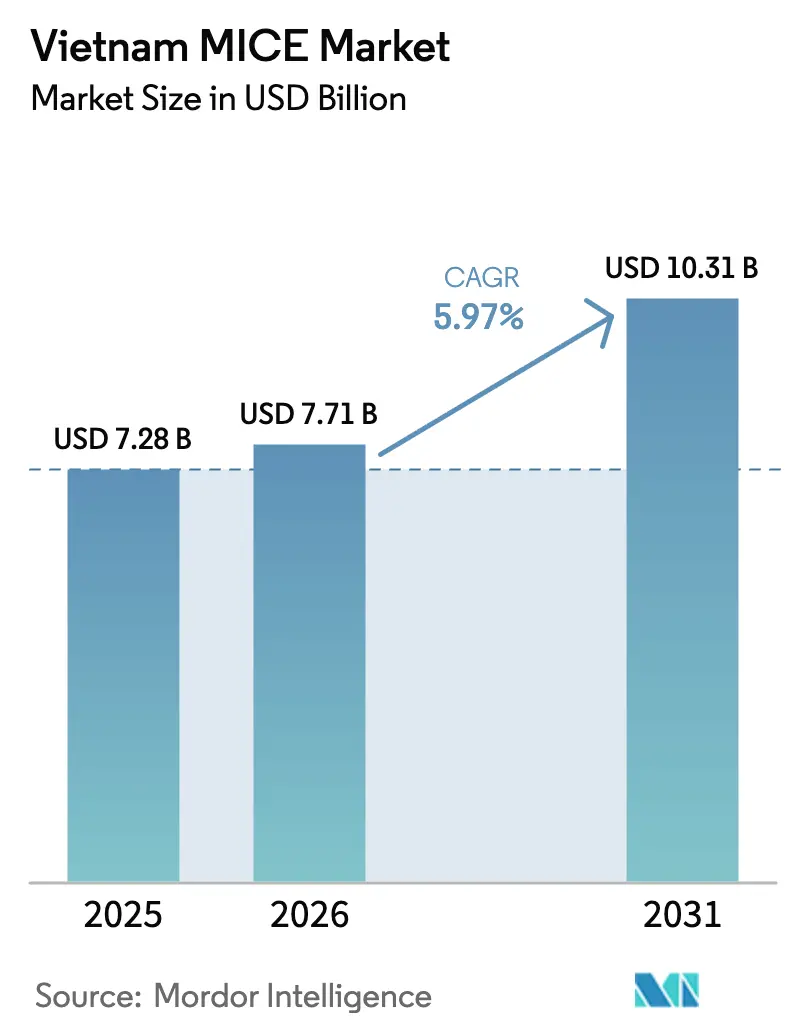
| Base Year Market Size (2025) | USD 7.28 Billion |
| Market Size (2026) | USD 7.71 Billion |
| Market Size (2031) | USD 10.31 Billion |
| Growth Rate (2026 - 2031) | 5.97 % |
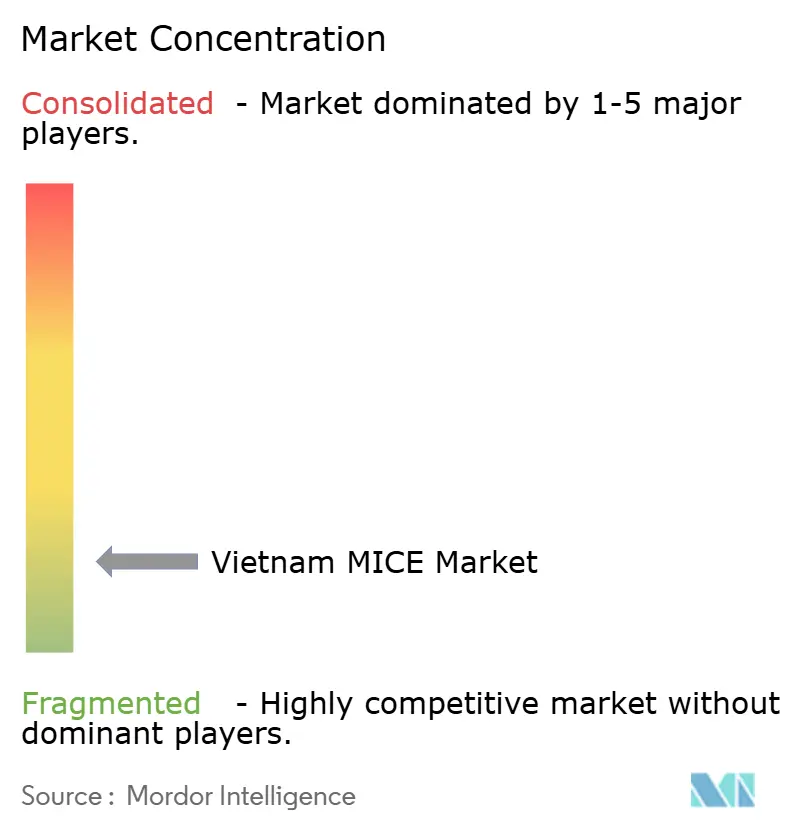
| Market Concentration | Low |
Major Players *Disclaimer: Major Players sorted in no particular order Image © Mordor Intelligence. Reuse requires attribution under CC BY 4.0. | |
Vietnam MICE Market Analysis by Mordor Intelligence
The Vietnam MICE market size reached USD 7.28 billion in 2025, and it is projected to expand at a 5.97% CAGR to USD 10.31 billion by 2031. Corporate demand drives Vietnam's MICE market, with manufacturing multinationals accounting for 37% of inbound meetings in 2025. This reduces seasonality and stabilizes quarterly volumes. Southern Vietnam holds the largest share, while Central Vietnam shows the fastest growth due to improved connectivity and administrative integration. Relaxed visa rules, including 90-day e-visas and broader exemptions, increased inbound volumes in 2024 and supported business travel into 2025. Digital engagement and hybrid formats enhanced monetization, with advertising revenue expected to grow, driven by Eventista's widespread adoption among organizers and sponsors in Vietnam.
Key Report Takeaways
- By event type, meetings led with 44.78% of the Vietnam MICE Market in 2025, while exhibitions are forecast to expand at an 8.05% CAGR through 2031.
- By source of revenue, tickets and registration fees held 41.92% of the Vietnam MICE Market in 2025, while advertising is projected to grow at an 8.63% CAGR through 2031.
- By industry participant, corporates accounted for 50.64% of the Vietnam MICE Market in 2025, while associations and NGOs are forecast to post a 6.60% CAGR through 2031.
- By geography, Southern Vietnam led with 47.85% of the Vietnam MICE Market in 2025, while Central Vietnam is projected to grow at a 7.02% CAGR through 2031.
Note: Market size and forecast figures in this report are generated using Mordor Intelligence’s proprietary estimation framework, updated with the latest available data and insights as of 2026.
Vietnam MICE Market Trends and Insights
Drivers Impact Analysis*
| Drivers | (~) % Impact on CAGR Forecast | Geographic Relevance | Impact Timeline |
|---|---|---|---|
| Government‑driven promotion efforts and infrastructure investments are accelerating MICE sector development | +1.8% | National, with concentrated gains in Hanoi, Ho Chi Minh City, Da Nang, and Phu Quoc | Medium term (2-4 years) |
| A more relaxed e‑visa framework and expanded air‑lift capacity are strengthening international event inflows | +1.2% | Global, with early gains from India, Russia, and European markets | Short term (≤ 2 years) |
| Rising demand for hybrid and environmentally sustainable events is reshaping organizer preferences | +0.9% | APAC core, spill-over to North America and the EU | Long term (≥ 4 years) |
| The emergence of secondary MICE destinations such as Phu Quoc and Quy Nhon is broadening the market landscape | +0.7% | National, with spillover to regional delegates seeking alternatives | Medium term (2-4 years) |
| Bleisure‑oriented offerings are becoming increasingly popular among Asian millennial travelers | +0.5% | APAC, with early gains in South Korea, Taiwan, and India | Short term (≤ 2 years) |
| ESG‑focused venue selection by multinational corporations is influencing hosting decisions across the sector | +0.6% | Global, with strongest impact in Northern and Southern Vietnam | Medium term (2-4 years) |
| Source: Mordor Intelligence | |||
Government‑driven promotion efforts and infrastructure investments are accelerating MICE sector development
Government-backed transport and venue upgrades are addressing mobility challenges in major cities, enhancing the Vietnam MICE market's calendar utilization. Sun Group is expanding Phu Quoc International Airport to handle 20 million passengers annually, aligning with APEC 2027 requirements. This upgrade will improve transfer times and enable same-day, multi-location scheduling for organizers. The Ministry of Planning and Investment has reduced permitting lead times from nine months to under four through a one-stop desk, accelerating venue delivery and encouraging private-sector investments in large-scale conventions and exhibitions. Ho Chi Minh City’s metro Line 1 extension, expected by Q2 2026, will reduce cross-district travel times, improving multi-venue scheduling for peak events. Upgrades also extend to tier-2 airports, such as Dong Hoi Airport, which plans to increase capacity by 2027. This aims to ease overflow pressures and provide new options for regional conferences previously displaced to larger cities[1].
A more relaxed e‑visa framework and expanded air‑lift capacity are strengthening international event inflows
Vietnam's visa reforms, which extended e-visa validity to 90 days and broadened exemptions, increased arrivals and improved business travel by reducing administrative hurdles and planning times for corporate organizers. Direct flights from Bengaluru and Hyderabad, introduced by Vietnam Airlines, boosted Indian delegate numbers in 2024 and 2025 by lowering costs and eliminating layovers. Vinpearl's partnerships with four Russian tour operators added 25 routes targeting 400,000 visitors, diversifying inbound MICE demand and raising hotel occupancies in key coastal areas beyond projections by late 2025[2]. Vietnam Airlines resumed the Da Nang–Osaka route in July 2025 with four weekly flights, enhancing Central Vietnam's event pipeline and access for Japanese corporate groups. The carrier also expanded its Japan network in 2025, with plans to increase frequencies and deploy wide-body aircraft on select routes, supporting larger delegations. Discussions on an ASEAN multi-country visa framework could further streamline planning and reduce costs for international organizers.
Rising demand for hybrid and environmentally sustainable events is reshaping organizer preferences
Corporate planners in the Asia-Pacific region have increasingly prioritized ESG compliance when selecting venues for events in 2025 and 2026, as highlighted by 2024 surveys. Sheraton Saigon Hotel & Towers implemented ISO 20121 practices, allowing it to secure higher pricing for multi-day conferences compared to non-certified venues. This reflects a growing preference for certified venues in Vietnam’s tier-1 cities. Eventista’s platform supported hybrid engagement, processing 10 million transactions by mid-2025 and expanding delegate reach by 3.2 times without requiring additional physical space. This enhanced sponsor value and operational efficiency in Vietnam’s MICE market. However, supply-side challenges persisted, with only seven venues achieving carbon-neutral certification by mid-2025, compared to a larger number in Singapore. Certified venues maintained pricing power for high-stakes meetings requiring zero-waste execution. Industry programs in 2025 expanded certification to accommodations and allied services, gradually stabilizing sustainable event supply, which is essential for international association bidding cycles through 2027.
The emergence of secondary MICE destinations such as Phu Quoc and Quy Nhon is broadening the market landscape
Phu Quoc, Quy Nhon, and Hue became cost-effective options in 2025, offering venue rates 28–34% lower than tier-1 locations. Resort-linked experiences extended stays by nearly two days for corporate and incentive programs, increasing per-delegate spending in Vietnam's MICE market. Phu Quoc’s 2027 APEC preparations by Sun Group include a light rail connecting the airport to a convention center and an 11,050 m² column-free ballroom, ensuring efficient group movement. By Q3 2025, Phu Quoc attracted more Asia-Pacific incentive bookings, appealing to planners seeking integrated beach, gastronomy, and team-building options. Quy Nhon’s clean-technology initiatives, such as wind and solar site tours, drew specialized association programs in 2025, diversifying Vietnam’s bid portfolio beyond urban venues by 2026. However, tier-2 locations face challenges, with only 40% of venues having fiber-optic coverage for hybrid broadcasting. Bilingual staffing pipelines are expected to mature by 2027, limiting complex congress capacity temporarily.
Restraints Impact Analysis*
| Restraints | (~) % Impact on CAGR Forecast | Geographic Relevance | Impact Timeline |
|---|---|---|---|
| Competition from established regional hubs like Singapore and Bangkok is limiting Vietnam’s MICE market share | -1.1% | APAC, with the strongest impact on Northern and Central Vietnam | Medium term (2-4 years) |
| Insufficient tier‑2 venue capacity is restricting the scale and diversity of events that can be hosted | -0.8% | National, acute in Quy Nhon, Hue, and emerging hubs | Long term (≥ 4 years) |
| A shortage of bilingual and sustainability‑certified staff is reducing service readiness for international events | -0.6% | National, acute outside Hanoi and Ho Chi Minh City | Medium term (2-4 years) |
| Fragmented digital ticketing and event‑tech systems are hindering seamless attendee management | -0.4% | National, with highest friction in tier-2 cities | Short term (≤ 2 years) |
| Source: Mordor Intelligence | |||
Competition from established regional hubs like Singapore and Bangkok is limiting Vietnam’s MICE market share
Singapore and Bangkok's established MICE ecosystems create switching costs for repeat clients, limiting Vietnam's ability to attract high-value delegates compared to peers with legacy infrastructure and extensive services. Bangkok's high venue density supports short-notice event scheduling and quick site inspections, unlike Vietnam's smaller venue pool. Vietnam counters with unique experiences, competitive pricing in tier-2 hubs, and integrated leisure options, which increased delegate monetization and extended stay lengths in 2025 and 2026. Proposed regional visa coordination could simplify processes for multinational steering committees, enhancing Vietnam's success in multi-destination tenders through 2027. Vietnam's near-term strategy focuses on experience-driven content, competitive attendance costs, and sustainability-aligned venues to narrow the brand equity gap while infrastructure and staffing scale in the medium term[3].
Insufficient tier 2 venue capacity is restricting the scale and diversity of events that can be hosted
Constraints in tier-2 cities caused inquiries to be rejected at tier-1 venues during peak months in 2025. This led to higher rates and shifted some demand to later dates due to inventory shortages in Vietnam's MICE market. Only 40% of tier-2 venues offered fiber-optic connectivity for hybrid formats, forcing organizers to fund temporary uplinks, increasing costs and complicating production planning for broadcasts in 2025 and 2026. Staffing remains a challenge, with only 14% of event managers holding ISO 20121 credentials, limiting the workforce for zero-waste or carbon-neutral programs preferred for regional congresses in 2026. Transport upgrades by 2028 are expected to expand secondary city access and reduce transfer times, integrating more venues into national schedules. Private projects in coastal hubs are set to add rooms and event spaces by 2027, improving availability and supporting corporate and association events in Vietnam's MICE market[4].
*Our forecasts treat driver/restraint impacts as directional, not additive. The impact forecasts reflect baseline growth, mix effects, and variable interactions.
Segment Analysis
By Event Type: Fleet Meetings Drive 44.78% Share, Yet Exhibitions Gain from Binh Duong's 22,000 m² Column-Free Hall
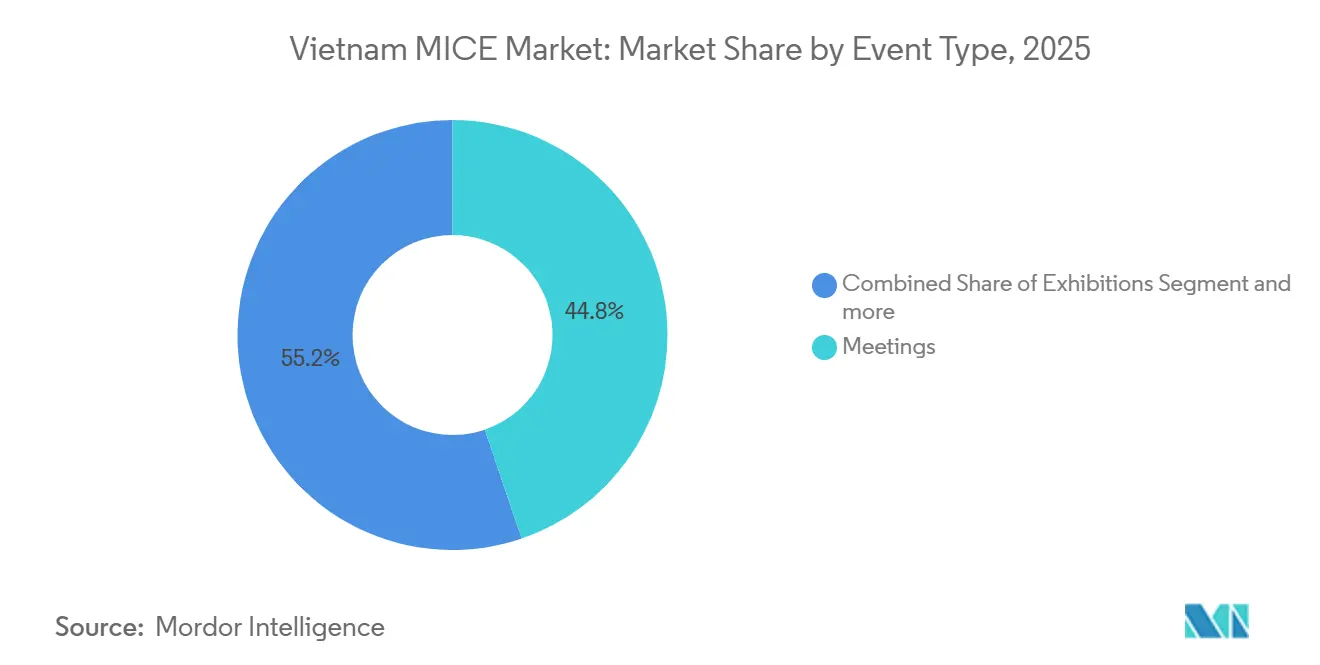
Meetings captured 44.78% of Vietnam's MICE market share in 2025, supported by corporate cycles driven by foreign direct investments and quarterly steering committees that sustained year-round demand. Exhibitions are projected to grow at an 8.05% CAGR through 2031, driven by the resurgence of product launches and buyer-seller matchmaking. Hybrid tools, such as those offered by Eventista, have become integral to exhibition planning, enabling live polling, digital ticketing, merchandise, and analytics. These tools expanded digital sponsor inventory and improved engagement metrics in 2025. By mid-2025, only seven venues in Vietnam had carbon-neutral credentials, creating demand for certified facilities and encouraging early bookings. Limited tier-2 fiber coverage at 40% restricted full-hybrid experiences at regional exhibitions, keeping complex launches concentrated in tier-1 cities in 2026.
Upgrades in destinations, including improved airport access, venue capacity, and leisure-focused itineraries, strengthened bids for regional showcases tied to manufacturing and technology supply chains in 2026. Sun Group’s APEC 2027 program in Phu Quoc introduced a convention center with an 11,050 m² column-free ballroom and a light rail link, reducing logistical challenges and supporting large-scale exhibitions. The resumption of Vietnam Airlines’ Da Nang–Osaka route in July 2025 enhanced Central Vietnam’s appeal to Japanese corporate exhibitors and buyers seeking direct access and reliable schedules in 2026. Coastal hubs continued to attract corporate incentives, extending stay durations and increasing spending on food, beverages, and entertainment around exhibition schedules. Planned metro and airport upgrades in 2026 and 2027 are expected to streamline multi-venue day plans for exhibitions and related events, improving visitor experience and throughput in the Vietnam MICE market.

By Source of Revenue: Tickets Command 41.92%, While Advertising Climbs 8.63% CAGR on Hybrid Architectures
Tickets and registration fees contributed 41.92% of revenue in 2025, indicating reliance on consistent gate receipts for cash flow. Integrated digital journeys supported improved conversions. The adoption of ISO 20121 allowed higher rates for multi-day conferences, as observed at Sheraton Saigon Hotel & Towers, which outperformed non-certified venues in 2025 and 2026. Accommodation revenue is expected to grow as international chains, such as IHG, establish meeting facilities in underserved areas, including Quang Binh, by late 2025 and 2026. Advertising is projected to grow at an 8.63% CAGR through 2031, driven by hybrid event models that monetize sponsor slots across live, on-demand, and digital platforms. By mid-2025, hybrid adoption among Vietnamese planners expanded sponsor reach and improved ROI tracking through transaction-linked engagement analytics in 2026.
Platform-led monetization is increasing as venues upgrade AV and connectivity through 2027, creating new sponsor opportunities such as real-time polling and digital sampling beyond the show floor. Hotels are adding meeting spaces and breakout rooms to attract mid-scale conferences. Hyatt Regency Nha Trang’s late-2025 opening, featuring flexible event areas and a pillarless ballroom, enhanced Central Vietnam’s capacity. Longer stays tied to incentive-linked bleisure are boosting accommodation and F&B revenue, increasing per-delegate spending and supporting higher ADRs for coastal properties in 2026. Unified funnels integrating registration, content previews, and merchandise are driving ticketing conversions, as demonstrated by Eventista’s 2025 transaction volume. Advancing data standards across platforms are expected to improve pricing strategies for sponsors and yield management for organizers, increasing advertising’s contribution to the Vietnam MICE market through 2031.
By Industry Participant: Corporations Hold 50.64%, Yet Associations' 6.60% CAGR Signals ESG-Mandate Shift
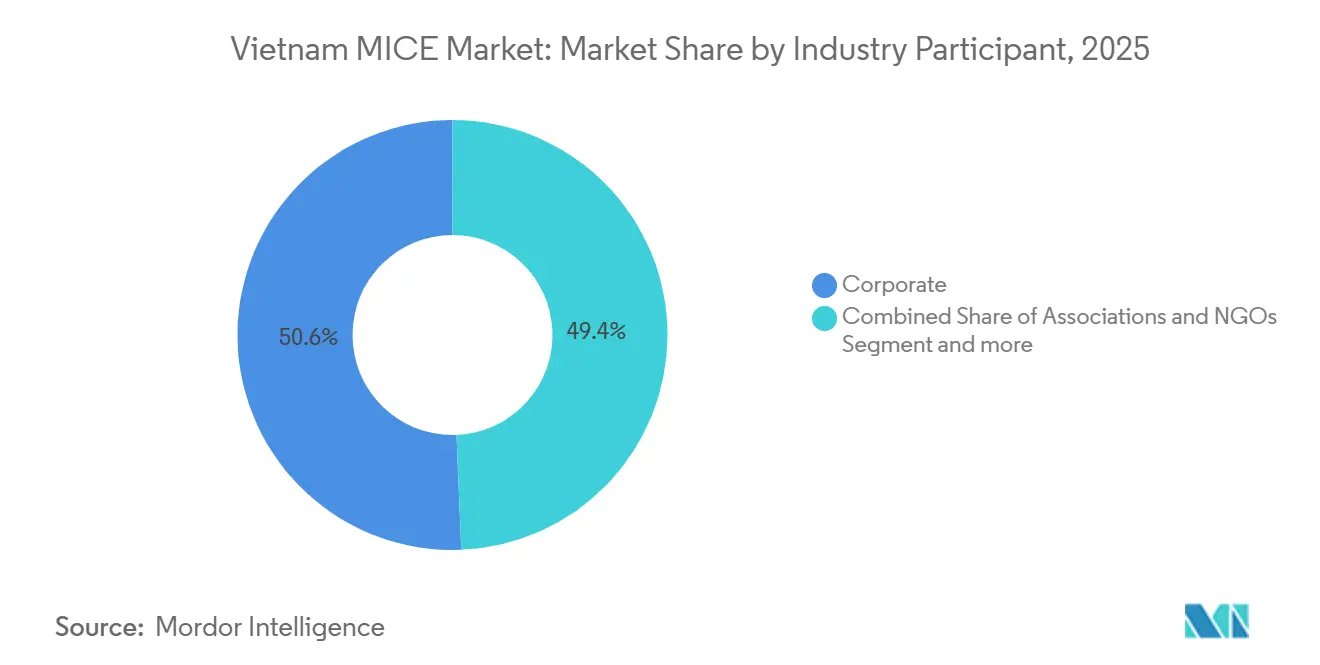
Corporates held 50.64% of the Vietnam MICE market in 2025, driven by routine steering committees and supplier summits essential for operations. Manufacturing multinationals accounted for 37% of inbound meetings, highlighting Vietnam's role in regional supply chains and the need for in-person collaboration with local partners. Associations and NGOs are projected to grow at a 6.60% CAGR through 2031, but limited sustainability-certified infrastructure in 2026 poses challenges for zero-waste or carbon-neutral events. By mid-2025, only seven venues were carbon-neutral, and just 14% of event managers held ISO 20121 credentials, restricting large association congresses requiring ESG compliance. Visa policy upgrades and increased non-stop services in 2025 and 2026 reduced lead times and intermediary fees, enhancing the feasibility of regional meetings for corporates and associations.
Government and public sector events provide long-term visibility. APEC 2027 preparations increased demand for large, secure venues and reliable logistics across host cities in 2026. Sun Group’s APEC 2027 precinct in Phu Quoc, under construction, includes a light rail link and a column-free ballroom, accommodating state and multilateral programs while freeing hotel ballrooms for corporate events. Fragmented digital ticketing in 2025 and 2026 complicated data reconciliation for associations relying on accurate pre-registration analytics for session and F&B planning. Certification and training expansion through 2027 will broaden the talent pool for ESG-mandated events. Corporates are expected to continue prioritizing Vietnam for quarterly and annual cycles, requiring consistent air-lift and reliable facilities. Visa reforms and new airline routes support a stable participation mix across corporates, public sector, and associations in 2026 and beyond.
Geography Analysis
Southern Vietnam is expected to dominate the MICE market by value in 2025, with Central Vietnam projected to achieve the highest CAGR through 2031. The southern corridor, including Ho Chi Minh City, Binh Duong, and Ba Ria‑Vung Tau, will support multi-site rotations for exhibitions and conferences within a unified logistics zone by 2026. Enhanced urban mobility, hotel investments, and expanded airport capacities will streamline event scheduling and reduce conflicts on high-demand days. A strong supplier base and advanced event services will attract technology and manufacturing sectors for quarterly and annual cycles. Visa reforms and improved air connectivity will further boost short-lead corporate demand through direct links and simplified entry processes.
Central Vietnam’s growth will be driven by administrative integration and direct flights connecting Da Nang to Northeast Asia, including the resumed Osaka route, enhancing its competitiveness for association and corporate events. UNESCO-recognized cultural assets will enrich program designs for incentives and leadership meetings, aligning with event planners’ preference for authentic experiences. Coastal cities will see an increase in branded hotels with meeting spaces, adding capacity for mid-sized congresses. Sustainability initiatives in heritage cities will attract ESG-focused programs requiring waste and energy performance reporting. Expanding airline schedules and new hotel openings will strengthen Central Vietnam’s role as a key growth driver in the MICE market.
Northern Vietnam will remain a hub for government and public-sector events, supported by venues equipped for high-security protocols and large delegations. Transport improvements will expand event distribution beyond Hanoi, increasing utilization in nearby provinces. Stable corporate participation from finance and technology sectors will sustain leadership meetings and policy-driven conferences. Simplified visa processes will aid bid conversions, enabling multilateral delegations to confirm attendance closer to event dates. Advancements in connectivity, capacity, and certification will drive event growth across all regions through 2027.
Competitive Landscape
Vietnam's MICE market in 2026 reflects a fragmented structure as destination management companies, venue operators, and hotel chains enhance their capabilities. Sun Group’s APEC 2027 project in Phu Quoc integrates a light rail link, expanded airport, and a column-free ballroom, catering to state and private congresses. Vinpearl’s 2025 capital markets listing supports its expansion, leveraging its national network of upscale hotels and parks to handle larger groups during peak conference seasons. Eventista’s adoption of integrated digital tools like polling and ticketing enables measurable sponsor outcomes, while airlines and hotels align schedules with precincts to reduce transit friction and support larger regional summits.
Global brands are expanding meeting facilities and event spaces. IHG’s 2025 deal in Quang Binh introduces branded meeting capacity to a new provincial destination. Hyatt Regency Nha Trang, launched in December 2025, offers flexible meeting rooms and a pillarless ballroom for mid-sized events. Hilton’s 2024 regional strategy signals increased competition among global chains. Domestic developers continue to enhance attractions and event infrastructure, broadening options for peak seasons. Visa reforms and new air routes favor operators integrating hospitality, transport, and digital engagement into cohesive event experiences.
Corporate clients, particularly from manufacturing and technology sectors, drive demand, requiring reliable connectivity. Associations push vendors to scale sustainability efforts. Vietnam’s cost advantage and emerging tier-2 coastal destinations attract incentive and leadership programs. Organizers consolidate technology platforms to improve sponsor outcomes and justify higher ad budgets as hybrid formats remain standard. With more certified venues and trained staff by 2027, Vietnam is positioned to attract association congresses emphasizing ESG performance and zero-waste execution. The market combines infrastructure growth and technology-driven monetization to maximize client value.
Vietnam MICE Industry Leaders
-
Vietravel
-
Saigontourist
-
Ben Thanh Tourist
-
Fiditour Travel
-
Thien Minh Group (TMG)
- *Disclaimer: Major Players sorted in no particular order
Recent Industry Developments
- February 2026: Vietnam Airlines has signed an USD 8.1 billion agreement to purchase 50 Boeing 737-8 MAX aircraft. Deliveries are scheduled between 2030 and 2032. This acquisition aims to expand the airline's fleet to 151 aircraft by 2030, enhancing connectivity for the Meetings, Incentives, Conferences, and Exhibitions (MICE) sector.
- January 2026: Sun PhuQuoc Airways plans to launch its first international route, connecting Phu Quoc and Taipei, on March 29, 2026. This initiative aims to enhance air connectivity for Phu Quoc, supporting its development as a MICE hub in preparation for the APEC summit in 2027.
- December 2025: Sun Group is constructing a USD 2 billion casino-integrated tourism complex in the Van Don Economic Zone, Quang Ninh. The 70-year project includes conference and exhibition facilities, hotels, and entertainment venues, aiming to enhance the region's tourism infrastructure.
- December 2025: Hyatt Regency Nha Trang opened with 434 guestrooms and 8,428 square feet of flexible meeting and event space. The property includes nine breakout rooms and a pillarless Regency Ballroom, designed to accommodate various events and gatherings.
Vietnam MICE Market Report Scope
The Vietnam MICE Industry report examines the meetings, incentives, conferences, and exhibitions ecosystem, focusing on demand trends, supply-side dynamics, and regional market performance. The study segments the market by event type (meetings, incentives, conferences, exhibitions), revenue sources (tickets, accommodation, F&B, advertising), industry participants (corporate, government, associations/NGOs), and regions (North, Central, South). Key drivers include government promotions, e-visa expansions, hybrid and sustainable event demand, secondary hub growth, bleisure trends, and ESG-linked venue selection. Challenges such as regional competition, limited tier-2 venue capacity, staffing shortages, and fragmented digital systems are also analyzed. The report evaluates the regulatory environment, technological advancements, supply-chain structure, and competitive intensity using Porter’s Five Forces framework. It provides market size estimates, growth forecasts, company profiles, strategic developments, and future opportunities, including net-zero venues and smart-city-integrated delegate experience platforms. The report provides market size and forecasts for the Vietnamese MICE industry, in value (USD), for the above segments.
| Meetings |
| Incentives |
| Conferences |
| Exhibitions |
| Tickets & Registration Fees |
| Accommodation |
| Food & Beverage |
| Advertising |
| Corporate |
| Government & Public Sector |
| Associations & NGOs |
| Northern Vietnam | Hanoi |
| Haiphong | |
| Central Vietnam | Da Nang |
| Hue | |
| Southern Vietnam | Ho Chi Minh City |
| Can Tho |
| By Event Type | Meetings | |
| Incentives | ||
| Conferences | ||
| Exhibitions | ||
| By Source of Revenue | Tickets & Registration Fees | |
| Accommodation | ||
| Food & Beverage | ||
| Advertising | ||
| By Industry Participant | Corporate | |
| Government & Public Sector | ||
| Associations & NGOs | ||
| By Region | Northern Vietnam | Hanoi |
| Haiphong | ||
| Central Vietnam | Da Nang | |
| Hue | ||
| Southern Vietnam | Ho Chi Minh City | |
| Can Tho | ||
Key Questions Answered in the Report
What is the current size and growth outlook of the Vietnam MICE market?
The Vietnam MICE market size was USD 7.28 billion in 2025 and it is projected to reach USD 10.31 billion by 2031 at a 5.97% CAGR, supported by corporate demand, visa reforms, and infrastructure upgrades.
Which event type leads demand in Vietnam’s MICE space?
Meetings led with 44.78% share in 2025, anchored by manufacturing multinationals and routine corporate steering cycles that stabilize year-round demand across major cities.
Which region is growing the fastest for business events in Vietnam?
Central Vietnam is forecast to grow at a 7.02% CAGR through 2031, helped by the Da Nang–Quang Nam integration and restored Japan connectivity that favor association and corporate bids.
How are visa changes and air routes affecting Vietnam’s MICE performance?
Visa reforms with 90-day e visas and added non-stop flights, including Vietnam Airlines’ resumed Da Nang–Osaka route, lower friction, and raise conversion for inbound corporate and association events.
What are the main capacity constraints for MICE in Vietnam?
Tier 2 cities face limited venue and hybrid-ready connectivity, with only 40% fiber coverage and a shortage of ISO 20121 certified staff, which constrains large ESG-mandated events in the near term.
Which supplier strategies stand out in Vietnam’s MICE ecosystem?
Integrated precincts by developers like Sun Group for APEC 2027, hotel pipeline additions by IHG and Hyatt, and Eventista’s hybrid engagement platform illustrate the focus on capacity, connectivity, and digital monetization.