
India MICE Tourism Market Analysis by Mordor Intelligence
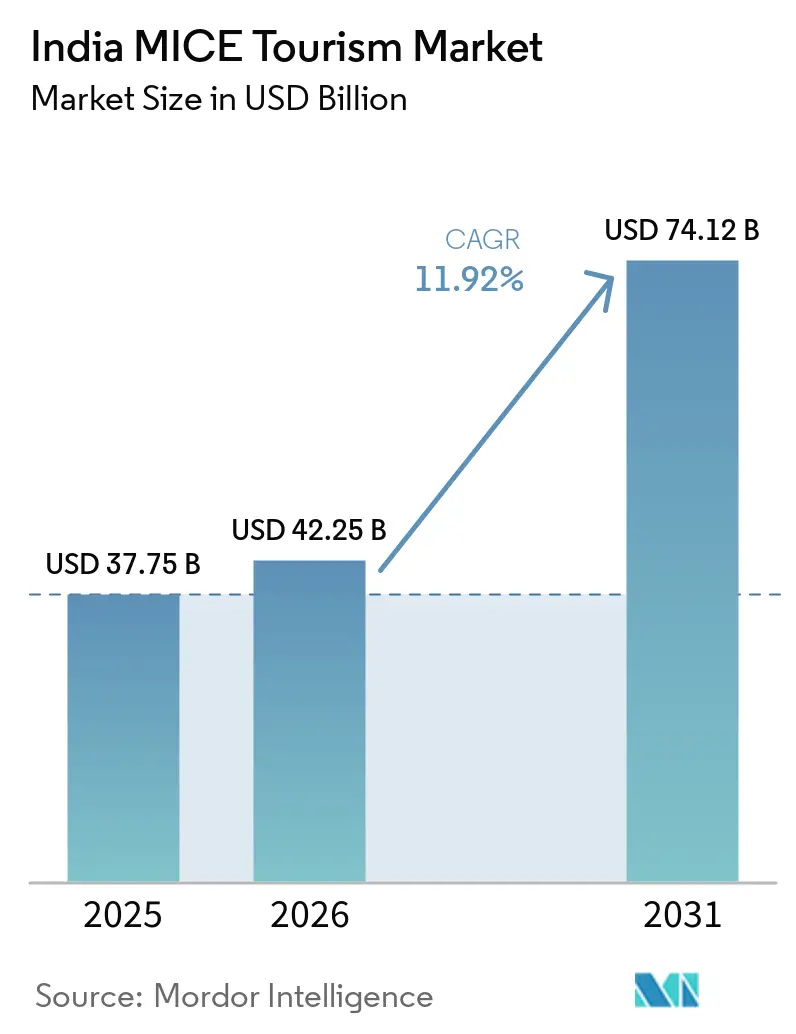
The India MICE tourism market size is expected to increase from USD 42.25 billion in 2026 to USD 47.29 billion in 2027 and reach USD 81.39 billion by 2032, growing at a CAGR of 11.47% over 2027-2032.
Corporate travel and public-sector programs in India provide customers for residential meetings and associated services. Government venue initiatives and hotel projects can serve those programs when rooms and meeting space become available together. Hotel groups can extend branded networks through owner agreements, making conversion execution part of the supply response. Accommodation taxes and interrupted air access can nevertheless limit how readily buyers use that capacity. Aligning room blocks and venues with workable delegate journeys gives destination managers a commercial role in turning capacity into purchasable residential programs.
Key Report Takeaways
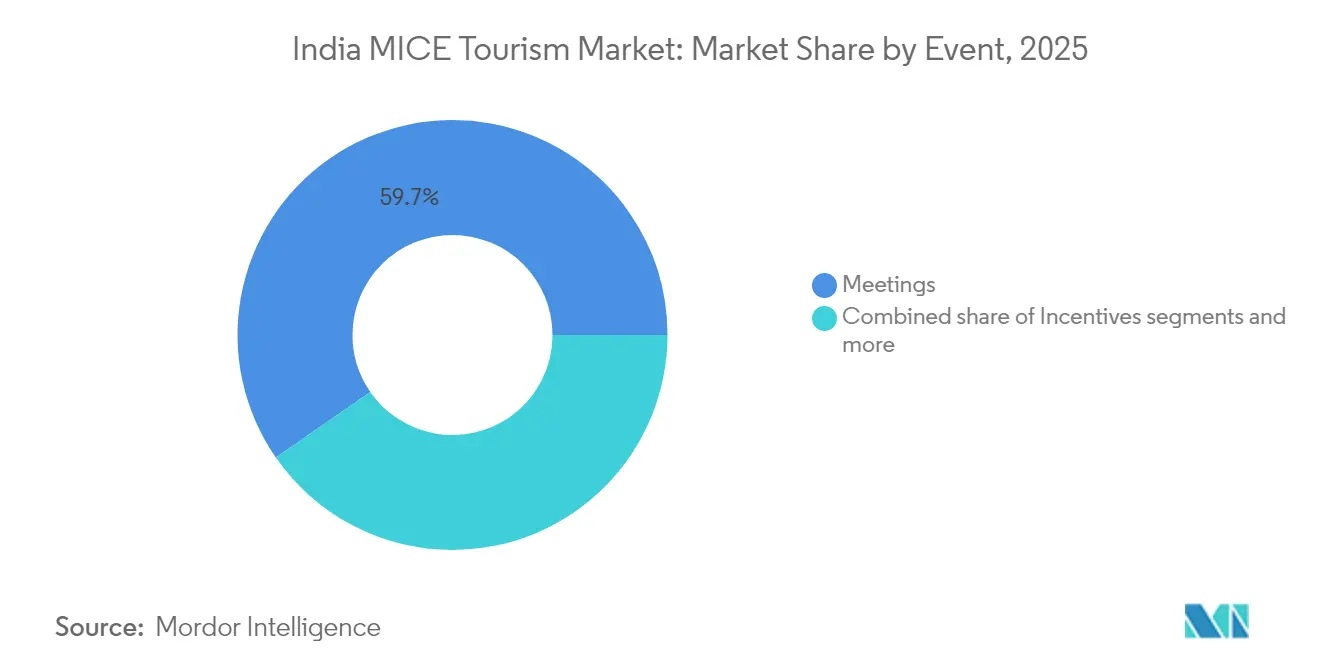
- By event, meetings held a 59.45% India MICE tourism market share in 2026, while incentives are forecast to lead growth at a CAGR of 12.6% over 2027-2032.
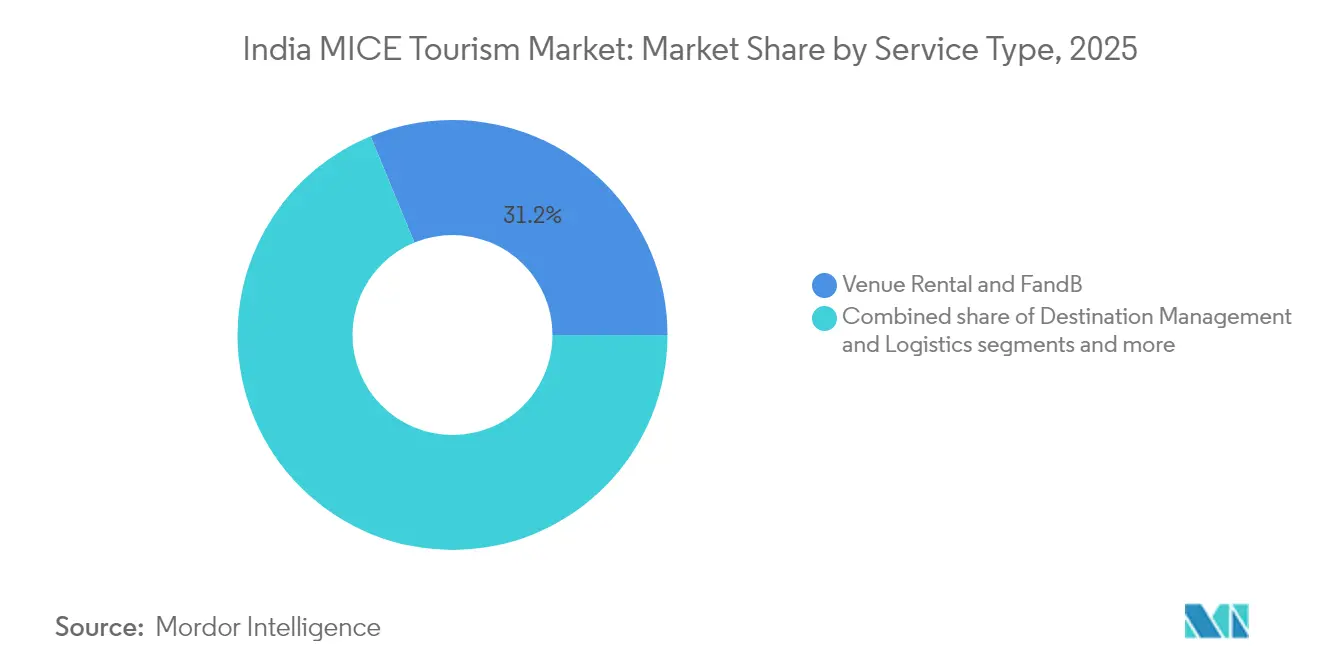
- Among service types, venue rental and food and beverage accounted for a 30.95% share of the India MICE tourism market size in 2026, and event technology enablement is projected to grow fastest at a CAGR of 15.9% over 2027-2032.
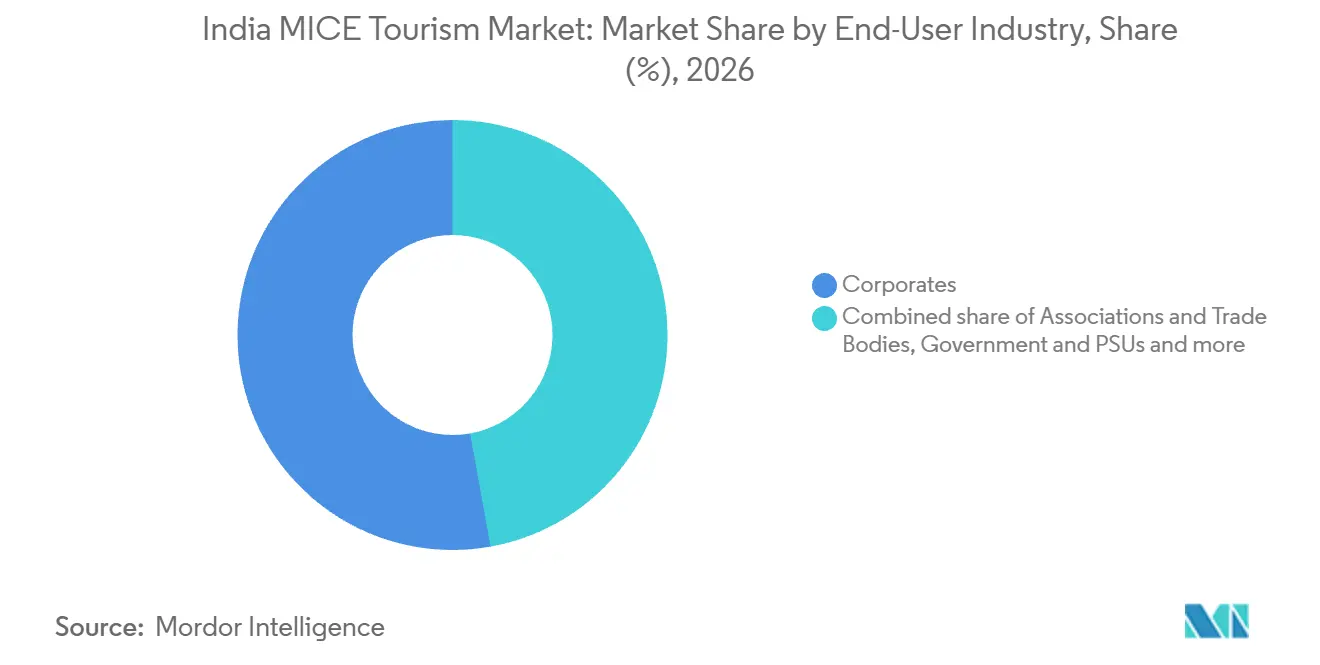
- Corporate buyers led end-user industries with 52.83% of spending in 2026, whereas government and PSUs are forecast to be the fastest-growing segment at a CAGR of 11.8% over 2027-2032.
- Across India’s regions, North India held 45.2% of spending in 2026, with East & North-East India forecast to lead growth at a CAGR of 13% over 2027-2032.
Note: Market numbers in this report are based on Mordor Intelligence's proprietary estimation framework, which combines nine months of actuals with Q4 projections for base year 2026.
India MICE Tourism Market Trends and Insights
Drivers Impact Analysis*
| Driver | (~) % Impact on CAGR Forecast | Geographic Relevance | Impact Timeline |
|---|---|---|---|
| Surge in corporate travel spending | +5.1% | Nationwide | Short term (≤ 2 years) |
| Government push via “Meet in India”, G-20 legacy venues | +3.4% | New Delhi and Jaipur | Short term (≤ 2 years) |
| Rapid hotel and convention-center pipeline | +3% | Nationwide | Medium term (2-4 years) |
| E-visa & E-Conference Visa facilitation | +2.2% | Nationwide | Short term (≤ 2 years) |
| Rise of hybrid/tech-enabled event platforms (under-radar) | +1.5% | Nationwide | Medium term (2-4 years) |
| Bleisure & wellness add-ons boosting delegate spend (under-radar) | +1.2% | Maharashtra and Hyderabad | Medium term (2-4 years) |
| Source: Mordor Intelligence | |||
Surge in corporate travel spending
Corporate travel gives meeting suppliers a substantial customer base through which to sell organized group programs and their associated services. MakeMyTrip said gross bookings across its corporate travel platforms exceeded USD 1 billion in calendar 2025. In February 2026, Thomas Cook (India) and SOTC Travel reported that nearly 65% of surveyed Indian corporates expected travel volumes to rise over the following 12 months. Their report described a survey of 25 or more leading enterprises alongside internal booking and transactional data. Suppliers with established corporate relationships are better placed to convert that travel activity into MICE demand by offering group programs alongside business travel.
Government push via “Meet in India”, G-20 legacy venues
Government departments and public sector undertakings give convention operators an institutional customer base for organized programs. In FY 2025-26, government departments organized around 135 events and public sector undertakings (PSUs) organized 75 at Bharat Mandapam in New Delhi.[1] The Ministry of Tourism, Rajasthan’s Department of Tourism and FICCI also organized the Meet in India Conclave in Jaipur on May 4, 2025. For a convention operator, departmental and PSU assignments can support scheduling across different institutional users. Associated service demand can extend to conference production, participant administration, and on-site execution as each institutional program takes shape. Existing venues can therefore generate supplier work through their institutional customer mix, independently of the pace of new hotel construction.
Rapid hotel and convention-center pipeline
Hotel development can expand the pool of destinations capable of accommodating delegates alongside their convention and meeting facilities. On January 16, 2026, IHG reported 80 hotels in development in India.[2] For a residential conference, the usable room block needs to match attendance across the same dates, so accommodation capacity complements the event hall. Additional hotels can make larger group programs feasible where available rooms would otherwise constrain the choice of venue. The development portfolio creates an opportunity for destination managers to assemble new venue and lodging combinations as properties open. Commercial benefits depend on completed rooms being available near suitable meeting facilities, making delivery and location more consequential than the pipeline count alone.
E-visa & E-Conference Visa facilitation
Digital visa access supports international conferences by giving eligible delegates a defined application route before they commit to traveling. Eligible-country applicants may apply online for India’s e-Conference Visa from 4 to 120 days before arrival. An organizer invitation and Ministry of External Affairs political clearance are mandatory application documents, while Ministry of Home Affairs event clearance is an optional document. In August 2026, the Government of India notified 11 additional international entry ports for e-visa holders.[3] The application window gives organizers a basis for coordinating invitations with delegate registration, while the wider entry network increases potential itinerary choices. Converting that access into conference participation depends on preparing the mandatory documents alongside the program, making organizer readiness part of the destination’s international appeal.
Restraints Impact Analysis*
| Restraint | (~) % Impact on CAGR Forecast | Geographic Relevance | Impact Timeline |
|---|---|---|---|
| High indirect taxes (GST 18% on premium tariffs) | -2% | Nationwide | Short term (≤ 2 years) |
| Air-route concentration & slot scarcity | -1.5% | Bhubaneswar and Odisha | Short term (≤ 2 years) |
| Security-perception shocks in select states | -0.9% | Jammu and Kashmir | Short term (≤ 2 years) |
| Fragmented vendor ecosystem limiting service quality (under-radar) | -0.5% | Nationwide | Long term (≥ 4 years) |
| Source: Mordor Intelligence | |||
High indirect taxes (GST 18% on premium tariffs)
Premium hotel GST can constrain a residential event through both its invoice charge and the buyer’s ability to use tax credits. Hotel accommodation above the prescribed per-unit, per-day value threshold attracts 18% GST in India. The Central Board of Indirect Taxes and Customs treats each state registration of a firm as a separate registered person and bars cross-utilization of credit between those registrations. For an organizer contracting accommodation across states, that separation makes the location of usable credits relevant to the final event cost. A tax-inclusive room quote therefore answers a different question from whether a particular buyer can use the associated credit. For premium residential programs, the relevant constraint is the potentially unrecovered accommodation tax across the delegate stay.
Air-route concentration & slot scarcity
Direct-flight availability can become a binding constraint when an organizer needs international delegates to reach a regional convention destination. By June 2026, Bhubaneswar’s direct Dubai and Singapore services had been discontinued because of declining passenger demand. Both services remained suspended on October 2, 2026. For Odisha event planners, this weakens the accessibility proposition even when suitable meeting facilities are available. In September 2026, the Odisha government said it was extending airline assistance through its new destination policy and viability gap funding to encourage route resumptions and new links. The commercial constraint is dependable delegate access, so incentives alone cannot remove the itinerary uncertainty associated with suspended services.
*Our forecasts treat driver/restraint impacts as directional, not additive. The impact forecasts reflect baseline growth, mix effects, and variable interactions.
Segment Analysis
By Event: Recurring Meetings Sustain Demand as Incentive Programs Expand
Meetings accounted for a 59.45% share of the India MICE tourism market size in 2026, making them the largest event segment. MICEtalk reported that smaller residential conferences typically involve 10 to 12 intimate meetings per month, often for leadership teams, training programs, brainstorming sessions and internal reviews. Their smaller format allows a hotel to serve several kinds of institutional work without depending on a single large convention booking. Flexible meeting spaces can support that variety, while lodging and dining turn an internal session into a residential program. This format can therefore support repeatable demand from several institutional uses, giving hotels an operating role between larger event bookings.
Incentives are forecast to be the fastest-growing event segment, with a CAGR of 12.6% over 2027-2032. In September 2026, IB Group rewarded its best-performing farmers and traders with a Goa trip under the Samriddhi initiative. The sponsor’s purpose links travel to recognized performance, turning the Goa visit into an organized recognition program. Rewarding farmers and traders gives incentive travel an application beyond internal meetings and staff rewards, broadening the commercial relationships around which sponsors can commission group trips.

By Service Type: Venue Utilization Anchors Spending as Event Technology Expands
Venue rental and food and beverage represented a 30.95% India MICE tourism market share in 2026, making it the largest service segment. Bharat Mandapam hosted approximately 365 events in FY 2025-26. The venue’s event calendar illustrates how operating capacity can be used across numerous assignments, giving a facility repeated opportunities to sell event-linked services. Such scheduling makes the fit between a booking’s space requirements and the venue’s available dates commercially important for its operator. Matching those event slots with the catering requirements of individual programs gives the operator a route to supply several on-site components of a single booking.
Event technology enablement is forecast to be the fastest-growing service segment, with a CAGR of 15.9% over 2027-2032. In September 2025, the Ministry of Communications launched an AI-powered India Mobile Congress 2025 app with real-time attendee networking, chat, and meeting scheduling. The app offered these functions to participants, exhibitors, startups, and partners. For the organizer, that audience mix makes networking a service requirement across several groups taking part in the same congress. A technology supplier can address those interactions through one networking and scheduling brief, giving the platform a role in the event’s professional exchanges.
By End-User Industry: Corporate Allocations Lead as Public Institutions Commission Programs
Corporates were the largest end-user segment, accounting for 52.83% of total spending in 2026. In MICEtalk’s 2025 survey, 42.1% of Indian corporate respondents allocated 25% to 50% of their travel budgets to MICE or group movements. Another 34.2% of corporate respondents allocated less than 25% of their travel budgets to those programs. The survey described most companies as balancing MICE spending against broader travel needs, placing suppliers in competition for a bounded allocation within the corporate travel account.
Government and PSUs are forecast to be the fastest-growing end-user segment, with a CAGR of 11.8% over 2027-2032. The Central Electricity Authority held the first day of its 2-day international power-sector AI conference-cum-exhibition at New Delhi’s Manekshaw Centre on October 14, 2026. On November 14, 2025, India Tourism Development Corporation’s Ashok Events Division invited bids for a 2-year nationwide rate contract for conference signage and exhibition-stall setup services on hire. These activities create requirements for both technical convening and repeatable physical event delivery across the public-sector customer base. A multi-year rate framework can spread supplier preparation across assignments, favoring reusable execution capabilities over a separate delivery setup for each institutional event.
Geography Analysis
North India MICE Tourism Market
North India held a 45.2% share of the India MICE tourism market size in 2026, making it the largest regional segment. India Mobile Congress 2025’s conference program at Yashobhoomi in New Delhi featured 918 speakers across 113 sessions from October 8 to 11, 2025. The Department of Telecommunications and the Cellular Operators Association of India jointly organized the congress, bringing a substantial technical conference program to the venue. Its mix of keynote addresses, roundtables, and panel discussions can give specialized conference-production teams work across several technical formats under a single congress engagement.
East & North-East India MICE Tourism Market
East & North-East India is forecast to be the fastest-growing regional segment, with a CAGR of 13% over 2027-2032. Odisha’s 2026 policy provides an April 1 to September 30 incentive for events booking at least 100 rooms daily in Ministry of Tourism or Department of Tourism notified hotels rated 3 stars or above. At least 50% of daily bookings must be for participants from outside Odisha, and payment covers only rooms occupied by those participants. In Kolkata, the NOVACON conference accompanying the International Poultry Fair brought together 1,150 delegates at Biswa Bangla Convention Centre in February 2026. Targeting the incentive to outside-state room nights makes residential conferences a concrete acquisition opportunity for Odisha hotels seeking lean-season delegates.
In West India, real estate developer Casagrand chartered an air-conditioned train with a pantry car, facilitated by IRCTC, for 800 employees from different zones traveling on a corporate offsite to Goa. Consolidating the journey into a charter makes transport coordination part of the offsite proposition, creating work for group-travel organizers. In South India, the American Society of Mechanical Engineers’ International Mechanical Engineering Congress & Exposition India 2025 was underway in Hyderabad on September 13, 2025, the city’s first time hosting the event. That research and industry audience creates a different service requirement around technical sessions and professional exchange, giving specialist congress organizers a separate route to work. Destination strategy can therefore differ sharply between employee-group movement and technical convening, even when both purchases fall within organized MICE travel.
Regulatory Framework and Outlook
The comparison covers selected national and Maharashtra requirements from the perspective of an organizer arranging international conferences and digital delegate registration. National obligations combine conditional conference-security clearance with phased rules for entities acting as data fiduciaries. Maharashtra’s requirements attach fire-safety certification and monitoring duties to covered building owners or occupiers, making supplier compliance relevant to venue choice.
Regulatory Table
| Decision factor | India national framework | Maharashtra |
|---|---|---|
| Primary authority | Ministry of Home Affairs, Foreigners Division for conference clearance; Data Protection Board of India for data-protection enforcement | Director, Chief Fire Officer, or nominated officer |
| Key instruments or direction | Prior-reference conference parameters; phased Digital Personal Data Protection Rules, 2025 | Fire-safety maintenance certificates; monitoring rules for section 45 buildings |
| Commercial effect | Covered-event clearance and applicable attendee-data compliance work | Covered owners or occupiers furnish January and July certificates; approval renewal when another applicable law requires it |
| Current policy attractiveness | Medium | Medium |
| Future direction of policy attractiveness | Hardening | No change |
| Source: Mordor Intelligence | ||
The national framework’s medium attractiveness reflects conditional clearance work, while its hardening direction follows specified notice and processing rules scheduled 18 months after November 2025 publication. Maharashtra’s medium rating balances January and July maintenance certificates and monitoring for section 45 buildings against final-approval renewal only when another applicable law requires it. Its 2025 rules started Phase I monitoring when they took effect, while Phase II routing of critical alarms to local fire services is an undated later stage. Because these duties fall on covered building owners or occupiers and licensed agencies, organizers face the same venue-selection checks pending a notified Phase II date.
Value Chain Stages
The value chain compares program coordination, venue delivery, attendee administration, and destination execution, linking supplier earnings to distinct delivery responsibilities. IHCL’s FY 2025-26 company-wide customer revenue included room, food and beverage, and banquet sales. These channels give hotel operators several on-site earnings sources, while organizers and destination managers provide the coordination needed to assemble the wider event program.
Value Chain Analysis Table
| Primary activity | Key participants | Value capture | Bottleneck | Resilience response |
|---|---|---|---|---|
| Program design and coordination | MICE organizers such as Thomas Cook (India) | Program-coordination service sales | Misalignment between program requirements and local delivery | Confirm responsibilities and service milestones before mobilization |
| Venue and accommodation delivery | Hotel operators such as Indian Hotels Company Ltd. (IHCL) | Room, food and beverage, and banquet sales | Mismatch between room blocks and event-space availability | Coordinate event dates with confirmed room blocks |
| Registration and ticketing | Event-technology suppliers such as Dreamcast India Pvt. Ltd. | Event-platform service sales | Mismatch between registration workflow and arrival volumes | Rehearse check-in and prepare arrival contingencies |
| Destination execution | Destination-management companies such as Creative Travel DMC India | Destination-management service sales | Unsynchronized bookings and transfers | Align supplier confirmations with delegate arrival schedules |
| Source: Mordor Intelligence | ||||
Venue operators earn through on-site purchases, while organizers and destination managers monetize coordination across the program’s separate suppliers. Date and arrival planning connect those roles, since an available ballroom alone does not secure delegate lodging or synchronized ground handling. Closer coordination can shift more work toward service integration while preserving a distinct earnings role for venues supplying rooms and banquet facilities.
Competitive Landscape
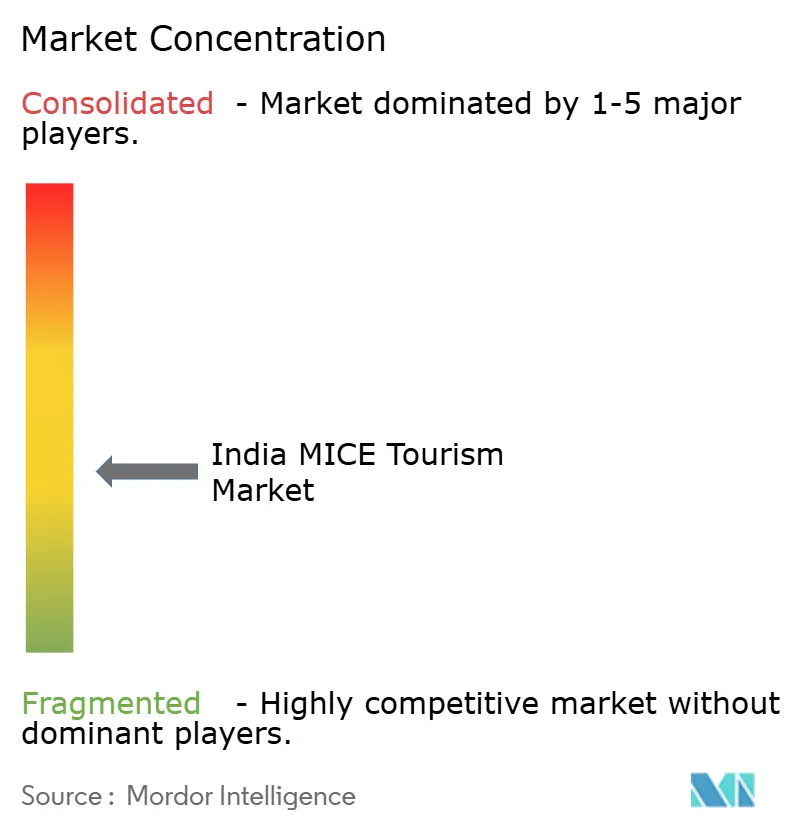
Competition combines large hotel groups with third-party property owners, creating a dispersed operating and ownership base around recognizable brands. Leading participants include Indian Hotels Company Ltd. (IHCL), Marriott International India, Accor India, Hyatt Hotels India, and ITC Hotels. IHCL served MICE guests alongside leisure, business, and long-stay guests in FY 2025-26. In May 2025, Marriott announced a founding agreement with Concept Hospitality covering The Fern portfolio of 84 open properties and 31 executed pipeline deals in India. Those properties were expected to join over time after owner discussions and long-term franchise agreements, making conversion execution decisive for an organizer seeking participating hotels.
In June 2026, Accor signed an agreement with Amarnani Promoters Group for the planned 160-key Novotel Lucknow Convention Centre. The Lucknow project was scheduled to open in 2031 with approximately 4,000 square meters of banquet and event space. Pairing rooms with dedicated event space gives the development a potential role in accommodating and convening the same group. For organizers considering Lucknow, the competitive proposition is therefore an integrated residential venue, with its usefulness dependent on delivery of the planned hotel and event facilities.
ITC Hotels’ October 2025 Epiq Collection announcement paired an owned 118-room Puri project with a managed 201-room Tirupati project. Both projects were under development and planned to open within 2 years of the announcement. Those formats separate ownership-led expansion in Puri from a management-led addition in Tirupati. In FY 2025-26, IHCL said its hotels aligned with Food Safety and Standards Authority of India regulations through continuous monitoring, documented compliance protocols, and periodic verification. ITC’s announced room expansion therefore depends on project delivery, while IHCL’s documented food-safety verification addresses catering risk at hotels it already operates.
India MICE Tourism Industry Leaders
-
Indian Hotels Company Ltd. (IHCL)
-
Marriott International India
-
Accor India
-
Hyatt Hotels India
-
ITC Hotels
- *Disclaimer: Major Players sorted in no particular order
Key Opportunities for Market Participants
Convention organizers need venue capacity that can accommodate both events and overnight delegates. In September 2026, Tivoli Hospitality Group said Omnia Convention by Tivoli in Gurugram had expanded from 40 to 152 rooms and from two to four banquet venues. Full operation was scheduled by the end of November 2026, creating a prospective addition to the destination’s event-and-stay offer.
Market Opportunities Table
| Opportunity | Why now | Buyer / lead segment | Recommended play | Main barrier | Likely beneficiaries |
|---|---|---|---|---|---|
| Integrated event-and-stay packages | Additional Gurugram rooms and banquet venues were scheduled for full operation | Conference organizers with overnight delegates | Build conditional packages combining meeting space and accommodation | Verifying venue readiness before confirming event dates | Hotels and destination-management companies |
| Multi-format banquet and meeting programs | The announced expansion doubled banquet venues | Corporate meetings and conference buyers | Match the event format to the available venue configuration | Actual availability and operating readiness | Convention operators and event organizers |
| Delegate coordination around new capacity | Scheduled operation provides a planning point for future events | Organizers coordinating accommodation and local services | Coordinate room blocks and delegate services after confirming readiness | No committed bookings or open supplier procurement were established | Destination-management companies and participating hotels |
| Source: Mordor Intelligence | |||||
The central opening is a coordinated event-and-stay offer for organizers using Gurugram’s additional convention capacity. Room blocks and banquet requirements can be planned together, reducing the number of separate arrangements an organizer must manage. The announced completion timetable provides a planning point, while final booking commitments depend on confirmed operating readiness. Service providers should validate access and availability before committing capacity of their own.
Recent Industry Developments
- Sep 2026: Tivoli Hospitality Group expanded Omnia Convention by Tivoli in Gurugram from 40 to 152 rooms and from 2 to 4 banquet venues.
- Sep 2026: Following a July 16 agreement, ITC Hotels completed its acquisition of GHK Hospitality & Infrastructures Limited, owner of the 130-room Welcomhotel Ahmedabad, which ITC already operated under an operating-services agreement.
- Apr 2026: IHCL signed a greenfield Gateway Hotel and Convention Centre project with Hombale Group in Kanamangala, Devanahalli, near Bengaluru Airport, specifying 300 keys and more than 16,000 square feet for the largest banquet hall.
Research Methodology Framework and Report Scope
Market Definition and Coverage
The India MICE tourism market measures annual spending on organized MICE programs and the services used to deliver them. It counts event-linked purchases by organizers, sponsoring organizations and delegates throughout India.
Scope exclusions: Pure leisure tourism spending, non-event corporate travel, and spending on non-MICE events are excluded.
Segmentation Overview
- By Event
- Meetings
- Incentives
- Conferences
- Exhibitions
- By Service Type
- Venue Rental & F&B
- Destination Management & Logistics
- Event Technology Enablement
- Creative & Production Services
- By End-User Industry
- Corporates
- Associations & Trade Bodies
- Government & PSUs
- Academic & Research
- By Geography
- North India
- West India
- South India
- East & North-East India
Data Sources, Market Sizing, and Validation
Desk Research
Public sources such as the Ministry of Tourism's Research & Analytics Division and tourism statistics portal can establish domestic and inbound travel patterns, while its annual report and Press Information Bureau releases describe tourism policy, MICE promotion and public convention infrastructure. India Convention Promotion Bureau material can inform event categories, city promotion and convention activity, and hotel company disclosures such as IHG's India development updates can indicate accommodation capacity relevant to residential programs.
Company annual reports, exchange filings, investor presentations and reputable business press can supplement public tourism and event evidence with hotel openings, venue investments, event bookings and service expansion. These sources can be compared with official arrival and tourism measures and association material to clarify whether a signal concerns organized MICE activity or a wider tourism or event category. The named sources are examples and not exhaustive, and further sources inform collection, validation and clarification.
Primary Interviews and Surveys
Structured interviews and a concise survey would cover Indian MICE organizers, venue and hotel operators, destination managers, event technology and production suppliers, and corporate, association and public-sector buyers. Respondents would check source interpretations, event-linked spending boundaries, service and event mix, geographic allocation and demand drivers, while unresolved gaps would be documented and triangulated against public company, tourism and venue evidence.
Distribution of primary research fieldwork respondents
| Company type | Respondent position | Region |
|---|---|---|
| Top tier: 30% | CXOs: 20% | |
| Mid tier: 50% | Functional/Unit leaders: 35% | |
| Smaller Players: 20% | Managers: 45% |
Market-Sizing & Forecasting
The estimate would start with a top-down value for organized MICE spending in India, then test key totals through selective checks such as supplier revenue roll-ups and sampled event spending by attendance and realized price. Event-linked travel and lodging, venue and catering spend, event planning and destination services, and technology and production purchases provide practical indicators: travel and room data help gauge residential program scale, venue and hotel capacity inform event throughput, and supplier disclosures and buyer interviews help test service spending and price changes. Event, service, end-user and regional shares would be built from these activity and spending signals, with bundled packages counted once at the final customer price and subcontract payments removed where they are already embedded.
Annual history and the available indicator series would support a multivariate regression where relationships are sufficiently stable, with scenario analysis for policy, travel access or venue changes that cannot be represented reliably by past patterns. Value forecasts would reflect both activity and price or service mix, while missing indicator years would be bridged using the closest consistent official or company series and checked against supplier and buyer evidence. India-based experts would review the direction and plausibility of variable-level forecasts, and any disagreement would prompt a documented sensitivity check rather than an assumed consensus.
Data Validation & Update Cycle
Analysts would triangulate official tourism and policy signals with hotel, venue, organizer and supplier evidence, then check totals and segment shares for unexplained changes, inconsistent periods and outliers against prior years and related indicators. A second analyst review would trace material inputs to their source and resolve anomalies before sign-off, with re-contact triggered when a source definition is unclear or an important estimate conflicts with independent evidence. The dataset would be refreshed annually, reviewed between cycles after material events such as major venue openings or travel disruptions, and given a fresh pre-delivery update pass.
Mordor Intelligence's India Mice Tourism Market Size Versus Other Published Estimates
The India MICE tourism market measures annual spending on organized MICE programs and the services used to deliver them. Event-linked travel and lodging, venue and catering spend, event planning and destination services, and technology and production purchases provide practical indicators: travel and room data help gauge residential program scale, venue and hotel capacity inform event throughput, and supplier disclosures and buyer interviews help test service spending and price changes.
Key Gap Drivers are addressed through a consistent transaction boundary, market-specific demand inputs and cross-checks across the study. Analysts would triangulate official tourism and policy signals with hotel, venue, organizer and supplier evidence, then check totals and segment shares for unexplained changes, inconsistent periods and outliers against prior years and related indicators.
Benchmark comparison
| Source | Market Size | Gaps in Research Methodology |
|---|---|---|
| Mordor Intelligence | USD 47.29 B (2027) | |
| Global Consultancy A | USD 124.7 B (2026) | At its 2026 base, this estimate is 163.7% above this report's 2027 value of USD 47.3 B, 1 year later. |
| Regional Consultancy B | USD 5.42 B (FY2025) |
Mordor Intelligence ties the estimate to the study’s defined coverage and demand model. Analysts would triangulate official tourism and policy signals with hotel, venue, organizer and supplier evidence, then check totals and segment shares for unexplained changes, inconsistent periods and outliers against prior years and related indicators.
Key Questions Answered in the Report
What is the India MICE tourism market size and growth outlook?
The size is expected to reach USD 47.29 billion in 2027 and USD 81.39 billion by 2032, at a CAGR of 11.47% over 2027-2032.
Which forces are expanding MICE demand in India?
Corporate travel, institutional event programs, and hotel development support demand. IHG reported 80 hotels in development in India on January 16, 2026.
Which event category leads MICE spending in India?
Meetings held 59.45% of total spending in 2026. Incentives are forecast to grow fastest, at a CAGR of 12.6% over 2027-2032.
Which companies are key participants in India’s MICE sector?
Key participants include Indian Hotels Company Ltd. (IHCL), Marriott International India, Accor India, Hyatt Hotels India, and ITC Hotels.
Which cost challenge affects premium residential MICE programs?
Qualifying premium hotel accommodation in India attracts 18% GST. Separate state registrations can also limit the use of tax credits across registrations.
Which Indian regions lead MICE activity and growth?
North India held 45.2% of spending in 2026. East & North-East India is forecast to grow fastest, at a CAGR of 13% over 2027-2032.