
Vehicle Mounted Router Market Size and Share
Market Overview
| Study Period | 2020 - 2031 |
|---|---|
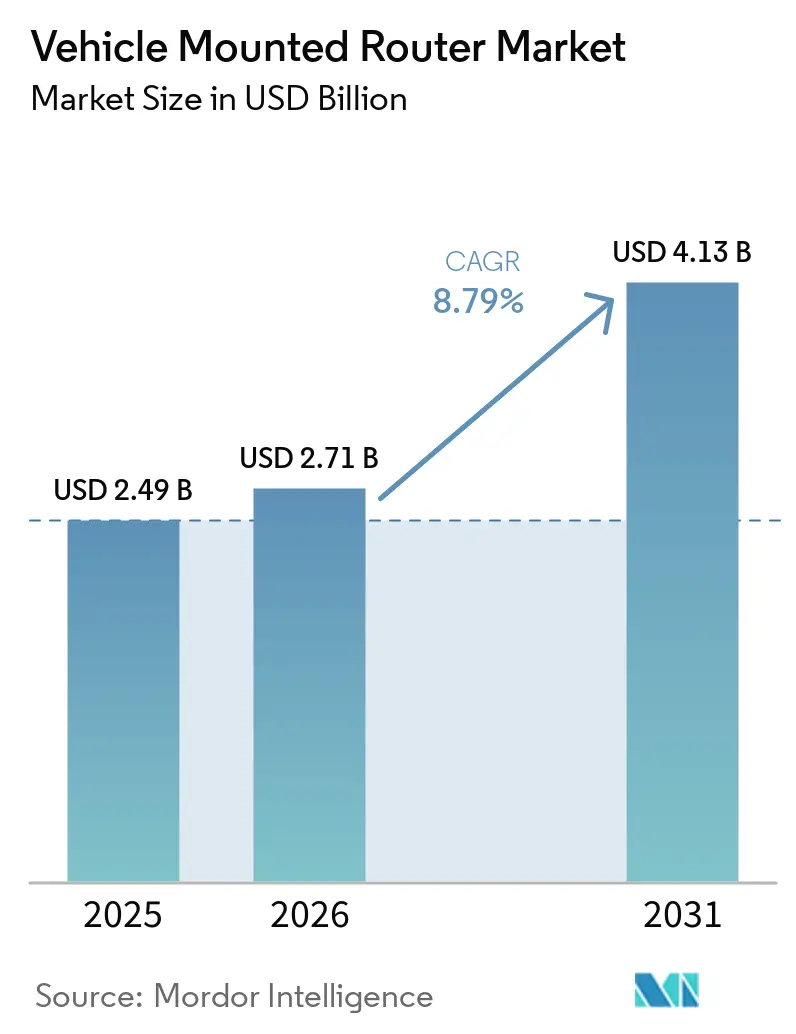
| Market Size (2026) | USD 2.71 Billion |
| Market Size (2031) | USD 4.13 Billion |
| Growth Rate (2026 - 2031) | 8.79 % |
| Fastest Growing Market | Middle East |
| Largest Market | Asia |
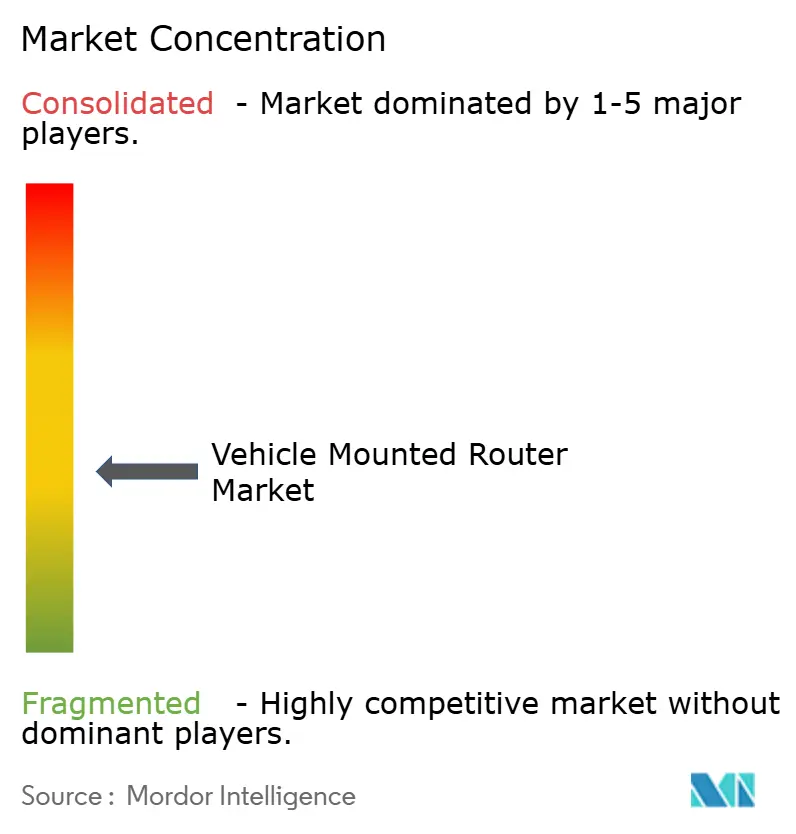
| Market Concentration | Medium |
Major Players *Disclaimer: Major Players sorted in no particular order Image © Mordor Intelligence. Reuse requires attribution under CC BY 4.0. | |
Vehicle Mounted Router Market Analysis by Mordor Intelligence
The vehicle-mounted router market size was valued at USD 2.49 billion in 2025 and is estimated to grow from USD 2.71 billion in 2026 to USD 4.13 billion by 2031, at a CAGR of 8.79% during the forecast period (2026-2031). Mandatory eCall and intelligent-transport compliance in Europe and Asia, rapid 5G vehicle-to-everything rollouts that achieve sub-20-millisecond latency, and logistics networks that depend on real-time telematics combine to accelerate demand. Automotive OEMs now default to factory-installed dual-SIM routers that support over-the-air updates, while last-mile delivery fleets retrofit older vehicles to meet tighter service-level agreements. Public-safety broadband programs such as FirstNet expand premium demand for ruggedized units, yet high hardware costs and cross-border roaming frictions temper adoption. Asia-Pacific leads deployment volumes, but the Middle East posts the fastest growth as governments fund 5G highway corridors and citywide C-V2X grids.
Key Report Takeaways
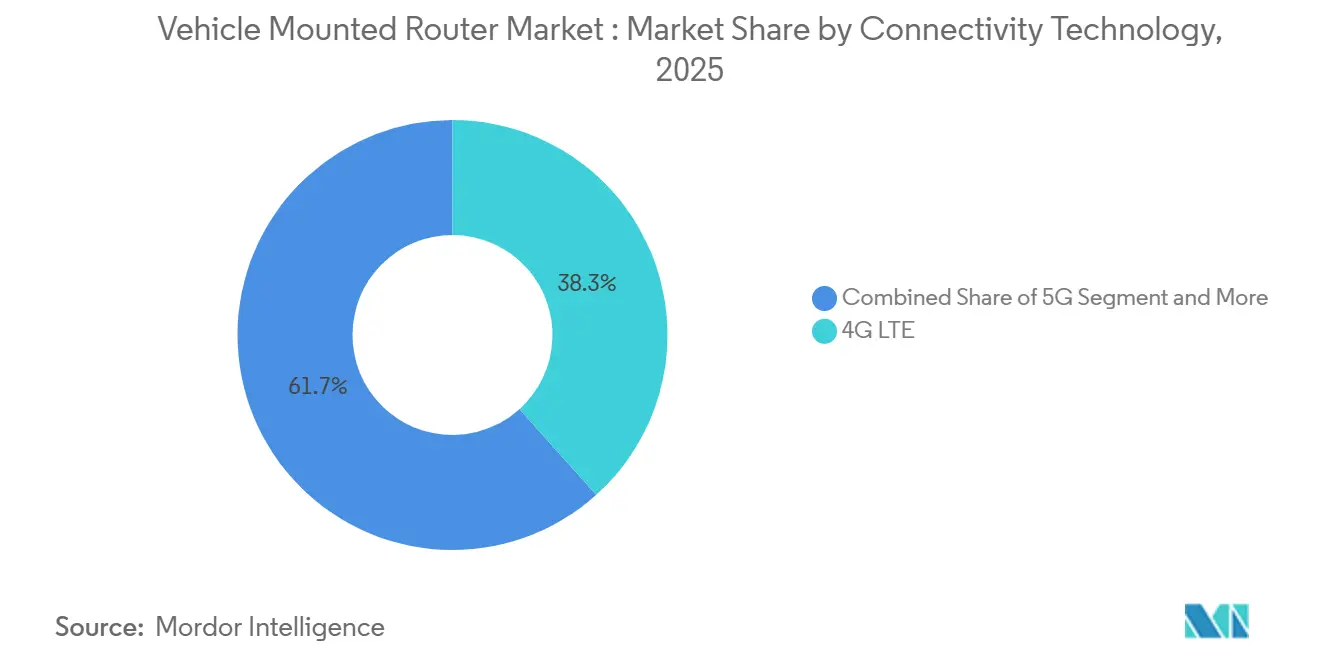
- By connectivity technology, 4G LTE led with 38.34% of vehicle mounted router market share in 2025, while 5G modules are projected to expand at a 14.26% CAGR through 2031.
- By application, fleet management accounted for 41.92% revenue share in 2025; autonomous driving data uplink is forecast to register the fastest 15.61% CAGR to 2031.
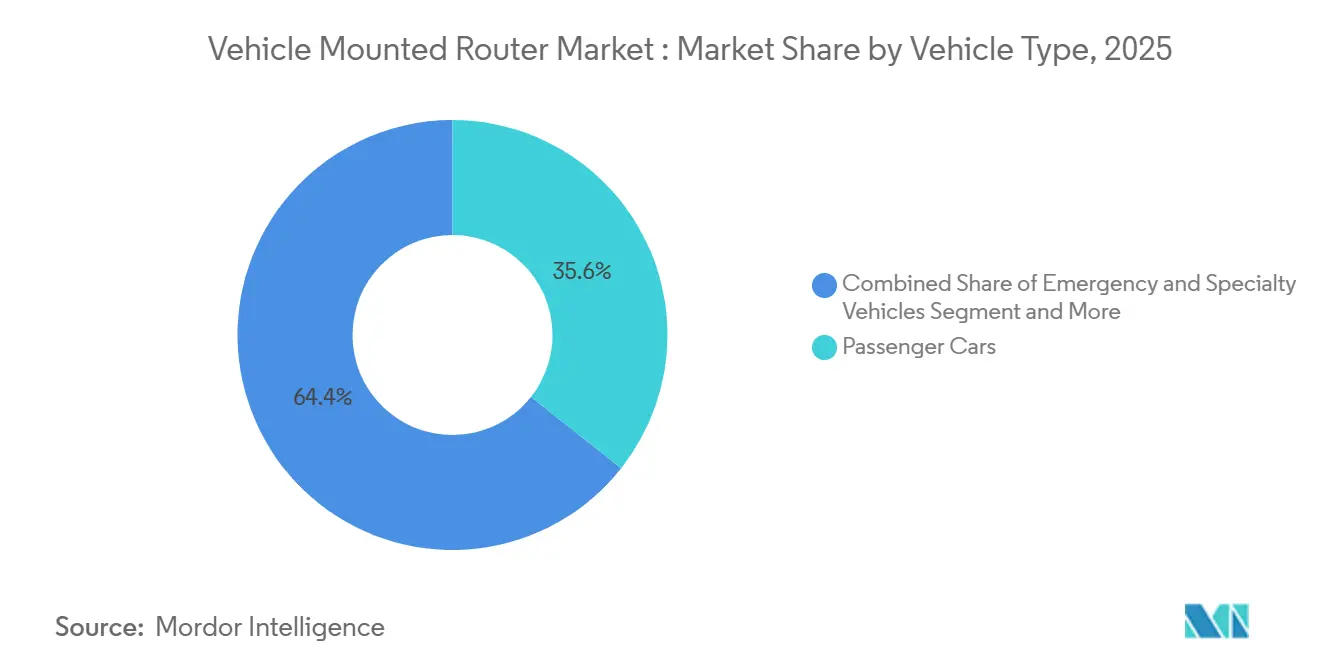
- By vehicle type, passenger cars represented 35.63% of 2025 shipments, whereas emergency and specialty vehicles are poised to grow at a 12.32% CAGR over 2026-2031.
- By end-user, OEM-installed routers captured 52.71% of 2025 demand, while mobility-as-a-service providers are projected to rise at a 13.83% CAGR during the same period.
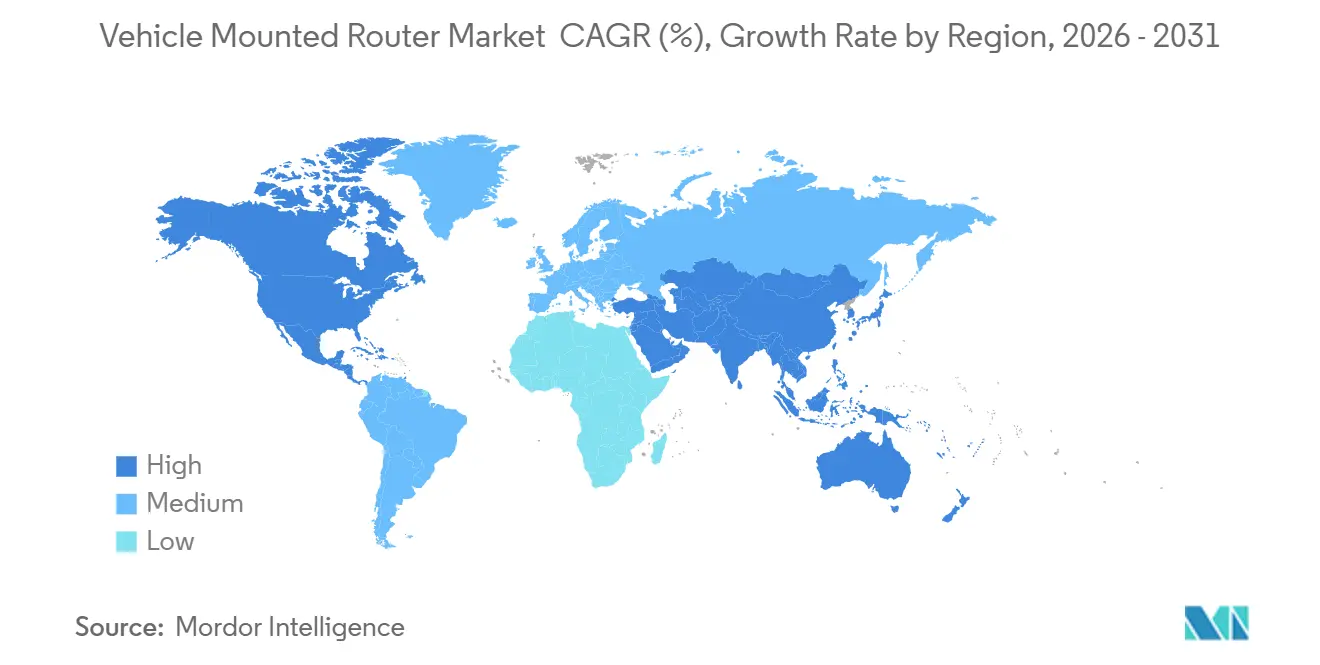
- By geography, Asia-Pacific held a 36.24% revenue share in 2025, and the Middle East is expected to post the quickest 11.24% CAGR through 2031.
Note: Market size and forecast figures in this report are generated using Mordor Intelligence’s proprietary estimation framework, updated with the latest available data and insights as of January 2026.
Market Trends and Insights
Drivers Impact Analysis of Vehicle Mounted Router Market*
| Driver | (~) % Impact on CAGR Forecast | Geographic Relevance | Impact Timeline |
|---|---|---|---|
| Proliferation of 5G Vehicle-to-Everything Standards | +2.10% | Global, led by China, South Korea, Germany | Medium term (2-4 years) |
| Rising Demand for Real-Time Fleet Telematics in E-Commerce Logistics | +1.80% | Urban corridors in North America, Europe, Asia-Pacific | Short term (≤ 2 years) |
| Increasing Adoption of Connected Emergency Response Vehicles | +1.30% | North America, Europe, Middle East | Medium term (2-4 years) |
| OEM Integration of Over-the-Air Software Update Capabilities | +1.10% | Global, strongest in North America and Europe | Long term (≥ 4 years) |
| Regulatory Mandates for eCall and Intelligent Transport Systems | +0.90% | Europe, India, China | Short term (≤ 2 years) |
| Emergence of Edge-Enabled Content Delivery for In-Vehicle Infotainment | +0.60% | Premium segments in North America, Europe, Asia-Pacific | Long term (≥ 4 years) |
| Source: Mordor Intelligence | |||
Proliferation Of 5G Vehicle-To-Everything Standards
Releases 16 and 17 of 3GPP formalize sub-20 millisecond latency and 99.999% reliability thresholds, removing technical ambiguity and accelerating OEM-level commitment to C V2X integration. China’s policy targets 50% 5G penetration in new vehicles by 2026 and 95% by 2030, structurally expanding demand for dual 5G routers with carrier redundancy and failover capabilities. Europe’s 2024 regulatory alignment toward C V2X over 802.11p has already translated into model year 2026 platform commitments from major OEMs, while South Korea’s mandate for C V2X in all new commercial vehicles from 2024 ensures baseline volume. Over 30 live pilots across 12 countries validate use cases such as cooperative adaptive cruise control and hazard signaling, collectively creating a sustained upgrade cycle and shifting vendor competition toward certification breadth, interoperability, and lifecycle management capabilities.[1]
Rising Demand For Real-Time Fleet Telematics In E-Commerce Logistics
Large fleet operators such as Amazon and DHL stream high-frequency telematics, including location, driver behavior, and cold-chain parameters, at roughly 30-second intervals, which materially increases bandwidth utilization and forces routers to dynamically manage dual SIM failover alongside embedded edge analytics that suppress non-critical data. This architecture reduces detention times and fuel pilferage through real-time visibility but materially increases carrier data costs, often exceeding USD 10 per gigabyte, creating a direct operating expense trade-off. Empirical evidence from platforms such as Shipsy indicates up to 18% reduction in yard dwell time when transitioning from batch to continuous data transmission. In parallel, North America and Europe are enforcing Quality of Service prioritization, where safety-critical alerts override bulk telemetry, pushing router vendors to integrate traffic shaping and policy-based routing at the firmware level. This combination of efficiency gains and regulatory alignment sustains hardware refresh cycles, even among cost-constrained mid-market fleet operators.[2]
Increasing Adoption Of Connected Emergency Response Vehicles
The FirstNet ecosystem now supports over 6.25 million connected devices, with its Fusion platform integrating video, geolocation, and dispatch workflows through in-vehicle rugged routers, effectively setting a de facto standard for mission-critical connectivity. More than 50% of the top 100 U.S. police departments have standardized on hardened units designed to withstand high shock, vibration, and temperature extremes, reinforcing strict hardware durability benchmarks. This model is being replicated in the United Arab Emirates and Saudi Arabia, where government-backed programs are funding sub-10-millisecond C-V2X corridors to enable priority signaling for emergency vehicles such as ambulances and fire services. For router vendors, achieving FirstNet or equivalent certification creates high entry barriers but unlocks multi-year procurement contracts with predictable replacement cycles, driving elevated average selling prices and stable long-term revenue streams.[3]
OEM Integration Of Over-The-Air Software Update Capabilities
Automakers increasingly substitute physical recalls with over-the-air firmware updates, a shift that General Motors reports has delivered cumulative savings of USD 2 billion, fundamentally altering lifecycle cost structures and aftersales risk management. Under UNECE Regulation No. 156, OEMs must implement encrypted update pipelines and secure boot architectures, effectively raising the baseline telematics hardware requirements to at least 2 GB of DRAM and 32 GB of flash. Tesla, Inc. established early benchmarks for OTA-first vehicle architectures, but incumbent OEMs are now allocating multi-year capex to platform redesigns that embed higher-performance routers at the production stage. This transition increases the bill of materials value per vehicle, extends design-win visibility for suppliers, and introduces structural entry barriers for low-cost vendors lacking cybersecurity compliance and firmware orchestration capabilities.
Restraints Impact Analysis of Vehicle Mounted Router Market*
| Restraint | (~) % Impact on CAGR Forecast | Geographic Relevance | Impact Timeline |
|---|---|---|---|
| High Total Cost of Ownership for Ruggedized Automotive Routers | -1.40% | Global, acute in South America and Africa | Short term (= 2 years) |
| Interoperability Challenges Among Multi-Carrier Networks | -0.90% | Cross-border corridors in Europe, North America-Mexico, ASEAN | Medium term (2-4 years) |
| Data Privacy and Cybersecurity Concerns Limiting Adoption | -0.70% | Europe, North America, China | Long term (= 4 years) |
| Supply Chain Constraints of Automotive-Grade Chipsets | -0.50% | Global, advanced-node fabs | Short term (= 2 years) |
| Source: Mordor Intelligence | |||
High Total Cost Of Ownership For Ruggedized Automotive Routers
Dual 5G rugged routers are priced near USD 4,600 per unit, more than 3x the cost of comparable 4G LTE hardware once compliance costs such as MIL-STD-810H validation, IP67 sealing, and multi-carrier certification are included in the bill of materials. In parallel, engineering outlays can reach USD 500,000 per SKU, constraining the viable supplier base to vendors with sufficient scale and depth of certification. Cost pressure is most visible in South America and Africa, where smaller fleets often substitute industrial routers with consumer-grade hotspots placed in protective enclosures, capturing up to 80% upfront savings but accepting materially higher failure rates and lifecycle replacement costs. Connectivity opex compounds the issue: a 10-vehicle fleet consuming 5 GB per month per unit incurs roughly USD 6,000 annually, which compresses ROI unless offset by quantifiable gains such as fuel efficiency improvements, reduced downtime, or insurance premium discounts tied to telematics adoption.
Interoperability Challenges Among Multi-Carrier Networks
Cross-border fleet operations face structural inefficiencies as vehicles roam across heterogeneous carrier networks with uneven 5G standalone coverage, creating latency volatility and fragmented billing regimes. Handover delays exceeding 150 milliseconds breach collision-warning thresholds required for real-time safety applications, while dual-SIM redundancy, though operationally necessary, effectively doubles connectivity costs. Adoption of GSMA IoT SAFE remains limited, with fewer than 30% of operators supporting remote SIM provisioning by 2025, constraining seamless identity and credential management across borders. Although the European Union has proposed tariff harmonization frameworks, disputes around wholesale access and operator economics continue to delay implementation. As a result, fleet operators must incorporate connectivity cost buffers into planning, while router vendors prioritize multi-carrier bonding, intelligent failover, and latency-optimization algorithms to mitigate service discontinuities.[4]
*Our forecasts treat driver/restraint impacts as directional, not additive. The impact forecasts reflect baseline growth, mix effects, and variable interactions.
Vehicle Mounted Router Market Segment Analysis
By Connectivity Technology:
Dual-5G Redundancy Underpins Mission-Critical Use CasesThe vehicle-mounted router market for connectivity modules remains anchored in 4G LTE, which accounted for 38.34% of the market in 2025, as Cat 4 to Cat 12 variants sufficiently meet most telematics bandwidth requirements at a lower total cost of ownership. However, 5G modules are projected to grow at a 14.26% CAGR through 2031, driven by OEM migration toward dual 5G architectures that maintain parallel connections across two carriers to ensure sub-50 millisecond failover during safety-critical events. Vendors are increasingly integrating Wi-Fi 6 and 6E radios to offload high-bandwidth infotainment traffic from cellular networks, improving spectrum efficiency. Satellite hybrid routers remain limited to niche deployments such as mining and remote agriculture due to cost constraints. As telecom operators phase out 3G infrastructure globally, legacy devices are exiting the installed base, triggering a replacement cycle that structurally supports higher-value 5G router adoption, particularly in urban and high-growth logistics corridors.
Second-generation dual 5G routers are advancing toward simultaneous carrier aggregation across the mid-band C-band and high-frequency millimeter-wave spectrum, enabling peak speeds approaching 10 gigabits per second under controlled conditions. For logistics operators, this configuration functions as operational insurance against network disruptions, such as the February 2025 outage that impacted approximately 70,000 users on a major United States carrier. Embedded edge intelligence is increasingly used to dynamically prioritize safety-critical data packets when signal quality deteriorates, ensuring compliance with latency thresholds near 20 milliseconds. Over the forecast horizon, declining semiconductor costs and more standardized global certification frameworks are expected to compress the price differential between 4G and 5G modules, accelerating adoption and reinforcing 5G as the primary connectivity layer for next-generation vehicle-mounted router deployments.

By Application:
Data-Intensive Autonomous Operations Outpace Traditional TelematicsFleet management accounted for 41.92% of revenue in 2025, anchored by regulatory mandates around GPS tracking, driver logging, and compliance reporting that sustain baseline demand across logistics and commercial transport. However, autonomous driving data uplink is set to outpace all other use cases with a 15.61% CAGR through 2031, driven by the need to transmit high volume edge case sensor logs for continuous refinement of perception and decision models. This workload requires routers capable of sustained uplink bursts near 500 Mbps, pushing hardware specifications toward higher throughput modems and advanced antenna configurations. In parallel, public safety applications represent an above average growth segment, supported by real time video streaming, situational awareness feeds, and command center integration in emergency vehicles, all of which impose stringent latency, reliability, and prioritization requirements on router infrastructure.
On the demand side, rising infotainment subscriptions are incentivizing OEMs to embed Wi Fi 6 and 6E modules at the factory level, reducing cellular backhaul costs by offloading high bandwidth content to local networks where available. Predictive maintenance analytics further reinforce adoption, as fleets leverage continuous diagnostics to minimize unplanned downtime and extend asset life cycles, directly improving operating margins. At the margin, niche applications such as mobile point of sale systems and precision agriculture contribute a fragmented but expanding revenue tail, particularly favoring vendors that support open firmware environments for application level customization. Across all verticals, quality of service enforcement, network slicing compatibility, and integrated cybersecurity modules are becoming baseline procurement criteria, effectively separating premium, enterprise grade routers from commoditized low cost alternatives.
By Vehicle Type:
Emergency Fleets Justify Premium SpecsPassenger cars accounted for 35.63% of unit shipments in 2025, primarily driven by mid-range sedans and SUVs equipped with 4G LTE routers that support infotainment, navigation, and baseline safety services at optimized cost. In contrast, emergency and specialty vehicles are projected to grow at a 12.32% CAGR, as agencies transition toward mission-critical connectivity built on FirstNet-certified hardware. These deployments require real-time video transmission, automatic vehicle location updates at intervals as short as 5 seconds, and traffic signal preemption capabilities. Consequently, routers must meet stringent requirements for ruggedness, multi-carrier redundancy, and cybersecurity compliance, enabling vendors to command pricing premiums and secure long-term procurement contracts within public-sector ecosystems.
Light commercial vehicles benefit directly from the structural expansion of e-commerce, which increases last-mile delivery density and drives incremental demand for telematics and route-optimization systems. Heavy trucks maintain steady replacement cycles due to regulatory enforcement of electronic logging and fleet monitoring mandates, ensuring consistent baseline revenue. Buses and construction equipment exhibit slower adoption due to longer asset lifecycles and lower digital integration urgency, although policy-driven safety mandates in markets such as China are accelerating retrofit and new installation rates. Overall, the market shows a divergence between volume and value, with high-specification requirements in emergency and specialty fleets elevating average selling prices and disproportionately contributing to revenue growth despite relatively lower shipment volumes.
By End-User:
OEM Pre-Installation Dominates, MaaS Retrofits SurgeOEM-installed units accounted for 52.71% of demand in 2025, reflecting automakers’ strategy to embed telematics at the factory level to streamline warranty management, enable over-the-air updates, and unlock recurring subscription revenues tied to connectivity and digital services. In contrast, mobility-as-a-service operators are projected to expand at a 13.83% CAGR through 2031, as ride-hailing platforms and electrified car-share fleets retrofit routers across rapidly scaling vehicle pools to ensure continuous connectivity and fleet-level data visibility. The aftermarket channel remains structurally important, particularly for aging commercial fleets with service lives exceeding 15 years, where multiple upgrade cycles are triggered as telecom operators decommission legacy network generations and introduce higher performance standards.
Government fleets and rental car operators represent the remaining demand segments, each shaped by specific operational requirements, such as tamper-resistant hardware, remote immobilization, and integration with digital key systems. Across all buyer categories, cybersecurity and compliance have shifted from optional features to baseline procurement criteria, with requirements such as secure boot, encrypted firmware delivery, and adherence to ISO/SAE 21434 now embedded into tender specifications. This shift is compressing the viability of low-cost consumer-grade hotspots, as even budget-constrained buyers are increasingly compelled to adopt mid-tier or enterprise-grade routers that meet evolving regulatory and risk-management requirements.
Geography Analysis
APAC Vehicle Mounted Router Market
Asia Pacific accounted for 36.24% of global revenue in 2025, supported by the large-scale deployment of connected vehicle infrastructure and regulatory mandates. China leads with approximately 7.76 million C V2X-enabled vehicles, reflecting strong alignment between industrial policy and telecom ecosystem readiness. India contributes through AIS 140 compliance, covering about 4.5 million commercial vehicles with mandated tracking and safety systems. Additional momentum comes from subsidy programs in Japan and regulatory enforcement in South Korea, which collectively accelerate adoption across both passenger and commercial segments. The region benefits from vertically integrated supply chains, lower manufacturing costs, and aggressive 5G rollout timelines, creating a structurally favorable environment for sustained volume growth and technology standardization.
Europe, North America and Middle East Vehicle Mounted Router Market
The Middle East is projected to record the fastest growth at 11.24% CAGR through 2031, albeit from a smaller base, driven by government-backed infrastructure programs and strategic digital transformation initiatives. Saudi Arabia is investing in highway-based 5G corridors to support connected mobility and logistics optimization, while the United Arab Emirates is advancing national programs to achieve 100% C-V2X coverage by 2028. North America maintains a high 20% share, anchored by FirstNet's nationwide footprint and supported by federal funding for pilot deployments, although spectrum coordination challenges in the 5.9 GHz band continue to slow roadside infrastructure expansion. Europe holds a mid-20 % share, but near-term growth is moderated by the transition from 802.11p to C V2X standards, creating a temporary pause in investment cycles.
South America and Africa Vehicle Mounted Router Market
Brazil, South Africa, and other emerging markets across South America and Africa together represent a low single-digit share, constrained by limited 5G network coverage and strong price sensitivity that caps average selling prices below USD 300. However, regulatory developments such as electronic logging mandates in Brazil and toll road telematics pilots in South Africa indicate early-stage structural demand formation. As telecom operators reduce network deployment costs and multi-band modem technologies become more cost-efficient, deferred connectivity projects in these regions are expected to convert into active deployments toward the latter half of the forecast period. This transition will incrementally expand the installed base and contribute to long term market volume growth despite near term monetization constraints.
Competitive Landscape
The competitive landscape is moderately concentrated, with leading vendors including Sierra Wireless, Cradlepoint, Teltonika, Digi International, and Huawei Technologies collectively dominating global revenue without any single player achieving outsized control. Sierra Wireless and Cradlepoint differentiate through deep OEM integration, securing multi-year design wins across vehicle platforms by combining multi-carrier certifications with tightly coupled over-the-air update ecosystems. In contrast, Teltonika and several China-based suppliers focus on aftermarket channels, emphasizing rapid product iteration and aggressive pricing strategies to capture cost-sensitive fleet operators.
Strategically, Cradlepoint benefits from its integration with Ericsson, which enables privileged access to carrier distribution channels and positions its R series routers as reference architectures for mobile edge computing deployments. Digi International has expanded its capabilities through the acquisition of Opengear, strengthening out-of-band management and remote network recovery functions critical for distributed fleets. Concurrently, collaboration between Cisco Systems and Verizon Communications integrates in-vehicle routers with edge network platforms to deliver latency performance below 20 milliseconds, aligning with emerging requirements for real-time applications.
The broader ecosystem includes specialized technology providers such as Airgain, which enhances antenna performance for multi-band connectivity, and Peplink, which develops advanced link bonding algorithms to improve network resilience. Increasing compliance requirements tied to ISO/SAE 21434 and UNECE Regulation No. 156 are raising certification costs and technical barriers, effectively filtering out smaller, informal entrants. As a result, the minimum efficient scale for participation is increasing, favoring established vendors with integrated hardware, software, and compliance capabilities while limiting the pace of new market entry.
Vehicle Mounted Router Industry Leaders
-
Sierra Wireless, Inc.
-
Cradlepoint, Inc.
-
Digi International Inc.
-
Peplink International Limited
-
Teltonika Networks UAB
- *Disclaimer: Major Players sorted in no particular order
Vehicle Mounted Router Market Companies Covered in this Report
- Sierra Wireless, Inc.
- Cradlepoint, Inc.
- Peplink International Limited
- Digi International Inc.
- Teltonika Networks UAB
- Advantech Co., Ltd.
- NetModule AG
- Perle Systems Limited
- Kontron AG
- LILEE Systems, Inc.
- Teldat Group
- InHand Networks Co., Ltd.
- MOXA Inc.
- Cisco Systems, Inc.
- Huawei Technologies Co., Ltd.
- Viprinet Europe GmbH
- CalAmp Corp.
- MikroTikls SIA (MikroTik)
- CommScope Holding Company, Inc.
- Proscend Communications Inc.
Recent Industry Developments in Vehicle Mounted Router Market
- April 2026: Cradlepoint launched the R3000 5G router featuring dual-5G modems and Wi-Fi 6E, certified for FirstNet, Verizon Frontline, and AT&T programs.
- March 2026: Teltonika Networks and Vodafone Business agreed to pre-integrate RUTX50 5G routers with Vodafone’s IoT platform, targeting 50,000 units across Europe by year-end 2026.
- February 2026: Sierra Wireless reported a 22% year-over-year rise in AirLink shipments and won a USD 18 million contract to supply XR90 routers to a Gulf Cooperation Council emergency fleet.
- January 2026: Huawei released the MH5000-31 automotive router supporting 5G-Advanced carrier aggregation across eight bands and RedCap for low-complexity IoT devices.
Global Vehicle Mounted Router Market Report Scope
The vehicle-mounted router market comprises ruggedized networking devices installed in vehicles to provide continuous, secure, and high-performance connectivity for telematics, fleet management, infotainment, and safety applications. These routers integrate cellular, Wi Fi, and satellite links with edge computing and cybersecurity features, enabling real-time data exchange, multi-carrier redundancy, and compliance with automotive and public safety communication standards across diverse operating environments.
The Vehicle Mounted Router Market Report is Segmented by Connectivity Technology (5G, 4G LTE, Dual 5G/4G, Wi-Fi 6 and 6E, Satellite Hybrid, and Rest of Connectivity Technology), Application (Fleet Management, In-Vehicle Infotainment, Public Safety and Emergency Response, Autonomous Driving Data Uplink, Predictive Maintenance, and Rest of Application), Vehicle Type (Passenger Cars, Light Commercial Vehicles, Heavy Commercial Vehicles, and Emergency and Specialty Vehicles, Rest of Vehicle Type), End-User (OEM-Installed, Aftermarket Retrofit, Mobility-as-a-Service Providers, amd Rest of End-User), and Geography (North America, South America, Europe, Asia-Pacific, Middle East, and Africa). The Market Forecasts are Provided in Terms of Value (USD).
Segmentation Overview
| 5G |
| 4G LTE |
| Dual 5G/4G |
| Wi-Fi 6 and 6E |
| Satellite Hybrid |
| Rest of Connectivity Technology |
| Fleet Management |
| In-Vehicle Infotainment |
| Public Safety and Emergency Response |
| Autonomous Driving Data Uplink |
| Predictive Maintenance |
| Rest of Application |
| Passenger Cars |
| Light Commercial Vehicles |
| Heavy Commercial Vehicles |
| Emergency and Specialty Vehicles |
| Rest of Vehicle Type |
| OEM-Installed |
| Aftermarket Retrofit |
| Mobility-as-a-Service Providers |
| Rest of End-User |
| North America | United States |
| Canada | |
| Mexico | |
| Rest of North America | |
| South America | Brazil |
| Argentina | |
| Rest of South America | |
| Europe | Germany |
| France | |
| United Kingdom | |
| Italy | |
| Spain | |
| Rest of Europe | |
| Asia-Pacific | China |
| Japan | |
| South Korea | |
| India | |
| Australia and New Zealand | |
| Rest of Asia-Pacific | |
| Middle East | Saudi Arabia |
| United Arab Emirates | |
| Turkey | |
| Rest of Middle East | |
| Africa | South Africa |
| Egypt | |
| Nigeria | |
| Rest of Africa |
| By Connectivity Technology | 5G | |
| 4G LTE | ||
| Dual 5G/4G | ||
| Wi-Fi 6 and 6E | ||
| Satellite Hybrid | ||
| Rest of Connectivity Technology | ||
| By Application | Fleet Management | |
| In-Vehicle Infotainment | ||
| Public Safety and Emergency Response | ||
| Autonomous Driving Data Uplink | ||
| Predictive Maintenance | ||
| Rest of Application | ||
| By Vehicle Type | Passenger Cars | |
| Light Commercial Vehicles | ||
| Heavy Commercial Vehicles | ||
| Emergency and Specialty Vehicles | ||
| Rest of Vehicle Type | ||
| By End-User | OEM-Installed | |
| Aftermarket Retrofit | ||
| Mobility-as-a-Service Providers | ||
| Rest of End-User | ||
| By Geography | North America | United States |
| Canada | ||
| Mexico | ||
| Rest of North America | ||
| South America | Brazil | |
| Argentina | ||
| Rest of South America | ||
| Europe | Germany | |
| France | ||
| United Kingdom | ||
| Italy | ||
| Spain | ||
| Rest of Europe | ||
| Asia-Pacific | China | |
| Japan | ||
| South Korea | ||
| India | ||
| Australia and New Zealand | ||
| Rest of Asia-Pacific | ||
| Middle East | Saudi Arabia | |
| United Arab Emirates | ||
| Turkey | ||
| Rest of Middle East | ||
| Africa | South Africa | |
| Egypt | ||
| Nigeria | ||
| Rest of Africa | ||
Key Questions Answered in the Report
What is the projected value of the 4G/5G cellular router market by 2031?
The 4G/5G cellular router market is forecast to reach USD 34.34 billion by 2031, expanding at a 14.53% CAGR over 2026-2031 (Mordor Intelligence).
Which end-user vertical is growing fastest for 4G/5G routers?
Public safety and emergency services lead growth with a 16.21% CAGR, propelled by FirstNet and equivalent mandates that require routers with priority and preemption features (Mordor Intelligence).
How significant is Asia-Pacific to future 4G/5G cellular router demand?
Asia-Pacific is expected to post a 17.84% CAGR through 2031, driven by extensive 5G rollouts in China and India that elevate demand for carrier-aggregation capable routers (Mordor Intelligence).
What differentiates edge-compute routers from conventional CPE?
Edge-compute routers embed multi-core processors and RAM to execute containerized analytics locally, reducing backhaul costs by up to 40 percent while meeting sub-10 ms latency targets.
How are spectrum regulations affecting router design?
Fragmented regional allocations force vendors to produce different hardware SKUs, inflating R&D costs by roughly 20 percent and extending certification cycles by up to twelve months.
Why are dual-SIM routers becoming standard in enterprise deployments?
Outages on single carriers have exposed revenue risks; dual-SIM routers with automatic failover now provide 99.99% uptime guarantees that are critical for finance, healthcare, and retail operations.