
Consumer Router Market Size and Share
Market Overview
| Study Period | 2020 - 2031 |
|---|---|
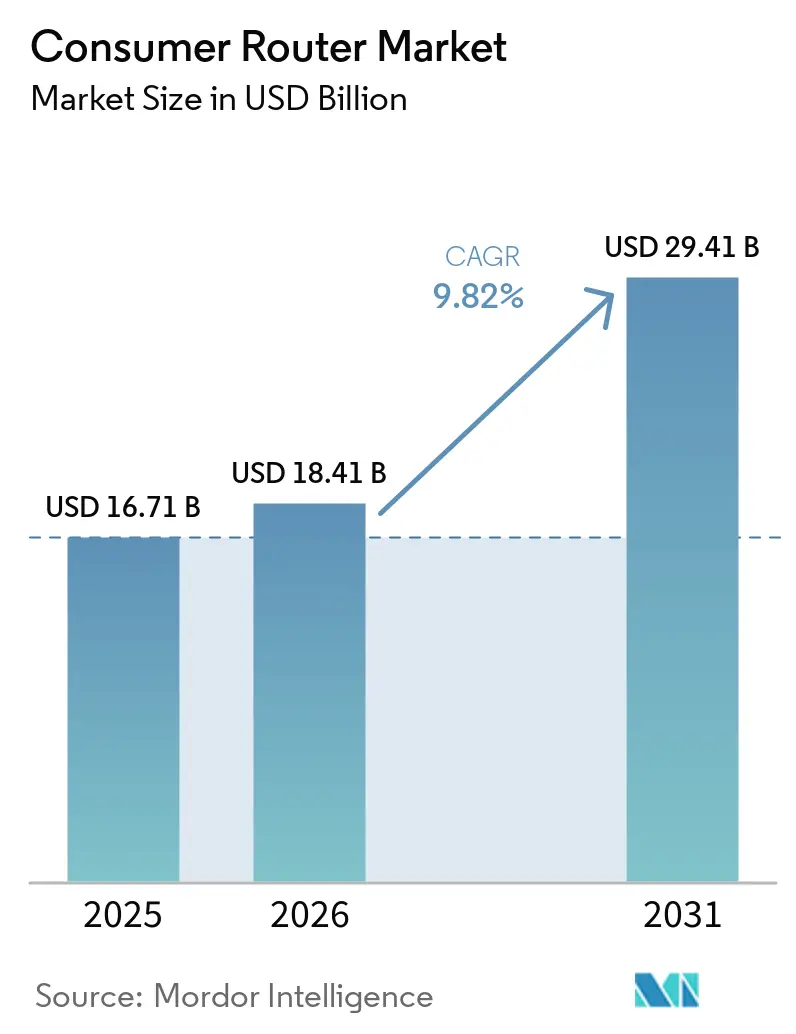
| Market Size (2026) | USD 18.41 Billion |
| Market Size (2031) | USD 29.41 Billion |
| Growth Rate (2026 - 2031) | 9.82 % |
| Fastest Growing Market | Asia-Pacific |
| Largest Market | Asia-Pacific |
| Market Concentration | Medium |
Major Players *Disclaimer: Major Players sorted in no particular order Image © Mordor Intelligence. Reuse requires attribution under CC BY 4.0. | |
Consumer Router Market Analysis by Mordor Intelligence
The consumer router market size is expected to be USD 16.7 billion in 2025, USD 18.41 billion in 2026, and reach USD 29.41 billion by 2031, growing at a CAGR of 9.82% from 2026 to 2031. Permanent hybrid-work patterns, the rapid pivot to Wi-Fi 7 hardware, and the widening pool of bandwidth-hungry smart-home devices are redefining performance baselines across the consumer router market. Regulatory actions that restrict certain foreign hardware suppliers are nudging vendors toward domestic or allied-nation manufacturing footprints, tightening component allocation strategies, and amplifying R&D investment in on-device intelligence. Competition is intensifying as dual-band incumbents defend value price bands while mesh-system specialists pursue premium margins, creating a bifurcated consumer router market in which vendors must juggle cost leadership and feature leadership simultaneously. Semiconductor lead-time volatility and the growing requirement for AI-enabled traffic orchestration are likely to determine the next round of market-share realignment.
Key Report Takeaways
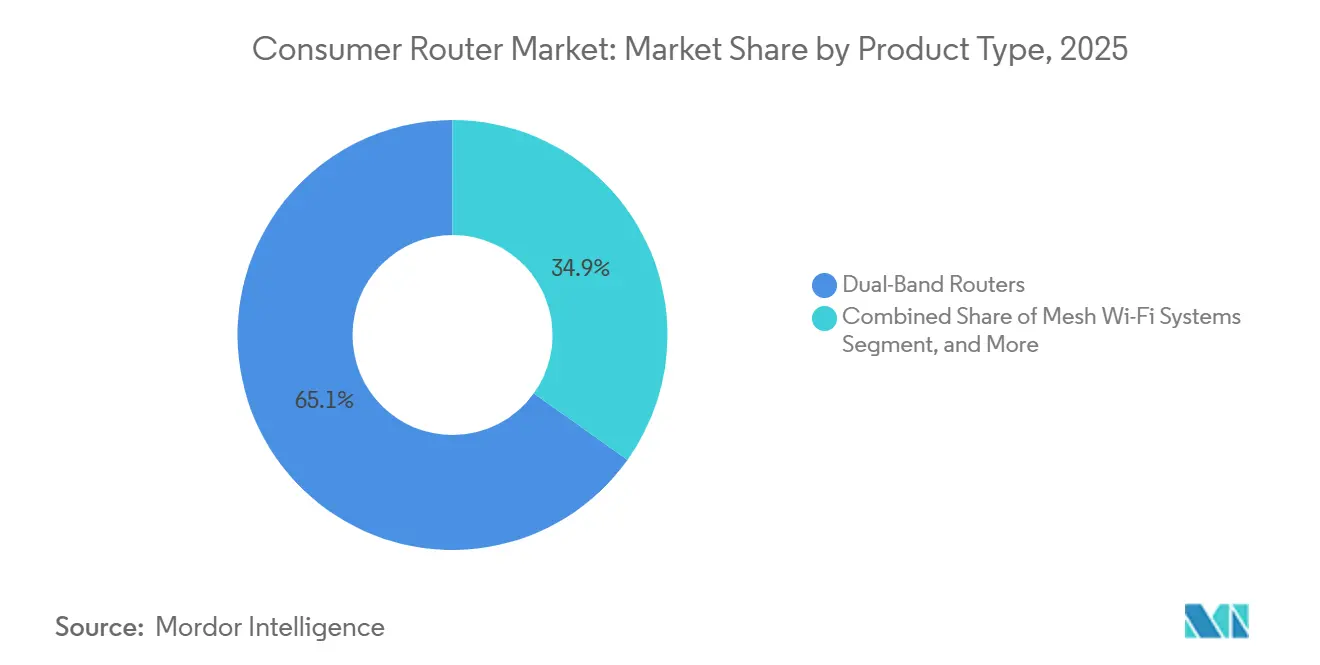
- By product type, dual-band routers held 65.12% of the consumer router market share in 2025, while mesh systems are projected to expand at a 14.32% CAGR through 2031.
- By technology standard, Wi-Fi 6 accounted for 45.21% of shipments in 2025, whereas Wi-Fi 6E is forecast to post a 12.49% CAGR over 2026-2031.
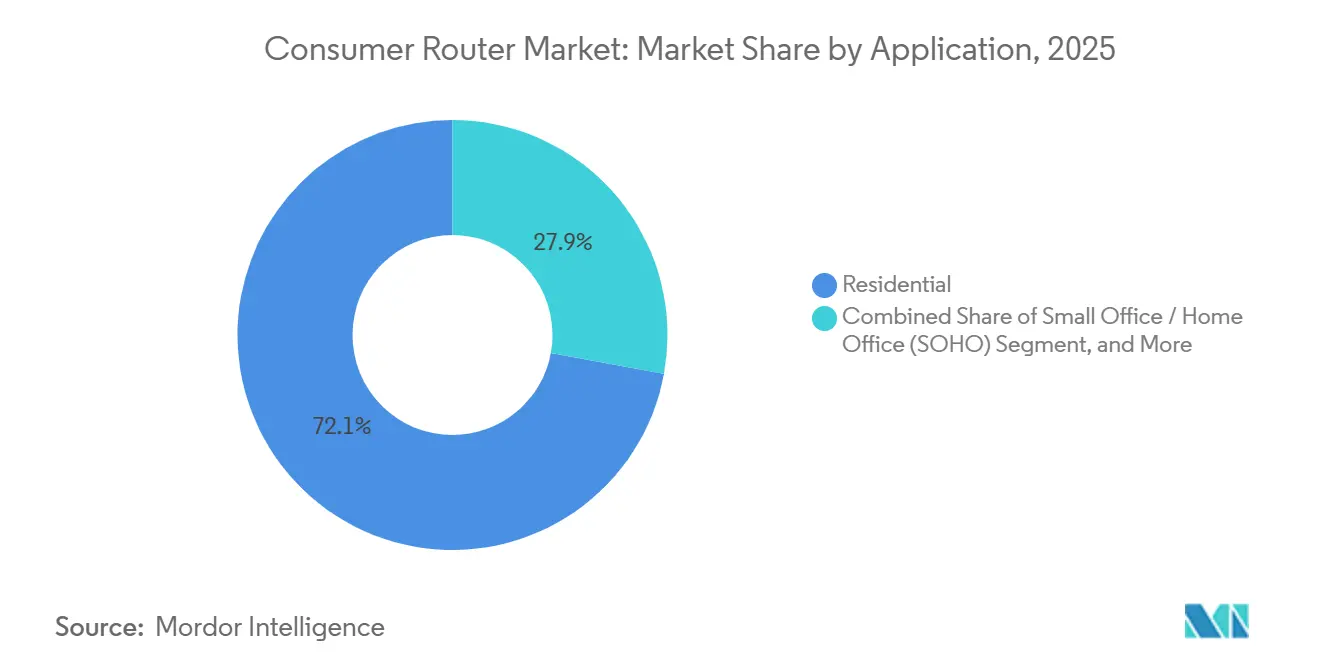
- By application, residential deployments commanded a 72.12% share in 2025, whereas the small-office and home-office segment is advancing at a 10.47% CAGR to 2031.
- By distribution channel, offline retail controlled 57.79% of 2025 revenue, yet online retail is rising at a 13.43% CAGR, the fastest among all channels.
- By geography, Asia-Pacific led with a 34.12% revenue share in 2025, and the region is expected to grow at an 11.13% CAGR during the forecast horizon.
Note: Market size and forecast figures in this report are generated using Mordor Intelligence’s proprietary estimation framework, updated with the latest available data and insights as of January 2026.
Market Trends and Insights
Drivers Impact Analysis of Consumer Router Market*
| Driver | (~) % Impact on CAGR Forecast | Geographic Relevance | Impact Timeline |
|---|---|---|---|
| Rapid Adoption of Wi-Fi 6 and Wi-Fi 6E Standards | +2.8% | Global, led by Asia-Pacific and North America | Medium term (2-4 years) |
| Surge in Smart-Home and IoT Device Installations | +2.3% | Global, concentrated in North America, Europe, urban APAC | Medium term (2-4 years) |
| Growth of Remote Work and Hybrid Learning Models | +1.6% | Global, higher intensity in North America and Europe | Short term (≤ 2 years) |
| Mainstream Broadband Penetration in Emerging Economies | +1.4% | Asia-Pacific core, spill-over to South America and Middle East | Long term (≥ 4 years) |
| Telecom ISP Bundling of Premium Routers | +0.9% | North America, Europe, select APAC markets | Medium term (2-4 years) |
| AI-Enabled Network Optimization in Consumer Routers | +0.7% | North America and Europe, early urban APAC | Long term (≥ 4 years) |
| Source: Mordor Intelligence | |||
Rapid Adoption Of Wi-Fi 6 And Wi-Fi 6E Standards
Wi-Fi 6E opens seven 160 MHz-wide channels in the 6 GHz band, eliminating legacy channel congestion and supporting latency-sensitive use cases such as cloud gaming and virtual reality. Mandatory WPA3 encryption and Hash-to-Element key exchange raise the security baseline, shrinking the attack surface for downgrade exploits. Wi-Fi 7 is forecast to exceed 90% of consumer and enterprise access-point shipments by 2029, driven by multi-link operation that aggregates 2.4, 5, and 6 GHz spectrum for theoretical throughput above 40 Gbps. ASUS showcased this capability at CES 2026 through the ROG NeoCore, revealing a two-year cadence between major standard releases and compressing product life cycles.[1] Uneven spectrum allocation across Asia-Pacific complicates global SKU planning, yet early-moving jurisdictions are already recording accelerated replacement cycles. The net result is a shortening payback period for router upgrades, which directly lifts the consumer router market.
Surge In Smart-Home And IoT Device Installations
Households now average 17-18 connected endpoints, up from 11 in 2022, and device penetration is projected to reach 68.6% of global homes by 2027. Legacy single-band routers struggle when 40+ devices contend for airtime, leading to noticeable quality-of-service degradation. Security risks have scaled in parallel; a 2025 study reported 5,200 malicious connection attempts per IoT device each month, with 75% exploiting router vulnerabilities.[2] Vendors such as TP-Link use on-device machine learning to prioritize real-time traffic and schedule firmware downloads during off-peak periods. The rise of Matter-certified ecosystems demands IPv6-native support and persistent low-power links, forcing a new baseline for router silicon. Collectively, these dynamics accelerate mid-cycle upgrades and uplift the consumer router market.
Growth Of Remote Work And Hybrid Learning Models
A 2025 National Bureau of Economic Research study found each additional megabit of broadband raised work-from-home participation by 0.6 percentage points and lifted property values by 8% in areas with at least 16 Mbps service. Ofcom confirms that daytime residential traffic in the United Kingdom remains 40% above pre-pandemic levels, with upload demand rising faster than downloads. Wi-Fi 6E’s orthogonal frequency-division multiple access efficiently schedules symmetric uplink and downlink, an essential feature for collaboration platforms. Router vendors targeting small-office and home-office environments now bundle multi-gigabit Ethernet ports and VLAN segmentation to segregate professional workloads. These enterprise-grade functions entering the residential channel shorten replacement cycles and expand the dollar opportunity in the consumer router market.
Mainstream Broadband Penetration In Emerging Economies
India added 28 million fiber-to-the-home premises in 2025, bringing total connections to 85 million and spurring demand for gigabit-capable routers outside tier-1 cities. Guinea recorded a 337.84% increase in router inquiries for LTE Band 20 fixed-wireless models priced between USD 30 and USD 60. South America is projected to move from USD 1.45 billion in 2024 to USD 5.18 billion by 2034, a 14.3% CAGR, as subsidized broadband expands into favelas and rural areas. Localization, including firmware in Portuguese, Spanish, and indigenous languages, acts as a competitive moat for regional upstarts. Established global brands must therefore invest in region-specific regulatory compliance and language support, further enlarging the consumer router market.
Restraints Impact Analysis of Consumer Router Market*
| Restraint | (~) % Impact on CAGR Forecast | Geographic Relevance | Impact Timeline |
|---|---|---|---|
| High Average Selling Prices of Tri-Band and Mesh Systems | -1.2% | Global, higher sensitivity in Asia-Pacific and South America | Short term (≤ 2 years) |
| Persistent Semiconductor Supply Constraints | -0.9% | Global, acute in North America and Europe | Medium term (2-4 years) |
| Limited Consumer Awareness of Wi-Fi Standards | -0.6% | Global, concentrated in emerging markets | Medium term (2-4 years) |
| Cyber-Security and Firmware Maintenance Challenges | -0.50 | Global, with regulatory pressure in Europe and North America | Long term (≥ 4 years) |
| Source: Mordor Intelligence | |||
High Average Selling Prices Of Tri-Band And Mesh Systems
Flagship mesh kits such as NETGEAR Orbi 970 and ASUS ZenWiFi Pro ET12 list between USD 1,200 and USD 1,500, pricing many households out of the premium tier. NETGEAR’s July 2025 Orbi 370 introduction at USD 599 for a two-pack narrowed the entry barrier by 30%, but it still exceeds the sub-USD 150 sweet spot that dominates unit volumes. Dual-band products now account for 65% of shipments yet generate under 40% of total revenue, underscoring margin compression.[3] Vendors are caught between cannibalizing their own value portfolios and conceding the high-margin segment to rivals. This price bifurcation slows upgrade intent and weighs on the consumer router market.
Persistent Semiconductor Supply Constraints
Wi-Fi 7 system-on-chip production remains concentrated at a handful of Taiwan and South Korean fabs; a 2025 earthquake briefly suppressed wafer output by 2.1 million units and delayed premium router launches. Broadcom, Qualcomm, and MediaTek have earmarked USD 4.2 billion for capacity additions, yet output is unlikely to stabilize before late 2027. Vendors hedge by engineering dual-sourced boards, a strategy that raises bill-of-materials costs and elongates design cycles. Compounding the issue, the Federal Communications Commission barred new authorizations for specified foreign-made routers in March 2026, demanding supply-chain redirection.[4] Limited wafer availability and regulatory requalification delays lead to sporadic stock-outs and inflated retail prices, tempering the consumer router market’s expansion.
*Our forecasts treat driver/restraint impacts as directional, not additive. The impact forecasts reflect baseline growth, mix effects, and variable interactions.
Consumer Router Market Segment Analysis
By Product Type:
Mesh Systems Redefine Coverage EconomicsMesh systems are growing at 14.30% annually through 2031, the fastest within the consumer router market. Dual-band routers, once the default, accounted for 65.12% of 2025 unit volume, yet their share is eroding as households discover that two radios cannot efficiently serve 17+ IoT endpoints. Tri-band designs dedicate a high-band backhaul that gamers and content creators value for low-latency uploads, lifting attach rates in North America and Europe. Single-band models now play niche roles, such as in Guinea’s fixed-wireless access market, priced at CNY 429 (USD 61) or less.
NETGEAR’s Orbi 370 at USD 599 compresses the price-performance curve, democratizing 320 MHz channels and 4K QAM that were confined to USD 1,200 flagships. The Wi-Fi Alliance certified more than 1,200 Wi-Fi 7 products by early 2026, unleashing scale economies that lower silicon cost baselines. Chinese challenger Tenda pushed price walls further with the Taishan BE7200 Ultra at CNY 429 (USD 61), pressuring global brands to defend margins. Vendor success now hinges on balancing sub-USD 150 dual-band throughput expectations with premium mesh differentiation, a trade-off central to the trajectory of the consumer router market size over the next five years.

By Technology Standard:
Wi-Fi 6E Bridges The Transition GapWi-Fi 6 retained 45.21% shipment share in 2025, indicating maturity and broad device compatibility, while Wi-Fi 6E is climbing 12.49% annually through 2031. The shift is principally motivated by the unlicensed 6 GHz spectrum, which provides 7 160 MHz channels, bypassing congestion in older bands. Wi-Fi 7 device shipments jumped from 583 million in 2025 to 1.1 billion in 2026, signaling an 88% growth rate that eclipses prior adoption curves for Wi-Fi standards.
Wi-Fi 5 stubbornly clings to 22% share in low-cost routers priced below USD 50. ASUS’s CES 2026 preview of a Wi-Fi 8-ready ROG NeoCore platform demonstrates a two-year cadence that will likely compress router amortization periods and expand the consumer router market in bleeding-edge segments. Persistent regulatory fragmentation, however, forces vendors to maintain dual certification pathways, which inflate engineering costs. As more jurisdictions harmonize 6 GHz rules, unified SKU roadmaps will emerge, offering procurement leverage and reducing time-to-market for new designs.
By Application:
SOHO Segment Captures Hybrid-Work PremiumResidential environments accounted for 72.12% of shipments in 2025, anchored by single-family dwellings using value dual-band hardware. Yet the small-office and home-office slice is forecast to clock a 10.47% CAGR through 2031 as video conferencing, cloud back-ups, and symmetrical traffic patterns demand enterprise-grade functionality. Each incremental megabit of broadband expands work-from-home participation and thereby router upgrade intent.
Ubiquiti’s USD 199 UniFi Express 7 bundles PoE power and centralized dashboards, lowering IT overhead for micro-businesses. Firmware variants are diverging: residential builds stress parental controls, while SOHO editions foreground VLAN isolation. This forked development path expands addressable software monetization opportunities and encourages premium-support subscriptions, further upping the share that the consumer router market derives from service adjacencies.
By Distribution Channel:
E-Commerce Reshapes Margin StructuresOffline retail still accounted for 57.79% of 2025 revenue but trailed e-commerce growth by 6.4 percentage points. Amazon’s bestseller list shows TP-Link’s AX1800 dual-band model clearing 9,000 units each month, reaffirming the power of peer reviews and algorithmic placement. Online marketplaces compress the discovery funnel, compelling vendors to invest in sponsored listings and influencer promotions that add a new operating-expense layer.
Telecom ISP bundling blurs channel borders. AT&T’s OneConnect shifts capital expenditure from households to carriers via USD 10 monthly rental plans, fortifying customer stickiness. EE’s early 2026 Wi-Fi 7 bundle does likewise in the United Kingdom, while Verizon aggregates volumes through regional fiber partners. As bundling scales, retail shelf space may shrink, channeling a growing fraction of the consumer router market through just a handful of service providers.
Geography Analysis
APAC Consumer Router Market
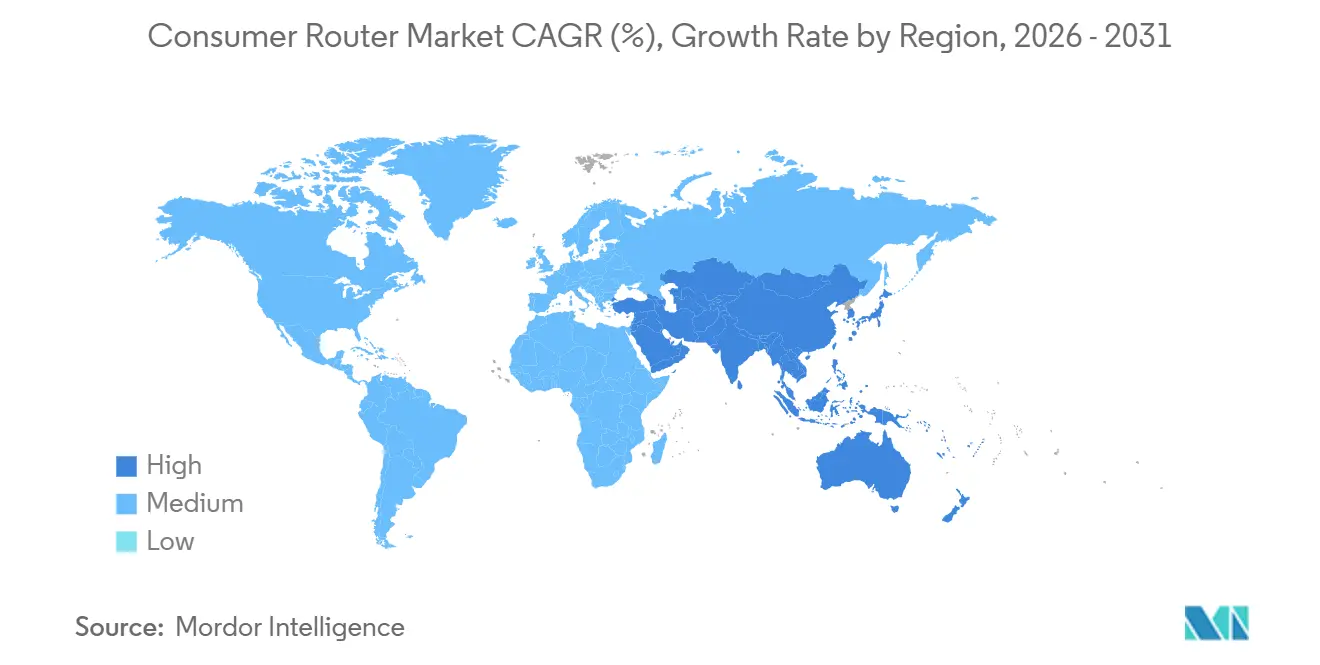
Asia-Pacific dominated the consumer router market in 2025 with 34.12% revenue share and is projected to post an 11.13% CAGR through 2031. India alone added 28 million fiber connections in 2025, leapfrogging legacy DSL and driving demand for multi-gigabit routers in tier-2 and tier-3 cities. Chinese vendors, TP-Link, Huawei, Xiaomi, and Tenda, maintain more than 70% domestic share, propped up by vertical integration and localized firmware. Xiaomi’s April 2026 BE3600 Pro release at CNY 1,799 (USD 248) and Huawei’s Wi-Fi X portable router at CNY 2,499 (USD 364) spotlight the rapid commoditization of Wi-Fi 7 in the region.
North America and Europe Consumer Router Market
North America and Europe collectively contributed about 48% of 2025 revenue. Growth moderates to 8.5% annually as replacement cycles lengthen beyond 4 years, but high attach rates for tri-band mesh units keep revenue density elevated. The Federal Communications Commission’s March 2026 ban on specified foreign-sourced routers is forcing redesigns and supplier diversification, potentially delaying product refreshes. The European Union’s harmonized 6 GHz framework, in contrast, accelerates time-to-market for Wi-Fi 6E devices.
MEA and South America Consumer Router Market
South America is slated to grow from USD 1.45 billion in 2024 to USD 5.18 billion by 2034, with a 14.3% CAGR, with Brazil capturing more than half of the regional spend. The Middle East and Africa remain early-stage but show outsized potential, with fixed-wireless LTE routers priced under USD 100 bridging the digital divide. Localization hurdles, including import duties, currency volatility, and multilingual firmware, favor lower-margin regional entrants, but multinationals that address these frictions can unlock incremental market share in the consumer router market.
Competitive Landscape
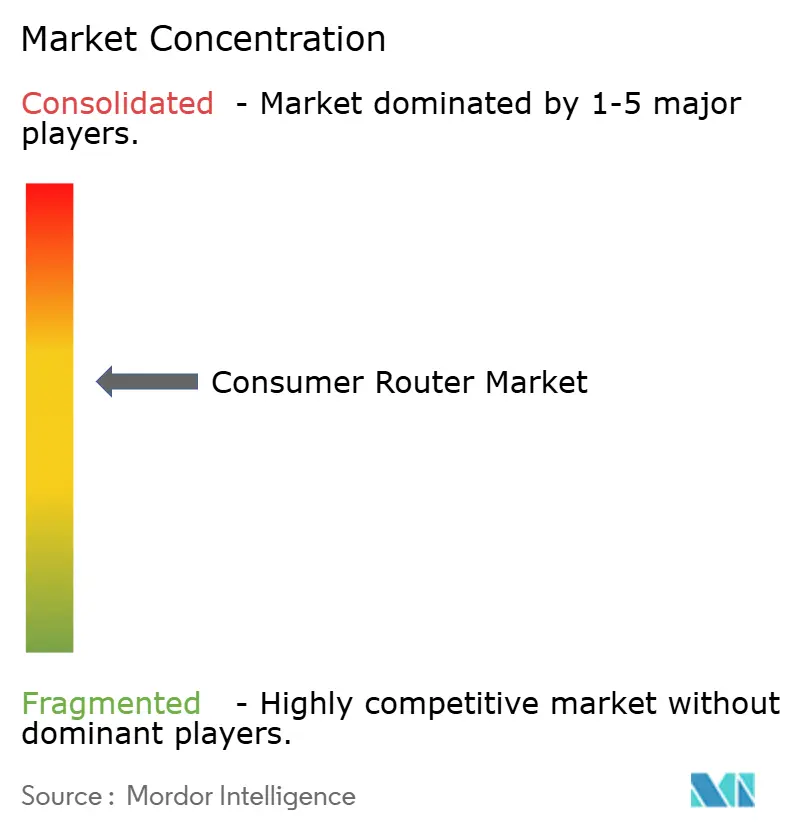
The consumer router industry exhibits moderate concentration; the top five vendors control 60% of 2025 sales, leaving ample whitespace for agile challengers. TP-Link dominates the sub-USD 150 tier, while NETGEAR and ASUS carve premium share with USD 500-plus mesh and gaming SKUs. AI-enabled traffic orchestration has emerged as the next battleground: ASUS deploys neural processing units in its RT-BE96U to shave latency by 35% during peak concurrency, whereas TP-Link’s Aireal lineup classifies flows in real time to preserve video-call quality.
White-space opportunities populate the small-office arena. Ubiquiti’s UniFi Express 7 melds cloud provisioning and PoE power at USD 199, appealing to franchises that lack on-site IT staff. UI.COM. ISP bundling strategies intensify vendor reliance on a handful of volume buyers; AT&T, EE, and Verizon negotiate bespoke firmware that embeds branded support portals, reducing churn but shrinking per-box margins.
Regulatory turbulence also shifts the competitive mix. The March 2026 FCC prohibition accelerates supply-chain relocation for U.S.-market SKUs and could strand rivals that lean heavily on excluded plants. Semiconductor scarcity, meanwhile, advantages players with pre-secured wafer allocations. As language localization, AI differentiation, and foundry access converge, nimble vendors stand to gain incremental consumer router market share at the expense of slower incumbents.
Consumer Router Industry Leaders
-
TP-Link Technologies Co., Ltd.
-
NETGEAR, Inc.
-
ASUSTeK Computer Inc.
-
Linksys Holdings, Inc.
-
D-Link Corporation
- *Disclaimer: Major Players sorted in no particular order
Consumer Router Market Companies Covered in this Report
- TP-Link Technologies Co., Ltd.
- NETGEAR, Inc.
- ASUSTeK Computer Inc.
- D-Link Corporation
- Linksys Holdings, Inc.
- Ubiquiti Inc.
- MikroTikls SIA
- Zyxel Communications Corporation
- Shenzhen Tenda Technology Co., Ltd.
- Mercusys Technologies Co., Ltd.
- eero LLC
- Google LLC (Nest Devices)
- Buffalo Inc.
- AVM Computersysteme Vertriebs GmbH
- Edimax Technology Co., Ltd.
- Peplink International Limited
- DrayTek Corp.
- Comtrend Corporation
- Synology Inc.
- Huawei Device Co., Ltd.
Recent Industry Developments in Consumer Router Market
- April 2026: Xiaomi launched the BE3600 Pro Wi-Fi 7 router in China at CNY 1,799 (USD 248), featuring dual 2.5 Gbps Ethernet ports and 320 MHz channels.
- March 2026: Huawei introduced the Wi-Fi X portable router at CNY 2,499 (USD 364) with integrated 5G modem and 10,000 mAh battery.
- March 2026: Xiaomi announced the BE19000 Pro tri-band mesh system for global markets, pending regulatory approval, priced at USD 799 for a three-pack.
- March 2026: Tenda rolled out the 5G06 AX3000 fixed-wireless router at CNY 599 (USD 85), tuned for rural connectivity.
Global Consumer Router Market Report Scope
The Consumer Router Market comprises hardware devices and embedded software designed to provide internet connectivity, local-area networking, and wireless access in residential and small-office environments. These routers manage data traffic between broadband sources such as fiber, DSL, or fixed wireless and end-user devices, including smartphones, PCs, smart TVs, and IoT systems. The market includes single-band, dual-band, tri-band, mesh, and Wi-Fi-standard-based routers, such as Wi-Fi 5, Wi-Fi 6, 6E, and Wi-Fi 7. It also encompasses value-added features such as security protocols, parental controls, and AI-driven traffic management, but excludes enterprise-grade networking infrastructure and carrier-core equipment.
The Consumer Router Market Report is Segmented by Product Type (Single-Band, Dual-Band, Tri-Band, and Mesh Wi-Fi Systems), Technology Standard (Wi-Fi 5, Wi-Fi 6, Wi-Fi 6E, and Wi-Fi 7 Ready), Application (Residential, SOHO, and Small Business), Distribution Channel (Online, Offline), and Geography (North America, South America, Europe, Asia-Pacific, Middle East, and Africa). The Market Forecasts are Provided in Terms of Value (USD).
Segmentation Overview
| Single-Band Routers |
| Dual-Band Routers |
| Tri-Band Routers |
| Mesh Wi-Fi Systems |
| Wi-Fi 5 (802.11ac) |
| Wi-Fi 6 (802.11ax) |
| Wi-Fi 6E (6 GHz) |
| Wi-Fi 7 Ready (802.11be) |
| Residential |
| Small Office / Home Office (SOHO) |
| Small Business |
| Online Retail |
| Offline Retail |
| North America | United States |
| Canada | |
| Mexico | |
| South America | Brazil |
| Argentina | |
| Chile | |
| Rest of South America | |
| Europe | Germany |
| United Kingdom | |
| France | |
| Italy | |
| Spain | |
| Russia | |
| Rest of Europe | |
| Asia-Pacific | China |
| Japan | |
| India | |
| South Korea | |
| Australia | |
| Rest of Asia-Pacific | |
| Middle East | United Arab Emirates |
| Saudi Arabia | |
| Turkey | |
| Rest of Middle East | |
| Africa | South Africa |
| Nigeria | |
| Kenya | |
| Rest of Africa |
| By Product Type | Single-Band Routers | |
| Dual-Band Routers | ||
| Tri-Band Routers | ||
| Mesh Wi-Fi Systems | ||
| By Technology Standard | Wi-Fi 5 (802.11ac) | |
| Wi-Fi 6 (802.11ax) | ||
| Wi-Fi 6E (6 GHz) | ||
| Wi-Fi 7 Ready (802.11be) | ||
| By Application | Residential | |
| Small Office / Home Office (SOHO) | ||
| Small Business | ||
| By Distribution Channel | Online Retail | |
| Offline Retail | ||
| By Geography | North America | United States |
| Canada | ||
| Mexico | ||
| South America | Brazil | |
| Argentina | ||
| Chile | ||
| Rest of South America | ||
| Europe | Germany | |
| United Kingdom | ||
| France | ||
| Italy | ||
| Spain | ||
| Russia | ||
| Rest of Europe | ||
| Asia-Pacific | China | |
| Japan | ||
| India | ||
| South Korea | ||
| Australia | ||
| Rest of Asia-Pacific | ||
| Middle East | United Arab Emirates | |
| Saudi Arabia | ||
| Turkey | ||
| Rest of Middle East | ||
| Africa | South Africa | |
| Nigeria | ||
| Kenya | ||
| Rest of Africa | ||
Key Questions Answered in the Report
What revenue will the consumer router market reach by 2031?
The consumer router market size is projected to reach USD 29.41 billion by 2031.
Which product type leads unit shipments today?
Dual-band routers held 65.12% of 2025 shipments, the largest slice of the consumer router market share.
How fast is the mesh-system category growing?
Mesh systems are forecast to rise at a 14.32% CAGR between 2026 and 2031 as households seek seamless whole-home coverage.
Why is Wi-Fi 6E adoption accelerating?
Access to the 6 GHz band, mandatory WPA3 security, and congestion-free 160 MHz channels are pushing Wi-Fi 6E shipments upward at a 12.49% CAGR.
Which region will log the quickest growth?
Asia-Pacific leads growth with an expected 11.13% CAGR through 2031, driven by fiber rollouts in China, India, and Southeast Asia.
How concentrated is vendor competition?
The top five brands account for roughly 60% of global revenue, placing the market at a moderate concentration level of 6 on a 10-point scale.