
Renewable Energy Market Analysis by Mordor Intelligence
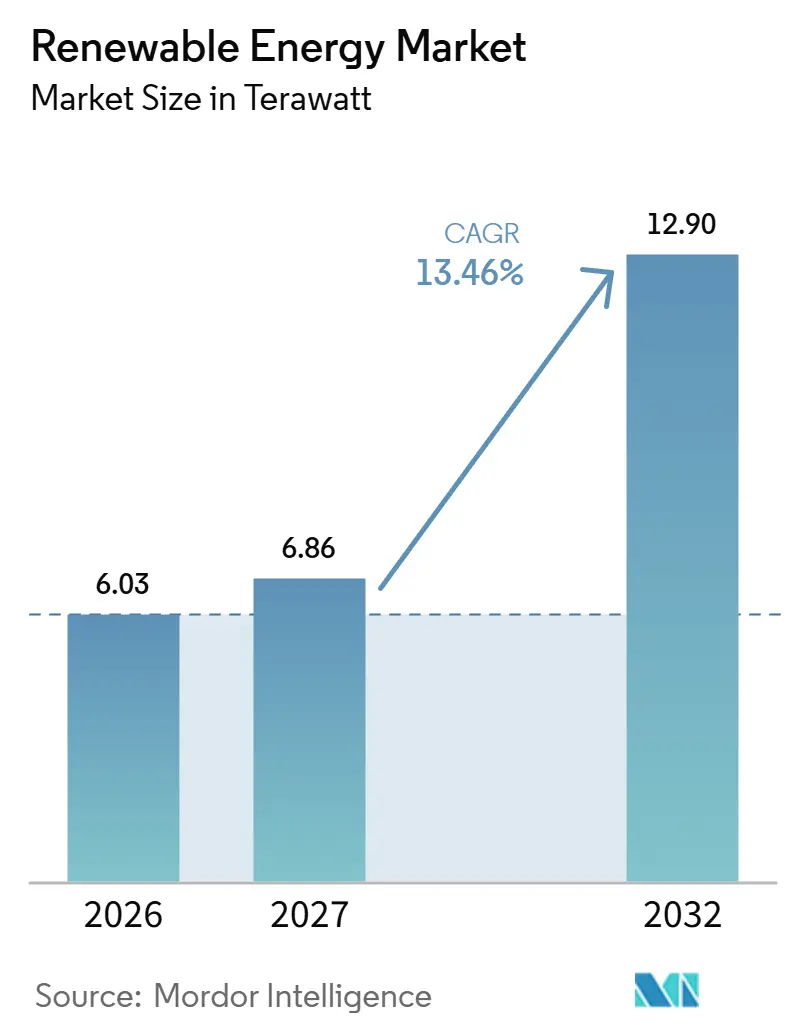
The renewable energy market size is projected to expand from 6.03 Terawatt in 2026 and 6.86 Terawatt in 2027 to 12.9 Terawatt by 2032, registering a CAGR of 13.46% between 2027 and 2032.
Corporate electricity procurement helps translate demand into financeable solar and wind projects, with Spain illustrating the role of long-term offtake. Data-center consumption and hydrogen-linked generation concentrate buyer requirements, while household rooftop programs in India create a more distributed installation opportunity. These sources of demand favor developers that coordinate contracted revenues, equipment delivery and commissioning. Developers that secure contracted offtake before committing to equipment orders reduce revenue risk at financing, while congestion and wind-blade recovery obligations make saleable output and lifecycle costs central to the economics of expansion.
Key Report Takeaways
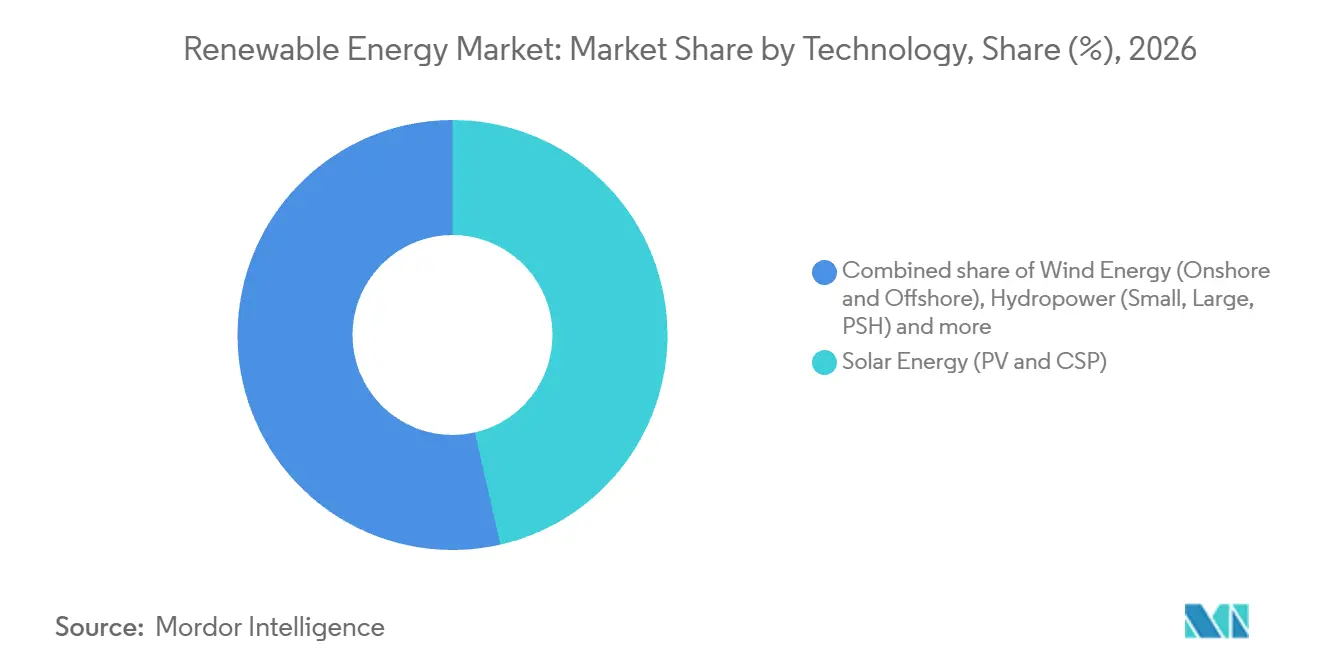
- Solar energy (PV and CSP) was the leading technology, with a 46.42% renewable energy market share in 2026, while ocean energy (tidal and wave) is forecast to be the fastest-growing segment at a CAGR of 35.6% from 2027 to 2032.
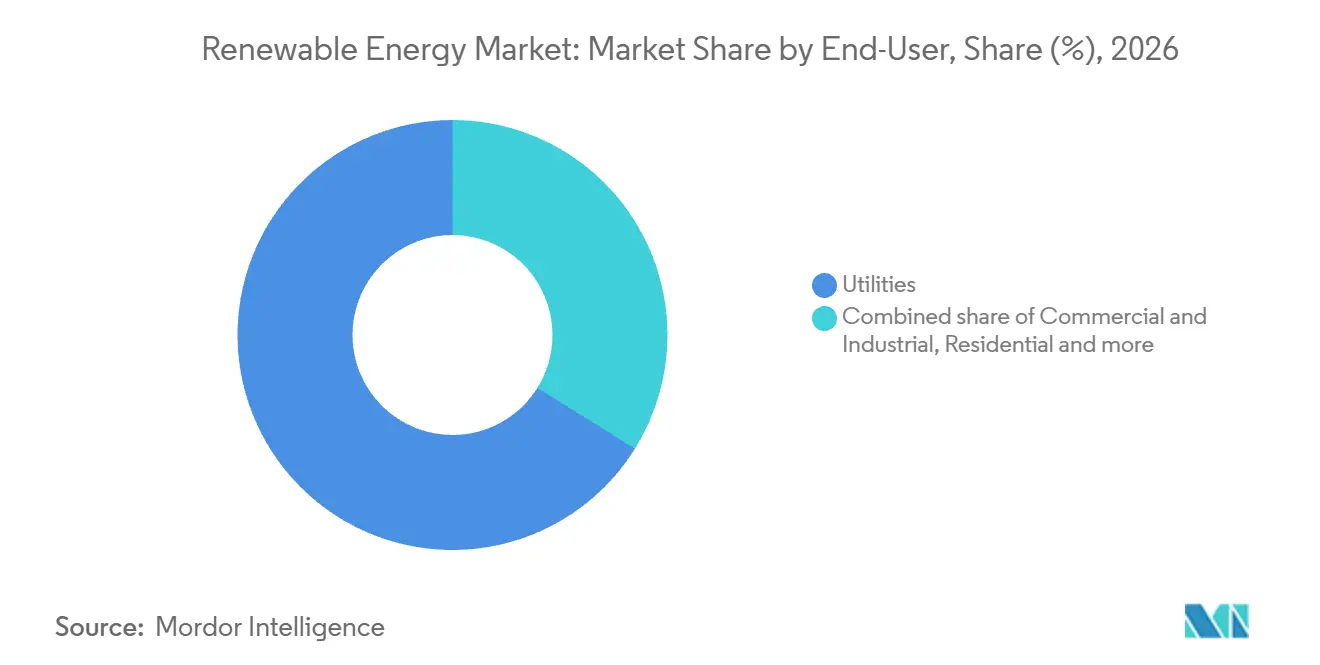
- Among end users, utilities held a 66.13% share of the renewable energy market size in 2026, and commercial and industrial users are forecast to be the fastest-growing segment at a CAGR of 16.3% from 2027 to 2032.
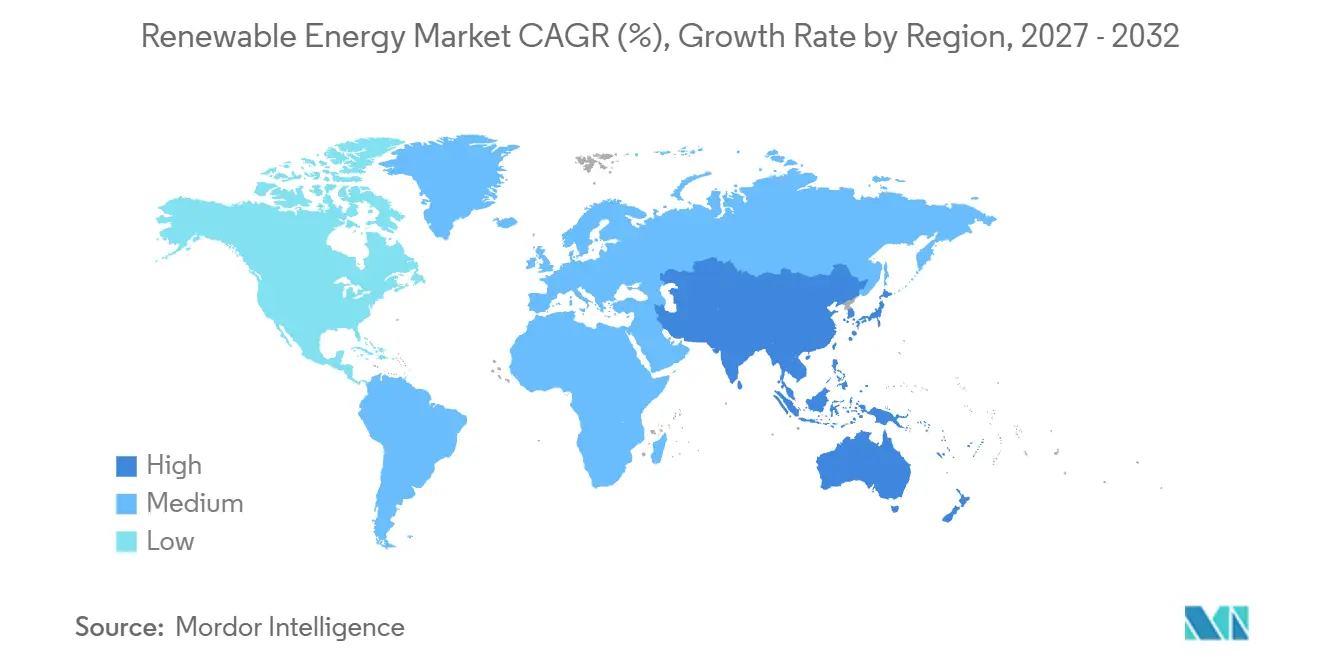
- Geographically, Asia-Pacific led with a 58.61% share in 2026 and is forecast to grow fastest at a CAGR of 15.9% from 2027 to 2032.
Note: Market numbers in this report are based on Mordor Intelligence's proprietary estimation framework, which combines nine months of actuals with Q4 projections for base year 2026.
Market Trends and Insights
Drivers Impact Analysis of Renewable Energy Market*
| Driver | (~) % Impact on CAGR Forecast | Geographic Relevance | Impact Timeline |
|---|---|---|---|
| Corporate Power-Purchase Agreements Accelerating Utility-scale Builds in North America & Europe | +5.6% | Spain, Italy, Poland and Bulgaria | Medium term (2-4 years) |
| Hyperscale Data-Center Demand Boosting Solar-Wind Procurement in the Nordics & Ireland | +4.5% | Finland, Sweden and Ireland | Short term (≤ 2 years) |
| Green-Hydrogen Gigawatt Pipelines Driving Capacity Additions in MENA & Australia | +3.4% | Saudi Arabia and Western Australia | Medium term (2-4 years) |
| EU 'REPowerEU' Fast-Track Permitting Cutting Onshore-Wind Lead-Times in Southern Europe | +2.2% | Italy's regional authorization jurisdictions | Medium term (2-4 years) |
| Source: Mordor Intelligence | |||
Corporate Power-Purchase Agreements Accelerating Utility-scale Builds in North America & Europe
Corporate power-purchase agreements can help developers assemble the contracted revenues needed to finance utility-scale solar projects. Spain recorded more than 2 GW of corporate solar PPAs signed annually from 2023 through 2025. Quinbrook completed the battery financing tranche for the Cleve Hill solar and storage project in Kent, UK, in March 2025. Tesco PLC's offtake covered 65% of solar generation at Cleve Hill, which comprises 373 MW of solar and 150 MW of battery storage. That offtake was among revenue contracts critical to financing, alongside a 15-year solar Contract for Difference and a 15-year battery Capacity Market Agreement. Combining corporate offtake with separate solar and battery revenue contracts can support financing across both assets without treating the corporate PPA as sufficient on its own.
Hyperscale Data-Center Demand Boosting Solar-Wind Procurement in the Nordics & Ireland
Data-center electricity demand offers renewable developers a buyer pool capable of absorbing substantial generation through long-term contracts. Irish data centers consumed 7,663 GWh of metered electricity in 2025, up 10% from 6,973 GWh in 2024.[1] In April 2025, Amazon agreed to buy all electricity from 2 Finnish wind farms under construction, with a combined capacity of 472 MW. OX2 retained ownership under the long-term power-purchase agreement, while Amazon operated data centers in neighboring Sweden. Amazon's purchase of both farms' full output, despite its April 2025 statement that it did not plan a Finnish data center, shows that wind developers can secure offtake from operators with facilities in another country.
Green-Hydrogen Gigawatt Pipelines Driving Capacity Additions in MENA & Australia
Green-hydrogen projects can concentrate demand for renewable generation and its transmission infrastructure into a single industrial development. On March 26, 2026, NEOM Green Hydrogen Company reported that its Saudi project's wind garden, solar farm and transmission grid were approximately 95% complete. The company had targeted completion of 4 GW of dedicated solar and wind generation by mid-2026. The owner also reports that plant construction is in its final stage and commissioning has started with energization. Its sequence places electrolyzer commissioning after generation-site completion, making power-system handover a prerequisite for the next industrial commissioning stage.
EU 'REPowerEU' Fast-Track Permitting Cutting Onshore-Wind Lead-Times in Southern Europe
A defined authorization timetable can reduce the open-ended development exposure that makes wind projects difficult to advance toward equipment procurement. Italy's regional authorities conduct Article 9 unique-authorization conferences with a 120-day deadline for listed wind projects from 60 kW through 300 MW. The clock can pause for up to 60 days for environmental impact assessment screening or 90 days for projects undergoing assessment. Those provisions separate a bounded administrative stage from the additional review required by a project's environmental characteristics. The European Commission's 2025 review classified Italy's 6-month renewable permitting cap among clear deadlines that affected permitting duration. The resulting demand mechanism is earlier confidence in progressing viable wind sites toward turbine orders, with assessment-related delays incorporated into the investment decision.
Restraints Impact Analysis of Renewable Energy Market*
| Restraint | (~) % Impact on CAGR Forecast | Geographic Relevance | Impact Timeline |
|---|---|---|---|
| Grid Congestion & Curtailment Risks in ERCOT (US) and Inner Mongolia (CN) | -1.2% | ERCOT and Inner Mongolia | Short term (≤ 2 years) |
| End-of-Life Blade Waste Regulations Raising Costs in Germany & France | -0.5% | Germany and France | Medium term (2-4 years) |
| Lack of Long-Duration Storage Slowing High VRE Penetration in SE-Asia | -0.3% | Southeast Asian power systems | Long term (≥ 4 years) |
| Local-Content Mandates Inflating Offshore-Wind CAPEX in India & Brazil | -0.2% | India and Brazil | Long term (≥ 4 years) |
| Source: Mordor Intelligence | |||
Grid Congestion & Curtailment Risks in ERCOT (US) and Inner Mongolia (CN)
Congestion weakens the connection between adding wind capacity and selling the electricity that capacity could generate. In ERCOT, congestion curtailed roughly 4.7% of wind generation in 2025, and Potomac Economics said curtailment had a major impact on wind project economics.[2] CECEP Wind-Power Corporation reported curtailment rates of 7.83% in 2023, 10.56% in 2024 and 13.64% in 2025 for its own Inner Mongolia wind operations. For developers evaluating comparable locations, forgone output reduces the revenue available to support equipment and financing costs. Across CECEP's Inner Mongolia operations, a growing share of potential output went unsold each year.
End-of-Life Blade Waste Regulations Raising Costs in Germany & France
Wind developers face recovery specifications at procurement alongside a separate question of economical treatment when blades retire. European Commission Implementing Regulation (EU) 2026/718 requires qualifying public wind tenders launched from June 30, 2026, including in Germany and France, to demonstrate at least 70% blade recyclability by relative material weight by contract completion. French wind-farm projects with complete permit applications filed after January 1, 2023, have a rotor-mass reuse or recycling target of at least 55% from January 1, 2025. Fraunhofer IWES describes high-quality blade recycling in Germany as cost intensive and limited to laboratory scale. Selecting high-quality recycling would expose developers to cost-intensive end-of-life processing beyond the task of demonstrating blade recyclability.
*Our forecasts treat driver/restraint impacts as directional, not additive. The impact forecasts reflect baseline growth, mix effects, and variable interactions.
Renewable Energy Market Segment Analysis
By Technology:
Solar Deployment and Tidal Delivery CommitmentsSolar energy (PV and CSP) accounted for a 46.42% share of the renewable energy market size in 2026. IRENA reported about 2,391.6 GW of global installed solar energy capacity at year-end 2025, illustrating the largest segment's deployment scale. Solar PV's levelized electricity generation cost held at USD 44/MWh in 2025, equal to its 2024 level. An expanding solar fleet therefore does not guarantee falling generation costs, so the unchanged PV benchmark leaves project economics to support further additions.
Ocean energy (tidal and wave) is the fastest-growing segment, with a forecast CAGR of 35.6% from 2027 to 2032. In February 2026, the UK offered Contracts for Difference to 4 tidal stream projects totaling 20.9 MW, with delivery years of 2028/29 or 2029/30.[3] Those delivery years place potential tidal capacity additions within the forecast period, provided the 4 UK projects move from contract offer to equipment procurement and construction.

By End-User:
Centralized Procurement and Commercial Project CompletionUtilities represented a 66.13% renewable energy market share in 2026. Saudi Power Procurement Company signed PPAs as principal buyer for 7 solar and wind projects totaling 15 GW in Saudi Arabia in July 2025. ACWA Power led the developer consortium, separating the electricity buyer from the companies responsible for project development. That structure concentrates substantial demand through a procurement program while allocating individual generating projects to developers. Equipment suppliers selling into these 7 projects therefore deal with the ACWA Power-led developer consortium rather than with the buyer that signed the PPAs.
Commercial and industrial users form the fastest-growing segment, with a forecast CAGR of 16.3% from 2027 to 2032. U.S. commercial solar installations grew 6% year over year in 2025 while California's legacy net-metering project pipeline continued to come online. U.S. commercial solar pricing also rose 10% in 2025. Legacy tariff eligibility can support project completion despite higher system prices, making that pipeline a distinct source of commercial solar demand.
Geography Analysis
Asia-Pacific Renewable Energy Market
Asia-Pacific held a 58.61% renewable energy market share in 2026 and is the fastest-growing region, with a forecast CAGR of 15.9% from 2027 to 2032. Within that region, Asia added 513.3 GW of renewable capacity in 2025, according to IRENA. Utility-scale geothermal adds another deployment route, illustrated by Energy Development Corporation bringing the Tanawon project in the Philippines into commercial operation in August 2025. By September 29, 2026, India's PM Surya Ghar scheme had enabled approximately 5.01 million rooftop solar installations benefiting 5.95 million households. Household programs such as PM Surya Ghar multiply deployment sites, so installation reach matters alongside equipment volume.
In North America, wind and utility-scale solar supplied 17% of U.S. electricity in 2025, rising to 19% when small-scale solar was included. That additional 2 percentage points gives distributed solar developers a distinct contribution alongside utility-scale generation. Europe's technology mix is illustrated by the EU, where wind supplied 37.5% of renewable electricity in 2025, followed by solar at 27.5% and hydro at 25.9%. Italy's regional authorities conduct the national authorization conference for listed wind projects, giving developers a local approval milestone within an EU renewable generation mix led by wind.
In South America, renewables supplied 86.6% of Brazil's domestic electricity supply in 2025, with hydropower providing 52.2% of that supply, which combines national production and imports. Uruguay requires consumer-site plants generating for self-consumption to register or seek authorization, whether grid-connected or isolated. Within Middle East and Africa, Africa's renewable power capacity grew 15.9% to 82 GW in 2025, driven by Ethiopia, South Africa and Egypt. Middle East renewable capacity grew 28.9% in 2025, led by Saudi Arabia.
Regulatory Framework and Outlook
The comparison covers selected jurisdictions from the perspective of developers of renewable-generation projects. Revenue support, access rights, electricity-demand obligations and project approvals affect different parts of development economics. Saudi Electricity Regulatory Authority (formerly Water and Electricity Regulatory Authority) administers approvals for covered renewable self-consumption systems.
Regulatory Table of Renewable Energy Market
| Decision factor | United States | Germany | China | Brazil | Saudi Arabia |
|---|---|---|---|---|---|
| Primary authority | Internal Revenue Service | Bundesnetzagentur for support auctions | Provincial energy authorities | Federal executive | Saudi Electricity Regulatory Authority |
| Key instruments or direction | Sections 45Y and 48E tax credits | EEG auctions and proposed EEG 2027 reform | June 2026 renewable-consumption targets for key energy-intensive industries | Law No. 15,097 for nonhydro offshore generation and April 2026 implementation guidelines | Covered same-premises self-consumption above 1 kW and up to 30 MW; PV up to 2 MW uses a separate framework |
| Commercial effect | Credits end for applicable wind and solar facilities placed in service after December 31, 2027, if construction begins after July 4, 2026 | Proposed support cuts for new small solar retain transition payments alongside lower curtailment compensation in constrained areas; proposed CfDs for new installations ≥100 kW retain hedging with excess-revenue returns | Covered buyers must remedy shortfalls through certificates or market transactions within 3 months of target publication | Federal authorization or concession; signature bonuses and occupation fees plus proportional payments after commercial operation | Study authorization required before preparatory work and activity license before construction |
| Current policy attractiveness | Medium | Medium | High | Medium | Medium |
| Future direction of policy attractiveness | Hardening | Hardening | Easing | Easing | No change |
| Source: Mordor Intelligence | |||||
In the United States, Section 45Y and 48E credits end for applicable wind and solar facilities placed in service after December 31, 2027, if construction starts after July 4, 2026, while Germany's proposed EEG 2027 reform would replace fixed feed-in remuneration with contracts for difference for new installations of at least 100 kW, preserving a hedge but requiring some excess-revenue returns when market earnings are significantly higher. China's June 2026 targets for key energy-intensive industries favor generator demand by requiring shortfalls to be remedied through certificates or market purchases within 3 months of target publication. Despite required signature bonuses and occupation fees, Brazil's April 1, 2026, National Energy Policy Council resolution advanced nonhydro offshore generation toward operating rules through implementation guidelines for Law No. 15,097. Covered same-premises systems in Saudi Arabia follow an operative staged-permit framework that preserves a defined development sequence, supporting a steady policy direction.
Value Chain Stages
The value chain compares how equipment supply, plant construction, asset operation and maintenance generate supplier earnings. Engineering, procurement and construction (EPC) earnings and equipment revenues differ from the continuing power-sale cash flows available to a generating-asset owner. An integrated developer can participate across construction and ownership, while a turbine supplier can retain a service relationship after supplying equipment. These structures allocate different responsibilities for converting a completed project into a sustained source of revenue.
Value Chain Analysis Table of Renewable Energy Market
| Primary activity | Key participants | Value capture | Bottleneck | Resilience response |
|---|---|---|---|---|
| Renewable equipment supply | Wind-turbine manufacturers such as Vestas Wind Systems A/S | Turbine and component sales | Matching production to committed project deliveries | Stage production against contracted delivery milestones |
| Plant engineering and construction | Renewable plant builders such as Scatec ASA and Vestas Wind Systems A/S | EPC and turnkey project revenue | Coordinating generation, storage and construction interfaces | Set common commissioning milestones across project packages |
| Generation ownership and operation | Renewable asset owners and operators such as Scatec ASA | Power sales under PPAs or in power markets and plant cash-flow dividends | Grid bottlenecks can constrain saleable generation | Assess export limits and contract exposure before new asset commitments |
| Turbine maintenance | Wind-turbine service providers such as Vestas Wind Systems A/S | Service contracts and transactional service sales | Coordinating service delivery across an installed fleet | Align service coverage with the installed asset footprint |
| Source: Mordor Intelligence | ||||
Scatec reported in its 2026 second-quarter update that the Obelisk solar and storage project in Egypt reached full commercial operation ahead of schedule and below budget. That result illustrates how an integrated developer can carry construction activity into an operating asset, with a change in the source of value capture. For owners, coordinating commissioning with usable electricity-export arrangements helps connect physical project completion to the power-sale cash flows that underpin investment returns.
Competitive Landscape
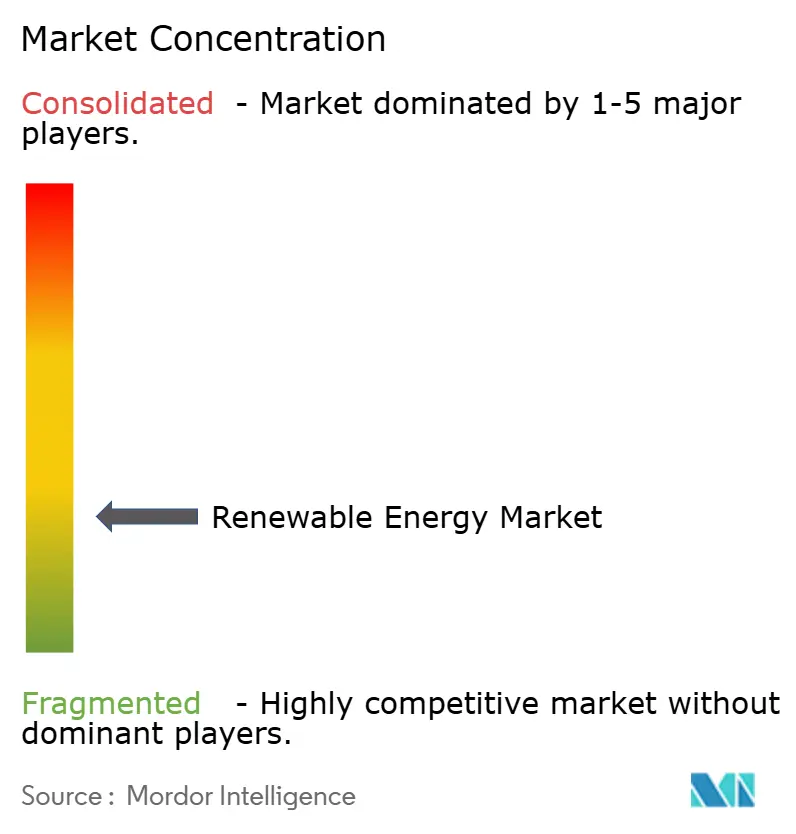
Competition is fragmented across project development, generation ownership and equipment supply, with large participants performing different commercial roles. NextEra Energy, Inc.'s generation and storage business, NextEra Energy Resources, added approximately 13.5 GW of new generation and storage to its backlog in 2025. Orsted A/S develops offshore wind projects, while Iberdrola, S.A.'s group owns and operates renewable generating capacity. These developers and owners compete through project origination and asset participation, with responsibilities that differ from those of equipment manufacturers. Backlog conversion consequently matters alongside asset scale because prospective projects must advance before they contribute operating generation.
Vestas Wind Systems A/S supplies wind turbines, and JinkoSolar Holding Co. Ltd. supplies solar modules, placing equipment manufacturers alongside developers in the competitive system. JinkoSolar shipped 86.1 GW of solar modules globally in 2025, down 7.3% from 2024. In 2025, Orsted divested a 50% equity stake in the 2.9 GW Hornsea 3 Offshore Wind Farm in the UK. Partial divestment distributes ownership exposure across participants in a large offshore wind project, giving developers a way to retain participation with a smaller equity stake.
Vestas's onshore business combines geographic breadth with uneven national order conversion. Vestas recorded 13.7 GW of onshore wind order intake in 2025, with Germany, the United States and Brazil its 3 largest onshore markets. The company attributed Germany's 4.1 GW of firm and unconditional orders in 2025 to improved permitting and record auction awards. Its U.S. order intake fell from 3.2 GW in 2024 to 3 GW in 2025, while Brazil rose from zero to 0.8 GW. Germany's permitting gains therefore support part of the order book without establishing uniform growth across Vestas's leading onshore markets.
Renewable Energy Industry Leaders
-
NextEra Energy, Inc.
-
Orsted A/S
-
Iberdrola, S.A.
-
Vestas Wind Systems A/S
-
JinkoSolar Holding Co. Ltd.
- *Disclaimer: Major Players sorted in no particular order
Renewable Energy Market Companies Covered in this Report
- NextEra Energy, Inc.
- Orsted A/S
- Iberdrola, S.A.
- EDF Renewables (EDF S.A.)
- Duke Energy Corporation
- Berkshire Hathaway Energy
- Acciona Energía S.A.
- Engie S.A.
- China Three Gorges Corporation
- Enel Green Power S.p.A.
- Statkraft AS
- Pattern Energy Group
- Invenergy LLC
- RWE Renewables GmbH
- ACWA Power
- EDP Renewables S.A.
- Brookfield Renewable Partners L.P.
- ReNew Energy Global PLC
- Scatec ASA
- First Solar, Inc.
- Vestas Wind Systems A/S
- Siemens Gamesa Renewable Energy S.A.U.
- GE Vernova Inc.
- JinkoSolar Holding Co. Ltd.
- Canadian Solar Inc.
- Longi Green Energy Technology Co., Ltd.
- Goldwind Science & Technology Co., Ltd.
- Trina Solar Co., Ltd.
- Enphase Energy, Inc.
- Sungrow Power Supply Co., Ltd.
- Mitsubishi Power, Ltd.
- Nordex SE
- Vestas Offshore Wind A/S
- Shanghai Electric Group Co., Ltd.
- Hitachi Energy Ltd.
- ABB Ltd.
- Climeon AB
- Pelamis Wave Power Ltd. (in Administration)
- Ocean Power Technologies, Inc.
Key Opportunities for Market Participants
The comparison covers India's grid-connected wind tender and, separately, Great Britain's Contracts for Difference Allocation Round 8 (AR8) for developers already in that process. Solar Energy Corporation of India Limited (SECI) opened a tender for 1,200 MW of grid-connected wind projects in India, with online bids due October 29, 2026. AR8's application window ran from July 20 to August 7, 2026. On October 15, 2026, the Department for Energy Security and Net Zero confirmed that AR8 would not use the Pending Applications process.
Market Opportunities Table of Renewable Energy Market
| Opportunity | Why now | Buyer / lead segment | Recommended play | Main barrier | Likely beneficiaries |
|---|---|---|---|---|---|
| Utility-scale wind delivery in India | SECI Tranche XXI procurement | Eligible wind-project developers | Submit a costed project-delivery bid with a grid-connection plan | Award uncertainty before equipment commitment | Wind developers and turbine suppliers |
| Onshore-wind repowering through AR8 | Post-application allocation process for eligible repowering | Repowering project companies already in the AR8 process | Stage turbine replacement around a competitive contract-delivery case | Finite budget and competing lower strike-price bids | Qualified repowering developers and turbine suppliers |
| Solar PV generation through AR8 | Solar PV eligibility within the allocation process | Solar project companies already in the AR8 process | Align equipment commitments with a financeable strike-price bid | Finite budget and competing lower strike-price bids | Qualified solar developers and module suppliers |
| Source: Mordor Intelligence | |||||
Great Britain's AR8 offers existing onshore-wind repowering and solar PV applicants a contract route, with the October 15, 2026, decision excluding Pending Applications and making qualification and price competition decisive. For Great Britain's existing applicants, participation depends on qualification after review or appeal, followed by price competition against a limited allocation budget. Turbine-replacement spending thus remains exposed to auction failure even after a repowering project clears qualification.
Recent Industry Developments in Renewable Energy Market
- Oct 2026: Clearway Energy Group closed financing and began construction on the 650 MW Swan Energy Center solar facility in Bates County, Missouri, under a 20-year power-purchase agreement.
- Sep 2026: Fervo Energy achieved first power from the first 33 MW GeoBlock at its Cape Station geothermal development in Beaver County, Utah, part of an approximately 100 MW first phase.
- Sep 2026: ACWA Power and partners SPIC Huanghe Hydropower and Saudi Tabreed began commercial operation of The Red Sea's integrated utilities system in Saudi Arabia, with 340 MWac of solar PV alongside battery storage.
Renewable Energy Market Report Scope and Research Methodology
Market Definition and Coverage
The renewable energy market measures installed power-generation capacity from renewable resources worldwide. It is a year-end stock of installed capacity, reported in terawatts.
Scope exclusions: Nuclear power-generation capacity, fossil-based power-generation and cogeneration capacity, standalone energy-storage capacity other than pumped-storage hydropower, and renewable heat-only and transport-fuel production capacity are excluded.
Segments Covered in This Report
- By Technology
- Solar Energy (PV and CSP)
- Wind Energy (Onshore and Offshore)
- Hydropower (Small, Large, PSH)
- Bioenergy
- Geothermal
- Ocean Energy (Tidal and Wave)
- By End-User
- Utilities
- Commercial and Industrial
- Residential
- By Geography
- North America
- United States
- Canada
- Mexico
- Europe
- United Kingdom
- Germany
- France
- Spain
- Nordic Countries
- Russia
- Rest of Europe
- Asia-Pacific
- China
- India
- Japan
- South Korea
- Malaysia
- Thailand
- Indonesia
- Vietnam
- Australia
- Rest of Asia-Pacific
- South America
- Brazil
- Argentina
- Colombia
- Rest of South America
- Middle East and Africa
- Saudi Arabia
- United Arab Emirates
- South Africa
- Egypt
- Rest of Middle East and Africa
- North America
Data Sources, Market Sizing, and Validation
Desk Research
Public sources such as IRENA's Renewable Capacity Statistics provide country and technology capacity series through 2025, while the International Energy Agency's Renewables 2025 report supplies deployment forecasts and policy context. REN21's Global Status Report collection helps frame technology and energy-system developments, and the U.S. Energy Information Administration's Electricity Data Browser offers a national series for checking U.S. electricity capacity trends.
Company filings, annual reports, investor presentations, project disclosures and reputable energy press can clarify project commissioning, retirements, ownership classification and announced additions that national totals do not explain. These named sources are not exhaustive, and further sources inform collection, validation and clarification.
Primary Interviews and Surveys
Interviews with renewable developers, asset owners, equipment suppliers, project lenders and energy analysts can clarify how a facility's technology, commissioning status, retirement and end-user are recorded. Functional leaders and managers can check project pipelines and country-level additions against the secondary capacity series, while executives can test market-wide assumptions and forecast drivers. Where published records conflict or leave a material gap, analysts can document the competing definitions, seek clarification from relevant respondents and compare independent project and country evidence before using a bounded estimate.
Distribution of primary research fieldwork respondents
| Company type | Respondent position | Region |
|---|---|---|
| Top tier: 30% | CXOs: 20% | APAC: 45% |
| Mid tier: 45% | Functional/Unit leaders: 35% | EMEA: 30% |
| Smaller Players: 25% | Managers: 45% | Americas: 25% |
Market-Sizing & Forecasting
The model begins with a top-down estimate of the global year-end installed-capacity stock, anchored in country and technology totals, then checks selected country and technology roll-ups against project additions and retirements. Key indicators include annual net capacity additions, commissioning and retirement schedules, technology-specific deployment, regional build rates, and publicly announced auction or project pipelines. Analysts use scenario analysis to extend the historical stock using expected net additions, with segment shares derived from technology, end-user and geographic capacity totals. Primary experts can test individual assumptions such as project timing, retirement rates and pipeline conversion. If a selected country or technology series is missing, analysts compare adjacent years, reconcile project-level evidence with national totals, and record a range until the gap is resolved rather than treating announced capacity as operational.
Data Validation & Update Cycle
Analysts triangulate country statistics, technology totals, project commissioning records and independent deployment signals, then check year-on-year changes, segment shares and cross-source variance for anomalies. They trace outliers to reporting revisions, timing, capacity definitions or duplicate project records, and seek clarification from the relevant source or respondent when the difference could change the estimate. A second analyst reviews reconciliations and model inputs before sign-off, with re-contact triggered by conflicting project status, material revisions or a change in the forecast driver. The series is refreshed annually, updated between cycles after material policy or project events, and checked once more against newly available evidence before delivery.
Mordor Intelligence's Global Renewable Energy Market Size Compared Against Other Published Estimates
Published estimates can differ in the transactions and products they count and the inputs used to model demand. The renewable energy market measures installed power-generation capacity from renewable resources worldwide.
Key Gap Drivers include the study's defined coverage and market-specific modeling choices. Key indicators include annual net capacity additions, commissioning and retirement schedules, technology-specific deployment, regional build rates, and publicly announced auction or project pipelines.
Benchmark comparison
| Source | Market Size | Gaps in Research Methodology |
|---|---|---|
| Mordor Intelligence | 6.86 Terawatt (2027) | |
| Global Agency A | 5.15 Terawatt (2025) | At its 2025 base, this estimate is 24.9% below this report's 2027 value of 6.86 Terawatt, 2 years later. The source records a year-end stock before the report's later measurement year, which includes subsequent additions. |
| Global Consultancy B | 4.1 Terawatt (2025) | At its 2025 base, this estimate is 40.2% below this report's 2027 value of 6.86 Terawatt, 2 years later. Its published base precedes the report's later measurement year, while its outlook anticipates further installed-capacity growth. |
Mordor Intelligence's analysts triangulate country statistics, technology totals, project commissioning records and independent deployment signals, then check year-on-year changes, segment shares and cross-source variance for anomalies.
Key Questions Answered in the Report
What is the renewable energy market size and growth outlook?
Size is projected to increase from 6.86 Terawatt in 2027 to 12.9 Terawatt by 2032, registering a CAGR of 13.46% between 2027 and 2032.
What is driving renewable power capacity additions?
Corporate power-purchase agreements, data-center demand and hydrogen-linked generation support additions. Spain recorded more than 2 GW of corporate solar PPAs annually from 2023 through 2025.
Which technology holds the largest share of renewable generating capacity?
Solar energy (PV and CSP) accounted for 46.42% of capacity in 2026.
Which companies are major renewable energy industry participants?
Major participants include NextEra Energy, Inc., Orsted A/S, Iberdrola, S.A., Vestas Wind Systems A/S and JinkoSolar Holding Co. Ltd.
What can constrain returns from new wind capacity?
Congestion can reduce saleable generation. In ERCOT, congestion curtailed roughly 4.7% of wind generation in 2025.
Which region leads renewable capacity deployment?
Asia-Pacific held 58.61% of capacity in 2026 and has a forecast CAGR of 15.9% from 2027 to 2032.