
India UPVC Doors And Windows Market Analysis by Mordor Intelligence
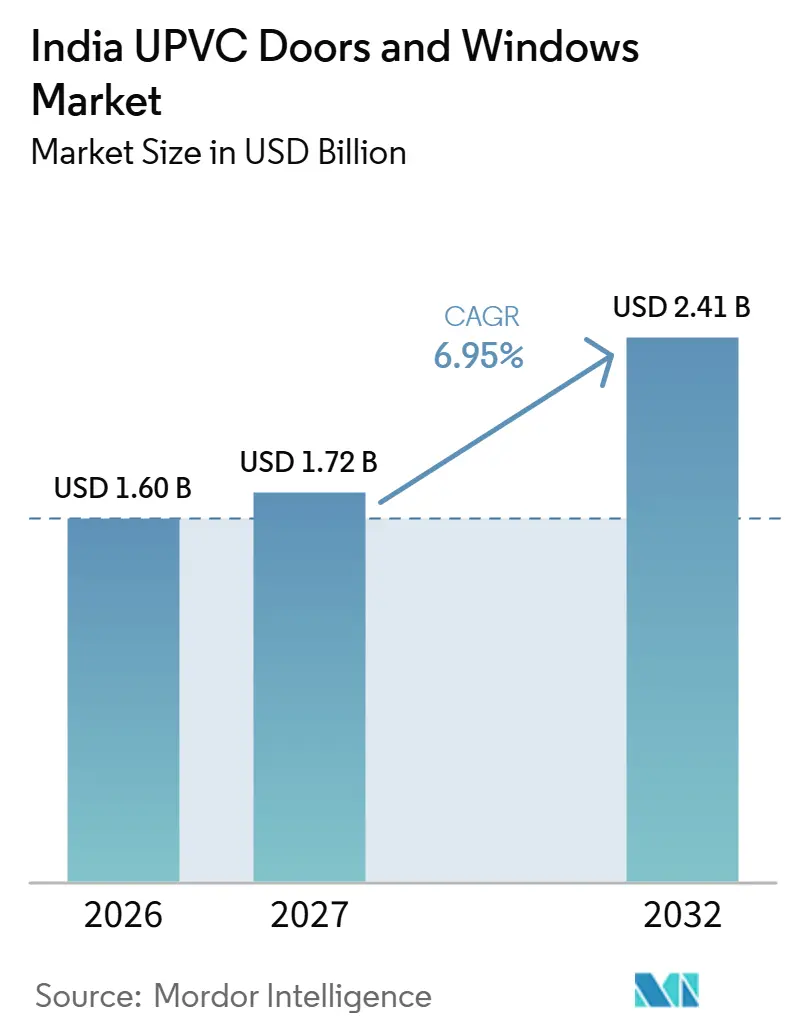
The India UPVC doors and windows market size is expected to increase from USD 1.6 billion in 2026 to USD 1.72 billion in 2027 and reach USD 2.41 billion by 2032, growing at a CAGR of 6.95% over 2027-2032.
India's housing programs and refurbishment needs create demand opportunities for UPVC window systems across household construction and institutional work. Broader customer access and component control give suppliers routes to connect branded products with local building projects. Planned domestic PVC capacity could broaden resin availability if the projects enter service. Project specifications and installation risks make the finished assembly central to this effort, directing attention to performance at the building. Growth depends on converting construction and facilities activity into specified orders while maintaining confidence in the installed door or window.
Key Report Takeaways
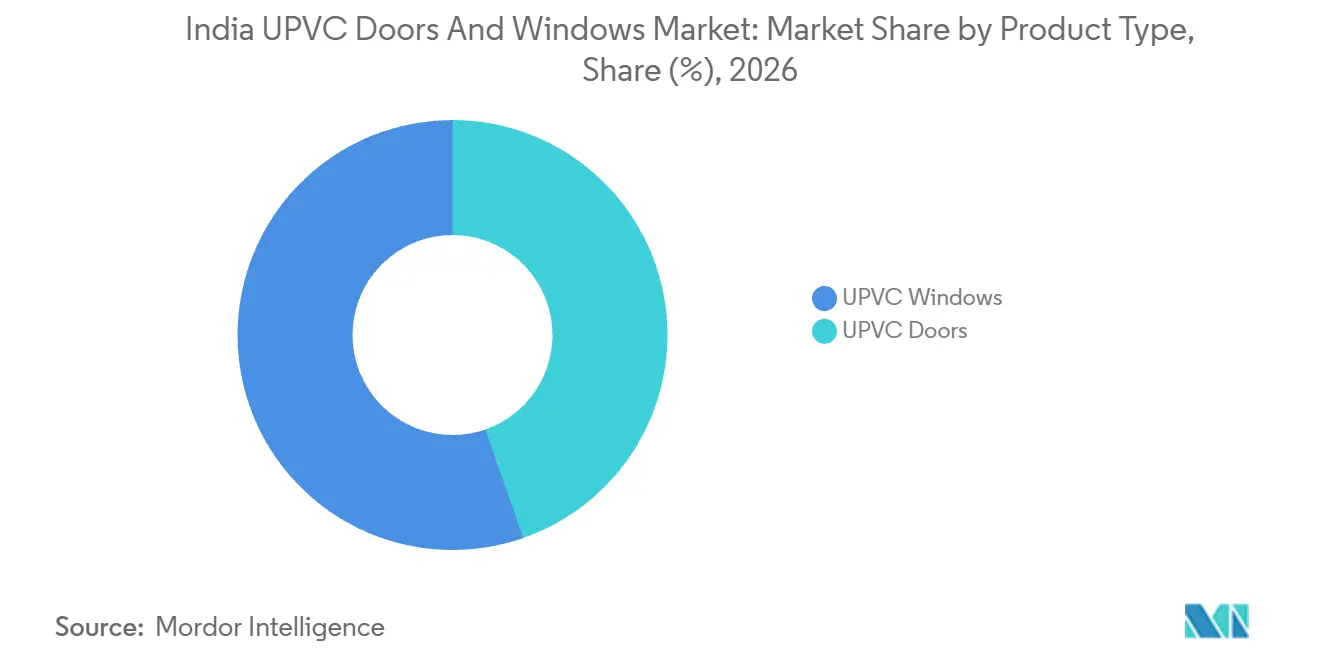
- By product type, UPVC windows held a 55.33% India UPVC doors and windows market share in 2026, while UPVC doors are forecast to grow fastest at a 7.82% CAGR over 2027-2032.
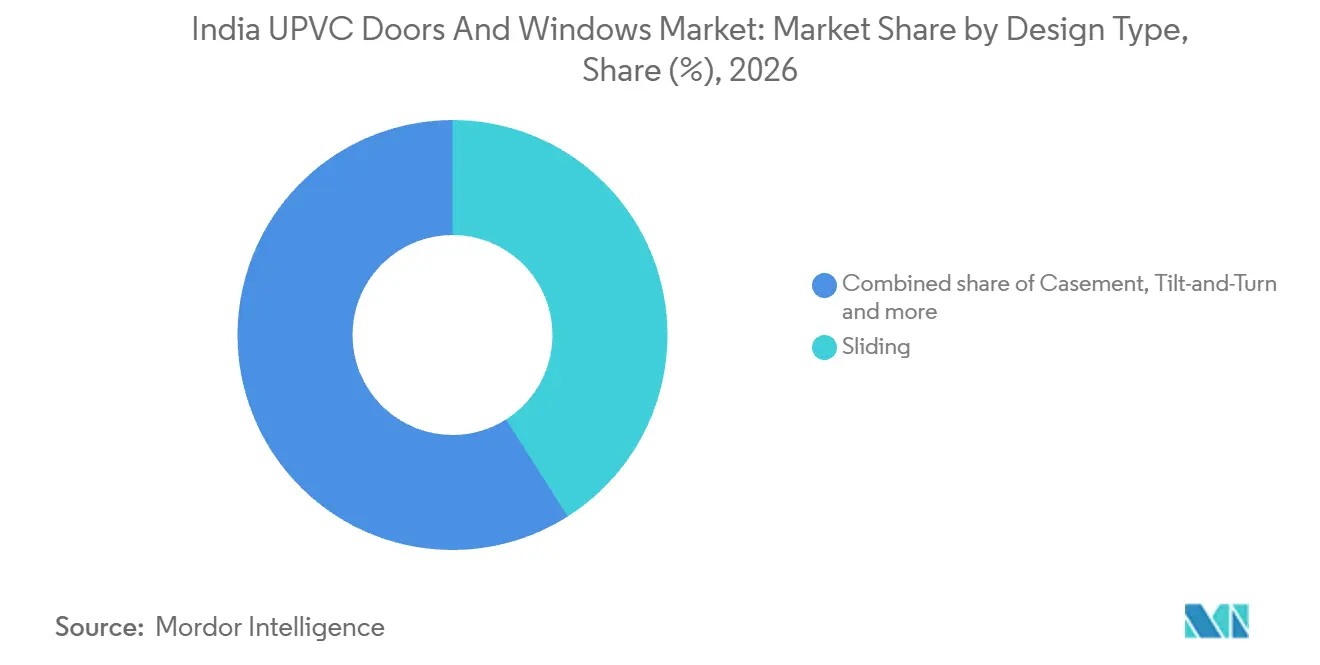
- Sliding led design types with a 40.99% share in 2026, whereas tilt-and-turn is forecast to be the fastest-growing segment at a 7.32% CAGR over 2027-2032.
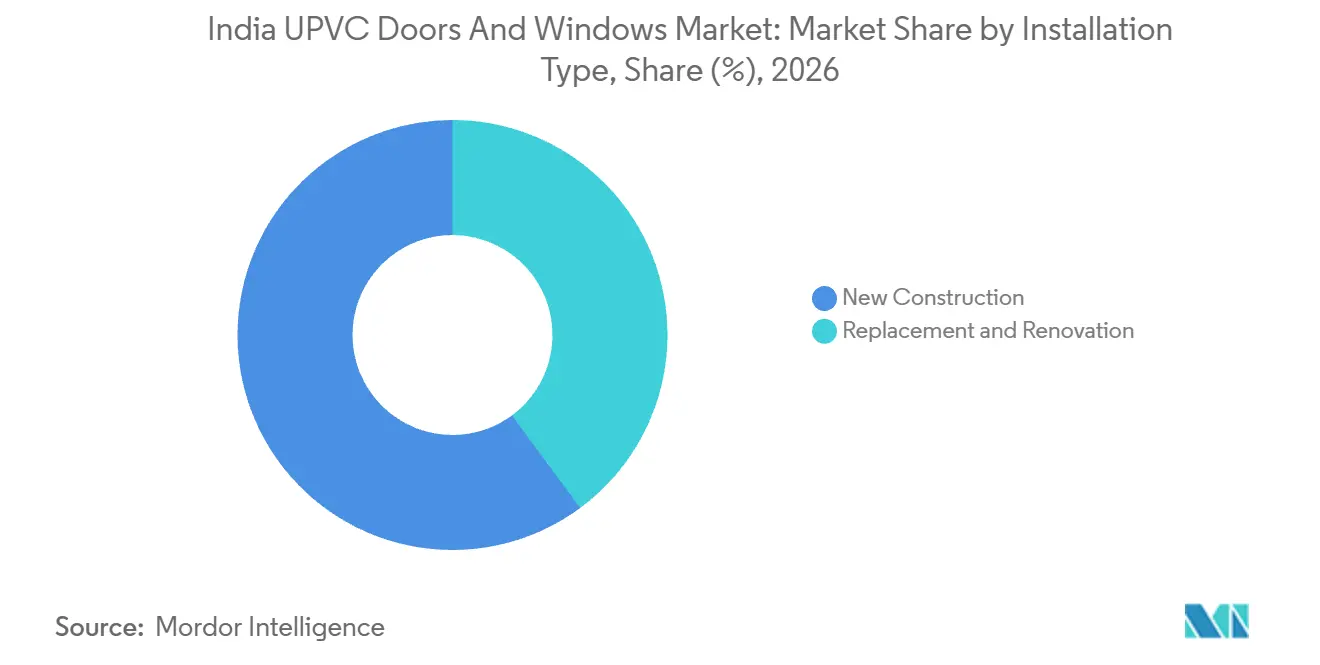
- Installation types were led by new construction, with a 60.12% share of the market in 2026, while the replacement and renovation segment is forecast to lead growth at a 7.44% CAGR over 2027-2032.
- Among end users, residential held a 66.21% share of the India UPVC doors and windows market size in 2026, and commercial is forecast to be the fastest-growing segment at an 8.27% CAGR over 2027-2032.
- Dealers and distributors led distribution channels with a 64.6% share in 2026 and are forecast to be the fastest-growing segment at a 7.1% CAGR over 2027-2032.
- South led the regional breakdown with a 29.05% share in 2026, while West is forecast to be the fastest-growing geography at a 7.85% CAGR over 2027-2032.
Note: Market numbers in this report are based on Mordor Intelligence's proprietary estimation framework, which combines nine months of actuals with Q4 projections for base year 2026.
Market Trends and Insights
Drivers Impact Analysis of India UPVC Doors And Windows Market*
| Driver | (~) % Impact on CAGR Forecast | Geographic Relevance | Impact Timeline |
|---|---|---|---|
| Government Push For Energy-Efficient, Green & Affordable Housing Schemes | +2.5% | Nationwide | Long term (≥ 4 years) |
| Rising Consumer Preference For Low-Maintenance Fenestration In Tier-II & III Cities | +2.2% | Nationwide | Medium term (2-4 years) |
| Accelerated Real-Estate Renovations Post-COVID Unlocking Retrofit Demand | +1.9% | Nationwide | Medium term (2-4 years) |
| Rapid Expansion Of Organized Retail Showrooms & E-Commerce Configurators | +1.6% | Mumbai and New Delhi | Short term (≤ 2 years) |
| Planned Domestic PVC Capacity Additions (Reliance, Adani) Could Reduce Raw-Material Cost Volatility | +1.1% | Maharashtra and Gujarat | Medium term (2-4 years) |
| Integration Of Smart-Home Sensors & IoT-Ready Locks Into UPVC Profiles | +0.6% | Nationwide | Long term (≥ 4 years) |
| Source: Mordor Intelligence | |||
Government Push For Energy-Efficient, Green & Affordable Housing Schemes
Housing approvals and residential envelope guidance create distinct routes through which government policy can support fenestration demand. The Ministry of Housing and Urban Affairs approved more than 193,000 additional houses under PMAY-U 2.0 on October 16, 2026.[1] In April 2025, the Ministry of Power said the Bureau of Energy Efficiency's residential Eco Niwas Samhita (ENS) had been published for adoption and implementation by states and local bodies. ENS 2024 sets a maximum residential envelope transmittance value of 15 W/m², excluding the roof, in composite, hot-dry, warm-humid, and temperate climates. Its calculation includes heat gain through windows, doors, and ventilators. The opportunity for UPVC suppliers is to make the fenestration package contribute to a project's envelope design while fitting affordable-housing costs.
Rising Consumer Preference For Low-Maintenance Fenestration In Tier-II & III Cities
For a household in a Tier-II or Tier-III city, low-maintenance fenestration offers a way to consider recurring upkeep alongside the purchase price. A maintenance-saving proposition becomes more valuable when the buyer is choosing several openings for the same home, because the ownership obligation extends across the installation. That makes the condition of the complete window or door relevant to the decision, including the frame, fittings, and associated service commitment. A higher initial quote would be easier to defend if the offer gives the household a credible basis for expecting less subsequent attention. The supplier can therefore compete through a defined upkeep commitment for the installed system, connecting the material choice to the household's longer ownership horizon.
Accelerated Real-Estate Renovations Post-COVID Unlocking Retrofit Demand
Refurbishment creates a route for fenestration suppliers into existing assets, extending demand beyond the specification of new buildings. JLL estimated in 2026 that around three-fifths of India's Grade A office stock, more than 550 million square feet, needed upgrading for future occupier and sustainability standards. Separately, Power Grid Corporation of India awarded a contract on October 9, 2025, to replace aluminum windows with UPVC windows in the transit camp, GIS hall, and other buildings at its Leh and Khaltsi substations. The utility's award places the material change inside a facilities-maintenance package, while the office stock provides a separate potential buyer pool. Suppliers can pursue specified replacement work through facilities buyers and works contractors, giving retrofit demand a commercial route distinct from new-building specification.
Rapid Expansion Of Organized Retail Showrooms & E-Commerce Configurators
Organized showrooms give UPVC suppliers a physical setting in which to translate wider product access into a household's material choice. Fenesta opened The Window Project showroom in Mumbai on January 8, 2025, offering UPVC windows, aluminum windows, and solid panel doors. That setting allows a buyer to compare UPVC with an alternative frame material through the same branded sales channel. For the supplier, the outlet creates an additional route to the customer while preserving competition between products inside its own portfolio. A mixed-material showroom therefore rewards the supplier that can convert a general window inquiry into a specific UPVC choice.
Restraints Impact Analysis of India UPVC Doors And Windows Market*
| Restraint | (~) % Impact on CAGR Forecast | Geographic Relevance | Impact Timeline |
|---|---|---|---|
| High Gst Bracket (18%) Versus 12% On Aluminium & Wood Alternatives | -1% | Nationwide | Short term (≤ 2 years) |
| Persistent Skilled-Installer Deficit Causing Quality-Perception Issues | -0.9% | Nationwide | Medium term (2-4 years) |
| Import Dependence For Premium Hardware & Multi-Chamber Profiles | -0.7% | Nationwide | Short term (≤ 2 years) |
| Rising Competition From Thermally-Broken Aluminum Systems In Premium Segment | -0.4% | Nationwide | Long term (≥ 4 years) |
| Source: Mordor Intelligence | |||
High Gst Bracket (18%) Versus 12% On Aluminium & Wood Alternatives
Tax classification affects the final cost quoted for an interstate building-product order, making the taxable category commercially relevant before a fenestration package is priced. From September 22, 2025, India's integrated GST schedule sets an 18% rate for interstate supplies of plastic builders' ware under heading 3925. For an order falling within that heading, the tax becomes part of the amount the customer must fund. This cost layer can make a price-sensitive construction project harder to serve when the supplier's proposal has limited room to absorb additional charges. The remaining commercial pressure is the tax-inclusive price of the classified product, which must fit the customer's construction-cost limit.
Persistent Skilled-Installer Deficit Causing Quality-Perception Issues
Limited access to installation expertise can restrict how many UPVC window orders a supplier can fit and hand over reliably. In February 2026, the window and door manufacturers association UWDMA described uncertain long-term water tightness for UPVC windows sealed only with silicone. Its magazine said that uncertainty was especially relevant during monsoons, even with skilled technicians and the best silicone. This makes the fitting task broader than adding technicians, because the sealing approach also forms part of the performance proposition. Where expertise is scarce, a supplied window can remain dependent on a constrained fitting team before becoming a usable opening. The remaining constraint is the time and specialist capacity needed at the building, alongside the residual quality risk of the chosen installation method.
*Our forecasts treat driver/restraint impacts as directional, not additive. The impact forecasts reflect baseline growth, mix effects, and variable interactions.
India UPVC Doors And Windows Market Segment Analysis
By Product Type:
Window Reach And Door Category Entry Broaden SupplyUPVC windows accounted for a 55.33% share of the India UPVC doors and windows market size in 2026. AIS Windows, a strategic business unit of Asahi India Glass Ltd, unveiled its 50th showroom in Hyderabad on January 13, 2025, displaying UPVC and aluminum windows and doors. This gives the largest segment a customer-facing route through an integrated glass-solutions business, connecting its established commercial identity to assembled fenestration. The window sale can therefore combine a frame-material decision with the glazing discussion, widening the specification role of a supplier operating in glass solutions.
UPVC doors are forecast to be the fastest-growing segment at a 7.82% CAGR over 2027-2032. Apollo Pipes Limited launched its combined UPVC doors and windows product category for the domestic market on July 14, 2025. For doors, inclusion in a wider fenestration offer can create access to buyers specifying several openings within the same building project. Door suppliers can compete for inclusion in a project's complete fenestration specification, giving the new product category a route to orders beyond the initial launch announcement.

By Design Type:
Installation Packages Give Design Choices Commercial FormSliding was the largest segment by design, accounting for 40.99% of the market in 2026. Through its Chennai office, the Reserve Bank of India (RBI) invited bids for the supply and installation of UPVC sliding windows with MS grills in 2025. The work covered ground-floor balconies in phase II of its Besant Nagar residential quarters. The specification combines the sliding operating format with a grill and a floor-specific application, giving suppliers a defined installation package to deliver. The commercial role consequently extends from supplying a profile to delivering the specified window and grill at the balcony, with the scope of site work shaping the offer.
Tilt-and-turn is forecast to be the fastest-growing segment at a 7.32% CAGR over 2027-2032. For a buyer considering this system, the relevant trade-off is the value of its operating choice against the complexity of the installed mechanism. That puts the interaction of sash movement, operating hardware, and completed installation at the center of the product proposition for a particular room. Suppliers can position the finished system around that functional choice, making the operating arrangement a reason to specify the window and including the hardware and fitting needed to deliver it.
By Installation Type:
Construction Responsibility And Repair Procurement DifferNew construction represented a 60.12% India UPVC doors and windows market share in 2026. PMAY-G recorded 2.66 million rural houses completed in FY2025-26, including homes sanctioned in earlier financial years, with beneficiaries constructing or supervising construction of their houses. The largest segment therefore combines national program scale with construction responsibility placed at the individual-household level. For fenestration suppliers pursuing this buyer base, that structure makes the route into each building's specification commercially relevant alongside the aggregate construction volume. The selling task is to make a window-and-door package workable for beneficiary-led building, linking national housing activity to local project execution.
Replacement and renovation work is forecast to be the fastest-growing segment at a 7.44% CAGR over 2027-2032. Virender Kumar & Co. received a May 27, 2025, special-repair award covering glass, a UPVC wire-mesh door, and UPVC windows in the residential area of the All India Institute of Ayurveda, Goa. This puts the fenestration requirement inside an awarded repair package, with the named contractor responsible for the works contract. For system suppliers, the route to business can therefore run through the contractor assembling the broader repair scope. A complete door-and-window offer can compete on its contribution to that defined work package, connecting product supply to an existing-building repair requirement.
By End-user:
Housing Demand Includes Institutional ProcurementResidential was the largest end-user segment, with a 66.21% share in 2026. RBI Chennai's 2025 staff-quarter UPVC window procurement restricted participation to selected enlisted contractors. The Bank could reject any or all tenders and was not bound to accept the lowest bid. For a window manufacturer, access to this residential work would therefore depend on its own eligibility or a commercial relationship with an invited contractor. Residential demand can include institutionally procured housing packages, making access to the specified project a distinct selling task from reaching an individual homeowner.
Commercial is forecast to be the fastest-growing segment at an 8.27% CAGR over 2027-2032. The All India Institute of Speech and Hearing invited bids in June 2026 for the provision and installation of UPVC windows in quadrangle rooms at its Special Education Building in Mysuru. A room-group specification allows the procurer to define a window package within a larger educational facility. Commercial demand can therefore reach suppliers as targeted institutional works, giving them an opportunity whose scope is set by selected rooms within a building.
By Distribution Channel:
Dealer Reach And Direct Engagement CoexistDealers and distributors were the largest segment with a 64.6% share in 2026 and are forecast to be the fastest-growing segment at a 7.1% CAGR over 2027-2032. A company-specific illustration comes from Fenesta's broader windows and doors business, which had 421 dealers across 268 cities and served 976 Indian cities in FY2025-26. The relationship between partner locations and wider service reach makes physical representation and territory coverage separate decisions for a branded manufacturer. The commercial proposition for dealer-led expansion therefore includes how the brand serves locations beyond its partner cities, alongside the local presence created by each dealer.
Direct sales from manufacturers offer a different form of buyer engagement, with the producer's retail organization taking a more visible role in the customer relationship. Fenesta opened showrooms in Kozhikode and Noida during FY2024-25 to strengthen direct-to-customer engagement across its building solutions business. The coexistence of these outlets and its dealer network shows how a manufacturer can combine direct contact in selected locations with broader partner representation. For suppliers choosing between channel formats, the commercial distinction is therefore the degree of direct customer involvement they seek in particular locations, alongside the geographic access available through partners.
Geography Analysis
South UPVC Doors And Windows Market
South accounted for a 29.05% India UPVC doors and windows market share in 2026, making it the largest regional segment. Knight Frank reported 27,968 residential housing sales in Bengaluru, 19,249 in Hyderabad, and 9,198 in Chennai in H1 2026. The reported year-over-year increases were 5% in Bengaluru, 1% in Hyderabad, and 3% in Chennai. These readings give fenestration suppliers several metropolitan housing pools with different combinations of transaction volume and growth. Regional coverage can be distributed across those housing centers, giving suppliers more than one local buyer pool through which to pursue the leading region's opportunity.
West UPVC Doors And Windows Market
West is forecast to be the fastest-growing regional segment at a 7.85% CAGR over 2027-2032. Kaka Industries reported annual UPVC door and window profile capacity of 3,537 metric tons at its Lasundra operations in Kheda District, Gujarat, in its H2 FY26 presentation. Mumbai's Grade A office market recorded 5.88 million square feet of gross leasing in H1 2026, up 17.8% from H1 2025. Regional profile capacity and commercial occupier demand provide separate entry points for fenestration businesses, with the commercial opportunity depending on linking manufacturing capability to the project specification for a finished system.
In North, Knight Frank reported 24,862 residential housing sales in the National Capital Region in H1 2026, down 7% from H1 2025. East's Kolkata recorded 8,368 residential housing sales in H1 2026, up 3% from H1 2025. Fenesta opened showrooms offering UPVC and aluminum fenestration in New Delhi on March 27, 2025, and in Guwahati on February 18, 2025. The examples separate the demand backdrop created by housing transactions from the customer access created by adding a local outlet. For a national supplier, regional coverage can extend through local contact points while the housing opportunity in individual cities moves in different directions.
Regulatory Framework and Outlook
The selected jurisdictions are compared from the perspective of UPVC system suppliers seeking covered commercial-building work in India. IS 19609:2026 specifies materials, fabrication, and performance for complete external UPVC doors, windows, and sliders. Its scope excludes smoke-leakage, fire-resistance, and escape-route applications, curtain walls, revolving doors, internal partitions, and bullet- or blast-resistant products. A supplier's specification task therefore has two boundaries, the external product covered by the standard and the building covered by the applicable energy code.
Regulatory Table of India UPVC Doors And Windows Market
| Decision factor | India | Karnataka | Maharashtra |
|---|---|---|---|
| Primary authority | Bureau of Indian Standards for product standards; state-designated agencies for energy-code enforcement | Karnataka Renewable Energy Development Limited; local building authorities | Maharashtra Energy Development Agency; local building authorities |
| Key instruments or direction | IS 19609:2026 external-system specification; 2018 ECBC state-implementation framework | K-ECBC 2018 whole-assembly U-factor requirement for covered commercial buildings | Maharashtra ECBC Rules 2025 building-envelope provisions for covered commercial buildings |
| Commercial effect | Common system specification alongside state-administered energy-code duties | Performance assessment includes sash and frame | Envelope compliance at specified commercial-building thresholds |
| Current policy attractiveness | Medium | Medium | Medium |
| Future direction of policy attractiveness | No change | No change | No change |
| Source: Mordor Intelligence | |||
National conditions are rated Medium because a common external-system specification provides a reference point, while commercial energy-code enforcement depends on state implementation. Karnataka's Medium rating reflects the need to demonstrate sash-and-frame performance under its covered commercial-building code. Maharashtra's Medium rating reflects envelope obligations under its 2025 rules, excluding buildings using neither electricity nor fossil fuel and systems primarily used for manufacturing processes. State adoption connects national model codes to binding project duties, so the existing commercial frameworks support the No change outlook for the selected jurisdictions.
Value Chain Stages
Value capture is compared across profile production, completed-system fabrication, and installation at the building. Fenesta upgraded its Kota UPVC extrusion facility in FY2024-25, raising annual capacity from 8,600 to 12,284 metric tons, with higher precision and fewer defects as stated objectives.[3] The investment illustrates how expanding profile capacity also creates a need to preserve manufacturing consistency before additional material reaches fabricators.
Value Chain Analysis Table of India UPVC Doors And Windows Market
| Primary activity | Key participants | Value capture | Bottleneck | Resilience response |
|---|---|---|---|---|
| Profile extrusion | Profile manufacturers such as Prominance Window Systems and Fenova, a division of Arihant Polymer Extrusions | Profile sales | Dimensional consistency during capacity expansion | Stage process upgrades before loading added capacity |
| Window and door fabrication | System manufacturers such as Fenesta Building Systems, Aparna Venster, and Encraft India Pvt Ltd | Finished-system sales | Balancing profile supply with fabrication throughput | Coordinate extrusion supply and fabrication schedules |
| Installation and service | Installation providers such as Aparna Enterprises and Encraft India Pvt Ltd | Installed-system sales and service work | Handoffs between measurement and final fitting | Assign responsibility across measurement and installation, with after-sales support where offered |
| Source: Mordor Intelligence | ||||
In Q1 FY2027, Fenesta operated one UPVC extrusion unit and 4 UPVC fabrication plants. That combination places successive manufacturing stages within one business, while Aparna's measurement-to-installation service extends responsibility to the building itself. Combining factory and site responsibility can concentrate the customer relationship with the installed-system supplier, making independent profile producers' and installers' access depend on their role within that offer.
Competitive Landscape
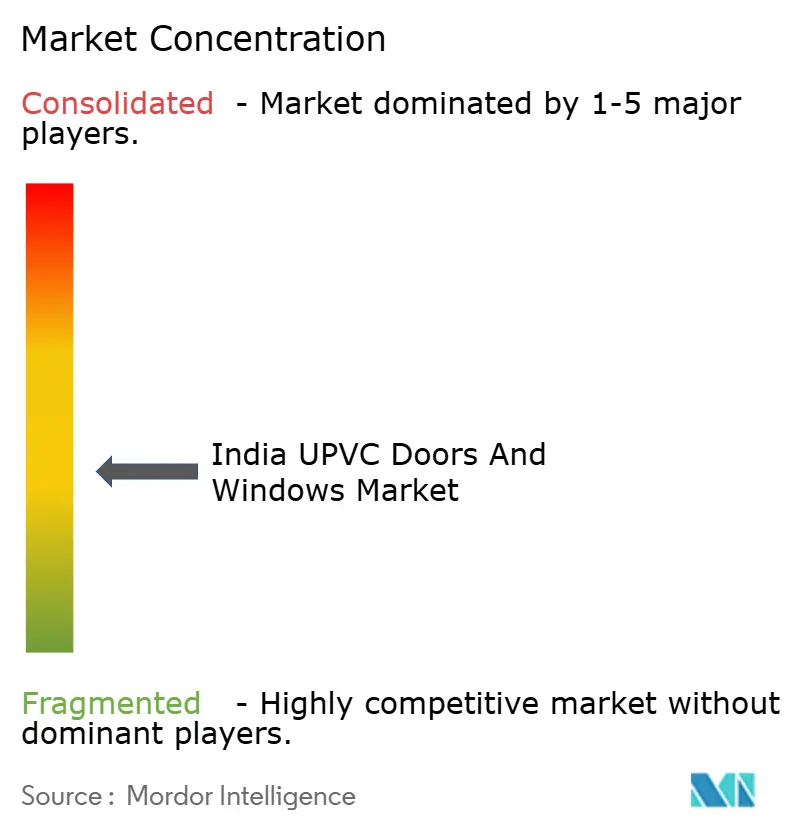
Competition spans several established suppliers with different combinations of profile manufacturing, finished systems, and customer-facing capabilities. Fenesta Building Systems (DCM Shriram) competes through its broader fenestration business, while VEKA Group's NCL VEKA Ltd manufactures UPVC profiles for windows and doors. Aparna Venster reported capacity exceeding 18,000 UPVC window and door units per month in its 2025 corporate brochure. Encraft India Pvt Ltd supplies UPVC doors and windows, and Prominance Window Systems manufactures profiles and provides window-system design and technical services. These overlapping business models give buyers a choice between suppliers whose commercial responsibilities begin at the profile and those offering a more complete system.
Fenesta's broader Building Systems revenue grew 28% in FY2025-26, with DCM Shriram attributing the increase to higher volumes across project and retail segments.[2] During that financial year, Fenesta acquired a 53% stake in window-hardware manufacturer DNV Global Private Limited to improve supply and product innovation. The investment gives the finished-system business an ownership interest in a component producer, creating a route to coordinate hardware development with its own offering. For buyers, the strategic significance lies in a supplier taking greater responsibility across connected parts of a window system, with the acquisition's value depending on execution of that wider responsibility.
VEKA Group acquired the remaining shares in NCL VEKA Pvt. Ltd. in February 2025, bringing the Indian profile manufacturer into full ownership. The transaction places the profile business within a single ownership structure, adding integration to the competitive choices facing fabricators and finished-system suppliers. Ownership control gives the group a route to coordinate its profile offering, while finished-system suppliers also need a basis for technical differentiation. Within the external-system category covered by IS 19609:2026, standards positioning can depend on evidence for complete-assembly performance. An independent fabricator can consequently differentiate through the finished assembly's performance, addressing a buyer requirement that ownership scale alone does not resolve.
India UPVC Doors And Windows Industry Leaders
-
Fenesta Building Systems (DCM Shriram)
-
NCL VEKA Ltd
-
Aparna Venster
-
Encraft India Pvt Ltd
-
Prominance Window Systems
- *Disclaimer: Major Players sorted in no particular order
India UPVC Doors And Windows Market Companies Covered in this Report
- Fenesta Building Systems (DCM Shriram)
- Encraft India Pvt Ltd
- VEKA India
- Rehau India Pvt Ltd
- Deceuninck Profiles
- Prominance Window Systems
- Aparna Venster
- Window Magic India
- Koemmerling India
- LX Hausys India
- NCL VEKA Ltd
- Lesso India
- Lingel Windows & Doors Technologies
- Shani Corporation (CORA Windows)
- Aluplast India
- AIS Windows
- Welltech Systems
- KAKA Profiles Pvt Ltd
- Elite Window Factory
- Eurostar Fenestration
- Perfect Window Solutions
Key Opportunities for Market Participants
The opportunities compare institutional replacement work, complete retrofit packages, and performance-based commercial window specifications. On October 19, 2026, IIT Delhi invited bids by October 26 to replace existing Zanskar Boys Hostel windows with sliding UPVC shutters, toughened glass, and fly-proof stainless-steel mesh. Separately, the Ministry of Power reported in April 2025 that BEE's commercial Energy Conservation and Sustainable Building Code had been published for adoption by states. These premises create different routes into finished-system demand, through a defined replacement package and through projects choosing code-based design criteria.
Market Opportunities Table of India UPVC Doors And Windows Market
| Opportunity | Why now | Buyer / lead segment | Recommended play | Main barrier | Likely beneficiaries |
|---|---|---|---|---|---|
| Institutional window replacement | October 2026 institutional replacement procurement | Campus estate and maintenance teams | Offer surveyed replacement UPVC window systems | Matching replacement systems to existing openings | UPVC system suppliers such as Aparna Venster |
| Complete glass-and-mesh retrofit packages | Buyer specification combines sliding UPVC shutters, toughened glass, and stainless-steel mesh | Contractors serving institutional renovation buyers | Supply a complete specified fenestration assembly | Coordinating frame, glazing, and mesh within the package | Finished-system suppliers such as Aparna Venster and Fenesta Building Systems |
| Performance-qualified commercial windows | Published commercial code provides climate-specific assembly criteria for projects using its design approach | Commercial-building project teams | Qualify complete UPVC assemblies against the selected project criteria | Meeting whole-assembly thermal requirements | Window-system suppliers such as Fenesta Building Systems and Encraft India |
| Source: Mordor Intelligence | |||||
The clearest near-term opening is a complete replacement-window offer that resolves the existing-opening survey and the specified glazing and mesh together. Such an offer would give a works contractor a defined fenestration package to incorporate into a wider refurbishment. The revenue opportunity lies in the finished, project-ready assembly, making coordination across those components part of the system supplier's offer.
Recent Industry Developments in India UPVC Doors And Windows Market
- Oct 2026: On October 19, IIT Delhi invited bids by October 26 to replace Zanskar Boys Hostel's existing windows with sliding UPVC shutters, toughened glass, and fly-proof stainless-steel mesh.
- Nov 2025: Arihant Profile-Extrusion LLP commissioned a Solapur facility for Fenova UPVC door and window profiles, with live annual capacity of 6,000 metric tons.
- Oct 2025: Power Grid Corporation of India awarded a contract to replace aluminum windows with UPVC windows in the transit camp, GIS hall, and other buildings at its Leh and Khaltsi substations.
India UPVC Doors And Windows Market Report Scope and Research Methodology
Market Definition and Coverage
The India UPVC doors and windows market measures annual spending on supplied and installed uPVC fenestration systems in India. It covers complete window and door systems sold for buildings, valued once at the system sale, including installation when bundled.
Scope exclusions: Non-uPVC doors and windows, general civil works not directly tied to supplying and fitting uPVC door and window systems, separately sold repair, maintenance, replacement parts or hardware, and PVC resin and other materials sold as inputs are excluded.
Segments Covered in This Report
- By Product Type
- UPVC Windows
- UPVC Doors
- By Design Type
- Sliding
- Casement
- Tilt-and-Turn
- Others (French, Awning, etc.)
- By Installation Type
- New Construction
- Replacement & Renovation
- By End-user
- Residential
- Commercial
- Industrial & Infrastructure
- By Distribution Channel
- Direct from the Manufacturers
- Dealers and Distributors
- By Geography
- North
- West
- South
- East
Data Sources, Market Sizing, and Validation
Desk Research
Secondary research draws on public and official sources such as the Ministry of Housing and Urban Affairs' PMAY-U releases for housing approvals, the Bureau of Energy Efficiency's Eco Niwas Samhita materials for building-envelope requirements, the Bureau of Indian Standards' IS 19609 product specification, and the Indian Centre for Plastics in the Environment's plastics industry status report for PVC-profile supply context. These sources help establish demand, performance and supply indicators, while company disclosures and project notices provide market-specific checks.
Company annual reports, investor presentations and relevant regulatory filings can clarify product scope, capacity, distribution and realized pricing. Reputable business and trade press can cross-check construction, renovation and installation developments. The named sources are illustrative and not exhaustive, and further sources inform collection, validation and clarification.
Primary Interviews and Surveys
Primary research is designed around India-based interviews with profile producers, window and door fabricators, dealers, installers, developers, architects and institutional procurement teams, with respondents selected to cover company scale and operating roles. Their input checks the interpretation of construction, product, channel, price and capacity evidence, clarifies gaps in the secondary record, and helps reconcile conflicting indicators through follow-up questions and cross-checks.
Distribution of primary research fieldwork respondents
| Company type | Respondent position | Region |
|---|---|---|
| Top tier: 30% | CXOs: 20% | |
| Mid tier: 45% | Functional/Unit leaders: 30% | |
| Smaller Players: 25% | Managers: 50% |
Market-Sizing & Forecasting
With annual spending measured once at complete-system sale value, analysts establish the India total through a top-down demand model and selectively check it against supplier roll-ups and sampled installed price multiplied by volume. Housing approvals and completions, construction activity, renovation tenders, domestic profile capacity, resin costs and installed package prices indicate new openings, replacement demand, feasible supply and value realization. Scenario analysis carries these indicators into the forecast. Market shares are derived from system sales and project specifications by product, design, installation, end use, channel and Indian region, while India-based industry interviews check segment paths. Conflicting or missing observations are reconciled against construction and supplier evidence before gaps are carried as ranges.
Data Validation & Update Cycle
Analysts triangulate supplier, channel, project and construction signals, then check totals, segment shares, unit values and year-to-year movements for anomalies against the prior series and independent market indicators. A second review traces material variances to source definitions, timing, possible duplicate upstream and resale transactions, or changed product and price mix. Unresolved points trigger source re-contact or targeted respondent follow-up before sign-off. The series is refreshed annually, reviewed between cycles after material policy, capacity or construction events, and given a fresh pre-delivery review.
Mordor Intelligence's India Upvc Doors and Windows Market Size Measured Against Other Published Estimates
Published estimates can differ in the transactions and products they count and the inputs used to model demand. It covers complete window and door systems sold for buildings, valued once at the system sale, including installation when bundled.
Key Gap Drivers include the study's defined coverage and market-specific modeling choices. Scenario analysis carries these indicators into the forecast.
Benchmark comparison
| Source | Market Size | Gaps in Research Methodology |
|---|---|---|
| Mordor Intelligence | USD 1.72 B (2027) | |
| Market Research Publisher A | USD 1.49 B (2025) | At its 2025 base, this estimate is 13.4% below this report's 2027 value of USD 1.72 B, 2 years later. Its published complete-system total is measured two years before the comparison year. |
| Market Research Publisher B | USD 1.35 B (2025) | At its 2025 base, this estimate is 21.5% below this report's 2027 value of USD 1.72 B, 2 years later. Its stated market covers uPVC windows, leaving door-system sales outside the product total. |
Mordor Intelligence's analysts triangulate supplier, channel, project and construction signals, then check totals, segment shares, unit values and year-to-year movements for anomalies against the prior series and independent market indicators.
Key Questions Answered in the Report
What is the India UPVC doors and windows market size and expected growth?
The market is forecast at USD 1.72 billion in 2027 and USD 2.41 billion by 2032, with a 6.95% CAGR over 2027-2032.
What is supporting demand for UPVC doors and windows in India?
Government housing programs provide a building pipeline, with more than 193,000 additional houses approved under PMAY-U 2.0 on October 16, 2026.
Which product type leads India's UPVC doors and windows sector?
UPVC windows held the largest share at 55.33% in 2026. UPVC doors are forecast to grow fastest at a 7.82% CAGR over 2027-2032.
Who are the major suppliers of UPVC doors and windows in India?
Major suppliers include Fenesta Building Systems (DCM Shriram), NCL VEKA Ltd, Aparna Venster, Encraft India Pvt Ltd, and Prominance Window Systems.
What installation challenge could affect the outlook for UPVC windows in India?
In February 2026, UWDMA described uncertain long-term water tightness for silicone-only UPVC window seals, especially during monsoons, even with skilled technicians and the best silicone.
Which Indian regions lead the UPVC doors and windows sector?
South held 29.05% of the national market in 2026, while West is forecast to grow fastest at a 7.85% CAGR over 2027-2032.