
Home Decor Market Size and Share
Home Decor Market Analysis by Mordor Intelligence
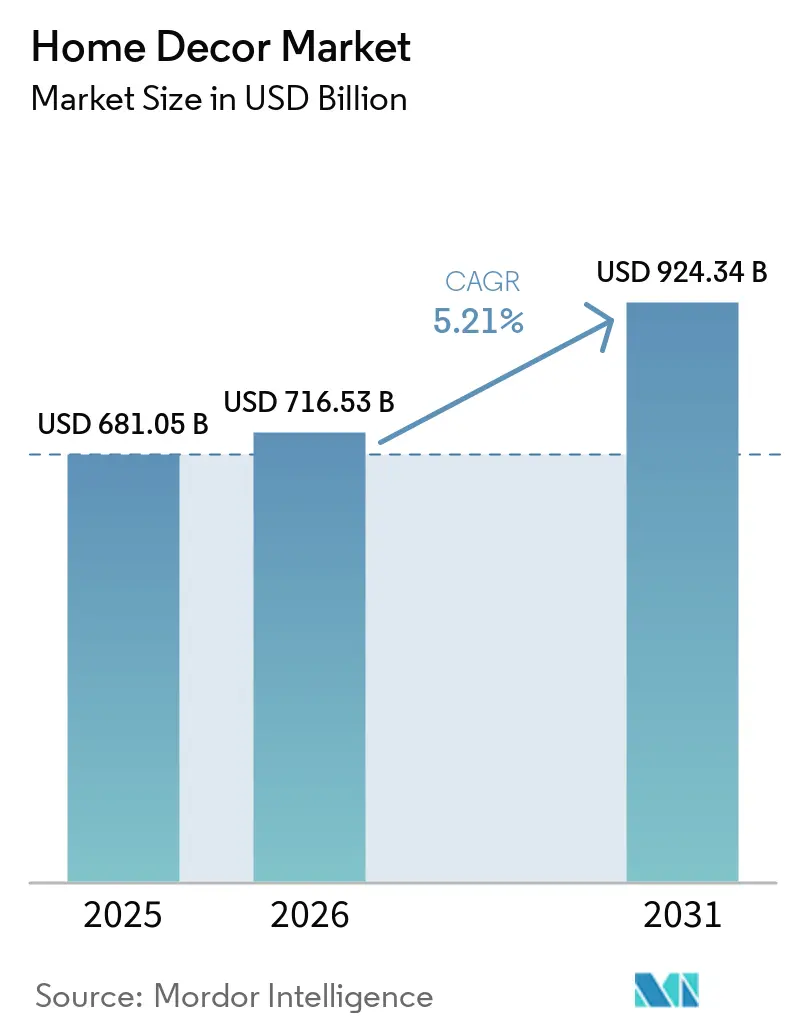
The home decor market size is expected to increase from USD 716.5 billion in 2026 to USD 753.9 billion in 2027 and reach USD 955.3 billion by 2032, growing at a CAGR of 4.85% over 2027-2032.
Interest in room updates combines with digital inspiration in Japan to create opportunities for coordinated furnishing offers. Retailers can respond by connecting finished lighting and furniture to accessible discovery and ordering routes that carry design attention toward a transaction. That approach must also reckon with price-led buying, where affordability decides how much design interest converts into revenue. Material-cost pressure and scarce artisanal skills can limit what suppliers profitably deliver, making production execution central to capturing that demand.
Key Report Takeaways
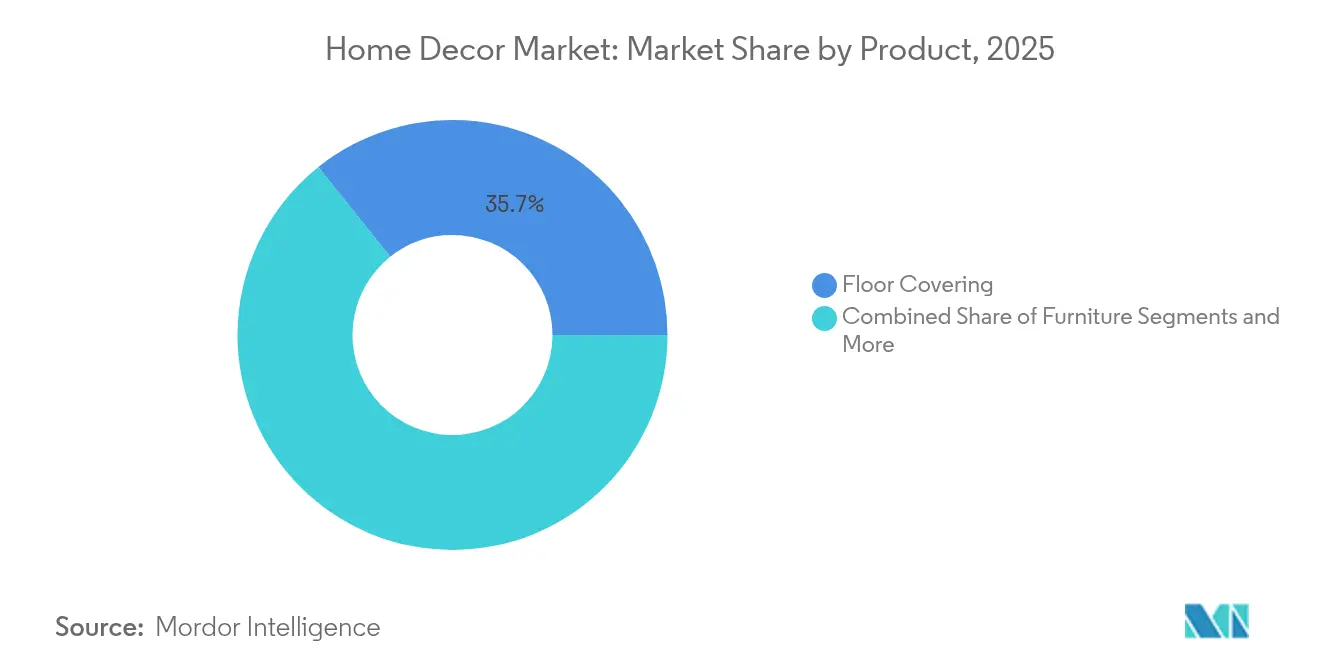
- By product, floor coverings led with a 35.45% home decor market share in 2026, while the textiles (curtains, bedding, cushions) segment is forecast to grow fastest at a CAGR of 6.8% over 2027-2032.
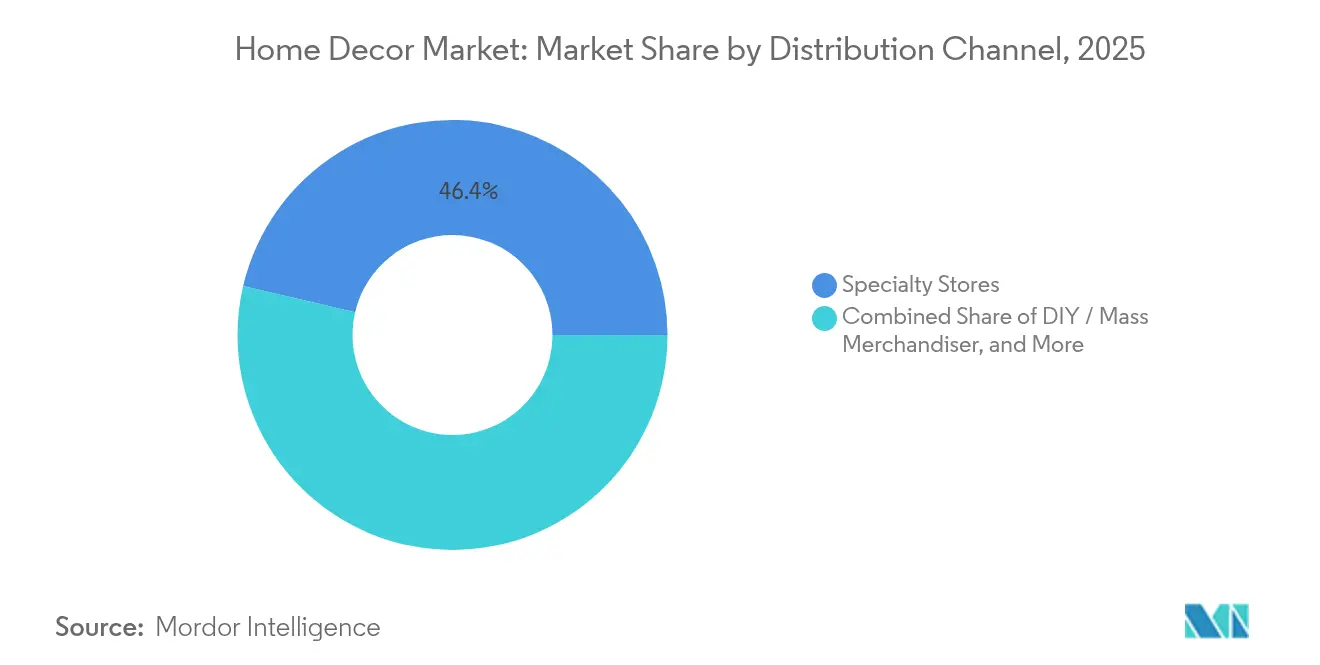
- Specialty stores led distribution channels with a 45.61% share of the home decor market size in 2026, whereas DIY / mass merchandiser is forecast to grow fastest at a CAGR of 7.4% over 2027-2032.
- Across price tiers, mass / value held the largest revenue share at 60.1% in 2026, with premium forecast to be the fastest-growing segment at a CAGR of 6.4% over 2027-2032.
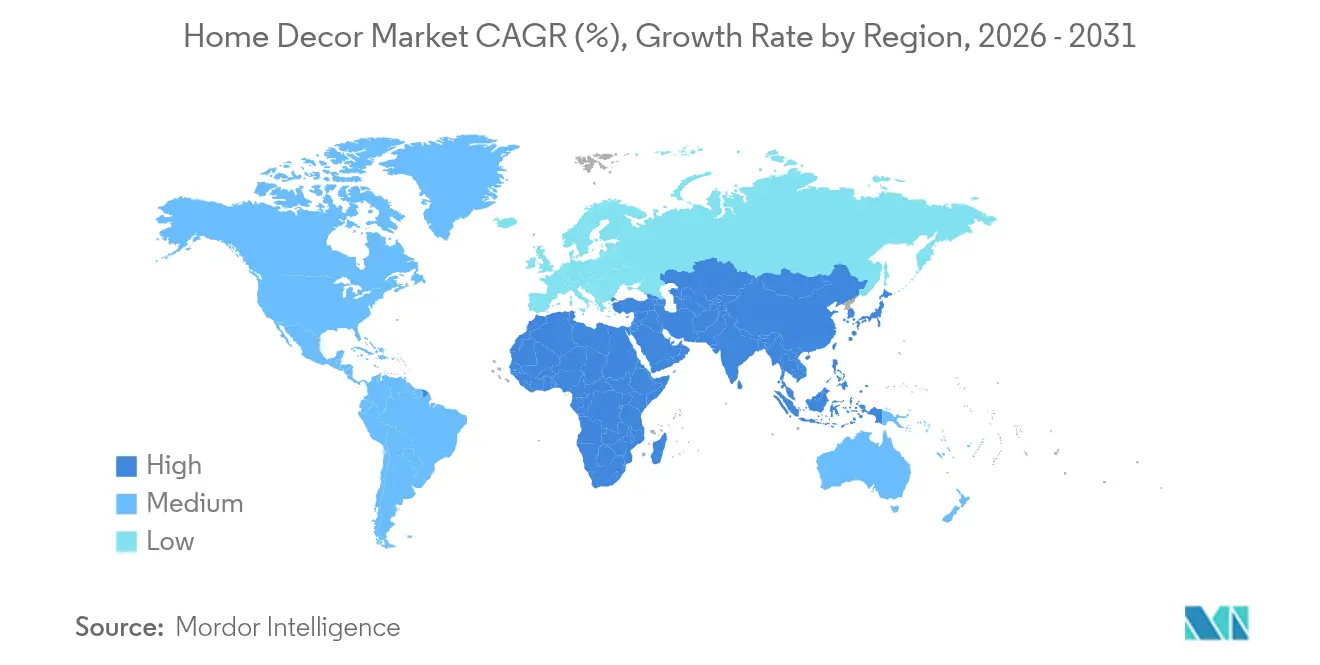
- Among regions, North America held the largest revenue share at 41.81% in 2026, and Asia-Pacific is forecast to grow fastest at a CAGR of 7.1% over 2027-2032.
Note: Market numbers in this report are based on Mordor Intelligence's proprietary estimation framework, which combines nine months of actuals with Q4 projections for base year 2026.
Market Trends and Insights
Drivers Impact Analysis of Home Decor Market*
| Driver | (~) % Impact on CAGR Forecast | Geographic Relevance | Impact Timeline |
|---|---|---|---|
| Rising consumer interest in interior design and aesthetics | +1.8% | The United States | Short term (≤ 2 years) |
| Growing influence of social media and digital platforms | +1.4% | Japan and the United Kingdom | Short term (≤ 2 years) |
| Shift toward eco-friendly and sustainable materials | +1% | The United Kingdom | Medium term (2-4 years) |
| Expansion of smart-home compatible decor | +0.9% | Germany and Japan | Medium term (2-4 years) |
| Urban micro-living spurring multifunctional furniture | +0.7% | Singapore and Hong Kong | Long term (≥ 4 years) |
| Emerging "phygital" AR/VR showroom adoption | +0.5% | The United States | Medium term (2-4 years) |
| Source: Mordor Intelligence | |||
Rising consumer interest in interior design and aesthetics
Interest in refreshing a room creates a demand opportunity beyond the initial purchase of its furnishings. In a 2025 survey, 58% of adult U.S. home-furnishing buyers and planned buyers said they liked to update their home decor often. The research covered 1,200 primary or joint furniture purchase decision-makers surveyed during August 16-18, 2025. This preference gives suppliers a reason to offer design continuity between an existing interior and a new decorative purchase. A coordinated refresh can address that interest without requiring the buyer to replace the entire room. For retailers, the commercial opportunity is a sequence of compatible aesthetic updates, rather than dependence on a single complete furnishing project.
Growing influence of social media and digital platforms
Decor suppliers need to address both the creation of a room idea and the channel that completes its purchase. In Japan, 42.1% of 2,930 respondents to homebuilder Ichijo Co., Ltd.’s May 9-17, 2026, interior survey said they referred to Instagram when choosing interiors. At IKEA UK, online sales reached 43.2% of the retailer’s total sales in FY25, compared with 40% in FY24. These examples place digital sources at both inspiration and transaction stages, with different commercial tasks at each. Room imagery can introduce a furnishing, while a clear buying route makes the identified product available for selection.
Shift toward eco-friendly and sustainable materials
Sustainable furnishing specifications create demand for certified or recycled inputs from suppliers able to meet them. Inter IKEA Group reported that 96.5% of wood and paper purchased by the group and first-tier suppliers for IKEA product manufacturing was FSC-certified or recycled in FY25.[1] Its manufacturing scope included semi-finished products, components and manufacturing by-products, with reported volume of 14.7 million cubic meters roundwood equivalent, comprising 81% virgin and 19% recycled fibers. Suppliers were required to hold FSC certification and source certified or recycled material, although exceptional acceptance of uncertified suppliers left 3.5% outside that sourcing measure. UK kitchen supplier Howdens introduced its Frome family in 2025, its first with MDF made using up to 30% recycled timber. Such range specifications give certified-material and recycled-MDF suppliers a defined route into furnishing production.
Expansion of smart-home compatible decor
Household adoption gives decorative-lighting suppliers an opportunity to sell additional smart fixtures into an established user base. In Germany, 46% of respondents reported using smart lamps and luminaires at home in 2026, up 13 percentage points from 2024, according to Bitkom Research. The representative survey covered 1,159 people aged 16 and older, with all respondents forming the base for the multiple-response question. For decor suppliers, that rise and breadth support an offer that combines decorative appearance with functions already used in German households. Room-by-room additions give suppliers a selling route to households extending an existing lighting setup, alongside first-time adopters.
Restraints Impact Analysis of Home Decor Market*
| Restraint | (~) % Impact on CAGR Forecast | Geographic Relevance | Impact Timeline |
|---|---|---|---|
| Raw-material price volatility | -0.6% | The United States | Short term (≤ 2 years) |
| Skilled artisanal labor shortage | -0.4% | Bhadohi in India | Medium term (2-4 years) |
| Costly cross-border e-commerce returns | -0.3% | Westzaan, the Netherlands | Short term (≤ 2 years) |
| Stricter EPR / take-back mandates | -0.2% | France and the Netherlands | Long term (≥ 4 years) |
| Source: Mordor Intelligence | |||
Raw-material price volatility
Higher material costs can restrict flooring suppliers’ ability to hold selling prices while preserving manufacturing earnings. Interface’s consolidated cost of sales rose USD 16.8 million in 2025, partly because of higher raw-material costs and sales volume.[2] U.S. tariffs on imported rubber and luxury vinyl tile products added approximately USD 7.3 million to the company’s costs. Lower manufacturing costs partly offset those pressures through production efficiencies and favorable fixed-cost absorption on higher volume. The combination makes material inflation commercially consequential even where greater output improves factory economics, because the offset need not remove the input burden. Flooring suppliers facing that balance must absorb the remaining cost or seek higher prices, potentially limiting demand at the affected price points.
Skilled artisanal labor shortage
Handmade carpet suppliers cannot convert buyer interest into deliveries when the required weaving skills are unavailable. By May 2026, a shortage of weavers had brought high-quality handmade carpet production in Bhadohi, India, almost to a halt. The commercial constraint lies in completing the specified handmade product. For importers serving this product niche, that creates exposure to restricted availability even where customers remain willing to buy. Importers sourcing these high-quality handmade carpets face a limit on deliverable volume that additional orders alone cannot remove.
*Our forecasts treat driver/restraint impacts as directional, not additive. The impact forecasts reflect baseline growth, mix effects, and variable interactions.
Home Decor Market Segment Analysis
By Product:
Floor Coverings Lead While Textile Growth Draws on Retail MixFloor coverings accounted for a 35.45% share of the home decor market size in 2026, making it the largest segment. In 2025, carpet and area rugs represented 43.4% of the U.S. flooring market’s 16.666-billion-square-foot volume. That flooring measure included residential and commercial activity, with carpet and rugs forming a substantial soft-surface category. The area-based scale highlights the commercial importance of supplying substantial physical coverage, tying decorative choice to the quantity required for an installation. Manufacturers serving that requirement can compete through the ability to deliver a consistent surface across the specified area, making production scale relevant alongside appearance.
The textiles (curtains, bedding, cushions) segment is forecast to grow fastest at a CAGR of 6.8% over 2027-2032. Dunelm Group attributed growth in the 26 weeks ended December 27, 2025, to core categories including its bedding and cushion ranges. Across the retailer’s business, first-half volumes were broadly stable while average item values increased through category and product mix, rather than headline retail prices. That distinction points to assortment composition as a commercial growth mechanism even when the retailer’s aggregate product volumes change little. Textile suppliers can pursue value growth through the retailer’s assortment decisions, making the commercial offer broader than a commitment to higher production volume.

By Distribution Channel:
Specialist Reach Meets Project-Led Retail GrowthSpecialty stores represented a 45.61% home decor market share in 2026, making it the largest segment. IKEA stores welcomed 915 million visitors worldwide in FY25, up 1.9% from FY24, illustrating physical specialist-retail reach. Those visits give a furnishing specialist opportunities to connect a decorative item with the room setting in which it will be used. A specialist can organize that choice around a consistent interior presentation, helping the buyer judge combinations within the same shopping visit. Because IKEA of Sweden AB designs the range under assignment from Inter IKEA Systems B.V. and Inter IKEA Group sources most of the furnishing range externally, suppliers participate through manufacturing IKEA-designed products.
DIY / mass merchandiser is the fastest-growing segment, with a forecast CAGR of 7.4% over 2027-2032. The Home Depot reported positive Storage & Organization and Kitchen & Blinds comparable sales in its U.S., Canadian and Mexican Primary segment for the first six months of fiscal 2026. That measured period ended August 2, 2026, providing a recent example of activity in departments connected to furnishing and home-improvement tasks. Retailers can position decorative choices within such an active improvement project, giving the household a defined setting for its purchase. The growth mechanism is the ability to bring furnishing decisions into a practical room-improvement transaction already being considered.
By Price Tier:
Affordability Supports Volume as Premium Orders ExpandMass / value held 60.1% of total revenue in 2026, making it the largest segment. Ingka Group reported that IKEA Retail quantities sold rose 1.6% in FY25 while sales declined 1.6% as it continued to keep prices low. The retailer operates IKEA sales channels under franchise agreements and positions its home-furnishing range around affordability. This combination illustrates how greater purchasing activity can coexist with lower retailer revenue when the offer emphasizes lower prices. For suppliers serving the value tier, the commercial task is to support affordable unit prices while generating sufficient additional product volume to sustain the business.
Premium is the fastest-growing segment, with a forecast CAGR of 6.4% over 2027-2032. Arhaus, Inc., a premium home-furnishings brand and integrated retailer, reported company-wide net revenue of USD 385 million for the quarter ended June 30, 2026, up 7.4% year over year. Its comparable written sales from showrooms and e-commerce, including catalogs and other mailings, rose 12.5% from the second quarter of 2025. Written sales capture ordering activity separately from delivered sales. Growth across comparable operations makes established selling routes a potential source of additional premium-furnishing orders, without requiring a new showroom as the growth trigger.
Geography Analysis
North America Home Decor Market
North America accounted for a 41.81% share of the home decor market size in 2026, making it the largest regional market. IKEA U.S. recorded 60.9 million store visits in FY25, illustrating the scale of physical retail contact within the United States. That traffic makes the retailer’s sourcing relationships commercially relevant to manufacturers supplying its U.S. stores. IKEA of Sweden AB designs the range under assignment from Inter IKEA Systems B.V., and Inter IKEA Group sources most home furnishings externally, so suppliers participate through production of IKEA-designed products.
Asia-Pacific Home Decor Market
Asia-Pacific is the fastest-growing regional market, with a forecast CAGR of 7.1% over 2027-2032. In August 2025, Ingka Group launched IKEA sales on JD.com in China, offering more than 6,500 products across categories with delivery and membership services. IKEA India began online deliveries across Delhi-NCR and 9 satellite cities in March 2025, offering more than 7,000 products and solutions through app, website and phone ordering. These extensions provide a growth mechanism through additional selling access, allowing furnishing suppliers to reach households through established digital shopping routes and newly served delivery territories.
In South America, Brazil’s furniture buyers faced costly credit and tighter household budgets in 2025, which weakened durable-goods demand and lengthened purchase decisions. Suppliers targeting Brazil can make financing terms part of their furniture proposition because expensive credit delays the purchase decision. Within Europe’s EU countries, Malta recorded the highest furniture-and-furnishings price level in 2025, in a comparison against the EU average. In Middle East & Africa, South African household furniture, appliances and equipment retailers’ seasonally adjusted sales at constant 2019 prices were 0.1% below June in July 2026.
Regulatory Framework and Outlook
Selected jurisdictions are compared on furnishing-product compliance from the perspective of manufacturers and importers. Covered upholstered seating, furniture and wood-based articles, and textiles face different performance, emissions and information duties. The commercial comparison therefore centers on the work needed to place the participant’s specific products on each national market.
Regulatory Table of Home Decor Market
| Decision factor | United States | Germany | China | Brazil |
|---|---|---|---|---|
| Primary authority | Consumer Product Safety Commission | Federal Office for Chemicals at BAuA | Ministry of Industry and Information Technology | Inmetro, its superintendencies and delegated state bodies |
| Key instruments or direction | 16 CFR Part 1640 and TB 117-2013; certificates rule | REACH Annex XVII entry 77; planned furniture ecodesign work | Mandatory GB 18584-2024; voluntary GB/T 47600.7-2026 and GB/T 32445-2026 | Portaria Inmetro No. 118/2021 for covered textiles |
| Commercial effect | Smolder resistance and permanent labels for covered upholstered seating; eFiling for certification-required imports | Formaldehyde release limit of 0.062 mg/m³ under specified test conditions for covered furniture and wood-based articles, subject to listed exceptions | Furniture must meet applicable harmful-substance limits | Permanent, visible Portuguese markings for responsible-party identity and tax identification, origin, fiber composition by mass and care; size when applicable |
| Current policy attractiveness | Medium | Medium | Medium | High |
| Future direction of policy attractiveness | Hardening | Hardening | No change | No change |
| Source: Mordor Intelligence | ||||
The United States’ Medium rating reflects established product duties, with Hardening tied to the January 8, 2027, certificates-rule phase-in for qualifying foreign-trade-zone entries. Germany’s Medium rating reflects the EU-wide REACH formaldehyde restriction for furniture and wood-based articles applicable after August 6, 2026, while the European Commission’s plan gives furniture ecodesign an indicative 2028 adoption timeline, supporting Hardening. China’s Medium rating and No change outlook distinguish mandatory substance compliance from voluntary furniture standards scheduled for implementation on November 1, 2026, and February 1, 2027. Brazil’s High rating reflects defined textile-information duties, with near-term No change grounded in reaffirmed guidance and no textile-labeling item in the 2026-2027 agenda, whose ordinary review is due one year after publication.
Value Chain Stages
Manufacturing, sourcing and retailing capture value through different capabilities in the furnishing supply chain. Inter IKEA Group combines internal manufacturing with an external supplier network for its home-furnishing range. That structure makes coordination between product specifications and external production commercially significant alongside ownership of manufacturing capacity.
Value Chain Analysis Table of Home Decor Market
| Primary activity | Key participants | Value capture | Bottleneck | Resilience response |
|---|---|---|---|---|
| Product manufacturing | Furnishing manufacturers such as IKEA Industry and Mohawk Industries Inc. | Manufactured-product sales | Exposure to changing material costs | Qualify material alternatives against the required product specification |
| Product sourcing and wholesale | Sourcing and wholesale groups such as Inter IKEA Group | Wholesale product sales to franchisees | Coordinating specifications across external suppliers | Qualify supplier alternatives before transferring production commitments |
| Consumer retail | Online home-products retailers such as Wayfair Inc. | Retail product sales | Translating broad assortments into coherent room choices | Connect complementary items within a purchasable room concept |
| Source: Mordor Intelligence | ||||
Inter IKEA Group reported that raw-material, commodity, transportation and logistics costs fell early in FY25 before rising in the second half amid uncertainty around announced U.S. tariffs. In FY25, the group manufactured about 10% of its home-furnishing range and sourced the remainder from more than 800 external suppliers. External suppliers bear manufacturing-stage input exposure for most of that range, while Inter IKEA Group manages sourcing and logistics exposure across the network.
Competitive Landscape
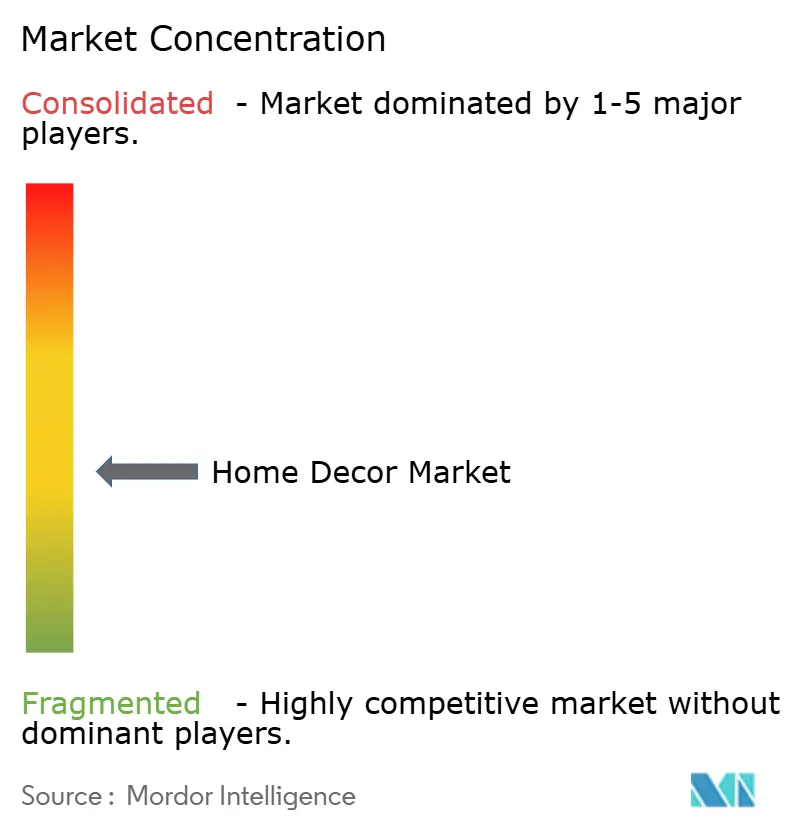
Competition is moderately fragmented, with large retail systems operating alongside differentiated furniture and design businesses. Inter IKEA Systems B.V. owns and franchises the IKEA concept, while The Home Depot Inc. competes through home-improvement retail. Ashley Global Retail LLC, Wayfair Inc. and MillerKnoll Inc. add furniture retail, online home products and modern furnishings, respectively. Wayfair’s company-wide net revenue rose 7.5% year over year to USD 3.5 billion in the second quarter of 2026, illustrating the commercial scale of online home retail. These different operating models give suppliers competing routes to buyers through retail reach, brand identity and differentiated furnishing ranges.
On November 28, 2025, Ashley launched a transactional furniture-shopping experience through Perplexity with PayPal payment technology. Perplexity hosts the conversational platform, while PayPal supplies payment technology that enables customers to complete search through checkout within that interface. That moves the point of purchase into the conversational interface, allowing a shopper to act on a furniture search and complete checkout there. For the furniture retailer, this channel depends on coordinating its furnishing offer with the platform and payment partners, making integration a competitive capability alongside assortment.
MillerKnoll’s Global Retail segment increased net sales by 5.9% as reported and 4.3% organically in fiscal 2026, which ended May 30. Its modern design furnishings and accessories, including Holly Hunt, reach third-party retailers and direct consumer channels, placing the growth within a business serving both routes. Alongside Ashley’s platform partnership and Wayfair’s online scale, that result makes access to buyers a competitive consideration alongside furnishing design. For suppliers seeking entry into IKEA’s network, IWAY Forest Materials Section 6.1 requires suppliers and subcontractors using virgin or recycled forest materials to comply with applicable forest-related laws and provide evidence under IKEA specifications. Supplier qualification for IKEA business joins furnishing design with documented material compliance, making entry into that retail system a product and sourcing decision.
Home Decor Industry Leaders
-
Inter IKEA Systems B.V.
-
The Home Depot Inc.
-
Ashley Global Retail LLC
-
Wayfair Inc.
-
MillerKnoll Inc.
- *Disclaimer: Major Players sorted in no particular order
Home Decor Market Companies Covered in this Report
- Inter IKEA Systems B.V.
- The Home Depot Inc.
- Wayfair Inc.
- Ashley Global Retail LLC
- MillerKnoll Inc.
- Williams-Sonoma Inc. (Pottery Barn, West Elm)
- Mohawk Industries Inc.
- Mannington Mills Inc.
- Shaw Industries Group Inc.
- La-Z-Boy Incorporated
- RH (Restoration Hardware)
- Ethan Allen Interiors Inc.
- Haverty Furniture Companies Inc.
- Crate & Barrel Holdings Inc.
- Lowe's Companies Inc.
- Walmart Inc. (Home & Living)
- Target Corporation (Threshold, Hearth & Hand)
- At Home Group Inc.
- Neighborhood Intelligence Inc.*
Key Opportunities for Market Participants
The opportunities compare resale among existing IKEA owners with an additional digital sales route for new finished furnishings. Ingka Group launched the IKEA Douyin Official Flagship Store in China on October 11, 2026, offering more than 6,500 IKEA products across 179 categories with delivery available in 301 cities.[3] The store complements Ingka Group’s existing Chinese stores, website, app, WeChat and other e-commerce channels.
Market Opportunities Table of Home Decor Market
| Opportunity | Why now | Buyer / lead segment | Recommended play | Main barrier | Likely beneficiaries |
|---|---|---|---|---|---|
| Resale of existing IKEA furnishings | A live member-to-member selling route | IKEA Family buyers in the United Kingdom and Ireland | Build precise listings around product identity and condition | Agreement on condition and handover | Existing IKEA product owners |
| Second-hand room completion | Direct access to other members’ pre-owned furnishings | IKEA Family households seeking additional furnishings | Match available pieces to a specific room requirement | Finding the required piece in acceptable condition | IKEA Family buyers |
| Furnishing sales through social commerce | An additional live IKEA selling channel in China | Chinese home-furnishing shoppers served by the Douyin store | Connect product discovery to a deliverable furnishing offer | Converting browsing into a completed product order | Ingka Group’s IKEA retail operation |
| Source: Mordor Intelligence | |||||
The central opening is to turn Douyin shoppers into delivered orders for new finished decor. Its assortment and delivery coverage put a direct sales route behind that opportunity. Because the store complements Ingka Group’s existing Chinese channels, the commercial test is whether it adds buyers or shifts orders within the group.
Recent Industry Developments in Home Decor Market
- Oct 2026: Ingka Group launched IKEA’s Douyin Official Flagship Store in China on October 11, offering more than 6,500 IKEA products across 179 categories with delivery available in 301 cities.
- Mar 2026: Wayfair opened its approximately 150,000-square-foot Atlanta store on March 31, carrying furniture and home decor alongside outdoor living, housewares, appliances and home-improvement products.
Home Decor Market Report Scope and Research Methodology
Market Definition and Coverage
Home decor market measures annual end-user spending on finished household goods used to furnish, cover, decorate and illuminate residential spaces. It covers product sales through consumer retail, online commerce and professional project channels, across price points worldwide.
Scope exclusions: Construction materials sold for building or renovation work, large household appliances, interior design and contracting service fees, and disposable party supplies are excluded.
Segments Covered in This Report
- By Product
- Furniture
- Textiles (Curtains, Bedding, Cushions)
- Floor Coverings
- Wall Decor and Accessories
- Lighting
- By Distribution Channel
- Specialty Stores
- DIY / Mass Merchandiser
- Online / E-commerce
- Interior Designers and Contractors
- By Price Tier
- Mass / Value
- Premium
- Luxury / Designer
- By Geography
- North America
- Canada
- United States
- Mexico
- South America
- Brazil
- Peru
- Chile
- Argentina
- Rest of South America
- Europe
- United Kingdom
- Germany
- France
- Spain
- Italy
- BENELUX (Belgium, Netherlands, Luxembourg)
- NORDICS (Denmark, Finland, Iceland, Norway, Sweden)
- Rest of Europe
- Asia-Pacific
- India
- China
- Japan
- Australia
- South Korea
- South East Asia (Singapore, Malaysia, Thailand, Indonesia, Vietnam, and Philippines)
- Rest of Asia-Pacific
- Middle East & Africa
- United Arab Emirates
- Saudi Arabia
- South Africa
- Nigeria
- Rest of Middle East & Africa
- North America
Data Sources, Market Sizing, and Validation
Desk Research
Public sources such as the United Nations Statistics Division's COICOP 2018 classification help map furniture, floor coverings, household textiles and lighting to household consumption categories, while also showing adjacent equipment and services that require separate treatment. Eurostat's Household Budget Survey and 2024 household consumption tables provide household spending patterns and time comparisons, and the U.S. Bureau of Economic Analysis' National Income and Product Accounts handbook describes consumer-spending categories and source data that can inform a country-level cross-check.
Company annual filings and investor materials can clarify product mix, channel exposure, revenue trends and price or volume commentary, while reputable business reporting can cross-check dated changes in retail, housing and sourcing conditions. These sources are illustrative and not exhaustive, and further sources inform collection, validation and clarification.
Primary Interviews and Surveys
Interviews and structured surveys would include executives and functional leaders at home decor manufacturers, retailers, online sellers, distributors and interior project businesses, alongside managers responsible for merchandising, sourcing, sales and category planning. Their responses would test secondary evidence on category mix, route to market, price changes and purchase cycles, while gaps would be logged for targeted follow-up rather than filled by assumption. Analysts would compare respondent evidence with public spending, trade, company and retail indicators, then reconcile material differences by product, channel and region before using an input.
Distribution of primary research fieldwork respondents
| Company type | Respondent position | Region |
|---|---|---|
| Top tier: 35% | CXOs: 20% | APAC: 40% |
| Mid tier: 45% | Functional/Unit leaders: 35% | EMEA: 32% |
| Smaller Players: 20% | Managers: 45% | Americas: 28% |
Market-Sizing & Forecasting
A top-down global revenue model would start with household spending on finished decor products and use household consumption, housing turnover and renovation activity, retail sales and product price or mix, and online channel growth as indicators of demand and value. Scenario analysis would carry the indicators into the 2027-2032 outlook, with the central path checked against slower housing activity, faster online adoption and stronger replacement or connected-lighting demand. Product, channel, price-tier and regional shares would be built from available spending classifications, company and retailer category disclosures, and evidence on each group's relative growth, then reconciled to the global total. Selective bottom-up checks would compare supplier or retailer roll-ups and sampled average selling prices multiplied by volumes with the relevant category estimates. Where either input is missing, analysts would retain a documented range, test another source or use an evidence-based proxy and flag the unresolved gap for review. Subject-matter respondents would be asked to assess the direction and practical plausibility of the underlying indicators and segment forecasts, with conflicting views tested against observed evidence rather than treated as consensus.
Data Validation & Update Cycle
Analysts would triangulate household-spending classifications, company and retailer disclosures, trade signals and respondent evidence, then investigate outliers and material variance from prior periods or related category indicators before sign-off. A second analyst review would check definitions, units, calculations and reconciliations, with targeted re-contact triggered by conflicting evidence or a material unexplained movement. The model would be refreshed annually, revisited sooner after material market events, and given a fresh pre-delivery review.
Mordor Intelligence's Home Decor Market Size Measured Against Other Published Estimates
Published estimates can differ in the transactions and products they count and the inputs used to model demand. Home decor market measures annual end-user spending on finished household goods used to furnish, cover, decorate and illuminate residential spaces.
Key Gap Drivers include the study's defined coverage and market-specific modeling choices. A top-down global revenue model would start with household spending on finished decor products and use household consumption, housing turnover and renovation activity, retail sales and product price or mix, and online channel growth as indicators of demand and value.
Benchmark comparison
| Source | Market Size | Gaps in Research Methodology |
|---|---|---|
| Mordor Intelligence | USD 753.9 B (2027) | |
| Global Consultancy A | USD 680.6 B (2025) | At its 2025 base, this estimate is 9.7% below this report's 2027 value of USD 753.9 B, 2 years later. The estimate starts from a 2025 base and projects 3.4% annual growth over 2026-2035. |
| Global Consultancy B | USD 665.33 B (2025) | At its 2025 base, this estimate is 11.7% below this report's 2027 value of USD 753.9 B, 2 years later. Its published base precedes a rising 2026 projection, so the older measurement point is below a later-year value. |
Mordor Intelligence's analysts would triangulate household-spending classifications, company and retailer disclosures, trade signals and respondent evidence, then investigate outliers and material variance from prior periods or related category indicators before sign-off.
Key Questions Answered in the Report
What is the home decor market size and growth outlook?
The market is forecast at USD 753.9 billion in 2027 and USD 955.3 billion in 2032, growing at a CAGR of 4.85% over 2027-2032.
What is driving demand for home furnishings and decorative products?
Room-refresh interest and smart-lighting use support demand. In Germany’s 2026 survey, 46% of respondents reported using smart lamps and luminaires at home, up 13 percentage points from 2024.
Which product category leads home decoration spending?
Floor coverings were the largest product segment, accounting for 35.45% of sector revenue in 2026.
Which companies are major competitors in home decor?
Major competitors include Inter IKEA Systems B.V., The Home Depot Inc., Ashley Global Retail LLC, Wayfair Inc. and MillerKnoll Inc., spanning franchise, home-improvement, furniture, online and design businesses.
What supply constraint affects high-quality handmade carpet production in Bhadohi, India?
A weaver shortage brought high-quality handmade carpet production in Bhadohi, India, almost to a halt by May 2026.
Which region leads home decor demand, and which is forecast to grow fastest?
North America held 41.81% of revenue in 2026. Asia-Pacific is forecast to grow fastest at a CAGR of 7.1% over 2027-2032.