
Windows and Doors Market Size and Share
Market Overview
| Study Period | 2021 - 2031 |
|---|---|
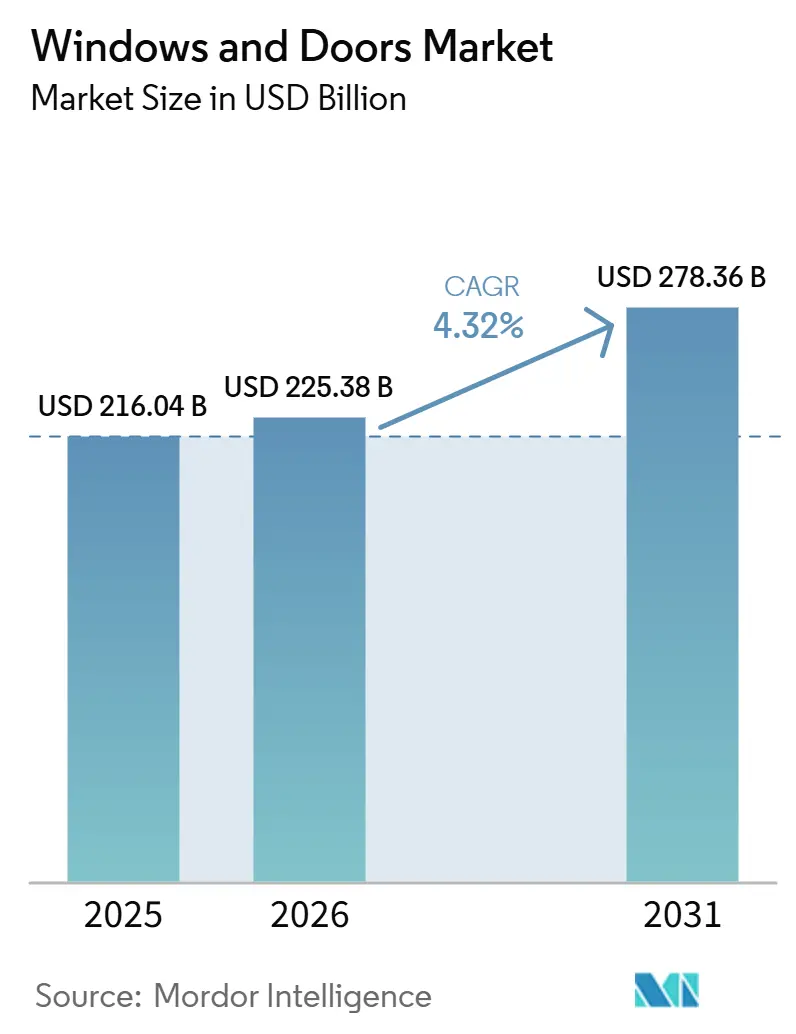
| Market Size (2026) | USD 225.38 Billion |
| Market Size (2031) | USD 278.36 Billion |
| Growth Rate (2026 - 2031) | 4.32 % |
| Fastest Growing Market | Middle East and Africa |
| Largest Market | Asia Pacific |
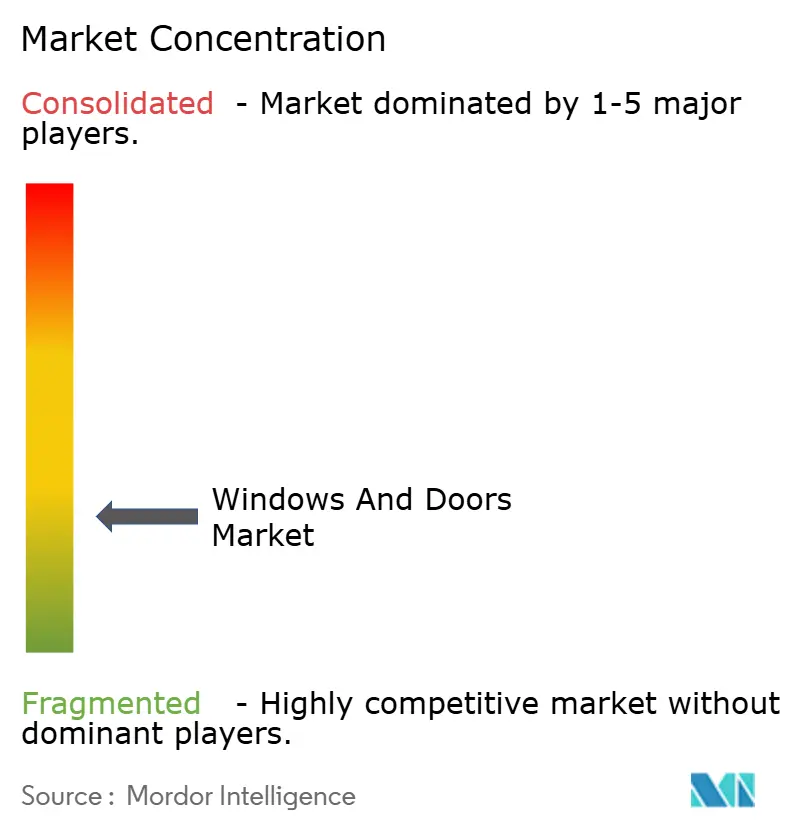
| Market Concentration | Low |
Major Players *Disclaimer: Major Players sorted in no particular order Image © Mordor Intelligence. Reuse requires attribution under CC BY 4.0. | |
Windows and Doors Market Analysis by Mordor Intelligence
The Windows And Doors Market size was valued at USD 216.04 billion in 2025 and is estimated to grow from USD 225.38 billion in 2026 to reach USD 278.36 billion by 2031, at a CAGR of 4.32% during the forecast period (2026-2031).
Strong demand for energy-efficient building envelopes, tighter performance codes, and steady renovation spend underpin this growth. The ENERGY STAR Version 7.0 update is already pushing U-factor limits toward 0.22 in colder U.S. zones, motivating triple-pane glazing and advanced framing. Parallel momentum in the EU’s Energy Performance of Buildings Directive (EPBD) is steering specifications toward zero-emission buildings by 2030, accelerating adoption of high-performance fenestration across both residential and commercial projects. Supply-side shifts—especially light-weight framing options, modular construction, and smart-glass upgrades—continue to widen design choices and shorten lead times, even as aluminum and labor shortages remain persistent headwinds. Manufacturers able to combine material innovation, automated fabrication, and regional fulfillment are positioned to capture the next wave of specification-driven demand in the windows and doors market.
Key Report Takeaways
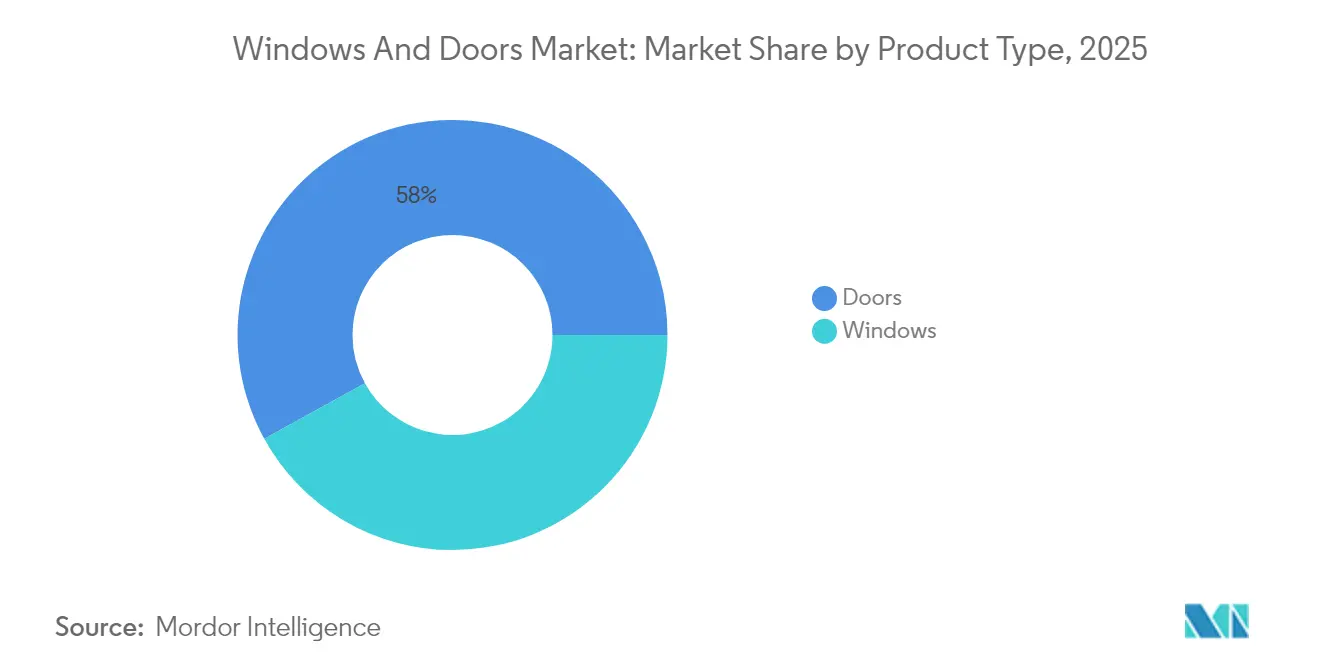
- By product category, doors led with 58.02% revenue share in 2025, while windows are projected to register a 7.35% CAGR to 2031.
- By material, metal commanded 46.15% of the windows and doors market share in 2025; plastic/uPVC is on track for an 8.59% CAGR through 2031.
- By application, folding mechanisms contributed 9.45% CAGR, outpacing swinging, sliding, and revolving formats.
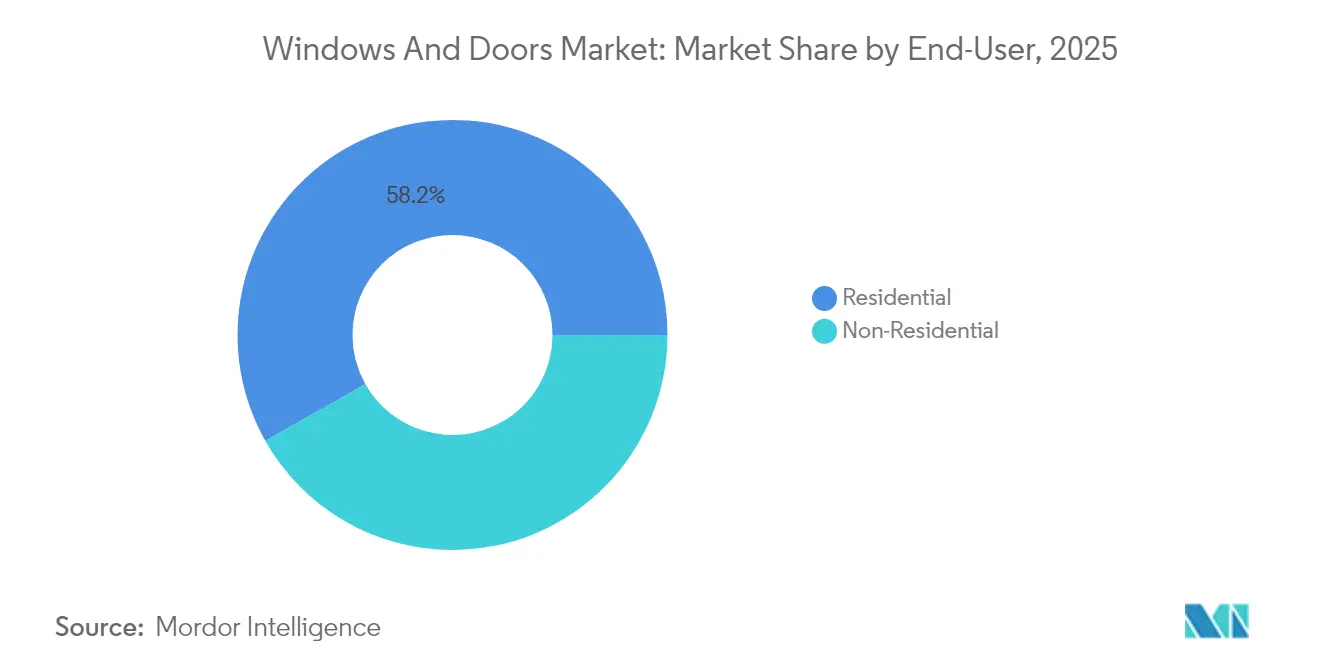
- By end-user, residential projects accounted for 58.18% of the windows and doors market size in 2025; non-residential is forecast to grow at 8.09% CAGR to 2031.
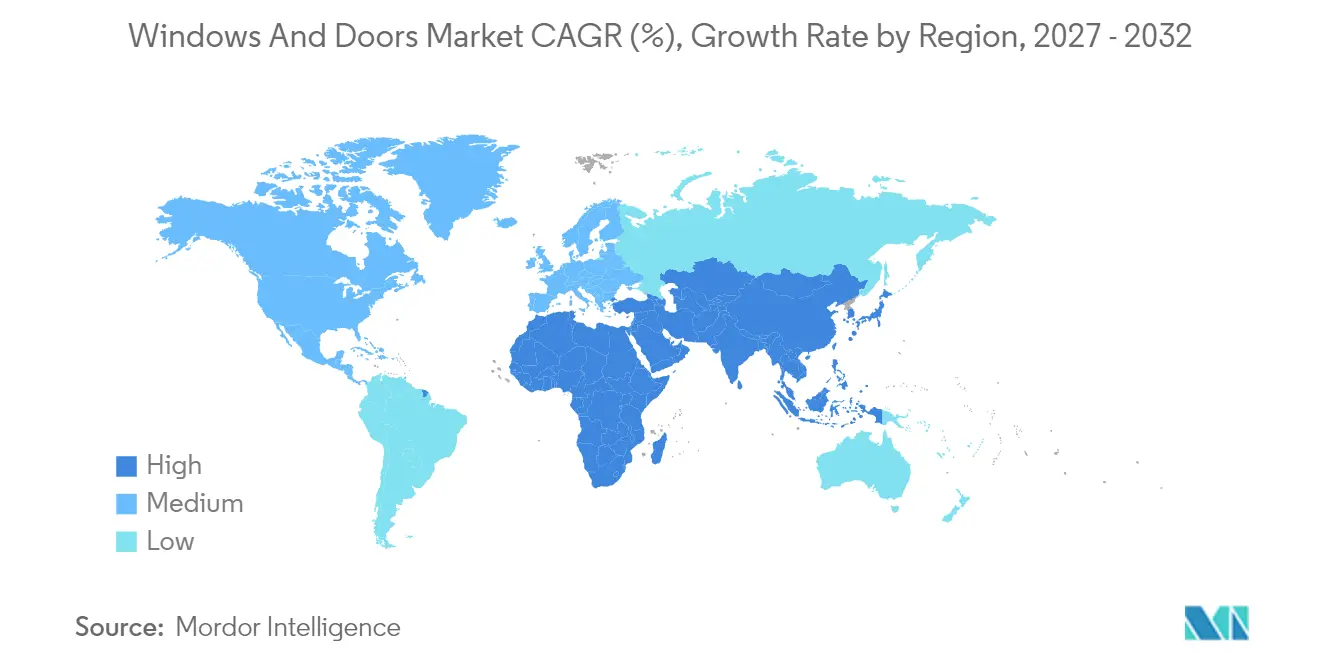
- By geography, Asia-Pacific represented 41.72% revenue in 2025, whereas Middle East & Africa is anticipated to record a 7.02% CAGR through 2031.
- Andersen Corporation, JELD-WEN, Pella, YKK AP, and Marvin collectively held the largest combined slice of 2024 revenues.
Note: Market size and forecast figures in this report are generated using Mordor Intelligence’s proprietary estimation framework, updated with the latest available data and insights as of 2026.
Market Trends and Insights
Drivers Impact Analysis of Windows and Doors Market*
| Driver | (~) % Impact on CAGR Forecast | Geographic Relevance | Impact Timeline |
|---|---|---|---|
| Residential renovation boom and aging housing stock | +1.2% | Global, with concentration in North America and Europe | Medium term (2-4 years) |
| Energy-efficiency regulations (ENERGY STAR V7.0, EU EPBD) | +0.9% | North America & EU, expanding to APAC | Long term (≥ 4 years) |
| Rapid urbanisation and infra spend in APAC | +0.8% | APAC core, spill-over to MEA | Long term (≥ 4 years) |
| Modular construction driving unitised façades | +0.5% | Global, early adoption in North America and Northern Europe | Medium term (2-4 years) |
| Insurance incentives for impact-rated fenestration | +0.3% | North America (hurricane-prone states), expanding to Caribbean | Short term (≤ 2 years) |
| Building-integrated PV (BIPV) window uptake | +0.2% | EU and North America, pilot projects in APAC | Long term (≥ 4 years) |
| Source: Mordor Intelligence | |||
Residential renovation boom and aging housing stock
Elevated borrowing costs have locked most homeowners into favorable rates, channeling discretionary capital toward upgrades rather than relocation. Remodel spending grew sharply in 2024 and is projected to maintain 5% growth in 2025, supported by an aging North American and European housing base, much of which crosses the 20- to 39-year prime replacement window for fenestration. Nearly half of hurricane recovery projects in coastal U.S. counties now include window or door upgrades, highlighting the dual value of protective and energy-saving features. Remodeling professionals also note a surge in “aging-in-place” requests that favor wider clear openings, lower sill heights, and ergonomic hardware. These usage patterns keep the windows and doors market firmly aligned with consumer wellness and resilience priorities.
Energy-efficiency regulations (ENERGY STAR V7.0, EU EPBD)
Performance codes are tightening in a coordinated fashion across major economies. In the United States, ENERGY STAR V7.0 pushes U-factors down 15% from the previous cycle, practically standardizing triple-pane construction in cold climates[1]. The 2024 International Energy Conservation Code now caps air leakage at 0.35 cfm/ft², demanding improved weather-stripping and frame design. Europe’s revised EPBD locks in zero-emission requirements for new buildings starting 2030, along with staged renovation targets for the existing stock[2]. Attractive tax credits and utility rebates offset part of the upfront cost, fostering faster payback and heightening product differentiation within the windows and doors market.
Rapid urbanization and infrastructure spend in Asia-Pacific
Megacity expansion in India, Indonesia, Vietnam, and the Philippines is boosting demand for efficient façades that temper tropical heat loads while maximizing daylight. Government-led transport and health-care investments are funneling procurement toward longer-life aluminum curtain walls, mechanically robust door systems, and solar-ready smart glass. Regional developers increasingly specify low-embodied-carbon materials to satisfy emerging green-building certifications, a trend that rewards suppliers with verified environmental product declarations. Rising land prices further intensify the need for space-saving fenestration designs that support flexible interior layouts. As a result, the windows and doors market sees its highest absolute volume growth in Asia-Pacific.
Modular construction driving unitized facades
Factory-built volumetric and panelized units shorten project schedules, cut waste, and provide consistent quality. Successful deployments in U.S. multifamily towers and Scandinavian social-housing schemes showcase how pre-glazed frames reduce on-site trades and commissioning time. Standardization favors repeatable window sizes, pre-set anchor positions, and plug-and-play hardware compatibility. Regulatory handbooks issued in Australia and the United Kingdom now guide compliance for off-site methods, smoothing the pathway for broader adoption. Suppliers that engineer products for dry-joint installation, integrated sensors, and quick exterior sealing will edge ahead within the modular wave of the windows and doors market.
Restraints Impact Analysis of Windows and Doors Market*
| Restraint | (~) % Impact on CAGR Forecast | Geographic Relevance | Impact Timeline |
|---|---|---|---|
| Raw-material price volatility (aluminium, PVC) | -0.8% | Global, acute in regions dependent on imports | Short term (≤ 2 years) |
| Skilled-labour shortage for installation | -0.6% | North America and Europe, emerging in APAC | Medium term (2-4 years) |
| ESG scrutiny on vinyl lifecycle emissions | -0.4% | EU and North America, expanding globally | Long term (≥ 4 years) |
| Smart-glass shift in high-end commercial builds | -0.2% | Global, concentrated in premium commercial segments | Medium term (2-4 years) |
| Source: Mordor Intelligence | |||
Raw-material price volatility (aluminum, PVC)
Energy cost spikes and smelter curtailments have trimmed aluminum supply just as post-pandemic demand recovered, lifting average premiums and lengthening lead times. PVC producers also struggle with higher input costs and stricter chlorine-production rules, especially in Europe, where environmental scrutiny is intense. To hedge volatility, manufacturers are pivoting toward recycled billet, thermoplastic-reinforced profiles, and regional sourcing agreements. Lightweight composite frames, which reduce metal use without sacrificing strength, continue to gain share. Nonetheless, price swings squeeze smaller fabricators’ margins, slowing project awards and tempering growth in parts of the windows and doors market[3].
Skilled-labor shortage for installation
Contractors report that finishing crews with fenestration expertise remain scarce even as new construction rebounds. The U.S. industry alone needs roughly half a million additional workers in 2025 to align with spending plans, pushing hourly wages to record highs and delaying project completion. Improper window or door installation can negate promised U-values, leading builders to favor suppliers that deliver pre-assembled units or turnkey installation services. At the factory level, automation investments—ranging from robotic glazing lines to AI-driven quality inspection—help offset staffing gaps and stabilize output quality. Training alliances between manufacturers, vocational schools, and veteran retraining programs represent a longer-range fix yet to scale.
*Our forecasts treat driver/restraint impacts as directional, not additive. The impact forecasts reflect baseline growth, mix effects, and variable interactions.
Windows and Doors Market Segment Analysis
By Product Type:
Windows Accelerate Despite Door DominanceDoors generated the majority of 2025 revenue at 58.02%, confirming their foundational role in every building type. Security doors, fire-rated assemblies, and smart locks sustain a replacement cadence that keeps demand relatively stable even during cyclical slowdowns. Conversely, windows outpace in growth at a 7.35% CAGR thanks to stringent heat-gain limits and the rise of building-integrated photovoltaics, which capture solar energy directly through glass. This pull-through effect positions windows as the technological spearhead of the windows and doors market.
Door makers invest in multi-point locking, impact-rated panels, and seamless smart-home integration; however, the highest margins are migrating to advanced window solutions that fuse electro-chromic coatings with solar-harvesting interlayers. Lawrence Berkeley National Laboratory recorded up to 15.9% whole-building energy savings from such installations, a metric that drives premium pricing and short paybacks. As a result, the windows and doors market size for the window segment is projected to rise from USD 89 billion in 2025 to USD 136 billion by 2031, even though the door segment will still dominate on volume.

By Material:
Metal Leads as Plastic/uPVC SurgesMetal frames, particularly aluminum, held 46.15% revenue in 2025 because of their favorable strength-to-weight ratio, slim sightlines, and recyclability. Curtain-wall high-rises, hospitals, and transport hubs nearly always specify aluminum frames for both doors and glazed façades. Yet plastic/uPVC profiles are capturing the fastest gains, 8.59% CAGR, inside fast-growing suburban and peri-urban housing corridors where budget sensitivity and quick installation matter most. Updated formulations featuring embedded fiberglass or steel micro-reinforcements deliver thermal performance without compromising rigidity, answering earlier criticisms of PVC’s structural limits.
Lifecycle scrutiny is pushing producers toward phthalate-free, lead-free stabilizers and closed-loop recycling commitments that turn profile off-cuts into new extrusions. Meanwhile, emerging wood-plastic composites, composite doors and windows, and fiberglass frames offer a middle ground between aluminum’s stiffness and vinyl’s insulative edge. Against this backdrop, the windows and doors market size for PVC systems is projected to add USD 13.6 billion between 2026 and 2031, while metal growth moderates in line with primary-aluminum capacity constraints. Regulatory debates in the EU about potential PVC phase-downs beyond 2030 create strategic risk but also encourage innovation in recyclable and bio-based polymer blends.
By Application:
Folding Mechanisms Drive InnovationSwinging designs remained the default choice in 2025 with a 44.88% share, favored for their mechanical simplicity, legacy hardware, and broad code acceptance. Sliding configurations dominate high-rise balconies and hospitality corridors where floor space is tight. Folding, also known as bi-fold or accordion systems, is the breakout segment, recording a 9.45% CAGR on the back of seamless indoor-outdoor lifestyles, especially in compact urban dwellings and retail frontage remodels.
Manufacturers are refining slim-frame aluminum folding doors with thermal breaks, concealed bottom rollers, and ADA-compliant thresholds. Automation kits now allow motorized stacking via low-voltage drives, a boon for hospitality venues seeking barrier-free transition zones. Sensor-integrated fold walls tied to HVAC controls adjust interior climate zones dynamically, offering operational savings beyond simple daylighting. Consequently, the windows and doors market size for folding applications is forecast to crest USD 36.7 billion by 2031, while swinging products, although growing more slowly, continue to dominate retrofits due to standardized rough openings.
By End-User:
Non-Residential AcceleratesResidential projects accounted for 58.18% of global revenue in 2025, underpinned by long replacement cycles, storm-hardening grants, and homeowners' desire for energy-efficient upgrades. The doors and windows market benefits every time a mortgage lock-in shifts spending toward renovations, reinforcing baseline demand even when new-build permits wobble.
Non-residential demand, however, grows faster at 8.09% CAGR, fueled by corporate net-zero pledges, campus expansions, and code-mandated façade retrofits in Europe and major U.S. cities. Office landlords chase higher rents through WELL-certified daylighting metrics and thermal comfort scores, translating to electro-chromic glass orders and dynamic sunshades. Healthcare and education projects, backed by public funding streams, layer infection control filters, low-emissivity coatings, and forced-entry ratings onto fenestration schedules. Consequently, non-residential’s slice of the windows and doors market share is projected to climb to 45.40% by 2031, trimming—but not overtaking—residential’s historical lead.
By Installation Type:
Retrofit Gains MomentumNew construction remains the volume backbone of the windows and doors market, giving fabricators economies of scale through bundled façade packages. That said, retrofit activity is tightening the gap as building owners chase quick efficiency gains without gutting interiors. Home-improvement incentives such as Florida’s My Safe Florida Home Program cover up to two-thirds of impact-window costs, catalyzing demand in hurricane-exposed zip codes.
In colder climates, tax credits tied to ENERGY STAR-qualified replacements accelerate triple-pane adoption, and low-expansion foams simplify occupant-occupied change-outs. Pre-flashed cassette systems, screw-through nailing fins, and factory-applied sealants shorten site phases, appealing to contractors squeezed by labor shortages. As a result, the windows and doors market size attached to replacement work is set to rise at a 6.29% CAGR through 2031, crossing the USD 100 billion line well before decade-end.
Geography Analysis
APAC Windows and Doors Market
Asia-Pacific held 41.72% of 2025 revenue, anchored by rapid urban build-outs and policy incentives for energy-conserving, climate-resilient construction. National building codes in China, India, and Indonesia have progressively lowered allowable U-values, setting a lucrative baseline for thermally broken frames and low-e insulated glass. Indigenous fabricators increasingly export unitised façades to neighboring markets, strengthening intra-regional supply chains and shaving logistics costs for the windows and doors market.
North America Windows and Doors Market
North America ranks second in size, propelled by strong renovation expenditure and a maturing off-site housing segment. ENERGY STAR tax credits and state-level storm hardening grants keep demand solid despite fluctuating housing starts. Skilled-labor scarcity remains the main growth bottleneck; however, rising automation rates at major plants, plus integrated installation programs, are mitigating cycle delays. Across Canada and the northern United States, triple glazing is fast becoming the baseline for multi-family projects seeking lower heating loads.
Europe Windows and Doors Market
Europe commands a smaller absolute slice but offers high margin potential because the EPBD mandates zero-emission targets for new builds from 2030. Minimum energy performance standards also force upgrades of the worst 16% of non-residential stock by that same year, ensuring a steady retrofit pipeline. Manufacturers with verifiable environmental product declarations and circular-economy frameworks stand to gain preferential procurement scores. The doors and windows market sees premium demand for noise-attenuating units in dense cities such as Paris and Berlin, while adaptive shading packages become standard in Mediterranean resorts.
MEA Windows and Doors Market
Middle East & Africa records the fastest CAGR at 7.02% through 2031, underpinned by large-scale hospitality, healthcare, and education projects. Extreme heat zones require solar-control glazing paired with wide-swing door systems that accommodate mixed indoor-outdoor occupancy patterns. Government mandates for green-building certifications, plus rising energy tariffs, hasten the shift to low-emissivity coatings. Local assembly hubs in the Gulf are beginning to serve East African corridors, reducing lead times and bolstering regional resilience within the windows and doors market.
South America Windows and Doors Market
South America shows a steadier climb, supported by urban densification in Brazil, Colombia, and Chile. High inflation limits short-term discretionary spend, yet long-term infrastructure concessions keep institutional projects moving forward. Revised performance codes in Chile and Peru now prescribe double-glazing for new high-altitude construction, further enlarging the addressable market for energy-conscious fenestration.
Competitive Landscape
Innovation and Sustainability Drive Future Growth
The competitive landscape is moderately concentrated, with Andersen Corporation, JELD-WEN Holding Inc., Pella Corporation, YKK AP Inc., and Marvin Windows & Doors controlling a sizeable share of global revenue. Their collective scale provides purchasing leverage for aluminum, glass, and hardware as raw material prices swing. Each of these leaders maintains integrated manufacturing networks that cover extrusion, glass fabrication, and finishing, reducing dependency on external suppliers. Distribution reach spans big-box retailers, dealer networks, and direct-to-builder channels, enabling rapid response to regional code changes. Combined, these strengths allow the top tier to defend share even as local fabricators pursue niche opportunities in the windows and doors market.
Consolidation accelerated in 2024 when Owens Corning agreed to acquire Masonite International for USD 3.9 billion, signaling a push toward broader building envelope offerings. Quanex Building Products followed by purchasing Tyman plc for USD 1.2 billion, adding hardware and sealing systems that round out its component portfolio. JELD-WEN trimmed costs by closing plants in California and Wisconsin, an action expected to lift annual pre-tax income by USD 11 million once complete. Fernweh Group’s acquisition of Wincore Window Company at the start of 2025 emphasized private equity interest in vinyl-focused producers positioned for renovation demand. These moves illustrate how capital allocation is shifting toward assets that combine automation readiness with exposure to high-growth retrofit programs.
Innovation remains a primary differentiator, with Andersen celebrating its ten-millionth 100 Series composite window that blends wood fiber and PVC for enhanced strength and thermal value. YKK AP is promoting unitised façades engineered for robotic installation, which directly addresses field-labor shortages in North America and Europe. Pella and Marvin are embedding IoT sensors into premium lines so building managers can monitor performance and schedule predictive maintenance. Regional specialists continue to capture project-specific contracts through climate-tuned laminates and locally sourced materials, keeping competitive pressure alive across the windows and doors market.
Windows and Doors Industry Leaders
-
Andersen Corporation
-
JELD-WEN Holding Inc.
-
Pella Corporation
-
YKK AP Inc.
-
Marvin Windows & Doors
- *Disclaimer: Major Players sorted in no particular order
Windows and Doors Market Companies Covered in this Report
- Andersen Corporation
- JELD-WEN Holding Inc.
- Pella Corporation
- YKK AP Inc.
- Marvin Windows & Doors
- Masonite International
- Cornerstone Building Brands / Ply Gem
- MI Windows and Doors
- LIXIL Corporation
- ASSA ABLOY Group
- Rehau Group
- VEKA AG
- Deceuninck NV
- Profine GmbH (Kommerling)
- Saint-Gobain Building Glass & Solutions
- Schuco International
- Aluplast GmbH
- Fenesta Building Systems (DCM Shriram)
- PGT Innovations
- Atrium Corporation
Recent Industry Developments in Windows and Doors Market
- January 2025: Fernweh Group acquired Wincore Window Company, citing a rebound in renovation demand and development of vinyl-based offerings.
- March 2024: Cornerstone Building Brands announced plans to acquire Harvey Building Products, including SoftLite and Thermo-Tech, to deepen repair-and-remodel reach.
- February 2024: Owens Corning agreed to purchase Masonite International for USD 3.9 billion, the largest recent fenestration transaction.
Global Windows and Doors Market Report Scope
A window is an opening in a wall of a building. Its use is to admit natural light and natural ventilation and provide vision. The primary function of a door in a building is to make a connecting link between the internal parts and allow free movement to the outside of the building.
The windows and doors market is segmented into material type, end user, and geography. The market is segmented by material type into wood, metal, plastic, and other materials. By end user, the market is segmented into residential and commercial. The market is segmented by geography: North America, Europe, Asia-Pacific, South America, Middle East and Africa. The report offers market size and forecasts for the windows and doors market in value (USD) for all the above segments.
| Doors |
| Windows |
| Wood |
| Metal |
| Plastic / uPVC / Composite |
| Swinging |
| Sliding |
| Folding |
| Revolving and Others |
| Residential |
| Non-Residential (Commercial, Industrial, Institutional) |
| New Construction |
| Replacement / Retrofit |
| North America | Canada |
| United States | |
| Mexico | |
| South America | Brazil |
| Peru | |
| Chile | |
| Argentina | |
| Rest of South America | |
| Europe | United Kingdom |
| Germany | |
| France | |
| Spain | |
| Italy | |
| BENELUX (Belgium, Netherlands, Luxembourg) | |
| NORDICS (Denmark, Finland, Iceland, Norway, Sweden) | |
| Rest of Europe | |
| Asia-Pacific | India |
| China | |
| Japan | |
| Australia | |
| South Korea | |
| South East Asia (Singapore, Malaysia, Thailand, Indonesia, Vietnam, Philippines) | |
| Rest of Asia Pacific | |
| Middle East and Africa | United Arab Emirates |
| Saudi Arabia | |
| South Africa | |
| Nigeria | |
| Rest of Middle East and Africa |
| By Product Type | Doors | |
| Windows | ||
| By Material | Wood | |
| Metal | ||
| Plastic / uPVC / Composite | ||
| By Application | Swinging | |
| Sliding | ||
| Folding | ||
| Revolving and Others | ||
| By End-User | Residential | |
| Non-Residential (Commercial, Industrial, Institutional) | ||
| By Installation Type | New Construction | |
| Replacement / Retrofit | ||
| By Geography | North America | Canada |
| United States | ||
| Mexico | ||
| South America | Brazil | |
| Peru | ||
| Chile | ||
| Argentina | ||
| Rest of South America | ||
| Europe | United Kingdom | |
| Germany | ||
| France | ||
| Spain | ||
| Italy | ||
| BENELUX (Belgium, Netherlands, Luxembourg) | ||
| NORDICS (Denmark, Finland, Iceland, Norway, Sweden) | ||
| Rest of Europe | ||
| Asia-Pacific | India | |
| China | ||
| Japan | ||
| Australia | ||
| South Korea | ||
| South East Asia (Singapore, Malaysia, Thailand, Indonesia, Vietnam, Philippines) | ||
| Rest of Asia Pacific | ||
| Middle East and Africa | United Arab Emirates | |
| Saudi Arabia | ||
| South Africa | ||
| Nigeria | ||
| Rest of Middle East and Africa | ||
Key Questions Answered in the Report
What is the current value of the windows and doors market?
The Windows And Doors Market stood at USD 225.38 billion in 2026 and is projected to reach USD 278.36 billion by 2031.
Which region contributes the largest revenue?
Asia-Pacific leads with 41.72% of global turnover, underpinned by rapid urbanization and strong infrastructure spend.
Which product segment is growing the fastest?
In the Windows And Doors Market, Windows, especially those integrating photovoltaic or smart-glass features, are expanding at a 7.35% CAGR.
What materials are gaining popularity in residential builds?
In the Windows And Doors Market, Plastic/uPVC profiles are advancing at an 8.59% CAGR owing to affordability and improving thermal performance.
How are regulations influencing demand?
ENERGY STAR V7.0 in the U.S. and the EU’s EPBD mandate lower U-factors and zero-emission goals, catalyzing higher-spec fenestration adoption.