
Market Overview
| Study Period | 2020 - 2031 |
|---|---|
| Forecast Data Period | 2026 - 2031 |
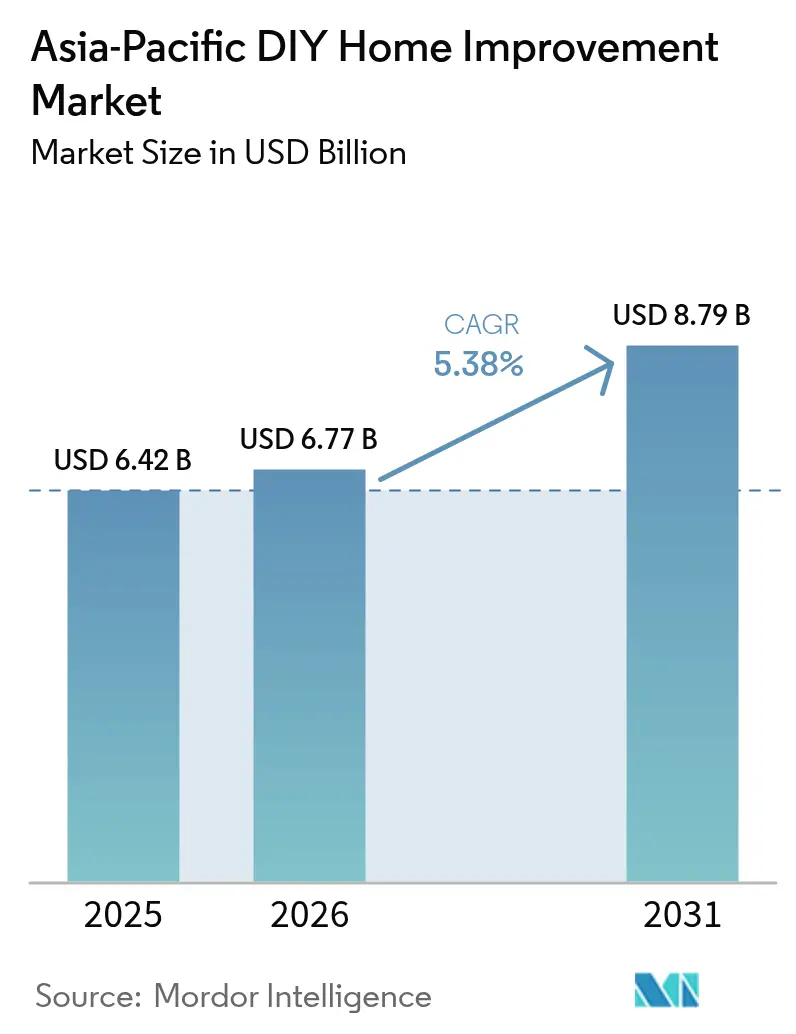
| Base Year Market Size (2025) | USD 6.42 Billion |
| Market Size (2026) | USD 6.77 Billion |
| Market Size (2031) | USD 8.79 Billion |
| Growth Rate (2026 - 2031) | 5.38 % |
| Market Concentration | Low |
Major Players *Disclaimer: Major Players sorted in no particular order Image © Mordor Intelligence. Reuse requires attribution under CC BY 4.0. | |
Asia-Pacific DIY Home Improvement Market Analysis by Mordor Intelligence
The Asia-Pacific DIY home improvement market size is expected to grow from USD 6.42 billion in 2025 to USD 6.77 billion in 2026 and is forecast to reach USD 8.79 billion by 2031 at 5.38% CAGR over 2026-2031. Demand growth benefits from sustained urban migration, higher disposable incomes, and rising acceptance of self-directed renovation projects. Embedded finance options such as buy-now-pay-later have improved affordability, while omnichannel retail investments shorten delivery lead times and strengthen customer engagement. Consumer preference for manageable cosmetic upgrades and plug-and-play smart-home devices continues to lift transaction volumes. Regulatory shifts toward low-VOC and fire-safe materials are steering category premiumization, creating opportunities for compliant suppliers.
Key Report Takeaways
- By product type, painting and wallpaper led with 22.91% of the Asia-Pacific DIY home improvement market share in 2025, while smart-home installation add-ons are projected to advance at a 13.10% CAGR through 2031.
- By distribution channel, DIY home improvement stores held 63.58% share of the Asia-Pacific DIY home improvement market size in 2025; online channels are set to expand at an 17.68% CAGR between 2026-2031.
- By project complexity, minor cosmetic upgrades accounted for 44.71% of the Asia-Pacific DIY home improvement market size in 2025, and smart-home installations are tracking a 12.84% CAGR to 2031.
- By geography, China captured 31.88% of the Asia-Pacific DIY home improvement market share in 2025, whereas India is positioned for the fastest 10.95% CAGR through 2031.
Note: Market size and forecast figures in this report are generated using Mordor Intelligence’s proprietary estimation framework, updated with the latest available data and insights as of 2026.
Market Trends and Insights
Drivers Impact Analysis of Asia-Pacific DIY Home Improvement Market*
| Driver | (~) ( %) Impact on CAGR Forecast | Geographic Relevance | Impact Timeline |
|---|---|---|---|
| Rapid urbanization and rising disposable incomes | +1.8% | China, India, and key Southeast Asian economies | Long term (≥ 4 years) |
| Omnichannel expansion of big-box DIY retailers | +1.2% | Australia, Thailand, Malaysia, Vietnam | Medium term (2-4 years) |
| E-commerce tutorials and influencer-led DIY culture | +0.9% | South Korea, Japan, wider Asia-Pacific | Short term (≤ 2 years) |
| Embedded finance and BNPL integrations | +0.7% | Southeast Asia, India | Medium term (2-4 years) |
| Regulatory push for low-VOC and fire-safe materials | +0.5% | China, Japan, Australia | Long term (≥ 4 years) |
| European softwood import diversification | +0.4% | Japan, South Korea, Australia | Short term (≤ 2 years) |
| Source: Mordor Intelligence | |||
Rapid urbanization and rising disposable incomes
Urban migration in India is driving increased housing turnover and reducing renovation cycle durations. The preference for DIY solutions over contractor services in smaller urban apartments is driving a notable shift in consumer behavior, effectively expanding the addressable market beyond traditional metropolitan areas. Parallel demographic trends in countries such as Indonesia and Vietnam are contributing to the emergence of new households characterized by increased purchasing power and a growing inclination toward self-managed home improvement projects. These combined factors are expected to underpin long-term growth in the Asia-Pacific DIY home improvement market, presenting significant opportunities for businesses operating in this space.
Omnichannel expansion of big-box DIY retailers
Regional chains are digitizing inventory and fulfilment to match e-commerce standards while leveraging store networks for click-and-collect convenience. Bunnings recorded 5.1% digital sales growth in the first half of fiscal 2024, supported by two-hour collection windows for loyalty members[1]. Big-box retailers enhance their in-store value proposition by offering integrated tutorials, tool rental services, and project consultations, which cater to customer needs and foster engagement. Additionally, the strategic implementation of micro-fulfillment within existing outlets optimizes last-mile logistics by reducing associated costs and improving delivery efficiency for bulky goods. This approach strengthens the competitive positioning of big-box formats in the market.
E-commerce tutorials and influencer-led DIY culture
Online content lowers perceived project complexity, boosting consumer confidence in tackling advanced tasks. Retailers are increasingly integrating augmented-reality applications into their websites, enabling consumers to visualize room transformations before making a purchase. This technological advancement has contributed to a measurable decline in product return rates. Additionally, influencer endorsements are playing a pivotal role in driving product discovery, particularly among younger demographics who place significant value on peer-driven recommendations. In response to these trends, manufacturers are strategically designing visually appealing, easy-to-assemble kits that cater to consumer preferences and are optimized for social media engagement, thereby enhancing brand visibility and customer interaction.
Embedded finance and BNPL integrations
Atome agreements with Southeast Asian retailers exemplify this shift toward frictionless credit at the point of sale[2]. Efficient KYC verification processes enable swift approvals, significantly improving consumer access to high-value products, including power tools and multi-room paint bundles. Regulatory bodies generally regard BNPL as a strategic instrument for advancing financial inclusion. This supportive regulatory perspective is anticipated to sustain the market's growth trajectory over the medium term, further solidifying its role in expanding consumer purchasing power and driving market development.
Restraints Impact Analysis of Asia-Pacific DIY Home Improvement Market*
| Restraint | (~) ( %) Impact on CAGR Forecast | Geographic Relevance | Impact Timeline |
|---|---|---|---|
| Skilled-labour shortages and material cost inflation | -1.4% | Japan, Australia, South Korea | Medium term (2-4 years) |
| Commodity and freight volatility are causing stockouts | -0.8% | Japan, South Korea, Singapore | Short term (≤ 2 years) |
| Low DIY skill levels are driving professional outsourcing | -0.6% | China, India, Indonesia | Long term (≥ 4 years) |
| Stringent insurance and permit rules in hazard zones | -0.3% | Australia, Japan, Philippines | Long term (≥ 4 years) |
| Source: Mordor Intelligence | |||
Skilled-labour shortages and material cost inflation
Since 2020, Japan has experienced a significant decline in its construction workforce, resulting in extended contractor wait times of up to six months. This labour shortage has compelled homeowners to explore alternative self-help solutions to address their construction and renovation needs. In 2024, Queensland experienced a significant increase in installer wages, reflecting heightened demand for skilled labour. The state faces a critical shortage, requiring an additional 18,000 tradespeople to meet market needs and sustain ongoing projects. Tool makers that simplify installation steps gain share as consumers replace labour costs with equipment purchases. Complex electrical or plumbing work remains out of scope for most DIY enthusiasts, limiting uptake in higher-value renovation categories.
Low DIY skill levels are driving professional outsourcing
The preference for professional craftsmanship in China and India significantly limits the adoption of self-installation practices for complex tasks. This trend is further reinforced by insurance policies that exclude coverage for installations performed by non-professionals, discouraging risk-averse homeowners from undertaking such activities. Recognizing these barriers, manufacturers and retailers are implementing targeted strategies, including the development of localized instructional videos and the organization of in-store workshops. These initiatives aim to enhance consumer proficiency, gradually bridging the skills gap and fostering greater confidence among homeowners in managing installation tasks independently.
*Our forecasts treat driver/restraint impacts as directional, not additive. The impact forecasts reflect baseline growth, mix effects, and variable interactions.
Asia-Pacific DIY Home Improvement Market Segment Analysis
By Product Type:
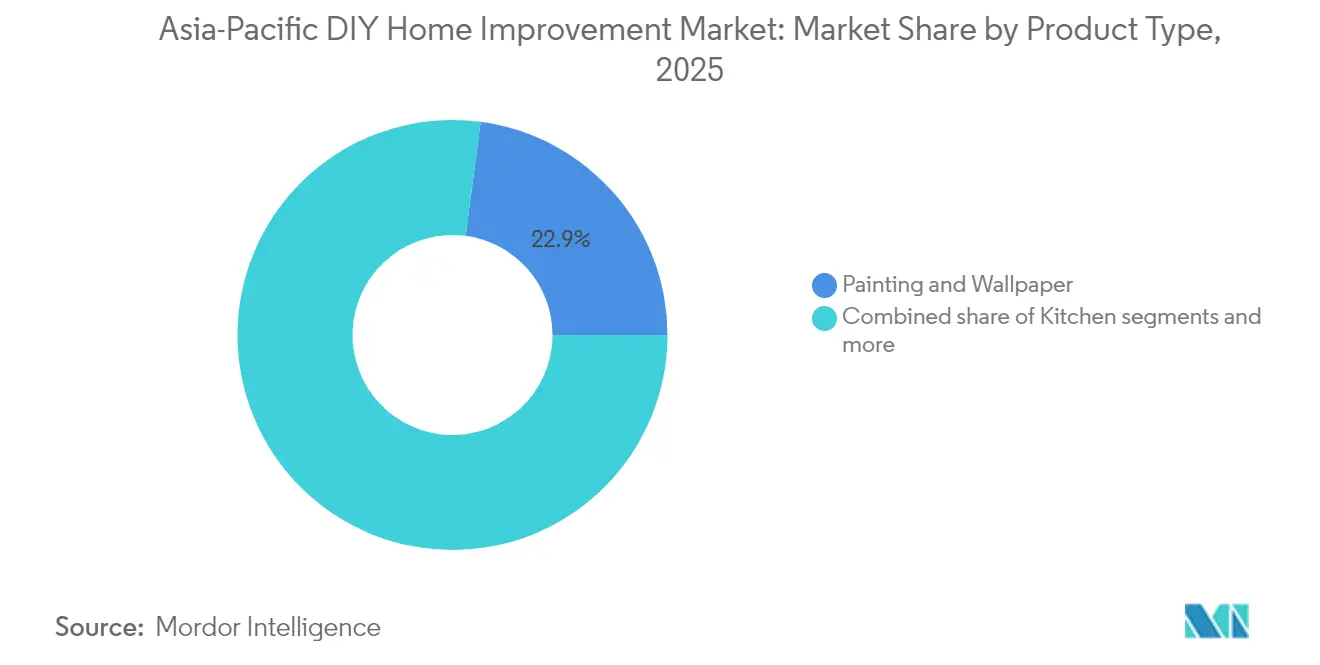
Smart Integration Drives Category EvolutionPainting and wallpaper retained 22.91% of the Asia-Pacific DIY home improvement market share in 2025, highlighting consumer interest in visually impactful yet straightforward projects. Smart-home add-ons are set to register a 13.10% CAGR through 2031, fueled by falling IoT hardware prices and the adoption of the Matter 1.4 interoperability standard MATTER.ORG. Demand for smart lighting, automated blinds, and voice-controlled devices lifts accessory tool sales, benefiting hardware suppliers. Kitchen renovation products sustain momentum as cooking-at-home habits persist, while modular cabinet kits attract renters seeking reversible upgrades. Regulatory requirements limit consumer forays into high-voltage electrical work, but low-voltage LED and switch replacements remain accessible. Lumber and landscape management growth trails other categories due to climate-related supply disruptions, although stabilized softwood imports support volume recovery. Across categories, manufacturers embed guided instructions and QR-linked videos, further lowering entry barriers.
Smart-home penetration reshapes competitive dynamics by encouraging partnerships between device makers and traditional DIY retailers. Tools bundled with calibration apps shorten installation time, and cross-selling opportunities emerge as homeowners integrate sensors with existing renovation plans. Premium paints formulated for low-VOC compliance command margins despite broader price sensitivity. Flooring and building materials benefit from urban apartment refurbishments, especially in China, where renovation cycles shorten and regulatory standards raise material specifications. Integrated product-service bundles, such as paint plus virtual colour simulation, help retailers differentiate and increase basket size.

By Distribution Channel:
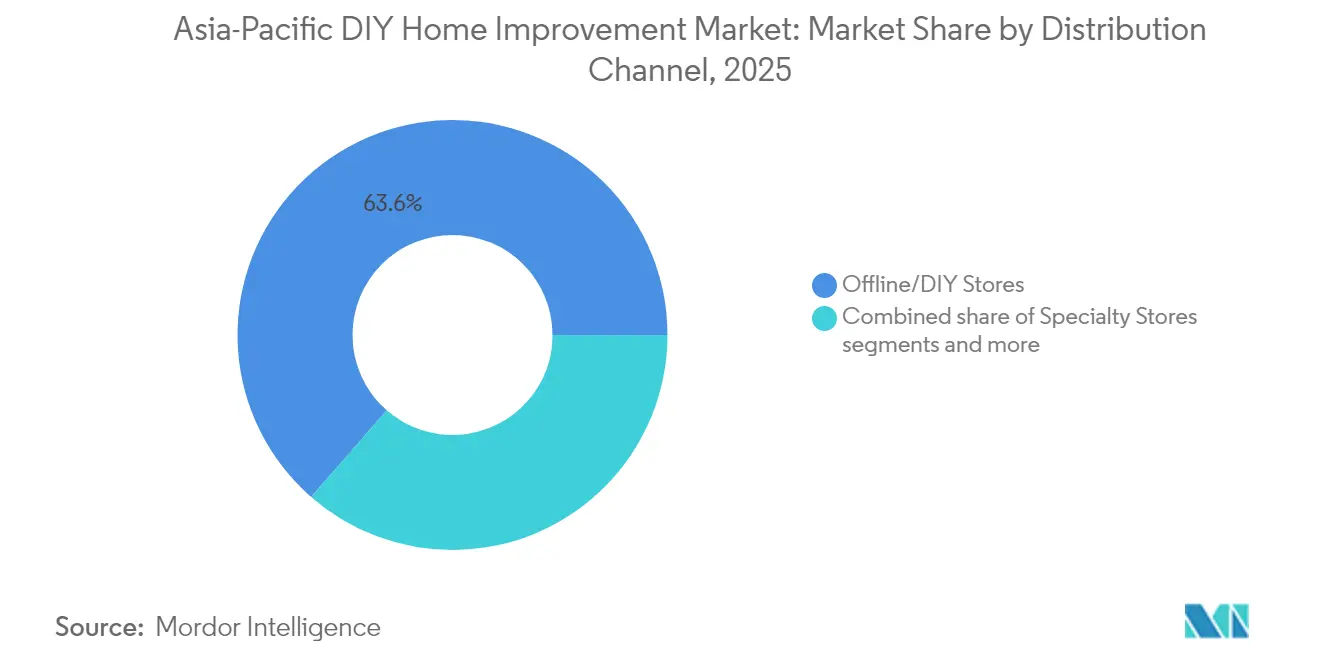
Digital Acceleration Reshapes RetailDIY home improvement stores captured 63.58% of the Asia-Pacific DIY home improvement market size in 2025, reflecting entrenched footfall and the tactile nature of product selection. Nevertheless, online sales are projected to climb at an 17.68% CAGR to 2031, driven by mobile commerce expansion and improved logistics infrastructure. Amazon’s Global Selling program facilitated USD 13 billion in Indian exports by end-2024, with home improvement categories recording 20% annual growth . Cross-border platforms allow regional manufacturers to reach distant customers, compressing traditional distribution hierarchies. Specialty stores pivot toward niche assortments and expert consultation to defend against pricing pressure from larger rivals. Social commerce channels blend content and checkout, capturing younger demographics seeking inspiration and immediate purchase. Traditional retailers respond with robust click-and-collect offerings and loyalty programs that integrate online and offline rewards, preserving traffic to physical outlets.
Transformational logistics investments deepen competitive advantages for scale players. In September 2025, Flipkart strategically increased its fulfilment capacity by 3.5 million square feet across India. This expansion is expected to significantly enhance the company's operational efficiency and broaden its two-day delivery coverage, thereby strengthening its competitive position in the e-commerce market. Bunnings deploys branch stores as micro-fulfilment nodes, achieving same-day delivery in metropolitan Australia. Consistent on-shelf availability remains critical for in-store conversion, prompting retailers to adopt predictive replenishment tools that leverage transaction data from both channels.
By Project Complexity:
Simplification Enables Market ExpansionMinor cosmetic upgrades held 44.71% of the Asia-Pacific DIY home improvement market size in 2025, underscoring the dominance of quick weekend tasks that carry limited risk. Smart-home installations represent the fastest-growing complexity tier at a 12.84% CAGR, propelled by wireless connectivity that avoids invasive rewiring. Manufacturers design plug-and-play hubs and adhesive mounts to bypass drilling, and retailers curate starter bundles that include step-by-step mobile app guidance. Structural renovations still demand contractor involvement owing to regulatory permits and safety considerations, though prefabricated wall panels and modular extensions gradually lower entry hurdles for advanced enthusiasts. Outdoor landscaping projects gain seasonal momentum, especially in drought-prone markets where water-efficient gardens appeal to cost-conscious homeowners. Augmented-reality measurement tools help consumers plan layouts accurately, reducing material wastage and boosting purchase confidence.
Regulatory authorities in high-risk zones establish clear guidelines distinguishing tasks that homeowners can perform independently from those requiring the expertise of licensed professionals. This regulatory framework ensures consumer protection while enabling the growth of the DIY market in non-critical areas. Additionally, collaborations between retailers and insurance providers focus on implementing educational initiatives that define the scope of compliant projects. These efforts aim to reduce liability risks and encourage the adoption of responsible DIY practices, fostering a balanced and sustainable market environment.
Geography Analysis
China DIY Home Improvement Market
China led with 31.88% Asia-Pacific DIY home improvement market share in 2025, supported by an integrated manufacturing base that keeps unit costs competitive. The dishwasher market demonstrated strong performance in 2023, achieving a valuation of USD 1.53 billion (11.2 billion CNY), reflecting sustained demand for appliance upgrades. The extensive penetration of e-commerce platforms, particularly in major urban centres, has played a pivotal role in driving consumer behavior. Features such as same-day delivery have significantly influenced impulsive renovation-related purchases, further bolstering market growth.
India DIY Home Improvement Market
India is forecast to deliver the fastest 10.95% CAGR through 2031. Shorter renovation cycles and rising middle-class income underpin growth, while tier-2 and tier-3 cities emerge as new demand centres. Amazon’s cumulative USD 26 billion investment pipeline earmarks significant fulfillment and seller services spending for home categories. IKEA’s plan to double its Indian store count by 2030, complemented by compact formats, signals confidence in long-term DIY potential.
APAC DIY Home Improvement Market
Japan and South Korea exhibit mature DIY cultures with high technological sophistication. Homeowners favor energy-saving smart systems, aligning with national sustainability goals. South Korea’s smart-home market is on track to surpass USD 6 billion by 2026, reflecting high broadband penetration and consumer appetite for integrated automation solutions. Australia and New Zealand maintain stable growth based on high home-ownership rates and an established project culture. Emerging Southeast Asian economies, Indonesia, Thailand, Vietnam, and Malaysia, deliver double-digit growth as urbanization and disposable income rise. Retailers entering these markets adapt assortments to local housing formats, humidity conditions, and regulatory standards. The Rest of Asia-Pacific cluster presents pockets of opportunity but requires tailored go-to-market strategies acknowledging divergent cultural views on self-installation.
Regulatory Landscape
Regulation across Asia-Pacific continues to shape product specifications and what can be safely DIY-installed, particularly for building materials, coatings, and electrical work. In Australia, the Australian Building Codes Board (ABCB) maintains the National Construction Code (NCC) as the core technical framework, with NCC 2025 scheduled for state and territory adoption from 1 May 2026. These updates reinforce compliance requirements that affect DIY-facing categories such as fire safety and energy-related building performance.
Market access is also being shaped by formalized product assurance pathways that can reduce approval friction for imported DIY building products. In New Zealand, the Building (Product Certification) Amendment Regulations 2025 enable the Chief Executive of MBIE to recognize overseas-certified building products and methods as Building Code compliant. An application process is planned to launch in 2026, and recognition notices will be required to be accepted by building consent authorities as evidence of compliance. In China, multiple 2025-issued green decoration and evaluation standards (including DB11/T 825-2025, effective from April 2026) add momentum to low-carbon and green decoration requirements, supporting premiumization for compliant paints, coatings, and interior fit-out materials.
Value Chain Analysis
The value chain runs from upstream raw materials and components (paint and coating inputs, wood-based panels and timber, metals and plastics for tools and fittings, and smart-home electronics) through manufacturing and packaging, then moves via importers and wholesalers into retail distribution through big-box DIY chains, specialty stores, and online marketplaces. Scale retailers in the region increasingly influence assortment and pricing through direct sourcing, private-label development, and centralized procurement, while compliance with low-VOC and fire-safe requirements increases supplier qualification and documentation needs.
Downstream, fulfillment capability and inventory visibility have become key differentiators as the market shifts toward omnichannel. Large retailers and platforms use regional distribution centers, store-based micro-fulfillment, and parcel networks to move bulky goods such as paint, flooring, and building materials alongside small hardware and accessories. Company disclosures point to tighter logistics and assortment control: MR D.I.Y. highlights end-to-end control across export, freight, warehousing, and distribution, and operates with an assortment of about 17,000 SKUs supported by a store network exceeding 1,500 outlets. In Thailand, HomePro has expanded its footprint with new HomePro and Mega Home stores, reflecting hybrid formats that serve both DIY households and project-oriented buyers.
Competitive Landscape
The Asia-Pacific DIY home improvement market is moderately fragmented, with the top participants collectively controlling roughly one-fourth of revenue. Big-box channels such as Bunnings and Mr DIY rely on deep product assortments, installation services, and rapidly growing online storefronts to reinforce customer loyalty. Bunnings is transforming select stores into family-oriented Hammerbarn concepts following a media partnership, boosting footfall during off-peak periods. Mr DIY continues fast expansion across Southeast Asia, supported by standardized store designs that optimize inventory turns.
E-commerce leaders Amazon and Flipkart pour capital into warehousing and last-mile fleets to capture the bulky goods share. Amazon commissioned 12 new fulfillment centers with 8.6 million cu ft capacity in 2025, enhancing one-day coverage for paint and power-tool categories. Flipkart countered with dark-store expansion supporting quick-commerce pilots that deliver small hardware items within one hour. Supply chain technology, including AI-driven demand forecasting, allows these platforms to manage SKU complexity and minimize stockouts.
Disruption stems from fintech and social-commerce entrants. BNPL providers integrate loyalty analytics that recommend complementary items based on project flow, lifting basket sizes. Direct-to-consumer tool brands leverage influencer partnerships to penetrate niche segments such as precision woodworking kits. Compliance costs tied to new environmental regulations favour scale players capable of funding certification and eco-label audits. Mergers and strategic property transactions, such as Wesfarmers’ USD 143 million BWP Trust management split, realign capital toward core retail innovation.
Asia-Pacific DIY Home Improvement Industry Leaders
-
Wesfarmers Ltd (Bunnings)
-
Mr DIY Group (Berhad)
-
HomePro Public Co.
-
Komeri Co. Ltd.
-
Kingfisher plc (B&Q China)
- *Disclaimer: Major Players sorted in no particular order

Asia-Pacific DIY Home Improvement Market Companies Covered in this Report
- Wesfarmers Ltd (Bunnings)
- Mr DIY Group (Berhad)
- HomePro Public Co.
- Komeri Co. Ltd.
- Kingfisher plc (B&Q China)
- Ace Hardware Indonesia
- IKEA (Southeast Asia & India)
- Amazon APAC
- Flipkart
- LIXIL Group
- Makita Corp.
- Bosch Power Tools APAC
- TOTO Ltd.
- Ozito Industries
- Hafele (Asia)
- Asian Paints
- Nippon Paint Holdings
- DuluxGroup
- Greenply Industries
- Siam Global House
Read Analysis of Asia-Pacific DIY Home Improvement Companies
Market Opportunities and Future Outlook
Smart-home retrofit kits and low-complexity upgrade bundles represent a specific opportunity in dense urban housing, where consumers prefer reversible, low-risk projects and depend on guided installation. Retailers and brands can package plug-and-play devices (smart lighting, sensors, and controls) with simplified tools, QR-linked instruction, and after-sales support, which fits the market emphasis on minor cosmetic upgrades and the report scope’s growth track for smart-home installations.
Supply localization and regional manufacturing expansion are also opening room in building materials and surface decoration categories, especially where faster replenishment and compliance-ready specifications matter. In March 2026, SCG Decor (SCGD) announced a 2026 capex budget exceeding THB 2.5 billion to expand glazed porcelain tile capacity by 6.6 million square meters in Vietnam and broaden adjacent offerings such as SPC flooring and adhesives, supporting faster availability of renovation materials for DIY and small contractors. Digital-first geographic expansion is becoming more visible as well: in June 2026, Bunnings launched a direct-to-consumer online platform for Fiji, providing a lower-capex way to serve Pacific demand without immediate physical-store buildout. That channel can also support cross-border assortment extensions across tools, hardware, and home maintenance products.
Recent Industry Developments in Asia-Pacific DIY Home Improvement Market
- June 2026: Wesfarmers announced the transition of its Industrial and Safety businesses (Blackwoods and Workwear Group) into the Bunnings Group, effective 1 July 2026. The consolidation brings adjacent trade and industrial supply capabilities under the Bunnings umbrella and improves procurement and fulfillment leverage across tools, hardware, and maintenance-led categories.
- May 2026: HomePro highlighted continued focus on private brand expansion and supply chain resilience in its 1Q26 update. This emphasis supports sharper price architecture for core DIY consumables and helps stabilize availability across a broad SKU set amid logistics volatility.
- September 2025: Flipkart increased fulfillment capacity by 3.5 million square feet across India ahead of the festive season to improve delivery reach for bulky categories. The additional capacity strengthens two-day coverage in key corridors and increases competitive pressure on traditional DIY chains to match delivery speed and reliability.
Asia-Pacific DIY Home Improvement Market Report Scope and Research Methodology
Market Definition and Coverage
For this study, the market includes consumer spending on do-it-yourself home improvement products across Asia-Pacific, covering materials and items bought to repair, replace, or upgrade homes and small residential spaces.
Scope exclusions: Professional contractor-only renovation services, labor charges, and design fees are excluded from the market value.
Segments Covered in This Report
- By Product Type
- Lumber and Landscape Management
- Decor and Indoor Garden
- Kitchen
- Painting and Wallpaper
- Tools and Hardware
- Building Materials
- Lighting
- Plumbing and Equipment
- Flooring
- Repair and Replacement
- Electrical Work
- By Distribution Channel
- DIY Home Improvement Stores
- Specialty Stores
- Online
- Other Channels
- By Geography – Country Level
- China
- India
- Japan
- South Korea
- Australia & New Zealand
- Indonesia
- Thailand
- Vietnam
- Malaysia
- Rest of Asia-Pacific
- By Project Complexity
- Minor Cosmetic Upgrades
- Structural Renovations
- Outdoor Landscaping Projects
- Smart-Home Installations
Data Sources, Market Sizing, and Validation
Desk Research
Desk work was used to pin down the demand context and the supply landscape before modeling began. We reviewed public data points that signal renovation and repair activity, such as housing completions, building permits where available, and household consumption trends across major Asia-Pacific economies.
To keep assumptions grounded, we referenced non-paywalled sources such as national statistics offices in key countries, customs and trade statistics portals, and central bank publications for inflation and FX context. We also used building or construction materials associations where they publish category commentary. In addition, we referenced annual reports, earnings decks, and investor presentations of listed retailers and branded manufacturers to understand category mix and channel shifts, and we used a paid subscription database for company financials, news, and patent databases to cross-check product pipelines and timing. These sources are illustrative, and many other public and paid references were used to collect, validate, and clarify inputs during the study.
Primary Interviews and Surveys
Primary work focused on filling gaps that desk sources cannot answer well, especially how DIY demand behaves by country, channel, and category when pricing and promotions change. We spoke with a mix of retailers, distributors, brand-side teams, and category specialists. Respondent input also clarified typical ticket sizes and how online and specialty formats contribute to sell-through across APAC.
Distribution of primary research fieldwork respondents
| Company type | Respondent position |
|---|---|
| Top tier: 29% | CXOs: 15% |
| Mid tier: 56% | Functional/Unit leaders: 31% |
| Smaller Players: 15% | Managers: 54% |
Market-Sizing & Forecasting
Market size was built using a top-down and bottom-up model logic so totals stay realistic and still match what is observable on the ground. The top-down build starts from country-level household consumption and home improvement retail indicators, which are then filtered using DIY participation signals and the share of spend that typically goes to repair and upgrade product baskets in APAC.
To keep the outcome practical, we then corroborated the totals with selective bottom-up approximations, such as channel checks for DIY home improvement stores versus other channels, sampled average selling price movements for key categories, and implied volumes from retailer and manufacturer disclosures. Where company or category disclosure was limited, gaps were handled through proxy ratios from comparable markets and then adjusted using interview feedback.
For forecasting, we used scenario analysis supported by simple trend fits, since macro and housing cycles can shift quickly in Asia-Pacific. Key inputs included housing turnover and new housing supply signals, renovation and repair frequency for owner-occupied homes, inflation and FX movements that affect ticket sizes, channel mix shifts toward online, and category mix changes across tools and hardware, paint and wallpaper, building materials, and plumbing and equipment. Assumptions were kept transparent so a client can trace each step back to a measurable driver.
Data Validation & Update Cycle
Outputs were checked against independent signals, such as retailer revenue direction, category-level price trends, and housing related indicators that move DIY demand. When a country or category showed an unusual jump, we revisited the driver assumptions, rechecked FX timing, and then re-contacted sources if the variance still looked high.
Before sign-off, the model and write-up go through multi-step analyst reviews so the math, definitions, and narrative stay aligned. The report is refreshed annually, and interim updates are made when material events occur, such as sharp currency moves, policy changes that affect building materials, or a major channel shift. Right before delivery, a final pass is done so clients receive the most current view available.
Mordor Intelligence's Asia Pacific Diy Home Improvement Market Size Compared Against Other Published Estimates
Published market sizes for DIY home improvement in Asia-Pacific often do not match because the underlying scope can shift between product retail sales, total home improvement spend, and even services and installation. Differences also come from the year used for currency conversion, how online channels are counted, and whether pricing is modeled as a simple inflation uplift or as category-specific ASP movement.
Installation and contractor labor sit outside Mordor Intelligence's scope in this report, which is a main reason the 2025 value can look much smaller than estimates that bundle retail goods with broader home improvement and improvement retailing revenue. Another common gap is geography grouping, where some sources treat Asia-Pacific as including wider "Asia" totals, and others mix DIY-only baskets with professional-grade building materials without checking DIY participation by country.
Benchmark comparison
| Source | Market Size | Gaps in Research Methodology |
|---|---|---|
| Mordor Intelligence | USD 6.42 B (2025) | |
| Regional Consultancy A | USD 48.70 B (2026) | Uses a retailing-focused definition that appears to aggregate a wider home improvement retail revenue pool, and the year is different, which can amplify the gap when FX and inflation are moving. |
| Trade Journal B | USD 87.10 B (2028) | Relies on a longer-range projection with a broad APAC retail market lens, and it can include categories and service-adjacent spend that are not restricted to DIY product-only baskets. |
Overall, the spread is mainly explained by what gets counted as "home improvement" and whether the figure is retail product spend only or a broader improvement retailing total. By tying the value to country demand drivers, channel splits, and category-level price and volume checks, our estimate stays easier to reproduce and to audit when assumptions need to be updated.
Key Questions Answered in the Report
How big is the Asia-Pacific DIY home improvement market in 2026?
The market stands at USD 6.77 billion in 2026 and is forecast to reach USD 8.79 billion by 2031.
Which product category holds the largest share?
Painting and wallpaper lead with a 22.91% share in 2025 because it offers high visual impact with low technical complexity.
What is the fastest-growing product segment?
Smart-home installation add-ons are projected to grow at a 13.10% CAGR through 2031 as IoT device prices fall and installation becomes easier.
What years does this Asia-Pacific DIY Home Improvement Market cover, and what was the market size in 2025?
In 2025, the Asia-Pacific DIY Home Improvement Market size was estimated at USD 6.77 billion. The report covers the Asia-Pacific DIY Home Improvement Market historical market size for years: 2020, 2021, 2022, 2023 and 2024. The report also forecasts the Asia-Pacific DIY Home Improvement Market size for years: 2026, 2027, 2028, 2029, 2030 and 2031.
What role does BNPL play in the sector?
Embedded buy-now-pay-later finance increases average order values by up to 60% by spreading out payments without added interest.How fragmented is the competitive landscape?
How fragmented is the competitive landscape?
The top players together hold about one-fourth of regional revenue, indicating moderate fragmentation and room for new entrants.