
Market Overview
| Study Period | 2020 - 2031 |
|---|---|
| Forecast Data Period | 2026 - 2031 |
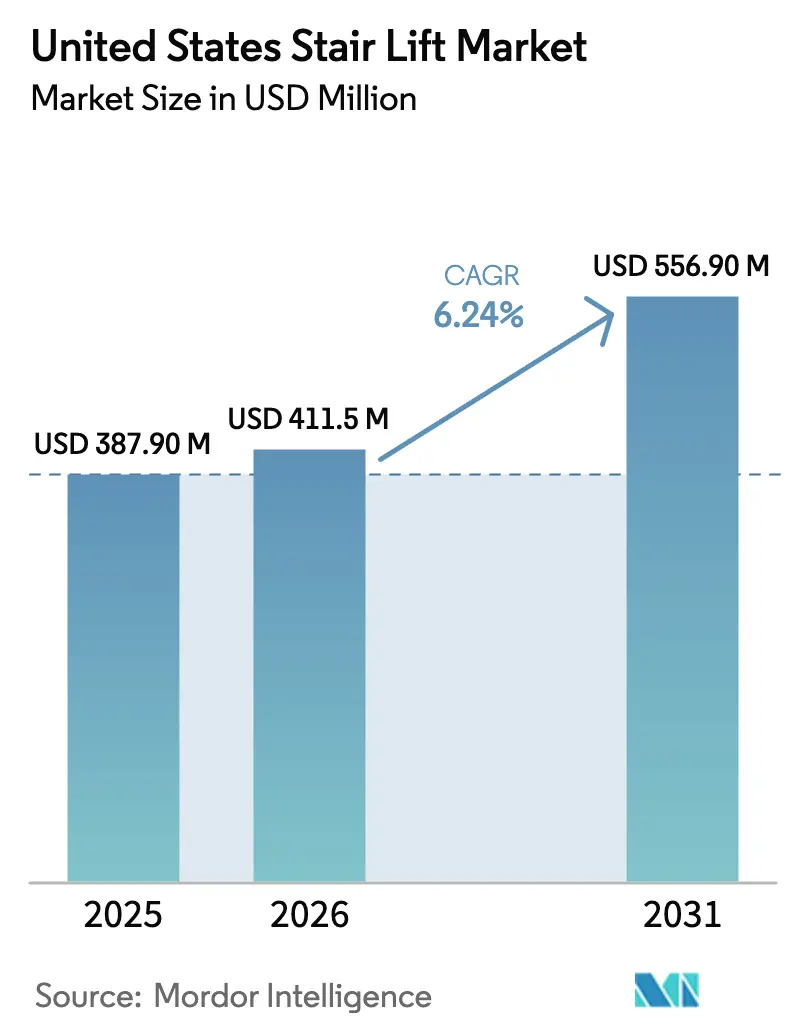
| Base Year Market Size (2025) | USD 387.90 Million |
| Market Size (2026) | USD 411.5 Million |
| Market Size (2031) | USD 556.90 Million |
| Growth Rate (2026 - 2031) | 6.24 % |
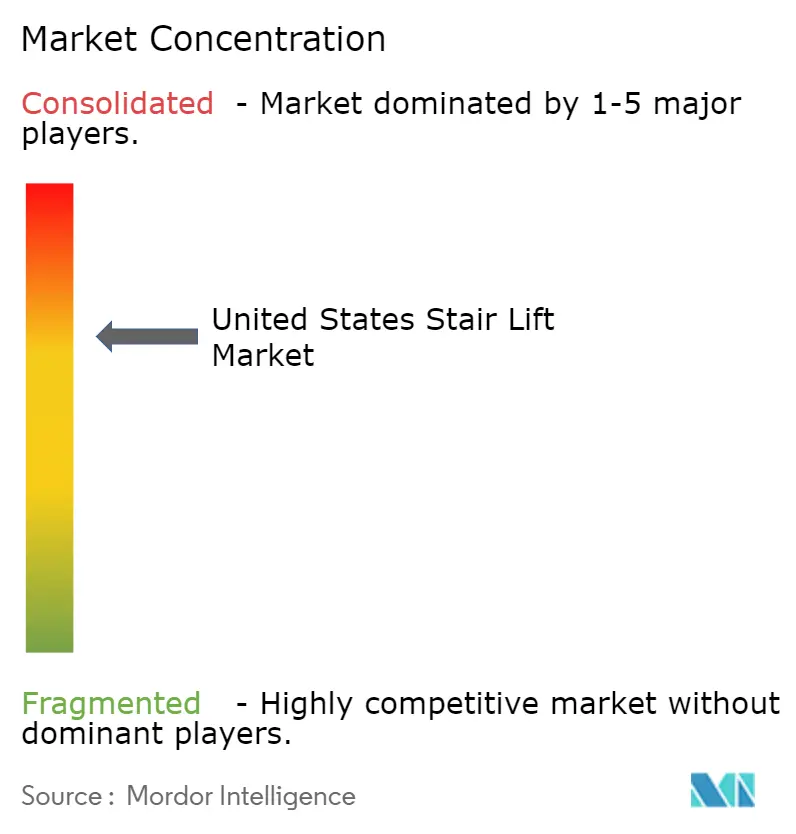
| Market Concentration | Medium |
Major Players *Disclaimer: Major Players sorted in no particular order Image © Mordor Intelligence. Reuse requires attribution under CC BY 4.0. | |
United States Stair Lift Market Analysis by Mordor Intelligence
The United States Stair Lift Market size is projected to be USD 387.90 million in 2025, USD 411.5 million in 2026, and reach USD 556.90 million by 2031, growing at a CAGR of 6.24% from 2026 to 2031. Demand strength reflects rising longevity, rapid technology improvements, and tax incentives that lower ownership costs. Straight rail systems remain the most frequently chosen configuration because installers can complete projects in a single visit, which curbs labor charges and appeals to price-sensitive seniors. Curved systems are expanding faster as new residential construction favors open stairwells with landings that require custom rails. Rental and subscription programs have increased market accessibility among middle-income households that prefer predictable monthly outlays over lump-sum payments. Competitive intensity is moderate: legacy brands rely on large dealer networks, while digital-first entrants focus on direct-to-consumer sales that compress margins, expedite quoting, and improve transparency.
Key Report Takeaways
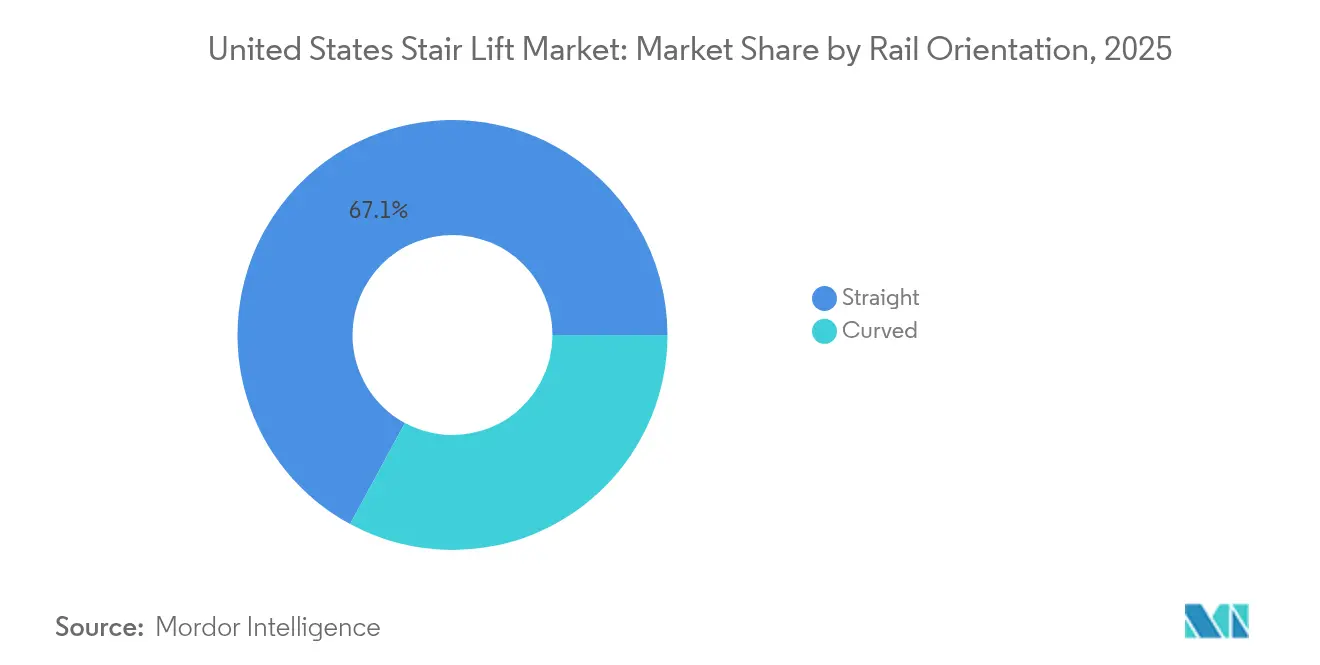
- By rail orientation, straight configurations led with 67.10% of the US stair lift market share in 2025, whereas curved systems are projected to post a 5.98% CAGR through 2031.
- By user orientation, seated models accounted for 56.10% of the US stair lift market size in 2025 and standing models are tracking a 5.85% CAGR through 2031.
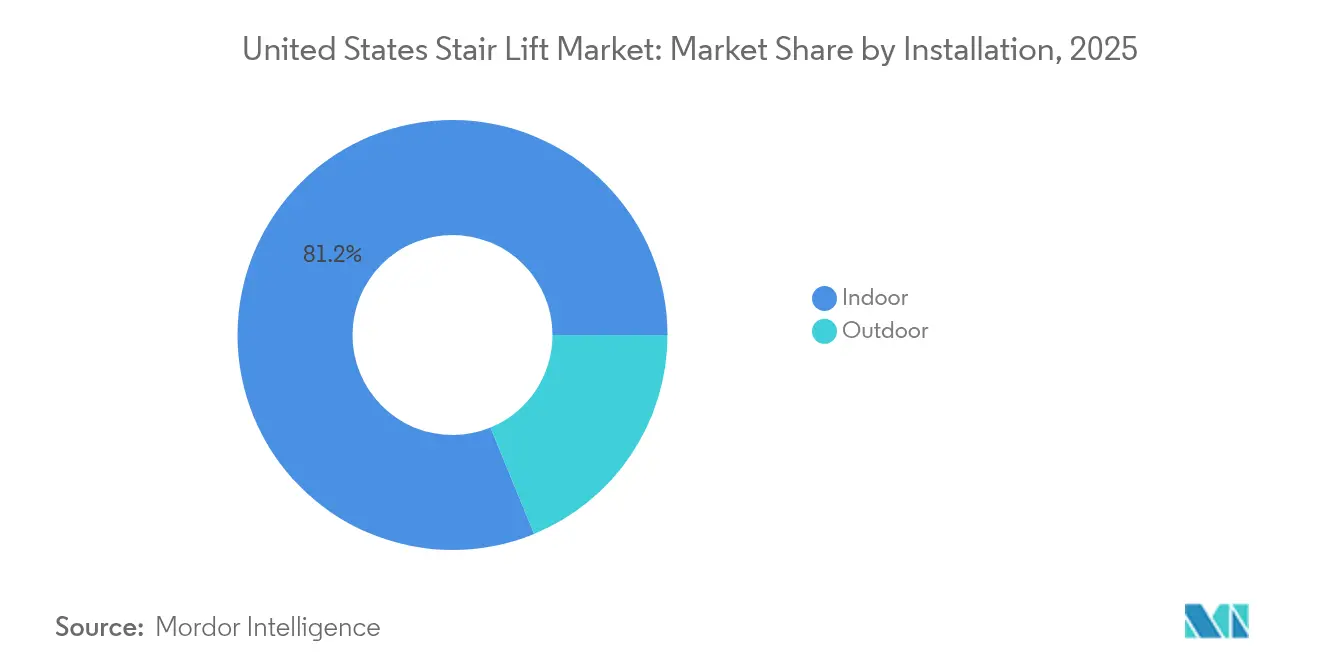
- By installation environment, indoor units dominated with an 81.20% share in 2025; outdoor systems are forecast to expand at a 6.05% CAGR to 2031.
- By application, residential installations contributed 75.60% of 2025 revenue, while healthcare facilities are advancing at a 6.18% CAGR through 2031.
- By geography, the South controlled 34.70% of 2025 sales and the West is anticipated to achieve a 6.21% CAGR by 2031.
Note: Market size and forecast figures in this report are generated using Mordor Intelligence’s proprietary estimation framework, updated with the latest available data and insights as of 2026.
United States Stair Lift Market Trends and Insights
Drivers Impact Analysis*
| Driver | (~) % Impact on CAGR Forecast | Geographic Relevance | Impact Timeline |
|---|---|---|---|
| Surge in ageing population and mobility disability | +1.8% | National with Southern and Western concentration | Long term (≥ 4 years) |
| Rising preference for ageing-in-place modifications | +1.2% | National, strongest in suburban and rural areas | Medium term (2-4 years) |
| Federal income-tax credits for home accessibility | +0.9% | National, greater effect in middle-income households | Short term (≤ 2 years) |
| Rental and subscription-based stair lift models | +0.8% | National, urban concentration | Medium term (2-4 years) |
| Insurance reimbursements expanding beyond Medicare Part B | +0.5% | National, state Medicaid variation | Long term (≥ 4 years) |
| Smart connected stair lifts enabling predictive maintenance | +0.4% | National, early adoption in tech-forward regions | Medium term (2-4 years) |
| Source: Mordor Intelligence | |||
Surge in Ageing Population and Mobility Disability
Adults aged 65 plus are projected to represent 22.8% of the U.S. population by 2040, with Sun Belt states experiencing the sharpest rise. Over one-third of this cohort reports difficulty climbing stairs, positioning the US stair lift market as a core pillar of safe-home retrofits. Each avoided fall-related hospitalization saves the health system USD 30,000-50,000, reinforcing payer interest in preventive accessibility solutions. Mobility impairments already affect more than 20 million Americans, underscoring a steadily widening addressable base. Manufacturers that bundle fall-prevention education with product demonstrations have found higher conversion rates among older consumers informed about the financial and health costs of in-home injuries.
Rising Preference for Ageing-in-Place Home Modifications
An assisted-living apartment costs roughly USD 4,500 per month, compared with a one-time USD 2,000-15,000 stair lift installation.[1] As 77% of adults aged 50 plus wish to remain in their own homes, spending on accessibility remodels continues to escalate. Medicare Advantage carriers are testing supplemental benefits that reimburse up to USD 5,000 for approved modifications, accelerating equipment orders when open-enrolment periods start each fall. Specialized contractors now market turnkey accessibility packages that include straight or curved stair lifts, grab bars, and widened doorways, simplifying the customer journey and compressing project timelines from weeks to days.
Federal Income-Tax Credits for Home Accessibility
The Internal Revenue Service permits taxpayers to deduct medically necessary modifications, lowering net stair lift outlays by 20-35% for qualifying filers [IRS.GOV]. Businesses may claim up to USD 5,000 via the Americans with Disabilities Act credit, encouraging small medical clinics and retail establishments to install public-access lifts rather than elevators. Several states offer dollar-for-dollar income-tax offsets up to USD 2,500, a structure that has increased adoption of premium curved rails despite their higher price tag. Combined incentives have broadened the US stair lift market beyond traditional cash-pay buyers and improved order intake for independent dealers.
Rapid Penetration of Rental and Subscription-Based Models
Monthly rentals between USD 150 and USD 400 convert steep upfront costs into manageable cash flows and cover maintenance visits that reassure risk-averse shoppers. Rehabilitation hospitals increasingly prescribe short-term rentals for post-surgery patients, a group that now constitutes roughly one-quarter of all placements. Dealers note that 40% of renters ultimately purchase the unit, indicating that rentals function as extended test drives. Subscription bundles that include automatic upgrades every five years are popular in urban condominiums where building boards restrict permanent modifications, expanding the US stair lift market into dense settings previously dominated by elevators.
Restraints Impact Analysis*
| Restraint | (~) % Impact on CAGR Forecast | Geographic Relevance | Impact Timeline |
|---|---|---|---|
| High purchase and installation cost for curved systems | -0.8% | National with pronounced effect in lower-income areas | Medium term (2-4 years) |
| Limited reimbursement under private insurance plans | -0.6% | National, dependent on insurer policies | Long term (≥ 4 years) |
| Safety concerns over DIY stair lift kits | -0.4% | National, regulatory scrutiny rising | Short term (≤ 2 years) |
| Post-installation servicing gaps in rural zones | -0.3% | Rural Mountain West and Great Plains | Medium term (2-4 years) |
| Source: Mordor Intelligence | |||
High Purchase and Installation Cost for Curved Systems
Curved rail projects command USD 7,500-15,000 because every rail is custom-bent, measured, and fitted onsite.[2] The absence of economies of scale limits price compression, pushing many middle-income households to postpone or abandon purchases. Insurance exclusions compound the hurdle, as most policies treat stair lifts as non-medical home upgrades. Some manufacturers pursue FDA Class I device designation to secure durable medical equipment codes, yet additional compliance spending may negate pricing relief, keeping adoption uneven across income brackets.
Limited Reimbursement Under Private Insurance Plans
Medicare Part B excludes stair lifts entirely, and private insurers often mimic that stance, leaving roughly 85% of customers to pay cash out of pocket.[3] State Medicaid waivers offer some relief but have multi-year waitlists and strict income caps. The reimbursement vacuum has curtailed volumes in regions with high insurance penetration and slowed the US stair lift market growth despite evident clinical need. Manufacturers lobby for policy reform but face protracted regulatory timelines, steering near-term strategy toward financing programs and extended warranties that offset the absence of insurer support.
*Our forecasts treat driver/restraint impacts as directional, not additive. The impact forecasts reflect baseline growth, mix effects, and variable interactions.
Segment Analysis
By Rail Orientation: Curved Systems Drive Premium Growth
Straight rails retained 67.10% of 2025 revenue thanks to template-based fabrication that cuts installation to under four hours, assuring swift project completion for the US stair lift market. The segment’s predictable cost profile attracts first-time buyers and rental customers who favor simplicity. Curved systems are projected to outpace straight installations with a 5.98% CAGR as modern architecture introduces switchbacks, landings, and sweeping staircases. Affluent seniors accept higher price points to maintain aesthetics and value seamless integration with smart-home dashboards that send maintenance alerts to dealers.
Smart sensors now log motor load, battery health, and rail vibration, enabling predictive maintenance calls before malfunctions. Curved platforms see faster adoption of these features because owners tend to invest in premium options to protect larger upfront investments. The US stair lift industry also notes rising demand for bespoke rail finishes - brushed nickel, bronze, and powder-coated hues that match banisters. Manufacturers report that offering design consultations raises close rates by 8-10%, turning style into a sales lever rather than a cost objection.

By User Orientation: Standing Models Gain Therapeutic Recognition
Seated units commanded 56.10% of 2025 sales, rooted in occupational-therapy protocols that prioritize stability during ascent. Clinicians still recommend seated lifts for users with vestibular disorders and muscle weakness, ensuring broad adoption across age and income segments. Standing and perch configurations, however, are gaining clinical acceptance, charting a 5.85% CAGR because they facilitate lower-body workouts for post-surgical patients. Physical therapists integrate step-through motions into rehabilitation exercises, citing improved joint flexibility.
The US stair lift market size for standing models remains smaller but benefits from ergonomic handlebars, fold-away platforms, and orthopedic cushioning that mitigate pressure on knee and hip joints. Early evidence shows standing lifts reduce time needed to regain stair-climbing independence by two weeks in knee-replacement cases, prompting some workers-compensation insurers to approve reimbursement. Manufacturers who bundle adjustable harnesses and remote monitoring are widening addressable demand beyond traditional senior demographics, capturing younger users recovering from sports injuries.
By Installation: Outdoor Applications Weather New Challenges
Indoor environments generated 81.20% of 2025 expenditure as controlled temperatures prolong motor and battery life. Indoor units now include lithium-ion packs that deliver up to 60 round-trips during power outages, addressing a common pain-point highlighted in dealer surveys. In contrast, outdoor installations are projected to rise at a 6.05% CAGR, propelled by multi-level patios, garage lofts, and elevated walkways. Marine-grade aluminum rails, UV-resistant seat fabrics, and sealed electronics enable year-round use in coastal and mountain climates alike.
Local permitting remains the biggest hurdle: coastal counties often demand hurricane-rated anchoring, while mountainous areas require snow-shedding designs to prevent ice buildup. Dealers that handle permit filings have higher closure rates because they simplify the homeowner’s administrative burden. Outdoor projects cost 20-30% more than indoor equivalents, but grant programs for veterans and people with disabilities partially offset premiums, expanding the US stair lift market reach into low-temperature regions.
By Application: Healthcare Facilities Embrace Compliance Solutions
Residential demand delivered 75.60% of 2025 revenue as seniors choose home-based aging strategies. Voice-activated call-senders and integration with Amazon Alexa or Google Assistant now ship standard on mid-range models, linking lifts to broader remote-care ecosystems that alert caregivers if daily ride counts fall below baseline. The US stair lift market size for healthcare facilities is smaller yet rising at 6.18% CAGR as hospitals and rehabilitation centers retrofit multistory wings under ASME A18.1 guidelines.
Healthcare buyers specify antimicrobial seat covers and redundant braking, driving average selling prices 15-20% higher than residential models. Bundling lifts with patient-handling slings further shortens patient transfer times during emergency evacuations. Hospitals with bed-to-board OR pathways spanning multiple floors have validated time savings that speed surgical turnaround, bolstering the ROI case for administrators. Dealers who complete infection-control certifications secure favored-vendor status, insulating revenues from consumer-market cycles.
Geography Analysis
The South preserved its leadership at 34.70% of 2025 national sales as retirees flock to Florida, Texas, and North Carolina. Lower labor costs and generous Medicaid waivers amplify adoption by widening affordability. Suburban tract homes built in the 1990s feature prominent central staircases, simplifying straight-rail installations that dominate southern purchase patterns. Dealer density is highest in Atlanta, Dallas, and Tampa, ensuring two-day average response times for service calls.
The West is projected to record a 6.21% CAGR through 2031, driven by California’s 75-plus age cohort rising 32% during the decade. Building codes mandate energy-efficient devices, boosting demand for stair lifts that regenerate battery power on descents. High construction wages inflate installation fees, but affluent homeowners and strong Veterans Affairs grant usage keep volume rising. Seismic safety standards have also prompted manufacturers to introduce anti-rollback mechanisms that lock rails during tremors, differentiating products in earthquake-prone zones.
The Northeast and Midwest generate steady replacement demand among long-time homeowners, though aging building stock often requires joist reinforcement before rail anchoring. Dealers offering turnkey carpentry secure higher close rates. Municipal programs in Chicago, Boston, and Philadelphia provide small grants for accessibility, partially cushioning price sensitivity. Population out-migration moderates the overall US stair lift market trajectory in these regions, yet dealer service contracts create recurring revenue that stabilizes cash flow.
Competitive Landscape
Four suppliers account for roughly 45% of 2024 revenue, placing the US stair lift market in a moderately concentrated tier. TK Elevator leads on smart connectivity, rolling out the MAX Home platform that streams component data to cloud dashboards for predictive maintenance.[4] Savaria Corporation leverages multi-product offerings - elevators, dumbwaiters, and platform lifts - to cross-sell within its dealer channel.[5] Bruno Independent Living Aids differentiates via American-made positioning and robust veteran outreach, while Handicare Group emphasizes lifetime motor warranties to allay long-term cost concerns.
Emerging rivals deploy direct-to-consumer logistics, shipping pre-assembled straight rails with modular extension kits that reduce install times to under two hours. Subscription models bundle annual maintenance, generating predictable revenue that appeals to investors backing these younger entrants. Technology partnerships with smart-home ecosystems are accelerating; integrations with Amazon Sidewalk and Zigbee allow dealers to troubleshoot remotely, cutting truck rolls by 25%. Rural servicing remains an Achilles heel: brands that set up mobile technician hubs in secondary cities gain a competitive edge in sparsely populated territories.
United States Stair Lift Industry Leaders
-
AmeriGlide Distributing 2019, Inc.
-
Handicare Group AB
-
ThyssenKrupp Elevator Technology
-
Stannah Lifts Holdings Ltd.
-
Acorn Stairlifts Inc.
- *Disclaimer: Major Players sorted in no particular order
Recent Industry Developments
- May 2025: Savaria Corporation completed one year of acquisition of D.A. Matot dumbwaiter and material-lift assets, enhancing cross-selling potential through shared dealer networks.
- March 2025: Lifeward Ltd. secured FDA clearance for the ReWalk 7 exoskeleton and obtained the first commercial insurance reimbursement for a personal robotic mobility device, establishing a benchmark that could influence stair lift coverage.
- February 2025: Independent Living Solutions expanded installation coverage in Colorado, emphasizing battery-operated stair lifts with automatic recharge systems for regions prone to utility outages.
United States Stair Lift Market Report Scope
The stair lift is a mechanical device for lifting people, typically those with disabilities, up and downstairs. These are equipped with buttons/joysticks to simplify the overall operation. The elderly population and physically challenged individuals can effortlessly access and maneuver the equipment. Low installation costs and ease of accessibility are some of the major elements fueling the growth of the stairlifts market. The study considers the revenue generated from the sale of Stairlifts by various vendors in the country.
The United States Stair Lift Market is segmented by Rail Orientation (Straight, Curved), User Orientation (Seated, Standing, Integrated), Installation (Indoor and Outdoor), and by Application (Residential, Healthcare).
By Rail Orientation
| Straight |
| Curved |
By User Orientation
| Seated |
| Standing |
| Integrated (Perch) |
By Installation
| Indoor |
| Outdoor |
By Application
| Residential |
| Healthcare Facilities |
| Other Applications (Commercial, Public Buildings) |
| By Rail Orientation | Straight |
| Curved | |
| By User Orientation | Seated |
| Standing | |
| Integrated (Perch) | |
| By Installation | Indoor |
| Outdoor | |
| By Application | Residential |
| Healthcare Facilities | |
| Other Applications (Commercial, Public Buildings) |
Key Questions Answered in the Report
How large is the US stair lift market in 2026?
The market reached USD 411.5 million in 2026 and is projected to grow at a 6.24% CAGR during the forecast period (2026-2031).
Which rail orientation captures the biggest share of US stair lift sales?
Straight rail systems held 67.10% of 2025 revenue because of lower customization and installation costs.
Why are curved stair lifts more expensive?
Each curved rail is custom-fabricated, adding design, manufacturing, and installation time that raises total cost to USD 7,500-15,000.
What regions generate the fastest stair lift demand growth?
The West is forecast to post a 6.21% CAGR to 2031, driven by aging populations in California, Arizona, and Nevada.
Do insurance plans cover stair lifts?
Medicare Part B excludes stair lifts, and most private insurers follow suit, leaving about 85% of buyers to self-fund installations.
How are rental programs influencing the market?
Monthly rentals between USD 150 and USD 400 allow users to test products and often convert to purchases, expanding overall adoption.