
United States Rechargeable Battery Market Size and Share
| Study Period | 2019 - 2030 |
| Forecast Data Period | 2025 - 2030 |
| Historical Data Period | 2019 - 2023 |
| Market Size (2025) | USD 18.55 Billion |
| Market Size (2030) | USD 33.96 Billion |
| CAGR (2025 - 2030) | 12.85% |
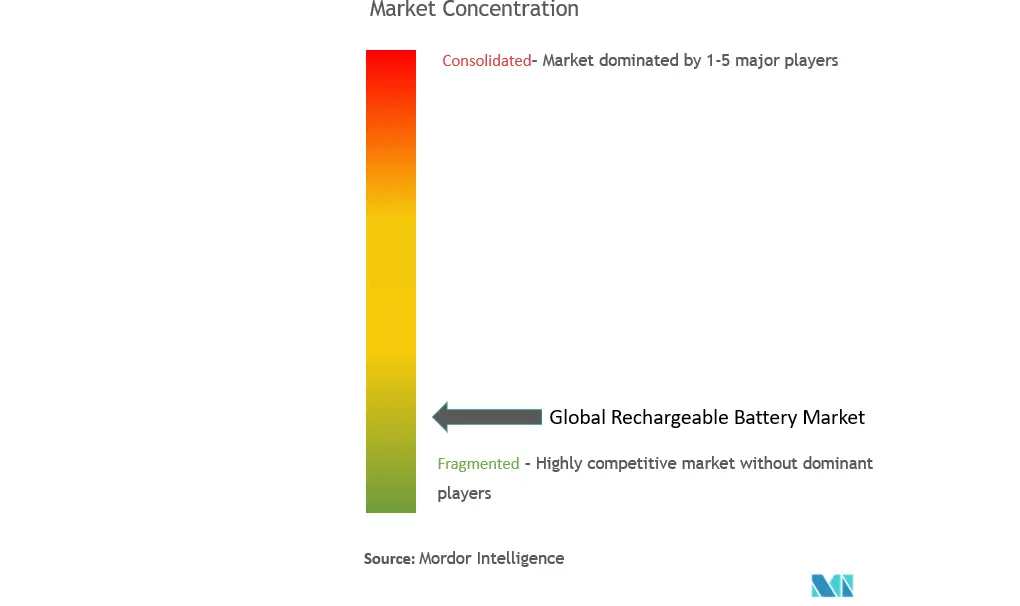
| Market Concentration | Low |
Major Players *Disclaimer: Major Players sorted in no particular order |
United States Rechargeable Battery Market Analysis by Mordor Intelligence
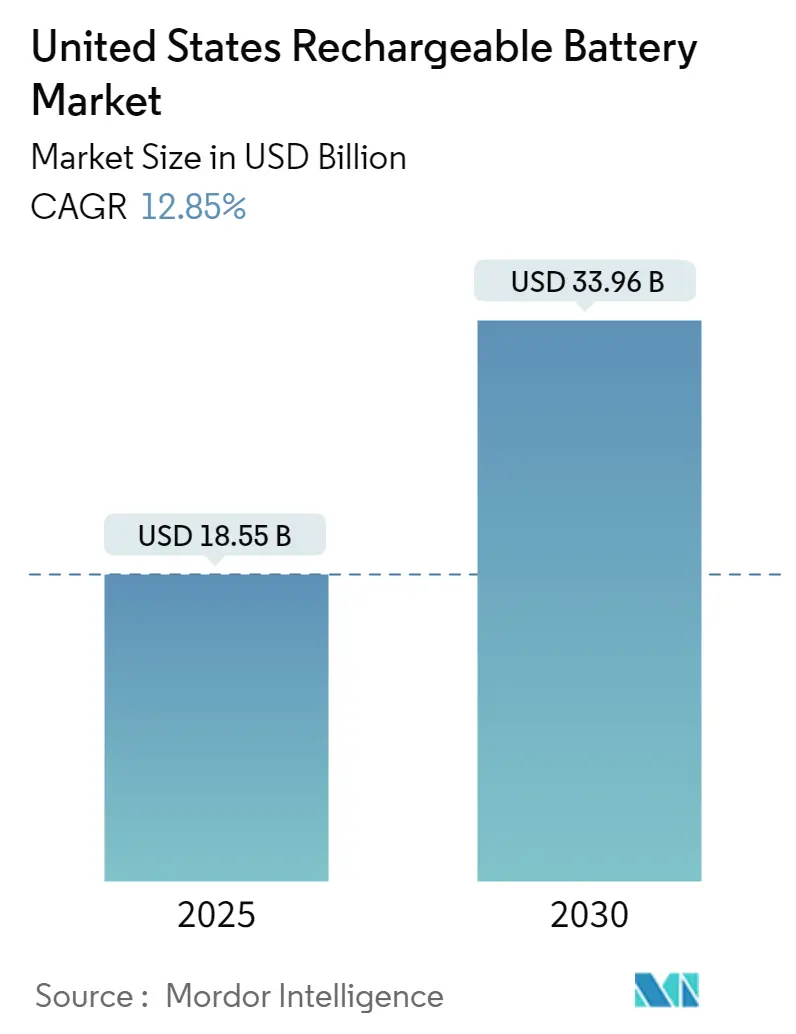
The United States Rechargeable Battery Market size is estimated at USD 18.55 billion in 2025, and is expected to reach USD 33.96 billion by 2030, at a CAGR of 12.85% during the forecast period (2025-2030).
- Over the medium term, factors such as increasing demand for electric vehicles and growing sales of consumer electronics are expected to be among the most significant drivers for the United States rechargeable battery market during the forecast period.
- Conversely, the United States faces significant supply chain constraints in procuring batteries, posing a potential threat to its rechargeable battery market during the forecast period.
- However, ongoing advancements in energy density, charging cycles, and energy retention have resulted in more efficient rechargeable batteries, paving the way for numerous future opportunities in the market.
United states contributes to a system defined not by any single country or region but by the interaction of many. The global rechargeable battery market data by Mordor Intelligence represents that combined structure.
United States Rechargeable Battery Market Trends and Insights
Lithium-Ion Batteries Expected to Witness Growth
- Lithium-ion batteries are poised for substantial growth in the market under consideration. Their rising popularity, especially when compared to other battery types, can be attributed to their favorable capacity-to-weight ratio. Additional factors fueling their adoption include superior performance (notably, a long lifespan and minimal maintenance), an extended shelf life, and decreasing prices. While lithium-ion batteries typically command a higher price than their counterparts, their advantages are driving demand.
- Consumer electronics are increasingly turning to lithium-ion batteries. This sector encompasses smartphones, laptops, tablets, and wearables. These devices demand lightweight components, efficient charging cycles, and prolonged battery life, making lithium-ion batteries the preferred choice. As the appetite for advanced electronics grows, so too will the demand for lithium-ion batteries, propelling market expansion.
- Moreover, the global shift towards renewable energy sources, like solar and wind, is amplifying the demand for energy storage solutions. Lithium-ion batteries excel in this role, adeptly storing excess energy from renewables and releasing it as needed. This capability not only bolsters grid stability but also curtails dependence on fossil fuels.
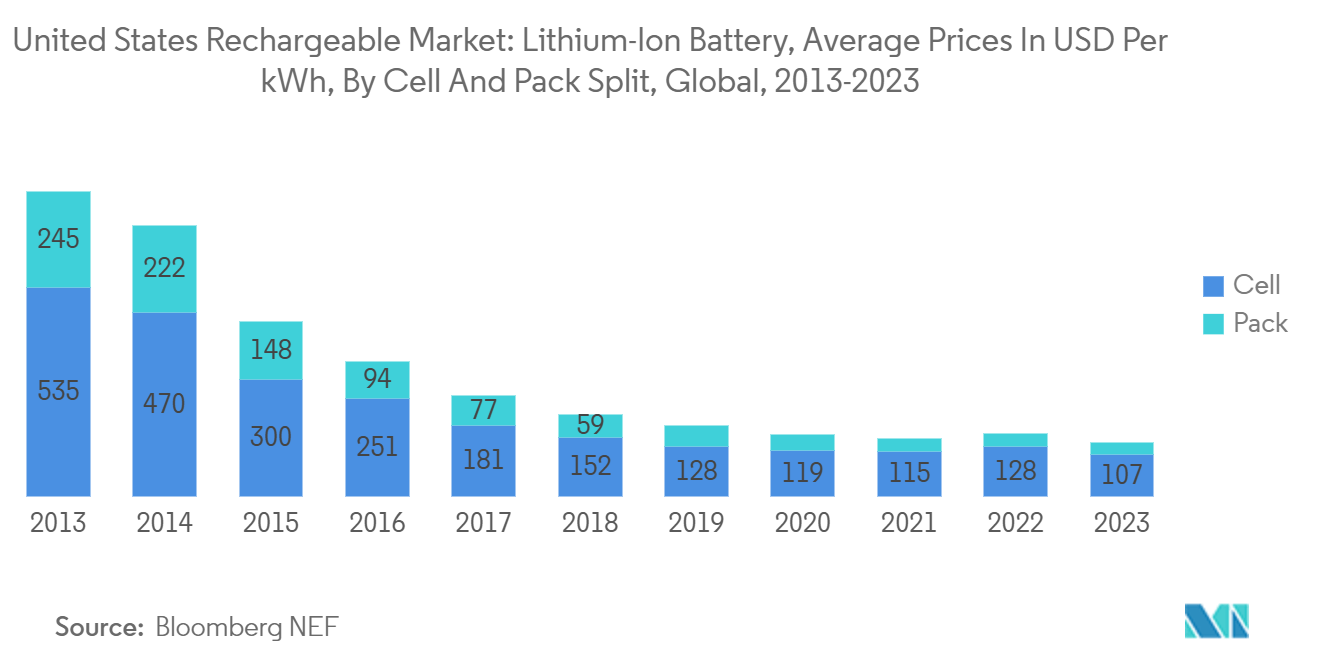
- In recent years, declining prices of lithium-ion batteries and cell packs have made them increasingly appealing to end-user industries. Following minor price increases in 2022, a downward trend resumed in 2023. Notably, the cost of lithium-ion battery packs plummeted by 14%, hitting a historic low of USD 139/kWh. This price drop is largely due to reductions in raw material and component costs, alongside expanded production capacities throughout the battery value chain.
- Ongoing research and development in lithium-ion technology are yielding enhancements in energy density, safety, and cost-effectiveness. Innovations in battery chemistries, such as lithium-nickel-manganese-cobalt-oxide (NMC) and lithium-iron-phosphate (LFP), are resulting in extended battery life, increased energy storage, and enhanced thermal stability, broadening their appeal across various applications.
- For example, in March 2023, the U.S. Department of Energy unveiled a groundbreaking lithium battery technology boasting superior energy density and efficiency. These advanced batteries are touted for potential use in power cars, domestic airplanes, and long-haul trucks. Furthermore, the battery's electrochemical chemistry enhances safety, making them suitable for industries with demanding operational conditions and temperature variations.
- Given these insights, lithium-ion batteries are set to experience notable growth in the coming years.


Growing Demand for Electric Vehicles to Drive The Market
- The United States stands as a key player in the global automobile market, leading not only in automobile production but also ranking among the top markets for rechargeable batteries. With rising electric vehicle (EV) sales, driven by escalating fossil fuel prices, the United States automobile industry is set to be dominated by EVs in the coming years.
- In a bid to boost EV adoption, the United States has set a 2035 deadline to halt sales of internal combustion engine (ICE) vehicles. Additionally, the United States has committed to achieving economy-wide net-zero emissions in the coming decades. Such forward-looking policies have spurred EV manufacturers to ramp up their R&D investments.
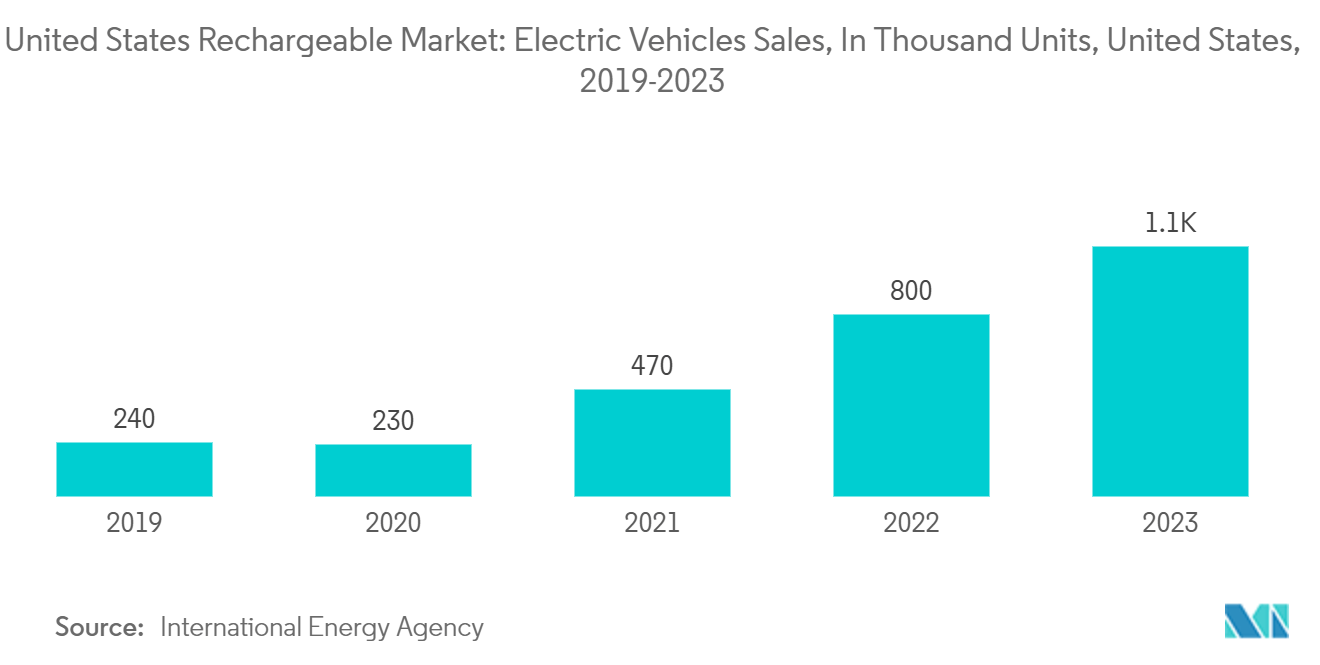
- These initiatives have catalyzed a swift embrace of electric vehicles across the nation. Data from the International Energy Agency highlights a 37.5% surge in United States electric vehicle sales from 2022 to 2023. This comes on the heels of a remarkable 71.6% annual average growth rate from 2019 to 2023, underscoring the escalating momentum towards EVs.
- As EV demand surges, so too does the need for batteries, prompting a proliferation of battery production facilities and heightened R&D activities in the United States rechargeable battery sector.
- For example, a January 2024 analysis by the Environmental Defense Fund revealed that the United States is set to unveil over 1,000 gigawatt hours per year of electric vehicle battery production capacity by 2028. This capacity, sufficient to power 10 million electric cars, exceeds the sales projections for 2030 set by the United States Environmental Protection Agency.
- Given these dynamics, it's clear that electric vehicle sales will be a primary driver of the rechargeable battery market in the United States in the years to come.

The rechargeable battery market is analyzed by Mordor Intelligence across multiple other geographies, with in-depth regional assessments available for Europe, North America, and Asia. This is complemented by country-specific insights for France, Japan, Spain, Italy, Sweden, and Netherlands, reflecting various localized market behavior and policy environments' coverage.
Competitive Landscape
The United States Rechargeable Battery Market is fragmented. Some of the key players in this market (in no particular order) are BYD Co. Ltd., Contemporary Amperex Technology Co. Ltd., Exide Industries, Panasonic Corporation, and GS Yuasa Corporation.
United States Rechargeable Battery Industry Leaders
BYD Co. Ltd.
Contemporary Amperex Technology Co Ltd
Exide Industries
GS Yuasa Corporation
Panasonic Corporation
- *Disclaimer: Major Players sorted in no particular order

Recent Industry Developments
- May 2024: Addionics, a leader in battery technology known for its innovative 3D current collectors, has teamed up with IL Science, a prominent name in mobility and battery solutions. Through a Memorandum of Understanding (MOU), both companies are set to collaborate on enhancing lithium metal rechargeable batteries. Their focus is on merging highly stable lithium metal with cutting-edge copper current collectors. This strategic alliance not only aims to elevate battery performance but also seeks to address key challenges that have hindered broader market acceptance.
- January 2024: Engineers at Harvard's John A. Paulson School of Engineering and Applied Sciences (SEAS) have developed a pioneering lithium metal battery. This battery boasts an impressive endurance of over 6,000 charge-discharge cycles, outpacing any existing pouch battery cell, and can be recharged in mere minutes. The research not only introduces an innovative method for producing solid-state batteries featuring a lithium metal anode but also sheds light on the materials employed in these game-changing batteries.


United States Rechargeable Battery Market Report Scope
A rechargeable battery is a type of battery that can be charged multiple times by passing an electric current through it in the opposite direction of its discharge. This allows the battery to be reused, reducing waste and cost compared to single-use, disposable batteries.
The United States Rechargeable Battery Market is segmented by technology and applications. By technology, the market is segmented into Lead Acid, Lithium-ion, Others (NiMh, Nicd, etc.). By applications, the market is segmented into Automobiles, Industrial Batteries, Portable Batteries, and Other Applications. Market sizing and forecasts were made for each segment based on revenue (USD).
| Lead Acid |
| Lithium-Ion |
| Others (NiMh, NiCd, etc.) |
| Automobiles |
| Industrial Batteries |
| Portable Batteries |
| Other Applications |
| Technology | Lead Acid |
| Lithium-Ion | |
| Others (NiMh, NiCd, etc.) | |
| Applications | Automobiles |
| Industrial Batteries | |
| Portable Batteries | |
| Other Applications |


Key Questions Answered in the Report
How big is the United States Rechargeable Battery Market?
The United States Rechargeable Battery Market size is expected to reach USD 18.55 billion in 2025 and grow at a CAGR of 12.85% to reach USD 33.96 billion by 2030.
What is the current United States Rechargeable Battery Market size?
In 2025, the United States Rechargeable Battery Market size is expected to reach USD 18.55 billion.
Who are the key players in United States Rechargeable Battery Market?
BYD Co. Ltd., Contemporary Amperex Technology Co Ltd, Exide Industries, GS Yuasa Corporation and Panasonic Corporation are the major companies operating in the United States Rechargeable Battery Market.
What years does this United States Rechargeable Battery Market cover, and what was the market size in 2024?
In 2024, the United States Rechargeable Battery Market size was estimated at USD 16.17 billion. The report covers the United States Rechargeable Battery Market historical market size for years: 2019, 2020, 2021, 2022, 2023 and 2024. The report also forecasts the United States Rechargeable Battery Market size for years: 2025, 2026, 2027, 2028, 2029 and 2030.
Page last updated on:
United States Rechargeable Battery Market Report
Statistics for the 2025 United States Rechargeable Battery market share, size and revenue growth rate, created by Mordor Intelligence™ Industry Reports. United States Rechargeable Battery analysis includes a market forecast outlook for 2025 to 2030 and historical overview. Get a sample of this industry analysis as a free report PDF download.





