
United States Household Battery Market Size and Share
| Study Period | 2021 - 2030 |
| Forecast Data Period | 2025 - 2030 |
| Historical Data Period | 2021 - 2023 |
| CAGR | 5.00% |
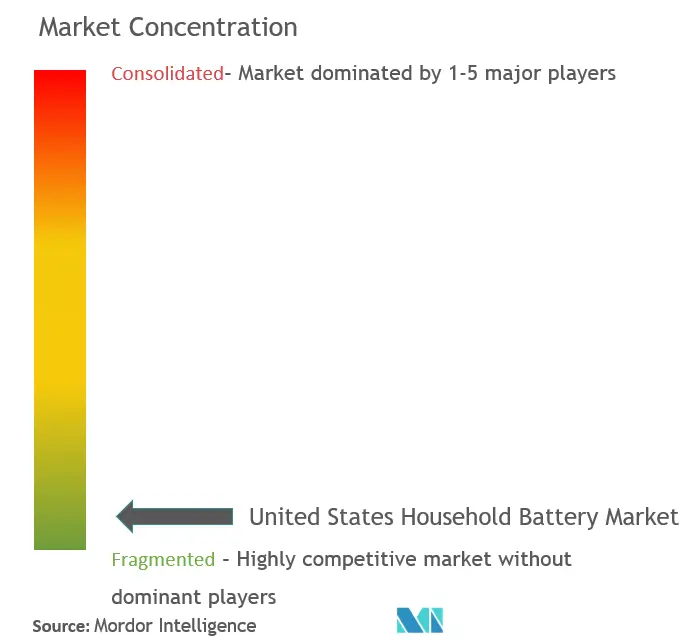
| Market Concentration | Low |
Major Players *Disclaimer: Major Players sorted in no particular order |
United States Household Battery Market Analysis by Mordor Intelligence
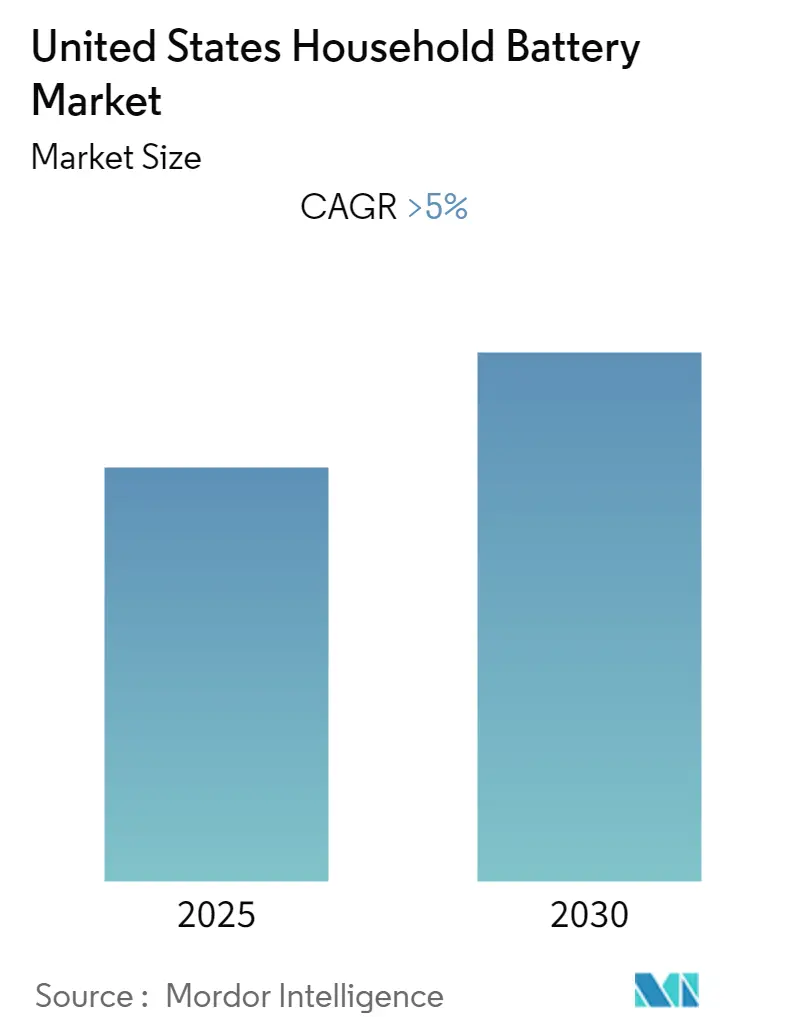
The United States Household Battery Market is expected to register a CAGR of greater than 5% during the forecast period.
The market was negatively impacted by COVID-19. The market has now reached pre-pandemic levels.
- With the increasing population and economic growth, the use of electronic appliances in the country is expected to grow over time. Household batteries are primarily used in electronic goods like smartphones, cameras, and many other electronic devices. The primary driver of the market studied is the growing use of electronic devices and technological development for longer-duration backup capabilities. Declining lithium-ion battery prices and technological developments are expected to drive the US household battery market during the forecast period.
- However, the demand-supply mismatch for raw material supply to manufacturing the batteries is expected to hinder the market growth during the forecast period.
- With an estimated population of around 398 million by 2050, the electronic market in the United States is expected to expand significantly. Technologies, such as developments in cell phone technology, and the implementation of artificial technology on electronic goods, are expected to transform digital technology to the way ahead. Moreover, the economy of the United States is expected to increase to USD 71,000 billion by 2050. Growth in the economy indicates growth in the lifestyle of people, thereby having a huge possibility for the adoption of updated technology, which is expected to create an opportunity for the market to grow in the near future.
United States Household Battery Market Trends and Insights
Lithium-Ion Battery to Dominate the Market
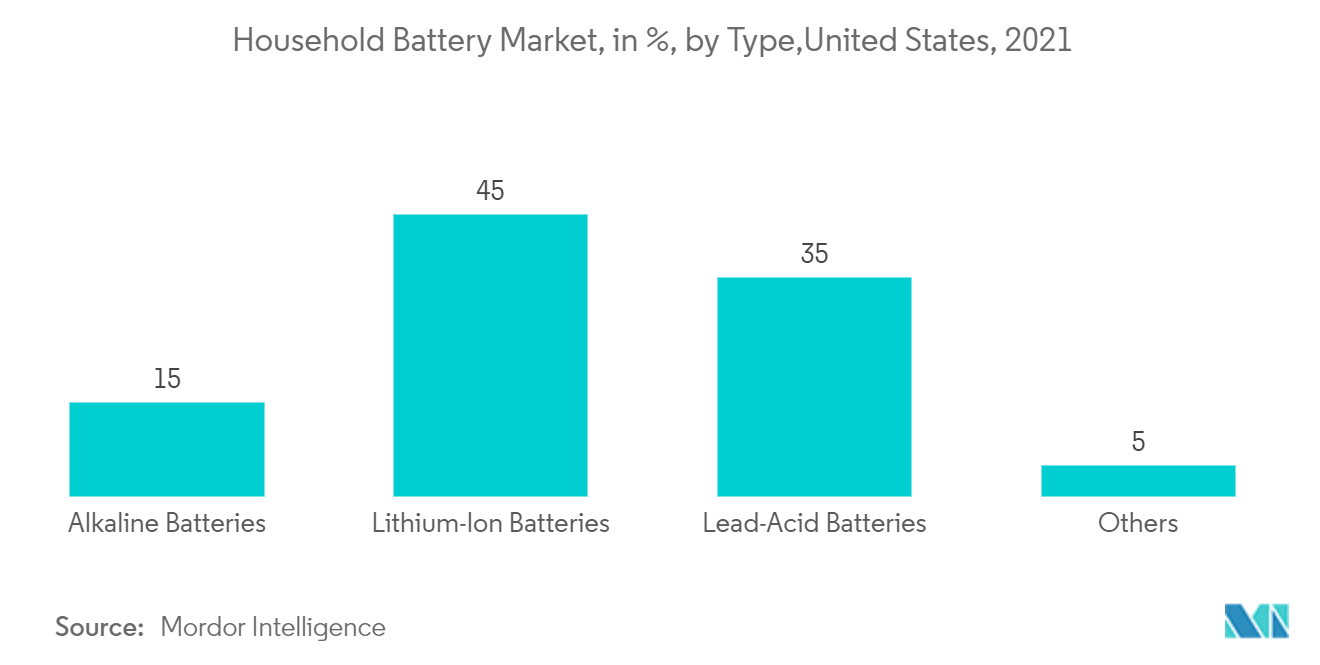
- The lithium-ion battery is a type of rechargeable battery, majorly used in electronic devices and electric vehicles. It has been growing in popularity in various military and aeronautical uses. In 2021, lithium-ion batteries in the United States had a significant market share in the household battery market because of the increased use of electronic devices.
- Lithium-ion batteries are commonly used in electronic devices, such as smartphones, laptops, clocks, watches, and remote controls. Sales of consumer electronics are very much dependent on the population and disposable income. The increasing disposable income in the United States has led to rising living standards, driving the demand for consumer electronics in the country.
- Li-ion batteries have been gaining more popularity compared to other battery types due to their favorable capacity-to-weight ratio. Other factors boosting its adoption include better performance, higher energy density, and decreasing price.
- Mobile phones are the most commonly used electronic devices, which use lithium batteries. With about 298 million smartphone users by 2021, the United States has one of the world's largest smartphone markets. It is likely to increase further with technological development and a drop in the price of mobile phones.
- Due to the high competition in the consumer electronics market, the prices of technology have been reducing, while the disposable income of people has also been increasing, resulting in increased penetration levels of the devices. Similarly, the growth over the forecast period is expected to drive the demand for batteries used in these devices.
Declining Lithium-ion Battery Price and Technological Development to Drive the Market
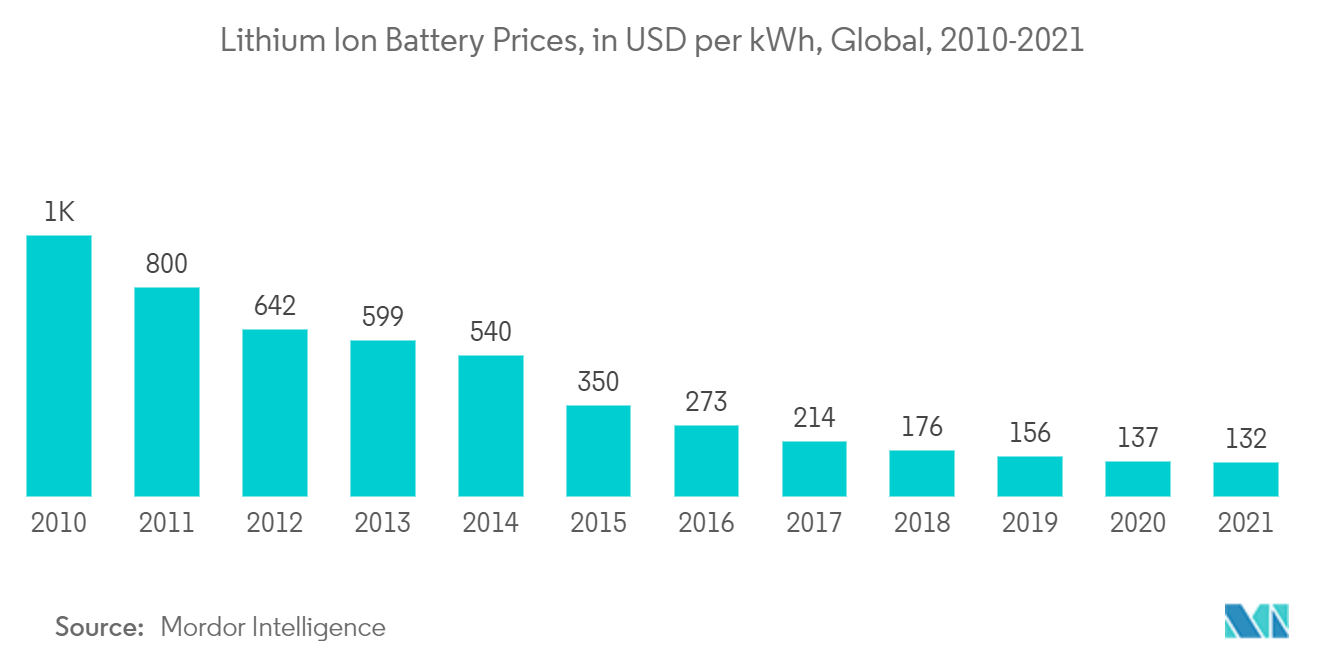
- The price of lithium-ion batteries has fallen steeply over the past ten years. In 2018, the lithium-ion battery price was USD 176 per kWh. Lithium-ion battery prices have been falling continuously, decreasing to USD 132 kWh in 2021.
- This sharp and sustained cost reduction is expected to help cement lithium-ion as the battery chemistry of choice in all energy storage markets, including grid-scale, behind-the-meter storage, residential storage, and micro-grids.
- Lithium-ion batteries are expected to dominate the overall battery market over the next ten years, as they are widely used in cell phones, tablets, and laptops, among other gadgets, whose demand has been increasing at a significant rate globally and in the United States.
- Furthermore, the decline in average lithium-ion battery prices is expected to continue and reach approximately USD 100/kWh by 2025, making it much more cost-competitive than other battery types. The trend is likely to result in an increased application of lithium-ion batteries in many other consumer electronics, with a decrease in the price of household electronic goods during the forecast period.
Competitive Landscape
The household battery market in the United States is fragmented. The key owners in the market studied (not in particular order ) include Duracell Inc., Energizer Holdings Inc., HBL Power Systems Ltd, BYD Company Ltd, Panasonic Corporation, Power-Sonic Corporation, and Zeus Battery Products, among others.
United States Household Battery Industry Leaders
-
Duracell Inc.
-
Energizer Holdings Inc.
-
HBL Power Systems Ltd
-
BYD Company Ltd.
-
Panasonic Corporation
- *Disclaimer: Major Players sorted in no particular order
Recent Industry Developments
- December 2022: The US Department of Energy (DOE) announced the conclusion of a USD 2.5 billion loan to Ultium Cells LLC to assist in financing the building of new lithium-ion battery cell manufacturing facilities in Ohio, Tennessee, and Michigan through its Loan Programs Office (LPO). The three facilities will be managed by Ultium Cells, a joint venture between General Motors and LG Energy Solution.
- August 2022: President Biden signed the Inflation Reduction Act, the greatest climate and energy package in US history, into law. Over USD 60 billion for American manufacturing across the clean energy supply chain is included in the IRA, including USD 30 billion in production tax credits to stimulate domestic manufacturing of solar panels, wind turbines, batteries, and essential minerals processing.
United States Household Battery Market Report Scope
Household battery means any device consisting of one or more electrically connected cells, each cell consisting of an anode, a cathode, and an electrolyte, as well as such connections (electrical and mechanical) as may be required to allow such cells to deliver or receive electrical energy, and designed to receive, store, and deliver electric energy, provided that Automotive Batteries are not included. The market is segmented by type (alkaline batteries, lead-acid batteries, lithium-ion batteries, and other types). The report offers the market size and forecasts in revenue (USD billion) for all the above segments.
Key Questions Answered in the Report
What is the current United States Household Battery Market size?
The United States Household Battery Market is projected to register a CAGR of greater than 5% during the forecast period (2025-2030)
Who are the key players in United States Household Battery Market?
Duracell Inc., Energizer Holdings Inc., HBL Power Systems Ltd, BYD Company Ltd. and Panasonic Corporation are the major companies operating in the United States Household Battery Market.
What years does this United States Household Battery Market cover?
The report covers the United States Household Battery Market historical market size for years: 2021, 2022, 2023 and 2024. The report also forecasts the United States Household Battery Market size for years: 2025, 2026, 2027, 2028, 2029 and 2030.
United States Household Battery Market Report
Statistics for the 2025 United States Household Battery market share, size and revenue growth rate, created by Mordor Intelligence™ Industry Reports. United States Household Battery analysis includes a market forecast outlook for 2025 to 2030 and historical overview. Get a sample of this industry analysis as a free report PDF download.