
Spain Rechargeable Battery Market Size and Share
| Study Period | 2019 - 2030 |
| Forecast Data Period | 2025 - 2030 |
| Historical Data Period | 2019 - 2023 |
| Market Size (2025) | USD 2.60 Billion |
| Market Size (2030) | USD 5.17 Billion |
| CAGR (2025 - 2030) | 14.72% |
| Market Concentration | Low |
Major Players *Disclaimer: Major Players sorted in no particular order |
Spain Rechargeable Battery Market Analysis by Mordor Intelligence
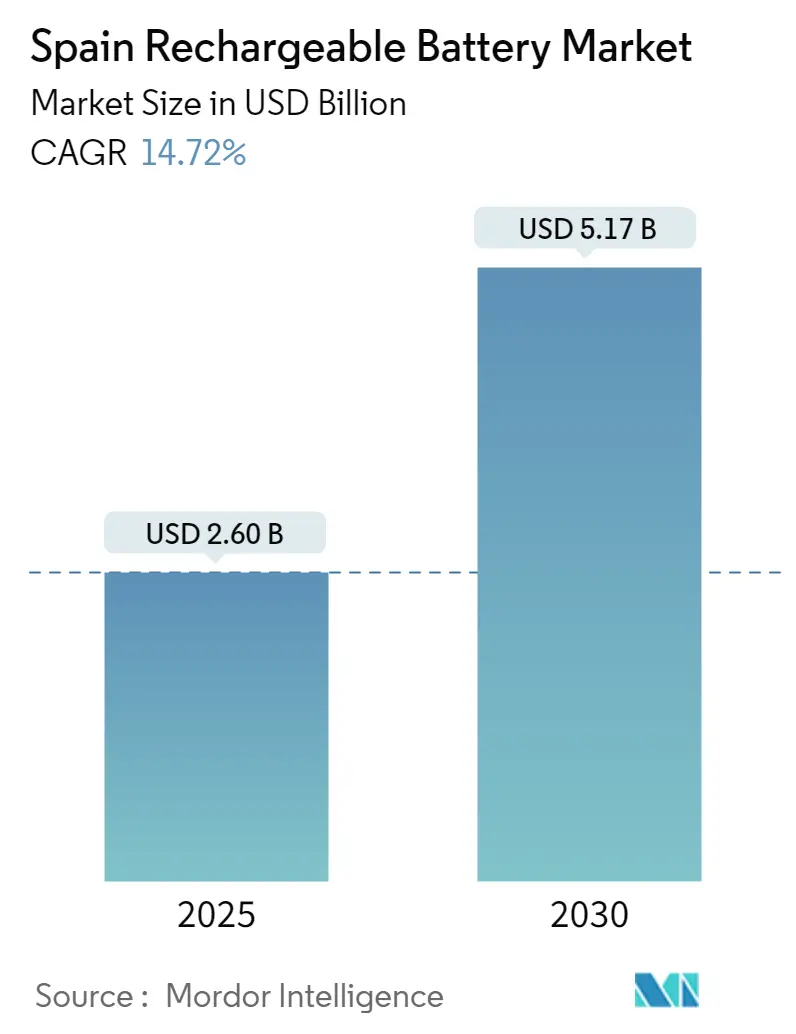
The Spain Rechargeable Battery Market size is estimated at USD 2.60 billion in 2025, and is expected to reach USD 5.17 billion by 2030, at a CAGR of 14.72% during the forecast period (2025-2030).
- Over the medium term, the declining lithium-ion battery prices, increasing adoption of electric vehicles, and the growing renewable energy sector aided by government initiatives are expected to drive the Spain rechargeable battery market during the forecast period.
- On the other hand, the demand-supply mismatch of raw materials, and the safety issues related to battery technologies are expected to hinder the market's growth during the forecast period.
- Nevertheless, the growing progress in developing new battery technologies and advanced battery chemistries will likely create opportunities for the Spain rechargeable battery market.
National developments in Spain connect differently with activity unfolding across other parts of the world. In the global rechargeable battery market coverage, Mordor Intelligence integrates these into a single analytical framework.
Spain Rechargeable Battery Market Trends and Insights
Lithium-ion Battery to be the Fastest Growing
- Among various battery technologies, lithium-ion batteries (LIBs) are poised to dominate the rechargeable battery market, experiencing rapid growth during the forecast period. Their rising popularity over other battery types can be attributed to their superior capacity-to-weight ratio, extended shelf life, reduced maintenance needs, and declining prices.
- Li-ion batteries boast distinct technical advantages over traditional lead-acid batteries. For instance, while lead-acid batteries offer a lifespan of approximately 400-500 cycles, rechargeable Li-ion batteries can exceed 5,000 cycles. Moreover, Li-ion batteries require less frequent maintenance and replacement. They also maintain consistent voltage throughout their discharge cycle, ensuring prolonged efficiency for connected electrical components.
- In recent years, major industry players have ramped up investments in R&D and production to enhance lithium-ion battery performance, intensifying competition and driving down prices. Due to technological advancements, manufacturing optimizations, and falling raw material costs, the average price of lithium-ion batteries plummeted from USD 780/kWh in 2013 to USD 139/kWh in 2023. Projections suggest a further decline to around USD 113/kWh by 2025 and USD 80/kWh by 2030, making lithium-ion batteries an increasingly attractive option.
- Historically, lithium-ion batteries powered consumer electronics like mobile phones and laptops. However, their application has expanded to include hybrids, fully electric vehicles (BEVs), and battery energy storage systems (BESS) in the renewable energy sector.
- In early 2022, the Volkswagen Group, in collaboration with partners, announced plans for a lithium-ion battery gigafactory in Sagunto, near Valencia. This location was strategically selected to supply battery cells to nearby EV plants in Martorell and Pamplona. The project, with an estimated cost of USD 3.25 billion, aims for an annual production capacity of 40 GWh. Construction commenced in Q1 2023, with production slated to begin in 2026. This gigafactory will be Volkswagen's third, joining existing sites in Sweden and Germany. Furthermore, the group envisions establishing six additional 40 GWh gigafactories across Europe, targeting a cumulative capacity of 240 GWh by 2030.
- Recognizing the importance of sustainable practices, Spain has seen a surge in lithium-ion battery recycling initiatives. Safe recycling not only conserves essential minerals but also presents a sustainable alternative to disposal. In July 2023, South Korean battery recycling specialist SungEel HiTech partnered with Spain's BeePlanet Factory to form a consortium focused on reusing and recycling lithium-ion batteries from electric vehicles.
- This consortium, named BeeCycle, will kick off its operations by constructing a recycling plant in Caparroso (Navarre). Set to commence in 2025, the facility will handle batteries at the end of their life cycle and scrap from battery cell manufacturing. With a processing capacity of 10,000 tonnes annually, it aims to produce 'black mass' – a crushed metal composite from batteries – equivalent to the output of 25,000 cars per year.
- In April 2023, Glencore, FCC Ámbito, and Iberdrola announced a collaborative effort to establish large-scale lithium-ion battery recycling solutions in Spain. Their goal is to address the pressing challenge of lithium-ion battery recycling by setting up a dedicated facility that offers both second-life repurposing and end-of-life recycling solutions.
- Given their lightweight nature, rapid charging capabilities, extended charging cycles, decreasing costs, and advancements in the industry, lithium-ion batteries are set to become the fastest-growing battery technology in Spain's rechargeable battery market during the forecast period.


Increasing Adoption of Electric Vehicles To Drive the Market
- Spain's rechargeable battery market, especially for lithium-ion batteries, is set to surge, driven by the country's accelerating adoption of electric vehicles (EVs). Recent data from the International Energy Agency (IEA) highlights this trend: BEV sales in Spain jumped to approximately 57,000 units in 2023, marking a 72% increase from 33,000 units in 2022. Additionally, PEV sales reached around 65,000 units in 2023. This uptick in EV adoption signals a corresponding rise in demand for rechargeable batteries in Spain.
- In 2023, BEV stocks in Spain hit about 160,000 units, a notable 66% increase from 96,000 in 2022. Meanwhile, PEV stocks grew by 50%, reaching around 200,000 units. Despite this growth, Spain's total vehicle stock falls short of the government's ambitious target of 5.5 million electric vehicles by 2030. This gap underscores a robust future demand for rechargeable batteries.
- Spain has become a focal point for EV players in recent years. Notably, in April 2024, Ebro-EV Motors and Chery Automobile forged a joint venture in Barcelona, marking Chery as the first Chinese automaker to produce in Europe, utilizing Ebro's former Nissan plant.
- In another significant move, EV supplier Mobis, in April 2024, unveiled plans for a USD 128 million investment in Navarre, Spain. This investment aims to establish Western Europe's inaugural electrification-dedicated plant. Navarre, strategically located at Spain's northern tip bordering France, offers a gateway into mainland Europe. Mobis, hailing from Seoul, boasts battery system production facilities across Korea, China, and the Czech Republic, with additional plants underway in the U.S. and Indonesia.
- Set to commence mass production in 2026, Mobis' Spanish facility aims for an ambitious output of 360,000 annual battery system assemblies (BSA). These assemblies, crucial for EV efficiency and safety, integrate electronic components and the Battery Management System (BMS). In a strategic move, Mobis clinched a significant BSA contract with Volkswagen in 2023. The BSAs from the new plant are destined for Volkswagen's next-gen EV platforms, set to be produced in Pamplona.
- Given these developments, Spain's rechargeable battery market is poised for growth, driven by the nation's evolving EV landscape.


Mordor Intelligence's coverage of the rechargeable battery market extends across other regions including Europe, Asia, and Middle East and Africa, while country-specific intelligence is also available for Italy, Sweden, China, Netherlands, Norway, and Japan, each offering a view on the jurisdiction-level dynamics as applicable.
Competitive Landscape
The Spain rechargeable battery market is semi-fragmented. Some of the key players in the market (not in any particular order) include Panasonic Corporation, BYD Company Ltd., AESC Group Ltd., Samsung SDI Co. Ltd., and LG Energy Solution Ltd.
Spain Rechargeable Battery Industry Leaders
Panasonic Corporation
BYD Company Ltd
AESC Group Ltd.
Samsung SDI Co. Ltd.
LG Energy Solution Ltd.
- *Disclaimer: Major Players sorted in no particular order


Recent Industry Developments
- December 2023: Volkswagen has unveiled its intention to establish a battery factory in Sagunt, Spain, kicking off with an investment exceeding USD 3.25 billion. This figure has the potential to escalate to USD 4.9 billion in a subsequent phase. This endeavor is a segment of Volkswagen's ambitious "Future: fast forward" initiative, which earmarks a total of USD 10.9 billion for investments in Spain. The primary objective is to propel the electrification efforts at VW's plants located in Landaben (Navarra) and Martorell (Barcelona). Once operational, the envisioned Gigafactory in Sagunt is projected to achieve an annual production capacity of 40 GWh, sufficient to manufacture batteries for approximately 800,000 electric vehicles each year. If all goes as planned, the factory could commence its initial production as soon as 2026.
- January 2024: Iberdrola, a leading player in the global renewable energy arena, has unveiled its ambitious plan to establish six Battery Energy Storage Systems (BESS) across Spain, boasting a total capacity of 150 MW. Each of these state-of-the-art batteries is designed to deliver 25 MW of power, complemented by a robust 50 MWh capacity. Strategically, the projects are set to unfold in regions including Castilla y León, Extremadura, Castilla La Mancha, and Andalusia. Harnessing cutting-edge lithium-ion technology, these batteries will be seamlessly integrated as hybrid systems, predominantly powered by solar energy. Notably, these initiatives have garnered the prestigious designation of Strategic Projects for Economic Recovery and Transformation (PERTE), securing a substantial funding boost of USD 37.5 million.


Spain Rechargeable Battery Market Report Scope
Rechargeable batteries are energy storage devices designed to be refill with electrical power after use, enabling multiple cycles of discharge and recharge. Unlike disposable batteries, which are single-use and must be replaced once depleted, rechargeable batteries can be reused numerous times, making them more cost-effective and environmentally friendly. These batteries come in various chemistries such as lithium-ion, nickel-metal hydride, and lead-acid, each offering different performance characteristics suited for various applications ranging from small electronic devices to electric vehicles.
The Spain rechargeable battery market is segmented into Technology and Application. By technology, the market is segmented into lead-acid, lithium-ion, and other technologies (NiMh, Nicd, etc). By application, the market is segmented into automotive batteries, industrial batteries (motive, stationary (telecom, UPS, energy storage systems (ESS), etc.), portable batteries (consumer electronics, etc.) and other applications. The report offers the market size and forecasts for the market in revenue for all the above segments.
| Lead-Acid |
| Lithium-Ion |
| Other Technologies (NiMh, Nicd, etc.) |
| Automotive Batteries |
| Industrial Batteries (Motive, Stationary (Telecom, UPS, Energy Storage Systems (ESS), etc.) |
| Portable Batteries (Consumer Electronics, etc.) |
| Other Applications |
| Technology | Lead-Acid |
| Lithium-Ion | |
| Other Technologies (NiMh, Nicd, etc.) | |
| Application | Automotive Batteries |
| Industrial Batteries (Motive, Stationary (Telecom, UPS, Energy Storage Systems (ESS), etc.) | |
| Portable Batteries (Consumer Electronics, etc.) | |
| Other Applications |


Key Questions Answered in the Report
How big is the Spain Rechargeable Battery Market?
The Spain Rechargeable Battery Market size is expected to reach USD 2.60 billion in 2025 and grow at a CAGR of 14.72% to reach USD 5.17 billion by 2030.
What is the current Spain Rechargeable Battery Market size?
In 2025, the Spain Rechargeable Battery Market size is expected to reach USD 2.60 billion.
Who are the key players in Spain Rechargeable Battery Market?
Panasonic Corporation, BYD Company Ltd, AESC Group Ltd., Samsung SDI Co. Ltd. and LG Energy Solution Ltd. are the major companies operating in the Spain Rechargeable Battery Market.
What years does this Spain Rechargeable Battery Market cover, and what was the market size in 2024?
In 2024, the Spain Rechargeable Battery Market size was estimated at USD 2.22 billion. The report covers the Spain Rechargeable Battery Market historical market size for years: 2019, 2020, 2021, 2022, 2023 and 2024. The report also forecasts the Spain Rechargeable Battery Market size for years: 2025, 2026, 2027, 2028, 2029 and 2030.
Page last updated on:
Spain Rechargeable Battery Market Report
Statistics for the 2025 Spain Rechargeable Battery market share, size and revenue growth rate, created by Mordor Intelligence™ Industry Reports. Spain Rechargeable Battery analysis includes a market forecast outlook for 2025 to 2030 and historical overview. Get a sample of this industry analysis as a free report PDF download.


 Your data is secure and never sold or shared.


