
Sweden Rechargeable Battery Market Size and Share
| Study Period | 2019 - 2030 |
| Forecast Data Period | 2025 - 2030 |
| Historical Data Period | 2019 - 2023 |
| Market Size (2025) | USD 1.64 Billion |
| Market Size (2030) | USD 3.08 Billion |
| CAGR (2025 - 2030) | 13.36% |
| Market Concentration | Low |
Major Players *Disclaimer: Major Players sorted in no particular order |
Sweden Rechargeable Battery Market Analysis by Mordor Intelligence
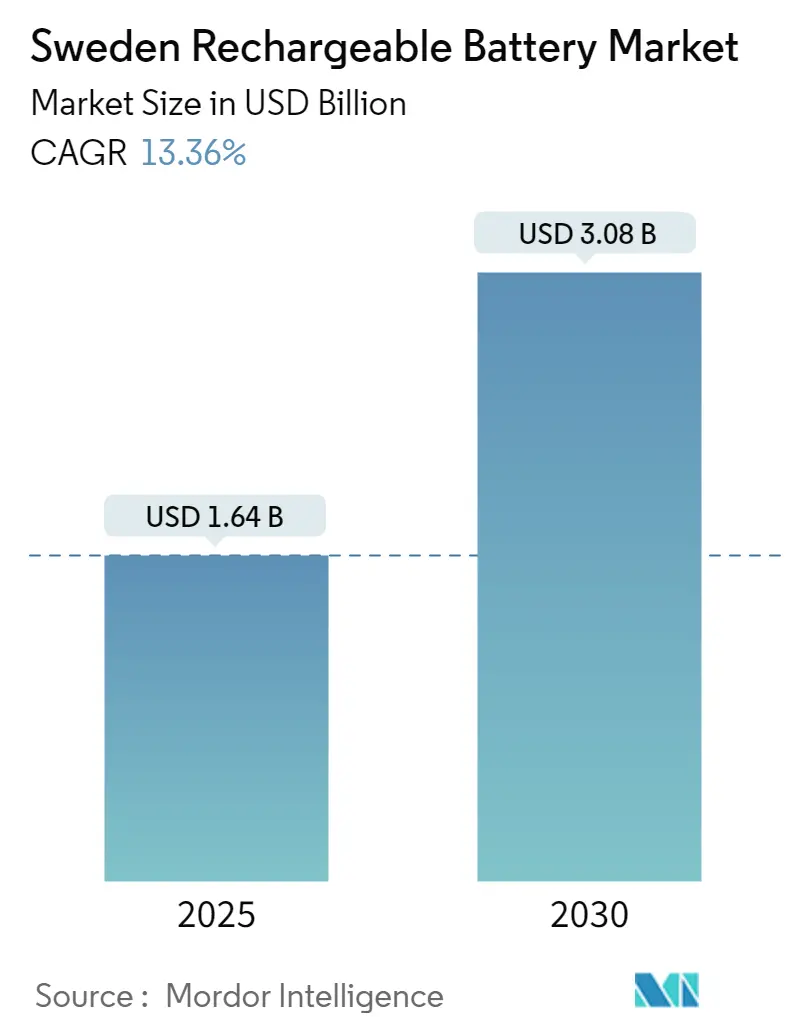
The Sweden Rechargeable Battery Market size is estimated at USD 1.64 billion in 2025, and is expected to reach USD 3.08 billion by 2030, at a CAGR of 13.36% during the forecast period (2025-2030).
- Over the medium term, factors such as increasing demand for consumer electronics coupled with rising penetration of solar and wind energies are expected to be among the most significant drivers for the Sweden Rechargeable Battery Market during the forecast period.
- On the other hand, the supply chain constraints for battery procurement are high. This poses a threat to the Sweden Rechargeable Battery Market during the forecast period.
- Nevertheless, continued advancements in energy density, charging cycles, and energy hold-up led to more efficient rechargeable batteries. This factor is expected to create several opportunities for the market in the future.
Sweden participates in a competitive field that extends beyond its own borders. The market landscape in the global rechargeable battery industry outlined by Mordor Intelligence covers that wider structure.
Sweden Rechargeable Battery Market Trends and Insights
Lithium-ion Battery Expected to Witness Growth
- In recent years, Sweden has increasingly committed to clean energy technologies, positioning itself as a European leader in this domain. This commitment has made lithium-ion batteries a preferred choice across various sectors, including automotive and consumer electronics.
- Moreover, Sweden's automotive industry is leading the charge in adopting lithium-ion battery technology. As the focus shifts towards electric and hybrid vehicles, automakers are increasingly relying on these high-performance batteries. The advantages of lithium-ion batteries, such as their superior energy density, extended lifecycle, and swift charging capabilities, make them the go-to choice for electric vehicles (EVs), facilitating longer driving ranges and an enhanced user experience.
- In recent years, declining prices of lithium-ion batteries and cell packs have made them more appealing to end-user industries. After a brief uptick in 2022, battery prices resumed their downward trend in 2023. Notably, the cost of lithium-ion battery packs plummeted by 14%, hitting a historic low of USD 139/kWh. This price drop is largely due to reductions in raw material and component costs, alongside an expansion in production capacity throughout the battery value chain.
- Furthermore, Sweden's consumer electronics sector has seen a notable shift, with a rising demand for portable devices like smartphones, laptops, and tablets. These devices, heavily reliant on rechargeable batteries, have increasingly adopted lithium-ion technology as the industry standard, thanks to its superior performance and compact design.
- For instance, in November 2023, Hitachi Energy announced plans to expand its production facilities in Smedjebacken and Ludvika, both located in Dalarna, Sweden. Construction of the new factory is set to kick off in the coming months, with operations expected to start by late 2024. This new facility will be adjacent to an existing Hitachi Energy site, established in August 2022. Moreover, the expansion efforts in Ludvika are slated to begin before the year concludes, with a completion target set for early 2025. Such expansion initiatives are likely to bolster the domestic production capacity of rechargeable lithium-ion batteries in Sweden, potentially enhancing their availability and affordability.
- Given these developments, lithium-ion battery types are poised for significant growth in the coming years.

Growing Demand for Electric Vehicles To Drive The Market
- Electric vehicle (EV) sales are set to play a crucial role in propelling the growth of Sweden's rechargeable battery market. As Sweden strides towards a greener future, its automotive sector is leading the charge in the electrification movement. With Swedish consumers increasingly adopting EVs, the automotive landscape is undergoing a notable transformation.
- Data from the International Energy Agency highlights a significant uptick in EV sales in Sweden. Sales surged over 14.58% from 2022 to 2023, and impressively, they skyrocketed nearly sevenfold from 2019 to 2023, underscoring the rising popularity of electric vehicles.
- To hasten the shift to electric vehicles, the Swedish government has rolled out an extensive array of policies and incentives. These initiatives, ranging from generous tax breaks and subsidies to the establishment of a comprehensive charging infrastructure, have cultivated a welcoming atmosphere for both consumers and businesses to adopt electric mobility.
- For example, in January 2024, the Swedish government introduced several incentives. Battery Electric Vehicles (BEVs) and Plug-in Hybrid Electric Vehicles (PHEVs) benefit from a reduced Road tax of SEK 360. Additionally, for charging infrastructure, there's a 50% tax deduction (capped at SEK 15,000) for home charging setups, and grants are available for charging installations in residential complexes.
- Consequently, there's been a marked surge in demand for high-capacity, durable rechargeable batteries, propelling the growth of Sweden's battery market. Furthermore, Sweden's dedication to its ambitious climate objectives has intensified the push towards sustainable transportation, further energizing the electrification of its transport sector.
- Given these dynamics, it's anticipated that the rising EV sales will continue to fuel the rechargeable battery market in Sweden in the coming years.

Mordor Intelligence provides coverage of the rechargeable battery market across other key regional markets, including Europe, South America, and North America, each with their regulatory frameworks and demand patterns. Detailed country-level analysis extends to Norway, Denmark, United States, South Korea, China, and Germany incorporating local coverage and market participation, as required.
Competitive Landscape
The Sweden Rechargeable Battery Market is semi-fragmented. Some of the key players in this market (in no particular order) are BYD Co. Ltd., Contemporary Amperex Technology Co. Ltd., Exide Industries, Panasonic Corporation, and GS Yuasa Corporation.
Sweden Rechargeable Battery Industry Leaders
-
BYD Co. Ltd
-
Contemporary Amperex Technology Co. Ltd.
-
Exide Industries
-
Panasonic Corporation
-
GS Yuasa Corporation
- *Disclaimer: Major Players sorted in no particular order

Recent Industry Developments
- May 2024: Researchers at Linköping University in Sweden have unveiled a cost-effective and eco-friendly battery solution. This innovative battery, crafted from zinc and lignin, boasts an impressive lifespan exceeding 8,000 cycles. The primary goal is to provide a sustainable and budget-friendly energy storage alternative. Significantly, this battery can hold its charge for about a week, marking a substantial enhancement over conventional zinc-based batteries that usually discharge in just a few hours.
- November 2023: Northvolt, a Swedish battery manufacturer, has unveiled an innovative sodium-ion cell technology, setting the stage for a ramp-up in rechargeable battery production in the years ahead. Northvolt's sodium-ion batteries, in contrast to conventional lithium-based counterparts, do away with lithium, cobalt, and platinum, tackling both cost and environmental challenges. Although Northvolt's sodium-ion cells boast an energy density of 160 watt-hour/kilogram (Wh/kg)—a tad below the 180 to 250 Wh/kg range of standard lithium-ion batteries—the advancement marks a pivotal move towards eco-friendly energy storage solutions.
Sweden Rechargeable Battery Market Report Scope
A rechargeable battery is a type of battery that can be charged multiple times by passing an electric current through it in the opposite direction of its discharge. This allows the battery to be reused, reducing waste and cost compared to single-use, disposable batteries.
The Sweden Rechargeable Battery Market is segmented into Technology and Application. By technology, the market is segmented into lead-acid, lithium-ion, and other technologies (NiMh, Nicd, etc). By application, the market is segmented into automotive batteries, industrial batteries (motive, stationary (telecom, UPS, energy storage systems (ESS), etc.), portable batteries (consumer electronics, etc.), and other applications. The report offers the market size and forecasts for the revenue (USD) for all the above segments.
| Lead Acid |
| Lithium-Ion |
| Others (NiMh, Nicd, etc.) |
| Automotive Batteries |
| Industrial Batteries (Motive, Stationary (Telecom, UPS, Energy Storage Systems (ESS), etc.) |
| Portable Batteries (Consumer Electronics, etc.) |
| Other Applications |
| Technology | Lead Acid |
| Lithium-Ion | |
| Others (NiMh, Nicd, etc.) | |
| Applications | Automotive Batteries |
| Industrial Batteries (Motive, Stationary (Telecom, UPS, Energy Storage Systems (ESS), etc.) | |
| Portable Batteries (Consumer Electronics, etc.) | |
| Other Applications |
Key Questions Answered in the Report
How big is the Sweden Rechargeable Battery Market?
The Sweden Rechargeable Battery Market size is expected to reach USD 1.64 billion in 2025 and grow at a CAGR of 13.36% to reach USD 3.08 billion by 2030.
What is the current Sweden Rechargeable Battery Market size?
In 2025, the Sweden Rechargeable Battery Market size is expected to reach USD 1.64 billion.
Who are the key players in Sweden Rechargeable Battery Market?
BYD Co. Ltd, Contemporary Amperex Technology Co. Ltd., Exide Industries, Panasonic Corporation and GS Yuasa Corporation are the major companies operating in the Sweden Rechargeable Battery Market.
What years does this Sweden Rechargeable Battery Market cover, and what was the market size in 2024?
In 2024, the Sweden Rechargeable Battery Market size was estimated at USD 1.42 billion. The report covers the Sweden Rechargeable Battery Market historical market size for years: 2019, 2020, 2021, 2022, 2023 and 2024. The report also forecasts the Sweden Rechargeable Battery Market size for years: 2025, 2026, 2027, 2028, 2029 and 2030.
Sweden Rechargeable Battery Market Report
Statistics for the 2025 Sweden Rechargeable Battery market share, size and revenue growth rate, created by Mordor Intelligence™ Industry Reports. Sweden Rechargeable Battery analysis includes a market forecast outlook for 2025 to 2030 and historical overview. Get a sample of this industry analysis as a free report PDF download.