
Japan Rechargeable Battery Market Size and Share
| Study Period | 2019 - 2030 |
| Forecast Data Period | 2025 - 2030 |
| Historical Data Period | 2019 - 2023 |
| Market Size (2025) | USD 3.29 Billion |
| Market Size (2030) | USD 6.83 Billion |
| CAGR (2025 - 2030) | 15.75% |
| Market Concentration | Low |
Major Players *Disclaimer: Major Players sorted in no particular order |
Japan Rechargeable Battery Market Analysis by Mordor Intelligence
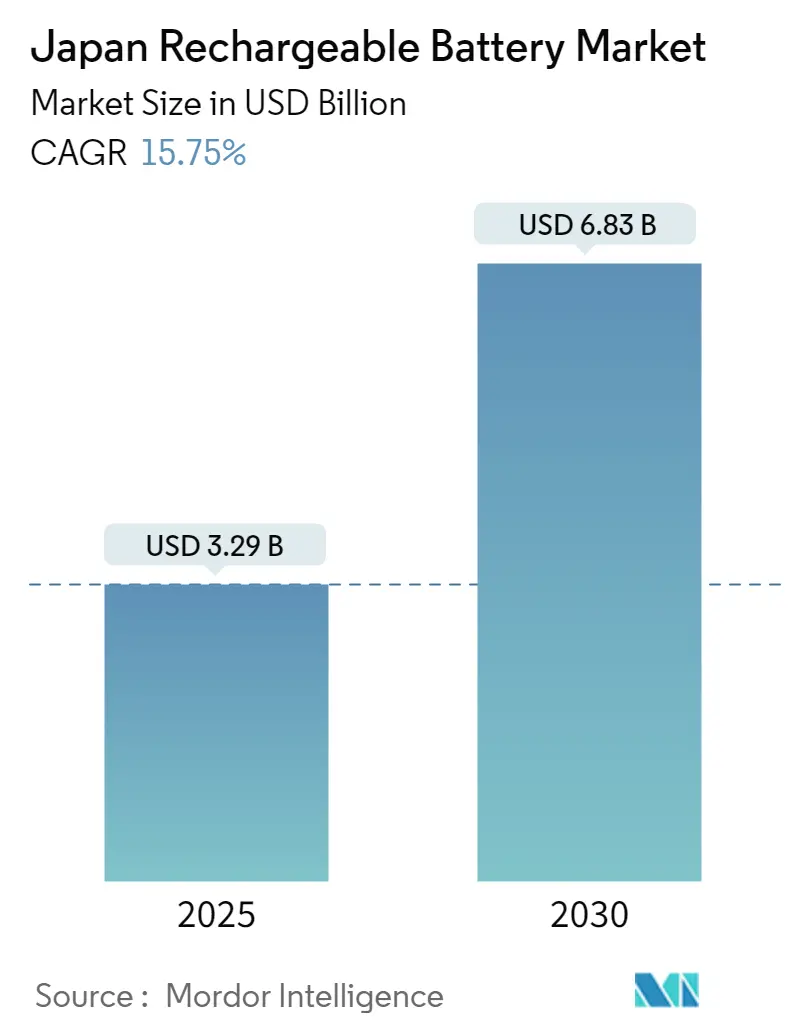
The Japan Rechargeable Battery Market size is estimated at USD 3.29 billion in 2025, and is expected to reach USD 6.83 billion by 2030, at a CAGR of 15.75% during the forecast period (2025-2030).
- Over the medium term, rising electric vehicle (EV) production and declining lithium-ion battery prices are expected to drive the demand for rechargeable batteries during the forecast period.
- On the other hand, the lack of raw material reserves can significantly restrain the growth of the Japan rechargeable battery market.
- Nevertheless, the growing adoption of wearable devices like smartwatches, wireless earphones, smart bands, and more are expected to create significant opportunities for rechargeable battery market players in the near future.
Understanding the full system requires moving beyond Japan boundaries into a wider international view. Mordor Intelligence captures the global rechargeable battery market scope in its worldwide coverage.
Japan Rechargeable Battery Market Trends and Insights
Lithium-Ion Battery Type Dominate the Market
- Lithium-ion rechargeable batteries, known for their numerous advantages, find extensive applications across various sectors. These batteries have emerged as a trusted and efficient solution for electrical energy storage. One of their standout features is their high energy density, allowing them to pack substantial power into a compact and lightweight form.
- Japan's lithium-ion rechargeable battery market is a dynamic arena, brimming with both opportunities and challenges. Thanks to their favorable capacity-to-weight ratio, lithium-ion batteries are outpacing other technologies in popularity. While lithium-ion batteries typically come with a premium price tag compared to their counterparts, leading market players are heavily investing in R&D and scaling up operations. This intensified competition has not only enhanced battery performance but also contributed to a downward trend in lithium-ion battery prices.
- In 2023, driven by rising average battery pack prices in electric vehicles (EVs) and battery energy storage systems (BESS), battery prices saw a notable dip, settling at USD 139/kWh—a drop of over 13%. With the ramp-up of extraction and refining capacities, lithium prices are projected to stabilize, aiming for USD 100/kWh by 2026.
- Central to many Battery Energy Storage Systems (BESS), lithium-ion batteries are prized for their high energy density, rapid charging, and extended cycle life. These attributes make them exceptionally suited for efficient energy storage and release in BESS applications. Companies in Japan are actively pursuing projects to bolster BESS in the upcoming years.
- As a case in point, in August 2023, Power X, a prominent Japanese battery manufacturer, teamed up with West Holdings, a local renewable energy developer. Their joint venture aims to roll out battery storage systems and solar power facilities nationwide. Targeting a spring 2025 completion, the duo plans to achieve a storage capacity of 200MWh and a solar output of 30MW. This initiative not only promises to bolster regional storage systems but also addresses the surging energy demand, subsequently driving up the need for lithium-ion rechargeable batteries.
- Japan's commitment to renewable energy, particularly solar and wind, underscores the pivotal role of lithium-ion batteries. These batteries are essential for harnessing and storing surplus energy from renewables, ensuring consistent power supply despite weather variations.
- Solar energy, among all sources, is set to take center stage. Japan's ambition to boost its solar capacity to nearly 108 GW by 2030, as part of its strategy to reduce nuclear energy reliance, signals a burgeoning demand for lithium-ion batteries in the near future.
- Given these projects and initiatives, the demand for lithium-ion rechargeable batteries is poised for an upswing in the coming years.


Automobile Segment to Witness Significant Growth
- For a long time, vehicles with internal combustion engines (ICE) dominated the roads. However, as environmental concerns grow, there's a noticeable shift towards electric vehicles (EVs). Predominantly, EVs utilize lithium-ion rechargeable batteries, celebrated for their high energy density, lightweight nature, minimal self-discharge, and low maintenance needs.
- Plug-in hybrids and electric vehicles are powered by lithium-ion battery systems. Thanks to their rapid recharge capability and high energy density, lithium-ion batteries stand out as the sole technology meeting OEM demands for driving range and charging time. In contrast, lead-based traction batteries fall short for full hybrids or EVs, given their heftier weight and lower specific energy.
- Japan has seen a remarkable surge in electric vehicle adoption recently. In 2023, the International Energy Agency (IEA) reported sales of 140,000 electric vehicles, marking a 44.3% increase from 2022. Projections indicate a significant uptick in EV sales across the region in the coming years.
- To champion electric vehicles and renewable energy, the Japanese government has rolled out a suite of policies and incentives. These initiatives have bolstered the demand for lithium-ion batteries. In 2023, the government unveiled ambitious plans to ramp up EV production and expedite the journey to zero carbon emissions.
- Japan's government introduced the Electrified Vehicle Strategy 2050, targeting a complete transition to EVs for all vehicles produced by Japanese automakers by 2050. Additionally, under Japan’s EV Charging Infrastructure Landscape, Tokyo Electric Power Company Holdings is set to increase rapid highway chargers to 1,000 units by 2025.
- Moreover, as the global community pivots towards sustainability, Japan is wholeheartedly embracing this electric revolution. The Tokyo government aims to amplify public charging points from 30,000 to 150,000 by 2030. With these concerted efforts, Japan is poised to boost EV production and, consequently, the demand for lithium-ion batteries.
- Given these proactive measures, it's anticipated that EV sales and charging infrastructure will flourish in the region, subsequently driving up the demand for rechargeable batteries in the forecast period.


Mordor Intelligence examines the rechargeable battery market across diverse other regional markets as well, including Europe, North America, and Asia, while also offering granular country-level perspectives for China, India, United Kingdom, United States, Romania, and Spain and more.
Competitive Landscape
The Japan rechargeable Battery is semi-fragmented. Some of the key players (not in particular order) are BYD Company Ltd, Duracell Inc., Exide Industries Ltd, EnerSys, and Panasonic Holdings Corporation, among others.
Japan Rechargeable Battery Industry Leaders
Duracell Inc.
BYD Company Ltd
Exide Industries Ltd
EnerSys
Panasonic Holdings Corporation
- *Disclaimer: Major Players sorted in no particular order


Recent Industry Developments
- October 2023: Japan has harnessed a chemical commonly used in cosmetics to develop next-generation rechargeable batteries. Titanium oxide, a key ingredient in sunscreen, soaps, and cosmetics, emerges as a promising solution to challenges faced in the production of advanced batteries, including solid-state and sodium-ion variants.
- June 2023: Researchers in Japan have developed a rechargeable all-solid-state air battery. This innovative battery utilizes a proton-conductive polymer electrolyte paired with a redox-active organic negative electrode. Impressively, these batteries operate near their theoretical maximum capacity.


Japan Rechargeable Battery Market Report Scope
Rechargeable batteries, also known as secondary batteries, are energy storage devices that can be recharged and reused multiple times. They play a crucial role in various applications, from consumer electronics to renewable energy storage. Rechargeable Batteries are widely used in smartphones, laptops, electric vehicles (EVs), and energy storage systems due to their high energy density and long cycle life.
The Japan rechargeable battery market is is segmented into Technology and Application. By technology, the market is segmented into lead-acid, lithium-ion, and other technologies (NiMh, Nicd, etc). By application, the market is segmented into automotive batteries, industrial batteries (motive, stationary (telecom, UPS, energy storage systems (ESS), etc.), portable batteries (consumer electronics, etc.) and other applications. The report offers the market size and forecasts for the market in revenue for all the above segments.
| Lithium-ion Battery |
| Lead-Acid Battery |
| Other Technologies (NiMh, Nicd, etc.) |
| Automotive Batteries |
| Industrial Batteries (Motive, Stationary (Telecom, UPS, Energy Storage Systems (ESS), etc.) |
| Portable Batteries (Consumer Electronics, etc.) |
| Other Applications |
| Battery Type | Lithium-ion Battery |
| Lead-Acid Battery | |
| Other Technologies (NiMh, Nicd, etc.) | |
| Application | Automotive Batteries |
| Industrial Batteries (Motive, Stationary (Telecom, UPS, Energy Storage Systems (ESS), etc.) | |
| Portable Batteries (Consumer Electronics, etc.) | |
| Other Applications |


Key Questions Answered in the Report
How big is the Japan Rechargeable Battery Market?
The Japan Rechargeable Battery Market size is expected to reach USD 3.29 billion in 2025 and grow at a CAGR of 15.75% to reach USD 6.83 billion by 2030.
What is the current Japan Rechargeable Battery Market size?
In 2025, the Japan Rechargeable Battery Market size is expected to reach USD 3.29 billion.
Who are the key players in Japan Rechargeable Battery Market?
Duracell Inc., BYD Company Ltd, Exide Industries Ltd, EnerSys and Panasonic Holdings Corporation are the major companies operating in the Japan Rechargeable Battery Market.
What years does this Japan Rechargeable Battery Market cover, and what was the market size in 2024?
In 2024, the Japan Rechargeable Battery Market size was estimated at USD 2.77 billion. The report covers the Japan Rechargeable Battery Market historical market size for years: 2019, 2020, 2021, 2022, 2023 and 2024. The report also forecasts the Japan Rechargeable Battery Market size for years: 2025, 2026, 2027, 2028, 2029 and 2030.
Page last updated on:
Japan Rechargeable Battery Market Report
Statistics for the 2025 Japan Rechargeable Battery market share, size and revenue growth rate, created by Mordor Intelligence™ Industry Reports. Japan Rechargeable Battery analysis includes a market forecast outlook for 2025 to 2030 and historical overview. Get a sample of this industry analysis as a free report PDF download.





