
Netherlands Rechargeable Battery Market Size and Share
| Study Period | 2019 - 2030 |
| Forecast Data Period | 2025 - 2030 |
| Historical Data Period | 2019 - 2023 |
| Market Size (2025) | USD 1.10 Billion |
| Market Size (2030) | USD 2.04 Billion |
| CAGR (2025 - 2030) | 13.19% |
| Market Concentration | Low |
Major Players *Disclaimer: Major Players sorted in no particular order |
Netherlands Rechargeable Battery Market Analysis by Mordor Intelligence
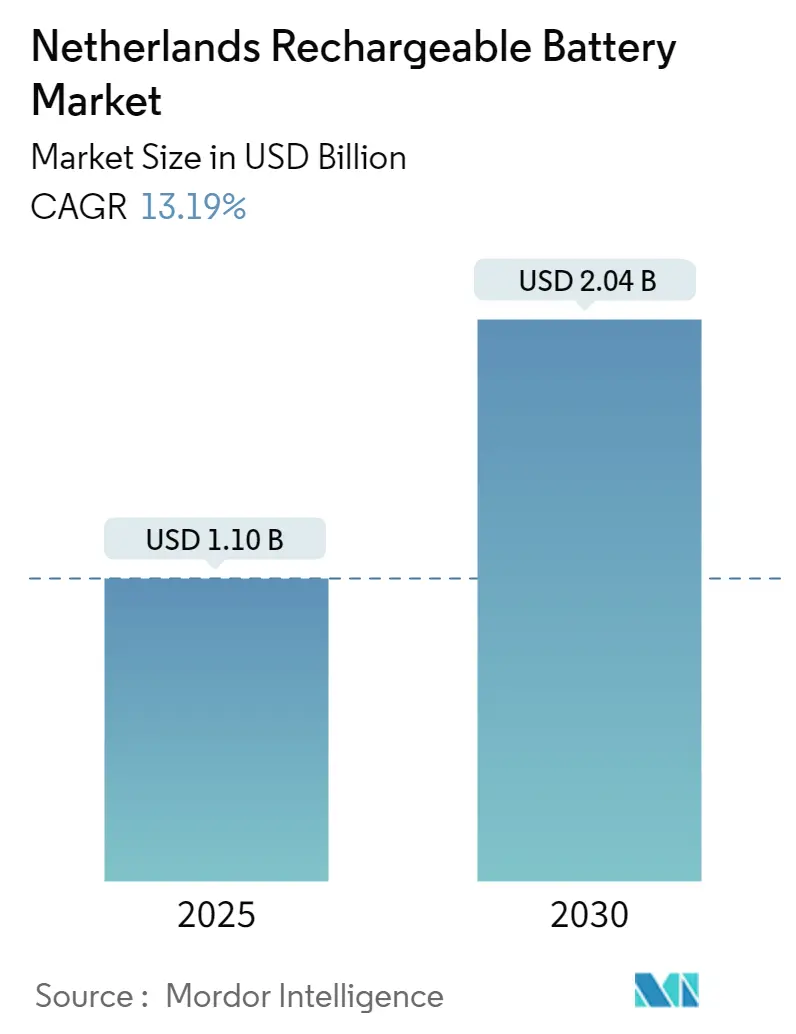
The Netherlands Rechargeable Battery Market size is estimated at USD 1.10 billion in 2025, and is expected to reach USD 2.04 billion by 2030, at a CAGR of 13.19% during the forecast period (2025-2030).
- Over the medium term, rising electric vehicle (EV) production and declining lithium-ion battery prices are expected to drive the demand for rechargeable batteries during the forecast period.
- On the other hand, the lack of raw material reserves can significantly restrain the growth of the Netherlands rechargeable battery market.
- Nevertheless, the growing adoption of wearable devices like smartwatches, wireless earphones, smart bands, and more are expected to create significant opportunities for rechargeable battery market players in the near future
Projections can easily extend beyond country and regional trends as they are defined by movement across the full international system. Mordor Intelligence's worldwide rechargeable battery market outlook captures this forward trajectory.
Netherlands Rechargeable Battery Market Trends and Insights
Lithium-Ion Battery Type Dominate the Market
- Lithium-ion rechargeable batteries, celebrated for their myriad advantages, find extensive application across diverse sectors. These batteries have emerged as a trusted and efficient solution for electrical energy storage. One of their standout features is their high energy density, allowing them to pack substantial power into a compact and lightweight form.
- The lithium-ion rechargeable battery market in the Netherlands is a dynamic arena, brimming with both opportunities and challenges. Thanks to their superior capacity-to-weight ratio, lithium-ion batteries are outpacing other technologies in popularity. While lithium-ion batteries typically command a premium price compared to their counterparts, leading market players are heavily investing in R&D and scaling operations. This intensified competition has not only bolstered battery performance but also contributed to a downward trend in lithium-ion battery prices.
- In 2023, driven by rising average prices in electric vehicle (EV) battery packs and battery energy storage systems (BESS), battery prices saw a notable dip, settling at USD 139/kWh, marking a decline of over 13%. With an anticipated boost in extraction and refining capacities, lithium prices are projected to stabilize, aiming for USD 100/kWh by 2026.
- The Netherlands, championing the transition to renewable energy and electric mobility, has seen its lithium-ion battery market evolve in tandem. As the nation increasingly harnesses renewable sources like solar and wind, the demand for energy storage solutions has surged. Lithium-ion batteries, pivotal in energy storage systems, are instrumental in capturing surplus renewable energy.
- For example, in February 2024, RWE, a leading multinational utility and independent power producer (IPP), broke ground on the Netherlands' inaugural utility-scale battery storage project. Boasting a power capacity of 35 megawatts (MW) and a storage capability of 41 megawatt-hours (MWh), RWE plans to integrate 110 lithium-ion battery racks, with operations set to commence by 2025. Such initiatives are poised to bolster the demand for lithium-ion batteries in the foreseeable future.
- Moreover, the Dutch government has been proactive, channeling substantial investments into renewable energy projects in recent years. These batteries are vital in harnessing and storing surplus energy from renewables, guaranteeing a consistent power supply, even amidst fluctuating weather conditions.
- In a notable move, the Dutch government, in July 2023, unveiled a EUR 412 million investment in a solar energy initiative. This investment aligns with the government's ambitious vision, projecting the nation's solar capacity to leap from 18GWp in 2022 to a staggering 100-250GWp by 2050.
- Given these undertakings and financial commitments, the Netherlands is set to amplify its renewable energy output, concurrently driving up the demand for lithium-ion rechargeable batteries in the coming years.

Automobile Segment to Witness Significant Growth
- For a long time, vehicles with internal combustion engines (ICE) dominated the automotive landscape. However, as environmental concerns grow, there's a noticeable shift towards electric vehicles (EVs). Predominantly, EVs utilize lithium-ion rechargeable batteries, favored for their high energy density, lightweight nature, low self-discharge rates, and minimal maintenance needs.
- Plug-in hybrids and electric vehicles rely on lithium-ion battery systems. Their high energy density, rapid recharge capability, and robust discharge power make lithium-ion batteries the sole technology meeting OEM standards for driving range and charging time. In contrast, lead-based traction batteries fall short for full hybrid or electric vehicles due to their lower energy efficiency and added weight.
- In recent years, the Netherlands has seen a remarkable surge in electric vehicle adoption. Data from the International Energy Agency (IEA) indicates that in 2023, electric vehicle sales reached 210,000, marking a 53.3% increase from 2022. Projections suggest a continued upward trajectory for EV sales in the region.
- To bolster the adoption of electric vehicles and renewable energy, the Dutch government has rolled out a series of policies and incentives. These initiatives have, in turn, spurred demand for lithium-ion batteries. For instance, in 2023, the government introduced subsidies of EUR 4,000 for new EV purchases or leases and EUR 2,000 for used ones. Additionally, there's a full exemption from the Motor Vehicle Tax (MRB) until 2024, followed by a 75% discount extending to 2025. Such incentives are poised to further accelerate the region's EV growth.
- As the global community pivots towards a greener future, the Netherlands is championing this electric revolution, not only by promoting EV usage but also by heavily investing in charging infrastructure. Major companies in the region are actively setting up this infrastructure to bolster EV adoption.
- For example, in March 2024, a consortium comprising Vattenfall InCharge (a Swedish energy firm), Shell Ubitricity, and TotalEnergies (a French utility giant) announced plans to install and oversee 35,000 public charging points across the Netherlands. This ambitious roll-out, commencing soon, aims for completion by 2028.
- Given these concerted efforts and initiatives, it's anticipated that EV sales will soar, charging infrastructure will expand, and the demand for rechargeable batteries will witness a significant uptick in the coming years.

The rechargeable battery market is analyzed by Mordor Intelligence across multiple other geographies, with in-depth regional assessments available for Europe, North America, and Asia. This is complemented by country-specific insights for Denmark, Germany, United States, China, South Korea, and Romania, reflecting various localized market behavior and policy environments' coverage.
Competitive Landscape
The Netherlands rechargeable battery market is semi-fragmented. Some of the key players (not in particular order) are BYD Company Ltd, Duracell Inc., Exide Industries Ltd, EnerSys, and Panasonic Holdings Corporation, among others.
Netherlands Rechargeable Battery Industry Leaders
-
BYD Company Ltd
-
Duracell Inc.
-
Exide Industries Ltd
-
EnerSys
-
Panasonic Holdings Corporation
- *Disclaimer: Major Players sorted in no particular order

Recent Industry Developments
- April 2024: The government of the Netherlands has allocated USD 109 million in subsidies for the installation of battery storage alongside solar installations for the upcoming year. Set to commence in January 2025, the program will run until 2034. This funding is part of a broader USD 453 million subsidy package announced in 2023.
- March 2024: LeydenJar, a Dutch manufacturer and developer of batteries, has revealed plans to establish its inaugural battery production facility in Eindhoven, Netherlands. The company aims to kick off production in 2026, all while working on crafting the world's most energy-dense battery.
Netherlands Rechargeable Battery Market Report Scope
Rechargeable batteries, also known as secondary batteries, are energy storage devices that can be recharged and reused multiple times. They play a crucial role in various applications, from consumer electronics to renewable energy storage. Rechargeable Batteries are widely used in smartphones, laptops, electric vehicles (EVs), and energy storage systems due to their high energy density and long cycle life.
The Netherlands rechargeable battery market is segmented into Technology and Application. By technology, the market is segmented into lead-acid, lithium-ion, and other technologies (NiMh, Nicd, etc). By application, the market is segmented into automotive batteries, industrial batteries (motive, stationary (telecom, UPS, energy storage systems (ESS), etc.), portable batteries (consumer electronics, etc.) and other applications. The report offers the market size and forecasts for the market in revenue for all the above segments.
| Lithium-ion Battery |
| Lead-Acid Battery |
| Other Technologies (NiMh, NiCd, etc.) |
| Automotive Batteries |
| Industrial Batteries (Motive, Stationary (Telecom, UPS, Energy Storage Systems (ESS), etc.) |
| Portable Batteries (Consumer Electronics, etc.) |
| Other Applications |
| Battery Type | Lithium-ion Battery |
| Lead-Acid Battery | |
| Other Technologies (NiMh, NiCd, etc.) | |
| Application | Automotive Batteries |
| Industrial Batteries (Motive, Stationary (Telecom, UPS, Energy Storage Systems (ESS), etc.) | |
| Portable Batteries (Consumer Electronics, etc.) | |
| Other Applications |
Key Questions Answered in the Report
How big is the Netherlands Rechargeable Battery Market?
The Netherlands Rechargeable Battery Market size is expected to reach USD 1.10 billion in 2025 and grow at a CAGR of 13.19% to reach USD 2.04 billion by 2030.
What is the current Netherlands Rechargeable Battery Market size?
In 2025, the Netherlands Rechargeable Battery Market size is expected to reach USD 1.10 billion.
Who are the key players in Netherlands Rechargeable Battery Market?
BYD Company Ltd, Duracell Inc., Exide Industries Ltd, EnerSys and Panasonic Holdings Corporation are the major companies operating in the Netherlands Rechargeable Battery Market.
What years does this Netherlands Rechargeable Battery Market cover, and what was the market size in 2024?
In 2024, the Netherlands Rechargeable Battery Market size was estimated at USD 0.95 billion. The report covers the Netherlands Rechargeable Battery Market historical market size for years: 2019, 2020, 2021, 2022, 2023 and 2024. The report also forecasts the Netherlands Rechargeable Battery Market size for years: 2025, 2026, 2027, 2028, 2029 and 2030.
Netherlands Rechargeable Battery Market Report
Statistics for the 2025 Netherlands Rechargeable Battery market share, size and revenue growth rate, created by Mordor Intelligence™ Industry Reports. Netherlands Rechargeable Battery analysis includes a market forecast outlook for 2025 to 2030 and historical overview. Get a sample of this industry analysis as a free report PDF download.