
United States Lime Market Analysis by Mordor Intelligence
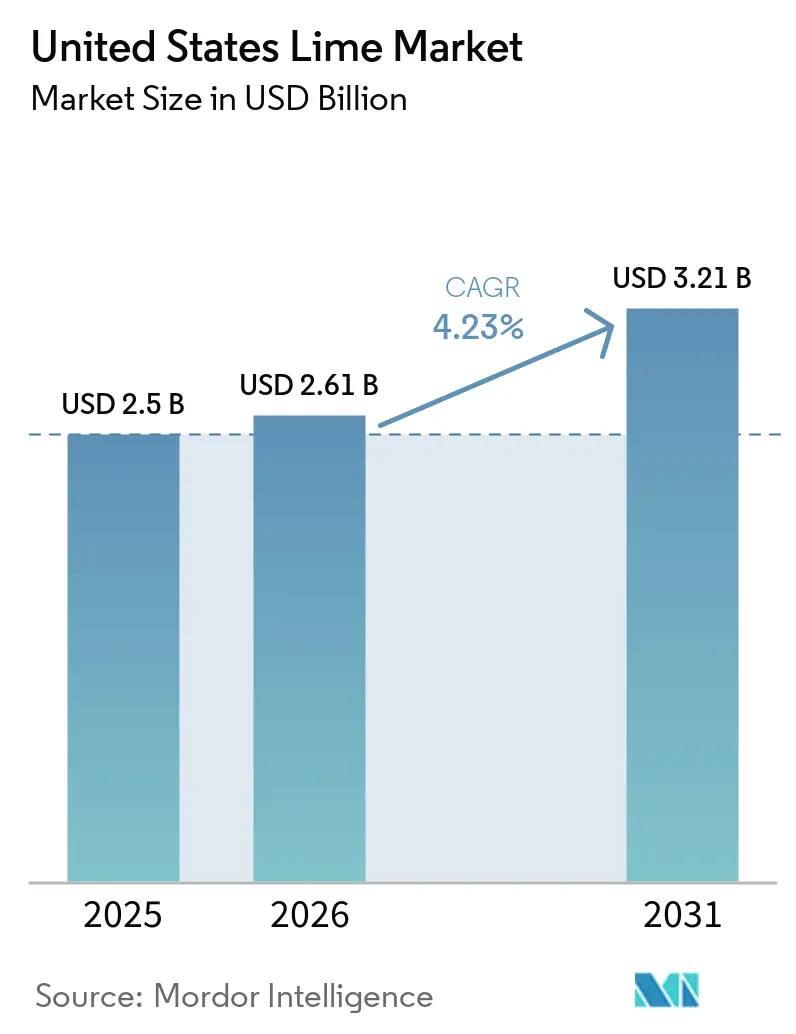
The United States lime market size was valued at USD 2.50 billion in 2025 and is estimated to grow from USD 2.61 billion in 2026 to reach USD 3.21 billion by 2031, at a CAGR of 4.23% during the forecast period 2026 to 2031. The United States lime market has moved well beyond a narrow ethnic-produce niche and now sits firmly inside daily retail, packaged food, beverage, and foodservice demand patterns. Demand is rising because lime has become a routine ingredient in low-sugar drinks, quick-service menus, cocktail programs, and year-round home cooking, broadening volume support across seasons. The supply side remains the main pressure point because the United States lime market still depends heavily on imports, with Mexico holding the clear lead and Colombia adding a useful but still limited second source for offseason continuity. Competitive advantage now rests less on retail branding and more on origin access, packing consistency, and cold-chain reach across multiple supply corridors. A further shift could emerge if Hawaii gains easier mainland access under the current federal review, because even modest domestic optionality would give West Coast buyers another supply path and add some pricing discipline to the United States lime market.
Key Report Takeaways
- United States lime imports are projected to increase marginally to 970,000 metric tons in 2025-2026, marking the fourth consecutive year of growth. This rise is attributed to the continued expansion of imports from emerging suppliers such as Colombia and Peru.
Note: Market size and forecast figures in this report are generated using Mordor Intelligence’s proprietary estimation framework, updated with the latest available data and insights as of 2026.
United States Lime Market Trends and Insights
Drivers Impact Analysis*
| Driver | (~) % Impact on CAGR Forecast | Geographic Relevance | Impact Timeline |
|---|---|---|---|
| Low-sugar beverage reformulation favors lime flavor | +0.8% | National, above-average in Western and Southern metro markets | Medium term (2-4 years) |
| Hispanic menu growth lifts everyday lime usage | +1.0% | National, concentrated in California, Texas, Florida, and the Southwest | Long term (≥ 4 years) |
| Cocktail and foodservice recovery lifts fresh-squeeze demand | +0.7% | National, strongest in metropolitan markets and tourism-intensive states | Short term (≤ 2 years) |
| Premium pricing supports orchard renewal and agronomy investment | +0.5% | Mexico, Colombia, and Southern California | Long term (≥ 4 years) |
| Colombia and Peru reduce offseason stockouts | +0.4% | Eastern ports and Midwest distribution hubs | Medium term (2-4 years) |
| Potential Hawaii mainland access expands domestic supply optionality | +0.3% | Western United States and Pacific Coast markets | Long term (≥ 4 years) |
| Source: Mordor Intelligence | |||
Low-Sugar Beverage Reformulation Favors Lime Flavor
Reduced-sugar beverage reformulation has made lime more important because it helps hold taste balance when sugar content falls. That role is especially relevant in sparkling drinks, electrolyte beverages, and functional waters where tartness supports a cleaner finish. As more brands lean on stevia and monk fruit, lime has become a dependable flavor anchor rather than a seasonal accent. This matters to the United States lime market because derivative demand from juice concentrates and natural flavor systems adds another layer of consumption beyond fresh produce sales. It also gives importers and processors a broader demand base that can soften some seasonal swings in distributor purchasing.
Hispanic Menu Growth Lifts Everyday Lime Usage
Everyday lime use has widened as Hispanic food moves further into mainstream restaurant and retail formats. Dishes that once sat mainly in specialist outlets now appear in fast-casual chains, grocery meal kits, and general restaurant menus, which raises routine lime usage across a larger customer base. The shift is not limited to one demographic group because younger consumers increasingly treat lime as a normal ingredient in tacos, seafood, grilled foods, and fresh drinks. This has helped the United States lime market move toward steadier weekly consumption rather than narrow holiday spikes. Over time, that pattern supports a more durable demand floor because repeat household use becomes less dependent on seasonal occasions.
Cocktail and Foodservice Recovery Lifts Fresh-Squeeze Demand
The foodservice rebound has favored fresh lime because higher-end beverage programs now place more value on ingredient quality. Many bars and restaurants have moved away from reconstituted juice and now specify fresh-squeezed product for cocktails and mixed drinks. Once purchasing teams and bartenders reset those standards, it becomes difficult to move backward without affecting customer experience. United States fresh lime import volumes reached 1.70 billion pounds in 2024, up 9% year over year, while per-capita fresh-weight availability reached 7 pounds (3.18 kgs) per person, which shows how strong fresh demand has become across channels[1]. This has also strengthened demand for Persian lime because buyers value its larger juice yield and seedless profile in high-volume service environments.
Premium Pricing Supports Orchard Renewal and Agronomy Investment
Premium pricing gives growers and exporters a reason to reinvest in orchard care, irrigation, and post-harvest handling. That incentive is especially important in supply chains where fruit quality determines whether shipments clear export channels or fall back into local sales. The United States lime market benefits when higher returns support better field practices because more consistent fruit means fewer disruptions for importers and retailers. Over time, these investments can improve delivered quality, even if reliability still takes longer to stabilize than total output.
Restraints Impact Analysis*
| Restraint | (~) % Impact on CAGR Forecast | Geographic Relevance | Impact Timeline |
|---|---|---|---|
| Mexican supply shocks drive price volatility | -0.8% | National, most acute at Texas, Arizona, and California entry points | Short term (≤ 2 years) |
| Citrus greening and weather stress limit United States orchard scaling | -0.6% | Florida, Southern California, and Hawaii | Long term (≥ 4 years) |
| Tariff and border-policy uncertainty complicates sourcing plans | -0.6% | National, highest impact on Colombia, Peru, and Guatemala sourcing | Medium term (2-4 years) |
| Colombian quality variability raises rejection and sorting costs | -0.4% | Eastern ports and importers using Colombian offseason volumes | Short term (≤ 2 years) |
| Source: Mordor Intelligence | |||
Mexican Supply Shocks Drive Price Volatility
The United States lime market faces significant risk due to heavy reliance on Mexico. Disruptions from weather, logistics, or security issues in Mexico quickly impact wholesale, retail, and foodservice pricing. Criminal cartel activity in Michoacán, which produced over 1 million metric tons of lime in 2024 (SIAP), adds further disruption beyond conventional supply chain monitoring. United States buyers are forced to maintain costly South American backup supplies, even during periods of Mexican abundance, as Colombia and Peru lack Mexico's scale. This creates sharp supply fluctuations, complicating planning for downstream customers.
Citrus Greening and Weather Stress Limit United States Orchard Scaling
Domestic orchard expansion remains limited because disease pressure and climate stress continue to narrow the practical scope for large-scale production. In Florida, Huanglongbing, also known as citrus greening, has significantly impacted the conditions required to rebuild a viable Persian lime base. Additionally, federal movement controls continue to regulate how citrus materials can be transported across states as of 2026[2]. California faces a different problem because water costs, recurring drought risk, and the high cost of organic compliance reduce the likelihood of broad, conventional-scale adoption. Hawaii offers potential, but its role still depends on the outcome of the current federal review. Taken together, these limits mean domestic acreage is unlikely to materially reduce import dependence during the forecast period.
*Our forecasts treat driver/restraint impacts as directional, not additive. The impact forecasts reflect baseline growth, mix effects, and variable interactions.
Geography Analysis
In the United States, the West and South remain the largest consumption regions in 2025, driven by strong Hispanic food traditions, warm-weather dining preferences, and proximity to major import routes. The Northeast is the fastest-rising consumption corridor as restaurant demand and urban retail adoption continue to expand. Domestic production geography is still marginal, but Hawaii has become the most important domestic watchpoint because the current federal review could reopen mainland access for Persian lime under a systems approach. If that rule moves forward, Hawaii would matter most to Pacific distribution hubs rather than to East Coast import corridors.
Mexico is keeping it at the center of the United States lime market and maintaining its market share by origin. Veracruz and Michoacán remain the most important export-producing areas because they anchor the cross-border flow into Texas, Arizona, and California. This geography matters because the market’s logistics still begin outside the United States, not within it. Inspection and phytosanitary compliance, therefore, shape the market as much as farm output does. In practical terms, the geography of supply remains a map of imported production corridors first, and domestic distribution lanes second.
Colombia held the largest secondary-source position and its Atlantic-facing corridor has become the fastest-growing supplement during offseason windows. Florida ports play an outsized role in this trade by reducing transit times and helping preserve arrival quality. Colombia’s January to April 2025 exports to the United States reached USD 38.5 million, which shows how strongly that route now supports East Coast replenishment[3]. Peru adds another useful geographic layer because its northern growing zones strengthen winter supply options. These South American corridors do not replace Mexico, but they matter more each year because they reduce the depth of seasonal shortages.
Competitive Landscape
The United States lime market is moderately concentrated at the importer and distributor level while remaining fragmented across growers and packing operations in origin countries in 2025. Competitive advantage is driven primarily by sourcing scale, multi-origin procurement, and reliable cold-chain logistics rather than by consumer-facing brand strength. Wonderful Citrus reflects this structure through its extensive citrus-growing, packing, and distribution network across the United States. This network supports supply reliability during periods of market volatility.
Fresh Del Monte Produce strengthened its year-round supply of limes and avocados through a joint venture with Managro Group and the expansion of production infrastructure in Palmira, Colombia. Limoneira also integrated its fresh citrus sales and marketing operations with Sunkist Growers beginning in late 2025. This integration expanded distribution reach across retail and foodservice channels. These developments show that competitive positioning in the United States lime market increasingly depends on supply continuity, logistics execution, and distribution scale rather than on price competition alone.
Growth opportunities remain strongest in premium-certified fruit, foodservice-grade Persian limes, and East Coast cold-chain distribution networks. Smaller specialized importers and distributors can still compete effectively through strong regional relationships and expertise in specific sourcing corridors. At the same time, companies with established Mexican-origin sourcing programs continue to benefit from logistical advantages and efficient supply-chain integration under North American trade structures. As a result, the United States lime market continues to reward companies that combine diversified sourcing, quality assurance, and disciplined logistics within integrated operating models.
Recent Industry Developments
- June 2025: The United States has established trade agreements with Thailand and Vietnam, enhancing market access for fruit exporters, including lime producers. These agreements permit citrus fruits from Arizona, such as limes, to be packaged in California facilities prior to export to Thailand, thereby improving operational efficiency and expanding market opportunities.
- June 2025: Sunkist Growers, Inc. has announced that Limoneira Company, one of its original founding members, will integrate its fresh citrus sales and marketing operations into the Sunkist cooperative network. This merger is projected to result in annual cost savings and an improvement in earnings before interest, taxes, depreciation, and amortization (EBITDA) of USD 5 million, starting in fiscal year 2026. The transaction aims to enhance Sunkist's citrus distribution across foodservice and retail customer channels.
- January 2025: The United States Department of Agriculture (USDA) has increased its specialty crop support program to USD 2.65 billion. This expansion benefits lime producers by reducing marketing and transportation costs associated with perishability and packaging.
United States Lime Market Report Scope
Lime is a small, lemon-shaped, greenish-yellow citrus fruit with a juicy, sour pulp, rich in ascorbic acid. It is primarily used for food and cosmetics. The study considers commercial lime fruit as a commodity.
The United States Lime Market Report Includes Production Analysis (Volume), Consumption Analysis (Value and Volume), Import Analysis (Value and Volume), Export Analysis (Value and Volume), Wholesale Price Trend Analysis and Forecast, List of Key Players, and More. The Market Forecasts are Provided in Terms of Value (USD) and Volume (Metric Tons).
United States
| Production Analysis | Production Volume | Area Harvested and Yield | |
| Consumption Analysis (Value and Volume) | |||
| Trade Analysis (Value and Volume) | Import Market Analysis | Import Value and Volume | |
| Key Supplying Markets | |||
| Export Market Analysis | Export Value and Volume | ||
| Key Destinations Markets | |||
| Wholesale Price Trend Analysis and Forecast | |||
| Regulatory Framework | |||
| Logistic and Infrastructure | |||
| Seasonality Analysis | |||
| United States | Production Analysis | Production Volume | Area Harvested and Yield | |
| Consumption Analysis (Value and Volume) | ||||
| Trade Analysis (Value and Volume) | Import Market Analysis | Import Value and Volume | ||
| Key Supplying Markets | ||||
| Export Market Analysis | Export Value and Volume | |||
| Key Destinations Markets | ||||
| Wholesale Price Trend Analysis and Forecast | ||||
| Regulatory Framework | ||||
| Logistic and Infrastructure | ||||
| Seasonality Analysis | ||||
Key Questions Answered in the Report
What is the current outlook for the United States lime market?
The United States lime market is valued at USD 2.61 billion in 2026 and is forecast to reach USD 3.21 billion by 2031, growing at a 4.23% CAGR over 2026 to 2031.
Which factor is expanding demand the fastest in daily use?
Daily use is broadening through low-sugar beverages, mainstream Hispanic menu adoption, and fresh-squeeze foodservice demand, which together make lime a more regular purchase.
Can the United States reduce import dependence soon?
Not in a major way during the forecast period. Hawaii offers a possible new domestic supply path, but large-scale mainland replacement of imports still looks limited.
What role does Colombia play in the supply chain?
Colombia is the largest secondary source and helps reduce offseason gaps, especially for East Coast buyers.
How are companies competing in this space?
The strongest companies are building advantage through multi-origin sourcing, packing capacity, cold-chain control, and strategic partnerships rather than through consumer branding alone.