
United States Heavy-Duty Truck Market Size and Share
Market Overview
| Study Period | 2019 - 2031 |
|---|---|
| Forecast Data Period | 2026 - 2031 |
| Base Year Market Size (2025) | USD 51.56 Billion |
| Market Size (2026) | USD 55.09 Billion |
| Market Size (2031) | USD 76.73 Billion |
| Growth Rate (2026 - 2031) | 6.85 % |
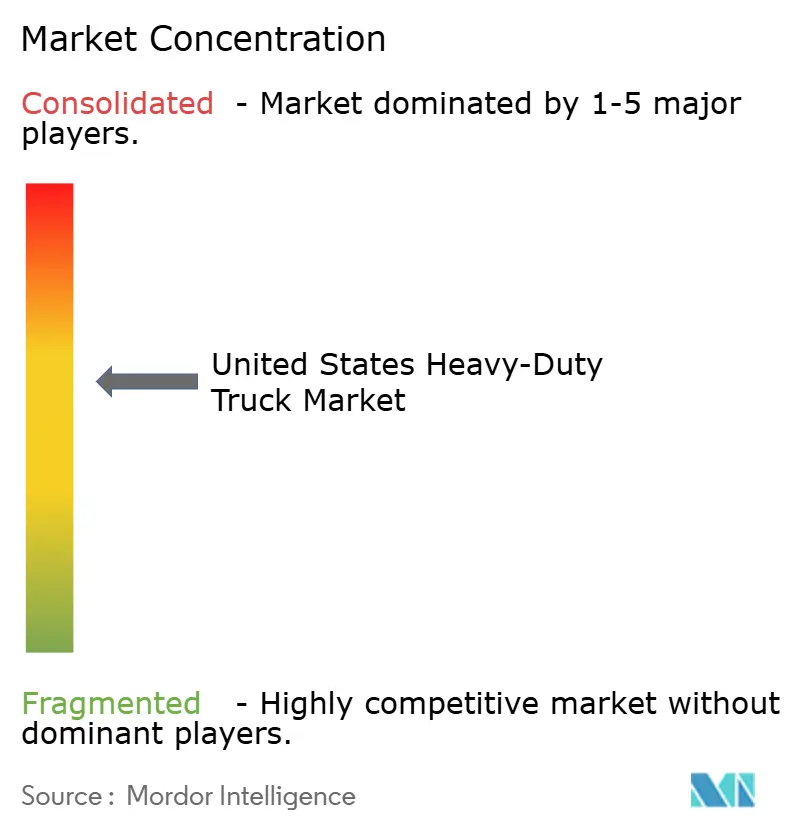
| Market Concentration | Medium |
Major Players *Disclaimer: Major Players sorted in no particular order Image © Mordor Intelligence. Reuse requires attribution under CC BY 4.0. | |
United States Heavy-Duty Truck Market Analysis by Mordor Intelligence
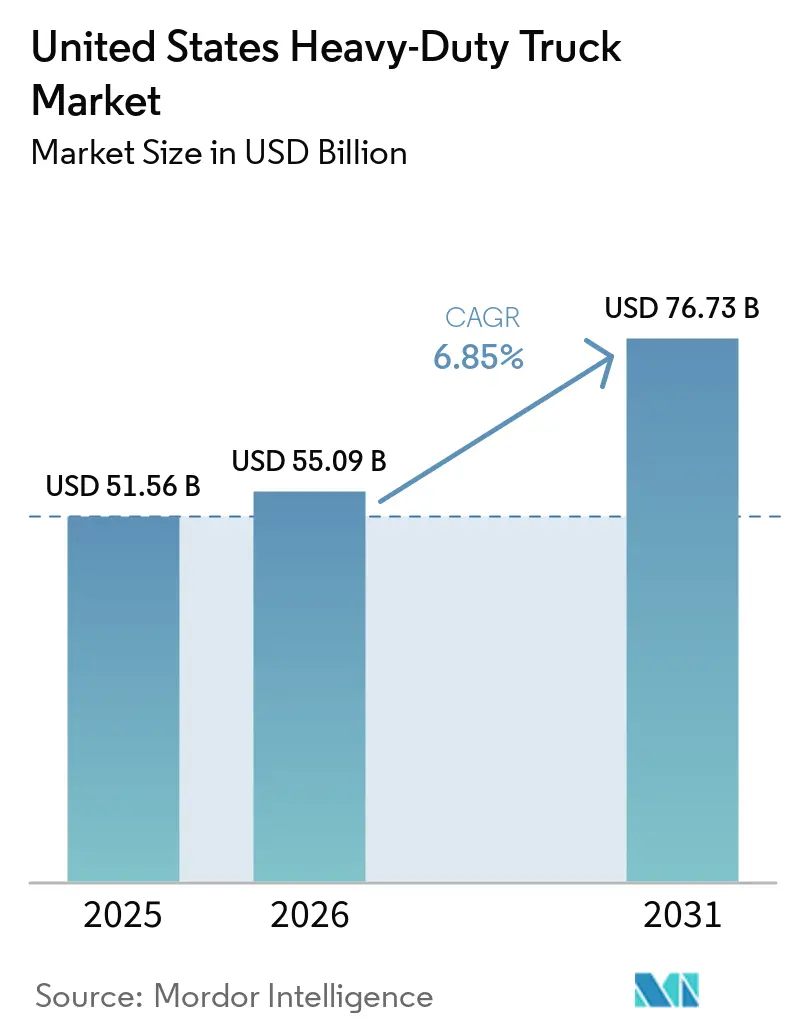
The United States heavy-duty truck market size was valued at USD 51.56 billion in 2025 and is estimated to grow from USD 55.09 billion in 2026 to reach USD 76.73 billion by 2031, at a CAGR of 6.85% during the forecast period (2026-2031). To sidestep upcoming nitrogen-oxide regulations, fleets hastened their diesel purchases. Simultaneously, battery-electric and fuel-cell initiatives are gaining momentum, marking the initial phase of a decade-long transition in power-trains. Funds from the Federal Infrastructure Investment and Jobs Act (IIJA) are channeling investments into port electrification and hydrogen-hub corridors[1]. However, utility interconnection queues are extending in multiple regional grids. While Class 8a tractors continue to dominate, configurations exceeding 80,000 lb are witnessing the fastest growth, driven by a surge in critical-minerals mining in the Mountain West. The competitive landscape is intensifying: Daimler, PACCAR, and Volvo command roughly two-thirds of registrations, while Tesla, Nikola, and a host of software-centric newcomers vie for a stake in the zero-emission and autonomous markets.
Key Report Takeaways
- By gross vehicle weight rating, Class 8a tractors captured 47.17% of the United States heavy-duty truck market in 2025, while trucks exceeding 80,000 lb are the fastest-growing class at a 9.45% CAGR.
- By propulsion, diesel maintained a 91.12% share in 2025, but battery-electric volumes are climbing at a 7.87% CAGR, driven by Tesla Semi production and state zero-emission mandates.
- By axle type, the 6x4 layout commanded 50.47% of the United States heavy-duty truck market share in 2025, whereas 6x2 variants are forecast to rise at a 7.88% CAGR to 2031.
- By truck type, articulated tractors led the United States heavy-duty truck market in 2025, accounting for 63.11% of the market, while rigid vocational chassis are set to grow at 7.95% per year as municipalities electrify refuse fleets.
- By application, freight and logistics captured 54.71% of 2025 demand, yet long-haul is advancing at an 8.12% CAGR, the fastest among all use cases.
Note: Market size and forecast figures in this report are generated using Mordor Intelligence’s proprietary estimation framework, updated with the latest available data and insights as of January 2026.
United states contributes to a system defined not by any single country or region but by the interaction of many. The global heavy duty trucks market data by Mordor Intelligence represents that combined structure.
United States Heavy-Duty Truck Market Trends and Insights
Drivers Impact Analysis*
| Driver | (~) % Impact on CAGR Forecast | Geographic Relevance | Impact Timeline |
|---|---|---|---|
| Infrastructure Investment and IIJA Stimulus | +2.8% | Nationwide, with concentrated benefits in Texas, California, Florida | Long term (≥ 4 years) |
| E-Commerce–Driven Freight Tonnage | +1.9% | West Coast ports, Southeast distribution hubs, Midwest logistics corridors | Medium term (2-4 years) |
| Pre-Buying Ahead of EPA 2027 | +1.7% | Manufacturing-heavy states: Michigan, Ohio, Indiana, North Carolina | Short term (≤ 2 years) |
| Critical-Minerals Boom | +1.4% | Nevada, Wyoming, Utah, Arizona mining regions | Long term (≥ 4 years) |
| Hydrogen-Hub Funding | +0.9% | Texas, California, Pacific Northwest, Northeast corridor | Medium term (2-4 years) |
| Autonomous-Ready Drayage | +0.8% | California, Texas, Georgia, New York port complexes | Long term (≥ 4 years) |
| Source: Mordor Intelligence | |||
Infrastructure Investment and IIJA Stimulus
Congress allocated significant funding for roads and bridges, as well as for zero-emission truck infrastructure. This funding is accelerating the replacement of weight-restricted spans and enabling higher-capacity configurations on rehabilitated corridors. Port authorities in Los Angeles, Savannah, and Houston matched these funds with local bonds, creating early demand clusters for battery-electric drayage tractors. Updated bridge-formula guidance now allows lighter tandems to carry increased payloads. This change is prompting fleets to downspec axles to save on fuel. State DOTs are accelerating pavement programs to obligate infrastructure dollars before deadlines, leading to a surge in concrete-mixer and dump-truck orders. However, Buy America rules have lengthened lead times for U.S.-assembled cabs and drivelines, causing some deliveries to shift to later timeframes.
E-Commerce–Driven Freight Tonnage Growth
Parcel and less-than-truckload tonnage grew, driven by retailers' efforts to position inventory closer to customers to uphold two-day delivery commitments. Amazon, with a large fleet of tractors, is transitioning a portion of its diesel linehaul to battery-electric Class 8 units. This move is pressuring competing carriers to experiment with similar zero-emission technologies. Both UPS and FedEx are leveraging telematics to minimize empty miles, thereby prolonging the lifespan of their current trucks and moderating the immediate need for replacements. Meanwhile, port drayage is experiencing a distinct surge. This is largely due to the California Advanced Clean Fleets mandate, which aims to accelerate significant adoption of zero-emission vehicles. This regulation is driving up orders for battery-electric and hydrogen trucks, even as congestion levels ease. Looking ahead, e-commerce is expected to create a substantial number of additional truck-driver roles. This anticipated shortfall is spurring heightened interest in autonomous and platooning technologies to maintain service standards.
Pre-Buying Ahead of EPA 2027 Standards
The EPA rolled out its Phase 3 engine regulations, mandating a significant reduction in nitrogen oxide emissions, effective for future model years[2]. In response, fleets secured a substantial number of Class 8 units in a single quarter, marking the highest bookings in recent years, as they rushed to lock in engines ahead of the new rules. OEMs cautioned that these compliant engines would come with a premium, prompting budget-conscious carriers to expedite their purchases. Cummins introduced the X15N, a natural-gas alternative that eliminates the need for diesel particulate filters. This move has piqued the interest of refuse and regional-haul operators, especially those with established CNG infrastructure. While robust backlogs are anticipated, there's speculation of a demand dip later, as fleets are likely to be saturated with a wave of pre-purchased trucks.
Critical-Minerals Boom Increasing Heavy-Haul Demand
Domestic lithium output is set to increase significantly, driven by new mines in Nevada’s Clayton Valley, North Carolina’s Kings Mountain, and Utah’s Great Salt Lake basin. Transporting battery-grade concentrate often necessitates heavy-duty trucks with high gross weights. This surge in demand has spotlighted super-heavy chassis, a niche market until recently. In response, Oshkosh and Mack introduced reinforced vocational frames tailored for these mines, successfully capturing market share from established brands. The Department of Energy’s Loan Programs Office has pledged substantial funding to new refining plants. Each of these sites will require dedicated tractors for efficient pit-to-plant shuttle operations. However, inconsistent permitting across state lines compels some fleets to transload at borders, inflating logistics costs and limiting broader deployment.
Restraints Impact Analysis*
| Restraint | (~) % Impact on CAGR Forecast | Geographic Relevance | Impact Timeline |
|---|---|---|---|
| Over-Capacity and High Inventory Levels | -1.6% | Nationwide, particularly acute in Texas, California freight corridors | Short term (≤ 2 years) |
| Elevated Interest Rates | -1.2% | Nationwide, with greater impact on smaller fleet operators | Medium term (2-4 years) |
| Utility-Grid Interconnection Delays | -0.7% | California, Texas, Northeast industrial corridors | Long term (≥ 4 years) |
| Interstate Permit Fragmentation | -0.5% | Western mining states, cross-border freight operations | Medium term (2-4 years) |
| Source: Mordor Intelligence | |||
Fleet Over-Capacity and High Inventory Levels
Lingering freight recession conditions have stretched to more than two years, pushing spot-rate indices below operating cost for many small carriers. Elevated used-truck volumes weigh on residual values, weakening equity available for trade-ins and delaying new-truck purchase decisions. The imbalance is particularly sharp in dry-van and refrigerated lanes where e-commerce volatility led to over-ordering in recent times. OEMs have responded by flexing build-rates and offering selective incentive programs targeted at large contract carriers. Although capacity discipline is gradually improving, near-term appetite for incremental equipment remains restrained until freight indices recover to profitable thresholds.
Elevated Interest Rates Raising Financing Costs
The Federal Reserve maintained its policy rate at elevated levels, leading commercial truck lease factors to reach their highest levels in over a decade [3]. As delinquencies among small carriers rose, PACCAR Financial and Daimler Truck Financial Services increased their credit-loss provisions. Zero-emission tractors, with capital costs significantly higher than diesel counterparts, face challenges: a substantial rate hike can push payback periods further, risking order cancellations. While fleets are shifting to operating leases—transferring residual-value risks to lessors like Ryder and Penske—demand remains dampened by elevated carrying costs. Projections indicate commercial lending rates will remain high for an extended period, further complicating financing even amid discussions of potential rate cuts.
*Our forecasts treat driver/restraint impacts as directional, not additive. The impact forecasts reflect baseline growth, mix effects, and variable interactions.
Segment Analysis
By Gross Vehicle Weight Rating: Super-Heavy Configurations Outpace the Core Class 8a Fleet
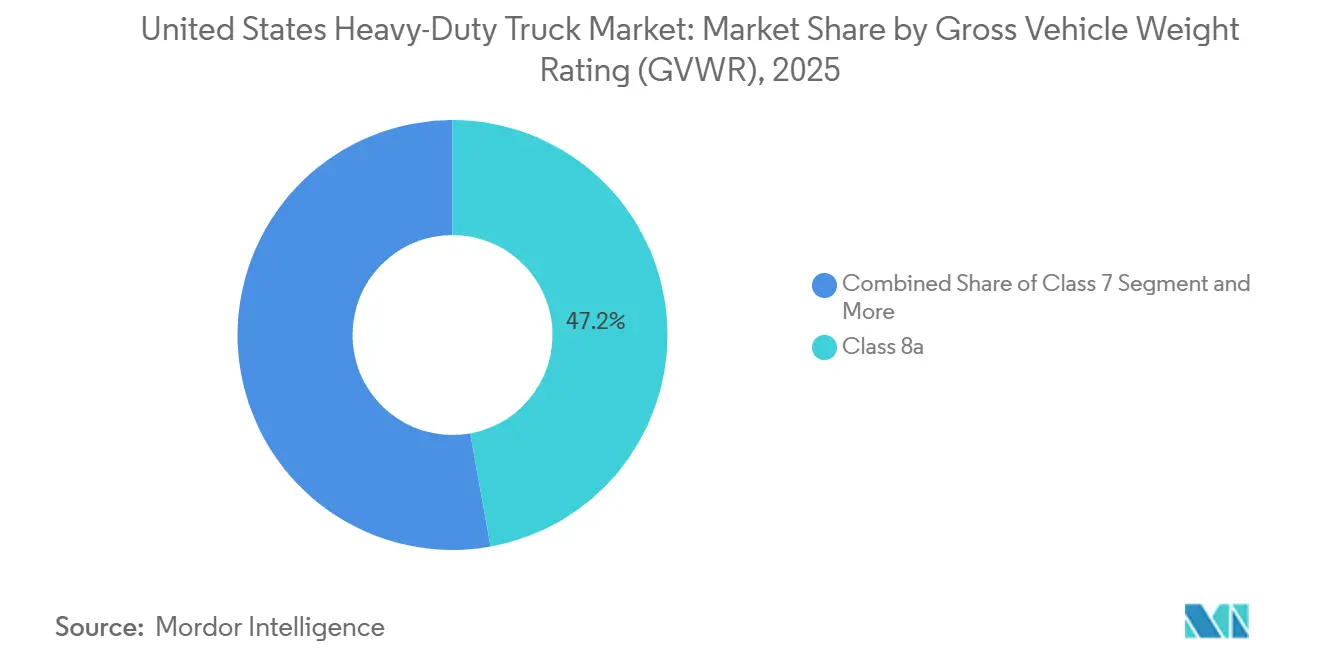
Class 8a tractors spanning 33,001-54,000 lb gross vehicle weight captured 47.17% of 2025 registrations, anchoring the United States heavy-duty truck market share because they balance payload capacity with interstate bridge-formula compliance. Trucks exceeding 80,000 lb are expanding at a 9.45% CAGR as lithium and rare-earth mining projects in Nevada, North Carolina, and Utah demand 8×6 and 8×8 drivetrains to haul battery-grade concentrate on unpaved haul roads. Class 8b units (54,001-80,000 lb) still serve long-haul freight but are ceding momentum to lighter 6×2 tandems that lower fuel burn on flat corridors. IIJA bridge-rehabilitation funds will permit higher axle weights on select corridors by 2028, letting fleets spec lighter frames without sacrificing legal payload.
Super-heavy growth remains hemmed in by fragmented oversize-overweight permits that force costly transloading at state borders and add 15-20% to logistics expense. Oshkosh and Mack have launched a reinforced chassis that withstands 120,000-lb gross weights, carving share from legacy vocational brands. Class 7 trucks (26,001-33,000 lb) benefit from predictable municipal routes, so battery-electric adoption is fastest in this class, where overnight depot charging eliminates range anxiety. The upshot is a bifurcated trajectory: while Class 8a volumes secure baseline scale for the United States heavy-duty truck market size, super-heavy rigs will set the pace for incremental revenue as the critical minerals cycle matures.

By Propulsion: Zero-Emission Uptake Accelerates From a Dominant Diesel Base
Diesel engines retained 91.12% of 2025 volume, underscoring their refueling speed, nationwide service network, and high energy density, while battery-electric units climbed 7.87% per year as the Tesla Semi began series production, coinciding with the activation of California's Advanced Clean Fleets rule. Battery-electric tractors now represent a small portion of the U.S. heavy-duty truck market, primarily in drayage and regional distribution, where daily mileage is typically limited. While hydrogen fuel-cell trucks hold a minimal market share, they've gained traction following DOE hub grants and Hyundai's deployment of XCIENT units in Northern California. Cummins' X15N natural-gas engine provides a diesel-free route to compliance for refuse and regional-haul carriers, especially those with existing CNG stations.
Due to the pre-buy wave, diesel assembly lines will remain busy for the near term. However, with cost premiums expected, late adopters are likely to pivot towards alternative fuels, especially once warranty data proves reliable. Hydrogen becomes increasingly appealing on routes where battery weight reduces payload, and grid connections can't keep up with charger demand. Hybrid and plug-in hybrid systems, currently holding a niche market share, face challenges: their added complexity diminishes payload without delivering equivalent fuel savings. Looking ahead, while diesel's market share will gradually decline, it's unlikely to plummet. This is due to varying total-cost-of-ownership calculations based on duty cycles, allowing fleets to maintain a diverse propulsion portfolio well into the future.
By Axle Type: 6×2 Tandems Erode 6×4 Dominance
The 6×4 layout captured 50.47% of the United States heavy-duty truck market in 2025 because it balances traction with bridge formula compliance across mixed-terrain routes. OEM demonstrations show that a 6×2 tandem can cut fuel consumption by 3-5% on flat interstate corridors, and that efficiency edge is propelling the configuration at a 7.88% CAGR to 2031. With the introduction of factory 6×2 options on their flagship tractors, Daimler Truck and Volvo Group are paving the way for large fleets to reduce operating expenses at no extra cost. Fleets predominantly navigating major highways are now equipping their tag axles with liftable axles. These axles automatically drop when sensors detect low-friction surfaces, ensuring winter uptime while still achieving fuel savings.
Due to a revised bridge-formula bulletin, lighter 6×2 tandems can now bear higher legal weights on upgraded structures. This change further accentuates the cost advantage over 6×4 drivetrains. Adoption of this technology is surging, especially among big box retailers and parcel carriers, whose operations seldom encounter steep grades. In contrast, bulk commodity transporters and timber haulers continue to favor the reliability of 6×4 traction. Component suppliers have noted a surge in demand for electronically controlled axle-load-shift systems, which have significantly increased as fleets increasingly prioritize real-time optimization. The strategic takeaway is clear: If diesel prices remain above a certain threshold, the 6×2 could capture a significant share of the U.S. heavy-duty truck market while maintaining payload integrity.
By Truck Type: Rigid Vocational Chassis Accelerate Under Electrification Push
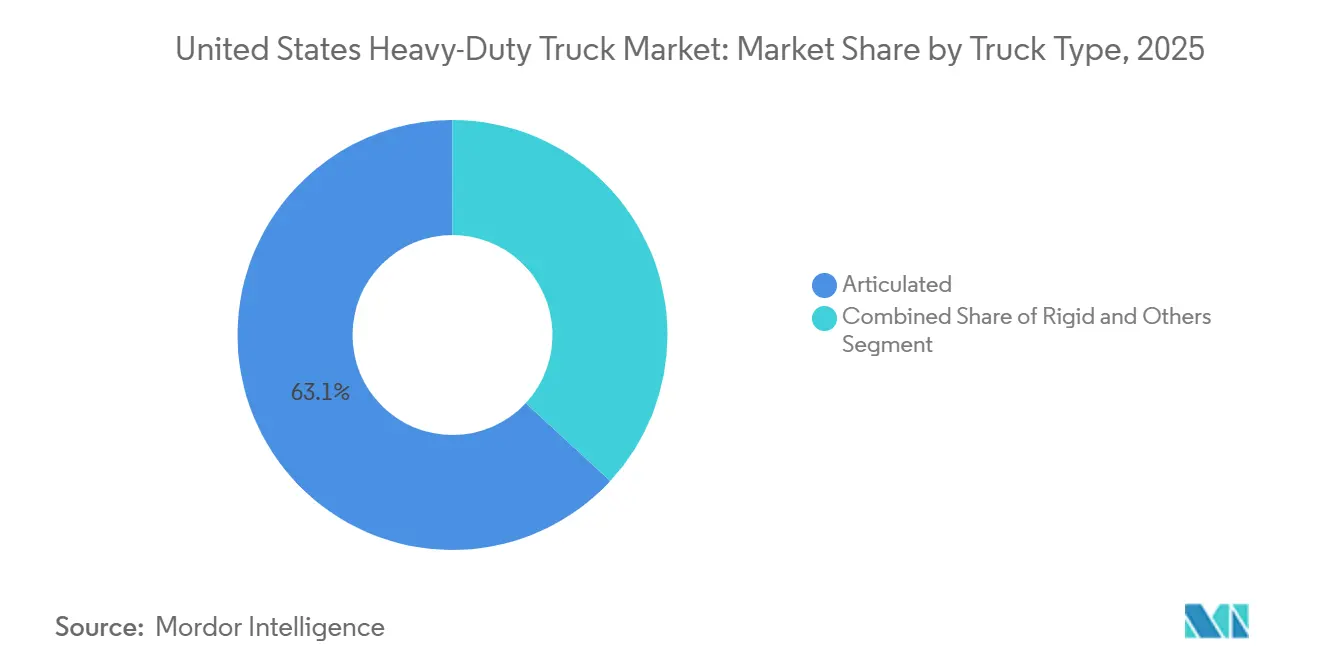
Articulated tractors retained 63.11% of 2025 registrations, but rigid vocational trucks are advancing at a 7.95% annual pace as municipalities electrify refuse, mixer, and dump fleets with predictable daily routes. Battery-electric refuse trucks, funded by Clean Cities grants, typically operate within a limited range per shift. This range allows for overnight charging at depots and reduces diesel idle time. Oshkosh and BYD collectively secured a significant number of orders for rigid electric units, marking a notable shift in a segment historically dominated by diesel. The rigid design's advantage lies in its ability to navigate tighter urban turning circles, a crucial benefit given city zoning constraints around job sites.
At lithium mines in Nevada and North Carolina, super-heavy rigid chassis with 8×6 and 8×8 drivetrains are becoming increasingly popular. These trucks can haul payloads exceeding gross vehicle weight limits without the need for trailers. On the other hand, long-haul carriers are sticking with articulated sleepers. The flexibility of trailer interchange allows them to maximize asset utilization over long journeys. These contrasting use cases indicate that the U.S. heavy-duty truck market is likely to evolve based on specific duty cycles, rather than adopting a uniform approach to electrification. While the growth of rigid trucks is notable, it's unlikely to dethrone articulated trucks' dominance. Instead, rigid trucks will find lucrative niches in refuse, construction, and heavy-haul sectors, where the demands for traction, quick cycle times, and zero-emission mandates align.
By Application: Freight and Logistics Command the Present; Long-Haul Charts the Growth Path
Freight and logistics applications captured 54.71% of 2025 demand, yet long-haul registered the fastest 8.12% CAGR as shippers consolidate linehaul with asset-based carriers that guarantee peak-season capacity. Amazon and UPS are redirecting parcels from brokered partners to owned fleets equipped with predictive-maintenance analytics, raising tractor utilization and driving orders for high-efficiency sleepers. Simultaneously, Aurora Innovation’s driverless corridor in Texas is pushing incumbents to accelerate autonomous pilots in a bid to lock down future hub-to-hub contracts.
Due to IIJA-funded infrastructure projects and a domestic critical-minerals boom, construction and mining have emerged as the sharpest upside tail, a phenomenon that previously did not exist. In a notable shift, super-heavy tractors are now transporting battery-grade lithium from Nevada’s Clayton Valley to newly established refining plants. This surge has propelled a niche, contributing to significant growth in the United States' heavy-duty truck market share for trucks exceeding a specific weight threshold. Another focal point is port drayage: California's ambitious zero-emission target mandates a conversion for half the drayage fleet. This move guarantees sustained demand for battery-electric and hydrogen units, even amid current charging bottlenecks. The overarching result is a divided landscape: while long-haul and heavy-haul segments thrive on distinct technological advancements, lighter regional routes are experiencing a plateau due to capacity rationalization.
Geography Analysis
California's stringent zero-emission mandates, coupled with the San Pedro Bay container throughput, have propelled the state to secure a significant share of registrations. Following closely is Texas, buoyed by its energy-sector freight and robust cross-border trade with Mexico. Meanwhile, the industrial Midwest, anchored by Chicago's intermodal hubs and automotive supply chains, accounts for a substantial share of the nation's demand.
As lithium extraction gains momentum, the Mountain West emerges as the U.S.'s fastest-growing cluster in the heavy-duty truck market, albeit grappling with fragmented overweight permit challenges. The Northeast, bolstered by utility demand-charge relief and port-drayage incentives, is accelerating battery-electric adoption at a pace exceeding the national average. In the Southeast, diesel's enduring popularity is attributed to abundant low-tax fuel and extensive long-haul corridors, where charging times pose challenges.
In the Pacific Northwest, pilots of hydrogen fuel cells and autonomous platforms are reaping benefits from state clean-fuel standards and abundant hydropower. However, these disparate regional regulations create a complex patchwork, compelling multi-state carriers to adopt varied power-train strategies within a single fleet.
The heavy duty trucks market is analyzed by Mordor Intelligence across multiple other geographies, with in-depth regional assessments available for Europe and Africa. This is complemented by country-specific insights for Mexico and Saudi Arabia, reflecting various localized market behavior and policy environments' coverage.
Competitive Landscape
In the U.S. heavy-duty truck market, Daimler Truck, PACCAR, and Volvo Group collectively secured around two-thirds of Class 8 registrations, highlighting a moderately concentrated market structure. Each industry leader is diversifying its propulsion strategies: Daimler is ramping up eCascadia production, PACCAR is preparing a hydrogen variant with Toyota's assistance, and Volvo is integrating Waabi's autonomous software. Meanwhile, Volvo Group's Mack brand has updated its diesel lineup with the OTA-enabled Anthem and Pioneer platforms, and Cummins is utilizing its engine expertise to introduce hydrogen ICE prototypes.
New players are intensifying the competition. Tesla rolled out Semis and aims to expand production, affirming the viability of battery-electric trucks for certain long-haul journeys. After a restructuring phase, Nikola dispatched hydrogen tractors but is seeking additional capital to boost production. Aurora Innovation's debut of its driverless technology on the Dallas-Houston route has prompted established players to hasten their autonomy initiatives. Additionally, Einride's foray into yard logistics is demonstrating early success with tele-operated electric vehicles.
Opportunities exist in areas like megawatt charging, hydrogen dispensing, and super-heavy vocational chassis, where traditional OEMs have yet to make significant inroads. Furthermore, Tesla and Nikola's asset-heavy "truck-as-a-service" offerings are disrupting the traditional sales and financing paradigm, posing a risk of reduced residual values if they gain widespread traction.
United States Heavy-Duty Truck Industry Leaders
-
Daimler Truck AG
-
Volvo Group
-
Traton Group
-
PACCAR Inc.
-
Mack Trucks
- *Disclaimer: Major Players sorted in no particular order
Recent Industry Developments
- July 2025: At ACT Expo 2025, Hyundai Motor introduced its latest XCIENT Fuel Cell Class 8 truck, featuring a 450-mile range, upgraded driver-assistance capabilities, and advancements in hydrogen fuel-cell technology to promote sustainable transportation solutions.
- March 2025: Mack Trucks showcased its Mack Anthem® and Class 6 Mack® MD6 at the Technology & Maintenance Council (TMC) Annual Meeting & Transportation Technology Exhibition. Mack also highlighted its connected vehicle technologies, including AutoSend and Self-Service Parameter Updates, which enhance Over-The-Air (OTA) capabilities to optimize performance and reduce administrative tasks.
United States Heavy-Duty Truck Market Report Scope
The United states heavy-duty truck market report is segmented by gross vehicle weight rating (class 7, class 8a, class 8b, and others), propulsion (internal-combustion engine (ice) and electric), axle type (4x2, 6x2, 6x4, 6x'6, 8x6, 8x8, and others ), truck type (rigid, articulated, and others), and application (construction and mining, freight and logistics, long haul and other). The market forecasts are provided in terms of value (USD) and volume (units).
| Class 7 (26,001 to 33,000 lb) |
| Class 8a (33,001 to 54,000 lb) |
| Class 8b (54,001 to 80,000 lb) |
| Others (Over 80,000 lb) |
| Internal-Combustion Engine (ICE) | Diesel |
| Natural Gas (CNG/LNG) | |
| Electric | Battery-Electric (BEV) |
| Hybrid and Plug-in Hybrid (HEV and PHEV) | |
| Fuel-Cell Electric (FCEV) |
| 4x'2 |
| 6x2 |
| 6x4 |
| 6x6 |
| 8x6 |
| 8x8 |
| Others |
| Rigid |
| Articulated |
| Others |
| Construction and Mining |
| Freight and Logistics |
| Long Haul |
| Other |
| By Gross Vehicle Weight Rating (GVWR) | Class 7 (26,001 to 33,000 lb) | |
| Class 8a (33,001 to 54,000 lb) | ||
| Class 8b (54,001 to 80,000 lb) | ||
| Others (Over 80,000 lb) | ||
| By Propulsion | Internal-Combustion Engine (ICE) | Diesel |
| Natural Gas (CNG/LNG) | ||
| Electric | Battery-Electric (BEV) | |
| Hybrid and Plug-in Hybrid (HEV and PHEV) | ||
| Fuel-Cell Electric (FCEV) | ||
| By Axle Type | 4x'2 | |
| 6x2 | ||
| 6x4 | ||
| 6x6 | ||
| 8x6 | ||
| 8x8 | ||
| Others | ||
| By Truck Type | Rigid | |
| Articulated | ||
| Others | ||
| By Application | Construction and Mining | |
| Freight and Logistics | ||
| Long Haul | ||
| Other | ||
Key Questions Answered in the Report
How large will the United States heavy-duty truck market be by 2031?
It is forecast to reach USD 76.73 billion by 2031, expanding at a 6.85% CAGR over 2026-2031.
Which power-train is growing fastest in heavy-duty trucks?
Battery-electric trucks are advancing at a 7.87% CAGR, the highest among all propulsion types.
Which region leads zero-emission truck adoption?
California leads with port-drayage mandates and state incentives that cut total cost of ownership for battery-electric tractors.
Which propulsion type is growing fastest?
Electric trucks are expanding at a 7.87% CAGR through 2031.