
UAE Data Center Construction Market Size and Share
Market Overview
| Study Period | 2020 - 2031 |
|---|---|
| Forecast Data Period | 2026 - 2031 |
| Base Year Market Size (2025) | USD 1.89 Billion |
| Market Size (2026) | USD 2.22 Billion |
| Market Size (2031) | USD 4.95 Billion |
| Growth Rate (2026 - 2031) | 17.42 % |
| Market Concentration | Medium |
Major Players *Disclaimer: Major Players sorted in no particular order Image © Mordor Intelligence. Reuse requires attribution under CC BY 4.0. | |
UAE Data Center Construction Market Analysis by Mordor Intelligence
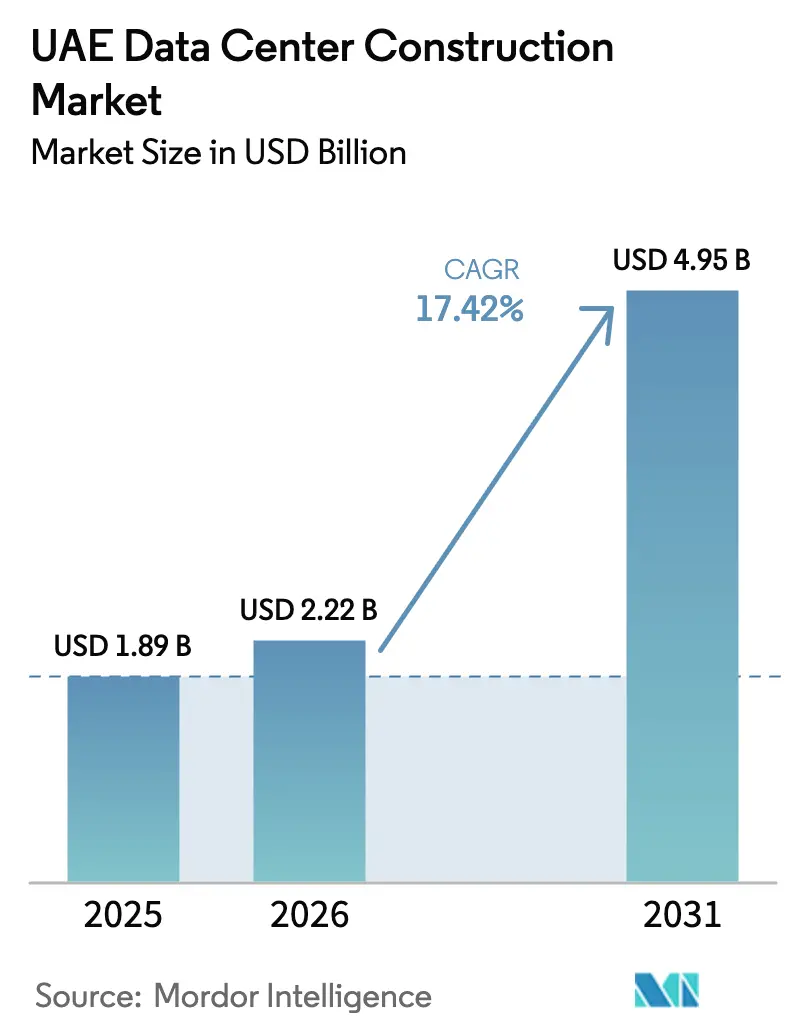
The UAE data center construction market size in 2026 is estimated at USD 2.22 billion, growing from 2025 value of USD 1.89 billion with 2031 projections showing USD 4.95 billion, growing at 17.42% CAGR over 2026-2031. The UAE data center construction market is expanding because hyperscalers are building sovereign-cloud regions that comply with local data-residency rules while supporting artificial-intelligence (AI) workloads at unprecedented power densities. Government programs such as Abu Dhabi’s AED 13 billion Digital Strategy 2025-2027 are catalyzing large-scale public-sector demand for Tier IV-certified capacity, which in turn is attracting private enterprises seeking hybrid deployment options. Strategic partnerships—exemplified by Microsoft’s AED 2 billion alliance with du—are steering the UAE data center construction market toward purpose-built hyperscale campuses engineered for GPU-rich computing. Parallel green-finance incentives introduced around COP28 are prompting operators to integrate on-site renewables and innovative cooling technologies. At the same time, supply-chain constraints, material inflation and shortages of Tier III/IV-qualified labor threaten to temper the near-term build-out curve.
Key Report Takeaways
- By tier type, Tier 3 facilities held 48.25% of the UAE data center construction market share in 2025; Tier 4 facilities record the fastest growth at 19.86% CAGR through 2031.
- By data-center type, colocation services led with 70.55% revenue share in 2025, while self-build hyperscaler projects are expanding at a 22.45% CAGR to 2031.
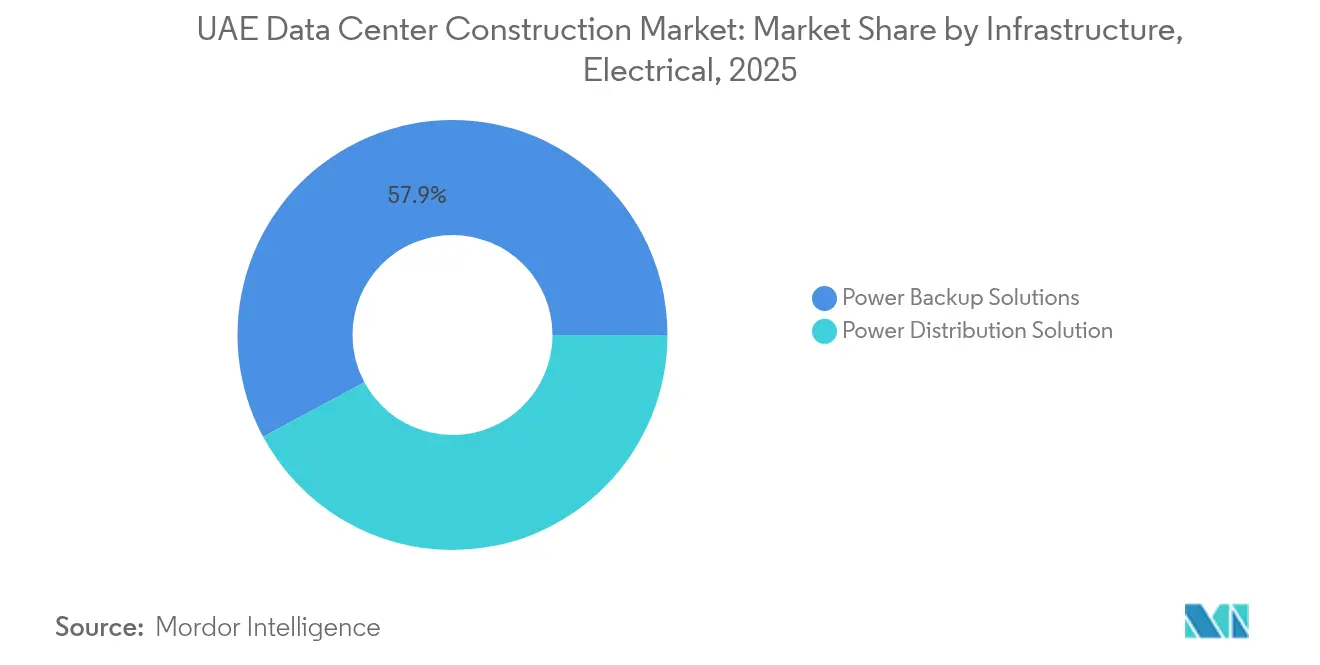
- By electrical infrastructure, power-backup systems accounted for 57.85% share of the UAE data center construction market size in 2025, with power-distribution solutions growing at 21.05% CAGR over 2026-2031.
- By mechanical infrastructure, cooling systems captured 55.9% of the UAE data center construction market size in 2025; servers and storage post the highest CAGR at 20.25% to 2031.
Note: Market size and forecast figures in this report are generated using Mordor Intelligence’s proprietary estimation framework, updated with the latest available data and insights as of 2026.
UAE Data Center Construction Market Trends and Insights
Drivers Impact Analysis*
| Driver | (~) % Impact on CAGR Forecast | Geographic Relevance | Impact Timeline |
|---|---|---|---|
| Increasing investments in cloud and AI workloads | +4.2% | UAE-wide, focused on Dubai and Abu Dhabi | Medium term (2-4 years) |
| Government-led digital-transformation programs | +3.8% | National, Abu Dhabi spearheading | Long term (≥ 4 years) |
| 5G- and IoT-fuelled edge-computing demand | +2.9% | Urban and industrial zones | Medium term (2-4 years) |
| Arrival of hyperscale cloud availability zones | +3.5% | Dubai and Abu Dhabi | Short term (≤ 2 years) |
| COP28-aligned green-finance incentives | +1.8% | Solar-rich regions | Long term (≥ 4 years) |
| Free-zone land-lease and tax holidays | +2.1% | Free zones across UAE | Medium term (2-4 years) |
| Source: Mordor Intelligence | |||
Increasing Investments in Cloud and AI Workloads
Rising AI demand is reconfiguring facility design, pushing power densities up to five times traditional levels as projects such as the planned 5 GW Abu Dhabi AI campus gain momentum. Khazna’s 100 MW AI-optimised complex in Ajman, which dedicates 20 halls to GPU clusters, illustrates how local operators are pivoting toward purpose-built layouts that favor liquid cooling and dense power distribution G42. This evolution is widening the competitive gap between legacy colocation halls and AI-native builds. The Microsoft-du alliance earmarks AED 2 billion to expand sovereign AI capacity in Dubai,[1]William Turton — “Microsoft, du Sign AED2 Billion Hyperscale Deal,” reuters.com signaling enterprise preference for infrastructure that is “future-proof” for upcoming AI migrations. As AI capability becomes a baseline expectation, even non-AI workloads are being contracted on AI-ready floors.
Government-Led Digital Transformation Programs
Abu Dhabi’s Digital Strategy 2025-2027 mandates 100 % adoption of sovereign cloud across all ministries, immediately enlarging addressable demand for domestic data-center space. The Federal Digital Network (FEDnet) extension calls for distributed nodes to back real-time e-government services, effectively guaranteeing multi-availability-zone capacity reservations. Abu Dhabi Municipality is already rolling out a Tier IV disaster-recovery site with Huawei to safeguard smart-city data.[2]Staff Writer — “Abu Dhabi Digital Strategy 2025-2027 Detailed,” zawya.com Once public-sector workloads migrate, private enterprises are expected to follow suit to preserve interoperability with government systems and secure B2G contracts. The job-creation target of 5,000 digital roles is spurring ancillary edge-facility builds near population centers to ensure low-latency service delivery.
5G- and IoT-Fuelled Edge-Computing Demand
Nation-wide 5G coverage combined with surging IoT device counts is moving compute closer to the user. Qualcomm’s Abu Dhabi Engineering Center is prototyping 5G edge-AI gateways that depend on micro-data-centers situated at base-station level. du is complementing macro-hyperscale projects by trialing 5G-Advanced cells capable of hosting micro-edge nodes on-site.[3]Staff Writer — “Qualcomm Opens Abu Dhabi Engineering Center,” qualcomm.com Utilities and energy producers are adopting localized compute for real-time grid optimisation, prompting a wave of containerised edge builds around industrial zones. These deployments boost overall utilisation of the UAE data center construction market by adding incremental capacity orders across secondary emirates.
Arrival of Hyperscale Cloud Availability-Zones
Dedicated cloud regions from Microsoft Azure, among others, are redefining baseline redundancy expectations in the UAE data center construction market . The G42-led campus plans illustrate the next iteration: integrated AI super-clusters embedded within sovereign-cloud frameworks. Contracting models increasingly require multi-phase buildouts that guarantee live power during construction, pressuring contractors to adopt modular “live-site” practices. Regional incumbents like Khazna are widening their footprint abroad to retain share as global hyperscalers land; their local regulatory knowledge remains a core selling point. Standardised hyperscale specifications are also opening doors for niche EPCs with repeatable, factory-built designs.
Restraints Impact Analysis*
| Restraint | (~) % Impact on CAGR Forecast | Geographic Relevance | Impact Timeline |
|---|---|---|---|
| Data-sovereignty and licensing complexities | -2.3% | Nationwide, variable by free zone | Medium term (2-4 years) |
| High electricity tariffs and grid constraints | -1.9% | UAE-wide, dense sites hit hardest | Short term (≤ 2 years) |
| Scarcity of Tier III/IV skilled labour | -1.6% | National, specialists in short supply | Long term (≥ 4 years) |
| Water-scarcity cooling surcharges | -1.2% | Desert regions | Medium term (2-4 years) |
| Source: Mordor Intelligence | |||
Data-Sovereignty and Licensing Complexities
The Federal Personal Data-Protection Law imposes overlapping obligations for operators serving multiple customer cohorts, requiring bespoke compliance protocols across federal, DIFC and ADGM regimes. Unresolved implementing regulations leave ambiguity on cross-border transfer conditions, delaying green-light decisions for new builds. Hyperscalers often duplicate workloads across two UAE zones to satisfy residency clauses, inflating capex and complicating traffic engineering. The new UAE Data Office introduces another checkpoint in project-approval workflows, compelling operators to widen legal and compliance budgets.
High Electricity Tariffs and Grid Constraints
Dubai’s tiered tariff—20 to 33 fils per kWh—creates a steep marginal-cost curve at power footprints above 50 MW. Intermittent renewables integration complicates grid-stability forecasts, especially outside Dubai and Abu Dhabi where utility upgrades lag. Operators are therefore investing in behind-the-fence solar arrays and battery farms, driving up initial capex even as long-term opex falls. Mega-projects must also coordinate with Emirates Water and Electricity Company to reserve dedicated feeders, elongating permitting timelines and amplifying the restraint on the UAE data center construction market.
*Our forecasts treat driver/restraint impacts as directional, not additive. The impact forecasts reflect baseline growth, mix effects, and variable interactions.
Segment Analysis
By Tier Type: Tier 4 Drives Premium Infrastructure Demand
The UAE data center construction market size allocated to Tier-certified facilities favored Tier 3 with 48.25% share in 2025. Growing hyperscale presence, however, is pushing Tier 4 capacity at a 19.86% CAGR through 2031 because machine-learning services require 99.995% uptime for regulated workloads. Abu Dhabi Municipality’s Tier IV disaster-recovery site illustrates the public-sector appetite for premium resilience
Tier 1 and Tier 2 footprints are receding as enterprise digitalisation programs pivot toward cloud-first architectures that assume higher service-level agreements. Operators use Tier 4 branding to justify premium pricing, which helps amortise step-ups in power-distribution gear and advanced cooling. The segment’s expansion concentrates skilled-labour shortages in commissioning and QA roles, reinforcing one of the market’s key restraints.




By Data Center Type: Hyperscaler Self-Build Reshapes Market Dynamics
Colocation retained 70.55% of the UAE data center construction market share in 2025, but self-build hyperscaler footprints are growing 22.45% annually, signalling a structural pivot. Microsoft’s decision to develop a dedicated du-operated campus rather than lease space in existing colocation halls confirms hyperscalers’ preference for bespoke specifications reuters.com. The UAE data center construction market size attached to self-builds is therefore on track to overtake retail colocation floors by the decade’s end.
Edge and enterprise builds continue to proliferate, mainly to satisfy data-sovereignty needs in healthcare and energy verticals. Qualcomm’s gateway initiative demonstrates corporate willingness to sponsor ultra-compact nodes when latency or data-protection requirements dictate local processing. These diversified build types distribute revenue streams across contractors while reducing single-customer concentration risk for landlords.
By Electrical Infrastructure: Power Backup Dominates Amid Grid Modernisation
Power-backup equipment such as rotary UPS and diesel-replacement flywheels captured 57.85% of electrical revenue in 2025. As AI clusters ramp, sophisticated bus-ducts and intelligent PDUs are forecast to record 21.05% CAGR through 2031, elevating their contribution to the UAE data center construction market size. Operators favour resilient designs that can absorb grid shocks without battery drain, reflecting lessons learned from intermittent renewables.
Khazna’s diesel-free operational concept uses grid plus battery-storage orchestration to align with national decarbonisation goals . These solutions raise up-front costs but lower lifecycle emissions and fuel logistics. Suppliers capable of integrating renewables into static-switch architectures are likely to win disproportionately as green-finance covenants tighten.
By Mechanical Infrastructure: Server and Storage Expansion Mirrors AI Pivot
Cooling remained the largest mechanical category at 55.9% share in 2025, reflecting the desert climate’s thermal-management challenges. Yet servers and storage hardware will expand 20.25% per year as hyperscalers install GPU-dense racks entering the UAE data center construction market. Vertiv’s MegaMod CoolChip modules, designed for 75 kW-per-rack deployments, highlight how suppliers are packaging prefabricated white space that can be commissioned in 12 weeks.
Racks, containment aisles and busways are being redesigned to facilitate liquid-coolant loops and rear-door heat exchangers. These mechanical upgrades ripple through to construction sequencing, as slabs must now accommodate heavier rack loads and embedded piping. The transition underscores how AI compute requirements drive capex distribution away from shell-and-core toward IT-and-cooling-heavy bill-of-materials.
Geography Analysis
Dubai and Abu Dhabi dominate the UAE data center construction market given their connectivity, policy support and concentration of enterprise headquarters. Dubai’s cluster benefits from omnidirectional subsea-cable ingress, enabling both Gulf and East-African traffic to interconnect at minimal latency. Free-zone frameworks grant 100 % foreign ownership, which accelerates permitting for newcomers. Azure’s forthcoming availability zone and Equinix’s continuous expansions reinforce Dubai’s status as the default on-ramp for multinational cloud services.
Abu Dhabi’s AED 13 billion sovereign-AI program positions the capital as a governmental and research nucleus, fuelling demand for Tier IV and GPU-optimised halls. The emirate’s G42-anchored 5 GW campus will become the largest single allocation of the UAE data center construction market size once energised, drawing a global ecosystem of AI chipmakers, software firms and academic partners zawya.com. Edge-node work packages are concurrently proliferating around government precincts to guarantee sub-5 millisecond round-trip for smart-city control loops.
Secondary emirates are absorbing spill-over builds as operators chase lower land prices and redundant power feeds. Ajman’s 100 MW Khazna project illustrates how cost-efficient plots can host AI mega-farms while still interconnecting via dark-fiber backbones to Dubai hubs. Fujairah leverages direct Arabian Sea cable landings for disaster-recovery footprints that avoid Strait of Hormuz choke points. Collectively, these satellite zones diversify risk and unlock incremental capacity without overburdening Dubai and Abu Dhabi grids.
Regulatory Landscape
The UAE data center construction market is shaped by national cyber and information-assurance obligations for critical entities, with oversight anchored around the Telecommunications and Digital Government Regulatory Authority (TDRA) and the UAE Cybersecurity Council. Requirements are aligned to the National Information Assurance Framework (NIAF) and the UAE Information Assurance Regulation. Data-residency and cross-border transfer controls under Federal Decree-Law No. 45 of 2021 (Personal Data Protection Law) constrain site selection and architecture, often pushing projects toward multi-zone designs to meet residency commitments for regulated workloads.
Sector regulators add additional layers. In February 2026, the Central Bank of the UAE (CBUAE) launched a sovereign financial cloud to keep sensitive financial data hosted within national borders, which reinforces compliance-driven demand for local, high-availability capacity. Healthcare and financial services also face localization and security obligations, increasing the focus on Tier III/IV resilience, audit-ready operational controls, and documented supply-chain assurance in construction programs.
Value Chain Analysis
The UAE data center construction value chain starts with land acquisition and power feasibility, including utility coordination, grid connection, and behind-the-fence energy planning. It then moves into concept design and authority approvals that incorporate information-assurance and data-residency requirements. Engineering, procurement, and construction (EPC) execution typically bundles shell-and-core works with electrical and mechanical integration, covering UPS and generators, switchgear and busways, cooling plants, and, increasingly, liquid-ready distribution. Commissioning and certification follow, where Tier III/IV talent availability can become a bottleneck.
On the demand and ownership side, hyperscalers and large enterprises often contract with local platforms to meet sovereign cloud and regulated-sector requirements. Domestic specialists such as Khazna Data Centers, along with sustainability-led operators such as Moro Hub (DEWA), influence energy and cooling design choices. Capital flows increasingly involve large-scale financing and sovereign-wealth-linked participation, while operational optimization is becoming part of the chain as operators test AI-led controls for power and cooling efficiency. This tightens feedback loops from operations back into new-build specifications.
Competitive Landscape
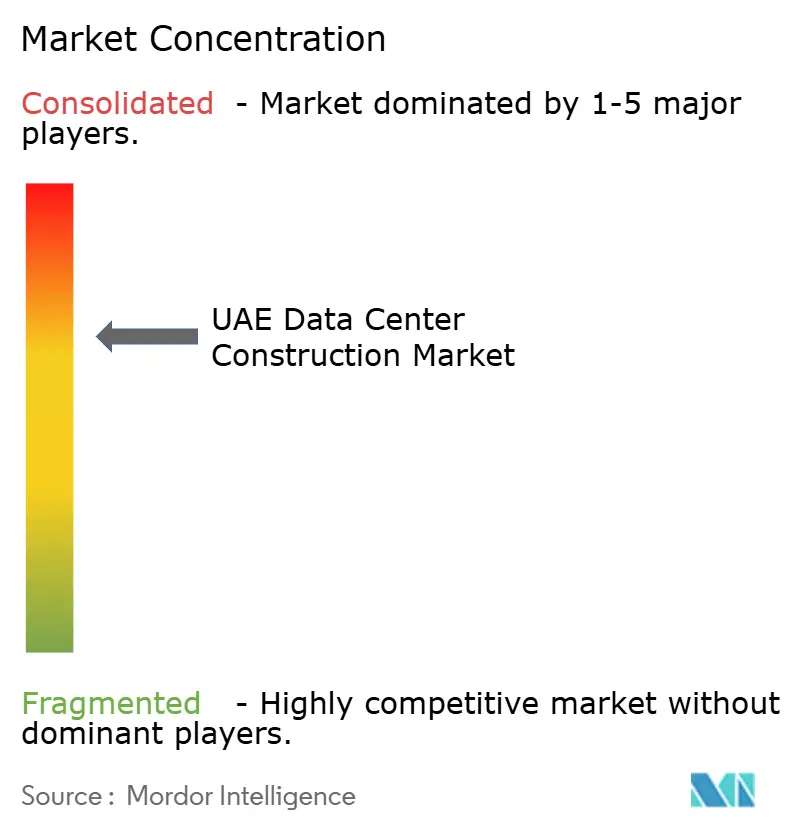
Competition is moderate, with a handful of regional specialists and several inbound global players. Khazna, Moro Hub and Gulf Data Hub collectively command a sizable share, yet no single operator exceeds half of installed capacity. International brands such as Equinix and Digital Realty leverage global design templates to accelerate time-to-market. The UAE data center construction market thus rewards firms that can localise global best practices within the UAE’s regulatory and climatic context.
Strategic focus centers on sustainability and localisation. Khazna’s diesel-free blueprint and Moro Hub’s solar-powered campus set new performance benchmarks that attract capital eligible for ESG frameworks. Concurrently, developers are rolling out Emiratisation programs to groom local engineers for Tier III/IV commissioning roles, helping mitigate labour bottlenecks.
MandA activity is heating up: the USD 5.5 billion valuation attached to Khazna after Silver Lake and MGX’s 40 % stake signals strong investor confidence in home-grown platforms. Cross-border outreach is rising too; Khazna’s Turkey expansion reveals a bid to export regulatory know-how while capturing emerging-market upside. Technology partnerships—like Vertiv’s modular-cooling alliance with Gulf Data Hub—illustrate how OEMs co-innovate with local builders to compress deployment timelines and cut PUE.
UAE Data Center Construction Industry Leaders
Khazna Data Centers
Equinix
Moro Hub (DEWA)
Amazon Web Services
Microsoft Azure
- *Disclaimer: Major Players sorted in no particular order

Market Opportunities and Future Outlook
AI-optimized capacity and sovereign-cloud compliance are expanding the addressable scope for higher-density electrical and mechanical packages, especially power distribution, advanced cooling, and liquid-ready fit-outs for GPU-rich halls. Khazna-led hyperscale builds in Ajman and Abu Dhabi illustrate the current level of activity, including the 100 MW QAJ1 project and the AUH4/AUH8 program totaling 60 MW. Capacity expansion initiatives tied to Microsoft and G42 are also adding build and integration work, particularly across phased commissioning, live-site construction practices, and prefabricated or modular delivery to reduce time-to-service.
Sustainability and efficiency programs are also creating whitespace in retrofit and design-for-operations services alongside new builds. The UAE Ministry of Energy and Infrastructure-backed AI-driven efficiency pilot using Phaidra control technology at Khazna facilities indicates demand for instrumentation, controls integration, and performance-tuning services that can be incorporated during construction rather than retrofitted later. On the supply side, data-residency obligations combined with grid and tariff considerations are pushing developers toward multi-site strategies across Dubai, Abu Dhabi, and secondary emirates. This supports contractor and OEM opportunities to standardize designs across sites while tailoring compliance documentation for federal and free-zone regimes.
Recent Industry Developments
- January 2026: Moro Hub (DEWA) - Managing Director and CEO Saeed Mohammed Al Tayer reviewed construction progress at the new solar-powered Green Data Centre in Warsan and endorsed the awarding of the second phase. The facility has a planned capacity exceeding 100MW and spans over 66,000 square meters. The first phase is scheduled for launch in the second half of 2026.
- October 2025: Khazna Data Centers - Announced plans to increase operational capacity by more than 1GW globally over the next five years, including new projects in Abu Dhabi, Dubai, and Ajman. The expanded footprint will broaden access to hyperscale capacity across key UAE markets and support digital infrastructure growth.
- September 2025: Khazna Data Centers - Secured a $2.62 billion financing facility from Abu Dhabi Commercial Bank (ADCB) and First Abu Dhabi Bank (FAB) for regional capacity expansion. The funding strengthens Khazna's ability to accelerate regional deployments and meet rising demand for secured data center capacity.


Research Methodology Framework and Report Scope
Market Definition and Coverage
For this study, the market covers the value of building and fitting out data centers in the United Arab Emirates, including general construction work and the supporting electrical and mechanical infrastructure needed to make the facility operational.
Scope exclusions: This sizing does not count ongoing colocation hosting revenues, cloud service revenues, or day to day facility operations and maintenance after handover.
Segmentation Overview
- By Tier Type
- Tier 1 and 2
- Tier 3
- Tier 4
- By Data Center Type
- Colocation
- Self-build Hyperscalers (CSPs)
- Enterprise and Edge
- By Infrastructure
- By Electrical Infrastructure
- Power Distribution Solution
- Power Backup Solutions
- By Mechanical Infrastructure
- Cooling Systems
- Racks and Cabinets
- Servers and Storage
- Other Mechanical Infrastructure
- General Construction
- Service - Design and Consulting, Integration, Support and Maintenance
- By Electrical Infrastructure
Data Sources, Market Sizing, and Validation
Desk Research
Desk research is used to set the factual base for the model, and then to sanity check the demand pipeline that drives construction spending in the UAE. We reviewed public planning and infrastructure signals that point to new builds and expansions, which are then translated into construction work packages.
The most useful non paywalled inputs usually come from sources such as UAE digital economy and ICT policy releases, energy and grid updates from national utilities, planning and statistics releases from federal and emirate level authorities, and international benchmarks from bodies such as the IEA and ITU. We also lean on company annual reports, investor presentations, association websites where available, and reputable press coverage of project announcements, and then use a paid subscription for company financials and news to cross check timelines and capex intent. This list is illustrative only, and many other public documents and databases were also referred to for data collection, validation, and clarification.
Primary Interviews and Surveys
Primary work is used to convert the desk level pipeline into realistic construction values, because pricing, sequencing, and scope splits vary by site. We spoke with EPC and subcontracting participants, specialist electrical and mechanical package providers, project consultants, and buyer side teams, and coverage was balanced across the main UAE demand centers so assumptions could be tested against active bids and recent awards.
Distribution of primary research fieldwork respondents
| Company type | Respondent position |
|---|---|
| Top tier: 29% | CXOs: 17% |
| Mid tier: 50% | Functional/Unit leaders: 27% |
| Smaller Players: 21% | Managers: 56% |
Market-Sizing & Forecasting
Sizing starts with a top-down build that reconstructs annual construction demand from UAE capacity additions and the known project pipeline, and then splits the spend into general construction, electrical infrastructure, and mechanical infrastructure using typical data center cost build ups. Once the first cut is prepared, the totals are corroborated through selective bottom-up approximations such as sampled project costs per MW, checks on contractor backlogs, and channel feedback on major equipment packages.
Key inputs include under construction and planned IT load additions (MW), the mix of new builds versus expansions, the tiering requirements that change redundancy and cost, and local cost movement for items like switchgear rooms, cooling systems, and civil works. Timing matters in this market, so we also model award to completion lags and staggered commissioning before annual market value is recognized.
Forecasts are developed using scenario analysis, where project phasing, power availability, and financing pace are varied within realistic bounds agreed during interviews. When a project has incomplete public details, gaps are handled by using ranges for MW and cost intensity, which are then narrowed using recent UAE deal benchmarks and contractor feedback.
Data Validation & Update Cycle
Outputs are triangulated across multiple checks so single source errors do not flow into the final market value. We compare implied spend per MW and per facility against recent build patterns, verify infrastructure splits against engineering norms, and recheck outliers where a project looks unusually high or low.
Before sign-off, the model and assumptions go through multi step analyst review, and follow up calls are triggered when a large new award, delay, or cancellation materially shifts the pipeline. Reports refresh annually, with interim updates for material events, and a final pre delivery pass is completed so clients receive the latest updated view.
Mordor Intelligence's United Arab Emirates Data Center Construction Market Size Versus Other Published Estimates
Published market values for UAE data center construction can look far apart because some sources track total data center investment or even operator revenue, and those metrics do not map one to one to yearly construction output. Differences also come from how electrical and mechanical packages are handled, whether expansions are counted like new builds, and how multi year projects are spread across calendar years.
Project pipeline signals and execution checks (for example, MW capacity under build and announced commissioning timelines) are used as reality tests, and that evidence is what keeps Mordor Intelligence's estimate focused on annual construction work packages (civil, electrical, and mechanical) rather than broader spend pools. When other published figures use an end year value or blend in non construction items like IT hardware and service revenue, the output becomes less comparable for construction budgeting.
Benchmark comparison
| Source | Market Size | Gaps in Research Methodology |
|---|---|---|
| Mordor Intelligence | USD 1.89 B (2025) | |
| Global Real Estate Advisory A | USD 1.26 B (2024) | Uses a broader data center market value lens and an earlier year, and it may blend investment and operator economics rather than isolating yearly construction scope across civil, electrical, and mechanical work. |
| Investment Briefing B | USD 3.33 B (2030) | Reported as a future end year value for the broader data center market, which can include non construction components and does not isolate annual construction output or the infrastructure split applied in this model. |
Looking across the table, the spread is mainly explained by scope and timing, since the external figures lean toward broader data center market values or multi year end points. Our method stays repeatable because it starts from UAE build activity signals, converts them into annualized construction scope, and then validates the totals with practical cost and phasing checks.


Key Questions Answered in the Report
How big is the UAE Data Center Construction Market?
The UAE Data Center Construction Market size is expected to reach USD 2.22 billion in 2026 and grow at a CAGR of 17.42% to reach USD 4.95 billion by 2031.
What is the current UAE Data Center Construction Market size?
In 2026, the UAE Data Center Construction Market size is expected to reach USD 2.22 billion.
Who are the key players in UAE Data Center Construction Market?
Jacobs Engineering Group, Arup Gulf Limited, AECOM., Turner & Townsend and Aurecon Group Pty. Ltd. are the major companies operating in the UAE Data Center Construction Market.
What years does this UAE Data Center Construction Market cover, and what was the market size in 2025?
In 2025, the UAE Data Center Construction Market size was estimated at USD 2.22 billion. The report covers the UAE Data Center Construction Market historical market size for years: 2019, 2020, 2021, 2022, 2023 and 2024. The report also forecasts the UAE Data Center Construction Market size for years: 2026, 2027, 2028, 2029, 2030 and 2031.
Page last updated on:
- Artificial Intelligence (AI) Data Center Market AI facilities across the global market, covering facility type, component and tier.
- Data Center Server Market Servers across the global market, covering tier, facility size and facility type.
- United Arab Emirates Data Center Power Market Power systems demand across the UAE, covering component, facility type and facility size.
- United Arab Emirates Data Center Server Market Servers demand across the UAE, covering tier, facility size and facility type.
- Middle East Data Center Rack Market Racks demand across the Middle East, covering rack size, rack type and tier.
- UAE Artificial Intelligence (AI) Data Center Market The UAE AI facilities, split by facility type, component and tier.
- Middle East Hyperscale Data Center Market The Middle East hyperscale sites, split by facility type, component and tier.
- Australia Hyperscale Data Center Market Hyperscale sites demand across Australia, covering facility type, component and tier.
- Denmark Data Center Storage Market Denmark's storage, split by facility size and tier.





