
Middle East Data Center Construction Market Size and Share
Market Overview
| Study Period | 2020 - 2032 |
|---|---|
| Forecast Data Period | 2026 - 2032 |
| Base Year Market Size (2025) | USD 5.24 Billion |
| Market Size (2026) | USD 6.51 Billion |
| Market Size (2032) | USD 23.86 Billion |
| Growth Rate (2026 - 2032) | 24.18 % |
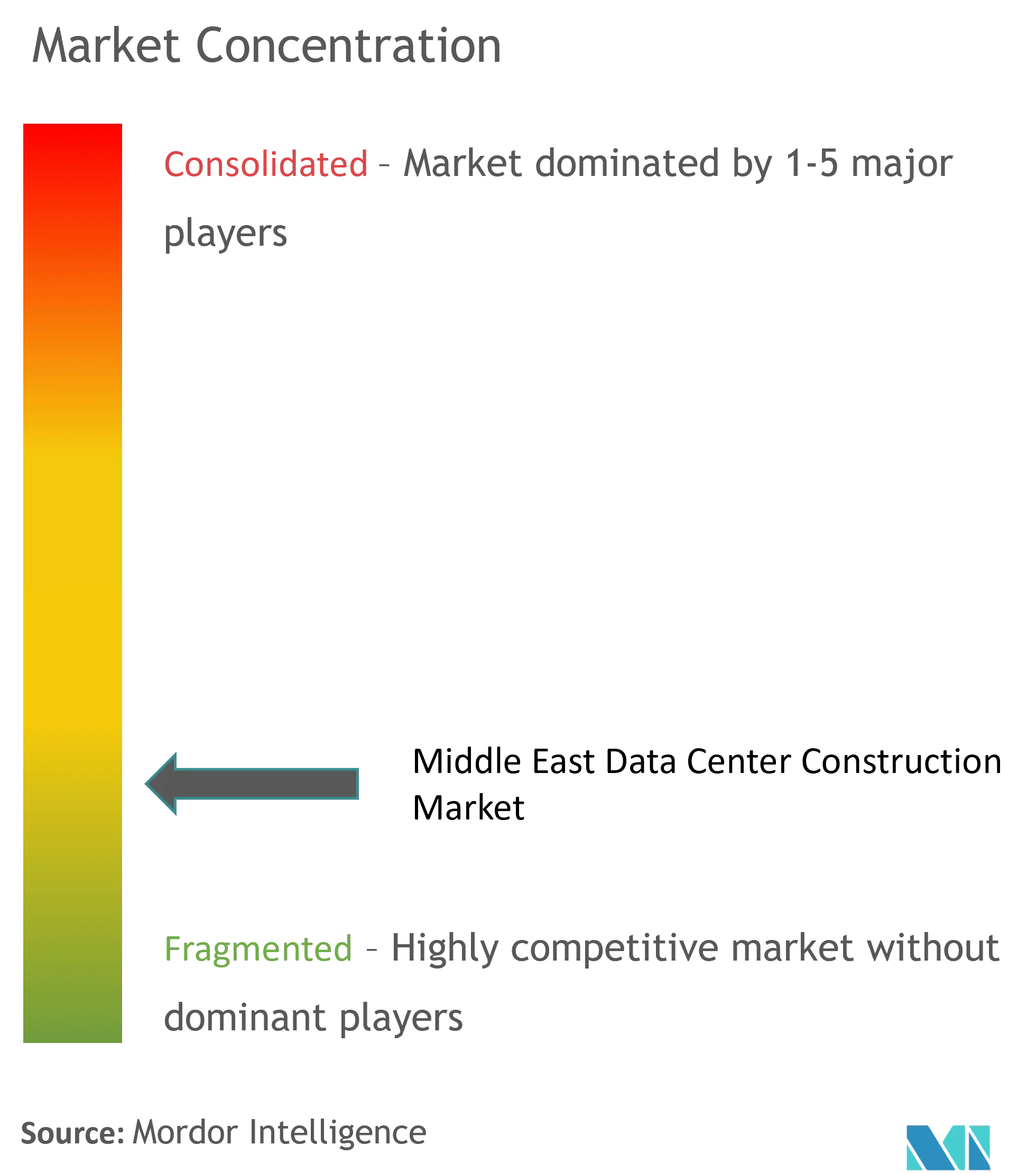
| Market Concentration | Medium |
Major Players *Disclaimer: Major Players sorted in no particular order Image © Mordor Intelligence. Reuse requires attribution under CC BY 4.0. | |
Middle East Data Center Construction Market Analysis by Mordor Intelligence
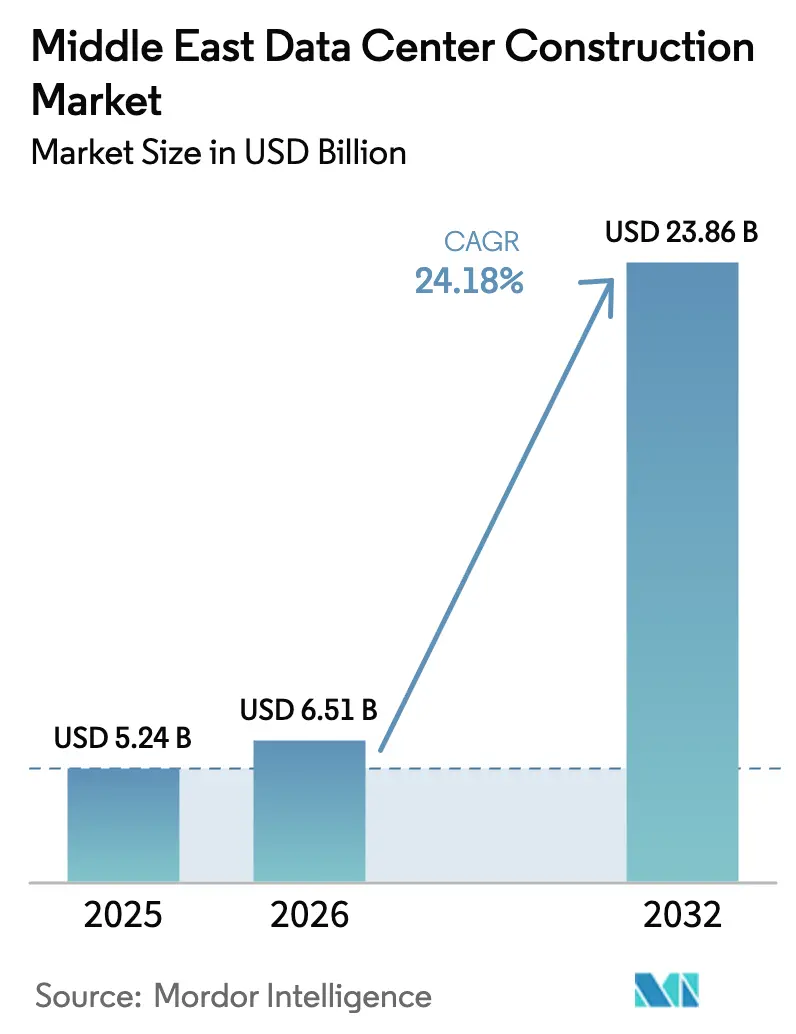
The Middle East data center construction market size was valued at USD 5.24 billion in 2025 and estimated to grow from USD 6.51 billion in 2026 to reach USD 23.86 billion by 2032, at a CAGR of 24.18% during the forecast period (2026-2032). Accelerated investment from sovereign wealth funds, hyperscale cloud build-outs, and government digital-economy programs underpin the region’s rapid capacity expansion. Mechanical infrastructure keeps a lead position thanks to cooling needs in desert climates, while electrical systems record the fastest spend growth as operators chase high-density AI workloads. The United Arab Emirates (UAE) anchors the Middle East data center construction market with mature connectivity and renewable power options, yet Saudi Arabia’s Vision 2030 pipeline turns the Kingdom into the highest-growth arena. Supply chain bottlenecks in steel and specialty cooling gear tighten project schedules, but long-term power-purchase agreements (PPAs) built on solar and nuclear assets help offset operating costs and carbon liabilities.
Key Report Takeaways
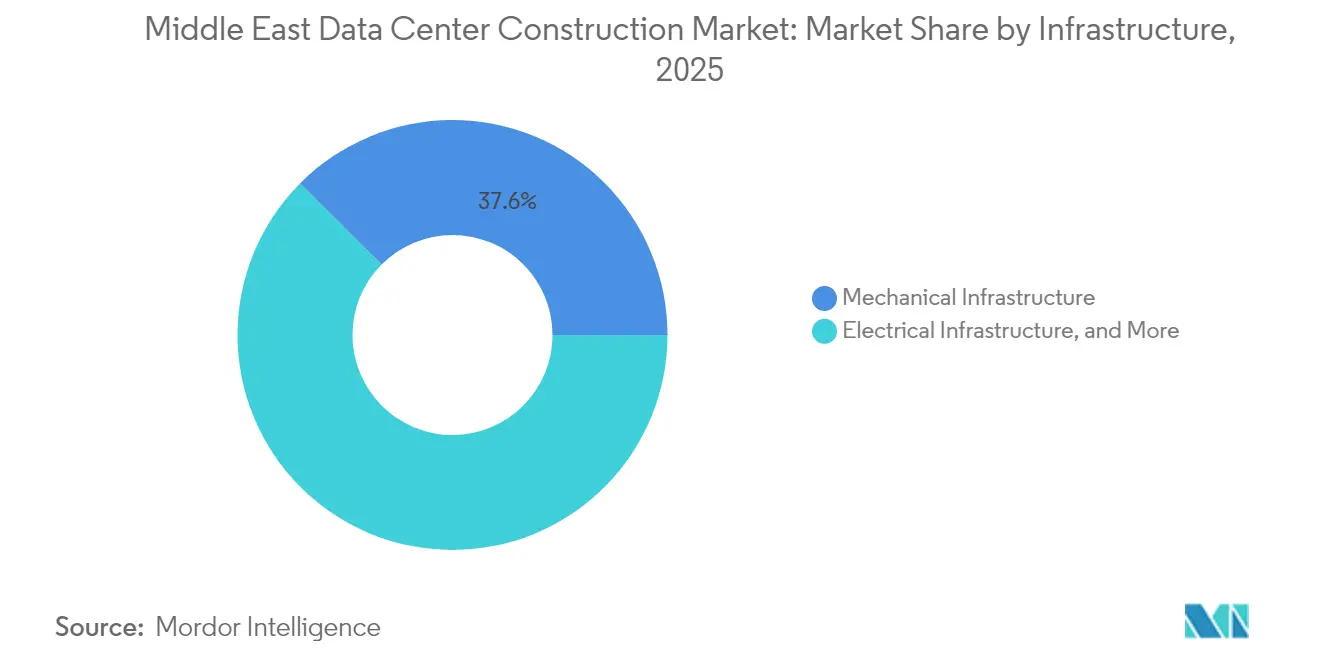
- By infrastructure, mechanical systems held 37.55% of the Middle East data center construction market share in 2025. And, electrical systems are projected to advance at a 27.84% CAGR through 2032.
- By tier type, Tier III installations commanded 53.65% revenue in 2025. And, Tier IV facilities are set to expand at a 21.72% CAGR to 2032.
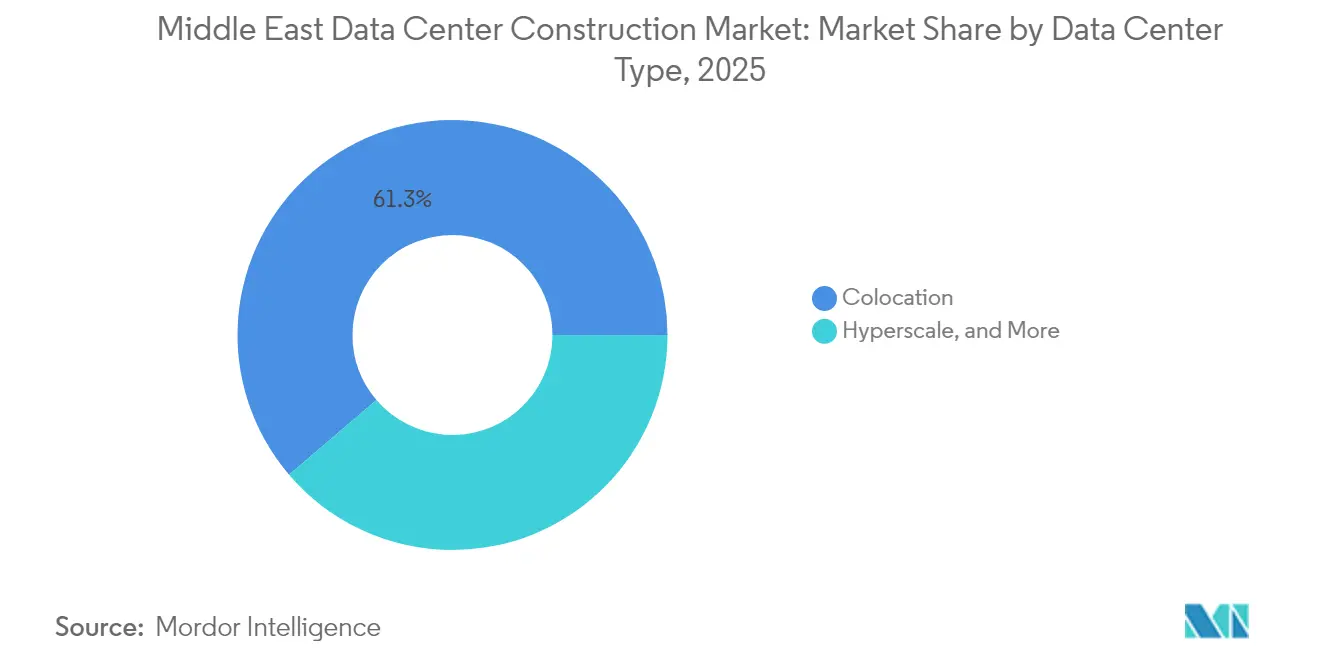
- By data center type, colocation led with a 61.25% share of the Middle East data center construction market size in 2025. By data center type, hyperscale deployments are forecast to rise at a 28.85% CAGR through 2032.
- By end-user industry, IT and Telecommunications led with a 40.35% share of the Middle East data center construction market size in 2025, and is forecast to rise at a 20.98% CAGR through 2032.
- By geography, the UAE captured 32.60% of 2025 revenue, while Saudi Arabia is growing at 20.83% through 2032.
Note: Market size and forecast figures in this report are generated using Mordor Intelligence’s proprietary estimation framework, updated with the latest available data and insights as of 2026.
Middle East Data Center Construction Market Trends and Insights
Drivers Impact Analysis*
| Driver | (~) % Impact on CAGR Forecast | Geographic Relevance | Impact Timeline |
|---|---|---|---|
| Hyperscale cloud and AI build-outs | +8.20% | UAE, Saudi Arabia, Qatar | Medium term (2-4 years) |
| Government digital-economy and Vision programs | +6.10% | Saudi Arabia, UAE, Oman | Long term (≥ 4 years) |
| 5G-edge latency requirements | +3.80% | GCC-wide, UAE lead | Short term (≤ 2 years) |
| Utility-scale solar and nuclear PPAs | +2.90% | UAE, Saudi Arabia | Long term (≥ 4 years) |
| Sovereign-wealth build-to-suit funding | +2.10% | UAE, Saudi Arabia, Qatar | Medium term (2-4 years) |
| Red Sea/Gulf cable landings | +1.40% | Saudi–Egypt corridor | Medium term (2-4 years) |
| Source: Mordor Intelligence | |||
Hyperscale Cloud and AI Build-outs Accelerate Regional Infrastructure Transformation
OpenAI’s partnership with G42 on the 5 GW “Stargate UAE” campus pushes rack power densities toward 80 kW and makes liquid cooling a baseline design. Microsoft’s zero-water technologies further widen mechanical complexity in desert settings [1]HPCwire, “Microsoft to Open ‘Zero Water’ Data Centers in 2026,” hpcwire.com. These deployments raise electrical subsystem demand and anchor the Middle East data center construction market as a testbed for next-generation high-density designs.
Government Digital-Economy and Vision Programs Drive Sovereign Infrastructure Development
Saudi Arabia’s draft Global AI Hub Law introduces data-embassy provisions favoring in-country build-outs [2]CMS LawNow, “Shaping the future of data sovereignty: Saudi Arabia issues new draft Global AI Hub Law,” cms-lawnow.com. Parallel moves in the UAE and Oman embed local-content thresholds in procurement rules. The resulting predictable demand stream underwrites long-horizon capital spending and cements the Middle East data center construction market as the core platform for digital-government strategies.
5G-Edge Latency Requirements Spur Distributed Site Development
Etisalat’s 5G-edge-in-a-box roll-out embeds micro data centers inside cellular nodes, trimming latency to sub-10 ms for AR and IoT workloads [3].Intel, “Etisalat Harnesses 5G Edge Computing,” intel.com These projects rely on prefabricated modules and favor local builders capable of rapid site activation, widening participation in the Middle East data center construction market.
Utility-Scale Solar and Nuclear PPAs Transform Energy Economics
The UAE’s 5.3 GW Barakah reactors provide carbon-free baseload that aligns with corporate net-zero targets. Saudi solar auctions settle below USD 0.02 per kWh, locking in thirty-year power cost visibility. Developers now synchronize PPA signing with early design, firmly linking energy strategy to construction phasing across the Middle East data center construction market.
Restraints Impact Analysis*
| Restraint | (~) % Impact on CAGR Forecast | Geographic Relevance | Impact Timeline |
|---|---|---|---|
| Grid-power bottlenecks and diesel inflation | −4.3% | Saudi Arabia, Kuwait, Oman | Short term (≤ 2 years) |
| Cooling-water scarcity and wastewater fees | −3.1% | GCC-wide; acute in UAE and Qatar | Medium term (2-4 years) |
| Shortfall of Tier III/IV certified staff | −2.8% | Regional; highest in Saudi Arabia | Long term (≥ 4 years) |
| Local-content and data-sovereignty hurdles | −1.9% | Saudi and UAE regulatory zones | Medium term (2-4 years) |
| Source: Mordor Intelligence | |||
Grid-Power Bottlenecks and Diesel Capex Inflation Constrain Rapid Deployment
Transmission upgrades trail demand, postponing energization by up to 18 months in Saudi growth corridors. Diesel backup systems cost 35-40% more than in 2024 due to steel and transport premiums [4]Steel Radar, “Rebar prices surge as Saudi Arabia’s mega projects drive market demand,” steelradar.com. These factors slow near-term project starts inside the Middle East data center construction market.
Cooling-Water Scarcity and Wastewater Fees Drive Innovation Requirements
Desalination fees send operating water costs to 15-20% of OPEX, prompting operators to adopt air-cooled or zero-water designs that raise energy draw by 20-30%. Approval cycles lengthen as authorities scrutinize wastewater plans, stretching construction schedules in the Middle East data center construction market.
*Our forecasts treat driver/restraint impacts as directional, not additive. The impact forecasts reflect baseline growth, mix effects, and variable interactions.
Segment Analysis
By Infrastructure: Electrical Systems Scale for High-Density Loads
Electrical equipment revenue rose behind growing GPU clusters, and electrical subsystems are on pace for a 27.84% CAGR. Switchgear, PDUs, and UPS units capable of 40-80 kW per rack reshape room layouts and lift structural loads. The Middle East data center construction market size for electrical systems is projected to reach USD 6.72 billion by 2032. Integration of liquid cooling pumps raises facility electrical consumption by 15-25%, blurring boundaries between mechanical and electrical trades. Service providers therefore bundle design, integration, and renewable-energy consulting into turnkey offers, deepening specialization inside the Middle East data center construction market.
Mechanical systems still absorb the largest spend because desert locations demand robust cooling. Rapid adoption of rear-door heat exchangers and direct-to-chip loops keeps mechanical share at 37.55% in 2025. Project designs now allocate extra white-space height for manifold routing and heavier chillers, increasing civil costs. Electrical and mechanical coordination thus defines project critical path and shapes competitive positioning throughout the Middle East data center construction market.



By Tier Type: Reliability Preferences Diversify Capex Profiles
Tier III accounted for a 53.65% stake in 2025 by balancing 99.982% uptime with cost control. Banking and public-sector clients, however, push Tier IV uptake to a 21.72% CAGR to 2032 as they adopt active-active architectures. Tier IV’s higher sealing and dual-bus electrical schemes uplift capex by 25-30% yet unlock premium pricing. The Middle East data center construction market share for Tier IV is poised to hit 17.45% by 2032 as regulatory and fintech workloads climb.
Edge deployments generally favor Tier II shells to speed roll-out. Modular vendors certify components in-factory, cutting site work by half and enabling 12-week go-live cycles. Uptime Institute certificates remain a procurement prerequisite, compelling smaller builders to partner with global assessors. Certification backlogs, however, accentuate the regional skills deficit and slow some Tier III upgrades inside the Middle East data center construction market.
By Data Center Type: Hyperscale Momentum Redefines Scale Economics
Colocation keeps the largest revenue slice at 61.25%, supported by enterprise outsourcing and cross-connect density. Yet hyperscale builds log a 28.85% CAGR as cloud giants chase in-country zones for AI and sovereign workloads. The Stargate UAE 5 GW campus alone will lift the Middle East data center construction market size by USD 2.5 billion between 2025-2028. Hyperscale contracts demand 50–100 MW blocks, shifting procurement toward mega-packages for electrical skids and liquid-cooling manifolds.
Enterprise, edge, and modular footprints address latency-sensitive use cases. Telecom operators co-locate edge pods in 5G towers, compressing build cycles to weeks. This distributed layer funnels traffic back to core hyperscale sites, forming a hybrid topology that broadens revenue channels across the Middle East data center construction market.
By End-User Industry: I IT and Telecommunications Sustain Structural Demand
IT and telecommunications firms generated 40.35% of 2025 construction value and maintain a 20.98% CAGR through 2032. Network transformation, content delivery, and AI platform roll-outs keep these buyers on multi-year capex plans. Financial-services clients implement Tier IV private clouds to satisfy instant-payment regulations, lifting high-availability demand. Healthcare accelerates on telemedicine adoption and mandates for secure patient data hosting, intensifying requirements for ISO 27001 and HIPAA-aligned builds. Government and defense entities reserve isolated halls or standalone compounds with air-gapped networks, raising physical-security specifications and pushing specialized contractors deeper into the Middle East data center construction market.
Geography Analysis
The UAE controls 32.60% of 2025 spending thanks to Dubai’s carrier-dense hubs and Abu Dhabi’s AI initiatives. Nuclear baseload and 2 GW of rooftop solar PPAs anchor power resilience, and submarine-cable aggregation cements Dubai as the principal interconnect gateway. The Middle East data center construction market size attached to UAE projects is projected to hit USD 7.79 billion by 2032.
Saudi Arabia enjoys the fastest trajectory at 20.83% CAGR, underwritten by Vision 2030 projects such as NEOM and smart-city corridors. The Kingdom’s Center3 plans 1 GW of capacity by 2030 while Alfanar and DataVolt announce multi-hundred-MW sites. Regulatory innovation, including data-embassy clauses, attracts foreign capital, and local energy mix diversification lessens fossil dependence.
Qatar, Kuwait, Oman, and Bahrain form the emerging cluster. Qatar’s LEED Platinum MEEZA build set a new sustainability benchmark. Oman Data Park’s USD 450 million Egypt partnership highlights regional spillover. Submarine-cable routes via the Red Sea and Gulf of Aqaba strengthen cross-market latency positions, unlocking edge-node opportunities and distributing work across the wider Middle East data center construction market.
Regulatory Landscape
Regulation for data center construction and operations in the Middle East is shaped by data-sovereignty requirements, cloud licensing, and zoning regimes that influence where capacity can be built and who can operate it. In Saudi Arabia, the Communications, Space and Technology Commission (CST) regulates data center service providers through the 2023 Data Center Services Regulations and Cloud Computing Services Provisioning Regulations, while the Saudi Personal Data Protection Law drives data residency considerations that steer hyperscalers and government workloads toward in-country facilities.
In the UAE, requirements are layered across federal legislation such as Federal Decree-Law No. 45 of 2021, alongside separate legal frameworks in free zones including DIFC and ADGM, which affects project structuring, contracting models, and the compliance scope by site location. Outside the GCC core, Oman introduced Ministerial Decision No. 1152/2/19/2024-20 (September 2024) covering cloud computing and data centers, adding formal licensing parameters that shape permitting and delivery timelines for new builds and expansions.
Value Chain Analysis
The value chain starts with site selection and utility coordination (land, grid interconnection, and water strategy), then moves into design and engineering (concept, detailed MEP, and compliance planning). It is followed by procurement of long-lead electrical and mechanical packages, and then civil works, fit-out, commissioning, and operations handover. In the Middle East, hyperscale projects often consolidate delivery under lead EPC or MEP contractors, with firms such as Laing O'Rourke, James L Williams (JLW), and Allied Group DCI supporting build and integration, while project management and cost control are commonly provided by specialists such as Turner & Townsend.
Procurement and logistics act as a defining midstream link because high-density builds require specialized switchgear, UPS, liquid-cooling components, and prefabricated skids that are frequently imported and staged through hubs such as Jebel Ali in the UAE. To compress schedules and improve bankability, developers and contractors increasingly rely on modular construction approaches, BIM-enabled coordination, and specialized procurement strategies that match OEM lead times with phased energization and commissioning milestones.
Competitive Landscape
Regional champions and global incumbents vie for land, power, and clients. Khazna commands 300 MW and pushes diesel-free design, pairing solar PPAs with battery storage to secure OPEX gains. Digital Realty and Equinix scale through joint ventures, leveraging brand trust and global reach to land hyperscale anchor tenants. Construction contractors form tri-partite alliances with OEMs and utilities to guarantee equipment supply and grid interconnection, a tactic that mitigates steel volatility and generator delays.
Supply-chain strategies differentiate operators. Bechtel’s joint fabrication unit with Unger Steel shores up structural steel availability inside the UAE. Schneider Electric’s USD 700 million U.S. expansion adds switchgear headroom for GCC projects. Liquid-cooling specialist partnerships surface as a new competitive lever, with vendors offering custom manifold kits bundled with thermal-management control software. Market incumbents that master cross-disciplinary coordination retain pricing power in the Middle East data center construction market.
Middle East Data Center Construction Industry Leaders
Laing O’Rourke
McLaren Construction Group PLC
Turner & Townsend
James L Williams Middle East.
Alfanar Group
- *Disclaimer: Major Players sorted in no particular order

Market Opportunities and Future Outlook
White-space expansion is increasingly tied to AI-ready, high-density design, creating openings for contractors and OEM ecosystems that can deliver integrated electrical, mechanical, and controls packages at scale. This direction shows up in the 5 GW Stargate UAE campus, which drives liquid cooling as a baseline design and increases power-delivery complexity, while Khazna's 100 MW AI-optimized facility in Ajman indicates growing demand for large, liquid-cooling-capable builds across the UAE and broader GCC.
Country-level regulatory steps and national digital programs are also laying out clearer pathways for new builds and partnerships, especially in Saudi Arabia and the UAE. Saudi Arabia's CST licensing framework for data centers and cloud services (2023 regulations), combined with active investment facilitation for new data center partnerships, improves the route to in-country capacity, while the UAE's federal and free-zone legal structures, including DIFC and ADGM, support multiple project structuring options for colocation and hyperscale developments. Together, these conditions broaden opportunities for specialized services such as grid-connection planning, zero-water and low-water cooling design, Tier III/IV certification support, and modular delivery models that target schedule risk and skills constraints.
Recent Industry Developments
- July 2026: T964 and Schneider Electric commence construction of a commercial Tier III data center in Iraq, with an initial 12 MW capacity. The project extends the regional footprint beyond the GCC and shows cross-border investment in data center scale and resilience.
- June 2026: Magna AI and Emaar Executive Company announce a strategic collaboration to develop sovereign AI data centers in Saudi Arabia, covering EPC, mechanical, electrical and systems integration services. The collaboration supports Saudi Arabia's AI data center push and accelerates sovereign capacity through integrated EPC and investment.
- June 2026: Vertiv, Edge-Serve, Integrated Roots Company Ltd. and PDC sign a framework agreement to develop converged AI-ready data center infrastructure across the GCC. The agreement sets up a multi-vendor, integrated supply and build approach for AI workloads across the region.


Research Methodology Framework and Report Scope
Market Definition and Coverage
For this study, the market is defined as annual spending tied to building and fitting out data center facilities across the Middle East, covering the full project cycle from design through commissioning where the spend is attributable to the site.
Scope exclusions: Land acquisition, ongoing facility operations, and pure telecom network buildouts outside the data center fence line are not counted.
Segmentation Overview
- By Infrastructure
- Electrical Infrastructure
- Power Distribution Solutions
- Power Distribution Units
- Switchgears
- Others
- Power Backup Solutions
- UPS
- Generators
- Power Distribution Solutions
- Mechanical Infrastructure
- Cooling Systems
- Liquid-based Cooling
- Air-based Cooling
- Racks and Cabinets
- Other Mechanical Infrastructure
- Cooling Systems
- IT Infrastructure
- Servers
- Storage
- Other IT Infrastructure
- General Construction
- Services (Design and Consulting, Integration, Support and Maintenance)
- Electrical Infrastructure
- By Tier Type
- Tier I and Tier II
- Tier III
- Tier IV
- By Data Center Type
- Colocation
- Hyperscale / Self-built
- Enterprise / Edge / Modular
- By End-User Industry
- Banking, Financial Services and Insurance
- IT and Telecommunications
- Government and Defense
- Healthcare
- Other End Users
- By Geography
- United Arab Emirates
- Saudi Arabia
- Qatar
- Kuwait
- Rest of Middle East
Data Sources, Market Sizing, and Validation
Desk Research
Desk research started with mapping the construction demand pool by country using public pipelines and macro indicators, then aligning those signals with data center capacity additions that can be tracked over time. We relied on official and industry sources such as national statistics offices and central banks, UN Comtrade for trade flows of electrical equipment, IEA and national energy regulators for power and grid context, and ITU for connectivity indicators that often move in parallel with digital infrastructure buildouts.
To translate activity into spend, secondary inputs were also pulled from company annual reports, investor presentations, tender portals, and reputable regional press that reports on new campuses and expansions. Select paid subscriptions were used only where they add structure, such as for shipment level import and export checks, patent lookups for cooling and power equipment trends, and company financial intelligence for cross-checking exposure to data center related work. The desk sources listed here are illustrative only, and additional references were used to collect data, validate assumptions, and close open questions.
Primary Interviews and Surveys
Primary work was used to confirm what the desk signals could not fully explain, especially the split between shell build, MEP fit out, and services, and how project phasing changes the yearly spend pattern. We spoke with engineering and construction stakeholders, equipment focused specialists, operators, and local advisors across the Middle East so cost per MW, tier requirements, and cooling choices stayed realistic at the country level.
Distribution of primary research fieldwork respondents
| Company type | Respondent position |
|---|---|
| Top tier: 38% | CXOs: 17% |
| Mid tier: 44% | Functional/Unit leaders: 27% |
| Smaller Players: 18% | Managers: 56% |
Market-Sizing & Forecasting
The model begins with a top-down build where planned and under-construction capacity is reconstructed into yearly construction spend by applying typical cost curves for civil works, electrical, mechanical, and fit out timing, and then it is adjusted for country-level execution realities. Once the spend pool is formed, we use selective bottom-up approximations to keep the totals grounded, such as sampled project cost benchmarks, channel checks on major equipment lead times, and sanity checks using typical ASP per unit for switchgear, UPS blocks, generators, and cooling systems.
Key inputs that shape the size include announced and tracked data center capacity additions (MW), average build cost per MW by tier, the share of liquid cooling versus air based systems in high density halls, power backup redundancy norms, and local cost inflation for steel, copper, and specialized MEP labor. Where a project lacks enough detail, the gap is handled by assigning it to a standardized profile based on data center type and tier, then rechecking the assumed timing with interview feedback.
Forecasts are produced using scenario analysis supported by a light multivariate regression, where expected MW additions, power availability, and timing of large digital economy programs act as the main drivers. The final path is aligned to what practitioners see as executable schedules, so the forecast does not assume that the entire pipeline converts at the same speed.
Data Validation & Update Cycle
Validation is done in several layers so the numbers do not depend on one dataset or one assumption. We compare the outputs against independent signals such as power connection announcements, construction award timing, and import intensity for major electrical and cooling equipment, which helps catch unusual jumps that do not match on-the-ground activity.
Any large variance triggers a re-check of project phasing, cost inputs, and country weights, followed by an internal analyst review before sign-off. Reports are refreshed annually, and interim updates are made when material events occur, such as a major hyperscale campus entering execution or a clear policy shift impacting power access. Before delivery, a final pass is completed so clients receive an updated view based on the latest available information.
Mordor Intelligence's Middle East Data Center Construction Market Estimate Compared With Other Published Estimates
Published values for this market can vary a lot because the word construction is not used the same way across studies, and because some sources mix active build spend with multi-year pipeline intentions. Differences also show up when the geography is widened from the Middle East to MEA, or when the measured unit is labeled as investment even though it can include items that are not consistently counted in annual construction spend.
IT infrastructure spend, especially servers and storage, sits inside Mordor Intelligence's scope for this market, which often pushes the reported value higher than estimates that restrict the model to civil works and MEP only. Gaps also come from how cost per MW is updated (fixed versus escalated with materials and labor), whether tier mix is assumed uniformly across countries, and how currency conversion timing is handled for large projects priced in local currencies.
Benchmark comparison
| Source | Market Size | Gaps in Research Methodology |
|---|---|---|
| Mordor Intelligence | USD 5.24 B (2025) | |
| Industry Research Release A | USD 4.12 B (2025) | Reported as market size by investment for MEA, and the Middle East only portion and annualization approach are not made explicit, which can reduce comparability to a Middle East spend model. |
| Industry Research Release A | USD 15.97 B (2031) | Uses an MEA total and an investment framing through 2031, which can blend country coverage and timing of project spend in a way that differs from a Middle East yearly construction spend build. |
The table shows that the spread is mainly explained by geography coverage and what gets counted inside annual spend versus a broader investment view. By keeping the demand pool tied to observable capacity additions and then checking cost and phasing assumptions through interviews, the resulting estimate stays traceable to clear inputs that can be revisited as project lists and costs change.


Key Questions Answered in the Report
How fast is construction spending growing in the Middle East data center construction market?
Outlays are rising at a 24.18% CAGR and are on pace to reach USD 23.86 billion by 2032.
Which country generates the largest revenue today?
The UAE holds 32.60% of 2025 spending, driven by strong connectivity and renewable power access.
What segment is expanding the quickest?
Hyperscale builds show a 28.85% CAGR as cloud providers deploy AI-optimized campuses.
Why are Tier IV facilities gaining traction?
Financial-services and public-sector clients need 99.995% uptime, lifting Tier IV demand at a 21.72% CAGR.
How are developers managing high energy use?
Long-term solar and nuclear PPAs secure low-cost, carbon-free baseload power and improve sustainability.
What is the biggest near-term obstacle to new projects?
Grid interconnection delays and diesel backup inflation add up to 18 months to many project timelines.
Page last updated on:
- Data Center Server Market Servers worldwide, split by tier, facility size and facility type.
- Artificial Intelligence (AI) Data Center Market Global AI facilities demand, split by facility type, component and tier.
- Middle East Data Center Rack Market Racks demand across the Middle East, covering rack size, rack type and tier.
- Middle East Data Center Physical Security Market The Middle East physical security, split by solution type and service type.
- Middle East Hyperscale Data Center Market Hyperscale sites in the Middle East, split by facility type, component and tier.
- Middle East And Africa Artificial Intelligence (AI) Data Center Market The Middle East and Africa AI facilities, split by facility type, component and tier.
- Data Center Infrastructure Management (DCIM) Market DCIM software worldwide, split by component, tier and facility size.
- Middle East Data Center Server Market The Middle East servers, split by facility size and tier.
- Saudi Arabia Artificial Intelligence (AI) Data Center Market AI facilities demand across Saudi Arabia, covering facility type, component and tier.





