
UAE Forklift Rental Market Size and Share
Market Overview
| Study Period | 2019 - 2031 |
|---|---|
| Forecast Data Period | 2026 - 2031 |
| Base Year Market Size (2025) | USD 424.41 Million |
| Market Size (2026) | USD 461.88 Million |
| Market Size (2031) | USD 705.14 Million |
| Growth Rate (2026 - 2031) | 8.83 % |
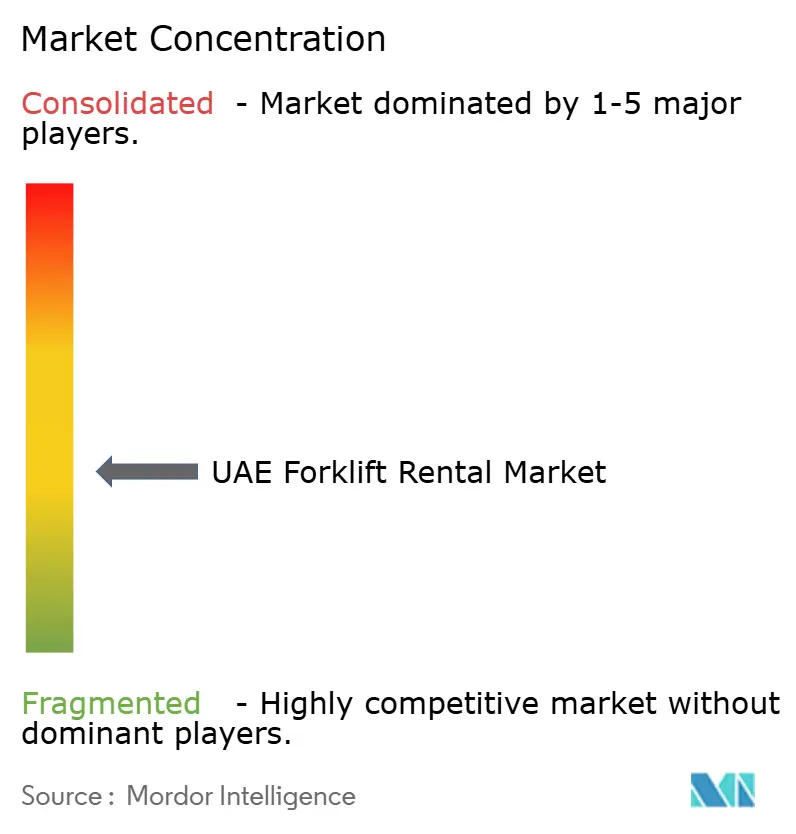
| Market Concentration | Medium |
Major Players *Disclaimer: Major Players sorted in no particular order Image © Mordor Intelligence. Reuse requires attribution under CC BY 4.0. | |
UAE Forklift Rental Market Analysis by Mordor Intelligence
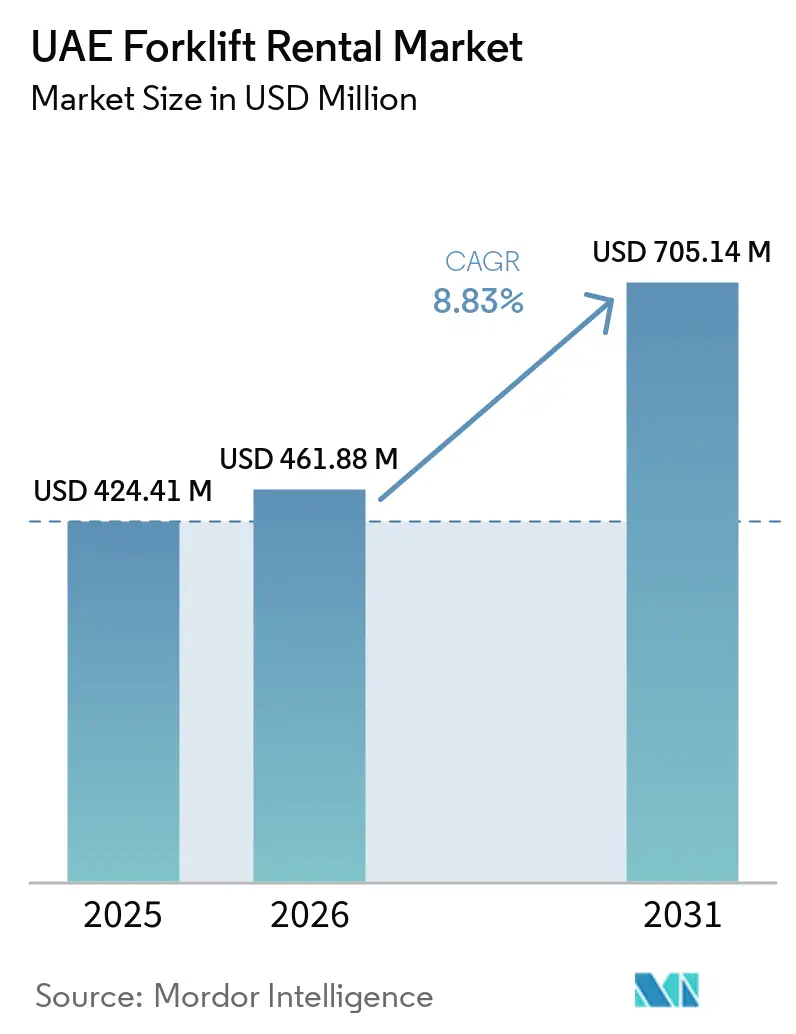
The UAE forklift rental market size was valued at USD 424.41 million in 2025 and is estimated to grow to USD 461.88 million in 2026 and reach USD 705.14 million by 2031, at a CAGR of 8.83% during the forecast period (2026-2031). Inventories remain tight around Jebel Ali Port and Dubai Investments Park, so short-term spot rentals continue to command premium day rates. Warehousing developers are adding Grade-A capacity, yet a full pipeline will not come online until late 2027, supporting multi-year lease commitments signed in 2026. Federal Decree-Law No. 11 of 2024 has made greenhouse gas reporting compulsory by May 2026, accelerating the transition from diesel or LPG to electric fleets. Key suppliers respond by bundling telematics, maintenance, and verified carbon footprints into long-term rental packages that convert client capex to predictable opex. Robotics programs launched under the Dubai Robotics and Automation Program are creating hybrid demand: firms keep conventional forklifts on contract while piloting autonomous mobile robots in parallel.
Key Report Takeaways
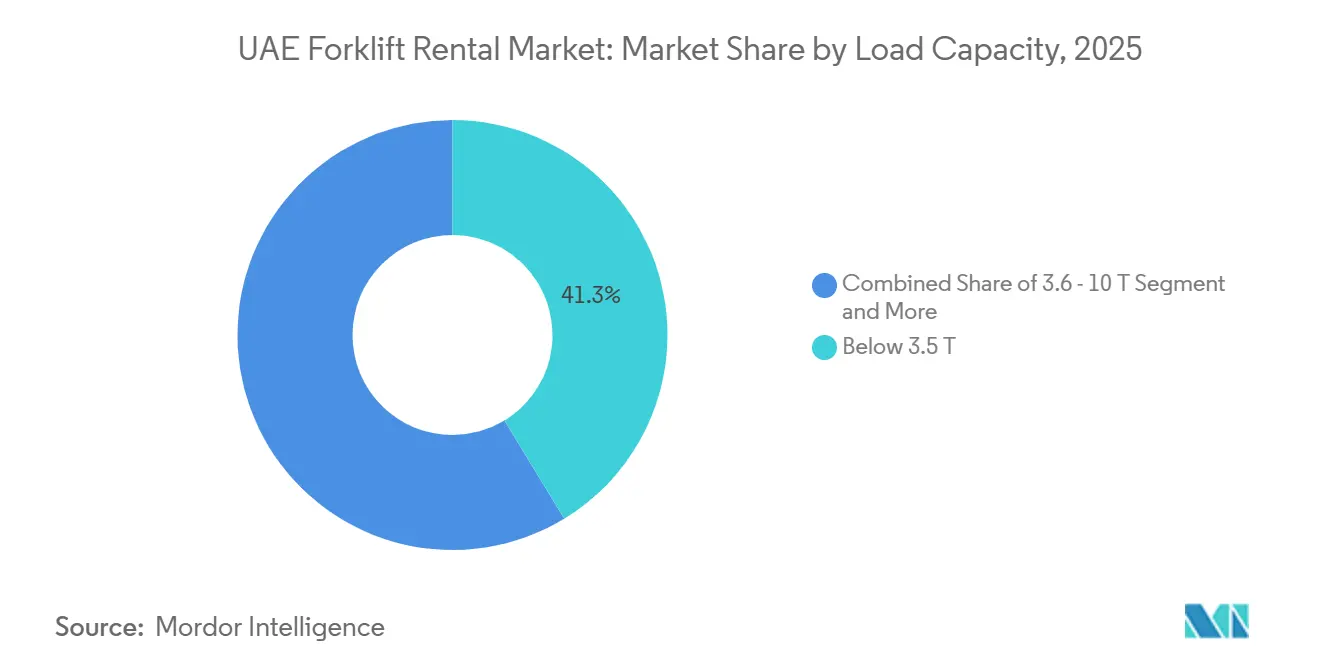
- By load capacity, forklifts under 3.5 tons led with 41.27% of the UAE forklift rental market share in 2025, whereas the 3.6-10 ton segment is projected to post the fastest growth at an 8.85% CAGR over 2026-2031.
- By rental duration, short-term spot rentals led with 45.51% of the UAE forklift rental market share in 2025, while long-term leases are projected to expand at an 8.88% CAGR through 2031.
- By power source, Internal-combustion forklifts held 67.18% of 2025, and electric forklifts are the fastest-growing segment, registering an 8.91% CAGR through 2031.
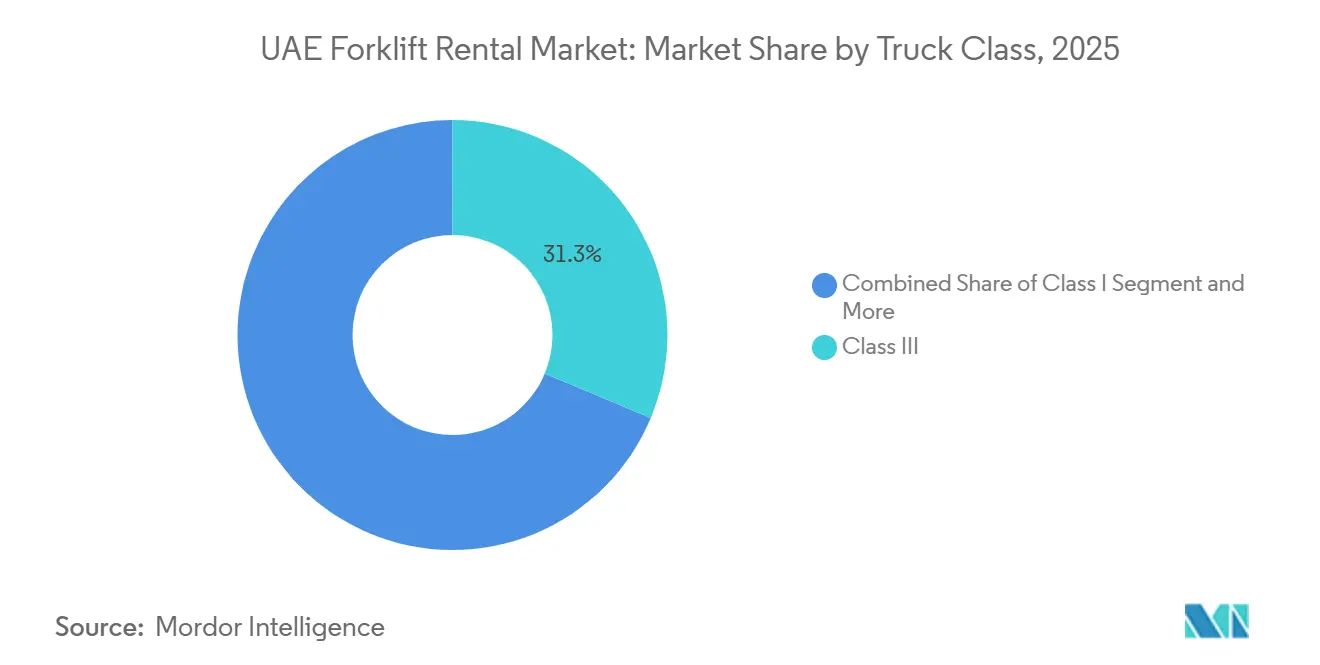
- By truck class, Class III warehouse trucks held the largest 31.27% share in 2025, while Class I electric counterbalance units are forecast to record the highest 8.93% CAGR through 2031.
- By end-use, warehousing and logistics accounted for a 48.83% share of the UAE forklift rental market size in 2025 and is advancing at an 8.96% CAGR over 2026-2031.
Note: Market size and forecast figures in this report are generated using Mordor Intelligence’s proprietary estimation framework, updated with the latest available data and insights as of January 2026.
United arab emirates operates as part of an interconnected international environment rather than as a self-contained country level unit. The forklift rental market research by Mordor Intelligence places together all major developments across the globe within that wider frame.
UAE Forklift Rental Market Trends and Insights
Drivers Impact Analysis*
| Driver | (~) % Impact on CAGR Forecast | Geographic Relevance | Impact Timeline |
|---|---|---|---|
| Logistics-Hub Expansion Fueled by E-Commerce and Free-Trade Zones | +2.1% | Dubai (Jebel Ali, JAFZA), Abu Dhabi (KEZAD, Masdar), Sharjah | Medium term (2-4 years) |
| Infrastructure Push for Mega-Projects and Smart Cities | +1.8% | Dubai, Abu Dhabi, Ras Al Khaimah | Long term (≥ 4 years) |
| Accelerating Shift Toward Electric Forklifts | +1.5% | National, with early gains in Dubai, Abu Dhabi | Medium term (2-4 years) |
| Sme Preference for Capex-Light Rental Models | +1.2% | National, concentrated in Dubai Industrial City, Sharjah | Short term (≤ 2 years) |
| Rising Labor Costs Spurring Warehouse Automation Demand | +1.0% | Dubai, Abu Dhabi logistics hubs | Medium term (2-4 years) |
| Mega-Event and Exhibition Cycles Driving Spot Rentals | +0.9% | Dubai (DWTC, Expo City), Abu Dhabi | Short term (≤ 2 years) |
| Source: Mordor Intelligence | |||
Logistics-Hub Expansion Fueled by E-Commerce and Free-Trade Zones
Phase 2 at JAFZA added 360,000 ft² of temperature-controlled warehousing in March 2025, bringing the total park to more than 922,000 ft² and serving 10,890 companies [1]“DP World Announces USD 8 Billion Terminal Upgrade,” DP World, DPWORLD.COM. Dubai’s port handles 14 million TEUs annually, and DP World has earmarked USD 8 billion for AI-enabled terminal upgrades, keeping forklift utilization high near the quay. China-UAE trade surpassed USD 80 billion in 2025, and regional e-commerce is forecast at AED 183.6 billion (Approximately USD 50.03 billion) by 2028, intensifying demand for narrow-aisle electric reach trucks. AD Ports Group posted revenue above USD 7 billion in 2025, following a string of acquisitions that lifted contract-logistics space to a record 6 million m². Peak-season surges linked to White Friday and Eid push spot-rental bookings upward, while anchor tenants are locking in three- to five-year deals to cover baseline flows.
Infrastructure Push for Mega-Projects and Smart Cities
Dubai’s Roads and Transport Authority is delivering 57 projects that include 226 km of highways and 115 bridges, many of which are already 50-60% complete [2]“Strategic Plan 2025-2027,” Dubai Roads & Transport Authority, RTA.AE . The Metro Blue Line extension will add 30 km of track by 2029, reinforcing transit-oriented development and prompting a shift toward compact electric forklifts for urban fulfillment hubs located within mixed-use districts. Elsewhere, Statevolt’s USD 3.2 billion gigafactory in Ras Al Khaimah, slated for end-2026, is driving early demand for heavy-capacity rentals during construction and will later require strict electrostatic-safe handling of battery packs. ADNOC’s USD 150 billion capex program spreads industrial demand to Ruwais and offshore islands, but schedule fluctuations add cyclicality to forklift deployment planning.
Accelerating Shift Toward Electric Forklifts for ESG Compliance
Federal Decree-Law No. 11 of 2024 obliges all UAE firms to report Scope 1 and 2 emissions by May 2026, with fines up to AED 4 million (approximately USD 1.088 million) for repeat offenders. Large corporates such as DP World and Emirates NBD cascade sustainability standards to suppliers, making verifiable carbon data a bid-qualification item for rental contracts. The UAE Net Zero 2050 strategy targets 50% electrification of all vehicles, nudging fleets toward lithium-ion solutions despite DEWA’s public-charging license fees of AED 500-7,500 per port. Early adopters gain access to sustainability-linked finance and can command up to a 10% rate premium versus diesel units in warehouse environments that mandate low noise and zero tailpipe emissions.
SME Preference for Capex-Light Rental Models Amid Credit Tightening
Warehouse rents in Dubai rose 13% year on year, and bank financing for equipment sits at 4-6% over seven years. Smaller importers, therefore, keep balance sheets lean by renting forklifts for one to 12 months, bundling maintenance and telematics in lieu of ownership. Robotics-as-a-service contracts are emerging, allowing firms to combine AMRs with Class I counterbalance trucks under a single variable-usage fee. Demand volatility tied to e-commerce flash sales keeps the UAE forklift rental market skewed toward flexible terms, ensuring short-term packages retain relevance beside the fast-growing long-term category.
Restraints Impact Analysis*
| Restraint | (~) % Impact on CAGR Forecast | Geographic Relevance | Impact Timeline |
|---|---|---|---|
| Limited Public Charging and High Electricity Tariffs | -0.8% | Dubai, Abu Dhabi (DEWA, ADDC zones) | Medium term (2-4 years) |
| Volatile Oil-and-Gas Project Timelines Creating Demand Swings | -0.6% | Abu Dhabi (ADNOC upstream/downstream zones), Ruwais | Short term (≤ 2 years) |
| Grey-Market Imports Depressing Fleet Utilization and Rates | -0.5% | National, concentrated in Sharjah, Ajman | Short term (≤ 2 years) |
| Stringent Emirate-Level Safety Certification Costs | -0.4% | Abu Dhabi (OSHAD-SF), Dubai (Dubai Municipality) | Medium term (2-4 years) |
| Source: Mordor Intelligence | |||
Limited Public Charging and High Electricity Tariffs for E-Forklifts
DEWA’s November 2025 regulation restricts public chargers to DEWA-controlled or licensed operators, imposes AED 0.7-1.2 per kWh caps, and bars rooftop solar from offsetting forklift-charging loads. Annual license fees can top AED 15,000 for a 150 kW unit, raising cost per operating hour by 8-10% versus diesel. Rental depots, therefore, rely on client-site private chargers, which limit fleet redeployment across contracts. While Statevolt’s forthcoming battery plant promises to cut pack costs, grid tariffs remain a near-term drag on electric adoption despite the segment’s 8.91% forecast CAGR.
Volatile Oil-and-Gas Project Timelines Creating Demand Swings
ADNOC’s USD 150 billion program runs through 2030, yet final investment decisions can slide with crude prices, leaving 8-18 ton forklifts idle or pushing operators to accept discounted day rates during gaps. New finds totaling 1.2 billion boe bolster long-range prospects, but near-term schedules remain fluid. Rental firms hedge by cross-leasing heavy units into construction or port-handling when energy work pauses, but the practice increases transport cost and undercuts utilization metrics that financiers track.
*Our forecasts treat driver/restraint impacts as directional, not additive. The impact forecasts reflect baseline growth, mix effects, and variable interactions.
Segment Analysis
By Load Capacity: Mid-Range Forklifts Gain on E-Commerce Density
Less-than-3.5-ton models held 41.27% of 2025 volume, yet 3.6-10 ton units are projected to rise at 8.85% through 2031 in the UAE forklift rental market. Jebel Ali’s record 630,000 t of breakbulk in October 2025 and automated quay cranes favor 5-ton diesel forklifts with container-ready masts. At the same time, automation grids in urban micro-fulfillment centers shrink aisle widths, sustaining demand for agile sub-3-ton electrics.
Warehouse retrofits using AS/RS raise storage density fourfold, reducing travel distances and reinforcing under-3.5-ton dominance inside buildings. Steel yards and precast plants still need Hyster H8-18XD units, but that niche moves with oil-and-gas cycles. Service history remains the prime purchase criterion for second-life units as buyers chase residual value in the tight equipment pool.



By Rental Duration: Long-Term Leases Accelerate as Operators Lock Capacity
Spot rentals under one month accounted for 45.51% of 2025 transactions, reflecting event spikes and short construction kicks. Yet three- to five-year agreements are growing fastest at 8.88% CAGR, as KEZAD tenants in Abu Dhabi and 3PLs in JAFZA fix fleets ahead of the 15 million m² logistics-space gap forecast by 2030.
Federal climate rules drive integrated contracts that fold in maintenance, telematics, and carbon reporting, making long-term deals more economical than bank-financed purchases for cash-tight SMEs. Providers respond with hybrid packages that grant surge add-ons during White Friday or GITEX peaks. This blend keeps every utilization band engaged, preserving liquidity across the UAE forklift rental market.
By Power Source: Electric Forklifts Surge Despite Charging Constraints
Internal-combustion forklifts held 67.18% of 2025 lift hours, yet electrics posted the highest 8.91% growth rate. Warehouse managers prefer zero-tailpipe options to meet Scope 1 targets, and lithium-ion units cut brake-wear downtime through regenerative systems. Linde’s Xi Roadster, launched in 2026 with A-pillar-free sightlines, is already booked into multiple high-bay DCs in Dubai South.
Charging fees and license costs hamper depot-level infrastructure, so fleets lean on customer sites with private AC chargers capped at 22 kW. Statevolt’s battery plant will localize cell supply and may shave acquisition costs by 2027. Until tariffs soften, rental firms promote overnight slow-charge models that fit single-shift schedules and widen their UAE forklift rental market size opportunity without violating uptime guarantees.
By Truck Class: Class I Electrics Lead Automation Integration
Class III warehouse trucks held 31.27% in 2025, yet Class I electric counterbalance units grew quickest at 8.93% CAGR. These forklifts sync with WMS and AMR fleets, enabling predictive slotting and hands-free load hand-offs that raise pick rates by up to 35%. The Dubai Robotics and Automation Program aims to install 200,000 robots by 2032, anchoring steady Class I demand.
Class IV/V diesel units dominate outdoor yards, but improved wet-disc braking and sealed cabins extend their service into dusty hinterland sites where electrics overheat. Narrow-aisle Class II reach trucks capture high-rise racks topping 16 m in JAFZA’s new sheds, proving that varied form factors will coexist across the UAE forklift rental market.
By End-Use Industry: Warehousing Dominates, Construction Sustains
Warehousing and logistics commanded 48.83% of 2025 turnover and is expected to expand at an 8.96% pace. DP World’s AI terminals and AD Ports Group’s 40% revenue jump foster continuous equipment cycles. Cold-chain capacity funded by Maersk and AD Ports pushes demand for freezer-rated electrics that tolerate -30 °C.
Construction remains the second pillar as RTA’s 226 km of new roads and the Metro Blue Line spur telehandler hires. The Statevolt gigafactory and ADNOC downstream upgrades combine to keep heavy diesel forklifts booked despite mixed oil-price signals. Combined, these verticals anchor the growth trajectory of the UAE forklift rental market through 2031.
Geography Analysis
Dubai retains the largest share of the UAE forklift rental market, supported by Jebel Ali’s high container throughput and JAFZA’s substantial annual trade activity. Rising warehouse rents are tightening fleet availability and prompting firms to pre-book equipment well ahead of White Friday demand peaks. The city’s urban planning vision is directing micro-fulfillment hubs into mixed-use districts, boosting demand for quiet, zero-emission electric forklifts that can operate at night without noise permits. This shift is also encouraging rental providers to strengthen electric fleet availability, improve service response times, and align equipment offerings with the needs of last-mile logistics operators.
Abu Dhabi is expected to record the fastest lease uptake as KEZAD and Masdar City attract spillover clients priced out of Dubai. Strong income growth across port-related activities and ADNOC’s Ghasha offshore development is expected to create uneven but significant heavy-lift requirements. However, OSHAD’s operator certification requirements enforce stricter compliance, limiting grey-market arrivals. These compliance costs raise entry barriers and give established distributors a longer runway to scale within the UAE forklift rental market. As a result, customers with complex industrial and energy-linked handling needs are likely to favor certified rental providers with reliable fleets, trained operators, and stronger maintenance capabilities.
Sharjah, Ajman, and the Northern Emirates serve price-sensitive roles in the market. Grey-market units enter through smaller ports, lowering rental rates while serving SMEs that cannot afford new electric forklifts. Ras Al Khaimah’s forthcoming battery plant is expected to create an advanced manufacturing node that should increase demand for specialized handling equipment over the medium term. Overall, Dubai and Abu Dhabi are expected to continue securing the clear majority of long-term contracts, supported by stronger logistics infrastructure, higher compliance requirements, and deeper customer demand from warehousing, manufacturing, port operations, and energy-related activities.
The forklift rental market is assessed by Mordor Intelligence through a multi-layered geographic lens, covering other regions such as North America, along with detailed country-level analysis for Saudi Arabia, United States, Indonesia, South Korea, and Brazil.
Competitive Landscape
The UAE forklift rental market remains fragmented, with a limited group of established distributors holding a meaningful share of national lift activity. FAMCO and Kanoo Machinery distribute Toyota, Linde, Hyster, and Combilift fleets and maintain a strong presence across key industrial and logistics hubs. Byrne Equipment Rental and Rapid Access operate multi-emirate depots to provide rapid delivery during exhibition build-outs, a key differentiator in Dubai’s event economy, where project timelines are compressed, and equipment availability directly affects execution.
Technology adoption has become the primary competitive battleground as rental companies seek to improve fleet reliability, utilization, and customer visibility. Jungheinrich introduced cloud-based telematics that helped reduce unplanned downtime in early pilot fleets by enabling more proactive maintenance and real-time equipment monitoring. STILL’s fleet-health dashboards combine OSHA checklists and carbon tracking in a single mobile app, supporting both safety compliance and sustainability reporting. Smaller specialists partner with AMR vendors, such as Addverb, to bid for hybrid RaaS contracts that combine robots and forklifts under an integrated service-level agreement, allowing customers to manage automated and manually operated material handling assets through a more unified service model.
Compliance and financing shape market strategies as customers place greater emphasis on certified training, emissions transparency, and audit readiness. Firms promote OSHAD-certified trainers to secure Abu Dhabi petrochemical bids, where safety standards and documentation requirements remain central to vendor selection. Emirates NBD offers discounted credit lines for electrified fleets supported by third-party-verified emissions data, encouraging operators to modernize equipment while aligning with sustainability objectives. Grey-market imports face increasing customs scrutiny, pushing buyers toward established lessors and consolidating the UAE forklift rental market around players that can meet audit requirements, provide reliable documentation, and support long-term compliance needs.
UAE Forklift Rental Industry Leaders
Byrne Equipment Rental
Al-Futtaim Auto & Machinery Co. (FAMCO)
Johnson Arabia
Kanoo Machinery
Mohamed Abdulrahman Al-Bahar (CAT)
- *Disclaimer: Major Players sorted in no particular order

Recent Industry Developments
- May 2025: Dayim Equipment Rental has marked a significant milestone in its expansion strategy with the arrival of its first batch of advanced forklifts in the UAE. These units are part of a strategic USD 15 million order placed with Hangcha Forklift. This delivery initiates a large-scale deployment, set to bolster Dayim’s long-term, multi-year rental contracts not just in the UAE, but also in Saudi Arabia, Kuwait, and other pivotal markets.
- February 2025: Dubai South and Expeditors International confirmed a 23,200 m² logistics facility slated for 2025 operations, likely boosting forklift rental volumes in the Logistics District.


UAE Forklift Rental Market Report Scope
The scope of the report includes Load Capacity (Less Than 3.5 T, 3.6 to 10 T, and More Than 10 T), Rental Duration (Short-term/Spot, Mid-term, and Long-term Lease), Power Source (Electric, Internal Combustion (Diesel/LPG), and Hybrid / Hydrogen Fuel-cell), Class (Class I, Class II, Class III, Class IV, and Class V), and End-Use Industry (Warehousing and Logistics, Construction, Automotive, Food and Beverage, Aerospace and Defense, and Others (Retail, Pharma, etc.)).
| Less Than 3.5 T |
| 3.6 - 10 T |
| More Than 10 T |
| Short-term / Spot ( Less Than 1 month) |
| Mid-term (1 - 12 months) |
| Long-term Lease (3 - 5 years) |
| Electric |
| Internal Combustion (Diesel/LPG) |
| Hybrid |
| Class I |
| Class II |
| Class III |
| Class IV |
| Class V |
| Warehousing & Logistics |
| Construction |
| Automotive |
| Food & Beverage |
| Aerospace & Defense |
| Others (Retail, Pharma, etc.) |
| By Load Capacity | Less Than 3.5 T |
| 3.6 - 10 T | |
| More Than 10 T | |
| By Rental Duration | Short-term / Spot ( Less Than 1 month) |
| Mid-term (1 - 12 months) | |
| Long-term Lease (3 - 5 years) | |
| By Power Source | Electric |
| Internal Combustion (Diesel/LPG) | |
| Hybrid | |
| By Truck Class | Class I |
| Class II | |
| Class III | |
| Class IV | |
| Class V | |
| By End-use Industry | Warehousing & Logistics |
| Construction | |
| Automotive | |
| Food & Beverage | |
| Aerospace & Defense | |
| Others (Retail, Pharma, etc.) |


Key Questions Answered in the Report
What is the 2026 value of the UAE forklift rental market?
It is estimated at USD 461.88 million, on track for USD 705.14 million by 2031.
Which rental duration is growing fastest?
Long-term leases of three to five years are increasing at an 8.88% CAGR through 2031.
Why are electric forklifts gaining ground in the UAE?
Mandatory GHG reporting, client ESG targets, and quieter operation inside Grade-A warehouses are accelerating electric adoption despite charging-infrastructure hurdles.
Which emirate generates the highest forklift rental demand?
Dubai leads due to Jebel Ali Port cargo volumes, JAFZA tenancy, and a dense calendar of global exhibitions.
How do new safety laws affect rental companies?
Abu Dhabi’s OSHAD Code 51.0 and Dubai Municipality rules raise certification costs but also deter grey-market competition, favoring compliant lessors.
Are automation and forklift rentals compatible?
Yes, many warehouses run hybrid fleets, renting conventional forklifts during the pilot phase of AMR or AS/RS rollouts to maintain service continuity.
Page last updated on:





