
Market Overview
| Study Period | 2020 - 2031 |
|---|---|
| Forecast Data Period | 2026 - 2031 |
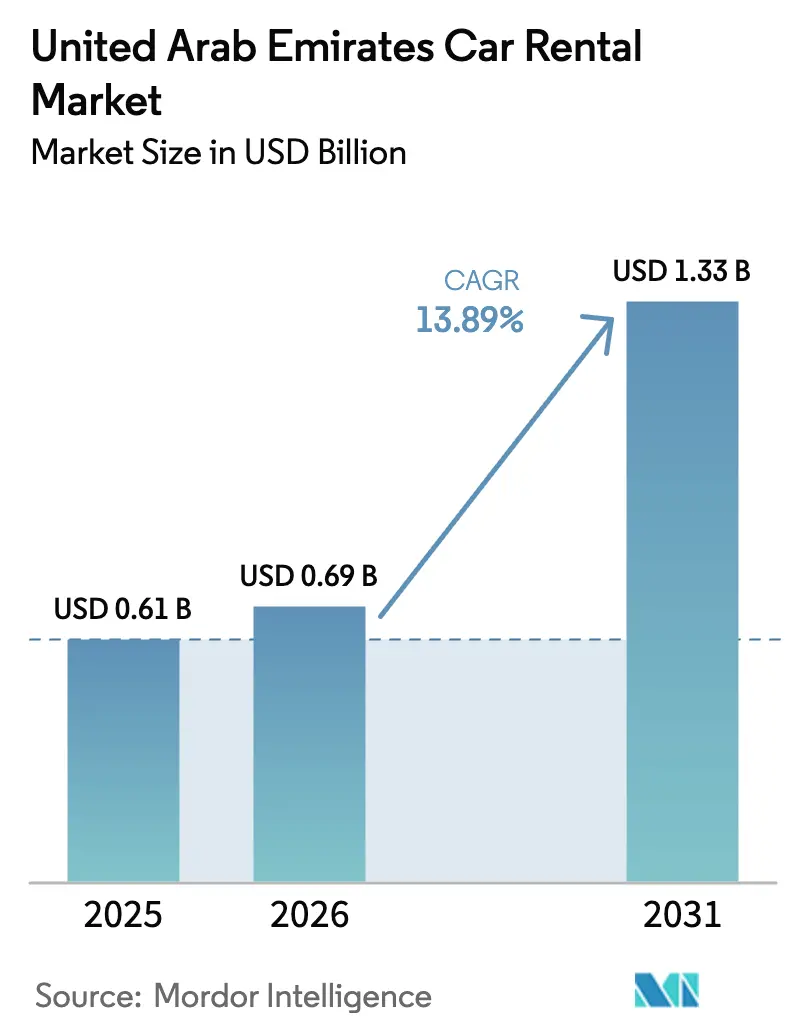
| Base Year Market Size (2025) | USD 0.61 Billion |
| Market Size (2026) | USD 0.69 Billion |
| Market Size (2031) | USD 1.33 Billion |
| Growth Rate (2026 - 2031) | 13.89 % |
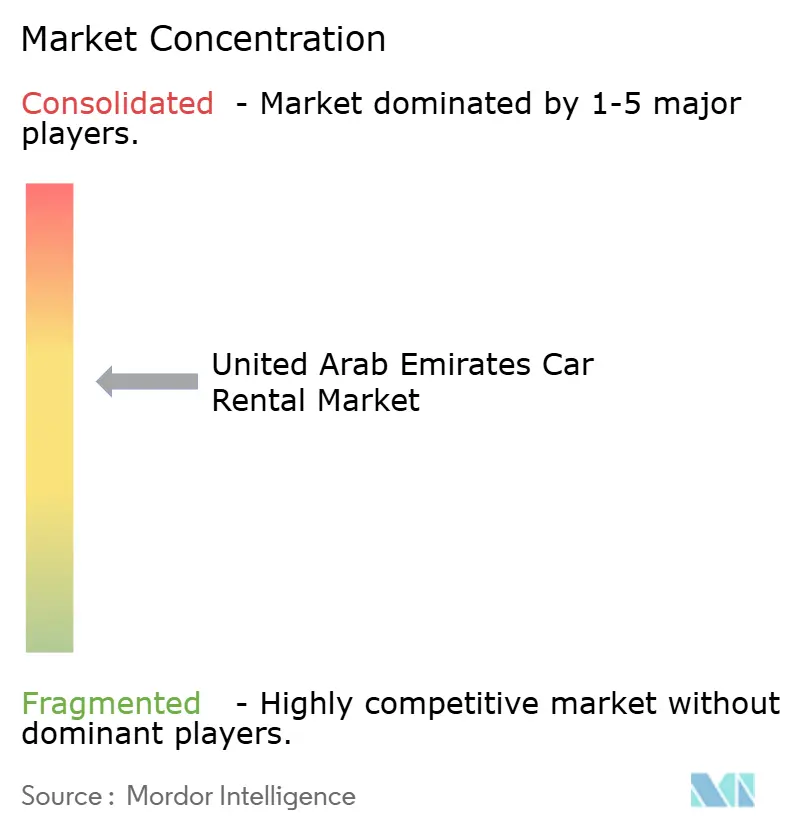
| Market Concentration | Medium |
Major Players
*Disclaimer: Major Players sorted in no particular order Image © Mordor Intelligence. Reuse requires attribution under CC BY 4.0. |
|
United Arab Emirates Car Rental Market Analysis by Mordor Intelligence
The UAE car rental market size was valued at USD 0.61 billion in 2025 and estimated to grow from USD 0.69 billion in 2026 to reach USD 1.33 billion by 2031, at a CAGR of 13.89% during the forecast period (2026-2031). Strong inbound tourism, steady corporate travel recovery, and rapid digitalization reinforce rental demand, while government policies favor fleet electrification and contactless service models. Platform-based operators continue to reduce customer acquisition costs, enabling dynamic pricing that boosts fleet utilization. Growing executive travel across free zones sustains premium fleet demand, even as stringent traffic-violation fines and ride-hailing price wars squeeze margins. Investment momentum remains intact because a large, diversified visitor base ensures resilience against cyclical shocks, and regulatory initiatives such as extended lifespans for electric vehicles improve total cost-of-ownership economics.
Key Report Takeaways
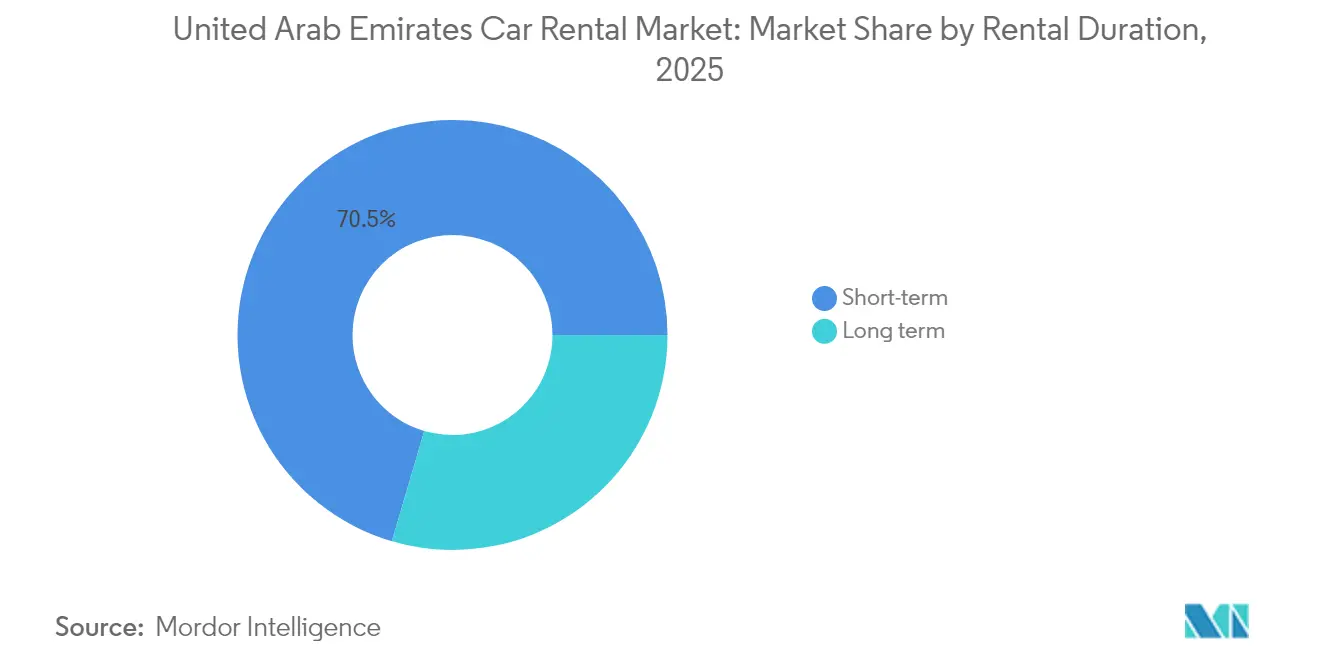
- By rental duration, short-term rentals held 70.45% of the United Arab Emirates car rental market share in 2025, while long-term rentals are projected to expand at an 11.21% CAGR through 2031.
- By booking type, online channels captured 63.25% revenue share of the United Arab Emirates car rental market size in 2025 and are forecast to grow at a 14.35% CAGR to 2031.
- By driving type, self-driven rentals commanded 77.12% of the United Arab Emirates car rental market in 2025; chauffeur-driven services represent the fastest-growing niche with a 14.24% CAGR through 2031.
- By vehicle type, budget and economy cars led with 68.35% revenue share of the United Arab Emirates car rental market in 2025, whereas premium and luxury rentals are advancing at a 14.05% CAGR through 2031.
Note: Market size and forecast figures in this report are generated using Mordor Intelligence’s proprietary estimation framework, updated with the latest available data and insights as of 2026.
United Arab Emirates Car Rental Market Trends and Insights
Drivers Impact Analysis*
| Driver | (~) % Impact on CAGR Forecast | Geographic Relevance | Impact Timeline |
|---|---|---|---|
| Growth of Inbound Tourism | +1.8% | UAE-wide, concentrated in Dubai and Abu Dhabi | Short term (≤ 2 years) |
| Government Push for EV-based Rental Fleets | +1.5% | National, with early adoption in Dubai and Abu Dhabi | Medium term (2-4 years) |
| Rising Digital-first Consumer Behaviour | +1.2% | UAE-wide, strongest in urban emirates | Short term (≤ 2 years) |
| Expansion of Corporate Long-term Leasing Programs | +0.8% | Dubai, Abu Dhabi business districts | Medium term (2-4 years) |
| Rise in Mega-events | +0.7% | Dubai, with spillover to Abu Dhabi and Northern Emirates | Long term (≥ 4 years) |
| Surge in Gig-economy | +0.6% | Urban emirates, concentrated in Dubai and Sharjah | Short term (≤ 2 years) |
| Source: Mordor Intelligence | |||
Growth of Inbound Leisure Tourism
Visitor arrivals continued to climb through 2025, sustaining all-season rental demand that peaks during November–May when cooler weather favors outdoor activities. Expanded airport capacity, new hotel inventory, and event-centric attractions—from World Expo legacies to Formula 1 in Abu Dhabi—translate directly into higher fleet utilization for operators positioned near key arrival hubs. Airline partnerships and visa-on-arrival privileges now attract tourists from Asia and Africa, broadening the addressable customer pool. Leisure travelers prefer the flexibility of multiday rentals for inter-emirate itineraries, driving average rental durations higher. Seasonality remains pronounced, with Ramadan and Eid holidays boosting volumes by roughly one-third, allowing companies to deploy surge pricing strategies. Demand predictability enables proactive fleet planning, reducing idle time and enhancing return on assets. Additionally, according to eZhire, car ownership in major GCC cities is projected to decline by 10% by 2030, driven by the rapid adoption of AI-powered mobility solutions and shifting lifestyle preferences[1]"On-Demand Mobility Gains Traction: eZhire Predicts a 10% Drop in Car Ownership by 2030," Bizpreneur Middle East, bizpreneurme.com.
Government Push for EV-Based Rental Fleets
The National EV Policy mandates 50% electric adoption by 2050 and already grants electric rentals six-year lifespans, versus four years for internal-combustion fleets. Dubai regulations go further, allowing premium electric cars to operate for up to 10 years, which favorably shifts residual value curves for high-end fleets. Early movers enjoy marketing advantages with sustainability-minded tourists and corporate clients that prioritize ESG reporting. Capital outlays are partially offset by lower energy and maintenance costs as fast-charging infrastructure expands along major corridors. Fleet rotation strategies are changing, with operators phasing out older sedans to finance electric crossovers that meet range requirements for inter-city trips. For lagging firms, compliance costs rise as internal-combustion residuals soften ahead of stricter 2030 targets.
Rising Digital-First Consumer Behavior
Mobile booking apps captured principal transaction value in 2024 and are still growing double-digit, underpinning the competitive edge of technology-centric operators. Seamless e-KYC, digital key handovers, and AI-driven damage assessment shorten pickup times, reducing branch overheads. Real-time data feeds enable predictive maintenance scheduling, cutting unexpected downtime and safeguarding the customer experience. Government-approved car-sharing pilots such as Udrive legitimize app-based rentals, spurring further consumer adoption. Cashless payments lower fraud risks and accelerate working-capital cycles, but smaller firms struggle with the upfront cost of platform development. Data analytics deepen customer insight, empowering loyalty-based upselling of insurance, accessories, and premium models.
Expansion of Corporate Long-Term Leasing Programs
Free-zone multinationals outsource fleet management to rental specialists to sidestep ownership depreciation and administration tasks. Contracts spanning 24–48 months assure operators of baseline utilization, stabilizing revenue in off-peak tourist seasons. Employers value bundled offerings—insurance, servicing, replacement vehicles—because they cap transportation budgets and simplify expense audits. Gig-economy delivery partners likewise demand month-to-month light-commercial vans, creating a new recurring-revenue pocket. Regulatory familiarity with tender processes favors incumbents, while telematics provided to corporate clients enable mileage-based billing and proactive safety coaching. Competitive tendering, however, pushes margins lower, reinforcing the need for scale economies and efficient life-cycle cost control.
Restraints Impact Analysis*
| Restraint | (~) % Impact on CAGR Forecast | Geographic Relevance | Impact Timeline |
|---|---|---|---|
| Stringent Traffic-Violation Penalties | -1.1% | UAE-wide, particularly Dubai and Abu Dhabi | Short term (≤ 2 years) |
| Growing Ride-Hailing Price Competitiveness | -0.9% | Urban emirates, concentrated in Dubai | Short term (≤ 2 years) |
| Limited Residual-Value For ICE Fleets | -0.7% | National, affecting all fleet operators | Long term (≥ 4 years) |
| High Insurance Premiums | -0.5% | UAE-wide, strongest impact in Dubai and Abu Dhabi | Medium term (2-4 years) |
| Source: Mordor Intelligence | |||
Stringent Traffic-Violation Penalties and Fines
Enhanced smart-camera networks automatically bill violations to car owners, shifting liability to rental companies when tourists depart before fines clear. Operators now pre-authorize larger deposits and deploy in-vehicle telematics to alert drivers of speeding thresholds. Insurance premiums for under-25 drivers rose in 2024, inflating total rental cost and dampening youth uptake. Additional back-office staffing is required to reconcile fines across multiple emirates, adding overhead. Firms educate customers through multilingual tutorials at pickup, yet longer check-in times reduce throughput. Persistent enforcement keeps accident rates low, but the administrative burden constrains smaller agencies lacking digital violation-management tools.
Growing Ride-Hailing Price Competitiveness
Daily ride-hailing bundles rival short-term rental rates for city-center stays where parking fees erode rental value. Surge promotions by Uber and Careem during peak tourist seasons intensify customer switching. Autonomous pilot fleets in Abu Dhabi hint at future structural cost declines that could undercut economy rentals. Corporate clients test mobility-as-a-service subscriptions for urban staff, reallocating travel budgets away from traditional leases. Rental companies respond with weekend packages and loyalty points redeemable for free upgrades to preserve share. Ride-hailing remains less suitable for multi-day desert excursions and luggage-heavy family trips, ensuring coexistence rather than wholesale displacement.
*Our forecasts treat driver/restraint impacts as directional, not additive. The impact forecasts reflect baseline growth, mix effects, and variable interactions.
Segment Analysis
By Rental Duration: Short-Term Leasing Accelerates Revenue Stability
Short-term contracts contributed a 70.45% share of the United Arab Emirates car rental market in 2025, and long-term rentals posted an 11.21% CAGR to 2031. The UAE car rental market size attributed to this segment is forecast to rise rapidly as multiyear fleet outsourcing gains board-level approval across finance, tech, and energy sectors. Mileage-inclusive packages lower total mobility cost, and telematics-supported preventive maintenance minimizes downtime. Rental firms deploy residual-value forecasting tools to align lease pricing with evolving EV resale curves, lowering balance-sheet risk.
Short-term rentals continue anchoring the UAE car rental market through tourist inflows, but growth moderates as ride-hailing absorbs some city-use occasions. Seasonal fleet swelling remains essential; firms leverage auction partnerships for quick divestment after peak periods. Add-on revenue—from navigation units to child seats—keeps per-transaction profitability attractive. Collaboration emerges when operators cross-market weekend deals to corporate lessees, smoothing utilization across weekdays and holidays.



By Booking Type: Online Channels Cement Dominance
Online platforms generated 63.25% of the United Arab Emirates car rental market revenue in 2025, with a 14.35% CAGR during the forecast period. Operators leverage AI-enabled rate engines to alter prices hourly, capturing consumer surplus during demand spikes. In-app upselling of collision-damage waivers lifts ancillary margins. Partnerships with airline and hotel apps funnel high-intent traffic directly into booking funnels, cutting aggregator fees.
Offline counters remain relevant for luxury rentals involving personalized vehicle handover and corporate invoice processing requiring on-site signatures. Yet branch networks are rationalizing footprints, relocating space savings into fleet electrification and software. Contactless kiosks in hotel lobbies combine the immediacy of physical presence with the efficiency of QR-code transactions, blending both channels.
By Driving Type: Self-Driven Services Gain Executive Traction
Self-drive options secured a 77.12% share of the United Arab Emirates car rental market in 2025, thanks to cost-effectiveness and privacy preferences. Still, chauffeured rides are projected to outpace overall market growth at a 14.24% CAGR through 2031, as productivity-minded executives outsource driving. Companies recognize value in en-route virtual meetings, justifying premium rates. Concierge-style perks—gate-side airport pickups, multilingual drivers—differentiate top-tier providers. Google Maps is widely used across the UAE, and Senyar offers an integrated navigation system for locating addresses.
Regulations stipulating RTA-licensed drivers and enhanced insurance elevate entry barriers, limiting supply to vetted operators. Fleet managers rotate drivers among EV sedans to showcase sustainability credentials to C-suite clients. Self-drive services counter with optional roadside-assistance apps and flexible return stations, sustaining their appeal among leisure travelers who prize spontaneity and extended mileage allowances.

By Vehicle Type: Premium and Luxury Rentals Accelerate
Budget and economy cars hold a 68.35% share of the United Arab Emirates car rental market in 2025, providing essential mobility for price-sensitive tourists and expatriates. However, premium models such as high-performance SUVs are expanding at a 14.05% CAGR through 2031, well ahead of the United Arab Emirates car rental market growth. Social-media-driven status signaling fuels demand for exotic models, especially during high-profile events. Extended 10-year operating windows for luxury EVs increase lifetime revenue potential, encouraging fleet diversification toward Tesla, Mercedes-EQ, and BMW i lines.
Economy fleets increasingly consist of fuel-efficient compacts that meet corporate sustainability metrics without premium pricing. Operators hedge residual risk via manufacturer buy-back programs, keeping refresh cycles under three years. Cross-segment bundling—upgrade offers for birthdays or conference delegations—creates revenue synergies and raises brand equity.
Geography Analysis
Dubai dominated the United Arab Emirates car rental market value in 2024 due to unmatched air connectivity, an extensive hotel pipeline, and dense business clusters. Mega-events such as COP28 and Art Dubai create predictable occupancy spikes that allow dynamic fleet deployment into downtown and resort corridors. Regulatory agility, including pilot approvals for autonomous shuttles, positions Dubai as a test-bed for future mobility formats.
Abu Dhabi is anchored by sovereign-wealth-fund headquarters, energy majors, and government agencies that require long-term executive transport. Cultural landmarks like Louvre Abu Dhabi and the Yas Marina circuit attract affluent tourists who favor luxury models, reinforcing premium-fleet utilization. The emirate’s Green Mobility strategy subsidizes fast chargers at hotels and malls, driving early electric-fleet ROI.
Tourism boosters—from Khor Fakkan cruises to mountain adventure parks—are widening leisure itineraries beyond Dubai-Abu Dhabi corridors, stimulating inter-emirate rental demand. Federal initiatives to harmonize parking regulations and toll-payment systems are easing cross-border fleet operations, making regional expansion financially viable for mid-scale firms.
Regulatory Landscape
Car rental operations in the UAE are governed primarily at emirate level, led by Dubai Roads and Transport Authority (RTA) and Abu Dhabi Department of Municipalities and Transport (DMT), alongside local economic licensing bodies that issue the underlying commercial trade license for the activity. In Dubai, the framework is anchored by Executive Council Resolution No. (47) of 2017 and its implementing bylaw (issued in 2022), which define operator licensing, operating requirements, and compliance obligations. Abu Dhabi publishes separate Hourly Car Rental Regulations through DMT. Entry and operating rules typically include minimum fleet thresholds (for example, 10 vehicles for new entrants in Dubai and 30 in Abu Dhabi), vehicle age limits for onboarding fleets, registration under the company name, and requirements to use regulator-linked electronic systems for monitoring and administration.
Consumer protection and transactional standardization are also becoming more explicit, including circulars requiring security deposits to be refunded within 30 days. This tightens back-office controls for agencies and increases auditability of payment and dispute processes. Compliance with mandatory insurance coverage, documented rental contracts, and regulator-prescribed procedures for fines and violations adds cost and process discipline, particularly for high-volume airport and online-led operators that must reconcile multi-emirate enforcement and billing rules at scale.
Competitive Landscape
Global giants leverage airport concessions, loyalty programs, and multi-country corporate contracts to secure volume. Local specialists counter with hyper-localized pricing, flexible payment options, and Arabic-language customer support. Digital-native entrants like eZhire and Udrive pursue asset-light models, sourcing cars from partner fleets and monetizing through subscription plans.
Technology has become the primary battlefield: API-driven booking, AI-guided dynamic pricing, and telematics-based risk scoring differentiate winners. Capital requirements for constant software upgrades and EV procurement nudge smaller firms toward mergers or niche specialization. Fleet insurers reward telematics adoption with premium discounts, providing a financial incentive for data-rich platforms. The Dubai Roads and Transport Authority's regulatory framework supports market development through streamlined licensing procedures and technology integration initiatives, while maintaining safety standards through comprehensive oversight mechanisms.
White-space opportunities persist in corporate long-term leasing, luxury EV experiences, and logistics van rentals supporting last-mile delivery. Heightened compliance audits by the RTA further professionalize the sector, tilting competitive advantage toward firms with robust governance footprints.
United Arab Emirates Car Rental Industry Leaders
-
SIXT SE
-
The Hertz Corporation
-
Avis Budget Group Inc.
-
Europcar International
-
Enterprise Holdings, Inc.
- *Disclaimer: Major Players sorted in no particular order

Market Opportunities and Future Outlook
Regulator-led digitization is creating operational whitespace for agencies that connect licensing, monitoring, and payment workflows to emirate platforms such as Dubai RTA systems. This reduces cycle time for onboarding vehicles, issuing contracts, and managing compliance. The shift toward clearer consumer rules, including the requirement to refund security deposits within 30 days, also supports differentiation through transparent pricing, automated deposit-release processes, and dispute-management tools. This aligns with the market structure where online bookings already account for 63.25% of revenue (2025).
Fleet composition and product design opportunities are also expanding around electrification and premiumization, supported by policy signals and operating-economics changes highlighted in-market. These include longer permitted lifespans for electric vehicles versus internal-combustion fleets, and extended windows for premium electric cars under Dubai rules. Operators can translate this into targeted EV and luxury-EV propositions for corporate accounts and high-spend tourists, while scaling short-stay demand concentrated in Dubai and Abu Dhabi through compliant digital processes (e-KYC, e-contracting, deposit automation) without expanding branch overhead at the same pace.
Recent Industry Developments
- June 2026: SIXT United Arab Emirates announced upcoming expansion to a new branch in a major destination in Dubai. The direct market expansion broadens SIXT's local network and increases access for travelers. The fleet and footprint growth at key transport hubs strengthens regional coverage and competitive positioning.
- June 2026: Hertz UAE initiated launch of a redesigned customer website focused on faster bookings and clearer information. The digital platform enhancement improves user experience and supports higher rental throughput. The improved online conversion strengthens Hertz UAE's ability to capture demand and streamline transactions.
- November 2025: Hertz UAE formed a leasing partnership to introduce 150 new BYD hybrid vehicles to its fleet. The fleet electrification expands the EV mix and aligns with regional green policies. The strategic move improves total cost of ownership and reinforces compliance with environmental standards.


Research Methodology Framework and Report Scope
Market Definition and Coverage
This market covers revenue earned from renting passenger cars in the United Arab Emirates, including fees linked to rental duration, booking activity, and driver arrangement, and reported in USD value for the study period.
Scope exclusions: It excludes ride-hailing trips, vehicle leasing treated as long-term financing, and peer-to-peer car sharing when it is not booked as a rental service.
Segmentation Overview
-
By Rental Duration
- Short-Term (Less than 30 days)
- Long-Term (More than 30 days)
-
By Booking Type
- Online
- Offline
-
By Driving Type
- Self-Driven
- Chauffeur-Driven
-
By Vehicle Type
- Budget/Economy
- Premium/Luxury
Data Sources, Market Sizing, and Validation
Desk Research
Desk research was used to map demand drivers and to anchor the model with UAE travel and mobility indicators. We relied on public sources such as releases from the UAE Ministry of Economy, datasets from the Federal Competitiveness and Statistics Centre, tourism dashboards from emirate-level tourism bodies, airport traffic publications, and central bank or IMF macro series that provide context for travel conditions and spending.
To keep the revenue build grounded, we also reviewed operator websites, public filings for listed groups, investor decks, and reputable business press covering fleet trends and pricing moves. In a few places, paid subscriptions were used only as supporting inputs, mainly for company financials and news screening, and to cross-check import and shipment signals where available. The sources above are illustrative rather than exhaustive, and additional public documents were reviewed to validate assumptions and clarify gaps.
Primary Interviews and Surveys
Primary work focused on checking how rental demand splits between airport locations and city locations, and how pricing changes with seasonality and fleet availability. We spoke with a mix of rental operators, fleet managers, channel partners, and corporate travel buyers across the UAE, so assumptions on utilization, average rental days, and add-on fees could be tested against day-to-day operating practice.
Distribution of primary research fieldwork respondents
| Company type | Respondent position |
|---|---|
| Top tier: 27% | CXOs: 14% |
| Mid tier: 52% | Functional/Unit leaders: 38% |
| Smaller Players: 21% | Managers: 48% |
Market-Sizing & Forecasting
Sizing starts with a top-down build where the travel and mobility demand pool is reconstructed using UAE visitor inflows, airport passenger volumes, hotel occupancy direction, and the resident base that frequently uses short-term rentals. Those demand signals are then converted into rental revenue using practical inputs such as average rental length (days), fleet utilization, typical daily rates by vehicle class, and the share of online bookings that can lift conversion.
We then corroborated totals with selective bottom-up checks, including a roll-up of sampled operator revenue bands, fleet count logic where it was available, and channel checks on pricing for short-term versus monthly rentals. When smaller operators had limited disclosure, gaps were handled by applying utilization and rate ranges that were validated in interviews, then reviewing them against observed seasonality around peak tourism periods. Forecasts were built using scenario analysis, where drivers such as tourism growth, corporate travel normalization, and cost items like insurance and vehicle replacement cycles were stress-tested before the final trajectory was locked.
Data Validation & Update Cycle
Validation is done through a set of consistency checks so the model does not drift away from real-world market signals. We compare implied revenue per vehicle with realistic utilization levels, check year-on-year movement against tourism and air traffic trends, and review outliers that could be caused by one-time events or pricing spikes.
A second analyst reviews key assumptions and intermediate calculations, followed by a final pass where anomalies are either corrected or re-tested through follow-up calls. Reports are refreshed annually, and interim updates are triggered when material events occur, such as sharp tourism swings, regulatory changes affecting mobility, or major pricing resets. Before delivery, we run a final update sweep so clients receive the latest view aligned to the same scope and logic.
Mordor Intelligence's United Arab Emirates Car Rental Market Size Measured Against Other Published Estimates
Published market sizes for UAE car rental can vary, even when they appear to measure the same thing, because boundaries and revenue items are not always treated the same way. Differences also show up when one estimate is anchored on travel indicators and fleet economics, while another leans more on broad mobility spending splits.
By checking seasonality-adjusted fleet utilization, average rental days, and rate movement by vehicle class, Mordor Intelligence keeps the total tied to rental service revenue in the UAE, rather than blending in leasing or ride-hailing value that can change the number quickly.
Benchmark comparison
| Source | Market Size | Gaps in Research Methodology |
|---|---|---|
| Mordor Intelligence | USD 0.61 B (2025) | |
| Industry Association A | USD 0.78 B (2025) | Often includes longer-term vehicle leasing revenue and bundled chauffeur services as a single pool, which can inflate value when lease-heavy corporate accounts are counted like rentals. |
| Regional Consultancy B | USD 0.52 B (2025) | Tends to apply conservative average daily rate assumptions and may undercount airport-led demand peaks, especially when utilization uplift in high-tourism months is not modeled explicitly. |
The spread is mainly explained by what gets counted as rental revenue and how pricing and utilization are treated across peak and off-peak months. Our method stays repeatable because each step can be traced back to drivers like travel flows, rental days, utilization, and observed rate bands, and then stress-tested through practical scenario checks.


Key Questions Answered in the Report
How big is the UAE car rental market in 2026?
The UAE car rental market size is USD 0.69 billion in 2026 and is projected to reach USD 1.33 billion by 2031.
What is the forecast growth rate for car rentals in the UAE?
Market revenue is expected to advance at a 13.89% CAGR between 2026 and 2031.
Which rental duration segment is growing fastest?
Long-term leasing leads growth with an 11.21% CAGR, driven by corporate outsourcing of fleet management.
How prominent are online bookings in UAE car rentals?
Digital platforms already account for 63.25% of revenue and are expanding at a 14.35% CAGR.
What impact does fleet electrification have on rental operators?
Extended vehicle lifespans, lower operating costs, and ESG-driven demand make electric fleets increasingly profitable, although high upfront investment remains a hurdle.
Which emirate generates the highest rental demand?
Dubai contributes major market share owing to its tourism infrastructure and international business hub status.
Page last updated on:




