
United Arab Emirates DOOH Market Size and Share
Market Overview
| Study Period | 2020 - 2031 |
|---|---|
| Forecast Data Period | 2026 - 2031 |
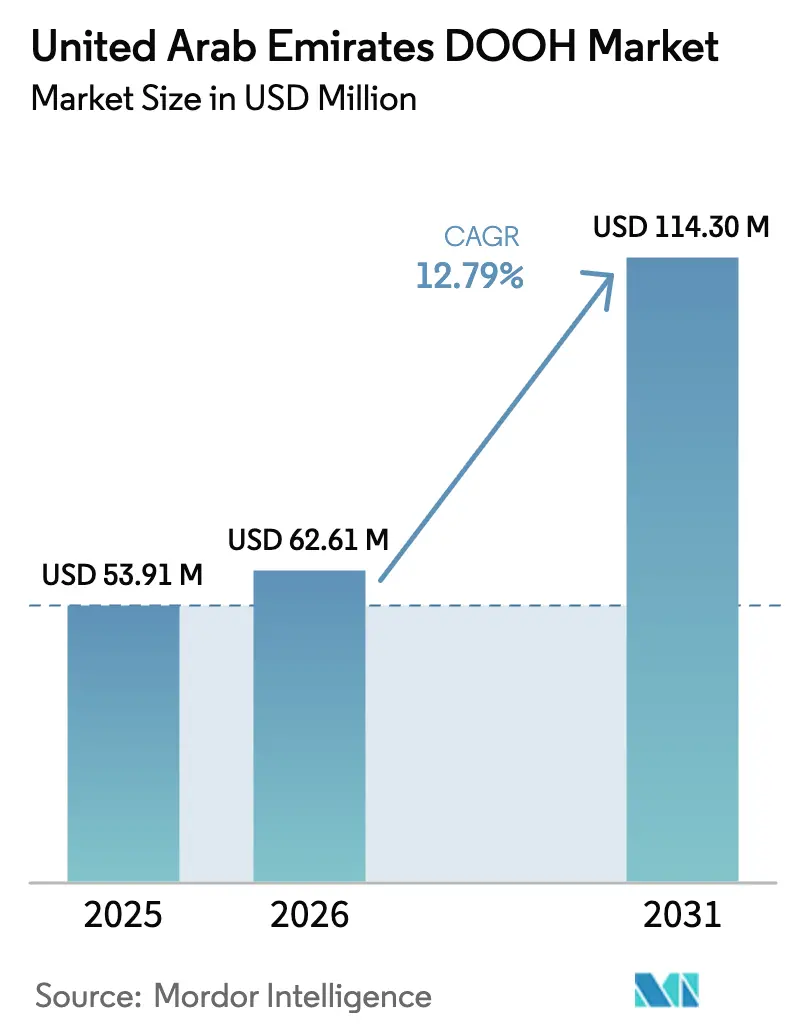
| Base Year Market Size (2025) | USD 53.91 Million |
| Market Size (2026) | USD 62.61 Million |
| Market Size (2031) | USD 114.30 Million |
| Growth Rate (2026 - 2031) | 12.79 % |
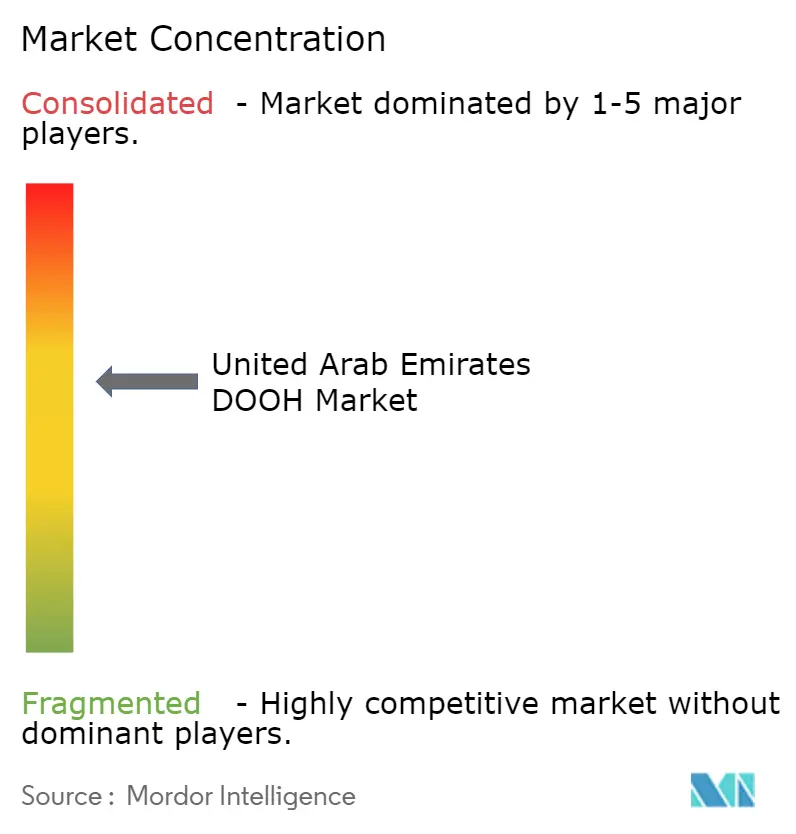
| Market Concentration | Medium |
Major Players-Market--comapny-logo.webp) *Disclaimer: Major Players sorted in no particular order Image © Mordor Intelligence. Reuse requires attribution under CC BY 4.0. | |
United Arab Emirates DOOH Market Analysis by Mordor Intelligence
The United Arab Emirates DOOH market size was valued at USD 53.91 million in 2025 and estimated to grow from USD 62.61 million in 2026 to reach USD 114.3 million by 2031, at a CAGR of 12.79% during the forecast period (2026-2031). The expansion is propelled by advertisers’ pivot from static posters to data-fueled screens, rapid airport passenger recovery, and a nationwide smart-city agenda that embeds display networks into bus shelters, metro stations, and retail precincts. Programmatic buying platforms now allow brands to bid on impressions in real time, while 3D anamorphic content and high-brightness LED technology enable creative differentiation that commands premium prices. Municipal concessions along Sheikh Zayed Road, Dubai International Airport, and key malls remain the most sought-after assets, but rising lease costs are nudging smaller operators toward secondary corridors in Sharjah and the Northern Emirates. Privacy regulation enacted in 2021 has pushed media owners to adopt anonymized camera analytics, tempering public concerns without stalling deployment momentum.
Key Report Takeaways
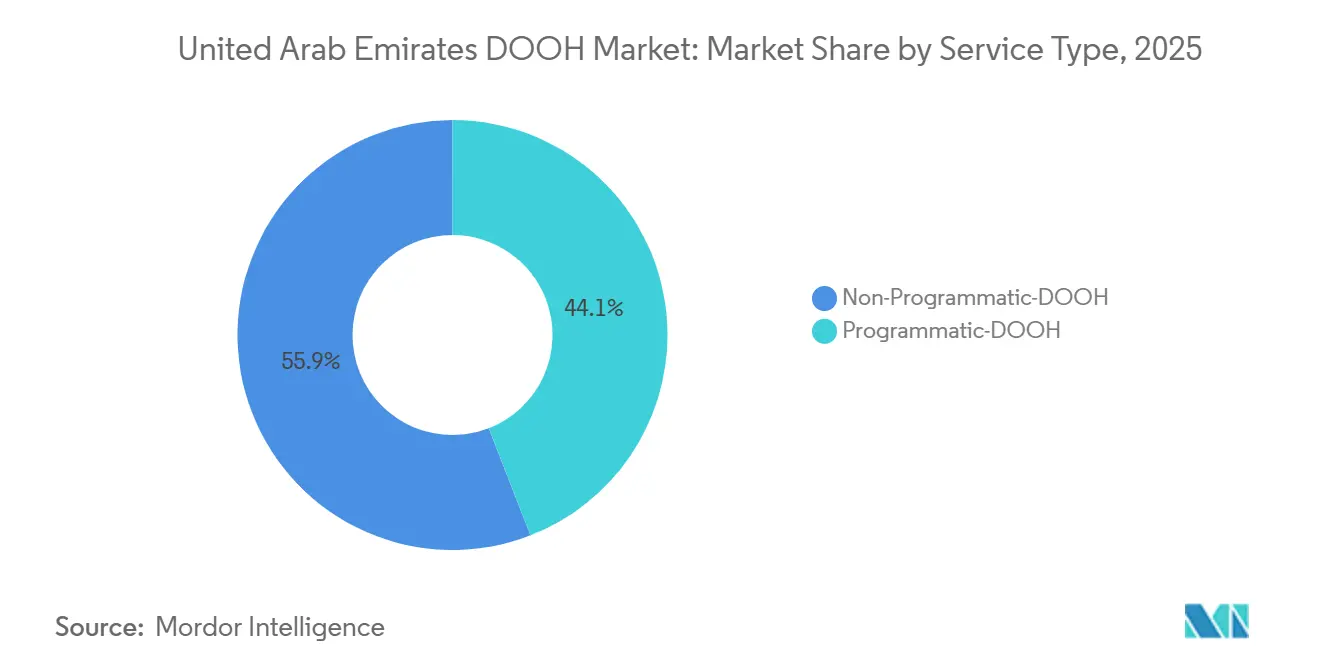
- By service type, non-programmatic screens led with 59.87% of United Arab Emirates digital out-of-home (DOOH) market share in 2025, while programmatic formats are advancing at a 16.03% CAGR through 2031.
- By application, billboards accounted for 37.89% of the United Arab Emirates DOOH market size in 2025, whereas transit screens are set to climb at a 15.27% CAGR to 2031.
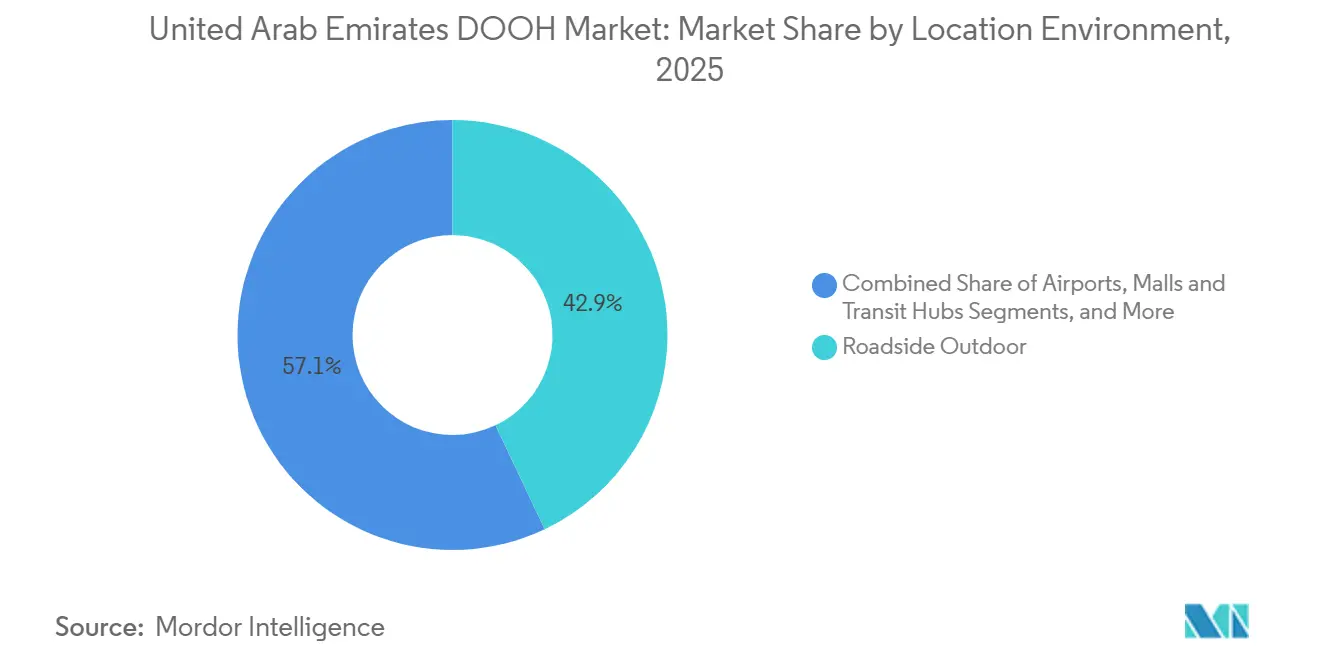
- By location environment, roadside displays dominated with 42.94% revenue share in 2025, yet airport inventory is projected to expand at a 15.42% CAGR over the forecast window.
- By end-user industry, retail topped spending at 27.06% in 2025, but automotive campaigns are forecast to post a 14.23% CAGR on the back of accelerating electric-vehicle launches.
Note: Market size and forecast figures in this report are generated using Mordor Intelligence’s proprietary estimation framework, updated with the latest available data and insights as of 2026.
United Arab Emirates DOOH Market Trends and Insights
Drivers Impact Analysis*
| Driver | (~) % Impact on CAGR Forecast | Geographic Relevance | Impact Timeline |
|---|---|---|---|
| Brand-Led Shift from Static to Dynamic DOOH Formats | +3.2% | National, concentrated in Dubai and Abu Dhabi | Medium term (2-4 years) |
| Government Smart-City Initiatives Boosting Street Furniture Digitization | +2.8% | National, led by Dubai and Abu Dhabi municipalities | Long term (≥ 4 years) |
| Surge in Mall Footfalls by International Tourists Post-Expo 2020 | +2.1% | Dubai, Abu Dhabi, Sharjah | Short term (≤ 2 years) |
| Wider Programmatic Advertising Capabilities | +2.5% | National, early adoption in Dubai | Medium term (2-4 years) |
| Real-Time Data Integration with RTA Nol Card Ecosystem | +1.4% | Dubai and Northern Emirates served by RTA | Medium term (2-4 years) |
| Integration of 3D Anamorphic Content to Differentiate Premium Screens | +0.9% | Dubai premium corridors | Short term (≤ 2 years) |
| Source: Mordor Intelligence | |||


Brand-Led Shift From Static to Dynamic DOOH Formats
Brands are diverting budgets away from printed billboards toward LED screens that enable day-part scheduling, rapid creative swaps, and campaign optimization within hours rather than weeks. BackLite Media reports eightfold revenue growth since digitizing its roadside network, underscoring the commercial upside of dynamic formats.[1]BackLite Media, “Digital Billboard Operations,” backlitemedia.com Luxury automakers launching electric models can update range claims and promotion details in near real time, aligning with evolving subsidy schemes. Eliminating print and installation costs frees funds for higher-visibility corridors, yet the upfront capital requirement for 4K LED panels and fiber connectivity favors well-financed incumbents. As a result, the United Arab Emirates digital out-of-home market continues to consolidate around operators with the balance sheet depth to retrofit entire networks at scale.
Government Smart-City Initiatives Boosting Street Furniture Digitization
The Roads and Transport Authority has rolled out 1,023 solar-powered smart bus shelters that stream transit data while doubling as high-dwell advertising nodes.[2]Roads and Transport Authority, “Smart Bus Shelters and Digital Infrastructure,” rta.ae Abu Dhabi’s Department of Municipalities and Transport is implementing comparable projects under Vision 2030, creating a consistent pipeline of municipal tenders for screen vendors. Solar mandates trim operating outlays and support the UAE’s net-zero-by-2050 pledge, strengthening the environmental credentials of outdoor campaigns. Digital street furniture also supports public-service broadcasts during emergencies, which eases permitting by demonstrating civic utility. Together, these smart-city programs embed advertising real estate into daily commuter journeys, underpinning long-run inventory growth across the United Arab Emirates digital out-of-home market.
Surge in Mall Footfalls by International Tourists Post-Expo 2020
Dubai hosted 24.3 million overnight visitors in 2024 and remains on track for further gains, funneling affluent tourists into The Dubai Mall and Mall of the Emirates. The Dubai Mall alone logged 105 million visits in 2023. Majid Al Futtaim’s Precision Media platform now pairs computer vision with programmatic buying to trigger context-aware ads inside its malls. Landlords are replacing static posters with interactive kiosks and LED walls, amplifying demand for premium indoor inventory. Abu Dhabi’s Yas Mall is mirroring this digital pivot to compete for spend from luxury houses and global electronics brands, adding further momentum to the United Arab Emirates digital out-of-home market.
Wider Programmatic Advertising Capabilities
JCDecaux’s Play+ integration across 378 airport screens enables advertisers to bid on impressions aligned with flight origin, destination, and passenger mix.[3]JCDecaux, “Play+ Programmatic Platform Launch,” jcdecaux.com Lemma Technologies advanced this automation with Lemma Phi, whose AI engine optimizes creative and day-parting based on real-time conditions.[4]Lemma Technologies, “Lemma Phi Launch,” lemmatechnologies.com Programmatic access lowers the friction of multi-city buys and attracts performance-oriented advertisers demanding measurable outcomes. Regional operators such as Elevision Media are onboarding exchanges like VIOOH to defend share against global platforms. As supply-side integrations mature, impression-level transparency will accelerate the scaling of programmatic spend across the United Arab Emirates digital out-of-home market.
Restraints Impact Analysis*
| Restraint | (~) % Impact on CAGR Forecast | Geographic Relevance | Impact Timeline |
|---|---|---|---|
| High Location-Lease Costs along Sheikh Zayed Road | -1.8% | Dubai, particularly Sheikh Zayed Road and Downtown corridors | Short term (≤ 2 years) |
| Tight Municipal Content-Approval Lead Times | -1.3% | National, with stricter enforcement in Dubai and Abu Dhabi | Medium term (2-4 years) |
| Privacy Concerns over Camera-Enabled Audience Measurement | -0.9% | National, heightened in urban centers | Long term (≥ 4 years) |
| Limited Premium Location Availability | -0.7% | Dubai and Abu Dhabi CBDs, airport terminals | Medium term (2-4 years) |
| Source: Mordor Intelligence | |||
High Location-Lease Costs Along Sheikh Zayed Road
Annual leases for flagship LED sites range from AED 1.8 million to AED 2.5 million (USD 0.49-0.68 million), elevating total project budgets above USD 1 million after hardware, installation, and connectivity. Smaller entrants struggle to raise capital or secure finance terms long enough to amortize the outlays, reinforcing the dominance of established concessionaires in the United Arab Emirates digital out-of-home market. Long-tenor contracts also curb agility, as operators cannot readily exit or relocate inventory when new transit corridors emerge.
Tight Municipal Content-Approval Lead Times
Dubai Municipality requires creative submission at least 10 business days prior to flight, with Federal Decree-Law No. 55 of 2023 adding a national media-content layer that can extend reviews to three weeks for sensitive sectors.[5]Dubai Municipality, “Outdoor Advertising Regulations,” dm.gov.ae These windows clash with the on-demand promises of programmatic buying, forcing brands to pre-clear multiple ad variants or risk launch delays. The bottleneck is most disruptive for event-driven and limited-time promotions, nudging advertisers toward media channels with faster turnaround. Although Dubai’s new DANA permit portal applies automated checks, full harmonization across emirates remains a work in progress, tempering growth across the United Arab Emirates digital out-of-home market.
*Our forecasts treat driver/restraint impacts as directional, not additive. The impact forecasts reflect baseline growth, mix effects, and variable interactions.
Segment Analysis
By Service Type: Programmatic Builds Momentum Inside a Non-Programmatic Stronghold
Non-programmatic placements captured 59.87% of United Arab Emirates digital out-of-home market share in 2025, a lead sustained by long-standing roadside contracts with luxury and automotive advertisers. Programmatic formats, however, are scaling at a 16.03% CAGR as demand-side platforms standardize impression trading and attribution. JCDecaux’s airport rollout and Elevision’s VIOOH partnership demonstrate how real-time bidding is moving from proof of concept to operational norm in large-format environments. Because airport and mall landlords can verify dwell time and demographic profiles, they are accelerating supply-side integrations that support dynamic creative rotation and third-party data overlays.
The coexistence of both sales models is reshaping operational priorities. Media owners are retraining account executives to handle audience-based packages while IT teams upgrade content-management systems to support OpenRTB protocols. Non-programmatic deals remain appealing where brand safety and exclusive positioning are paramount, notably for four-year automotive launches or government awareness drives. Over the forecast horizon, programmatic’s share gains will lift inventory liquidity and broaden advertiser participation, reinforcing the long-term competitiveness of the United Arab Emirates digital out-of-home market.

By Application: Transit Screens Accelerate on Ridership Data, While Billboards Retain Brand-Building Clout
Billboards accounted for 37.89% of United Arab Emirates digital out-of-home market size in 2025, owing to spectacular LED walls along Sheikh Zayed Road and Emirates Road that reach millions of motorists weekly. Transit formats, fueled by Dubai Metro’s 230 million annual riders and 1,023 smart bus shelters, are predicted to surge at 15.27% CAGR. Transit’s advantage lies in longer dwell windows, often three to five minutes, during which commuters absorb multi-frame storytelling and interactive prompts.
Advertisers now tap Nol card datasets to cluster screens by rider demographics, boosting targeting precision compared with vehicular audiences that blur socio-economic segments. Nevertheless, roadside billboards remain unrivaled for blockbuster visibility, as illustrated by BackLite Media’s 3D Whoop campaign that generated viral social buzz. Going forward, a balanced inventory mix will persist: billboards safeguard upper-funnel objectives and global launches, while transit deployments court performance budgets from retail, banking, and telecom brands across the United Arab Emirates digital out-of-home market.
By Location Environment: Passenger Rebound Steers Spend Toward Airports Without Displacing Roadside Dominance
Roadside displays led revenue with 42.94% in 2025, anchored by Dubai’s arterial grid that accommodates dense vehicular flows. Airport environments are set to expand at a 15.42% CAGR, underpinned by 91.6 million travelers at Dubai International and 16.1 million at Abu Dhabi International in 2024. Average exposure time above 20 minutes amplifies recall and allows luxury retailers to tailor messages by flight origin or cabin class through platforms such as Play+.
LED integrations now stretch into mixed-use promenades, evidenced by Daktronics’ 2025 Yas Bay Waterfront installation that courts leisure tourists with immersive content. While roadside tenure remains secure for mass-reach vehicle launches and public-service campaigns, airports, malls, and entertainment districts will command accelerating budget share as advertisers chase affluent and experience-seeking audiences across the United Arab Emirates digital out-of-home market.

By End-User Industry: Automotive Adoption Quickens Amid Electric-Vehicle Surge
Retail held 27.06% of spend in 2025, reflecting weekly mall promotions and seasonal sale cycles. Automotive outlays are projected to climb at a 14.23% CAGR as electric-vehicle stocks rise toward 19,000 units by 2025, with incentives such as free parking and toll waivers fanning consumer interest. Brands exploit 3D content and dynamic range updates on LED megastructures to differentiate in a crowded launch calendar.
Healthcare providers are scaling transit placements to reach expatriate professionals, while banks deploy screens near CBDs to push digital-banking adoption. Media and entertainment firms activate burst campaigns around concerts and film releases, using impression pacing tools to match ticket sales curves. Together, these shifts diversify vertical exposure, making the United Arab Emirates digital out-of-home market less cyclical and more resilient to single-sector slowdowns.
Geography Analysis
Dubai and Abu Dhabi dominate spending, undergirded by dense transit systems, record tourist arrivals, and well-defined regulatory frameworks. Dubai’s 230 million metro trips, 1 billion Nol card swipes, and triple-digit mall visitation provide unrivaled frequency layers for campaign planning. The emirate’s DANA permit portal, launched October 2025, automates compliance and cuts approval cycles, accelerating screen rollouts.
Abu Dhabi aligns DOOH investments with Vision 2030, channeling funds into upgraded street furniture and terminal extensions targeting 40 million passengers by 2030. Prestige leisure enclaves on Yas and Saadiyat Islands attract high-spend audiences that command premium CPMs. Sharjah, Ajman, Umm Al Quwain, Ras Al Khaimah, and Fujairah collectively form a growth frontier, offering lower lease rates that appeal to price-sensitive advertisers priced out of Dubai arterials.
The UAE’s role as a Europe-Asia-Africa hub multiplies airport screen impact because a single placement reaches travelers from myriad origin markets within hours. However, such geographic concentration also concentrates risk; regulatory changes or economic shifts in Dubai could ripple through nationwide demand. Continued infrastructure expansion in the Northern Emirates may gradually balance exposure across the wider United Arab Emirates digital out-of-home market.
Regulatory Landscape
The UAE DOOH market is governed by a layered framework that combines federal media rules with emirate-level outdoor advertising controls. Federally, the UAE Media Regulatory Office (MRO) oversees media activities and content standards, supported by Federal Decree-Law No. 55 of 2023, which sets requirements around compliant advertising content and separation of advertising from editorial material. At the emirate level, Dubai Decree No. (6) of 2020 regulates advertisements in the Emirate of Dubai, with Dubai Municipality (DM) and the Roads and Transport Authority (RTA) central to permitting and concession management for roadside and transit-linked assets.
Dubai has also moved toward more codified technical and process requirements through its Out-of-Home Advertising Manual, formalized via Administrative Resolution No. (180) of 2025, which provides contractors and media owners clearer specifications for installation and ongoing compliance. The same Dubai framework includes centralized oversight through an electronic advertisements database administered by Dubai Municipality, which shapes how inventory is registered, approved, and audited across high-value corridors and venues in the emirate.
Competitive Landscape
The competitive field is moderately fragmented. Global majors like JCDecaux leverage cross-market scale and proprietary data stacks to secure airport and metro concessions. Regional champions, BackLite Media, Hypermedia, Next Level Media, anchor premium roadside corridors via long-run RTA contracts, exemplified by BackLite’s AED 1 billion Sheikh Zayed Road mandate. Technology vendors LG Electronics, Samsung Electronics, and Daktronics supply LED modules, CMS platforms, and remote diagnostics, often in partnership with venue operators such as Expo City Dubai.
Smaller operators exploit niches in mall atriums, pedestrian bridges, and experiential pop-ups where capex is lower and creative experimentation is welcomed. Programmatic exchanges including VIOOH and Lemma aggregate multivendor supply, giving advertisers unified reach across the United Arab Emirates digital out-of-home market. Regulatory exclusivity clauses limit operator count per emirate, making concession renewals and municipal relationships pivotal to strategic positioning. Consolidation is anticipated as capital requirements escalate and data-driven buying standards rise.
United Arab Emirates DOOH Industry Leaders
JCDecaux Group
Next Level
Eyemedia
ELAN Group
Backlite Media (Multiply Group)
- *Disclaimer: Major Players sorted in no particular order

Market Opportunities and Future Outlook
A near-term opportunity centers on packaging and standardizing premium mall and lifestyle venue inventory into repeatable buying products that reduce friction for international and luxury advertisers. ELAN Media's in-mall planning packages (including Luxury Impact and Brand Accelerator), along with its ELAN Connect always-on option, indicate rising demand for managed, multi-site indoor DOOH offerings that can be activated without bespoke planning for every mall or precinct.
A second area of whitespace is translating premium roadside and destination inventory into decision-ready measurement and planning benchmarks for brand and performance teams, alongside tighter integration with programmatic activation. BackLite Media's collaboration with Publicis Media Luxe and Nielsen on premium OOH research benchmarks in 2026 provides a concrete reference point for how the market is moving toward more standardized evaluation of premium DOOH effectiveness. Operators that can align compliant audience analytics with the approval processes set by Dubai Municipality and federal media rules can then stand out on speed-to-market and repeatability across campaigns.
Recent Industry Developments
- February 2026: Lemma Technologies expanded its Lemma Phi AI CMS to UAE networks to enable dynamic creative optimization. The expansion enhances DOOH content optimization and real-time bidding support in the UAE. It supports data-driven campaign performance across UAE networks.
- January 2026: Dubai Municipality Phase 2 of the DANA permit platform added automated compliance checks. This streamlines approvals for UAE DOOH billboards and shortens deployment cycles for DOOH assets in Dubai.
- December 2025: INFiLED delivered high-br brightness LED panels for a flagship roadside DOOH unit in Dubai. The hardware upgrade supports 4K playback and weather-sealed DOOH assets. This strengthens premium roadside inventory capacity and viewer impact.


Research Methodology Framework and Report Scope
Market Definition and Coverage
For this report, the market is defined as advertising revenue generated from digital out-of-home screens operating in the UAE, covering major venue types such as roadside, transit, airports, malls, and other high-footfall locations.
Scope exclusions: This sizing excludes non-digital (static) OOH media, and it also excludes pure production costs for creative content unless they are bundled inside DOOH media-buying revenue.
Segmentation Overview
- By Service Type
- Programmatic-DOOH
- Non-Programmatic-DOOH
- By Application
- Billboard
- Transit
- Street Furniture
- Other Applications
- By Location Environment
- Roadside Outdoor
- Airports
- Malls and Transit Hubs
- In-Store and Indoor Venues
- Other Location Environments
- By End-User Industry
- Automotive
- Retail
- Healthcare
- Banking and Financial Services
- Media and Entertainment
- Other End-User Industries
Data Sources, Market Sizing, and Validation
Desk Research
Desk research was used to establish the fact base on how UAE DOOH inventory is expanding, and how ad spend typically flows across channels. We relied on public statistics and policy context, including telecom and digital infrastructure releases, plus transport and tourism indicators that influence impressions and dwell time (for example, UAE government open data, Dubai Roads and Transport Authority updates, and airport passenger traffic publications).
To keep the revenue model realistic, we also reviewed ad industry and standards inputs such as IAB MENA publications, outdoor media and advertising association materials, and peer-reviewed papers on audience measurement and privacy-compliant analytics. Alongside that, we used company filings, investor presentations, and credible media coverage to check pricing direction, concession terms, and rollout announcements. Paid subscriptions were used selectively for company financials, news and financials screening, patent lookups, and shipment-level trade checks where relevant. This list is illustrative only, and many other public sources were referenced for data collection, validation, and clarification.
Primary Interviews and Surveys
Primary work focused on filling gaps that desk sources do not explain well, such as how screen networks are monetized, typical campaign buying patterns, and how pricing varies by venue quality and time of day. We spoke with stakeholders across media owners, agencies, programmatic intermediaries, and brand-side media teams, and we kept coverage spread across key UAE demand centers so assumptions could be compared against real campaign execution.
Distribution of primary research fieldwork respondents
| Company type | Respondent position |
|---|---|
| Top tier: 28% | CXOs: 12% |
| Mid tier: 58% | Functional/Unit leaders: 31% |
| Smaller Players: 14% | Managers: 57% |
Market-Sizing & Forecasting
Sizing starts from a demand-pool view, where total addressable DOOH spend is reconstructed using UAE advertising spend direction, the shift from static to digital inventory, and venue-led impression supply signals. That top-down build is then corroborated with selective bottom-up approximations, where sampled screen counts by venue type are multiplied by typical sellable loop capacity and observed price ranges, before totals are adjusted for sell-through and discounting.
In the UAE context, the inputs that mattered most were airport passenger traffic and metro or bus shelter usage, mall footfall direction, the pace of new digital screen permits and upgrades, the programmatic share of traded inventory, and CPM or package-rate progression in premium corridors. Because data coverage is uneven by emirate and by venue, we handled gaps by using proxy roll-ups from comparable sites, then normalizing using interview inputs so outliers do not distort the total.
For forecasting, we used scenario analysis supported by a simple multivariate regression check, linking DOOH revenue to ad spend direction, mobility and tourism indicators, and the digitization pace of inventory. Assumptions on price and utilization were reviewed with industry participants, then applied consistently across the forecast window to keep the output repeatable.
Data Validation & Update Cycle
Model outputs were checked against independent signals, including reported ad spend direction, screen rollout announcements, and venue traffic metrics, and we investigated any variances before finalizing. Where numbers moved sharply, we re-checked the drivers, reviewed currency conversion timing, and re-contacted selected interviewees to confirm whether the change was due to a one-off event or a structural shift.
A multi-step internal review is followed so totals and growth rates remain aligned with the stated scope and do not conflict with known market constraints such as permit cadence or venue capacity. Reports are refreshed annually, and interim updates are made when material events occur, including major concession awards or step-changes in airport and transit volumes. Before delivery, we run a fresh pass on key indicators so the latest available information is reflected.
Mordor Intelligence's UAE Dooh Market Size Compared With Other Published Estimates
Published market numbers can look far apart even when they all use the same label, because scope and counting logic differ in small but important ways. The table highlights this spread, and it is usually driven by what is treated as DOOH revenue versus adjacent OOH activity, plus how pricing and utilization are normalized across premium and secondary locations.
The table shows a higher baseline than one external figure, which lines up with the fact that, in Mordor Intelligence's model, revenue is counted across a broad set of UAE DOOH environments including airports, transit, and retail venues (not only large roadside assets), and the forecast build is tied to venue traffic signals rather than a single screen-count assumption.
Benchmark comparison
| Source | Market Size | Gaps in Research Methodology |
|---|---|---|
| Mordor Intelligence | USD 53.91 M (2025) | |
| Trade Journal A | USD 31.39 M (2024) | This estimate is often presented as a narrow DOOH adspend snapshot for a single year and can undercount non-roadside environments or exclude parts of managed retail and transit inventory, which pushes the value lower versus a full-network revenue view. |
| Industry Portal B | USD 350.00 M (2024) | This figure appears to fold in wider OOH advertising spend or uses aggressive assumptions on premium screen pricing and sell-through across all inventory, which can overstate DOOH-only revenue when venue mix and utilization differences are not separated. |
Overall, the comparison suggests that the biggest driver of variation is not math, it is what gets included as DOOH and how pricing and utilization are applied by venue type. By anchoring the model on observable traffic and inventory expansion, then sanity-checking with channel and buyer feedback, the resulting size is easier to trace back to real market drivers and repeat in future updates.


Key Questions Answered in the Report
What is the current value of the United Arab Emirates digital out-of-home market?
The United Arab Emirates digital out-of-home market size stood at USD 62.61 million in 2026.
How fast is programmatic buying growing in UAE outdoor advertising?
Programmatic formats are expanding at a 16.03% CAGR between 2026 and 2031, making them the fastest-growing service type.
Which application is forecast to grow quickest within UAE DOOH?
Transit screens are projected to rise at a 15.27% CAGR, driven by metro and bus-shelter digitization.
Why are airports critical for DOOH advertisers in the Emirates?
Dubai and Abu Dhabi airports deliver dwell times exceeding 20 minutes to 100-plus million high-income passengers, providing premium reach and advanced data targeting.
What factor limits rapid creative changes despite programmatic capability?
Municipal content-approval cycles, which may stretch up to three weeks, constrain last-minute campaign adjustments.
Which industry vertical is set to increase its DOOH spending fastest?
Automotive advertisers are expected to grow at a 14.23% CAGR as electric-vehicle launches multiply.
Page last updated on:




