
France Digital Out-of-Home (DOOH) Advertising Market Size and Share
Market Overview
| Study Period | 2020 - 2031 |
|---|---|
| Forecast Data Period | 2026 - 2031 |
| Base Year Market Size (2025) | USD 9.201 Million |
| Market Size (2026) | USD 10.23 Million |
| Market Size (2031) | USD 17.43 Million |
| Growth Rate (2026 - 2031) | 11.24 % |
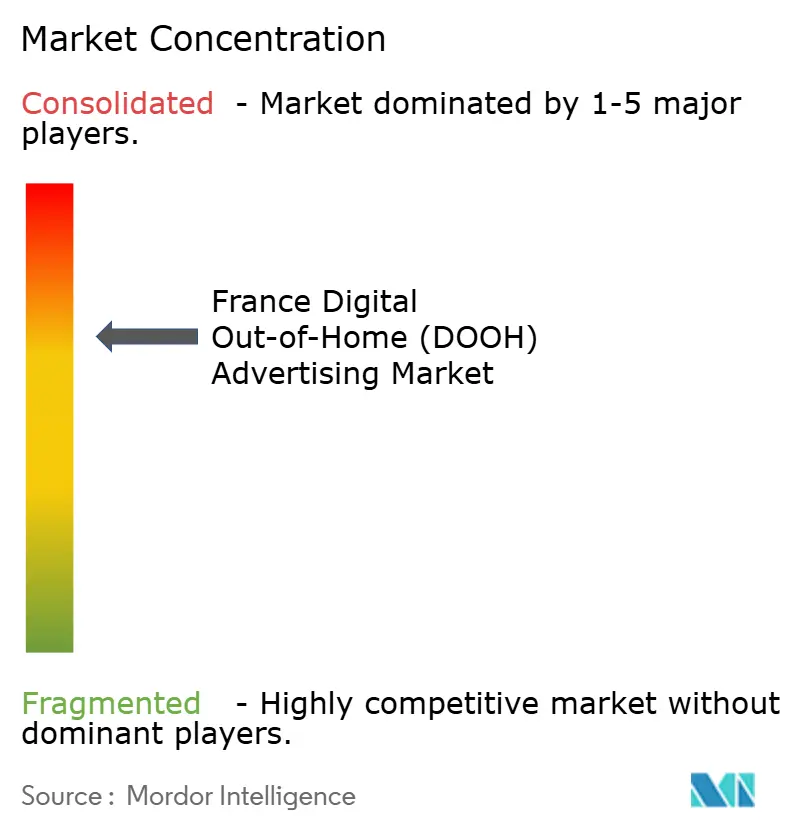
| Market Concentration | Medium |
Major Players *Disclaimer: Major Players sorted in no particular order Image © Mordor Intelligence. Reuse requires attribution under CC BY 4.0. | |
France Digital Out-of-Home (DOOH) Advertising Market Analysis by Mordor Intelligence
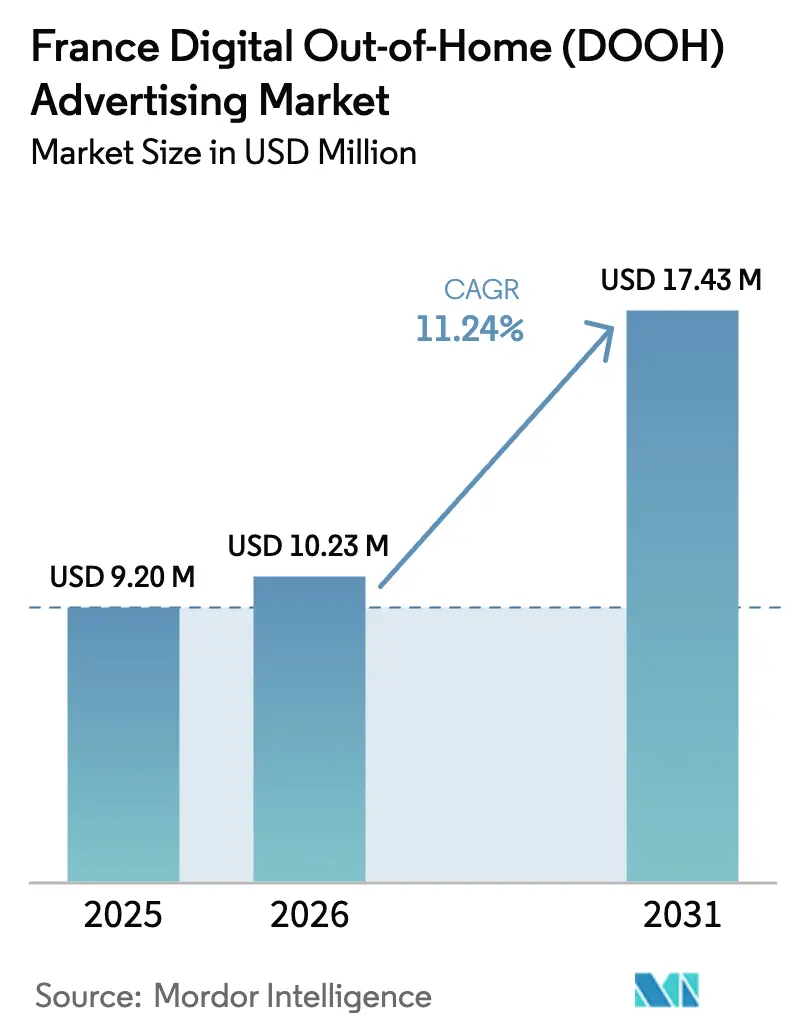
The France DOOH market size was valued at USD 9.201 million in 2025 and estimated to grow from USD 10.23 million in 2026 to reach USD 17.43 million by 2031, at a CAGR of 11.24% during the forecast period (2026-2031). [1]uropean Commission, “France 2024 Digital Decade Country Report,” digital-strategy.ec.europa.euStrong 5G coverage, a EUR 10.2 billion (USD 12.01 billion) government digital-transformation outlay, and privacy laws that favor location-based buying together propel the France DOOH market. Programmatic trading now sets the growth pace after JCDecaux posted a 61.8% jump in programmatic revenue to EUR 59.7 million (USD 70.28 million) in H1 2024. LED screens dominate deployments, while OLED technology scales fastest as cities demand lower power draw. Advertisers strongly prefer engagement-oriented formats and retail media networks expand beyond stores, creating fresh demand for dynamic messaging that ties into purchase journeys. At the same time, tight GDPR enforcement, heritage-site rules, and high capital costs temper expansion speed yet also raise entry barriers that cushion incumbent returns.
Key Report Takeaways
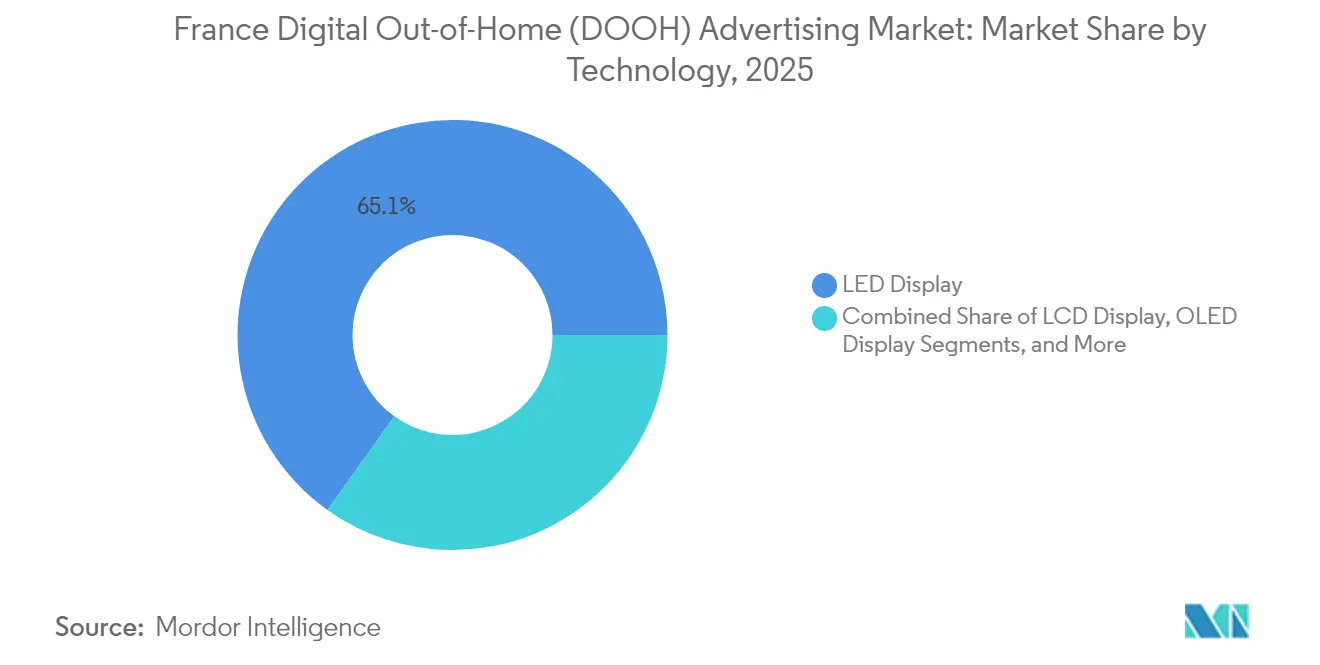
- By technology, LED displays led with 65.12% revenue share in 2025, whereas OLED displays are set for a 12.42% CAGR to 2031.
- By format, digital street furniture held 33.71% of the France DOOH market share in 2025, while interactive and experiential screens will advance at a 14.41% CAGR through 2031.
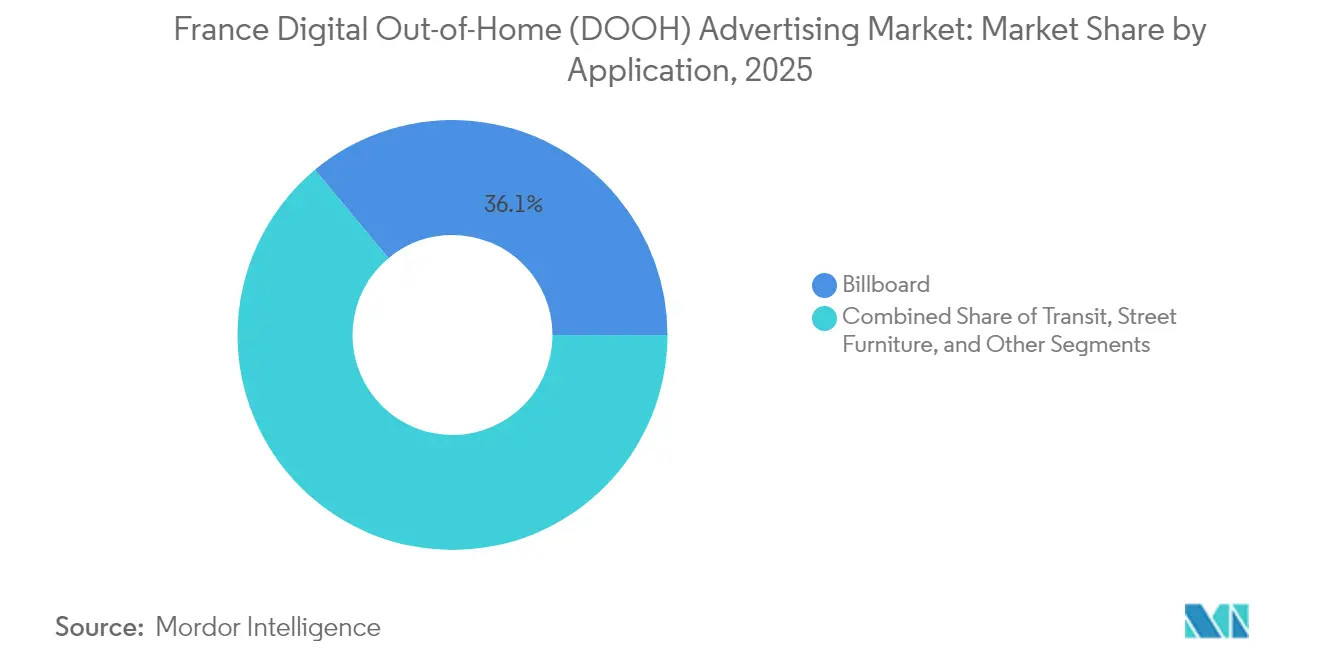
- By application, billboard advertising accounted for 36.05% of the France DOOH market size in 2025, and street furniture applications are expanding at a 12.58% CAGR to 2031.
- By end-use industry, the retail sector captured 33.62% revenue share in 2025 and will grow at an 11.46% CAGR to 2031.
- LED market leaders JCDecaux, Clear Channel, and Médiatransports together controlled roughly two-thirds of installed digital faces in 2024.
Note: Market size and forecast figures in this report are generated using Mordor Intelligence’s proprietary estimation framework, updated with the latest available data and insights as of 2026.
France Digital Out-of-Home (DOOH) Advertising Market Trends and Insights
Drivers Impact Analysis*
| Driver | (~) % Impact on CAGR Forecast | Geographic Relevance | Impact Timeline |
|---|---|---|---|
| Smart-City-Driven Digital Media Installations | +2.1% | National, concentrated in Paris, Lyon, Marseille | Medium term (2-4 years) |
| Rapid Deployment of Programmatic DOOH Platforms | +2.8% | National, with early adoption in metropolitan areas | Short term (≤ 2 years) |
| 5G-Enabled Dynamic Creative Optimization Across French Transit Hubs | +1.9% | National, prioritizing major transport networks | Medium term (2-4 years) |
| Retail-Media Networks Expanding Beyond Point-of-Sale in France | +1.7% | National, concentrated in urban commercial centers | Short term (≤ 2 years) |
| Rise of Eco-Friendly and Energy-Efficient LED Screens in Urban Centers | +1.4% | National, driven by municipal sustainability mandates | Long term (≥ 4 years) |
| AI-Based Audience Measurement Enhancing CPM Premiums | +1.3% | National, with premium applications in high-traffic areas | Medium term (2-4 years) |
| Source: Mordor Intelligence | |||
Smart-City-Driven Digital Media Installations
France’s EUR 10.2 billion (USD 12.01 billion) digital-transformation agenda funds municipal roll-outs of connected street furniture, kiosks, and public-information panels that double as ad inventory. With 93.2% 5G coverage, cities stream real-time content, sell ad slots programmatically, and share revenue to offset smart-city CAPEX. Paris now pilots intelligent bus shelters that push citizen alerts next to paid ads, which validates a blended public–private funding model. As more municipalities follow, the France DOOH market gains scalable inventory without over-reliance on heritage-sensitive billboards. Operators that integrate civic data feeds into campaigns secure exclusive tenders and lock in multi-year revenue guarantees.
Rapid Deployment of Programmatic DOOH Platforms
JCDecaux’s 61.8% programmatic revenue surge in H1 2024 shows how automated trading compresses campaign set-up from weeks to hours. Marketers now buy cross-border French inventory alongside UK sites through Clear Channel LaunchPAD, which already connects 4,700 screens. [2]Clear Channel UK, “Programmatic DOOH Expansion,” clearchanneleurope.com Real-time bidding allows dynamic pricing tied to footfall or weather, while demographic filters lift CPMs during premium events such as the Paris Olympics. This automation underpins the France DOOH market’s double-digit CAGR and supports smaller advertisers that previously lacked the scale to book national campaigns.
5G-Enabled Dynamic Creative Optimisation Across Transit Hubs
RATP’s fleet electrification and station upgrades equip 5G backbone that streams personalised content on concourse and platform screens. Advertisers rotate multiple creatives every few seconds, targeting morning commuters with coffee offers and evening travellers with streaming-service teasers. Transdev’s EUR 1.4 billion (USD 1.65 billion) contract renewals extend similar functionality beyond Paris into Lens, Le Havre, Reims, and Niort. Responsive messaging raises engagement metrics, which strengthens the France DOOH market case against static print posters.
Retail-Media Networks Expanding Beyond Point-of-Sale
Large grocers convert store façades, car-park totems, and nearby bus shelters into unified retail-media networks that complement in-store screens. Carrefour’s 2024 half-year report flagged higher digital profitability as DOOH placements redirected off-site traffic back to its e-commerce platform. Brands leverage loyalty-card data to trigger localised promotions, pushing incremental spend and reinforcing retailer bargaining power with CPG suppliers. This trend deepens the France DOOH market penetration into shopper-marketing budgets historically reserved for print circulars.
Restraints Impact Analysis*
| Restraint | (~) % Impact on CAGR Forecast | Geographic Relevance | Impact Timeline |
|---|---|---|---|
| Stringent French Data-Privacy Rules Limiting Real-Time Targeting | -1.8% | National, with stricter enforcement in metropolitan areas | Short term (≤ 2 years) |
| Municipal Heritage Codes Restricting Large-Format Digital Installs | -1.2% | National, concentrated in historic city centers | Long term (≥ 4 years) |
| Fragmented Ownership of Street Furniture Assets | -0.9% | National, varying by municipal jurisdiction | Medium term (2-4 years) |
| High Up-front CAPEX Versus Short Advertising Cycles | -0.8% | National, affecting smaller market entrants | Medium term (2-4 years) |
| Source: Mordor Intelligence | |||
Stringent French Data-Privacy Rules Limiting Real-Time Targeting
CNIL enforces GDPR rigidly and fined an ad-tech firm EUR 40 million (USD 47.09 million) in 2023 for consent breaches. [3] CNIL, “Dispositifs de mesure d’audience,” cnil.frDOOH operators must anonymise camera data within five minutes, which restricts long-term audience profiling. Compliance requires on-premise edge processing and drives up deployment costs, narrowing margins for smaller entrants. Yet clear rules also cement advertiser trust and shield the France DOOH market from future legal surprises that could otherwise freeze budgets.
Municipal Heritage Codes Restricting Large-Format Digital Installs
The Code de l’environnement caps display size and luminance in listed zones, curbing inventory growth in tourist-packed historic quarters. Operators pivot to smaller footprint street furniture or invest in peripheral districts, but these sites command lower CPMs than landmark plazas. Scarcity lifts prices for compliant screens, though it limits overall impression volume, tempering the France DOOH market trajectory in heritage cities such as Paris and Avignon.
*Our forecasts treat driver/restraint impacts as directional, not additive. The impact forecasts reflect baseline growth, mix effects, and variable interactions.
Segment Analysis
By Technology: LED Maturity with OLED Upside
LED displays generated 65.12% of France DOOH market revenue in 2025 thanks to high brightness and lower cost of ownership. Falling diode prices, 100,000-hour lifespans, and modular cabinets anchor LED as the workhorse for roadside and transit venues. OLED, while a niche, will post a 12.42% CAGR because ultra-thin panels fit heritage façades, while lower power draw supports city climate goals. Energy-efficient credentials align with France’s 52% emissions-reduction target by 2030. MicroLED and e-Paper address specialised needs such as architectural integration and off-grid rural kiosks, broadening the technology palette that sustains the France DOOH market.
The France DOOH market size for LED displays reached USD 5,992 thousand in 2025 and will climb alongside infrastructure upgrades. OLED’s France DOOH market share remains low today but rises as municipal tenders specify power caps. Operators future-proof assets by mixing LED billboards for reach with OLED street furniture for sustainability-linked concessions, balancing capex and energy tariffs.



By Format: Engagement Drives Interactive Screens
Digital street furniture owned 33.71% of revenue in 2025, reflecting entrenched street-level contracts that bundle maintenance, cleaning, and advertising rights. Clear contracts offer multi-year visibility, making the format a defensive asset class inside the France DOOH market. Interactive and experiential screens will expand at 14.41% CAGR as advertisers demand proof of engagement. Touch, gesture, and mobile-link technologies collect immediate feedback that feeds programmatic optimisation loops.
Large digital billboards preserve brand-awareness value, yet heritage curbs limit new permits. Transit displays inside stations and vehicles gain traction because 5G connectivity streams context-based creative. The France DOOH market size for interactive screens is projected to triple by 2030 as cost per engagement metrics align with online benchmarks. Operators leverage cloud CMS to refresh ads hourly, widening appeal to performance marketers accustomed to dynamic social feeds.
By Application: Street Furniture Outpaces Billboards
Billboards still accounted for 36.05% of 2025 revenue because single-face reach suits national brand launches. However, street furniture will outgrow at 12.58% CAGR through 2031 as municipalities roll out digitised bus shelters. These assets merge civic messaging, way-finding, and ad sales, positioning the France DOOH market closer to essential urban services. Transit applications ride ridership recovery post-pandemic, with RATP installing new concourse LEDs that monetise passenger dwell time.
Advertisers mix formats to maximise frequency and context. FMCG brands combine billboard reach with street-furniture proximity near supermarkets, while luxury labels exploit transit concourses before flagship boutiques. This format symbiosis raises overall campaign ROI, underpinning robust expansion across the France DOOH market.
By End-Use Industry: Retail Remains the Powerhouse
Retailers contributed 33.62% of 2025 spend and will grow at 11.46% CAGR as chains roll out omnichannel media. Loyalty and payment data inform localised DOOH messaging that mirrors digital display precision, enticing CPG brands to shift budget from printed POS. Automotive, banking, and telecom sectors follow by using rich-format video to explain complex products on high-footfall screens.
Public institutions and utilities add stable volumes via safety alerts and energy-saving campaigns, which protect the France DOOH market from cyclical dips. Healthcare remains a conservative spender due to strict promotion rules, yet digital signage inside pharmacies offers future upside once compliance frameworks mature.
Geography Analysis
The France DOOH market concentrates heavily in metropolitan hubs. Paris alone hosts more than one-third of national digital faces, leveraging dense pedestrian zones and tourism inflow that justify higher CPMs. Lyon and Marseille add scale with smart-city roadmaps that integrate connected bus shelters and sensor-enabled kiosks. The France DOOH market size in Île-de-France is forecast to grow at low-double-digit CAGR through 2031 as Olympics legacy infrastructure transitions to commercial use.
Secondary cities such as Lille, Toulouse, and Nantes accelerate as 5G coverage now spans 93.2% of national territory, allowing real-time programmatic deployments outside capital regions. These locales benefit from European Regional Development Fund grants that co-finance smart-street-furniture projects, reducing municipal capex hurdles. As a result, the France DOOH market widens geographically, cutting exposure to single-city policy shifts.
Rural corridors adopt smaller solar-powered e-Paper signs that deliver traffic and weather alerts beside hyperlocal ads. Although revenue per screen is lower, network operators aggregate long-tail inventory into national programmatic pools, extracting incremental impressions that lift the overall France DOOH market.
Regulatory Landscape
France DOOH operations sit at the intersection of outdoor advertising rules under the Code de l'environnement (Articles L581-1 and R581-1 et seq.), GDPR enforcement led by CNIL, and industry self-regulation through ARPP. Decree ndeg 2022-1294 (5 October 2022) strengthened the national framework on luminous advertising by codifying night-time extinction requirements, including a standard shutdown window (commonly 1 am to 6 am) with specified exceptions for certain transit furniture and airport contexts, which affects sellable dayparts and screen scheduling.
Local governments (mayors and EPCIs) can tighten rules through Local Advertising Regulations (RLP), shaping where digital street furniture, kiosks, and large-format screens can be permitted, particularly in heritage-sensitive areas. Energy-security provisions also introduce an operational risk layer, as Law ndeg 2022-1158 (16 August 2022) introduced powers under the Energy Code allowing the Minister of Energy to restrict digital advertising during threats to electricity supply security, reinforcing the role of power management, dimming, and compliant operating modes in tender specifications and network planning.
Competitive Landscape
The France DOOH market hosts a moderate concentration. JCDecaux, Clear Channel, and Médiatransports together control about 68% of digital faces, leveraging long-running street-furniture concessions. JCDecaux strengthened programmatic supply by taking a majority stake in Displayce, integrating demand-side routing and data analytics. Clear Channel scales its LaunchPAD SSP across Europe, giving French buyers seamless cross-border reach. Médiatransports focuses on transit exclusivity through SNCF and RATP partnerships, securing captive audiences.
New entrants emphasise software over hardware by offering AI-driven audience measurement compliant with CNIL five-minute anonymisation rules. However, high capex for premium sites and stringent heritage permits slow disruptive growth. Consequently, incumbents continue to bundle maintenance, data, and ad serving into turnkey packages, solidifying their lead in the France DOOH market.
Strategically, players pursue sustainability initiatives to win municipal bids. JCDecaux reported nearly 50% taxonomy-aligned revenue and a Net-Zero 2050 pledge. Clear Channel pilots recycled aluminium shelter frames, while start-ups develop low-carbon concrete kiosks, reflecting rising procurement points for ESG compliance across the France DOOH market.
France Digital Out-of-Home (DOOH) Advertising Industry Leaders
JCDecaux SE
Vistar Media
Exterior Plus
Clear Channel France SAS
DooH it
- *Disclaimer: Major Players sorted in no particular order

Market Opportunities and Future Outlook
There is a workable gap in scaling compliant, automated DOOH supply beyond traditional city-center billboards, especially through digital street furniture and transit inventory that can operate within France's luminance and night-time extinction constraints while still supporting high-reach campaigns. Programmatic trading offers a direct way to monetize this distributed footprint: JCDecaux reported a 61.8% jump in programmatic revenue to EUR 59.7 million in H1 2024, and platforms such as Displayce, VIOOH, and Clear Channel's LaunchPAD are used to route demand across fragmented owner networks, reducing booking friction for national and cross-border advertisers.
Another opportunity is outcome-based measurement that aligns DOOH with broader digital budgets under GDPR and CNIL constraints (including requirements to anonymize audience data quickly), shifting focus toward privacy-preserving analytics and on-device processing. In April 2026, Vistar Media partnered with Happydemics to integrate brand-lift measurement into programmatic DOOH workflows, showing measurement moving into mainstream programmatic adoption rather than remaining a bespoke add-on. With smart-city deployments funded under France's EUR 10.2 billion digital-transformation agenda and 93.2% 5G coverage, operators have room to expand dynamic creative use in transport hubs and retail media networks, while differentiating through energy-efficient screen specifications that fit municipal procurement and operating-hour rules.
Recent Industry Developments
- June 2026: JCDecaux unveiled the Le Bus Shelter urban service hub and Unlimited DOOH digital experience at VivaTech 2026 in Paris. The DOOH product portfolio expands into urban furniture as DOOH service hubs, strengthening programmatic and experiential positioning in France and enabling cross-channel monetization at high visibility events.
- June 2026: JCDecaux launched Celine Paris Experience, a DOOH advertising package utilizing 145 screens in Paris airports and 100 screens in Paris city center for the return of Celine Dion. The high-profile brand experience with large-format inventory demonstrates premium DOOH storytelling and multi-site reach, reinforcing city-center and transport network penetration.
- April 2026: Vistar Media announced a partnership with Happydemics to integrate brand lift measurement technology into Vistar's DOOH programmatic solutions in France and globally. The measurement-enabled DOOH programmatic offering advances data-driven accountability and comparability for DOOH campaigns, increasing appeal to brand advertisers and media owners.


Research Methodology Framework and Report Scope
Market Definition and Coverage
For this methodology, the market is the value of paid advertising delivered on digital out-of-home screens located in France, counted as media revenue linked to campaigns that ran on those screens during the year.
Scope exclusions: We exclude non-digital outdoor placements, screen hardware sales, installation and maintenance services, and non-advertising content shown on the screens.
Segmentation Overview
- By Technology
- LED Display
- Direct-View LED Video Walls (dvLED)
- LCD Display
- OLED Display
- Projection Mapping
- Other Technologies (e-Paper, MicroLED)
- LED Display
- By Format
- Large-Format Digital Billboards
- Digital Street Furniture (Kiosks, Bus Shelters)
- Digital Transit Displays
- Interactive and Experiential Screens
- By Location
- Roadside / Outdoor
- Indoor (Malls, Airports, Gyms)
- By Application
- Billboard
- Transit
- Street Furniture
- Others (Cinema, Stadiums)
- By End-use Industry
- Retail
- Healthcare / Pharmaceutical
- Financial Services
- Automotive
- Telecom / Utilities
- Government Agencies
- Other End Users (Entertainment, Education)
Data Sources, Market Sizing, and Validation
Desk Research
Desk research is used to map the France DOOH ecosystem and to set clear counting rules so the model stays consistent across years and formats. We rely on public sources to anchor the direction of advertising budgets, out-of-home regulation, and the pace of digital screen rollout, which then supports the assumptions tested in interviews.
We review non-paywalled sources such as ACPM publications on DOOH measurement and certified inventory, ARCOM materials that describe advertising and media oversight context, and INSEE releases for macro indicators tied to advertising spend. For market signals that are easier to validate in trade and infrastructure data, we also use Eurostat series where relevant, French public procurement portals that indicate municipal or transit tenders, and peer-reviewed or conference papers on digital signage and audience measurement methods. On top of this, we scan company annual reports, investor presentations, association websites, and trusted press coverage to confirm timelines and major commercial shifts like programmatic buying adoption. Analyst access to paid databases for company financials, news and financials, patent databases, and global contracts and tenders is used selectively to fill gaps and cross-check the plausibility of public statements. This list is illustrative and not exhaustive, and many other sources were referenced for data collection, validation, and clarification.
Primary Interviews and Surveys
Primary interviews and surveys help convert public signals into model inputs that can be applied consistently in France, such as sellable screen time, typical loop structure, utilization, and effective pricing by venue type. We also sanity-check how campaigns are actually bought in France, including the share of spend traded programmatically, and then use that feedback to tighten ranges before finalizing the totals.
Distribution of primary research fieldwork respondents
| Company type | Respondent position |
|---|---|
| Top tier: 30% | CXOs: 16% |
| Mid tier: 53% | Functional/Unit leaders: 32% |
| Smaller Players: 17% | Managers: 52% |
Market-Sizing & Forecasting
The market is modeled using top-down and bottom-up logic that is kept practical for an advertising revenue pool. We begin by reconstructing the France DOOH demand pool from advertising spend direction and media-mix splits, and then apportion that value to digital out-of-home using adoption and sell-through signals confirmed in interviews. After that, totals are corroborated with selective bottom-up approximations, such as sampled screen counts by location type, sellable hours, loop and spot structure, and implied revenue per screen based on realistic utilization.
A few inputs that matter most for this market include the number of live digital screens by venue, average ad spot duration, sellable hours and seasonality, the share of inventory sold programmatically, and effective pricing expressed through CPM or spot-equivalent rates. When gaps appear, they are handled through bounded ranges discussed with respondents, and then narrowed after re-checking consistency with operator economics and observed market behavior. For forecasting, we use scenario analysis supported by expert views on programmatic penetration, network expansion pace, and advertiser budget intent, and then we stress-test the outputs against macro indicators so growth does not out-run plausible spend capacity.
Data Validation & Update Cycle
We validate the model by triangulating outputs against independent signals, and then reviewing any large variances before final sign-off. Anomalies are traced back to inputs such as pricing progression, screen count growth, or utilization assumptions, and are only adjusted after they are supported by more than one confirming signal.
Before publication, an internal analyst review pass checks definitions, math, unit conversions, and year alignment so the series reads cleanly across the study period. Reports refresh annually, and interim updates are triggered when material events occur, such as changes in advertising rules, major network expansions, or a visible shift in trading practices. Before delivery, a final freshness pass is performed so clients receive the latest updated view based on newly available public data and any targeted expert re-contacts.
Mordor Intelligence's France Digital Out of Home Dooh Advertising Market Size Compared Against Other Published Estimates
Published numbers for France DOOH can vary widely because the term is used differently, and because the same year can be reported as booked spend, billed revenue, or a forward-looking target value. Currency timing, tax treatment, and whether buying fees are included can also shift totals even when the underlying market activity is similar.
Some estimates roll up broad outdoor advertising spend and then apply a digital share, and they may also blend in indoor digital signage that is not sold as advertising media. For Mordor Intelligence, only paid advertising delivered on DOOH inventory is counted, and non-media items like screen hardware, installation, and maintenance services are excluded so the number reflects campaign monetization.
Benchmark comparison
| Source | Market Size | Gaps in Research Methodology |
|---|---|---|
| Mordor Intelligence | USD 9.20 M (2025) | |
| Trade Journal A | USD 444.00 M (2024) | Uses an investment-style spend figure for 2024 and can include broader digital display activity and buying-related fees, which inflates the total versus pure DOOH media revenue. |
| Industry Association B | USD 700.00 M (2029) | Provides a forward forecast in EUR terms that is closer to total DOOH spend, and it can differ based on whether indoor networks and non-standard inventory are treated as DOOH. |
The table shows that the spread is mainly driven by spend-versus-revenue treatment and by how far the scope is stretched into adjacent digital display categories. By keeping the counting unit consistent, aligning to a single currency year, and re-checking utilization and pricing with practitioners, the final number stays traceable to repeatable variables that can be refreshed as the market changes.


Key Questions Answered in the Report
What is the current value of the France DOOH market?
The market is valued at USD 10.23 Million in 2026 and is forecast to reach USD 17.43 million by 2031, growing at an 11.24% CAGR.
Which technology dominates France’s DOOH landscape?
LED displays command 65.12% of 2025 revenue due to brightness and falling hardware costs.
Why are interactive screens growing fastest?
They support touch and mobile engagement, letting advertisers collect immediate feedback and justify premium CPMs, which drives a 14.41% CAGR.
How do French data-privacy rules affect DOOH advertising?
CNIL requires anonymisation within five minutes, increasing compliance costs but enhancing advertiser trust.
Which end-use sector spends the most on DOOH in France?
Retail leads with a 33.62% revenue share and 11.46% CAGR as grocers build omnichannel retail-media networks.
Will smart-city projects expand DOOH outside Paris?
Yes, government digital-transformation funds and 93.2% 5G coverage are enabling secondary cities to deploy connected street furniture and kiosks.
Page last updated on:





