
Market Overview
| Study Period | 2020 - 2031 |
|---|---|
| Forecast Data Period | 2026 - 2031 |
| Base Year Market Size (2025) | USD 20.55 Billion |
| Market Size (2026) | USD 22.92 Billion |
| Market Size (2031) | USD 39.58 Billion |
| Growth Rate (2026 - 2031) | 11.52 % |
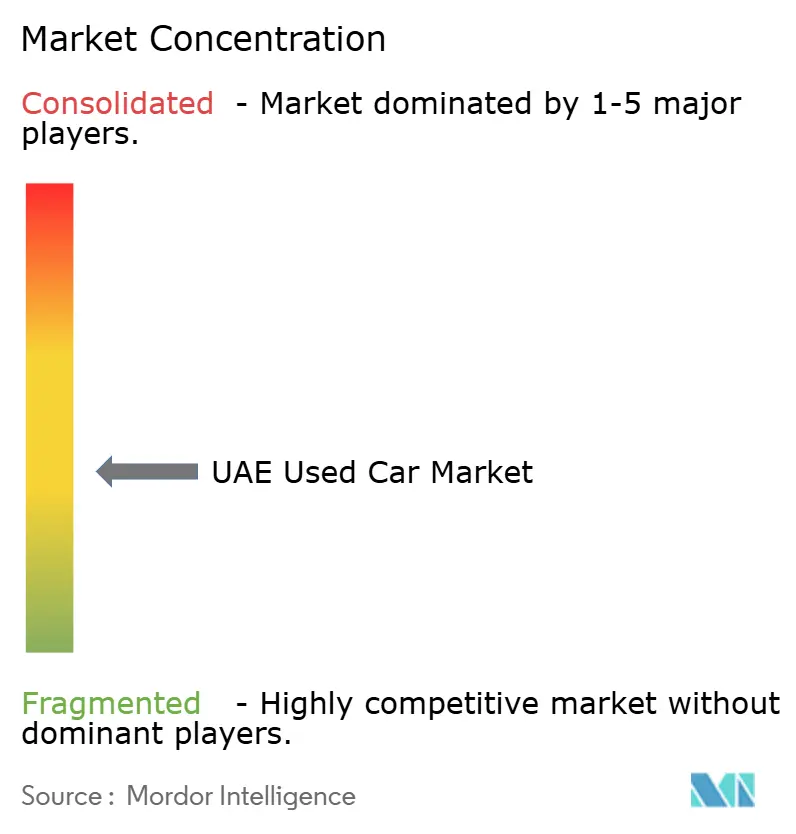
| Market Concentration | Medium |
Major Players *Disclaimer: Major Players sorted in no particular order Image © Mordor Intelligence. Reuse requires attribution under CC BY 4.0. | |
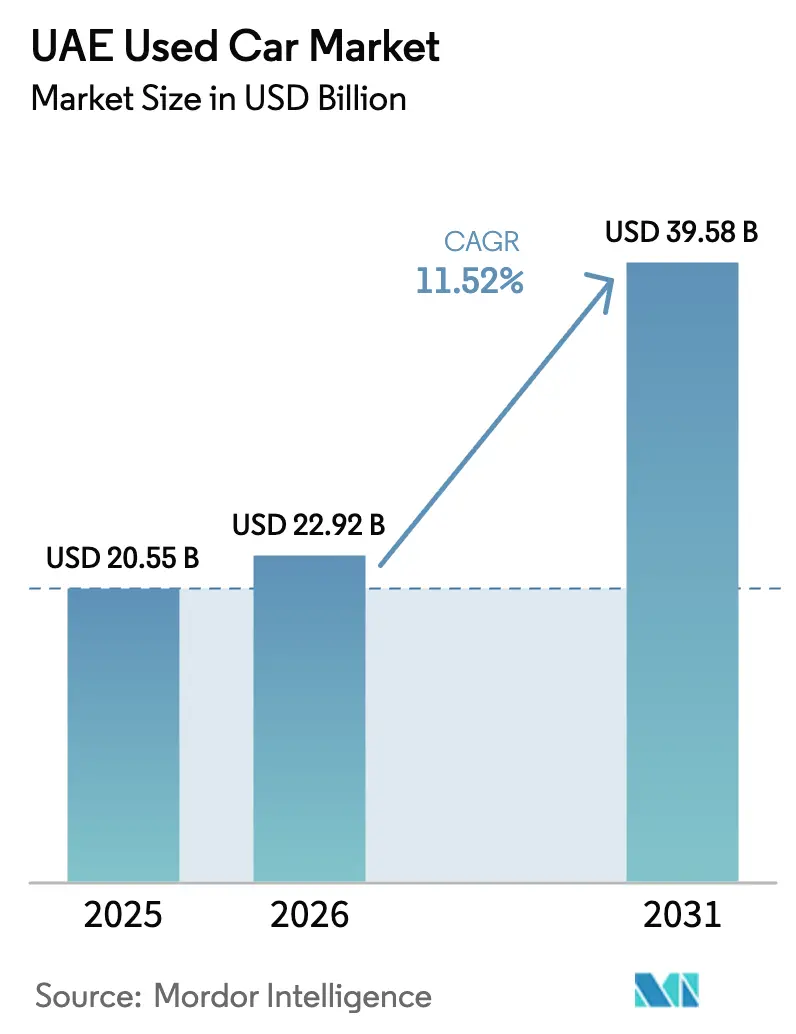
UAE Used Car Market Analysis by Mordor Intelligence
The UAE Used Car market size in 2026 is estimated at USD 22.92 billion, growing from 2025 value of USD 20.55 billion with 2031 projections showing USD 39.58 billion, growing at 11.52% CAGR over 2026-2031. Sustained consumer appetite for affordable mobility, the nation’s high vehicle-ownership ratio, and a resilient macroeconomic outlook set the foundation for this advance. Large volumes of nearly-new off-lease inventory are entering circulation, ensuring that supply can keep pace with growing demand while stabilizing residual values. The ecosystem’s shift toward organized retailing is gradually lifting overall service quality, narrowing price dispersion between emirates, and attracting buyers who traditionally favoured private sales. An observable outcome of these converging forces is the rise in cross-emirate transactions, which deepens liquidity and lifts average ticket sizes.
Key Report Takeaways
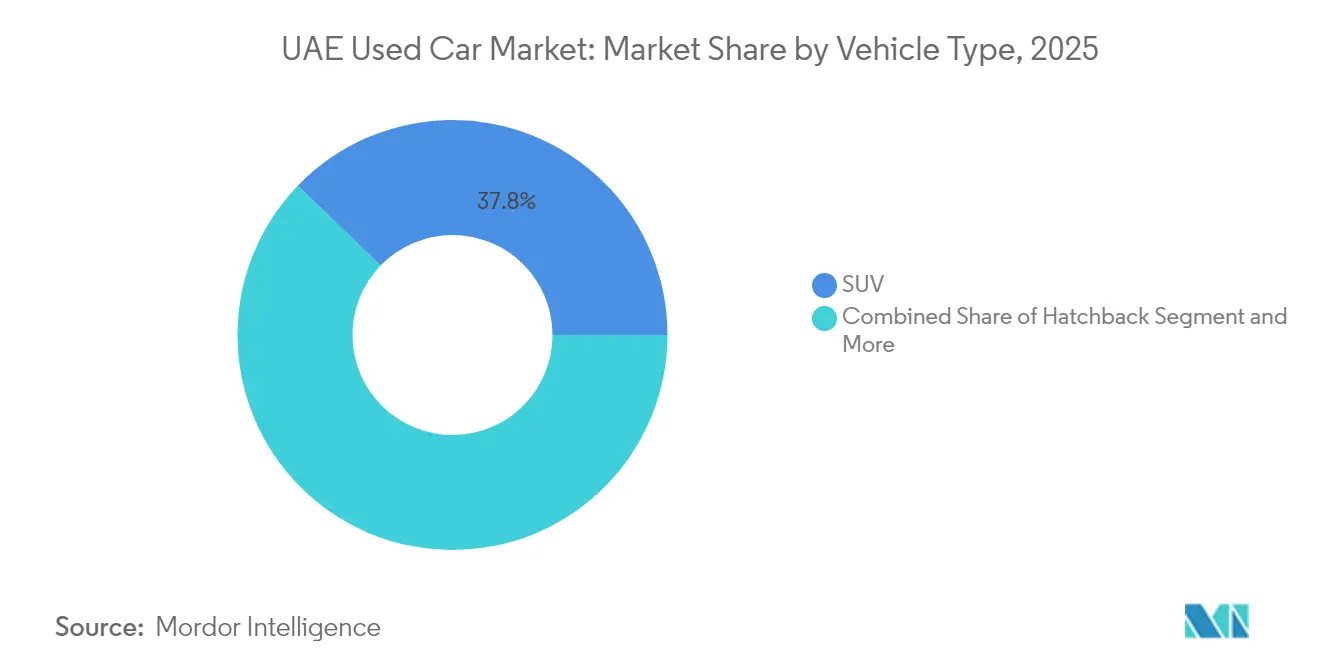
- By vehicle type, SUVs hold the leading 37.78% share of the UAE used cars market in 2025, while pickup trucks are the fastest growing at 10.24% CAGR.
- By vehicle age, cars aged 3 to 5 years command a 42.05% share of the UAE used cars market in 2025, whereas less than three years' used vehicles post the strongest 11.71% CAGR.
- By mileage band, the 50,000 to 100,000 km band is the market sweet holding 35.55% share in 2025; cars under 50,000 km grow quickest at 12.55% CAGR as early upgraders and fleets release lightly-driven stock.
- By fuel type, petrol power type dominates 71.85% share of the UAE used car market in 2025, while battery-electric cars deliver a 27.85% CAGR.
- By price band, USD 8,000 – 16,000 is the largest tier at 49.92% share of transactions in 2025; USD 16,000 – 30,000 is the fastest climber at 9.67% CAGR.
- By vendor type, unorganised independents still rule volume with a 54.88% share in 2025, while organised dealers/retailers expand at a 12.98% CAGR.
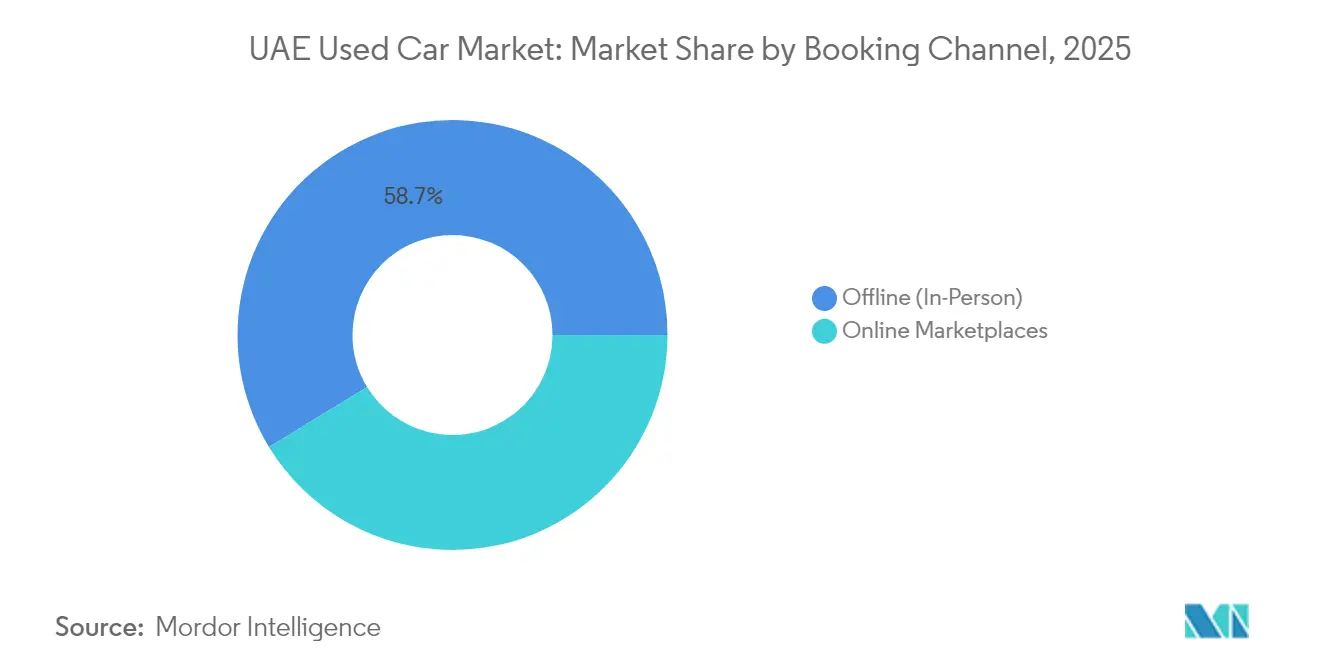
- By booking channel, offline (in-person) showrooms close 58.72% of shares in 2025; online marketplaces grow at a brisk 16.29% CAGR.
- By ownership type, individual sellers command 59.28% share of the UAE used cars market in 2025, whereas corporate and fleet de-fleets, rising 8.78% CAGR.
- By Emirates, Dubai commands a 56.84% share in 2025; Sharjah is the growth pacesetter at 9.48% CAGR.
Note: Market size and forecast figures in this report are generated using Mordor Intelligence’s proprietary estimation framework, updated with the latest available data and insights as of 2026.
UAE Used Car Market Trends and Insights
Drivers Impact Analysis*
| Driver | (~) % Impact on CAGR Forecast | Geographic Relevance | Impact Timeline |
|---|---|---|---|
| Large Expatriate Workforce | + 2.8% | Dubai, Abu Dhabi | Medium term (2-4 yrs) |
| Digital Inspection and Certification Platforms | + 2.3% | Nationwide, led by Dubai | Medium term (2-4 yrs) |
| Off-Lease Fleet Vehicles | + 1.7% | Major emirates | Medium term (2-4 yrs) |
| Surge in Luxury Vehicle Trade-ins | + 1.5% | Dubai, Abu Dhabi | Short term (≤ 2 yrs) |
| Regional Re-Export Demand | + 1.2% | Dubai, Sharjah | Long term (≥4 yrs) |
| Government EV Infrastructure Development | +1.2% | Dubai, Abu Dhabi | Long term (≥4 yrs) |
| Source: Mordor Intelligence | |||
Large Expatriate Workforce Driving Affordable Mobility Demand
Demand from expatriates shapes the mid-price tier of the UAE used car market, with units priced between AED 30,001 and AED 60,000 changing hands in especially high volumes. Dealers have learned to synchronize acquisition cycles with peak residency renewals, thereby maintaining suitable inventory depth when expatriate turnover spikes. Japanese and Korean make dominate this band because their perceived reliability trims long-run operating costs, which resonates with tenants managing tight household budgets. A parallel effect is the rising popularity of installment plans with flexible early-settlement clauses, a financing feature that aligns with the shorter average employment contracts of foreign professionals[1].
Digital Inspection and Certification Platforms Enhancing Trust and Liquidity
Standardised 200-plus-point inspection protocols, high-resolution imagery, and blockchain-anchored history reports have reset buyer expectations around transparency. Vehicles listed with digital certification typically clear inventory more than twice as quickly as unverified listings, illustrating how trust now speeds turnover and widens geographic reach[2]. Dealers benefit because shorter holding periods free working capital for reinvestment, while buyers secure sharper price discovery through algorithmic comparisons across emirates. The cascade effect is a marked fall in arbitrage opportunities for mileage manipulation, although enforcement gaps persist outside Dubai.
High Turnover of Off-Lease Fleet Vehicles Expanding Supply Pool
Corporate and rental fleets commonly replace cars within three years, releasing well-maintained stock into the UAE used car market in predictable waves. Documentation completeness on these units lowers due diligence costs for both dealers and retail buyers, reinforcing their status as preferred options for value-oriented households. The influx is particularly noticeable in the sedan category, where ex-fleet vehicles underpin stable residuals despite waning consumer enthusiasm for low-riding body styles. An observed corollary is that dealers specializing in volume sedans increasingly target fleet auctions to secure inventory, thereby reducing their dependence on private sellers.
Surge in Luxury Vehicle Trade-ins Boosting Premium Used Segment
The premium spectrum of the UAE used car industry owes its momentum to frequent luxury upgrades among affluent residents. Certified pre-owned (CPO) programs extend factory-grade warranties to second owners, which sustains resale values and compresses the price gap between new and lightly-used flagships. Mercedes-Benz and BMW dealerships report double-digit growth in CPO throughput, indicating that customers view official certification as adequate compensation for a modest premium. Wider availability of late-model luxury SUVs tells the same story, since trade-ins from urban households feed a robust second-cycle market that attracts aspirational buyers from neighbouring emirates. This circulation pattern subtly realigns showroom mix toward larger body styles without pressuring sticker prices on sedans.
Restraints Impact Analysis*
| Restraint | (~) % Impact on CAGR Forecast | Geographic Relevance | Impact Timeline |
|---|---|---|---|
| Odometer-Fraud Regulations | -1.9% | Global, most severe in Northern Emirates | Medium term (2-4 yrs) |
| GCC Import Restrictions | -1.7% | Global | Long term (≥4 yrs) |
| Elevated Financing Rates | -1.2% | Global, with higher impact in Abu Dhabi and Sharjah | Short term (≤2 yrs) |
| EV Model Depreciation | -0.6% | Dubai, Abu Dhabi | Short term (≤2 yrs) |
| Source: Mordor Intelligence | |||
Lack of Odometer-Fraud Regulations Undermines Buyer Confidence
Mileage discrepancies remain a persistent pain point because enforcement is uneven across emirates. Although Dubai’s Roads and Transport Authority has adopted digitalization to a great extent, most of the jurisdictions still rely on manual checks, leaving loopholes that dishonest sellers exploit. Consumers respond by concentrating purchases within organized retail networks, where recourse mechanisms and post-sale warranties mitigate perceived risk. The asymmetry has inadvertently widened the performance gap between formal dealerships and informal roadside traders, accelerating market consolidation.
GCC Age-Based Import Restrictions Limiting Supply Diversity
Rules barring vehicles older than ten years from initial registration squeeze the lower end of the UAE Used Car market size, especially for buyers targeting units below AED 30,000. Dealers offset the shortage by importing slightly newer stock with higher specification levels, effectively lifting the entry-price floor. One by-product of this policy is steeper depreciation for models approaching the age threshold, since cross-border resale windows close rapidly beyond the cut-off. Shoppers with deep product knowledge increasingly exploit this dynamic to find late-cycle bargains, sustaining a niche segment of price-driven demand.
*Our forecasts treat driver/restraint impacts as directional, not additive. The impact forecasts reflect baseline growth, mix effects, and variable interactions.
Segment Analysis
By Vehicle Type: SUVs Hold the Largest Market Share
SUVs hold the largest UAE used car market share at 37.78% in 2025, underscoring how family lifestyles and off-road leisure shape vehicle preferences. This dominance is strongest in Abu Dhabi, where desert terrains reward high ground clearance, while Dubai continues to lead luxury SUV resales. An emerging pattern is the rise of Chinese brands in the mid-size SUV class, supplying feature-rich alternatives that erode long-standing Japanese leadership. Dealers adjust by promoting after-sales support for these newer makes to reassure buyers unfamiliar with their long-term durability.
Pickup trucks post a 10.24% CAGR through 2031, reflecting their dual role in commercial fleets and weekend recreation. Lifestyle-oriented trims with passenger-car cabins broaden appeal beyond traditional worksite use, turning pickups into substitutes for large SUVs. The sedan pool still moves in large volumes via fleet defleets, but its share gradually yields to crossovers that feel modern yet require little adaptation in driving habits. Hatchbacks and MPVs fill niche requirements, with MPVs valued by larger families prioritizing seating capacity over status signalling.

By Vehicle Age: Cars Under 3 to 5 Years Lead the UAE Used Car Market
The cohort of 3 to 5-year-old cars accounts for 42.05% of the UAE used car market size, offering the sweet spot between modern features and manageable pricing. Buyers gravitate toward this bracket because manufacturer warranties often remain in effect, lowering perceived ownership risk.
Vehicles under three years display an 11.71% forecast CAGR, a trajectory fuelled by steady off-lease releases from corporates and rental firms. Enhanced inspection rules introduced by Dubai’s RTA accelerate depreciation for models at the five-year mark, which prompts bargain hunters to target units just inside the threshold. Cars older than eight years make up a modest minority, constrained by import ceilings and climate-related wear that dampen residuals.
By Mileage Band: Cars Between 50,000 and 100,000 km Lead the Market
Units showing 50,000 to 100,000 km command the largest 35.55% market share, balancing affordability against service-life expectations. This mileage band attracts commuters who prioritise reliable daily transport without accepting high odometer readings.
Sub-50,000 km cars are the fastest growing segment at a 12.55% CAGR, owing to corporate defleeting practices that release lightly driven stock. Blockchain-based mileage verification introduced by leading platforms differentiates these listings, enabling a price premium that rewards transparency. Models exceeding 150,000 km concentrate in Japanese nameplates, reflecting their reputation for longevity and the willingness of budget buyers to accept higher wear levels in exchange for lower capital outlay.
By Fuel Type: Petrol Cars Dominate the Market
Petrol cars dominate with a 71.85% UAE used car market share in 2025, reflecting the country’s affordable fuel and entrenched preference for internal-combustion performance. Diesel remains a small niche, mostly in light-commercial vehicles and European SUVs.
Hybrid systems grow tapping demand for improved fuel economy without charging anxieties, while battery-electric vehicles represent the fastest-growing pocket at a 27.85% projected CAGR. Depreciation curves for early-generation BEVs remain steeper than petrol equivalents, yet rising charger density and policy incentives gradually narrow the gap.
By Price Band: The USD 8,000 – 16,000 Bracket Delivers the Largest Volume
The USD 8,000 – 16,000 bracket delivers 49.92% of volume, confirming its position as the value core of the UAE used car industry demand. Consistent turnover in this segment supports dealers’ working-capital cycles and stabilises overall market liquidity.
Listings in the USD 16,000 – 30,000 band expand at a 9.67% CAGR on account of buyers trading up to vehicles with advanced safety technology still covered by warranty. The luxury tier above AED 100,000 shows price volatility as promotional campaigns on new models redefine used benchmarks, prompting savvy shoppers to time purchases around new-car launch schedules to capture sharper discounts.

By Vendor Type: Independent Traders Hold More Than Half of the UAE Used Car Market Share
Independent traders held 54.88% of the UAE used car market share, supplied by both individual sellers and small importers clustered in Sharjah and Dubai. Their cost-light structures enable competitive pricing, yet limited after-sales offerings leave them exposed to rising transparency expectations.
Organised dealers, forecast to grow at 12.98% CAGR, invest in omnichannel platforms that integrate inspection, financing, and logistics into a unified journey. OEM-backed certified programs capture 15.10 % share, signalling consumer readiness to pay for branded assurance, especially in the luxury and near-new sub-segments.
By Booking Channel: In-Person Purchases Maintain the Lea
In-person purchases account for 58.72% of transactions, a testament to the cultural importance of physical inspection and on-site negotiation. Sellers leverage tactile demonstrations to justify price points, reinforcing the dealership visit as a central step in high-value deals.
Online marketplaces, scaling at 16.29% CAGR, counter these traditions with conveniences such as home test drives and money-back guarantees. Real-time pricing engines increasingly anchor negotiations, narrowing gaps between listing and closing prices and thus compressing bargaining bandwidth.
By Ownership Type: Private Individuals Constitute the Majority of The Market
Private individuals constitute 59.28% of the supply, injecting diverse models and specifications that enrich buyer choice. Informal listings often carry incomplete documentation, prompting risk-averse customers to negotiate steeper discounts to offset verification effort.
Corporate fleet de-fleets, projected at an 8.78% CAGR, provide nearly-new stock with service records, creating a premium subset that frequently transitions directly into organised dealer pipelines. The rising prevalence of dedicated remarketing platforms reduces time-on-lot for such vehicles, making fleet disposals a strategic sourcing channel for multi-brand retailers.
Geography Analysis
Dubai controls around 56.84% of the UAE's used car market size, supported by the emirate’s dense expatriate clusters, tourist inflows, and retail sophistication. Sheikh Zayed Road hosts flagship luxury showrooms, while Ras Al Khor functions as a wholesale hub where bulk traders transact cross-border deals. Strengthening regulatory oversight, including blockchain verification, further cements Dubai’s leadership by building cross-emirate trust and widening its virtual catchment area.
Abu Dhabi holds a significant market share, characterised by cautious demand anchored in stable government employment. Buyers here favour lower-mileage inventories and are willing to pay premiums for documented maintenance histories, a behaviour that supports organised retailers with stringent sourcing standards. Corporate fleet disposals from state-owned enterprises constitute a reliable flow of two- to three-year-old sedans and SUVs, reinforcing Abu Dhabi’s reputation as a source of lightly used cars. Financing offers with subsidised rates from local banks facilitate upgrades, underpinning steady transaction volumes even during cyclical interest-rate swings.
Sharjah is expected to post the fastest CAGR of 9.48%, and covers a significant portion of sales, functioning as price-sensitive catchment zones that extend vehicle life cycles. Sharjah’s Industrial Area aggregates independent lots where older models find last-owner buyers, relieving inventory pressure in Dubai and Abu Dhabi. Digital platforms now channel more Sharjah listings to out-of-emirate customers, illustrating the diminishing role of geographic distance in purchase decisions. Meanwhile, Ajman and Ras Al Khaimah support niche export-focused dealers who funnel SUVs to African markets, a specialisation that injects foreign currency and stabilises local dealer margins when domestic demand pauses.
Regulatory Landscape
The UAE used-car ecosystem operates under a mix of federal technical conformity requirements and emirate-level registration and inspection practices. At the federal level, the Ministry of Industry and Advanced Technology (MoIAT), which absorbed ESMA functions, runs conformity and product-compliance processes that affect used-vehicle imports, including digital issuance of product status statements to confirm eligibility and screen out categories such as scrapped, flooded, or damaged-beyond-repair units. Cabinet Resolution No. 12 of 2018 underpins mandatory conformity assessment for key spare parts (for example, brakes, seat belts, and lighting), which increases the need for compliant parts sourcing during reconditioning and resale.
Environmental and digital-compliance initiatives also shape operating models for dealers and platforms. New vehicle emission limits require EURO 6B compliance for new models from 1 January 2026, with a broader compliance timeline extending to all imports by 1 July 2027, which affects the future composition and importability of late-model stock. Separately, the UAE e-invoicing rollout for B2B/B2G transactions introduces process and systems requirements for automotive participants, with a pilot phase starting 1 July 2026 and larger businesses (revenue above AED 50 million) required to comply by 1 January 2027, accelerating digitized documentation across trade, financing, and aftersales workflows.
Competitive Landscape
The five largest entities jointly deliver less than half of the UAE's used car market share, leaving substantial headroom for consolidation. Al-Futtaim Automall leads with a position fortified by its multi-brand footprint and synergies with Toyota’s service network. Digital-first players such as Cars24 and SellAnyCar.com grow briskly by automating valuations and facilitating same-day payments, innovations that raise customer expectations across the sector. Their capital-light asset models convert data into pricing accuracy, which in turn accelerates turnover and draws inventory from private owners eager for quick exits.
A visible strategic fork separates incumbents optimising physical sites from newcomers investing in cloud-native infrastructure. Traditional groups retrofit showrooms with digital kiosks and omnichannel booking tools to retain footfall advantages while providing online convenience. Simultaneously, purely online operators lease large reconditioning centres outside urban cores where lower rents trim refurbishment costs and protect gross margins. This bifurcation produces complementary rather than directly adversarial dynamics because surplus stock often passes from independents to platforms via wholesale auctions, integrating the ecosystem.
Competitive differentiation increasingly depends on data fidelity. Platforms deploying blockchain for mileage verification or AI for dynamic pricing win trust and extract efficiency gains. Meanwhile, white-space remains in certified pre-owned offerings for mainstream brands, where current solutions focus chiefly on high-value luxury lines. Market participants that bridge this gap stand to capture volume without ceding margin, since mid-range buyers increasingly value warranty coverage.
UAE Used Car Industry Leaders
-
Al-Futtaim Group
-
Al Nabooda Automobiles LLC
-
Al Tayer Motors
-
SellAnyCar.com
-
Cars24
- *Disclaimer: Major Players sorted in no particular order
Market Opportunities and Future Outlook
The clearest opportunity sits where compliance and trust intersect: import screening, standardized inspection, and certified reconditioning services that make vehicles easier to register and finance across emirates. MoIAT digital product-status checks for imported used vehicles, alongside mandatory spare-parts conformity requirements under Cabinet Resolution No. 12 of 2018, increase demand for professional refurbishment, compliant parts procurement, and documentation management, especially for high-volume 3 to 5-year and under-3-year cohorts where buyers pay for assurance. The announced AED 55 million DP World and Cars24 automotive refurbishment hub at Dubai National Industries Park, with operations scheduled for August 2026, also points to centralized refurbishment capacity and logistics-led turnaround becoming a scalable playbook. This creates room for third-party reconditioning, inspection-as-a-service offerings, and cross-emirate delivery solutions.
Digital operating models expand use cases beyond listing and sales into full lifecycle services, supported by formalization programs and large dealer footprints. The UAE e-invoicing transition (pilot from 1 July 2026) favors organized operators that can connect compliant invoicing, financing paperwork, warranty administration, and aftersales into one workflow, reducing friction for higher-ticket used vehicles. Established networks such as Al-Futtaim Auto Centers (over 13 locations in the UAE) and dealer groups running certified pre-owned programs (for example, Al Tayer Motors and Al Nabooda Automobiles) illustrate where commercial space is forming around service packages, warranties, and maintenance offerings that shift one-time used-car purchases into longer customer relationships while improving resale confidence.
Recent Industry Developments
- June 2026: Cars24 launches Cars24 Labs with AED 75 million commitment to AI build, partner, and investment arm. The initiative advances data-driven pricing, refurbishment, and platform-wide automation for UAE used-car market. Cars24's AI driven ecosystem push strengthens its role in the UAE market and accelerates cross-channel integration.
- October 2025: DP World and Cars24 announce AED 55 million automotive refurbishment hub at Dubai National Industries Park with operations planned August 2026. The centralized refurbishment capacity expands quality control and throughput for used-car stock, enabling faster turnover. The arrangement enhances cross-emirate liquidity by scaling processing capacity.
- July 2025: Al-Futtaim Automotives (Automall/Auto Center network) opens a new Automall and Auto Center in Mussafah, Abu Dhabi, expanding UAE network. The expanded organized retail footprint strengthens consumer access to certified used cars and boosts brand reach. The development supports higher consumer confidence through improved service and warranty offerings.
Research Methodology Framework and Report Scope
Market Definition and Coverage
For this methodology, the market covers the value created when a previously owned passenger vehicle or commercial vehicle is sold to an end buyer within the United Arab Emirates, including organized and unorganized channels.
Scope exclusions: We exclude brand new vehicle sales, motorcycles, and pure service revenues such as financing interest, insurance premiums, and repair-only work that is not part of the vehicle sale.
Segmentation Overview
- By Vehicle Type
- Hatchback
- Sedan
- SUV
- MPV
- Luxury and Sports Cars
- By Vehicle Age
- less than 3 Years
- 3 to 5 Years
- 6 to 8 Years
- Over 8 Years
- By Mileage Band
- Less than 50,000 km
- 50,000 to 100,000 km
- 100,001 to 150,000 km
- Over 150,000 km
- By Fuel Type
- Petrol
- Diesel
- Hybrid
- Battery-Electric
- CNG/LPG
- By Price Band
- Below USD 8,000
- USD 8,000 – 16,000
- USD 16,000 – 30,000
- Above USD 30,000
- By Vendor Type
- Organized Dealer/Retailer
- Unorganized Independent
- OEM-Certified Pre-Owned
- By Booking Channel
- Online Marketplaces
- Offline (In-Person)
- By Ownership Type
- Individual Sellers
- Corporate/Fleet De-fleets
- By Emirate
- Dubai
- Abu Dhabi
- Sharjah
- Northern Emirates (AJM, RAK, UAQ, Fujairah)
Data Sources, Market Sizing, and Validation
Desk Research
Desk research was used to set the market boundary, build a clean demand backdrop, and sanity-check the direction of prices and volumes across emirates. We relied on public UAE statistics and policy references, such as Ministry of Energy and Infrastructure transport updates, Federal Competitiveness and Statistics Centre releases, and Dubai Statistics Center indicators that help explain population, income, and vehicle ownership trends.
To translate the demand backdrop into used-car turnover signals, we also reviewed sources such as Roads and Transport Authority publications, customs and trade summaries where relevant, and research articles on residual values and vehicle depreciation patterns. Company annual reports, investor presentations, and credible local press were used to understand channel split shifts toward organized retail, online listings behavior, and typical reconditioning practices. A paid subscription database was referenced selectively for company financial intelligence and for shipment or trade-linked cross checks where public detail was thin. The sources listed here are illustrative, and many additional public and paid references were used for data collection, validation, and clarification.
Primary Interviews and Surveys
Primary interviews and surveys were used to validate transaction value logic and to tighten assumptions that desk research cannot show clearly, such as the typical price spread by age and mileage, and how fast inventory turns by emirate. We spoke with a mix of organized dealers, independent sellers, fleet or leasing stakeholders, and marketplace-side experts so that inputs could be compared across different selling routes and buyer profiles.
Distribution of primary research fieldwork respondents
| Company type | Respondent position |
|---|---|
| Top tier: 37% | CXOs: 14% |
| Mid tier: 46% | Functional/Unit leaders: 33% |
| Smaller Players: 17% | Managers: 53% |
Market-Sizing & Forecasting
Sizing was built using top-down and bottom-up checks that stay practical for a country market where every transaction is not visible in one public dataset. On the top-down side, we reconstructed an annual used-car value pool by linking the addressable vehicle parc and replacement cycle to expected resale activity, which was then translated into value using average transaction price bands.
Several market fingerprints were used as model inputs to keep the totals realistic, including used-vehicle transaction mix by vehicle type, price band movement over time, age and mileage distribution that shifts average selling price, and the share change between dealer-led sales and peer-to-peer sales. We also tracked signals tied to supply, such as off-lease and fleet churn, and demand indicators such as population growth, income conditions, and shifts in preference toward affordable mobility. Where direct volume was uncertain, gaps were handled through bounded assumptions that were tested against interview feedback and against observable listing and inventory patterns.
For forecasting, scenario analysis was used because price and turnover can move quickly with policy changes, fuel price expectations, and credit availability. The forward view was anchored on consensus ranges from primary discussions for unit turnover and price progression, and then adjusted for expected normalization in cross-emirate buying behavior and the ongoing move toward organized retailing.
Data Validation & Update Cycle
Validation was done through stepwise checks so that any single input could not drive the outcome unchecked. We compared model outputs against independent signals such as implied turnover rates, average ticket size ranges by emirate, and the direction of inventory flow from fleet and leasing sources, and then outliers were reviewed before sign-off.
A second analyst review was used to re-check arithmetic, scope consistency, and whether assumptions still matched current market behavior. Reports are refreshed annually, and interim updates are triggered when material events shift prices or volumes meaningfully. Before delivery, a final pass is completed so clients receive the latest view with updated assumptions and converted values aligned to the reporting year.
Mordor Intelligence's United Arab Emirates Used Car Market Sizing Compared With Other Published Estimates
Published values for the UAE used car market do not always match because the scope and the counting logic differ, even when the labels sound similar. The biggest swings usually come from whether the estimate is built from transaction value only, whether it mixes in related services, and how quickly price bands and channel shares are refreshed.
In this study, the value pool is tied to UAE resale transactions and then stress-tested using turnover and pricing checks by emirate and by vehicle condition, which is why some published figures land higher when they include add-on services or take a more aggressive price progression, a modeling choice applied by Mordor Intelligence.
Benchmark comparison
| Source | Market Size | Gaps in Research Methodology |
|---|---|---|
| Mordor Intelligence | USD 20.55 B (2025) | |
| Trade Journal A | USD 20.15 B (2022) | Uses an earlier base year and is commonly presented as a long-range projection headline, which can understate later price band shifts and the post-2022 mix change toward higher ticket SUVs. |
| Industry Consultancy B | USD 20.91 B (2025) | Often leans on listing-led or dealer-reported pricing and applies broad uplift factors, which can overstate realized transaction prices when private sales and discounting are not netted out consistently. |
The spread across sources is mainly explained by base-year choice, whether realized transaction values are separated from add-on services, and how price and mix are refreshed. By keeping the value build-up traceable to turnover and price band assumptions that can be rechecked, the final number stays easier to audit and update when the market moves.
Key Questions Answered in the Report
How big is the UAE Used Car Market?
The UAE Used Car Market size is expected to reach USD 22.92 billion in 2026 and grow at a CAGR of 11.52% to reach USD 39.58 billion by 2031.
Which vehicle type holds the biggest UAE Used Car market share?
SUVs lead with a 37.78% of total market share, reflecting family and off-road preferences.
Why are certified pre-owned programs gaining popularity?
They provide factory-backed inspections and warranties that build buyer confidence and support higher resale values.
How are digital marketplaces changing used car buying in the UAE?
Online platforms shorten sales cycles, offer transparent pricing, and enable remote purchases, prompting faster inventory turnover.