
Turkey OOH And DOOH Market Size and Share
Market Overview
| Study Period | 2020 - 2031 |
|---|---|
| Forecast Data Period | 2026 - 2031 |
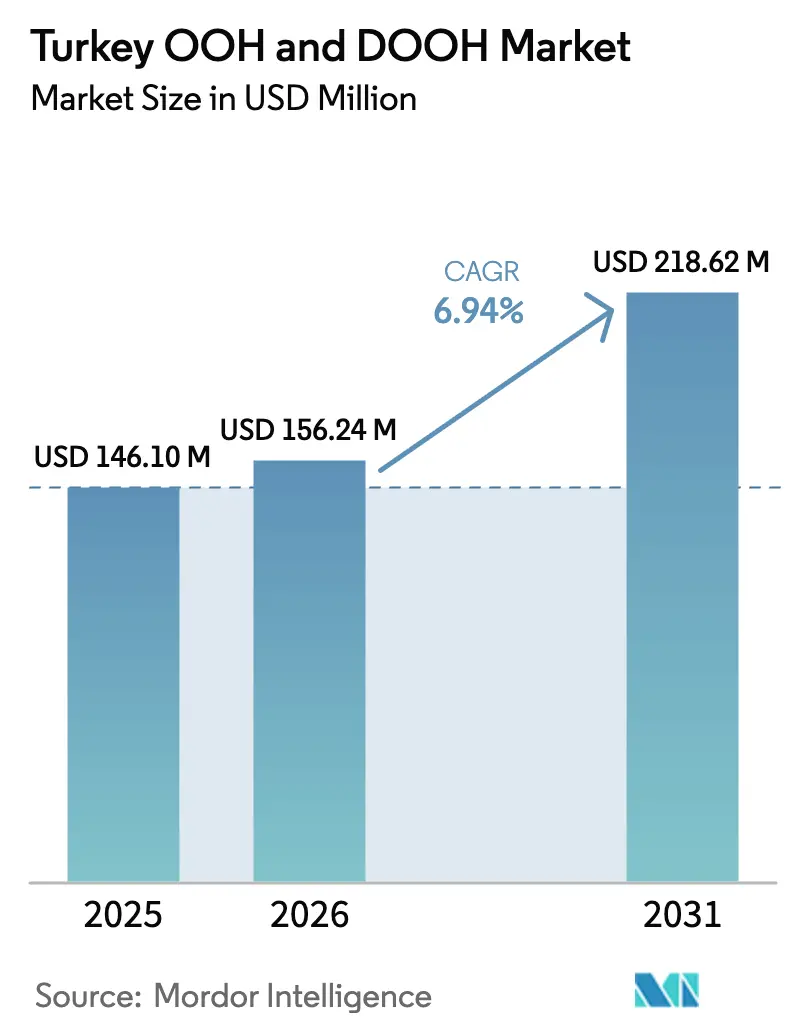
| Base Year Market Size (2025) | USD 146.10 Million |
| Market Size (2026) | USD 156.24 Million |
| Market Size (2031) | USD 218.62 Million |
| Growth Rate (2026 - 2031) | 6.94 % |
| Market Concentration | Medium |
Major Players *Disclaimer: Major Players sorted in no particular order Image © Mordor Intelligence. Reuse requires attribution under CC BY 4.0. | |
Turkey OOH And DOOH Market Analysis by Mordor Intelligence
The Turkey OOH and DOOH market size is expected to grow from USD 146.10 million in 2025 to USD 156.24 million in 2026 and is forecast to reach USD 218.62 million by 2031 at 6.94% CAGR over 2026-2031. This pace outstrips the global outdoor advertising average as smart-city spending, a sharp rebound in tourism, and currency-linked media budget shifts pull advertisers toward data-rich formats. Istanbul Airport’s expansion to 120 million passengers by 2025 widens premium inventory just as 5G roll-outs unlock real-time bidding and measurement. Cost-savvy FMCG brands are reallocating funds from television toward the more affordable reach of the Turkey OOH and DOOH market, while municipalities press ahead with GIS-based billboard oversight that favors high-yield digital furniture. Currency volatility still inflates imported LED costs, yet steady GDP growth near 3% and moderating inflation signal a gradually improving ad-spend environment.
Key Report Takeaways
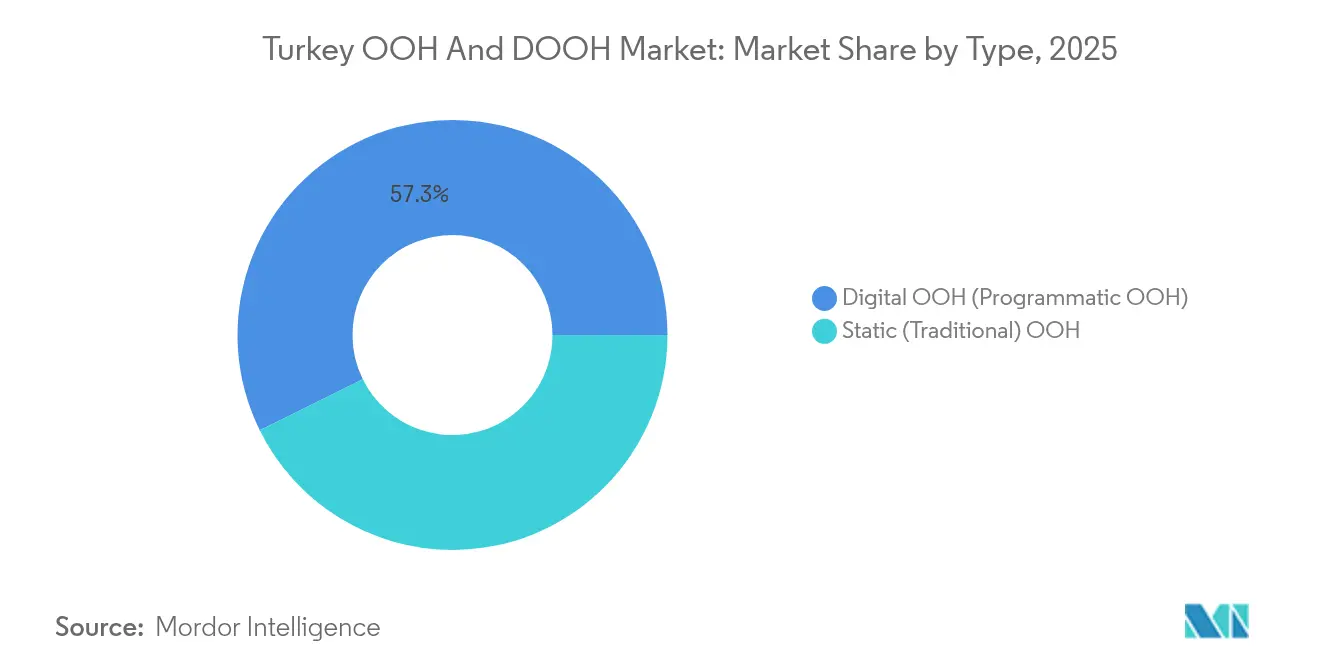
- By type, Digital OOH held 57.30% of the Turkey OOH and DOOH market share in 2025, and programmatic OOH is set to grow at a 14.02% CAGR through 2031.
- By format, billboards led with a 41.65% revenue share of the Turkey OOH and DOOH market in 2025, while airport advertising is projected to advance at a 10.96% CAGR to 2031.
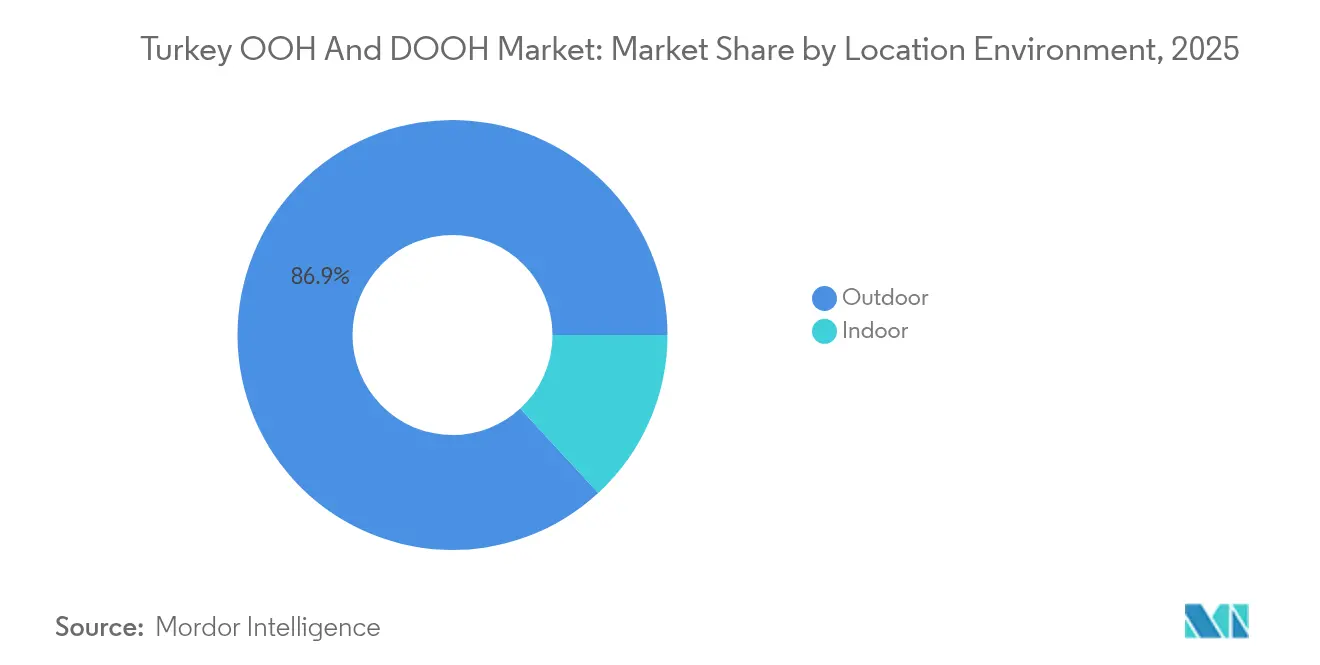
- By location environment, outdoor sites captured 86.85% of the Turkey OOH and DOOH market size in 2025; indoor venues are forecast to expand at a 9.98% CAGR.
- By end-user industry, retail and consumer goods accounted for 33.10% of spending in the Turkey OOH and DOOH market in 2025, whereas healthcare is projected to post the fastest growth, with a 9.56% CAGR, to 2031.
Note: Market size and forecast figures in this report are generated using Mordor Intelligence’s proprietary estimation framework, updated with the latest available data and insights as of 2026.
Turkey OOH And DOOH Market Trends and Insights
Drivers Impact Analysis*
| Driver | (~) % Impact on CAGR Forecast | Geographic Relevance | Impact Timeline |
|---|---|---|---|
| Rapid roll-out of Istanbul, Ankara and Izmir smart-city initiatives fuelling digital street furniture demand | +1.80% | Istanbul, Ankara, Izmir | Medium term (2-4 years) |
| Surge in domestic tourism and 45% jump in Istanbul Airport passenger volume boosting airport media | +1.50% | Istanbul Airport, major tourism destinations | Short term (≤ 2 years) |
| Lira depreciation driving FMCG advertisers toward cost-efficient OOH over TV | +1.20% | National urban markets | Short term (≤ 2 years) |
| 5G/edge networks enabling real-time programmatic DOOH bidding | +0.90% | Primary metros, expanding to secondary cities | Medium term (2-4 years) |
| Integration of mobile-location data improving ROI attribution for Turkish retailers | +0.70% | Major retail districts | Medium term (2-4 years) |
| Municipal digitization initiatives improving permit efficiency and revenue optimization | +0.60% | All metropolitan areas | Long term (≥ 4 years) |
| Source: Mordor Intelligence | |||
Smart-city build-out heightens demand for digital street furniture
Municipal IT investments in Istanbul, Ankara and Izmir combine GIS mapping, IoT traffic sensors and 5G backhaul, creating turnkey attachment points for connected screens. City authorities view advertising-enabled kiosks as dual-use civic assets that inform residents and fund public services, shortening payback periods for operators. International grants from the U.S. Trade and Development Agency validate the technical roadmap and accelerate pilot deployments.[1] Implementation cycles of two to four years suggest that the Turkey OOH and DOOH market will see a steady pipeline of new digital furniture through 2028. As permit workflows migrate to cloud dashboards, approval lead-times are falling, reducing market entry barriers for data-centric players and widening inventory for programmatic marketplaces.
Tourism rebound fuels premium airport inventory
Istanbul Airport’s Phase 2 completion increases capacity to 120 million passengers, with international travelers accounting for 80% of the footfall.[2] Longer dwell times, triple runway efficiency, and high-end retail corridors make airport screens one of the costliest yet most desired assets in the Turkey OOH and DOOH market. Turkish Airlines’ fleet expansion to 458 aircraft underpins traffic growth and widens cargo halls for brand exposure. Programmatic feeds enable advertisers to adjust their creative based on arriving flight origins, aligning language and product mix with traveler demographics. Luxury, travel retail, and fintech brands thus assign disproportionate budgets to this format in anticipation of continued tourism momentum.
Currency trends redirect FMCG spend
The lira’s depreciation raises LED import prices by more than 20% year-on-year, squeezing capex budgets, yet the same exchange-rate dynamics make nationwide outdoor buys relatively cheaper than television or digital video sold in USD. Discount-oriented retailers BIM and A101, now dominating Turkey’s USD 75 billion grocery channel, exploit this cost advantage to blanket commuter corridors with price-point messaging. As inflation is forecast to ease to 25% in 2025, media planners expect a gradual normalization of budgets yet see OOH retaining share owing to its comparative efficiency. The Turkey OOH and DOOH market therefore benefits from both tactical short-term currency arbitrage and longer-term reach economics.
5G unlocks real-time trading
Spectrum auctions completed in 2024 pave the way for nationwide 5G coverage by 2027, enabling sub-10-millisecond latency crucial for impression-level bidding. Edge servers co-located with screens can now ingest weather, traffic and point-of-sale feeds to trigger dynamic creatives. Compliance with Turkey’s Personal Data Protection Law, aligned to EU GDPR, reassures advertisers that location-derived targeting remains privacy-safe. Early pilots indicate double-digit ROI uplifts versus fixed-loop scheduling, steering more brand dollars into the programmatic subset of the Turkey OOH and DOOH market. As telcos offer bundled connectivity and analytics, smaller screen owners gain a low-friction path to programmatic liquidity.
Restraints Impact Analysis*
| Restraint | (~) % Impact on CAGR Forecast | Geographic Relevance | Impact Timeline |
|---|---|---|---|
| Volatile FX inflating imported LED screen costs by >20% YoY | -1.40% | Nationwide | Short term (≤ 2 years) |
| Municipal permit caps and fragmented zoning rules across 30 metros | -0.80% | All metropolitan areas | Long term (≥ 4 years) |
| Limited third-party audience-measurement standards lowering brand confidence | -0.60% | National, premium advertisers | Medium term (2-4 years) |
| High electricity tariffs eroding DOOH operator margins | -0.50% | National, regional variation | Medium term (2-4 years) |
| Source: Mordor Intelligence | |||
FX volatility raises hardware costs
Digital billboards rely on imported LEDs priced in USD or EUR, so every lira drop magnifies capex by double digits. Operators often postpone upgrades or opt for smaller pitch sizes, which compromise brightness. Hedging strategies remain limited due to long delivery lead times, and local component substitution is still years away. The near-term squeeze constrains the Turkey OOH and DOOH market’s digital refresh cycle, potentially slowing inventory growth until exchange rates stabilize or financing costs ease.
Fragmented permits hinder scale efficiencies
Turkey’s 30 metropolitan municipalities issue distinct quotas on screen density, height, and creative duration, forcing operators to manage dozens of compliance templates. Although Ankara and Istanbul now pilot GIS-based approval systems that cut processing time, most cities still rely on manual reviews, prolonging rollout schedules. The lack of uniformity raises legal risk, deters cross-regional campaigns, and limits nationwide network consolidation. Long-term harmonization would unlock cost efficiencies, yet political decentralization suggests a protracted timetable.
*Our forecasts treat driver/restraint impacts as directional, not additive. The impact forecasts reflect baseline growth, mix effects, and variable interactions.
Segment Analysis
By Type: Programmatic acceleration reshapes inventory
Programmatic OOH is forecast to climb at a 14.02% CAGR through 2031, the fastest among all categories. This leap is anchored in the expanding 5G mesh and cloud ad exchanges that dynamically price impressions. Digital OOH already commands 57.30% of the Turkey OOH and DOOH market share in 2025, underscoring a structural tilt away from static assets. Operators that retrofit legacy screens with SSP-enabled players can tap into incremental demand without full hardware replacement, while mobile-location datasets help prove a lift in footfall, nudging cautious brands to shift their spend. Static formats retain relevance in rural corridors where access to electricity and permit rules hinder digitization, yet their revenue yield per face is plateauing. International case studies reporting 63.5% programmatic revenue spikes convince local players that the same uplift is within reach once measurement standards mature. Consolidation moves such as T-Mobile’s USD 250 million purchase of Vistar Media foreshadow similar alliances in Turkey, especially among telecoms seeking to monetize edge capacity.
Continued device cost declines, bundled data plans, and cloud APIs are likely to push the Turkey OOH and DOOH market toward a majority programmatic trading model by the end of the decade. The technology’s auction-based floor pricing can also mitigate FX swings by instantly repricing slots in local currency, providing revenue certainty for operators and spend predictability for advertisers.

By Format: Airports outpace conventional billboards
Billboards still account for 41.65% of 2025 revenue, thanks to their extensive highway stock and landmark sites, but transportation-airport media is growing faster at a 10.96% CAGR. Istanbul Airport’s global hub status attracts luxury, financial services, and travel retailers that cater to affluent travelers. Premium CPMs are justified by long dwell times and biometric traffic verification, which ensures audited reach. Street furniture is enjoying a second wave of interest as city councils embed sensors that monitor air quality and traffic, turning screens into multi-service nodes eligible for smart-city grants. Transit media inside buses, metro cars, and ferries leverages Turkey’s rising public transport patronage, offering first-party card data for audience insights. Place-based networks in malls and hospitals diversify exposure contexts, mitigating seasonality. Although billboards remain volume leaders, their share is projected to inch down as operators redeploy capex toward higher-yield indoor and transit formats that suit programmatic overlays.
By Location Environment: Indoor venues gain momentum
Outdoor settings account for 86.85% of the Turkey OOH and DOOH market size in 2025, but indoor screens in malls, supermarkets, and gyms are on a 9.98% growth trajectory. Controlled lighting enhances creative fidelity and reduces maintenance, while proximity to the point of purchase boosts sales attribution. Retailers integrating self-checkout and digital shelving now package screen time with on-site activations, tempting CPG brands to pay a premium for this added value. Indoor energy bills are also lower because HVAC systems are already in place, lessening one major restraint that afflicts roadside DOOH. Yet, outdoor inventory continues to capture eyeballs during the average 92-minute daily commute across major metropolitan areas. Over the forecast span, operators are expected to blur lines by adding semi-enclosed transit shelters and pedestrian underpasses that combine outdoor reach with indoor advantages, sustaining balanced growth across both contexts.
By End-User Industry: Healthcare surges amid retail dominance
Retail and consumer goods advertisers held 33.10% of spend in 2025, reflecting intense price competition among grocery chains and apparel discounters. Currency indecision pushes these brands to favor mass-reach formats for quick turnover. Healthcare, however, is growing at a 9.56% CAGR as hospitals, telemedicine apps, and wellness supplement makers utilize OOH to build trust. Government investment in city hospitals and public health campaigns generates cooperative inventory buys that amplify private sector messages. Automotive, BFSI, and telecom each contribute mid-single-digit shares, leveraging the Turkey OOH and DOOH market’s urban mobility to seed top-of-mind recall. Over time, stricter data privacy around online cookies may redirect digital-only budgets toward compliant, location-based OOH, benefiting both healthcare and financial advertisers seeking brand-safe environments.
Geography Analysis
The Istanbul-Ankara-Izmir corridor dominates spend due to population density, higher GDP per capita and early 5G availability. Istanbul alone hosts more than one-third of national inventory, leveraging its 16 million residents and multi-airport ecosystem. Ankara’s role as the administrative capital channels government PSA allocations and lobbying budgets into local street furniture. Izmir’s export-oriented economy and port traffic spur a mix of B2B and leisure campaigns, making it the third anchor in the Turkey OOH and DOOH market.
Secondary metros such as Bursa, Antalya and Adana record accelerating demand as infrastructure funds trickle beyond the traditional triangle. Coastal tourism hubs generate summer peaks, with advertisers opting for flexible, two-month flight contracts priced via programmatic platforms to handle seasonality. Eastern cities still lag in digital penetration, yet government urban-renewal schemes could unlock fresh inventory pipelines by 2028.
Turkey’s position bridging Europe and Asia gives international advertisers a single-country testbed to reach varied demographics under one regulatory roof. Campaigns originating from Gulf brands increasingly treat Istanbul as an entry point before pan-EU expansion, supporting cross-border creative and language rotations. While regional income disparities persist, the share-of-voice achievable through a consolidated buy in the Turkey OOH and DOOH market remains cost-effective versus splintered multi-market schedules.
Competitive Landscape
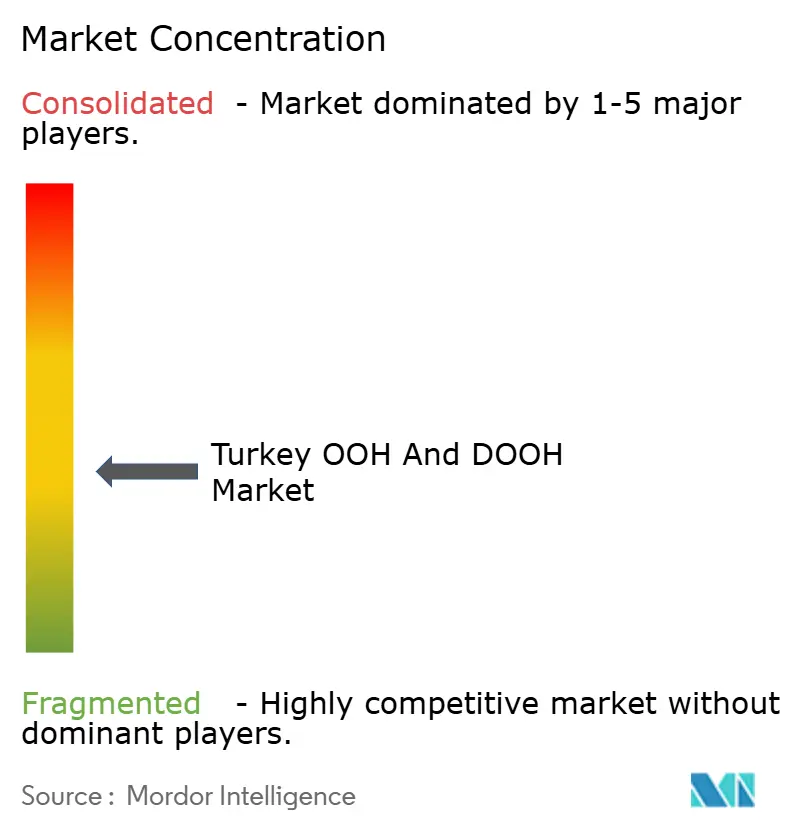
Competition is moderate, with roughly a dozen sizeable operators and many municipal-focused SMEs. International groups such as Clear Channel Türkiye and Ströer benefit from global client rosters, yet domestic firms like Union Istanbul, OutMedya and Kentvizyon excel at navigating local permits. Consolidation is hampered by zoning heterogeneity, prompting firms to specialize by geography or format instead of pursuing national footprints.
Technology investments define competitive edges: audience-measurement partnerships, energy-efficient LED retrofits and programmatic integrations attract blue-chip advertisers that demand transparency. Municipal digitization pilots invite software vendors and telcos to supply back-end platforms, injecting new entrants into the value chain. As high electricity tariffs persist, firms experimenting with solar arrays and adaptive brightness controls gain margin resilience, further differentiating offerings.
Global M&A signals are watched closely; T-Mobile’s Vistar Media acquisition underscores telecom appetite for ad tech and may catalyze similar deals between Turkish mobile operators and screen owners. Meanwhile, large retailers are building proprietary in-store networks, posing both partnership and competitive threats to traditional OOH specialists. Over the outlook period, scale will hinge less on raw face count and more on data, energy and programmatic capabilities.
Turkey OOH And DOOH Industry Leaders
-
Clear Channel Türkiye
-
Union Istanbul
-
OutMedya
-
Ströer Kentvizyon Turkey
-
Core Out of Home
- *Disclaimer: Major Players sorted in no particular order
Recent Industry Developments
- March 2025: T-Mobile closed its USD 250 million acquisition of Vistar Media, validating programmatic DOOH’s strategic value.
- January 2025: The U.S. Trade and Development Agency approved grants for Turkish smart-city pilots aligned with the national Digital Transformation Strategy 2024-2028.
- December 2024: Istanbul Airport completed Phase 2 infrastructure, enabling 120 million annual passengers by 2025.
- October 2024: Turkish Airlines announced 32% YoY cargo growth and a fleet of 458 aircraft.
Turkey OOH And DOOH Market Report Scope
The study monitors advertising expenditures throughout a broad range of out-of-home (OOH) formats that encompass billboards (including city-light boards), street furniture (such as city-light posters), transit and transportation (advertising on or in public transportation vehicles), and place-based media (media located at the point of sale). The study is focused on digital and static advertising, spanning indoor and outdoor settings such as shopping malls, airports, streets, and transit hubs. Notably, agency commissions and production costs are omitted from the study's analysis.
Segmented by application and end-user industry, the market analysis highlights key metrics, identifies growth drivers, and evaluates prominent industry participants. The study enhances global market estimates and growth rates for the forecast period alongside analyzing the broader impacts of COVID-19 on the market.
The Turkish OOH and DOOH market is segmented by type (static (traditional), digital OOH (LED screens) [programmatic OOH, others]), application (billboard, transportation (transit) [airports, others (buses, etc.)], street furniture, other place-based media), and end-user industry (automotive, retail and consumer goods, healthcare, BFSI, and other end-user industries).
The market sizes and forecasts are provided in terms of value (USD) for all the above segments.
| Static (Traditional) OOH | |
| Digital OOH | Programmatic OOH |
| Others |
| Billboard | |
| Transportation (Transit) | Airports |
| Others (Buses, Rail, Ferry) | |
| Street Furniture | |
| Other Place-based Media |
| Outdoor |
| Indoor |
| Automotive |
| Retail and Consumer Goods |
| Healthcare |
| BFSI |
| Other Industries (Entertainment, Government, Telecom) |
| By Type | Static (Traditional) OOH | |
| Digital OOH | Programmatic OOH | |
| Others | ||
| By Format | Billboard | |
| Transportation (Transit) | Airports | |
| Others (Buses, Rail, Ferry) | ||
| Street Furniture | ||
| Other Place-based Media | ||
| By Location Environment | Outdoor | |
| Indoor | ||
| By End-User Industry | Automotive | |
| Retail and Consumer Goods | ||
| Healthcare | ||
| BFSI | ||
| Other Industries (Entertainment, Government, Telecom) | ||
Key Questions Answered in the Report
What is the current size of the Turkey OOH and DOOH market?
The sector generated USD 156.24 million in 2026 and is projected to reach USD 218.62 million by 2031.
How fast is the market growing?
The compound annual growth rate stands at 6.94% for 2026-2031, outpacing global outdoor advertising averages.
Which segment is expanding the quickest?
Programmatic OOH is rising at a 14.02% CAGR, driven by 5G connectivity and data-rich bidding platforms.
Why are airport screens gaining prominence?
Istanbul Airport’s expansion to 120 million passengers boosts premium inventory, delivering high dwell times and affluent international audiences.
What restrains faster digital rollout?
Volatile FX inflates imported LED prices, and fragmented municipal permits complicate nationwide network scaling.
How will 5G influence future growth?
Low-latency networks enable real-time creative switching and measurement, encouraging brands to shift larger budgets into data-verified DOOH campaigns.