
Indonesia OOH And DOOH Market Size and Share
Market Overview
| Study Period | 2020 - 2031 |
|---|---|
| Forecast Data Period | 2026 - 2031 |
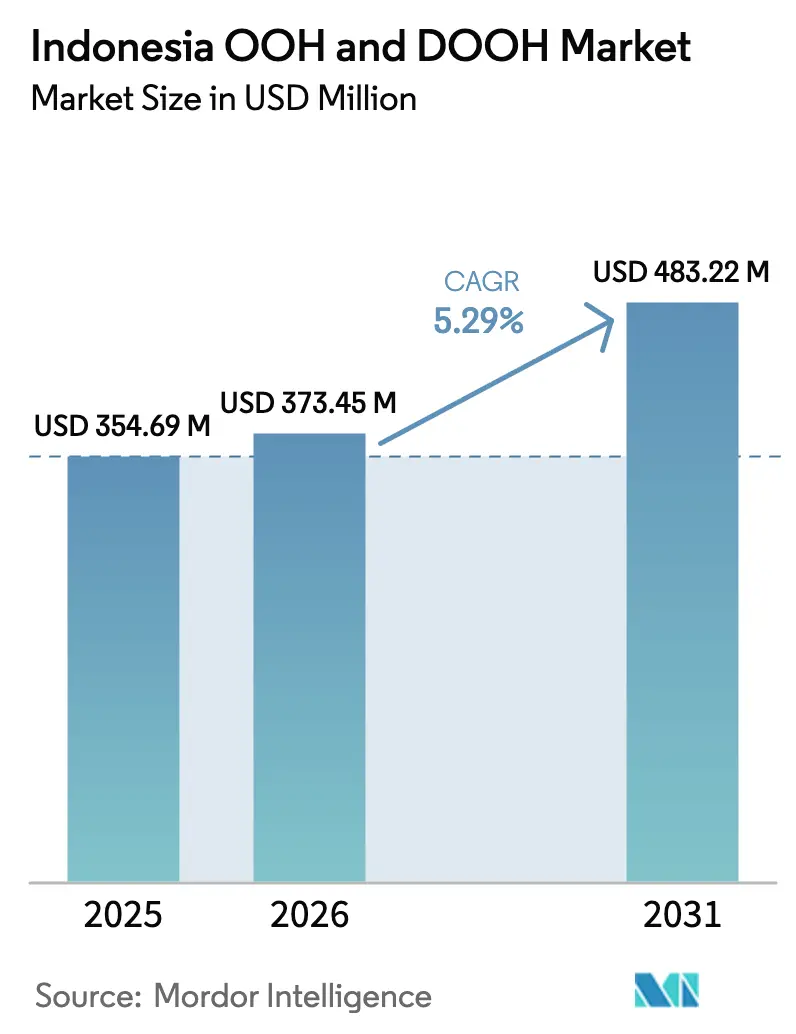
| Base Year Market Size (2025) | USD 354.69 Million |
| Market Size (2026) | USD 373.45 Million |
| Market Size (2031) | USD 483.22 Million |
| Growth Rate (2026 - 2031) | 5.29 % |
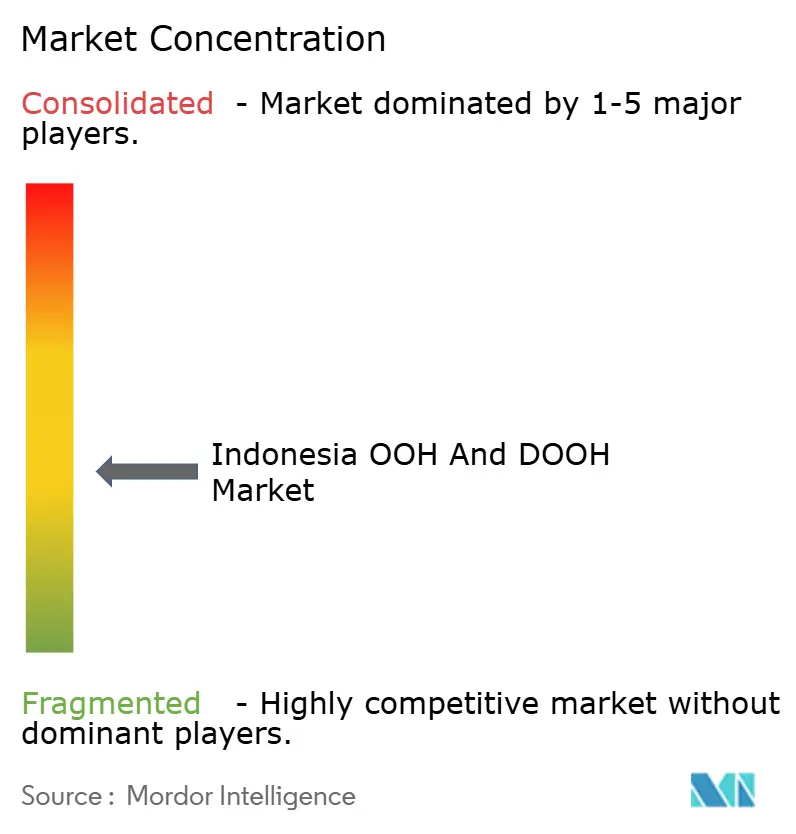
| Market Concentration | Medium |
Major Players *Disclaimer: Major Players sorted in no particular order Image © Mordor Intelligence. Reuse requires attribution under CC BY 4.0. | |
Indonesia OOH And DOOH Market Analysis by Mordor Intelligence
The Indonesia OOH advertising market size is expected to grow from USD 354.69 million in 2025 to USD 373.45 million in 2026 and is forecast to reach USD 483.22 million by 2031 at 5.29% CAGR over 2026-2031. This momentum mirrors Indonesia’s fast-growing digital economy, surging consumer spending, and continuing urbanization that is forecast to lift the urban share of the population from 53% in 2024 to 71% in 2030. [1] Digital connectivity upgrades and rising middle-class purchasing power encourage brands to blend outdoor placements with data-driven targeting. Airport expansion, smart-city initiatives, and ride-hailing screens enlarge premium inventory, while local content rules redirect budgets from global online platforms toward domestic media. Fragmented municipal permitting and uneven audience measurement in tier-2 and tier-3 cities still restrain nationwide campaign scale. Even so, the Indonesia OOH advertising market benefits from supportive 4G/5G roll-outs that enable dynamic content and programmatic trades.
Key Report Takeaways
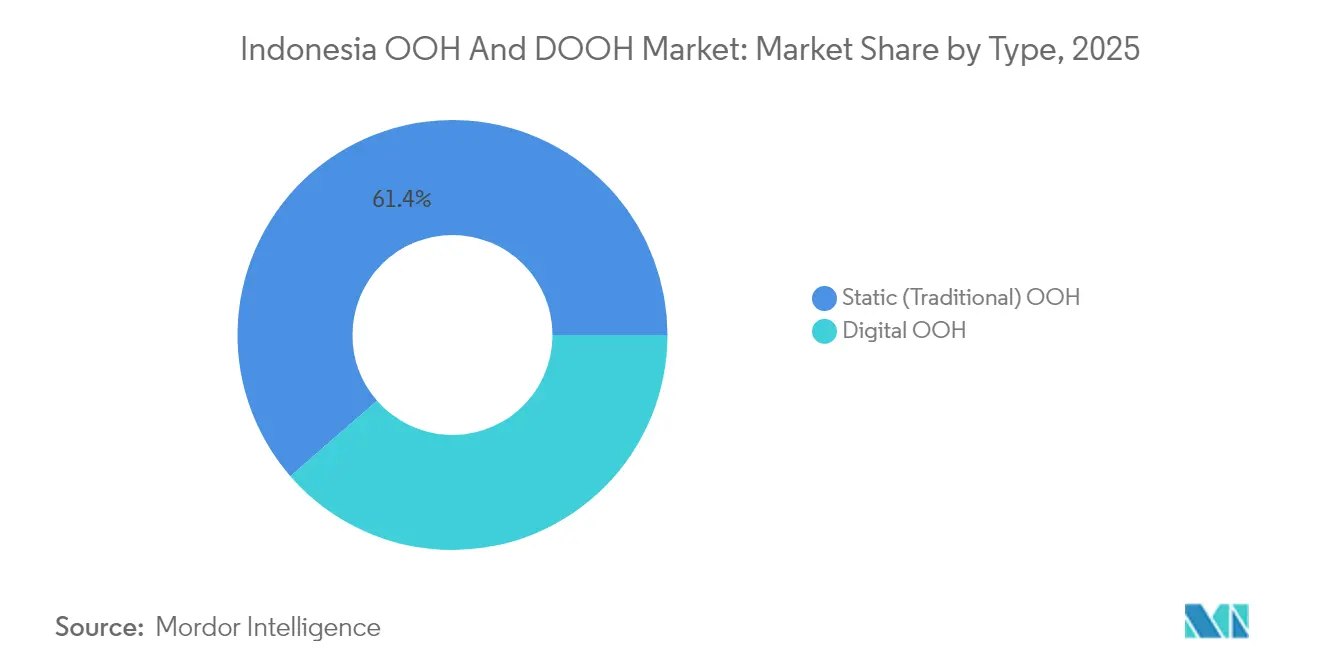
- By type, static formats held 61.40% of the Indonesia OOH advertising market share in 2025, while programmatic is forecast to post the fastest 11.1% CAGR through 2031.
- By format, billboards captured 45.30% of revenue in 2025; airport displays are projected to expand at a 7.55% CAGR to 2031.
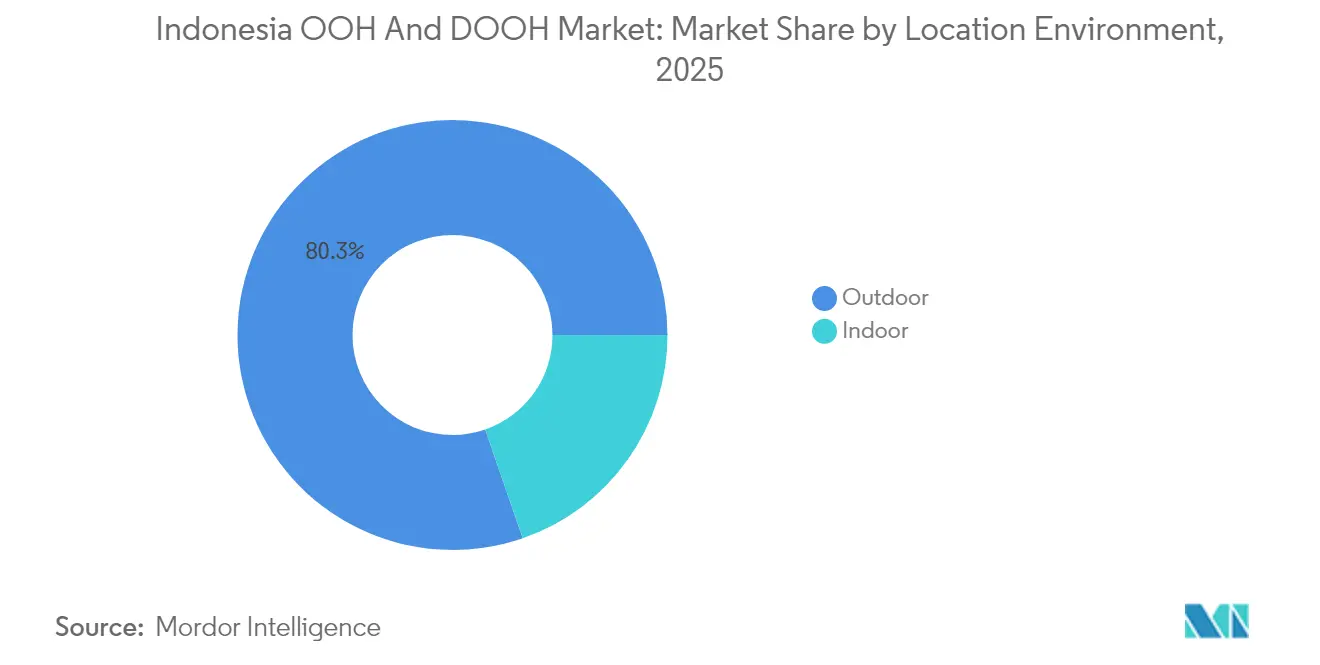
- By location environment, outdoor placements commanded 80.30% share in 2025, whereas indoor formats are advancing at an 8.25% CAGR.
- By end-user industry, retail and FMCG led with 21.60% revenue share in 2025; healthcare and pharma are expected to grow the quickest at 7.15% CAGR.
Note: Market size and forecast figures in this report are generated using Mordor Intelligence’s proprietary estimation framework, updated with the latest available data and insights as of 2026.
Indonesia OOH And DOOH Market Trends and Insights
Drivers Impact Analysis*
| Driver | ( ~ ) % Impact on CAGR Forecast | Geographic Relevance | Impact Timeline |
|---|---|---|---|
| Rising domestic digital media buying by Indonesian FMCG brands | +1.80% | National, concentrated in Java and major urban centers | Medium term (2-4 years) |
| Accelerated roll-out of 4G/5G networks enabling dynamic DOOH content | +1.20% | National, early gains in Jakarta, Surabaya, Bandung | Long term (≥ 4 years) |
| Jakarta Smart City Program’s allocation of roadside digital kiosks | +0.70% | Jakarta metro, spillover to other smart cities | Medium term (2-4 years) |
| Rapid airport capacity expansion | +0.60% | National, focused on Soekarno-Hatta, Kertajati, New Bali | Long term (≥ 4 years) |
| Growth of ride-hailing screens for in-car ads | +0.50% | Jakarta, Bandung, Surabaya | Short term (≤ 2 years) |
| Government budget reallocation to local media | +0.40% | National, emphasis on regional markets | Medium term (2-4 years) |
| Source: Mordor Intelligence | |||
Rising Domestic Digital Media Buying by Indonesian FMCG Brands
Unilever Indonesia boosted advertising outlays 64% year-on-year in Q2 2022, illustrating how major FMCG players now emphasize measurable omnichannel campaigns. [2] Brands with nationwide reach view OOH as a high-reach complement that reinforces loyalty among consumers who show a 60% preference for local labels. The shift accelerates as e-commerce is expected to represent 15–16% of FMCG sales by 2025, pushing marketers to connect online journeys with offline reminders. Operators that supply audience analytics and attribution attract larger budgets, especially near convenience stores and commuter hubs. Consequently, programmatic buying tools gain traction inside the Indonesia OOH advertising market, creating new revenue pools for media owners that can verify impressions and lift campaign ROI.
Accelerated Roll-out of 4G/5G Networks Enabling Dynamic DOOH Content
Telecom carriers expanded 4G/5G coverage across Java and key secondary cities in 2024, heightening bandwidth for real-time content swaps. High-speed links let advertisers trigger weather, traffic, or event-based creatives on roadside LEDs, narrowing relevance gaps versus mobile ads. Improved connectivity underpins ride-hailing screens such as Gojek’s GoScreen, which relies on GPS and always-on data to log verified impressions. The same networks lower latency for programmatic bidding, so buyers can adjust spend during rush hours. As a result, dynamic content becomes a mainstream feature inside the Indonesia OOH advertising market over the next five years.
Jakarta Smart City Program’s Allocation of Roadside Digital Kiosks
Jakarta installed interactive kiosks that double as public-service screens and advertising assets. The units provide real-time transit info while delivering targeted messages based on daypart and footfall analytics. Operators partner with the city to share revenue, aligning with state objectives to modernize streetscape infrastructure. Compliance remains key because luminance rules cap brightness to reduce glare, as studies along Bundaran Hotel Indonesia have shown potential driver distraction. Successful deployment in the capital spurs replication in Surabaya and Bandung once municipal budgets allow, extending premium inventory across the Indonesia OOH advertising market.
Rapid Airport Capacity Expansion
The USD 777 million Terminal 4 build at Soekarno-Hatta and new hubs like Bandara Dhoho Kediri add digital walls, way-finding panels, and baggage-claim screens that reach high-income travelers. These zones deliver extended dwell times, enabling long-form storytelling and dynamic product showcases. Airport concessions command premium CPMs yet limited supply, so media owners often secure multiyear exclusivity contracts. Consequently, airport displays are the fastest-growing format inside the Indonesia OOH advertising market, reinforcing the sector’s shift toward top-tier venues with superior engagement metrics.
Restraints Impact Analysis*
| Restraint | (~) % Impact on CAGR Forecast | Geographic Relevance | Impact Timeline |
|---|---|---|---|
| Persistent measurement gaps across tier-2/3 cities | −0.9% | Nationwide tier-2 and tier-3 cities | Long term (≥ 4 years) |
| High import duties on large-format LED modules | −0.6% | National | Medium term (2-4 years) |
| Fragmented municipality permitting across 514 regencies | −0.5% | National | Long term (≥ 4 years) |
| Competition from global digital platforms | −0.3% | Urban markets nationwide | Short term (≤ 2 years) |
| Source: Mordor Intelligence | |||
Persistent Measurement Gaps Across Tier-2/3 Cities
Outside Jakarta, Surabaya, and Bandung, many screens still rely on traffic counts or manual audits, limiting post-buy verification. Advertisers hesitate to shift sizeable budgets when viewership cannot be benchmarked against digital KPIs. Smaller operators lack resources to install cameras or partner with mobile data aggregators, widening capability gaps. The Indonesian Advertising Association released guidelines in September 2024, but implementation remains patchy. Weak analytics hamper scaling of the Indonesia OOH advertising market into emerging urban clusters, reinforcing spend concentration in Java.
High Import Duties on Large-Format LED Modules
Import tariffs inflate hardware prices, pushing capital costs beyond reach for small media owners. Currency swings add further volatility for operators that order panels from China or South Korea. Some suppliers explore local assembly yet the ecosystem remains nascent, prolonging dependency on imports. High duties slow network roll-outs in provincial corridors, delaying the digital share shift inside the Indonesia OOH advertising market. Operators mitigate risk by favoring smaller indoor screens or leasing structures rather than owning assets, but that lowers margin potential.
*Our forecasts treat driver/restraint impacts as directional, not additive. The impact forecasts reflect baseline growth, mix effects, and variable interactions.
Segment Analysis
By Type: Programmatic Drives Digital Transformation
Static displays accounted for 61.40% of the Indonesia OOH advertising market share in 2025, anchoring revenue with nationwide billboard stock. Programmatic formats, though smaller, are scaling quickly at an 11.1% CAGR as advertisers demand real-time bidding and audience proof. Programmatic buying automates campaign flighting and allows creative changes within minutes, advantages that attract performance-oriented FMCG and telecom brands. Operators integrate demand-side platforms to open inventory beyond direct sales teams, broadening buyer bases and smoothing occupancy. The Indonesia OOH advertising market size for programmatic inventory is poised to exceed USD 96.3 million by 2031, reflecting wider adoption of data-rich transactions. Static formats will still dominate rural corridors where power supply, costs, and local regulations favor print.
Second-wave automation includes dynamic pricing that links rates to footfall sensors and camera-verified impressions. Early pilots in Jakarta’s CBD show double-digit ROI lifts versus fixed-rate buying. Success stories encourage regional landlords to digitize prime faces, especially those near transit hubs. Still, programmatic uptake depends on harmonized measurement and lower LED import costs, two issues that remain developmental tasks for industry associations and ministries. When resolved, more than one-third of total spend could flow through programmatic pipes, cementing a hybrid future inside the Indonesia OOH advertising market.

By Format: Airport Displays Lead Premium Growth
Billboards captured 45.30% of spend in 2025, benefiting from high visibility along arterial roads and flyovers. Yet airport media is projected to grow the quickest at 7.55% CAGR, buoyed by passenger traffic that may hit 270 million annually by 2030. Jakarta’s Terminal 4 alone will deliver several thousand square meters of digital display area, including immersive LED tunnels and baggage-carousel panels. The Indonesia OOH advertising market size for airport screens could surpass USD 73.4 million by 2031 as hubs upgrade to smart-building standards. Elevated CPMs reflect affluent traveler profiles and low ad clutter, appealing to luxury, BFSI, and travel brands.
Transit shelters, rail concourses, and taxi toppers form the next layer of transport media, adding reach among daily commuters. Street furniture such as digital kiosks aligns with smart-city roll-outs, allowing municipalities to disseminate public alerts while earning rental fees. Place-based networks in offices, clinics, and supermarkets continue to widen the impression pool. Media owners diversify across formats to balance volatility; when highway restrictions tighten ahead of holidays, indoor and transport screens provide inventory continuity. This portfolio approach sustains revenue in the Indonesia OOH advertising market despite cyclical traffic swings.
By Location Environment: Indoor Acceleration Reflects Urbanization
Outdoor sites ruled with 80.30% revenue share in 2025, supported by Indonesia’s roadside retail culture and tropical climate that keeps foot traffic high. Indoor placements, however, should expand at an 8.25% CAGR as mall, hospital, and office floor space grows in major cities. The Indonesia OOH advertising market size for indoor screens is forecast to double by 2031, helped by climate control that shields devices from humidity and extends panel life. Indoors also permits finer audience tracking via Wi-Fi analytics and lift-lobby sensors. Advertisers like healthcare providers and BFSI brands prefer these controlled settings to target specific demographics.
Shopping mall networks integrate loyalty-app data so creatives can retarget recent purchasers with cross-sell offers. Office-tower screens show employment-focused messages on weekdays and real-estate ads during tenant-hand-over periods. Hospitals deploy patient education clips in waiting areas while layering pharma promotions in compliance with advertising codes. These use cases illustrate how indoor media converts dwell time into brand touchpoints, deepening engagement within the Indonesia OOH advertising market.
By End-User Industry: Healthcare Emerges as Growth Leader
Retail and FMCG brands generated 21.60% of 2025 spend, affirming their long-running reliance on mass reach. Automotive and telecom categories followed, leveraging launch campaigns to signal new model releases and unlimited-data plans. Healthcare and pharma, though still modest in absolute terms, are forecast to grow at 7.15% CAGR as Indonesia’s aging population seeks private medical services. The Indonesia OOH advertising market size for healthcare messaging is projected to rise to USD 31.2 million by 2031, as clinics, diagnostics chains, and wellness platforms adopt targeted outdoor campaigns. These advertisers favor proximity placements near hospitals, pharmacies, and fitness centers where intent signals are strong.
Rising medical tourism in Bali and new hospital corridors in Surabaya fuel demand for bilingual creatives addressing both domestic and foreign patients. Pharma guidelines restrict direct-to-consumer pitches for prescription drugs, so campaign focus often lies on disease awareness and over-the-counter remedies. This rules-based environment pushes agencies to craft educational narratives that meet compliance yet still drive brand recall. The shift broadens the advertiser mix inside the Indonesia OOH advertising market, spreading risk beyond traditional CPG heavyweights.
Geography Analysis
Jakarta’s metropolitan area captured 51.20% of Indonesia OOH advertising market revenue in 2025, supported by dense traffic, corporate headquarters, and premium inventory around landmark sites such as Sudirman and Thamrin. Soekarno-Hatta’s ongoing expansion further concentrates spend, turning airside walkways into high-yield venues. Surabaya and Bandung jointly account for a rising double-digit share, propelled by manufacturing investments and university clusters that spur consumer spending. Bali retains a niche yet profitable role, where hospitality clients demand creative packages that blend airport lightboxes with beach-road banners.
Eastern regions show budding growth as infrastructure corridors extend to Kalimantan and Sulawesi. Indosat’s “Growth beyond Metropolitan” initiative underscores telecom upgrades that will support digital screens in Makassar, Medan, and Batam. However, uneven permitting and limited measurement slow expansion beyond Java. Municipal councils in Bogor and Semarang started updating bylaws in 2024, but over 500 regencies still follow legacy print-era rules, creating a patchwork of fees and size restrictions. Harmonization would open wider canvases across the Indonesia OOH advertising market and redistribute spend more evenly.
Tourism super-priority zones such as Lake Toba and Labuan Bajo present premium yet seasonal opportunities. Brands in automotive, telecom, and FMCG sectors experiment with pop-up LED trucks during festivals to capture visitor flow. Meanwhile, logistic cost and power reliability challenge fixed installations in outlying islands. Media owners adopt hybrid solar arrays and remote-monitoring software to reduce site visits and ensure uptime. Geography-led innovation keeps the Indonesia OOH advertising market adaptable to the archipelago’s vast diversity while preparing operators for the upcoming Nusantara capital relocation, which will eventually form a new advertiser cluster on Borneo.
Competitive Landscape
The Indonesia OOH advertising market hosts a fragmented field where no single operator controls more than a tenth of national spend. JCDecaux leverages global scale to secure airport concessions and supply programmatic pipes, recording 20.8% DOOH revenue growth worldwide in 2023. Local specialist Eye Indonesia focuses on Jakarta and Surabaya premium billboards, maintaining close ties with municipal agencies. Alternative Media Group taps Vistar Media’s software to monetize office and hospital screens, extending reach inside indoor environments. [3] Competition intensifies from ride-hailing firms; Gojek’s GoScreen logged 40% volume growth in 2024, while Grab launched in-car tablets in five cities, offering cost-per-impression pricing that challenges fixed CPM models.
Technology investment dictates strategic differentiation. Larger operators embed AI-based camera analytics for impression audits, which attracts multinational advertisers demanding global standards. Smaller firms often band together in sales alliances to pitch nationwide packages, using shared dashboards to present unified inventory. Consolidation is expected, especially in tier-2 cities where standalone viability weakens against higher compliance costs. International M&A interest remains modest due to ownership caps and regulatory uncertainty, but joint ventures provide a pathway for foreign capital to enter the Indonesia OOH advertising market without acquiring controlling stakes.
Regulatory engagement serves as a competitive lever. Companies that assist municipalities with smart-city hardware gain first-mover advantage on new sites. JCDecaux’s street-furniture model offers revenue-share agreements that deliver public amenities such as Wi-Fi and benches, smoothing permit approvals. Local players replicate this template on a smaller scale, gifting bus shelters or pedestrian bridges in exchange for ad rights. This public-private partnership approach shapes asset pipelines and locks in long-term contracts, securing visibility in an otherwise crowded Indonesia OOH advertising market.
Indonesia OOH And DOOH Industry Leaders
-
JCDecaux SE
-
Hivestack
-
Next Digital Indonesia
-
Moving Walls
-
Eye Indonesia
- *Disclaimer: Major Players sorted in no particular order
Recent Industry Developments
- November 2024: Indonesian Advertising Association issued guidelines for standardized OOH measurement in tier-2/3 cities, targeting nationwide adoption by 2026.
- October 2024: Telkom Indonesia reported revenue gains from data-center services, underscoring the backbone supporting dynamic OOH content delivery.
- August 2024: Grab scaled its in-car display network to five large metros, competing with Gojek on CPM and attribution metrics.
- June 2024: Bogor city updated outdoor ad licensing rules, introducing digital screens into its Perda No. 1/2015 framework and setting a sliding tax scale tied to screen brightness.
Indonesia OOH And DOOH Market Report Scope
Digital out-of-home (DOOH) advertising refers to dynamic, digital ads displayed in both indoor and outdoor public spaces. Essentially, it merges digital elements with conventional out-of-home advertising. Digital OOH has overtaken traditional offline out-of-home advertising.
The Indonesian OOH and DOOH market is segmented by type (static (traditional) OOH, digital OOH (LED screens), programmatic OOH, and other digital OOH), application (billboard, transportation (transit) (airports, other transportation (buses, etc.)), street furniture, and other place-based media), and end-user industry (automotive, retail and consumer goods, healthcare, BFSI, and other end-user industries). The market sizes and forecasts are provided in terms of value in USD for all the above-mentioned segments.
| Static (Traditional) OOH | |
| Digital OOH | Programmatic OOH |
| Other Digital OOH |
| Billboards | |
| Transportation (Transit) | Airports |
| Other Transit (Bus, Rail, Taxi) | |
| Street Furniture | |
| Place-based Media |
| Indoor |
| Outdoor |
| Automotive |
| Retail and Consumer Goods |
| Healthcare and Pharma |
| BFSI |
| Telecom and IT |
| Others |
| By Type | Static (Traditional) OOH | |
| Digital OOH | Programmatic OOH | |
| Other Digital OOH | ||
| By Format | Billboards | |
| Transportation (Transit) | Airports | |
| Other Transit (Bus, Rail, Taxi) | ||
| Street Furniture | ||
| Place-based Media | ||
| By Location Environment | Indoor | |
| Outdoor | ||
| By End-User Industry | Automotive | |
| Retail and Consumer Goods | ||
| Healthcare and Pharma | ||
| BFSI | ||
| Telecom and IT | ||
| Others | ||
Key Questions Answered in the Report
What is the current size of the Indonesia OOH advertising market?
The market generated USD 373.45 million in 2026 and is forecast to reach USD 483.22 million by 2031.
Which segment is expanding the fastest?
Programmatic OOH is projected to grow at an 11.1% CAGR, driven by demand for measurable, data-rich campaigns.
How big is airport advertising within the market?
Airport displays are expected to post a 7.55% CAGR and could surpass USD 73.4 million in revenue by 2031.
What are the main challenges for advertisers outside major cities?
Lack of standardized audience measurement and fragmented municipal permitting slow deployment in tier-2 and tier-3 markets.
How does 4G/5G connectivity influence OOH growth?
High-speed networks support dynamic content, real-time bidding, and ride-hailing screens, improving targeting and campaign flexibility across the Indonesia OOH advertising market.
Which end-user vertical shows the highest growth potential?
Healthcare and pharma are set to increase spending at a 7.15% CAGR as private medical services expand nationwide.