
Malaysia OOH And DOOH Market Size and Share
Market Overview
| Study Period | 2020 - 2031 |
|---|---|
| Forecast Data Period | 2026 - 2031 |
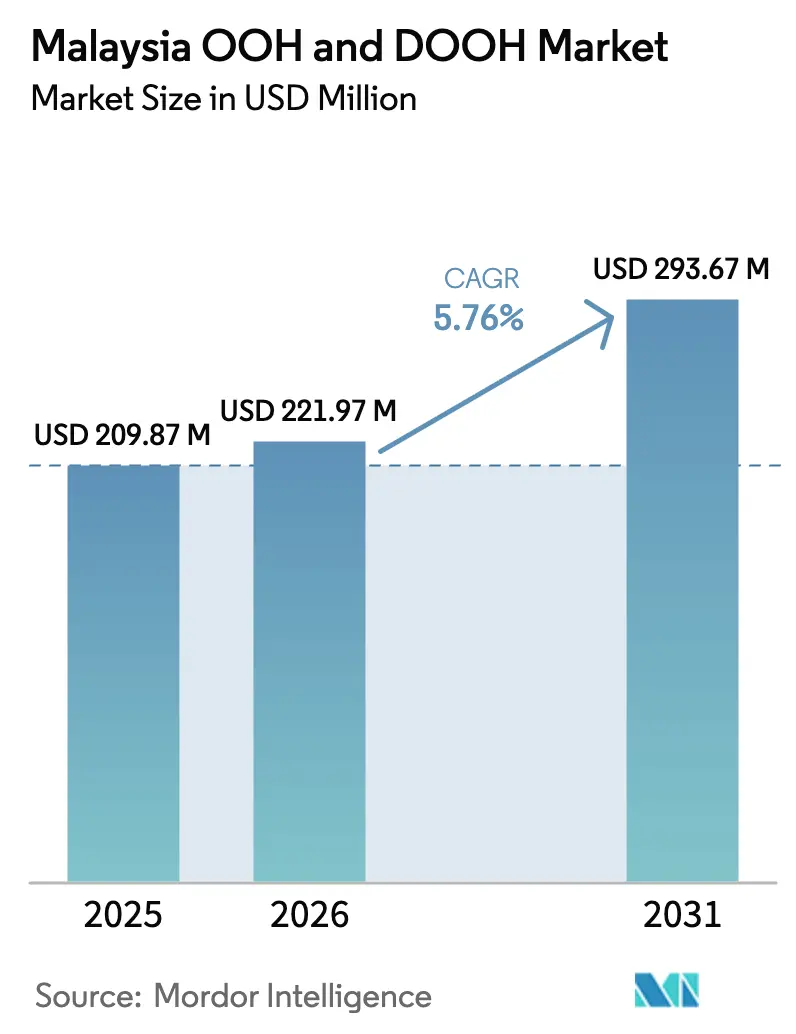
| Base Year Market Size (2025) | USD 209.87 Million |
| Market Size (2026) | USD 221.97 Million |
| Market Size (2031) | USD 293.67 Million |
| Growth Rate (2026 - 2031) | 5.76 % |
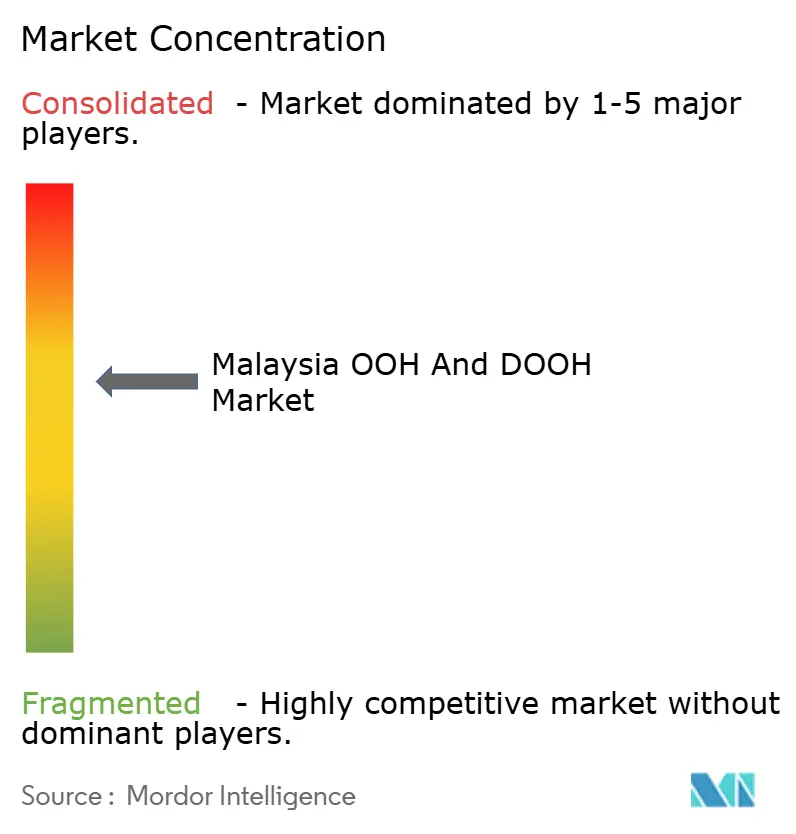
| Market Concentration | Medium |
Major Players *Disclaimer: Major Players sorted in no particular order Image © Mordor Intelligence. Reuse requires attribution under CC BY 4.0. | |
Malaysia OOH And DOOH Market Analysis by Mordor Intelligence
The Malaysia OOH and DOOH market size is expected to grow from USD 209.87 million in 2025 to USD 221.97 million in 2026 and is forecast to reach USD 293.67 million by 2031 at 5.76% CAGR over 2026-2031. Growth rests on rapid 5G rollout, a rebound in passenger movements at key airports, and sustained mall development across the Klang Valley. Digital out-of-home (DOOH) already delivers double-digit growth, thanks to programmatic buying and advanced audience measurement tools. Static formats still dominate in 2025, but falling LED costs and municipal smart-city projects are narrowing the gap. Transit and airport media benefit from surging mobility, while premium indoor screens inside new lifestyle malls attract brands seeking contextual relevance. Regulatory permit caps are inflating site values in core business districts, creating a seller’s market that favors incumbent operators.
Key Report Takeaways
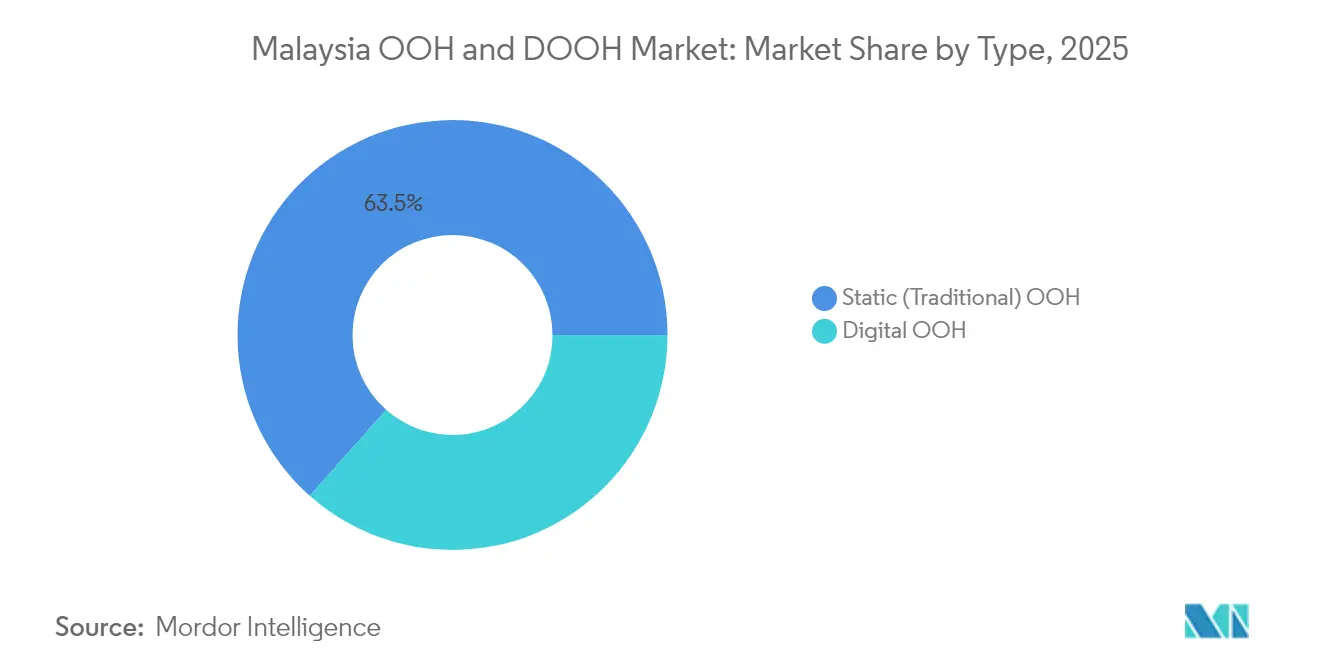
- By type, static formats held 63.45% of the Malaysia OOH and DOOH market share in 2025; DOOH is forecast to register an 10.75% CAGR to 2031.
- By format, billboards led with 50.18% of the Malaysia OOH and DOOH market share in 2025; transit media is projected to expand at an 8.05% CAGR through 2031.
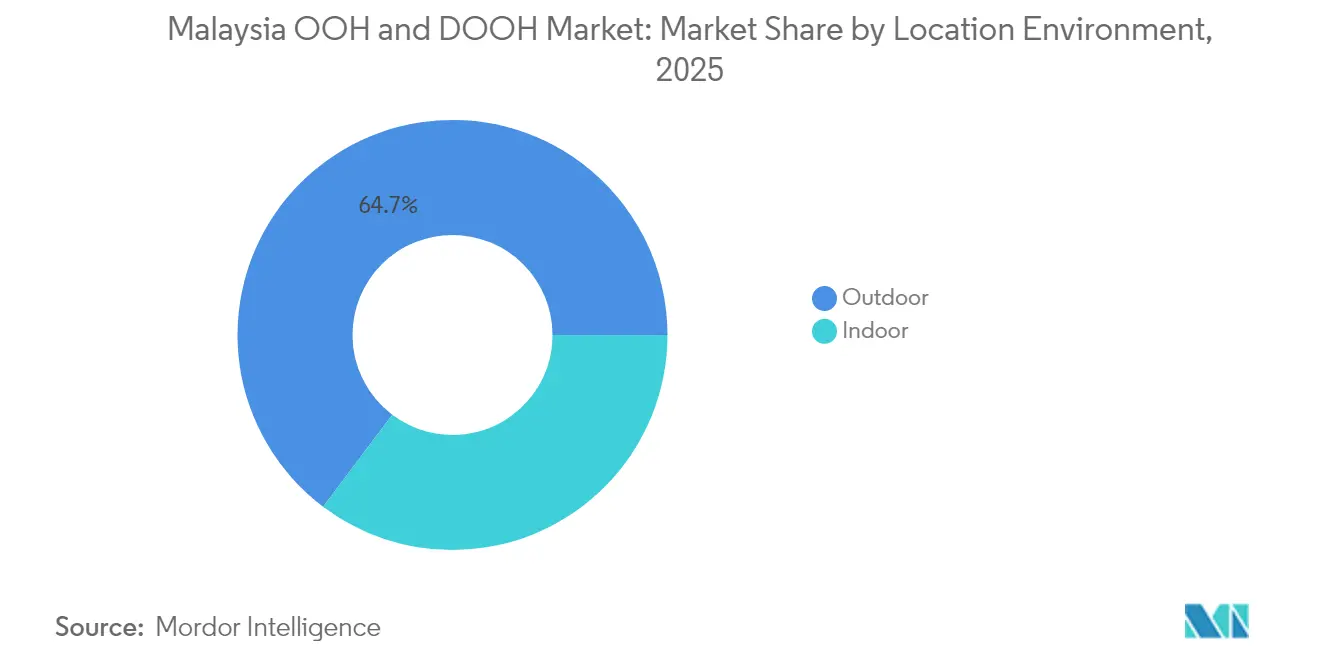
- By location environment, outdoor placements commanded 64.72% of the Malaysia OOH and DOOH market share in 2025, while indoor inventory is advancing at a 9.18% CAGR to 2031.
- By end-user industry, retail and consumer goods contributed 29.35% of the Malaysia OOH and DOOH market share in 2025; healthcare and pharma is the fastest-growing vertical at a 8.74% CAGR.
Note: Market size and forecast figures in this report are generated using Mordor Intelligence’s proprietary estimation framework, updated with the latest available data and insights as of 2026.
Malaysia OOH And DOOH Market Trends and Insights
Drivers Impact Analysis*
| Driver | (~) % Impact on CAGR Forecast | Geographic Relevance | Impact Timeline |
|---|---|---|---|
| Government-funded Smart-City and Digital Billboard Roll-out | +1.8% | Greater Kuala Lumpur, major urban centers | Medium term (3-4 yrs) |
| E-commerce Boom Pushing Omni-channel Brand Spend | +1.5% | National, with concentration in urban areas | Short term (≤2 yrs) |
| Tourism Rebound Lifting Airport and Transit Inventory | +1% | Major airports, tourist destinations | Short term (≤2 yrs) |
| Rapid Mall Development along Klang Valley | +0.9% | Klang Valley corridor | Medium term (3-4 yrs) |
| 5G-enabled Programmatic DOOH | +1.6% | Urban centers with 5G coverage | Medium term (3-4 yrs) |
| Audience-Measurement Platforms | +0.8% | National | Medium term (3-4 yrs) |
| Source: Mordor Intelligence | |||
Government-funded smart-city and digital billboard roll-out
Malaysia’s smart-city blueprint is funding sensor-laden street furniture that doubles as advertising real estate. Digital billboards linked to traffic-management platforms deliver both public service alerts and paid campaigns, allowing municipalities to offset capital costs with ad revenue. 5G Advanced, launched nationwide in February 2025, supplies the low latency needed for dynamic content swaps, making real-time creative rotation feasible on thousands of screens. This ecosystem lowers entry barriers for small advertisers that can now buy short bursts programmatically. Demand for centrally located LED monopoles has climbed, with average occupancy surpassing 90% in Kuala Lumpur’s Golden Triangle. Network owners are locking in multi-year concessions to secure early-mover advantage before permit quotas tighten.
E-commerce boom pushing omni-channel brand spend
Malaysian online retail sales rose sharply in 2024, and brands now use DOOH to bridge digital and physical journeys. QR-code overlays on mall screens drive shoppers straight to product pages, while NFC tags on transit shelters let commuters load coupons onto smartphones in seconds. Advertisers appreciate that a Malaysia OOH and DOOH market exposure can spark immediate mobile engagement, evidenced by campaigns reporting purchase-intent lifts above 60%. Retailers also synchronize flash-sale countdowns across web banners and roadside LEDs to build urgency. Programmatic pipes enable automated budget shifts between online video and DOOH when foot traffic peaks, protecting return on ad spend.
Tourism rebound lifting airport and transit inventory
Passenger movements at Malaysian airports climbed to 101.2 million in the first nine months of 2024, or 96.3% of 2019 levels.[4] Duty-free halls, immigration queues, and aero-train corridors now command rate-card premiums of 30-40% over comparable city-center sites. The government’s 30-day visa-free policy for visitors from China and India boosts international arrivals, expanding advertisers’ reach to high-spending tourists. Airlines have lengthened dwell time by promoting mobile check-in, inadvertently increasing exposure to concourse media. Brands in luxury goods, BFSI, and telco categories dominate these placements.
5G-enabled programmatic DOOH
CelcomDigi’s network modernization, 44% complete by April 2024, improved download speeds up to 26%. Faster networks let CMS platforms refresh creative every few seconds, enabling context-triggered spots based on weather or live sports scores. The February 2025 tie-up between CelcomDigi and Aduna opened network APIs to media owners, paving the way for location-based interactive content. Automotive advertisers now serve price drops on screens near dealerships whenever inventory rises, while F&B chains display menu variations keyed to temperature. These use cases are accelerating media budget migration toward DOOH within the Malaysia OOH and DOOH market.
Restraints Impact Analysis*
| Restraint | (~) % Impact on CAGR Forecast | Geographic Relevance | Impact Timeline |
|---|---|---|---|
| Municipal Permit Caps | -1.2% | Urban centers, particularly Kuala Lumpur | Long term (≥5 yrs) |
| Fragmented Asset Ownership | -0.8% | National | Medium term (3-4 yrs) |
| High Electricity Tariffs | -0.7% | National, higher impact in rural areas | Short term (≤2 yrs) |
| Tight Content Regulations | -0.3% | National | Long term (≥5 yrs) |
| Source: Mordor Intelligence | |||
Municipal permit caps
City councils now cap billboard numbers and require Bahasa Malaysia prominence in advertising creative, making new approvals rare. Scarcity inflates rents for legacy sites, pushing CPMs beyond regional norms and restricting campaign flexibility. Brands unable to secure large-format slots resort to multiple smaller faces, diluting reach. Operators concentrate on maximizing yield from existing footprints rather than expanding, slowing inventory growth in the Malaysia OOH and DOOH market.
Fragmented asset ownership
Hundreds of mid-sized vendors hold exclusive rights to pockets of inventory, forcing national advertisers into multi-contract buys. Disparate CMS platforms hinder unified audience reporting, delaying post-buy evaluations. Fragmentation also stalls programmatic adoption because buyers struggle to aggregate supply at scale. Consolidation remains limited by family ownership structures and regulatory hurdles, keeping transaction costs high.
*Our forecasts treat driver/restraint impacts as directional, not additive. The impact forecasts reflect baseline growth, mix effects, and variable interactions.
Segment Analysis
By Type: Digital Acceleration Outpacing Static Leadership
Static inventory retained 63.45% of Malaysia OOH and DOOH market share in 2025, buoyed by entrenched roadside networks and lower electricity costs. The segment continues to attract FMCG brands needing broad reach at economical CPMs. Yet DOOH revenue is climbing at an 10.75% CAGR, more than twice the overall Malaysia OOH and DOOH market growth rate. Falling LED panel prices and standardized CMS software shorten payback periods, encouraging conversions of prime gantries along the North–South Expressway. Programmatic impressions already exceed 30% of total DOOH plays, and buyers leverage hourly bidding to exploit traffic spikes.
The Malaysia OOH and DOOH market size is projected to climb from USD 76.7 million in 2025 to USD 141.6 million by 2031, nearing parity with static formats. National advertisers praise DOOH for its creative flexibility, while SMEs benefit from short-flight purchasing enabled by supply-side platforms. Meanwhile, static owners innovate with eco-friendly wraps and solar-powered lights to maintain relevance and meet municipal sustainability guidelines.

By Format: Transit Media Narrowing the Billboard Gap
Billboards generated 50.18% of format revenue in 2025, underscoring their visibility on key arterial roads into Kuala Lumpur’s CBD. Daily traffic of 40,000 vehicles on Jalan Sultan Ismail amplifies impressions for supersites located there. Nevertheless, transit media posts an 8.05% CAGR driven by rail extensions and bus-fleet digitization. Fully wrapped LRT trains and dynamic in-carriage screens turn commuting windows into high-attention moments.
Malaysia OOH and DOOH market size for transit media is set to rise alongside completion of Mass Rapid Transit 3 in 2028. Advertisers from e-wallets to quick-service restaurants leverage GPS-synced triggers to serve geo-fenced creatives when rolling stock nears retail clusters. Billboards respond by offering synchronized DOOH towers that echo the same message along the travel corridor, ensuring sequential exposure.
By Location Environment: Indoor Screens Capture Longer Dwell Times
Outdoor placements still account for 64.72% of spend, favored for mass reach during peak drive-time. However, indoor environments enjoy a 9.18% CAGR as property developers embed digital media networks in food courts, lifts, and cinema lobbies of new mega-malls. The Exchange TRX alone contributed 1.3 million sq ft of retail space with multiple LED portals when it opened in late 2023.
Within the Malaysia OOH and DOOH market, indoor operators price inventory using real-time footfall sensors, offering guaranteed audience packages to premium advertisers. Campaigns featuring sampling booths beside screen clusters increase conversion rates, especially for beauty and beverage brands. Outdoor incumbents counter with larger 3D anamorphic units that create viral social media moments, blurring the indoor-outdoor distinction.
By End-User Industry: Healthcare Vaults into High-Growth Status
Retail and consumer goods secured 29.35% of Malaysia OOH and DOOH market size during 2025 as supermarket chains and fashion labels contested shopper attention near points of sale. Their dominance relies on proximity messaging that nudges immediate store visits. Yet healthcare and pharma is the fastest riser at a 8.74% CAGR as clinics, insurers, and OTC brands exploit community trust in public-service style messaging. Post-pandemic wellness consciousness amplifies receptivity to health advisories displayed in residential lift lobbies and transit shelters.
Malaysia OOH and DOOH market newcomers from telemedicine to nutraceuticals now pair DOOH spots with QR code appointment booking. Automotive and BFSI advertisers maintain steady share by favoring spectacular formats for product launches and rate promotions. Meanwhile, entertainment platforms sync trailer ads on mall atriums with simultaneous mobile push notifications for frictionless ticket sales.
Geography Analysis
Greater Kuala Lumpur and the Klang Valley dominate both spend and premium inventory. LED superstructures on highways leading into Bukit Bintang post occupancy above 95%, with CPMs 40% higher than secondary cities. The Exchange TRX retail precinct created fresh indoor capacity, yet competition for its atrium screens is fierce, locking in annual sponsorships from luxury and tech brands. Klang Valley’s retail boom underpins the Malaysia OOH and DOOH market growth as developers bundle long-term media rights with tenancy agreements, assuring steady ad revenues.
Penang, Johor Bahru, and Kota Kinabalu form the next tier. Penang International Airport upgrades expand duty-free halls, attracting cosmetics and liquor advertisers targeting regional travelers. Johor’s Iskandar corridor benefits from cross-border traffic to and from Singapore, prompting transit-shelter digitization along the Coastal Highway. Kota Kinabalu leverages its cruise-ship terminal for large-format LED arches that greet disembarking tourists, with occupancy climbing after visa-free entry for Chinese travelers.
Tourist-centric zones such as Langkawi deploy freestanding monopoles on arterial roads to beach resorts. Although rural regions remain under-served, the 80% nationwide 5G coverage target for 2025 will enable solar-powered smart poles along trunk roads, opening fresh pockets of supply. These installations will help balance geographic dispersion of the Malaysia OOH and DOOH market, providing cost-effective reach for government safety campaigns and agricultural brands.
Competitive Landscape
Malaysia OOH and DOOH market features moderate fragmentation. JCDecaux Malaysia and Big Tree Outdoor anchor the leaderboard through decades-long concession agreements with transit authorities and municipal councils. JCDecaux's global revenue rose 14.0% in H1 2024, with DOOH up 28.3%, bolstering its local reinvestment in 3D digital tech.[3] Big Tree leverages Media Prima's content ecosystem to cross-sell integrated broadcast and out-of-home packages.
Mid-tier players such as Spectrum Outdoor and Sky Blue Media own strategic city-center rooftops, creating scarcity value. Location-based specialist VGI Malaysia focuses on transit interiors, bundling data from commuter apps to build audience segments. Measurement firms Moving Walls and Seedooh Malaysia do not own inventory but wield influence by certifying impressions and fraud safeguards, essential for multinational marketer audits.
Technology partnerships are altering rivalry contours. CelcomDigi and Aduna's 2025 API deal lets developers build interactive experiences that trigger on proximity, giving participating media owners a technical edge.[1] Firstboard aggregates static and digital sites from smaller landlords into a single marketplace, simplifying national buys and advancing programmatic adoption. Consolidation talk persists, yet strict permit transfer rules and culturally entrenched family ownership slow M&A velocity.
Malaysia OOH And DOOH Industry Leaders
-
Big Tree Outdoor Sdn. Bhd.
-
JCDecaux Malaysia
-
PowerScreen Sdn. Bhd.
-
Wow Media Sdn. Bhd.
-
Clear Channel Malaysia
- *Disclaimer: Major Players sorted in no particular order
Recent Industry Developments
- May 2025: LoopMe and Reveal Mobile deepened their partnership to improve global brand-lift measurement for out-of-home campaigns
- April 2025: RCR Wireless projected 5G to represent 84% of Malaysian mobile subscriptions by 2029, expanding DOOH addressable audiences
- March 2025: CelcomDigi and Aduna announced network API access for developers, fostering novel interactive DOOH applications
- February 2025: Digital Nasional Berhad and Ericsson launched 5G Advanced, enhancing low-latency content delivery for smart-city screens
Research Methodology Framework and Report Scope
Market Definitions and Key Coverage
Our study defines Malaysia's out-of-home (OOH) and digital out-of-home (DOOH) market as every cash-booked advertisement placed on billboards, street furniture, transit media, and indoor place-based screens, whether static posters or networked digital panels, across the country.
Scope exclusion: cinema preshow spots, brand-owned in-store displays, and one-off event screens remain outside this assessment.
Segmentation Overview
- By Type
- Static (Traditional) OOH
- Digital OOH (LED Screens)
- Programmatic DOOH
- Other Digital OOH (LED Screens)
- By Format
- Billboards
- Street Furniture
- Transit Media
- Airports
- Mass-Transit, Buses, Rail
- Place-based Media (Malls, Cinemas, Gyms)
- By Location Environment
- Outdoor
- Indoor
- By End-User Industry
- Automotive
- Retail and Consumer Goods
- Healthcare and Pharma
- BFSI
- Entertainment and Media
- Telecom
- Other End User Industry
Detailed Research Methodology and Data Validation
Primary Research
Mordor analysts held structured interviews with media-owner executives, agency buying heads, and municipal permit officers across Klang Valley, Penang, and Johor. These conversations validated inventory counts, average CPM, programmatic fill rates, and occupancy trends that secondary data only hinted at.
Desk Research
We started with public macro indicators from the Department of Statistics Malaysia, inbound visitor flows from Tourism Malaysia, and broadband penetration data released by the Malaysian Communications and Multimedia Commission. Industry fingerprints were added through Outdoor Advertising Association of Malaysia reports, local-council tender logs, and campaign case studies captured through Campaign Asia and Dow Jones Factiva. Paid intelligence from D&B Hoovers and patent insights via Questel helped benchmark operator revenue bands and technology adoption. Many other open datasets and regulatory circulars supplemented the evidence base.
The sources listed illustrate the mix; numerous additional registers, filings, and press releases were reviewed to cross-check figures and definitions.
Market-Sizing & Forecasting
A top-down demand pool was built from total ad spend, adjusted for OOH share, then filtered through audited inventory counts. Selective bottom-up roll-ups of operator screen numbers multiplied by sampled selling prices checked the totals. Key variables include LED panel deployment, commuter minutes in traffic, tourist arrivals, GDP per capita, smartphone penetration, and brand ad-spend mix. Multivariate regression against these drivers produced the 2025-2030 forecast, while gaps in operator disclosure were bridged using permit caps and historical occupancy ratios.
Data Validation & Update Cycle
Outputs pass a three-level analyst review; anomaly flags trigger re-checks with sources, and model drift is scanned quarterly. Reports refresh every year, with interim updates after material regulatory or technology moves.
Why Mordor's Malaysia OOH And DOOH Baseline Inspires Confidence
Published estimates often diverge because firms vary in scope, cost components, and refresh cadence.
One recent study pegs the 2025 market at USD 202.53 million. Another source, using a wider lens, claims USD 560 million for 2024.
Benchmark comparison
| Market Size | Anonymized source | Primary gap driver |
|---|---|---|
| USD 209.87 million (2025) | Mordor Intelligence | |
| USD 202.53 million (2025) | Regional Consultancy A | Omits indoor mall screens and agency-booked spend; projects growth from a single base year |
| USD 560 million (2024) | Industry Information Provider B | Blends cinema spots and production costs into OOH totals; inflating value |
When incomparable elements are stripped away, values converge toward Mordor's view. Our transparent scope, annually audited inputs, and replicable steps give decision-makers a dependable baseline for planning.
Key Questions Answered in the Report
What is the current size of the Malaysia OOH advertising market?
The market generated USD 221.97 million in 2026 and is projected to reach USD 293.67 million by 2031.
How fast is DOOH growing compared with static formats?
Digital out-of-home revenues are rising at an 10.75% CAGR, more than double the overall market’s 5.76% trajectory.
Which industry vertical spends the most on Malaysian OOH?
Retail & consumer goods led with a 29.35% share in 2025, driven by proximity marketing near malls and supermarkets.
Why are airport media rates higher than city-center billboards?
Passenger traffic rebounded to 96.3% of pre-pandemic levels by late 2024, giving airport screens captive, high-spending audiences and allowing 30-40% rate premiums.