
Train Battery Market Size and Share
Market Overview
| Study Period | 2021 - 2031 |
|---|---|
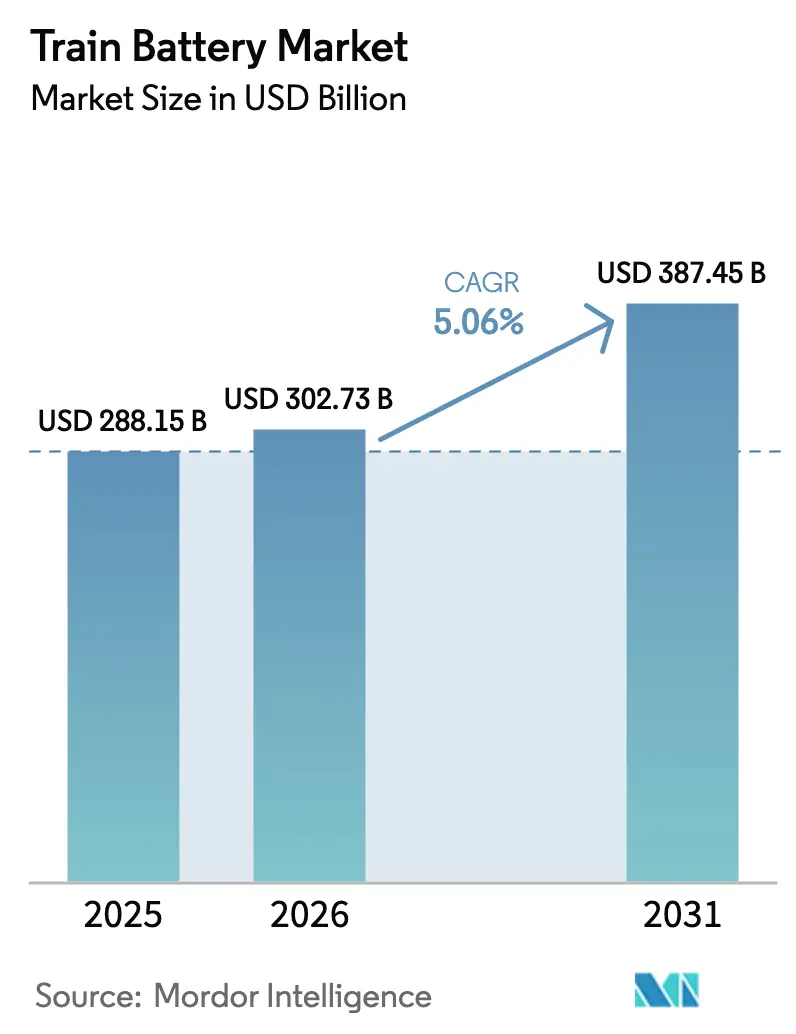
| Market Size (2026) | USD 302.73 Billion |
| Market Size (2031) | USD 387.45 Billion |
| Growth Rate (2026 - 2031) | 5.06 % |
| Fastest Growing Market | Asia-Pacific |
| Largest Market | Asia-Pacific |
| Market Concentration | Medium |
Major Players *Disclaimer: Major Players sorted in no particular order Image © Mordor Intelligence. Reuse requires attribution under CC BY 4.0. | |
Train Battery Market Analysis by Mordor Intelligence
The train battery market size is expected to grow from USD 288.15 billion in 2025 to USD 302.73 billion in 2026 and is forecast to reach USD 387.45 billion by 2031 at 5.06% CAGR over 2026-2031. Momentum comes from aggressive rail-electrification programs, falling lithium-ion costs, and stricter emissions rules that collectively shift procurement away from diesel traction toward battery-hybrid and battery-electric rolling stock. Operators increasingly consider total cost of ownership alongside upfront price, so chemistries offering longer life cycles and lower maintenance can displace legacy lead-acid solutions. Supply-chain localization programs in the United States and Europe are also spurring greenfield cell plants, while Asia-Pacific leverages existing scale advantages to deepen its dominance. Taken together, these forces keep the train battery market on a steady expansion path that balances cost, performance, and policy risk across regions.
Key Report Takeaways
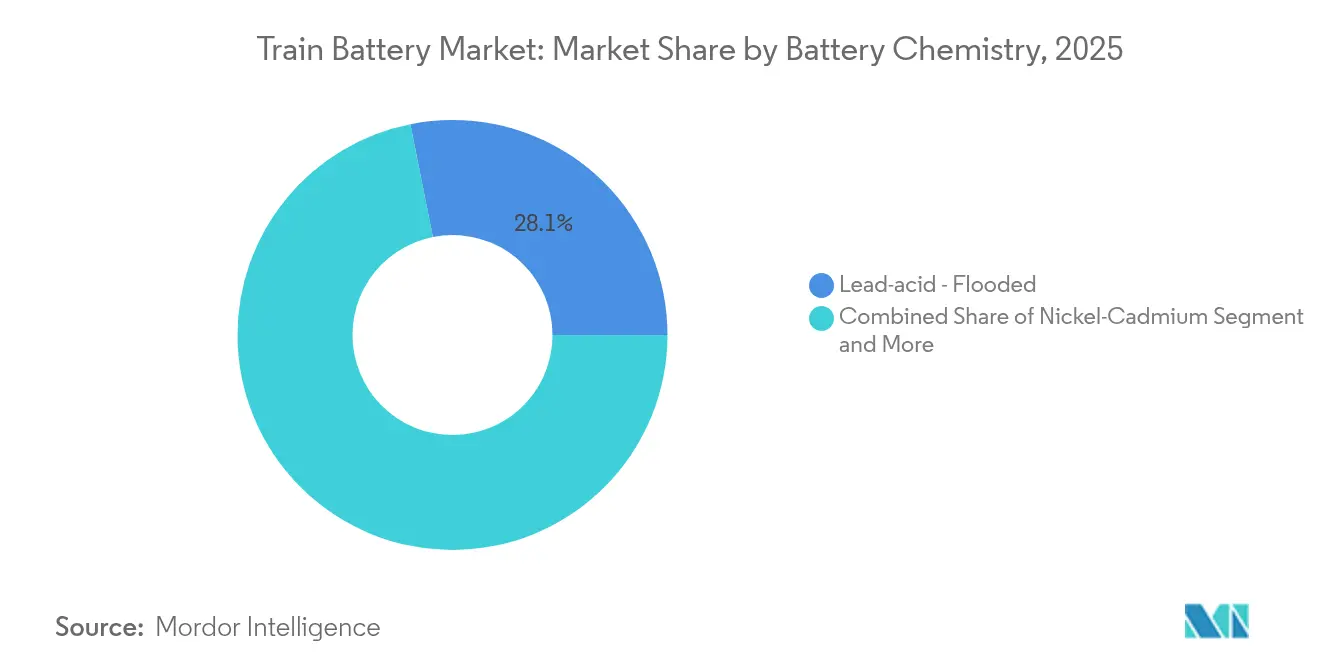
- By battery chemistry, lead-acid flooded units led with 28.14% revenue share in 2025; lithium-ion LFP chemistry is projected to grow fastest at a 7.12% CAGR through 2031.
- By capacity range, the 50-150 Ah band commanded 48.25% of the train battery market share in 2025, while >150 Ah packs are poised to advance at a 6.62% CAGR to 2031.
- By application, starter/cranking systems retained a 35.72% share of the train battery market size in 2025, whereas traction propulsion is set to post a 9.87% CAGR between 2026 and 2031.
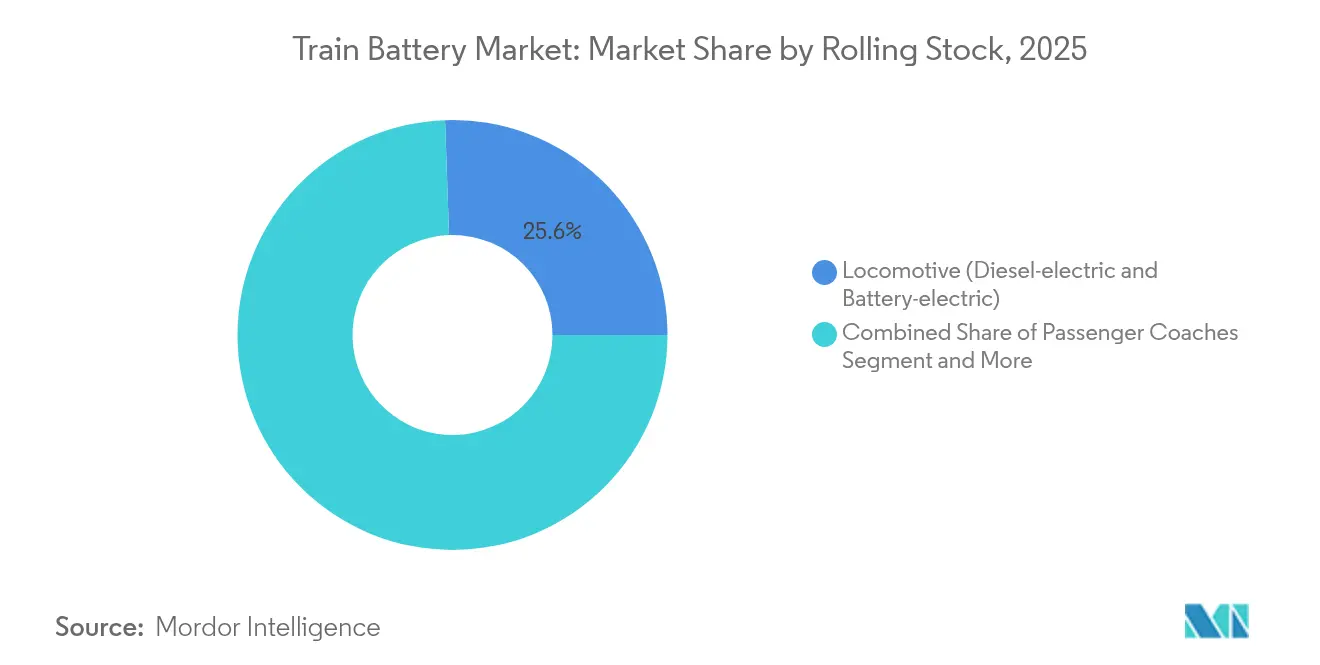
- By rolling stock, locomotive installations contributed 25.55% of 2025 revenue; EMU/BEMU formats are on track for the highest growth at 6.93% through 2031.
- By end-user, public rail operators held 49.10% of demand in 2025, but urban transit agencies are projected to lead growth at 8.86% CAGR to 2031.
- By geography, Asia-Pacific dominated with 47.30% of 2025 revenue and represents the fastest-growing geography at 7.18% CAGR through 2031.
Note: Market size and forecast figures in this report are generated using Mordor Intelligence’s proprietary estimation framework, updated with the latest available data and insights as of 2026.
Market Trends and Insights
Drivers Impact Analysis of Train Battery Market*
| Driver | (~) % Impact on CAGR Forecast | Geographic Relevance | Impact Timeline |
|---|---|---|---|
| Rail Electrification Across Urban & Regional Corridors | +1.2% | Global (APAC in front) | Medium term (2-4 years) |
| Diesel Phase-Out Mandates by 2030 | +0.9% | Global | Long term (≥4 years) |
| Cost & Weight Edge of Li-Ion / LFP Chemistries | +0.8% | Europe, North America spillover | Short term (≤2 years) |
| EU Funding for BEMU Adoption | +0.5% | Global | Long term (≥4 years) |
| Swap-Pack Maintenance Cuts Downtime | +0.4% | Europe, demonstration globally | Medium term (2-4 years) |
| AI-Driven BMS Extends Battery Life | +0.3% | APAC core, Europe spillover | Long term (≥4 years) |
| Source: Mordor Intelligence | |||
Rapid Electrification of Urban & Regional Rail Corridors
Policy mandates for carbon neutrality are pushing electrification into secondary and branch lines previously viewed as uneconomic for catenary. India lifted electrification to 96% of its network in 2024, more than tripling its annual track-wire rate over the last decade. Germany’s Schleswig-Holstein region will save 10 million L of diesel yearly once battery EMUs take over rural routes. Because overhead lines on low-density corridors can exceed USD 3 million per kilometer, batteries now represent a lower-risk path to decarbonization. Operators value the flexibility of trains that bridge electrified and non-electrified sections without service cuts, enabling step-wise capex profiles rather than all-or-nothing infrastructure outlays.
Cost / Weight Advantages of Next-Gen Li-Ion & LFP Chemistries
Lithium carbonate tumbled from USD 70,000 to under USD 15,000 per tonne between 2023 and 2025, pushing LFP system costs toward parity with lead-acid while slashing pack mass by 40% over five years. CATL now advertises 6C charging that fills a train pack in 10 minutes, meeting heavy-turnback urban timetables. Toshiba’s SCiB modules show 10,000 cycles with low fade, translating to longer intervals between overhauls [1]. The resulting total-life economics drive broader uptake, particularly where labour costs and energy prices reinforce the benefits.
Mandates for Phasing-Out Diesel Locomotives in Europe by 2030
European Union rules that remove diesel locomotives by 2030 are locking in battery demand. Germany plans to lift its electrified share to 70% by 2030 while converting residual mileage to battery or hydrogen power. France’s SNCF has earmarked EUR 40 million for battery-powered TER regional units that can run 80 km off-wire [2]. Penalties tied to carbon pricing and track-access surcharges leave fleet owners little room for delay, so suppliers with proven rail-grade batteries enjoy a clear tender advantage.
AI-Enabled Predictive BMS Extends Duty Cycles
Machine-learning algorithms now parse temperature, cell impedance, and duty data to prescribe optimal charge windows. Bangkok MRT posted 9.65% traction-energy savings after rolling out AI-driven scheduling across wayside storage and rolling stock [3]. Toshiba’s latest SCiB packs integrate cell-level analytics that adjust charge rates to arrest thermal drift, adding an estimated 20-30% life extension.
Restraints Impact Analysis of Train Battery Market*
| Restraint | (~) % Impact on CAGR Forecast | Geographic Relevance | Impact Timeline |
|---|---|---|---|
| High Li-Ion Cost vs. Lead-Acid | -0.7% | Global, acute in price-sensitive markets | Short term (≤2 years) |
| Safety & Certification Barriers for Rail Packs | -0.5% | Global, stringent in developed markets | Medium term (2-4 years) |
| Nickel & Lithium Price Volatility | 0.4% | Global supply chains | Short term (≤2 years) |
| Grid Limits on Regenerative Storage | -0.3% | Urban networks with aging infrastructure | Long term (≥4 years) |
| Source: Mordor Intelligence | |||
High Upfront Li-Ion Cost vs. Legacy Lead-Acid
Even after recent price drops, Li-ion packs still cost 3-5 times more than flooded lead-acid, so budget-constrained agencies often delay migration. Lead-acid’s 28.66% share in 2024 underscores its staying power in auxiliary duties where price trumps performance. Federal incentives such as EnerSys’s USD 199 million DOE grant soften the blow and create beachheads for higher-spec chemistries.
Thermal-Runaway & Certification Hurdles for Large Rail Packs
Stricter rules like China’s GB38031-2025 stretch validation timelines by up to 18 months and add USD 0.5-1 million per design. UL 1973 and European EN 50155 testing for vibration, EMC, and crashworthiness further raise barriers, favoring incumbents with deep lab capacity.
*Our forecasts treat driver/restraint impacts as directional, not additive. The impact forecasts reflect baseline growth, mix effects, and variable interactions.
Train Battery Market Segment Analysis
By Battery Chemistry:
LFP emerges as traction leaderLead-acid flooded units retained 28.14% of 2025 revenue, a figure that pins down much of the starter and auxiliary space in the train battery market. Yet lithium-ion LFP packs are forecast to grow 7.12% annually, lifted by falling material costs and inherent thermal stability. The train battery market size for LFP traction systems is projected to widen especially quickly on regional lines that demand 100-km off-wire range.
Nickel-cadmium persists in critical safety roles, while lithium-ion NMC/NCA caters to space-constrained premium services despite higher commodity exposure. Emerging solid-state prototypes in Japan and China could enter service after 2028, promising another wave of density gains. Each step in chemistry evolution tilts life-cycle economics further toward advanced lithium platforms, tightening the grip on growth segments of the train battery market.

By Capacity Range:
High-capacity systems drive growthPacks rated 50-150 Ah held 48.25% of 2025 revenue, reflecting continued dominance in mixed auxiliary and hybrid propulsion duties within the train battery market. The >150 Ah bracket, however, records 6.62% CAGR as freight locomotives and regional EMUs specify multi-megawatt-hour arrays. A single FLXdrive can mount 8.5 MWh, equivalent to roughly 16,000 Ah at 525 V, underscoring the demand for ultra-high current architectures.
Project calls from Irish Rail and Caltrans each stipulate battery-only ranges above 80 km, a requirement met only with large-format modules and sophisticated thermal management. As traction-heavy-duty use cases accelerate, the train battery market share for high-capacity packs will expand, with swap-pack logistics further smoothing depot workflows.
By Application:
Traction propulsion accelerates fastestStarter/cranking roles still dominate at 35.72% of spending in 2025, an anchor point that cuts across both diesel and hybrid fleets. Yet traction propulsion is rising at 9.87% CAGR, the single strongest pace among use cases. SNCF’s hybrid TER trains that recuperate 90% of braking energy and Hitachi Rail’s intercity trials illustrate traction’s leap from pilot to mainstream.
Regenerative-only storage and hotel-load support round out application diversity, but propulsion remains the headline. As diesel bans tighten, propulsion will command a larger slice of the train battery market, converting auxiliary stalwarts into comprehensive energy-platform solutions.
By Rolling Stock:
EMUs lead the electrification waveLocomotives accounted for 25.55% of turnover in 2025, but EMU/BEMU sets are on track for a 6.93% CAGR to 2031. Distributed power lets EMUs hide batteries beneath each carriage, boosting redundancy and trimming axle loads. Siemens’ battery Vectron order for JeMyn AG shows how modular packs free shunters and regional freight from overhead-line dependency.
High-speed fleets deploy compact packs for emergency roll-out, as seen on Japan’s N700S, pointing toward secondary safety niches. Over the outlook, EMUs will continue to pull the train battery market with their multi-car architecture that soaks up mid-size packs in high volumes.
By End-User:
Urban transit agencies accelerate adoptionPublic rail operators booked 49.10% of 2025 demand, but urban transit agencies rose fastest at 8.86% CAGR as city authorities chase zero-tailpipe vows. Metra’s USD 169.3 million CMAQ grant underpins 16 battery trainsets, an emblem of policy-backed momentum.
OEM refurbish divisions also see upside, retrofitting mid-life fleets with battery-ready underframes. With city air-quality targets firming and congestion-charge schemes spreading, metropolitan agencies will keep reshaping the demand profile of the train battery market.
Geography Analysis
APAC Train Battery Market
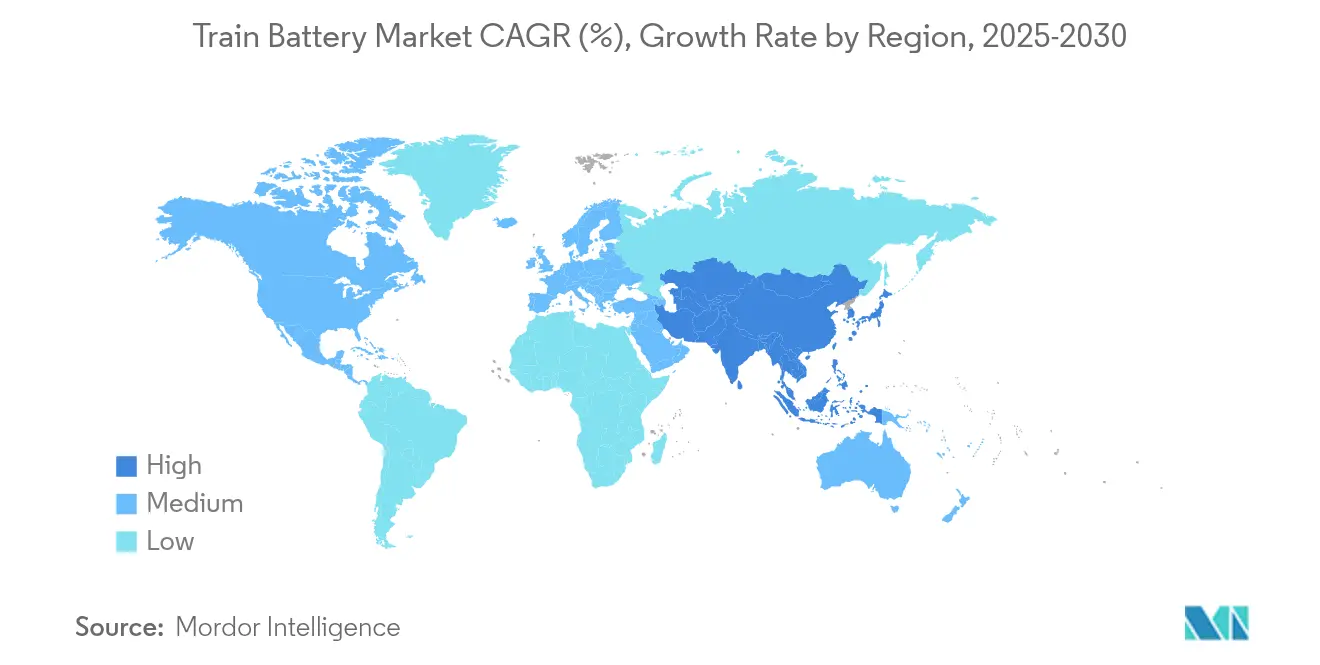
Asia-Pacific controlled 47.30% of 2025 revenue and is forecast to grow 7.18% annually by 2031, anchoring both size and momentum for the train battery market. India’s near-total rail electrification and China’s factory-to-network vertical integration secure supply and demand at scale. Japan continues to field-test solid-state packs, while South Korea’s battery firms eye export consortia with local rolling-stock OEMs.
Europe Train Battery Market
Europe ranks second by value and remains the regulatory bellwether. EU diesel-phase-out rules, Germany’s 70% wiring target, and France’s TER battery fleet all combine to pull forward orders across Spain, Italy, and the Nordics. Funding through CEF and national climate banks lowers the weighted average cost of capital, giving smaller regional operators a path into battery programs. As these fleets enter daily service, they feed proven-platform confidence back into global tenders.
North America Train Battery Market
North America begins with low electrification (≈1%) yet shows accelerating take-up. California’s zero-emission rail blueprint and federal production credits under the Inflation Reduction Act spur domestic supply chains. EnerSys’s government-backed plant in Pennsylvania and Wabtec–GM’s Ultium pact both target “Made in USA” compliance, opening slots for battery locomotives on freight short lines and passenger corridors. Given the vast length of non-electrified track, batteries provide a practical bridge while wiring economics remain prohibitive.
Regulatory Landscape
The regulatory environment for train batteries is tightening around safety, reliability, and cybersecurity, which raises qualification costs and extends validation timelines for high-energy packs. For large lithium-based rail packs, China introduced GB38031-2025, and battery systems entering global fleets also face UL 1973 and EN 50155 testing requirements covering vibration, EMC, and environmental robustness. In India, railway battery products for auxiliary and infrastructure duties align with Research Designs and Standards Organisation (RDSO) specifications, including RDSO/PE/SPEC/D/TL/0009-2008 (Rev1) for sealed maintenance-free lead-acid batteries.
As batteries move from auxiliary loads into propulsion and connected train architectures, functional safety and cyber requirements increasingly show up as procurement gates. Hitachi Rail and Turntide Technologies program documentation for UK battery-train applications references compliance expectations aligned with IEC 61508 (SIL 2) and IEC 62243 (cybersecurity). Taken together, these frameworks favor suppliers with established certification capability, documented safety cases, and in-region testing and manufacturing footprints that support operator acceptance and ongoing conformity.
Value Chain Analysis
The train battery value chain covers upstream raw materials (lead, lithium, phosphate/nickel, separators, and electrolyte), cell manufacturing, module and pack assembly, and battery management systems (BMS), then extends to rail-specific mechanical and thermal integration and final commissioning into rolling stock and rail infrastructure. OEMs and integrators also support depot-level service models that include diagnostics, swap-pack logistics where used, and end-of-life handling and recycling. The market operates with parallel supply streams, with legacy lead-acid and nickel-based products supporting starter and safety-critical roles, while lithium-ion systems, particularly LFP, target traction and higher-duty-cycle applications.
Recent programs emphasize localized integration and tiered partnerships between rolling-stock OEMs and specialized battery system suppliers. In the United Kingdom, Hitachi Rail integrates battery systems into tri-mode trains at its Newton Aycliffe factory, with Turntide Technologies supplying modular traction battery systems that progressed from earlier development work into production supply. In India, suppliers such as Exide Industries participate across OEM and replacement channels, supporting railway and infrastructure use cases aligned with RDSO specifications while also expanding lithium-ion manufacturing capability, reflecting how incumbents extend portfolios from conventional chemistries into higher-value lithium platforms.
Competitive Landscape
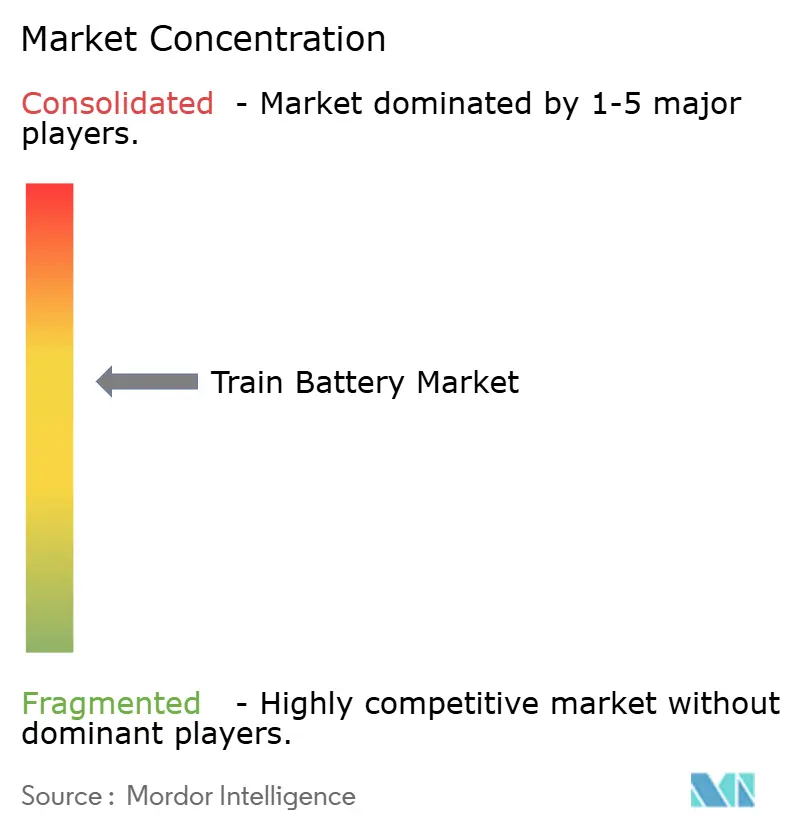
The train battery market shows moderate concentration. Top players—EnerSys, Saft, CATL, Toshiba, and Wabtec—hold scale advantages in cell manufacturing, systems integration, and certification know-how. Agile specialists focusing on AI-enabled BMS or swap-pack designs continue to secure niche contracts, keeping competitive pressure active.
Leaders differentiate through vertical integration and government-backed localisation. EnerSys leverages its USD 199 million DOE contract to anchor North American supply. CATL and BYD extend automotive volume economics to rail, bundling battery leasing and swapping infrastructure. Saft exploits legacy defence and aviation credentials to navigate stringent certification regimes. Meanwhile, Wabtec partners with GM’s Ultium platform to cross-pollinate automotive chemistries into freight locomotives.
Strategic partnerships shape procurement decisions. ABB and Stadler co-develop Pro-Series traction batteries assembled in Virginia for Metra and Caltrans, meeting Buy-America clauses. Toshiba’s long-running ties with JR East assure supply stability for SCiB modules. Patents around cell-level redundancy and predictive analytics harden entry barriers, while local content rules in the US and Europe increasingly influence tender scoring.
Train Battery Industry Leaders
-
EnerSys
-
Saft
-
GS Yuasa Corporation
-
Hitachi Rail
-
Exide Industries
- *Disclaimer: Major Players sorted in no particular order
Train Battery Market Companies Covered in this Report
- EnerSys
- Saft
- GS Yuasa Corporation
- Exide Industries
- Hitachi Rail
- BorgWarner Akasol
- Amara Raja Batteries
- Shuangdeng Group
- Toshiba (SCiB)
- HBL Power Systems
- East Penn Manufacturing
- Hoppecke Batteries
- Forsee Power
- CATL
- BYD Co Ltd
Market Opportunities and Future Outlook
One opportunity lies in converting existing diesel and diesel-electric fleets into battery-hybrid or tri-mode platforms on partially electrified networks, where batteries cut fuel burn without requiring full corridor electrification. In July 2026, Hitachi Rail and Turntide Technologies moved into production supply for modular LFP traction battery systems in the UK for Arriva Grand Central intercity tri-mode trains. This indicates rail-grade battery packs and associated BMS capabilities moving from pilot stages to repeatable manufacturing and fleet deployment, with the same collaboration also positioned around retrofit potential across a large installed base of Hitachi fleets. That broadens the addressable market beyond newbuild rolling stock into mid-life upgrades.
A second whitespace area is station, signaling, and telecom backup power, where rail infrastructure projects require high-reliability battery banks with defined voltage windows and compliance to local rail standards. In India, corridor projects such as RRTS have supported demand for specialized VRLA and energy storage batteries for rail infrastructure, and Indian suppliers continue to serve RDSO-specified railway applications. On the supply side, scaling lithium-ion production creates room for more localized procurement and dual-sourcing strategies, consistent with Exide Industries reporting cumulative equity investment reaching INR 48.02 billion by the end of FY 2025-26 toward lithium-ion manufacturing capability and commercialization planning for FY 2026-27.
Recent Industry Developments in Train Battery Market
- July 2026: Hitachi Rail has confirmed an order for Turntide Modular Traction Battery Systems to power Arriva Grand Central tri-mode trains, with production shifting to the Gateshead facility. The development supports localization of battery production in the UK and advances modular, high-cycle LFP chemistries for hybrid fleets. This provides regional supply resilience.
- July 2026: KONCAR Electric Vehicles contracts to procure six battery electric multiple units and build a hybrid charging station in Kotoriba, Croatia. The arrangement supports regional fleet modernization and establishes a local production footprint with charging-capable infrastructure. This aligns with Croatia's rail electrification ambitions.
- June 2026: Stadler unveils the EURO DuFour locomotive platform, including 22 battery-equipped units out of 36 ordered by SBB Cargo Switzerland. The initiative shows a shift toward battery propulsion in freight locomotives. It underlines the integration of battery platforms in core rolling stock.
Train Battery Market Report Scope and Research Methodology
Market Definition and Coverage
This market covers batteries supplied for trains and rail rolling stock, including batteries used for starting, auxiliary loads, and traction-related needs, and it is sized in value terms across key rail geographies.
Scope exclusions: We exclude non-rail batteries used only in wayside infrastructure, grid storage, and non-rail vehicles, even when they are used near rail depots.
Segments Covered in This Report
- By Battery Chemistry
- Lead-acid - Flooded
- Lead-acid - VRLA (AGM / Gel)
- Nickel-Cadmium
- Lithium-ion - LFP
- Lithium-ion - NMC / NCA
- Lithium-ion - LTO
- Nickel - Metal Hydride
- By Capacity Range
- Below 50 Ah
- 50 - 150 Ah
- Above 150 Ah
- By Application
- Starter / Cranking
- Auxiliary (Lighting, HVAC, Doors)
- Traction Propulsion (Hybrid and Battery trains)
- On-board Regenerative-Braking Storage
- By Rolling Stock
- Locomotive - Diesel-electric and Battery-electric
- Electric Multiple Unit (EMU) / Battery-EMU
- Diesel Multiple Unit Hybrid
- Metro and Light Rail
- Monorail and People-Mover
- High-speed Train
- Freight Wagon (Cold-move, E-axle)
- Passenger Coaches
- By End-User
- Public Rail Operators
- Private Freight Operators
- Urban Transit Agencies
- OEM Train Manufacturers
- By Geography
- North America
- United States
- Canada
- Rest of North America
- South America
- Brazil
- Argentina
- Rest of South America
- Europe
- Germany
- United Kingdom
- France
- Italy
- Spain
- Russia
- Rest of Europe
- Asia-Pacific
- China
- Japan
- India
- South Korea
- Australia & New Zealand
- Rest of Asia-Pacific
- Middle East and Africa
- Middle East
- Saudi Arabia
- United Arab Emirates
- Turkey
- Rest of Middle East
- Africa
- South Africa
- Egypt
- Rest of Africa
- Middle East
- North America
Data Sources, Market Sizing, and Validation
Desk Research
Desk research starts with public rail activity and fleet signals, which helps us set realistic demand ceilings before any pricing is applied. We reviewed sources such as national rail statistics and procurement notices, international transport databases, customs trade statistics for relevant battery categories, and safety and standards publications for rail equipment.
Then we grounded the model using company filings, investor presentations, association websites, and reputable press coverage of rolling stock deliveries and refurbishments. Where helpful, paid subscriptions for company financials and intelligence, patent databases, and an import export shipment-level database were used to verify product positioning and directional pricing. The desk research sources listed here are illustrative, and many other public and paid references were also used for data collection, validation, and clarification.
Primary Interviews and Surveys
Primary work was used to pressure-test what desk sources cannot fully explain, especially battery replacement cycles, typical pack sizing by rolling stock type, and how chemistry mix is shifting across regions. We spoke with a mix of battery suppliers, rail integrators, maintenance stakeholders, and procurement or engineering roles across the Americas, EMEA, and APAC. These interviews helped triangulate assumptions and flag outliers before finalizing the model.
Distribution of primary research fieldwork respondents
| Company type | Respondent position | Region |
|---|---|---|
| Top tier: 31% | CXOs: 18% | APAC: 49% |
| Mid tier: 47% | Functional/Unit leaders: 23% | EMEA: 32% |
| Smaller Players: 22% | Managers: 59% | Americas: 19% |
Market-Sizing & Forecasting
Sizing is built using a top-down demand pool, where rail fleet counts and annual delivery and overhaul activity are translated into battery fitment and replacement volumes, which are then priced using realistic average selling prices by chemistry and capacity band. To keep totals grounded, we also run selective bottom-up checks using supplier revenue cues, channel conversations, and sampled ASP-time math for common applications like starter and auxiliary batteries.
Key inputs that shape the model include installed rolling stock base by region, share of diesel-electric versus battery-electric and hybrid programs, average battery capacity ranges used in train sets, replacement intervals tied to duty cycles and climate, and pricing trends by chemistry (including how lithium-ion is progressing versus lead-acid and nickel-based systems). When data is missing for smaller rail operators or niche rolling stock, we handle gaps by proxying from comparable fleets and then adjusting based on interview feedback.
For forecasting, scenario analysis is used so that battery adoption in new rolling stock programs, refurbishment intensity, and chemistry mix can be flexed up or down in a controlled way. Those scenarios are aligned to what industry respondents expect on rail decarbonization timelines and procurement pacing, and the final forecast stays within realistic fleet and production constraints.
Data Validation & Update Cycle
Model outputs are validated through multiple checks, starting with consistency tests against independent rail activity indicators such as rolling stock deliveries, refurbishment volumes, and visible tender activity. Any sharp jumps are reviewed for logic errors, double counting across applications, or pricing mismatches, and then the assumptions are revisited with follow-up outreach when needed.
Before sign-off, the work is reviewed in steps by analysts who re-check calculations, unit conversions, and year alignment for exchange rates and inflation handling. Reports are refreshed annually, and interim updates are made when material events occur, such as major rail procurement shifts or policy changes. Right before delivery, a final pass is completed so clients receive the latest updated view.
Mordor Intelligence's Train Battery Market Size Measured Against Other Published Estimates
Published market sizes for train batteries can look far apart because the same words are used for different scopes, and then different time periods and pricing assumptions get layered on top. The gaps usually come from what is counted as a train battery versus a broader railway battery value chain, plus whether the estimate reflects OEM fitment only or also includes long replacement tails.
Wayside energy storage batteries are kept outside Mordor Intelligence's scope, which avoids inflating the number with stationary systems that are procured under rail infrastructure budgets rather than rolling stock bills of materials. Some published figures also mix currency timing, or they back-cast from aggressive adoption scenarios without cross-checking fleet counts, typical pack capacities, and replacement intervals by train type and region.
Benchmark comparison
| Source | Market Size | Gaps in Research Methodology |
|---|---|---|
| Mordor Intelligence | USD 288.15 B (2025) | |
| Trade Journal A | USD 269.30 M (2023) | Often presented as a narrow train-battery value, which can lean heavily toward aftermarket units and may not scale pack capacity and chemistry mix consistently across rolling stock classes. |
| Industry Study B | USD 420.00 M (2023) | Frequently framed as a broader railway battery scope, where train applications may be blended with adjacent rail uses and with limited clarity on OEM fitment versus refurbishment replacement cycles. |
The comparison shows that the main spread comes from scope and unit definitions, not just growth expectations. By anchoring the value build-up to fleet activity, typical battery sizing, and realistic replacement timing, the estimate stays traceable to repeatable steps that can be checked and updated as procurement and chemistry trends change.
Key Questions Answered in the Report
What is the current size of the train battery market?
The market is valued at USD 302.73 billion in 2026 and is projected to climb to USD 387.45 billion by 2031.
Which region leads the train battery market?
Asia-Pacific leads with 47.30% revenue share in 2025 and is also the fastest-growing region at a 7.18% CAGR.
Which battery chemistry is growing fastest?
Lithium-ion LFP packs record the quickest rise, forecast at 7.12% CAGR through 2031, thanks to lower cost and strong thermal stability.
How fast is traction propulsion demand expanding?
Battery systems for primary traction are expected to post a 9.87% CAGR from 2026 to 2031 as operators phase out diesel.