
US EV Battery Pack Market Size and Share
Market Overview
| Study Period | 2017 - 2029 |
|---|---|
| Forecast Data Period | 2025 - 2029 |
| Historical Data Period | 2017 - 2023 |
| Market Size (2025) | USD 14.81 Billion |
| Market Size (2029) | USD 29.95 Billion |
| Growth Rate (2025 - 2029) | 19.24 % |
| Market Concentration | High |
Major Players *Disclaimer: Major Players sorted in no particular order Image © Mordor Intelligence. Reuse requires attribution under CC BY 4.0. | |

US EV Battery Pack Market Analysis by Mordor Intelligence
The US EV Battery Pack Market size is estimated at 14.81 billion USD in 2025, and is expected to reach 29.95 billion USD by 2029, growing at a CAGR of 19.24% during the forecast period (2025-2029).
The US electric vehicle battery pack industry is undergoing a transformative phase driven by substantial investments in domestic manufacturing capabilities and technological advancements. Major battery manufacturers are establishing local production facilities to reduce dependency on imports from Asia, particularly China and South Korea. This shift is exemplified by significant investments such as Tesla's USD 3.6 billion expansion of its Nevada Gigafactory in 2023, which includes plans for a 100 GWh 4680 cell factory. The strategic move towards domestic production is reshaping the industry landscape while strengthening the local supply chain and creating new employment opportunities.
The industry is witnessing unprecedented levels of strategic partnerships and collaborations between automakers and battery manufacturers. In 2023, CATL demonstrated its commitment to securing raw materials by announcing a USD 1.4 billion investment in Bolivia's lithium development projects, highlighting the industry's focus on establishing robust supply chains. These partnerships are not only ensuring a steady supply but also driving innovation in EV battery pack technology, leading to improved performance metrics and cost efficiencies. The collaboration between traditional automakers and battery manufacturers is accelerating the development of next-generation automotive battery pack technologies.
Government support and policy initiatives are playing a pivotal role in shaping the market landscape. The Biden administration's ambitious target of having 50% of new car sales be electric by 2030 has set a clear direction for the industry. Federal tax incentives of up to USD 7,500 for EV buyers, combined with state-level incentives, are creating a favorable environment for market growth. These initiatives are complemented by investments in charging infrastructure and battery manufacturing facilities, creating a comprehensive ecosystem for electric vehicle adoption.
The market is experiencing significant technological advancements in battery chemistry and manufacturing processes. Leading manufacturers are investing heavily in research and development to improve battery performance, safety, and cost-effectiveness. LG Energy Solution, which commanded a 52.8% market share in 2022, continues to drive innovation in electric car battery technology. The industry is seeing a steady decline in battery pack costs, with average prices reaching USD 141 per kWh in 2023, making electric vehicles increasingly competitive with traditional internal combustion engine vehicles. This cost reduction, coupled with improvements in energy density and charging capabilities, is accelerating the transition to electric mobility.
US EV Battery Pack Market Trends and Insights
Tesla, Toyota, Ford, Hyundai, and Honda dominate the US electric vehicle battery pack market
- The electric vehicle market is highly consolidated, with five major players, Tesla, Toyota Group, Ford Group, Hyundai, and Honda, accounting for almost 75% of the market in 2023. Tesla is the largest seller of electric vehicles in the United States, accounting for around 30% of the market. The company focuses on innovative technologies and has strong strategic partnerships with manufacturers of various EV components (such as batteries). Being a US-based company, it has a strong customer base with great product and service offerings across the United States.
- Toyota Group is the second largest seller of electric vehicles, accounting for around 28% across the United States. The company has a strong supply and distribution network and operates as a reliable brand among customers with wide product offerings of various electric cars. The Ford Group holds 3rd place in EV sales across the United States, with around 10% of the market share. Being a domestic brand, the company has strong goodwill among customers with a wide product and service network in the United States.
- Hyundai is the fourth-largest player, accounting for around 5.4% of the market share in EV sales across the United States. The company has a strong production and supply chain network, with wide innovative products offered at reasonable prices over other brands. Honda is the fifth-largest player in the EV market, maintaining its market share at around 5%. Other players selling EVs in the United States include Kia, Jeep, BMW, and Volvo.


Tesla maintains dominance, holding the majority share, and contributes to the major demand for battery packs in the United States
- The United States is one of the most popular countries in North America, where the demand for EVs steadily increased during 2017-2023. The market for electric SUVs is steadily increasing as consumer preferences gradually move to a more sporty and adventurous drive and other benefits at a comparable price point as other EVs like sedans. SUVs offer more leg and headroom, which attracts customers as a comfortable ride is one of the main priorities.
- In the US EV battery pack market, sales of the Tesla Model Y have grown significantly. The car attracts customers seeking an electric car with long-range, good seating capacity, and large cargo capacity. Companies offering electric sedans are also getting good responses from the US population. Tesla Model 3 was also among the best sellers in the US EV battery pack market in 2023, owing to its full electric technology, high-performance capabilities, fast charging technology, and good range offerings.
- International brands also offer electric SUVs and sedans in the US EV battery pack market. Toyota RAV4 plug-in hybrid is one of the popular cars and witnessed good sales in 2023. A good service network, lower prices than other brands, and a reliable brand image are reasons for the growing sales of Toyota cars. Another good-selling car by Toyota in the US EV battery pack market is the Sienna, offered with a hybrid powertrain; consumers with big families looking for 7-seater cars have positively responded to the Toyota Sienna. Other vehicles competing in the US EV battery pack market include the Toyota Highlander, Jeep Wrangler, Toyota Camry, Honda Accord, and Ford Mustang Mach-E.

OTHER KEY INDUSTRY TRENDS COVERED IN THE REPORT
- Government investments boost electrification of buses and the demand for bus battery packs in the United States
- Decreasing battery pack prices and government initiatives drive the electric vehicle battery pack market in the United States
- Declining battery prices transform electric mobility; this trend was expected to continue in 2023
- Rising demand and strategic product launches drive the electric vehicle battery pack market in the United States
- Growing demand for electric vehicles in the United States drives the usage of NMC, NCA, and LFP battery chemistries
- Rising electric vehicle adoption in the United States drives the demand for battery materials, with NMC batteries dominating the market
- Advancements in battery technology are driving the growth of electric vehicles in the United States
Segment Analysis: Body Type
M&HDT Segment in US EV Battery Pack Market
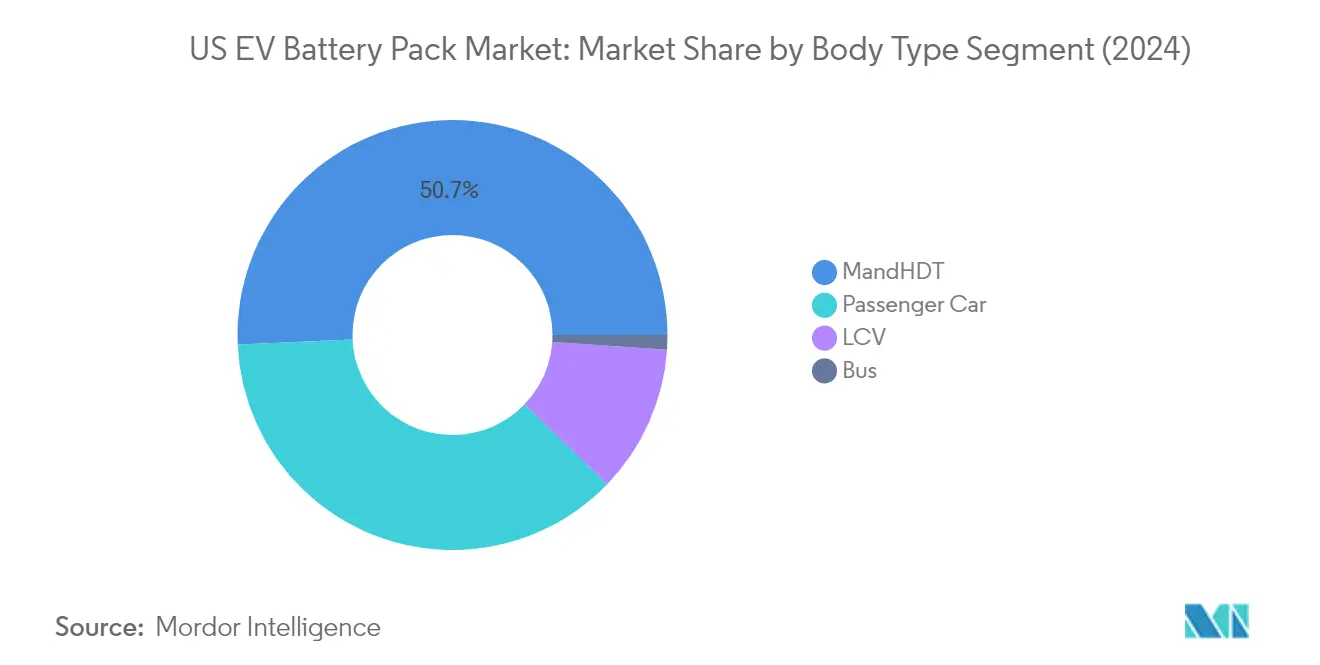
The Medium and Heavy-Duty Trucks (M&HDT) segment has emerged as the dominant force in the US EV battery pack market, commanding approximately 51% market share in 2024. This segment's prominence is driven by several factors, including the increasing adoption of electric trucks in commercial fleets, stringent emission regulations, and substantial government incentives for zero-emission commercial vehicles. The segment is also experiencing the fastest growth trajectory, with a projected growth rate of around 70% from 2024 to 2029. This exceptional growth is fueled by major fleet operators transitioning to electric vehicles, expanding charging infrastructure, and technological advancements in battery technology that enable longer range and faster charging capabilities. The Biden administration's ambitious climate goals and various state-level initiatives promoting zero-emission commercial vehicles are further accelerating the adoption of electric M&HDTs across the United States.

LCV Segment in US EV Battery Pack Market
The Light Commercial Vehicle (LCV) segment represents a rapidly evolving sector in the US EV battery pack market, with significant growth potential driven by the expanding e-commerce and last-mile delivery sectors. The segment is projected to grow at approximately 25% from 2024 to 2029, supported by increasing demand from urban delivery fleets and small businesses transitioning to electric vehicles. This growth is further bolstered by improving battery technology, decreasing operational costs, and expanding charging infrastructure. Major automotive manufacturers are introducing new electric LCV models with enhanced range and payload capabilities, while government incentives and urban emission regulations are encouraging fleet operators to accelerate their transition to electric LCVs. The segment's growth is also supported by advancements in fast-charging technology and increasing focus on sustainable urban logistics solutions.
Remaining Segments in Body Type
The passenger car and bus segments complete the US EV battery pack market landscape, each playing distinct roles in the market's evolution. The passenger car segment continues to be a significant contributor to market growth, driven by increasing consumer awareness, expanding model choices, and improving charging infrastructure. The bus segment, while smaller in market share, represents a crucial opportunity for electrification in public transportation, with many cities and transit authorities implementing electric bus programs. Both segments benefit from ongoing technological improvements in battery efficiency, range capabilities, and charging solutions, while also contributing to the broader goal of reducing transportation-related emissions across different vehicle categories.
Segment Analysis: Propulsion Type
BEV Segment in US EV Battery Pack Market
Battery Electric Vehicles (BEV) dominate the US EV battery pack market, commanding approximately 99% of the total market share in 2024. This overwhelming market dominance can be attributed to several factors, including significant improvements in battery technology, expanding charging infrastructure, and strong government support through incentives and regulations. Major automotive manufacturers are increasingly focusing on pure electric vehicles, with companies like Tesla, General Motors, and Ford making substantial investments in BEV technology and production capabilities. The Biden administration's push for electric vehicle adoption, including plans for 500,000 charging stations nationwide, has further strengthened the BEV segment's position. Additionally, advancements in battery chemistry and manufacturing processes have led to improved range capabilities and reduced costs, making BEVs more attractive to consumers.
PHEV Segment in US EV Battery Pack Market
The Plug-in Hybrid Electric Vehicle (PHEV) segment is projected to experience the fastest growth in the US EV battery pack market, with an expected growth rate of approximately 20% during 2024-2029. This accelerated growth is driven by consumers seeking a bridge between conventional vehicles and pure electric vehicles, as PHEVs offer the flexibility of both electric and gasoline powertrains. The segment's growth is further supported by various government incentives and tax credits specifically designed for plug-in hybrids. Automotive manufacturers are expanding their PHEV offerings with improved electric ranges and enhanced battery technology, making these vehicles increasingly attractive to consumers who experience range anxiety with pure electric vehicles. The segment is also benefiting from advancements in battery technology that enable longer electric-only driving ranges while maintaining the convenience of gasoline backup.
Segment Analysis: Battery Chemistry
NMC Segment in US EV Battery Pack Market
The Nickel Manganese Cobalt (NMC) battery chemistry segment maintains its dominant position in the US EV battery pack market, commanding approximately 56% market share in 2024. This substantial market presence can be attributed to NMC batteries' superior energy density and enhanced performance characteristics, making them particularly suitable for electric vehicles requiring longer ranges. Major automotive manufacturers, including Tesla and General Motors, have shown strong preference for NMC chemistry due to its optimal balance of cost, performance, and safety features. The segment's growth is further supported by ongoing technological advancements in NMC battery manufacturing processes, which have led to improved energy density and reduced production costs. Additionally, the establishment of domestic battery manufacturing facilities and strategic partnerships between automakers and battery manufacturers has strengthened the supply chain for NMC batteries in the United States.
NCM Segment in US EV Battery Pack Market
The Nickel Cobalt Manganese (NCM) battery chemistry segment is emerging as the fastest-growing segment in the US EV battery pack market, projected to grow at approximately 46% CAGR from 2024 to 2029. This remarkable growth trajectory is driven by several factors, including NCM batteries' improved thermal stability and enhanced safety features compared to traditional lithium-ion batteries. The segment is benefiting from substantial investments in research and development, focusing on optimizing the ratio of nickel, cobalt, and manganese to achieve higher energy density and lower costs. Major battery manufacturers are expanding their NCM production capabilities through new manufacturing facilities and technological innovations. The segment's growth is further supported by increasing adoption among electric vehicle manufacturers who are seeking to differentiate their products through improved battery performance and reliability.
Remaining Segments in Battery Chemistry
The remaining segments in the US EV battery pack market include Nickel Cobalt Aluminum (NCA) and Lithium Iron Phosphate (LFP) chemistries, each offering unique advantages for different applications. NCA batteries are particularly valued for their high energy density and long cycle life, making them suitable for premium electric vehicles and high-performance applications. LFP batteries, while offering lower energy density, are gaining traction due to their enhanced safety features, longer lifespan, and lower production costs. These segments continue to evolve through technological advancements and innovations in manufacturing processes. The diversity of battery chemistries available in the market allows manufacturers to choose the most suitable option based on their specific requirements for performance, cost, and safety considerations.
Segment Analysis: Battery Form
Cylindrical Segment in US EV Battery Pack Market
The cylindrical battery form dominates the US EV battery pack market, commanding approximately 60% market share in 2024. This significant market position can be attributed to cylindrical batteries' high energy density and robust performance characteristics that make them ideal for electric vehicle applications. Their cylindrical shape allows for efficient space utilization within battery packs, optimizing overall capacity and enabling longer driving ranges. Additionally, these batteries offer excellent thermal management capabilities and enhanced safety features, making them a reliable and durable option for EV applications. Major automakers continue to prefer cylindrical batteries due to their proven track record, established manufacturing processes, and ability to meet the demanding requirements of modern electric vehicles. The segment's growth is further supported by ongoing technological advancements in electrode materials and manufacturing processes, leading to improved energy density and enhanced performance.
Prismatic Segment in US EV Battery Pack Market
The prismatic battery segment is emerging as the fastest-growing segment in the US EV battery pack market, with a projected growth rate of approximately 39% from 2024 to 2029. This remarkable growth trajectory is driven by several key factors, including the superior packaging efficiency and enhanced safety features of prismatic batteries. The segment's expansion is further fueled by significant investments in research and development, leading to improvements in energy density and overall performance capabilities. Prismatic batteries are gaining traction among automotive manufacturers due to their compact design and ability to optimize space utilization in electric vehicles. The segment is also benefiting from advancements in manufacturing processes that are helping to reduce production costs while maintaining high quality standards. Additionally, the increasing focus on safety and reliability in electric vehicles is driving the adoption of prismatic batteries, as they offer robust structural integrity and excellent thermal management properties.
Remaining Segments in Battery Form
The pouch battery segment represents another significant component of the US EV battery pack market, offering unique advantages that complement the cylindrical and prismatic options. Pouch batteries are particularly valued for their design flexibility and ability to be molded into various shapes, making them ideal for specific vehicle architectures where space optimization is crucial. These batteries offer manufacturers greater freedom in designing their electric vehicle platforms, as they can be customized to fit available spaces more efficiently than their cylindrical or prismatic counterparts. The pouch format also provides advantages in terms of weight reduction and thermal management, contributing to overall vehicle efficiency. Manufacturers continue to invest in pouch battery technology, focusing on improving their durability and addressing challenges related to production scalability and cost-effectiveness.
Segment Analysis: Method
Laser Segment in US EV Battery Pack Market
The laser method has emerged as the dominant technology in the US EV battery pack market, commanding approximately 63% market share in 2024. This segment's prominence can be attributed to several key advantages, including higher precision in battery pack production, superior speed capabilities, and enhanced accuracy compared to traditional methods. The laser technology offers manufacturers the ability to achieve consistent, high-quality welds crucial for EV battery assembly, while also enabling automation and scalability in production processes. Looking ahead, this segment is projected to maintain its impressive growth trajectory with an estimated growth rate of around 41% during 2024-2029. This robust growth is expected to be driven by increasing investments in laser-based manufacturing facilities, technological advancements in laser welding systems, and the growing demand for high-performance battery packs in electric vehicles. The segment's expansion is further supported by the automotive industry's shift toward more efficient and reliable production methods, with major manufacturers increasingly adopting laser technology for their battery pack assembly operations.
Wire Segment in US EV Battery Pack Market
The wire method represents a significant portion of the US EV battery pack market, serving as a reliable and cost-effective alternative for battery pack manufacturing. This traditional approach continues to maintain its relevance due to its well-established infrastructure, lower implementation costs, and proven track record in the industry. Wire technology offers manufacturers the flexibility to adapt to various battery pack designs and configurations, making it particularly suitable for diverse production requirements. The method's reliability and ease of implementation have made it a preferred choice for many manufacturers, especially those focusing on cost-optimization while maintaining quality standards. The wire segment's continued presence in the market is supported by ongoing improvements in wire technology, including enhanced conductivity materials and improved connection techniques. Additionally, the method's compatibility with existing manufacturing setups and the relatively lower training requirements for operators contribute to its sustained adoption in the industry.
Segment Analysis: Component
Cathode Segment in US EV Battery Pack Market
The cathode segment has emerged as the dominant force in the US EV battery pack market, commanding approximately 69% of the total market share in 2024. This substantial market position can be attributed to cathode's crucial role in determining battery performance, energy density, and overall efficiency. Major OEMs like Tesla and General Motors have made significant investments in cathode material development, with Tesla announcing plans for an in-house cathode manufacturing facility. The segment's growth is further supported by ongoing technological advancements aimed at enhancing energy density and reducing production costs. The increasing emphasis on sustainable transportation and the rising demand for high-performance batteries have also contributed to the cathode segment's market leadership.
Separator Segment in US EV Battery Pack Market
The separator segment is projected to experience the most rapid growth in the US EV battery pack market, with an expected growth rate of approximately 20% during 2024-2029. This accelerated growth is driven by continuous innovations in separator materials, including the development of smaller pore sizes and improved thermal stability features. The segment's expansion is further supported by the increasing focus on battery safety and performance optimization. Manufacturers are investing in advanced separator technologies that offer enhanced conductivity and reduced resistance, while also exploring sustainable and eco-friendly materials. The trend toward improved thermal stability and enhanced conductivity in separator materials is expected to continue, driving innovation and growth in this segment.
Remaining Segments in Component
The anode and electrolyte segments also play vital roles in the US EV battery pack market. The anode segment is characterized by ongoing developments in graphite and silicon-based materials, focusing on improving energy density and charging capabilities. Major manufacturers are investing in research and development to enhance anode performance and reduce costs. Meanwhile, the electrolyte segment continues to evolve with innovations in liquid and solid-state technologies, contributing to improved battery safety and performance. Both segments are witnessing technological advancements and increased investment in research and development, particularly in areas such as fast charging capabilities and temperature stability.
Segment Analysis: Material Type
Natural Graphite Segment in US EV Battery Pack Market
Natural graphite has emerged as a dominant material in the US EV battery pack market, driven by its superior electrical conductivity, cost-effectiveness, and minimal environmental impact. The material's high tap density of approximately 1.6 g/cm3 and optimal particle size of around 15 1⁄4m make it particularly suitable for EV battery applications. In 2024, natural graphite is expected to hold approximately 30% share of the material market, supported by its extensive use in anode manufacturing. Major OEMs, including Tesla, are increasingly incorporating natural graphite in their battery designs, particularly focusing on high-nickel cathodes to enhance energy density and extend driving ranges. The material's porosity of about 20% and high intercalation capacity of roughly 360 mAh/g further cement its position as a preferred choice for EV battery manufacturers.
Nickel Segment in US EV Battery Pack Market
The nickel segment is experiencing remarkable growth in the US EV battery pack market, with projections indicating an impressive growth rate of approximately 33% during 2024-2029. This surge is primarily attributed to nickel's crucial role in enhancing battery energy density and overall performance. The material's superior characteristics, including high energy density and durability, make it increasingly indispensable in modern EV battery manufacturing. Various governmental initiatives and industry investments are further accelerating nickel adoption in battery production. The ongoing shift toward higher nickel content in cathode materials, particularly in premium EV segments, is expected to maintain this growth momentum. Technological advancements in nickel processing and integration are also contributing to its increased utilization in next-generation battery designs.
Remaining Segments in Material Type
The other significant materials in the US EV battery pack market include lithium, cobalt, and manganese, each playing vital roles in battery performance and functionality. Lithium remains fundamental to battery chemistry, providing essential ionic conductivity and energy storage capabilities. Cobalt, despite efforts to reduce its usage due to supply chain concerns, continues to be crucial for maintaining battery stability and thermal performance. Manganese serves as a cost-effective option that helps optimize battery performance while keeping production costs manageable. These materials collectively contribute to the diverse material ecosystem necessary for advancing EV battery technology, with manufacturers continuously exploring optimal combinations to achieve the best balance of performance, cost, and sustainability.
Competitive Landscape
Top Companies in US EV Battery Pack Market
The US EV battery pack market is characterized by intense competition and rapid technological advancement among key players like LG Energy Solution, Panasonic, CATL, SK Innovation, and Tesla. Companies are heavily investing in research and development to enhance battery performance, energy density, and charging capabilities while simultaneously working to reduce production costs. Strategic partnerships and collaborations between battery manufacturers and automotive OEMs have become increasingly common to secure supply chains and develop customized solutions. Manufacturing capacity expansion has emerged as a crucial trend, with companies establishing new production facilities across the United States to meet growing demand and comply with local content requirements. Additionally, vertical integration strategies are being pursued to gain better control over raw materials and EV battery component supply, while investments in sustainable manufacturing practices and recycling capabilities demonstrate the industry's commitment to environmental responsibility.
Consolidated Market with Strong Global Players
The US automotive battery pack market exhibits a high level of consolidation, with established global players dominating the landscape through their technological expertise and manufacturing capabilities. Asian manufacturers, particularly from South Korea and Japan, maintain a strong presence in the market due to their early investments in battery technology and established relationships with major automotive manufacturers. These companies leverage their global scale and research capabilities to maintain competitive advantages, while also establishing local manufacturing facilities to serve the US market more effectively and comply with regulatory requirements.
The market has witnessed significant merger and acquisition activity as companies seek to strengthen their market positions and acquire complementary technologies. Vertical integration has become increasingly important, with companies acquiring or partnering with raw material suppliers and component manufacturers to secure their supply chains. New entrants face considerable barriers due to high capital requirements, technical expertise needs, and established customer relationships, though opportunities exist in specialized market segments and emerging technologies.
Innovation and Localization Drive Future Success
Success in the US EV battery pack market increasingly depends on companies' ability to innovate while maintaining cost competitiveness and meeting stringent regulatory requirements. Manufacturers must focus on developing next-generation battery technologies that offer improved energy density, faster charging capabilities, and enhanced safety features. Building strong relationships with automotive OEMs through joint development programs and customized solutions has become crucial for maintaining market share. Companies must also invest in domestic manufacturing capabilities to benefit from government incentives and meet local content requirements under various regulatory frameworks.
For new entrants and smaller players, success lies in identifying and exploiting niche market segments or developing breakthrough technologies that address specific market needs. Companies must carefully balance their investment in research and development with the need to maintain competitive pricing structures. The ability to navigate complex regulatory requirements, particularly those related to environmental standards and safety certifications, will become increasingly important. Additionally, developing robust recycling programs and sustainable manufacturing practices will be crucial for long-term success in the market, as environmental considerations continue to influence both regulatory requirements and consumer preferences. The integration of EV battery assembly and EV battery cell technologies will further enhance the efficiency and sustainability of the electric vehicle battery system.
US EV Battery Pack Industry Leaders
Contemporary Amperex Technology Co. Ltd. (CATL)
Envision AESC Japan Co. Ltd.
LG Energy Solution Ltd.
Panasonic Holdings Corporation
SK Innovation Co. Ltd.
- *Disclaimer: Major Players sorted in no particular order


Recent Industry Developments
- June 2023: CATL will invest USD 1.4 billion in helping Bolivia develop its huge but largely untapped reserves of lithium. Following a meeting with CATL executives on June 25, Bolivian President Luis Arce confirmed the commitment to build two lithium plants to extract minerals from the country’s Uyuni and Oruro salt flats. Construction of both plants could begin as soon as July, according to the country’s energy ministry.
- March 2023: Tesla was reported to be in talks with Contemporary Amperex Technology Co. Ltd. (CATL) regarding plans to build a battery factory in the U.S., according to sources familiar with the matter.
- January 2023: Tesla has announced a new investment of USD 3.6 billion to expand its Gigafactory Nevada complex, hire 3,000 additional employees, and construct two new facilities on the site, including a 100 GWh 4680 cell factory.


US EV Battery Pack Market Report Scope
Bus, LCV, M&HDT, Passenger Car are covered as segments by Body Type. BEV, PHEV are covered as segments by Propulsion Type. LFP, NCA, NCM, NMC, Others are covered as segments by Battery Chemistry. 15 kWh to 40 kWh, 40 kWh to 80 kWh, Above 80 kWh, Less than 15 kWh are covered as segments by Capacity. Cylindrical, Pouch, Prismatic are covered as segments by Battery Form. Laser, Wire are covered as segments by Method. Anode, Cathode, Electrolyte, Separator are covered as segments by Component. Cobalt, Lithium, Manganese, Natural Graphite, Nickel are covered as segments by Material Type.| Bus |
| LCV |
| M&HDT |
| Passenger Car |
| BEV |
| PHEV |
| LFP |
| NCA |
| NCM |
| NMC |
| Others |
| 15 kWh to 40 kWh |
| 40 kWh to 80 kWh |
| Above 80 kWh |
| Less than 15 kWh |
| Cylindrical |
| Pouch |
| Prismatic |
| Laser |
| Wire |
| Anode |
| Cathode |
| Electrolyte |
| Separator |
| Cobalt |
| Lithium |
| Manganese |
| Natural Graphite |
| Nickel |
| Other Materials |
| Body Type | Bus |
| LCV | |
| M&HDT | |
| Passenger Car | |
| Propulsion Type | BEV |
| PHEV | |
| Battery Chemistry | LFP |
| NCA | |
| NCM | |
| NMC | |
| Others | |
| Capacity | 15 kWh to 40 kWh |
| 40 kWh to 80 kWh | |
| Above 80 kWh | |
| Less than 15 kWh | |
| Battery Form | Cylindrical |
| Pouch | |
| Prismatic | |
| Method | Laser |
| Wire | |
| Component | Anode |
| Cathode | |
| Electrolyte | |
| Separator | |
| Material Type | Cobalt |
| Lithium | |
| Manganese | |
| Natural Graphite | |
| Nickel | |
| Other Materials |


Market Definition
- Battery Chemistry - Various types of battery chemistry considred under this segment include LFP, NCA, NCM, NMC, Others.
- Battery Form - The types of battery forms offered under this segment include Cylindrical, Pouch and Prismatic.
- Body Type - Body types considered under this segment include, passenger cars, LCV (light commercial vehicle), M&HDT (medium & heavy duty trucks)and buses.
- Capacity - Various types of battery capacities inldude under theis segment are 15 kWH to 40 kWH, 40 kWh to 80 kWh, Above 80 kWh and Less than 15 kWh.
- Component - Various components covered under this segment include anode, cathode, electrolyte, separator.
- Material Type - Various material covered under this segment include cobalt, lithium, manganese, natural graphite, nickel, other material.
- Method - The types of method covered under this segment include laser and wire.
- Propulsion Type - Propulsion types considered under this segment include BEV (Battery electric vehicles), PHEV (plug-in hybrid electric vehicle).
- ToC Type - ToC 1
- Vehicle Type - Vehicle type considered under this segment include passenger vehicles, and commercial vehicles with various EV powertrains.
| Keyword | Definition |
|---|---|
| Electric vehicle (EV) | A vehicle which uses one or more electric motors for propulsion. Includes cars, buses, and trucks. This term includes all-electric vehicles or battery electric vehicles and plug-in hybrid electric vehicles. |
| PEV | A plug-in electric vehicle is an electric vehicle that can be externally charged and generally includes all electric vehicles as well as plug-electric vehicles as well as plug-in hybrids. |
| Battery-as-a-Service | A business model in which the battery of an EV can be rented from a service provider or swapped with another battery when it runs out of charge |
| Battery Cell | The basic unit of an electric vehicle's battery pack, typically a lithium-ion cell, that stores electrical energy. |
| Module | A subsection of an EV battery pack, consisting of several cells grouped together, often used to facilitate manufacturing and maintenance. |
| Battery Management System (BMS) | An electronic system that manages a rechargeable battery by protecting the battery from operating outside its safe operating area, monitoring its state, calculating secondary data, reporting data, controlling its environment, and balancing it. |
| Energy Density | A measure of how much energy a battery cell can store in a given volume, usually expressed in watt-hours per liter (Wh/L). |
| Power Density | The rate at which energy can be delivered by the battery, often measured in watts per kilogram (W/kg). |
| Cycle Life | The number of complete charge-discharge cycles a battery can perform before its capacity falls under a specified percentage of its original capacity. |
| State of Charge (SOC) | A measurement, expressed as a percentage, that represents the current level of charge in a battery compared to its capacity. |
| State of Health (SOH) | An indicator of the overall condition of a battery, reflecting its current performance compared to when it was new. |
| Thermal Management System | A system designed to maintain optimal operating temperatures for an EV's battery pack, often using cooling or heating methods. |
| Fast Charging | A method of charging an EV battery at a much faster rate than standard charging, typically requiring specialized charging equipment. |
| Regenerative Braking | A system in electric and hybrid vehicles that recovers energy normally lost during braking and stores it in the battery. |


Research Methodology
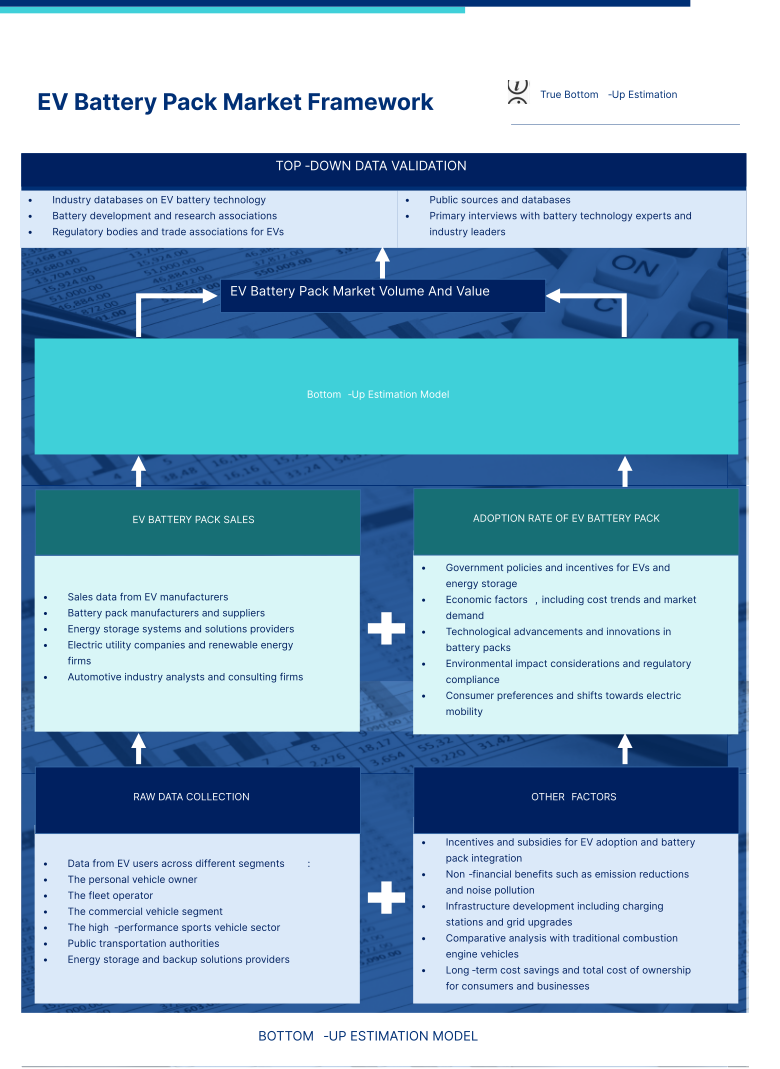
Mordor Intelligence follows a four-step methodology in all its reports.
- Step-1: Identify Key Variables: To build a robust forecasting methodology, the variables and factors identified in Step-1 are tested against available historical market numbers. Through an iterative process, the variables required for market forecast are set and the model is built based on these variables.
- Step-2: Build a Market Model: Market-size estimations for the historical and forecast years have been provided in revenue and volume terms. Market revenue is calculated by multiplying the volume demand with volume-weighted average battery pack price (per kWh). Battery pack price estimation and forecast takes into account various factors affecting ASP, such as inflation rates, market demand shifts, production costs, technological developments, and consumer preferences, providing estimations for both historical data and future trends.
- Step-3: Validate and Finalize: In this important step, all market numbers, variables, and analyst calls are validated through an extensive network of primary research experts from the market studied. The respondents are selected across levels and functions to generate a holistic picture of the market studied.
- Step-4: Research Outputs: Syndicated Reports, Custom Consulting Assignments, Databases & Subscription Platforms





 Your data is secure and never sold or shared.


