
Tracking-as-a-Service Market Size and Share
Market Overview
| Study Period | 2020 - 2031 |
|---|---|
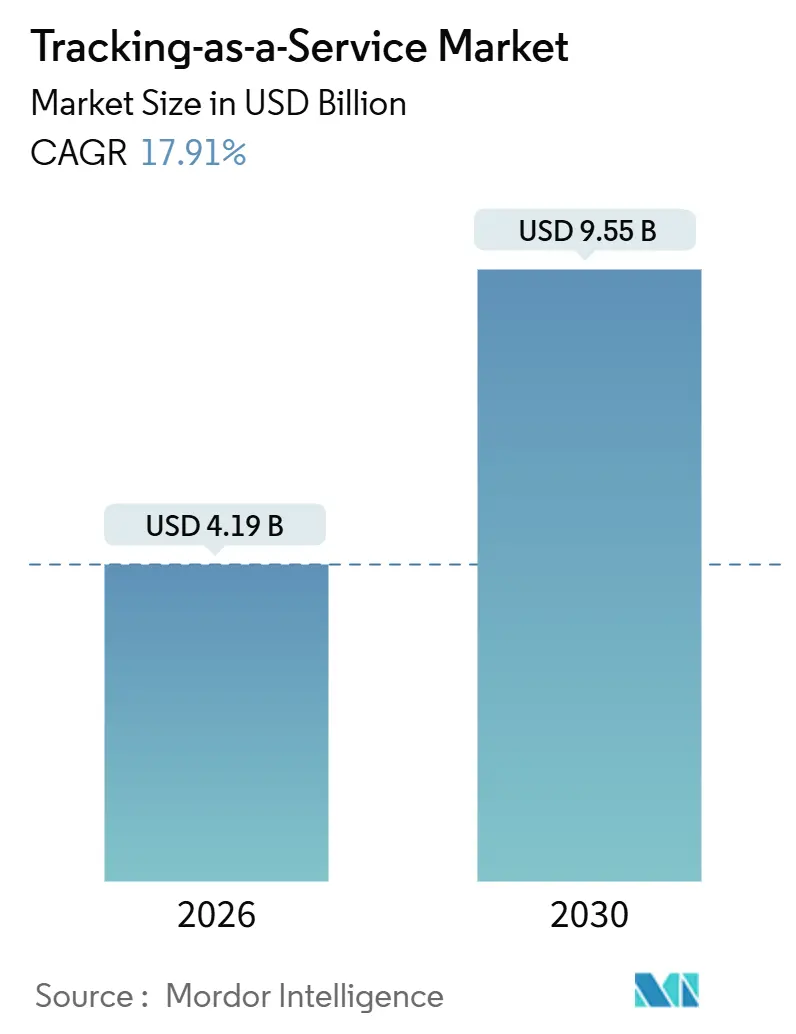
| Market Size (2026) | USD 4.19 Billion |
| Market Size (2031) | USD 9.55 Billion |
| Growth Rate (2026 - 2030) | 17.91 % |
| Fastest Growing Market | Asia Pacific |
| Largest Market | North America |
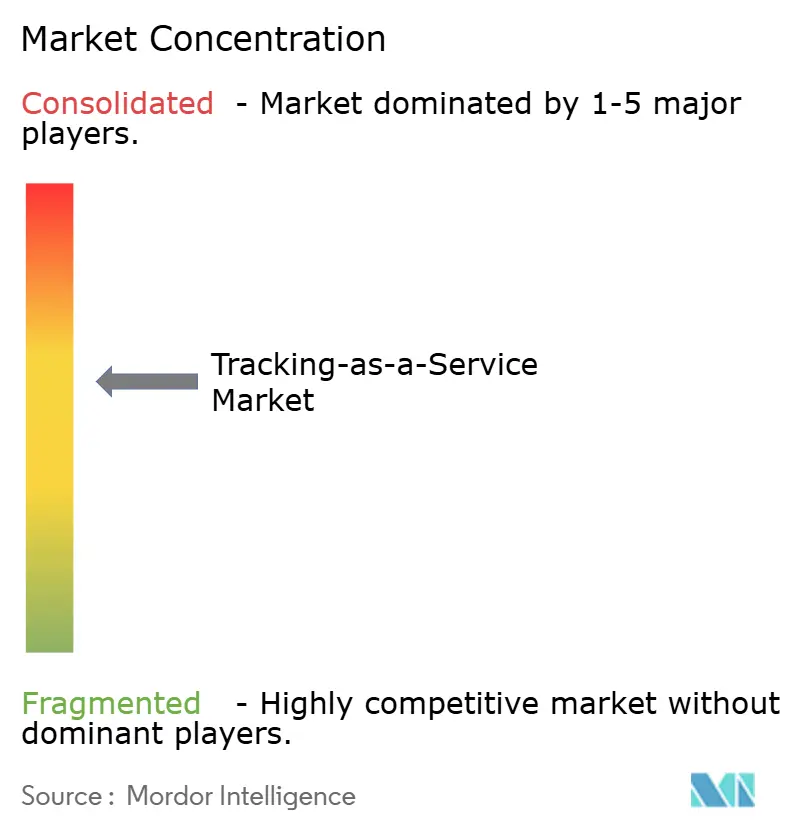
| Market Concentration | Medium |
Major Players *Disclaimer: Major Players sorted in no particular order Image © Mordor Intelligence. Reuse requires attribution under CC BY 4.0. | |
Tracking-as-a-Service Market Analysis by Mordor Intelligence
The Tracking-as-a-Service market size reached USD 4.19 billion in 2026 and is forecast to advance to USD 9.55 billion by 2031, translating into a 17.91% CAGR. Cloud subscriptions convert fixed capital outlays into variable operating expenses, while real-time data integration shortens implementation cycles. Regulatory mandates, such as the FDA’s Rule 204, also keep adoption momentum high. Insurers incentivize telematics with premium discounts, while 5G RedCap modules extend battery life and widen use cases. AI-driven route optimization, driver safety analytics, and predictive maintenance are now bundled in baseline offerings, pushing vendors to differentiate through vertical-specific features. Competitive intensity remains elevated because specialized requirements in healthcare, cold chain logistics, and cross-border trade resist one-size-fits-all solutions.
Key Report Takeaways
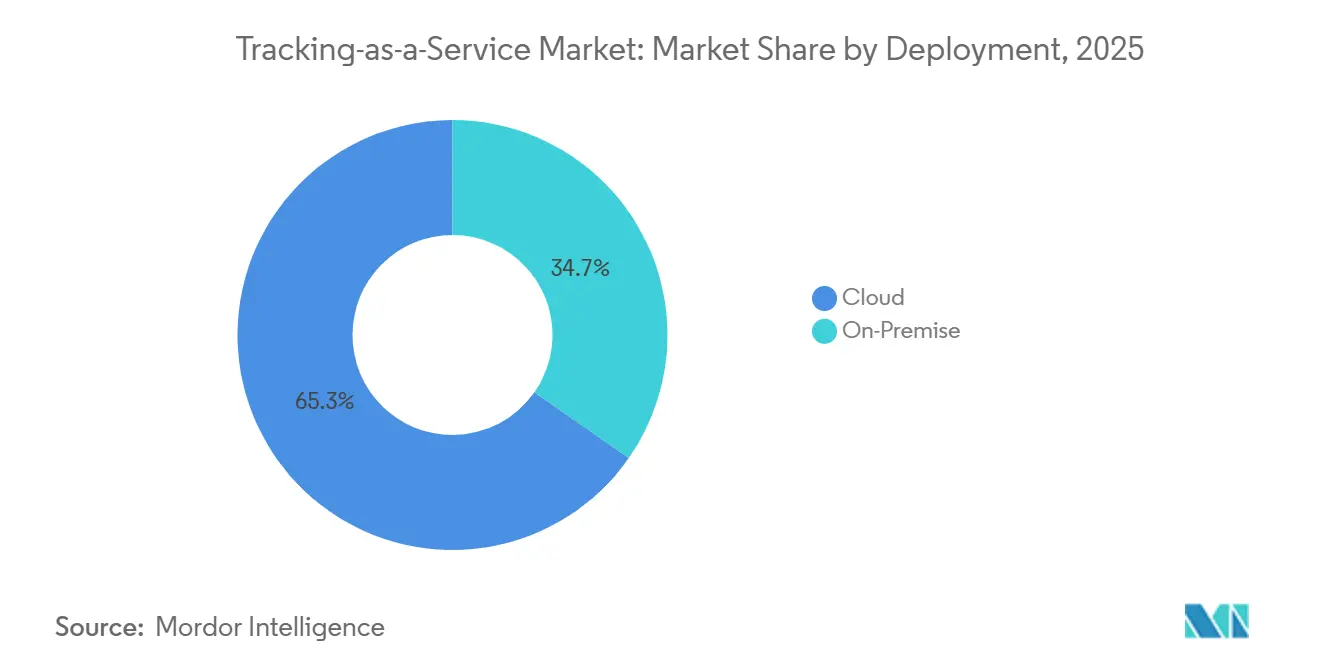
- By deployment, cloud captured 65.31% revenue in 2025; on-premise is projected to trail with a single-digit growth rate through 2031.
- By component, software accounted for 59.73% of the Tracking-as-a-Service market share in 2025; services are projected to expand at an 18.29% CAGR through 2031.
- By enterprise size, large fleets commanded 62.77% revenue in 2025, while SMEs are scaling fastest at 18.24% CAGR.
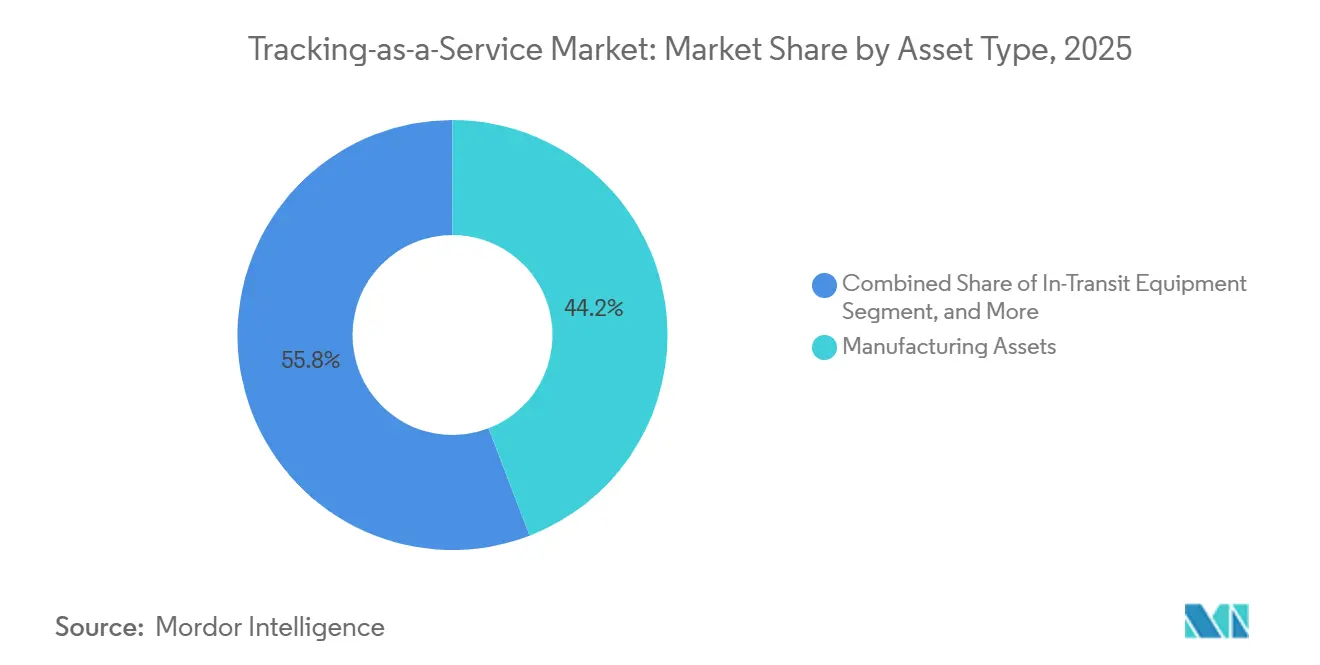
- By asset type, manufacturing assets accounted for a 44.16% share of the Tracking-as-a-Service market size in 2025, and in-transit equipment is projected to advance at an 18.51% CAGR.
- By end-user industry, transportation and logistics led with 37.89% revenue in 2025; healthcare is forecast to grow at 19.11% CAGR through 2031.
Note: Market size and forecast figures in this report are generated using Mordor Intelligence’s proprietary estimation framework, updated with the latest available data and insights as of January 2026.
Market Trends and Insights
Drivers Impact Analysis of Tracking-as-a-Service Market*
| Driver | (~) % Impact on CAGR Forecast | Geographic Relevance | Impact Timeline |
|---|---|---|---|
| Upsurge in Use of Mobile Technology | +3.2% | Global, with concentrated adoption in North America and Asia Pacific | Medium term (2-4 years) |
| Need to Improve Fleet Operator Efficiency | +4.1% | Global, strongest in North America and Europe | Short term (≤ 2 years) |
| Increasing Adoption of IoT | +3.8% | Global, led by Asia Pacific manufacturing hubs | Medium term (2-4 years) |
| Proliferation of 5G-Enabled Low-Latency Tracking | +2.6% | North America, Europe, and urban Asia Pacific | Long term (≥ 4 years) |
| AI-Driven Predictive Tracking and Route Optimization | +2.9% | North America and Europe, expanding to Asia Pacific | Medium term (2-4 years) |
| Regulatory Mandates for Supply-Chain Transparency | +3.5% | Europe and North America, emerging in Asia Pacific | Short term (≤ 2 years) |
| Source: Mordor Intelligence | |||
Upsurge in Use of Mobile Technology
Smartphone penetration topping 80% in advanced economies has repositioned tracking as a consumer-visible service that demands sub-second query responses, an architectural requirement better served by cloud-native platforms.[1] Field technicians now employ augmented-reality overlays on handsets to locate tagged assets, cutting retrieval time by 40%. Insurance telematics has shifted from USD 150 per vehicle plug-ins to USD 10 per month software, providing micro-fleets that were previously priced out of telematics with a viable entry point. Subscription platforms broaden addressable demand because operators no longer incur capital charges for hardware. This democratization fuels the Tracking-as-a-Service market by multiplying node counts faster than vehicle sales.
Need to Improve Fleet Operator Efficiency
Diesel costs represent 30%-40% of fleet spend, so dynamic routing that lowers fuel burn by 8%-12% directly boosts margins.[2] Electronic logging devices have removed the need for paper manipulation, yet predictive analytics now anticipate hours-of-service violations hours ahead, enabling dispatchers to re-route loads and avoid fines. Component wear models that schedule maintenance on condition rather than miles have squeezed 15%-20% from upkeep budgets, extending truck lifecycles. In aggregate, these operating gains justify monthly subscription fees and accelerate cloud migrations within the Tracking-as-a-Service market.
Increasing Adoption of IoT
GPS-cellular modules priced below USD 5 each eliminate cost barriers, enabling operators to track returnable pallets and totes that historically went missing at 10%-15% annual loss rates.[3] Factories use utilization data to postpone capex on new machines, while pharmaceutical shippers pair location and temperature logs to auto-generate compliance reports, saving multiple staff-hours per international consignment. However, interoperability hurdles persist when fleets deploy four to six sensor brands, which fragment views and slow down real-time decision-making.
Proliferation of 5G-Enabled Low-Latency Tracking
5G RedCap narrows positioning to under 3 meters and clips latency below 10 milliseconds, allowing yard operators to differentiate tightly packed trailers without manual scans. Battery life doubles relative to 4G equivalents, extending maintenance cycles to 7-10 years on global containers. Rural coverage gaps mean satellite or 4G fallback remains essential, segmenting service levels and enabling premium pricing at a 30%-40% uplift over legacy cellular.
Restraints Impact Analysis of Tracking-as-a-Service Market*
| Restraint | (~) % Impact on CAGR Forecast | Geographic Relevance | Impact Timeline |
|---|---|---|---|
| Privacy Concerns Regarding Electronic Monitoring | -2.1% | Europe and North America, driven by GDPR and labor regulations | Short term (≤ 2 years) |
| Limited Control Granted to End-Users | -1.3% | Global, particularly impacting SMEs | Medium term (2-4 years) |
| Cyber-Security and Data-Sovereignty Compliance Cost | -2.4% | Europe, North America, and emerging in Asia Pacific | Medium term (2-4 years) |
| Network Coverage Gaps in Remote Locations | -1.8% | Rural areas globally, concentrated in Africa, South America, and remote Asia Pacific | Long term (≥ 4 years) |
| Source: Mordor Intelligence | |||
Privacy Concerns Regarding Electronic Monitoring
Works councils in Germany and France limit data retention to 90 days and prohibit off-duty location logging, thereby trimming productivity gains and increasing development spending on region-specific privacy controls. Retail consumers also resist disclosing precise home coordinates to third-party couriers, pushing e-commerce platforms to anonymize final-mile tracking. Compliance complexity gives scale advantages to large vendors that can amortize legal overhead across their customer bases, yet it suppresses short-term elasticity in the Tracking-as-a-Service market.
Cyber-Security and Data-Sovereignty Compliance Cost
CISA guidance now mandates end-to-end encryption and over-the-air patching, adding USD 8-USD 15 to hardware builds plus USD 2-USD 5 monthly for monitoring. China, Russia, and India require domestic data residency, forcing multinationals to maintain regional clouds that inflate infrastructure budgets 40%-60%. Small operators often outsource security, consuming 15%-20% of total subscription spend and diluting ROI, which can temper adoption among price-sensitive fleets.
*Our forecasts treat driver/restraint impacts as directional, not additive. The impact forecasts reflect baseline growth, mix effects, and variable interactions.
Tracking-as-a-Service Market Segment Analysis
By Deployment:
Cloud Dominance Driven by Integration VelocityCloud captured 65.31% of revenue in 2025 and is forecast to expand at an 18.14% CAGR as enterprises favor four-to-eight-week rollouts over the six-month cycles typical for on-premises solutions. Multi-tenant architectures enable providers to train AI models across aggregated datasets, accelerating feature launches that on-premises customers typically wait months to receive. Defense and mining users who require air-gapped environments continue to opt for hybrid models, caching data locally and then synchronizing once connectivity is stable. The Tracking-as-a-Service market size crossover, where on-premises equals cloud opex, usually occurs after 500-1,000 vehicles. However, most CFOs now factor in the opportunity cost of diverted IT labor, keeping cloud in pole position.
Samsara’s Connected Workflows, introduced in 2025, exemplifies cloud momentum by automatically creating custom forms as vehicles cross borders and pinging warehouses when deliveries are 10 miles away. Such automation is infeasible in manual upgrade cycles that characterize on-premises. Security perceptions have shifted: SOC 2 Type II certifications on hyperscale clouds now surpass those of home-grown server rooms, eroding the last historical objection to subscription platforms within the Tracking-as-a-Service market.
By Component:
Services Surge as Complexity Outpaces Internal ExpertiseSoftware accounted for 59.73% of the revenue in 2025, yet services are growing at an 18.29% CAGR because extracting insights requires analytics talent that operators rarely possess. Managed bundles covering sensors, cellular plans, licenses, and predictive models run USD 25-USD 60 per vehicle monthly, turning capex spikes into usage-aligned opex.
Custom integrations swallow 500-2,000 developer-hours, yielding USD 200,000-USD 800,000 project fees and reinforcing stickiness. Edge computing reduces bandwidth by up to 90% as on-device vision tracks pallets in real-time, while outcome-based contracts shift risk to vendors. Regional service firms capture a significant share by offering on-site support that national giants cannot cost-effectively replicate, thereby maintaining a fragmented Tracking-as-a-Service market.
By Enterprise Size:
SMEs Close the Capability GapLarge operators accounted for 62.77% of the revenue in 2025, driven by enterprise-wide contracts exceeding USD 500,000, which resulted in switching costs. SMEs, however, post the fastest 18.24% CAGR thanks to cloud tariffs of USD 30-USD 50 per vehicle that insurers shave by 10%-15% via telematics discounts. Churn rates sit at 20%-30% because smaller fleets shop aggressively for price and service. Yet feature parity has narrowed; sustainability dashboards that quantify carbon and flag electrification routes are now accessible to any fleet, removing a historic enterprise advantage.
Large enterprises integrate tracking into customer relationship and enterprise resource planning suites for predictive inventory replenishment, while SMEs focus on theft deterrence and fuel savings. The democratization of advanced analytics keeps the Tracking-as-a-Service market fluid, preventing dominance by legacy incumbents.
By Asset Type:
In-Transit Equipment Gains on E-Commerce ExpectationsManufacturing assets supplied 44.16% of items tracked in 2025; however, in-transit equipment is expected to outpace this at an 18.51% CAGR, as consumers increasingly demand parcel-level visibility with sub-hour delivery windows. Device architecture shifts from facility-powered WiFi tags to multi-year battery cellular beacons that roam globally. Cold-chain rigs equipped with GPS-temperature sensors now automatically compile compliance reports, eliminating the need for manual logs that once consumed hours per shipment. Tracking pallets and returnable containers valued at USD 50-USD 200 becomes economical as the device cost drops to USD 5 per year, revealing shrinkage hotspots that previously went unmeasured.
Condition monitoring layers are applied to manufacturing assets; vibration analysis flags bearing failures weeks in advance, allowing plants to fix them during scheduled downtime and increase throughput without requiring new equipment. Electronics disposal auditing rounds out niche demand as data centers enforce strict chain-of-custody before decommissioned servers exit secure zones.

By End-User Industry:
Healthcare Velocity Reflects Asset Utilization CrisisTransportation and logistics accounted for 37.89% of the spend in 2025, but healthcare’s 19.11% CAGR highlights inefficiencies where staff waste up to 30% of their shifts searching for devices. Real-time location systems reduce search time to below 5% of work hours and enable inventory cuts of 15%-25%, freeing USD 20 million-USD 30 million in capital at a 500-bed hospital. Retail and e-commerce strive for 98% inventory accuracy through item-level tags, reducing out-of-stocks that cost 4%-8% of potential sales. Food and beverage supply chains are digitizing to comply with FDA Rule 204, while IT and telecom departments utilize technician tracking to reduce the number of service calls by one to two per shift.
Manufacturing utilizes sensor data to unlock bottlenecks, rather than investing in new lines, resulting in throughput gains of 8%-12%. These multi-sector dynamics broaden the install base and sustain double-digit growth for the Tracking-as-a-Service market.
Geography Analysis
North America Tracking-as-a-Service Market
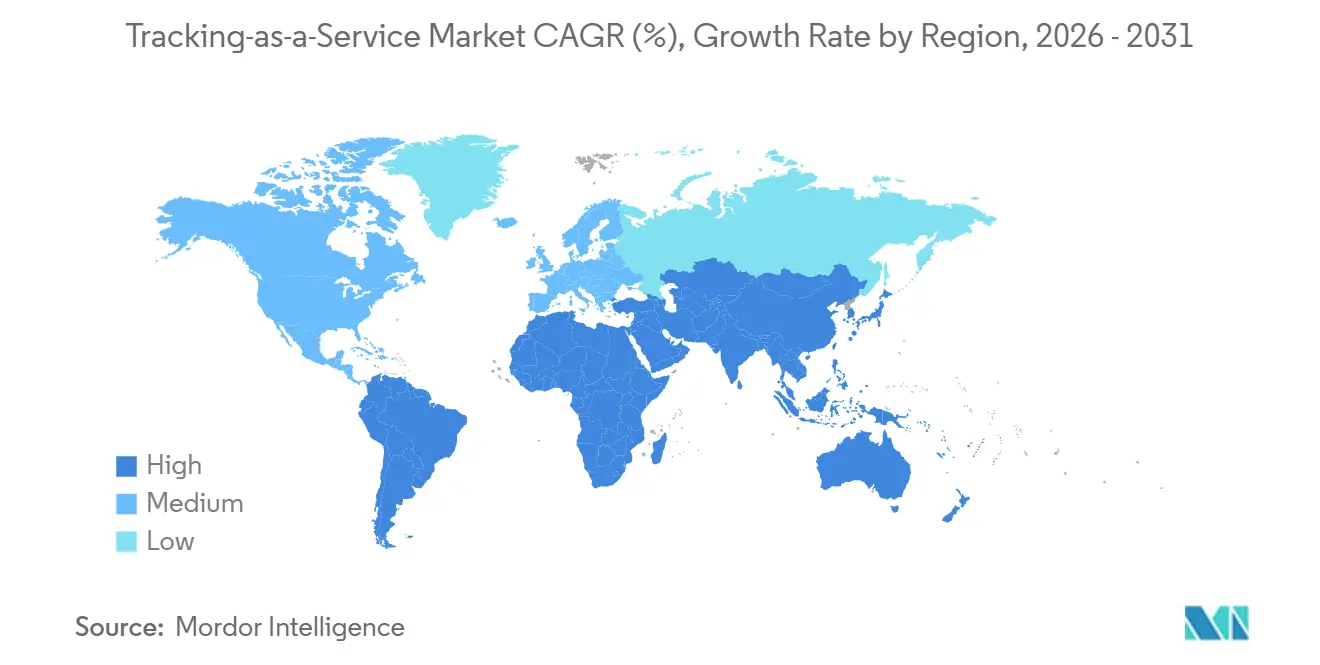
North America secured 35.82% of the revenue in 2025, owing to early telematics mandates and mature insurance programs. Growth moderates yet remains meaningful because fleets layer AI and predictive models on top of existing hardware. Canada’s sub-zero temperatures spur cold-start monitoring, while Mexico’s 5 million annual truck crossings through Laredo require cross-border customs automation. The United States continues to set service benchmarks as e-commerce giants enforce 30-minute delivery windows that ripple across carrier networks.
APAC Tracking-as-a-Service Market
Asia Pacific grows at 18.93% CAGR, led by China’s compulsory satellite tracking on over 15 million commercial vehicles. India’s e-way bill compliance drives digitization among small truckers, and Japan’s labor shortages push optimization to sustain service with 10%-15% fewer drivers. Southeast Asian e-commerce, which is growing at a rate of 25%-30% yearly, is driving the need for last-mile visibility, where GPS coordinates take precedence over non-standardized addresses, thereby accelerating device shipments and revenue within the Tracking-as-a-Service market.
EMEA and South America Tracking-as-a-Service Market
Europe balances stringent privacy curbs with deforestation and forced-labor traceability rules that require geolocation records throughout supply chains. Compliance stimulates demand even as GDPR limits data retention to 90 days. Middle East adoption centers on logistics hubs in the United Arab Emirates and Saudi Arabia, while South America focuses on Brazil’s agricultural exports, which satisfy European sustainability criteria. Africa advances in mining and high-value cargo corridors, but lags in rural connectivity, moderating its near-term CAGR.
Regulatory Landscape
Tracking-as-a-Service deployments are increasingly shaped by rules governing automated decisioning, traceability, and cross-border data handling. In the European Union, Regulation (EU) 2024/1689 (the EU Artificial Intelligence Act) entered into force on 1 August 2024, with key obligations phasing in and full application beginning 2 August 2026. This timeline increases compliance expectations for AI-enabled analytics used in safety, workforce monitoring, and other potentially high-impact tracking contexts.
Alongside regulation, global traceability standards are anchoring interoperability requirements in multi-party supply chains. GS1 standards such as EPCIS 2.0 (event data sharing across partners) and identifiers such as the Serial Shipping Container Code (SSCC), aligned with ISO/IEC 15459 for unique logistics-unit identification, support auditable location and status histories across shippers, carriers, and consignees. They are increasingly used as a baseline for scalable, cross-enterprise tracking implementations.
Value Chain Analysis
The Tracking-as-a-Service value chain begins with device and data-capture inputs (BLE/RFID/GPS sensors, gateways, and mobile computers) and connectivity (cellular and Wi-Fi). It then moves into ingestion and normalization layers that reconcile heterogeneous feeds.
Platforms typically aggregate telemetry from proprietary device streams plus third-party sources such as carrier APIs and terminal/port systems. Legacy EDI messages (for example, common shipment status and arrival-related transactions) remain prevalent across nodes, which requires adapters and mapping to create a unified asset lifecycle view. At the core, cloud software providers deliver event processing, analytics, alerting, and workflow automation, then distribute value through integrations into enterprise systems (ERP/TMS/WMS such as SAP S/4HANA). Services partners and systems integrators extend the chain through deployment, kitting, field installation, and customization, while bottlenecks concentrate around data fragmentation and runtime dependencies when synchronous enterprise calls tie tracking to ERP availability. That constraint is pushing more event-driven architectures that separate ingestion from orchestration to improve resilience at scale.
Competitive Landscape
The top five vendors hold a share of under 30%, underscoring fragmentation as vertical nuances deter platform convergence. Fleet-centric firms, such as Samsara and Geotab, thrive on recurring software revenue but often lack hospital-grade integrations, whereas CenTrak and AiRISTA dominate in this area. Orbcomm leads container tracking via maritime partnerships, while pallet tracking remains regionally splintered. Hardware commoditization shifts differentiation to AI software that predicts failures, optimizes routes, and flags anomalies. Mid-sized acquisitions favor niche capabilities or regional footholds over global scale, implying prolonged fragmentation in the Tracking-as-a-Service market.
Bluetooth Low Energy mesh and ultra-wideband disrupt warehouse and port operations with sub-meter accuracy. North American vendors emphasize software integrations, whereas Asia Pacific rivals compete on price and compliance with state monitoring portals. Samsara’s USD 300 million quarterly revenue illustrates momentum in software-first models.
Tracking-as-a-Service Industry Leaders
-
AT&T Inc.
-
Verizon Communications
-
Zebra Technologies Corp.
-
Trimble Inc.
-
Motorola Solutions
- *Disclaimer: Major Players sorted in no particular order
Tracking-as-a-Service Market Companies Covered in this Report
- AT&T Inc.
- Verizon Communications
- Zebra Technologies Corp.
- Trimble Inc.
- Motorola Solutions
- Geotab Inc.
- Honeywell International Inc.
- Blackline Safety Corp.
- Spidertracks Ltd.
- Wabco Holdings Inc.
- CalAmp Corp.
- Fleet Complete
- Teletrac Navman
- Spireon Inc.
- Samsara Inc.
- Garmin Ltd.
- TomTom N.V.
- Trackimo LLC
- Gurtam
- Powerfleet Inc.
- SkyBitz Inc.
- Orbcomm Inc.
- Queclink Wireless Solutions
- ATrack Technology Inc.
Market Opportunities and Future Outlook
Infrastructure-free tracking is expanding the opportunity set beyond facilities that can justify fixed readers or gateways. June 2026 launches such as IFCOs TRLLN (BLE labels plus a cloud platform for reusable asset visibility) and Samsaras Tracking Label with a Shipment Center dashboard point to models designed to reuse existing sensor footprints, mobile devices, and fleet hardware networks. This helps close visibility gaps for returnable transport items, small assets, and shipments that move across many third-party locations.
Another whitespace area sits at the intersection of tracking and enterprise execution, where normalized event streams drive operational and financial actions rather than only status updates. As platforms ingest mixed sources (carrier/terminal APIs, Wi-Fi observations, and EDI), demand concentrates on API-first integration, exception management, and auditable data sharing aligned with standards such as GS1 EPCIS 2.0 and SSCC. These requirements are most evident in cross-border logistics, cold chain compliance workflows, and claims or chargeback automation that depends on provable time and location records.
Recent Industry Developments in Tracking-as-a-Service Market
- July 2026: Geotab acquired Link Labs to deepen its asset-tracking capabilities for smaller, high-value assets and industrial equipment. The deal adds complementary IoT location technology to Geotabs platform and broadens its addressable use cases beyond vehicle-centric telematics into tools and equipment visibility.
- June 2026: IFCO launched TRLLN as an independent, industry-agnostic Tracking-as-a-Service offering using Bluetooth Low Energy labels and a cloud platform for reusable asset visibility. The approach reduces reliance on fixed infrastructure, supporting faster rollouts across multi-site supply chains where assets circulate between many partners.
- April 2026: Zebra Technologies introduced TC501 and TC701 mobile computers with its Frontline AI Suite for logistics workflows such as proof of delivery and asset visibility, including UHF RFID support. Embedding AI and capture capabilities into frontline devices shifts more tracking and validation to the edge and improves real-time execution in warehouses and field operations.
Tracking-as-a-Service Market Report Scope and Research Methodology
Market Definition and Coverage
The tracking as a service market covers subscription and managed offerings that help customers locate, monitor, and optimize assets using connected devices, software platforms, and related analytics, delivered through cloud or on-premise deployments.
Scope exclusions: one-time hardware-only sales and non-tracking IT services are excluded unless they are bundled and priced as part of an ongoing tracking service.
Segments Covered in This Report
- By Deployment
- Cloud
- On-Premise
- By Component
- Software
- Services
- By Enterprise Size
- Large Enterprises
- Small and Medium Enterprises
- By Asset Type
- In-Transit Equipment
- Manufacturing Assets
- Electronics and IT Assets
- By End-User Industry
- Transportation and Logistics
- Manufacturing Assets
- Retail and E-commerce
- Healthcare
- Food and Beverage
- IT and Telecom
- By Geography
- North America
- United States
- Canada
- Mexico
- Europe
- Germany
- United Kingdom
- France
- Russia
- Rest of Europe
- Asia-Pacific
- China
- Japan
- India
- South Korea
- Australia
- Rest of Asia-Pacific
- Middle East and Africa
- Middle East
- Saudi Arabia
- United Arab Emirates
- Rest of Middle East
- Africa
- South Africa
- Egypt
- Rest of Africa
- Middle East
- South America
- Brazil
- Argentina
- Rest of South America
- North America
Data Sources, Market Sizing, and Validation
Desk Research
For desk research, we started by building a clear fact base on connected tracking adoption and usage patterns, then mapped those patterns to paid and free price signals. Public sources such as US Federal Communications Commission (FCC) filings and spectrum updates, US International Trade Commission (USITC) trade statistics, the US Bureau of Transportation Statistics (BTS), and Eurostat transport indicators were used to sanity check activity levels tied to fleet movement and asset flows.
We also reviewed standards and policy sources such as ISO documentation and selected government and regulator notices that affect traceability and device compliance, then matched them with company annual reports, earnings transcripts, investor presentations, and credible press coverage. Where needed, paid database subscriptions were used for company financials and intelligence, news and financials, patent databases, and shipment-level import and export records to confirm directional trends. These desk sources are illustrative, and additional public references were used for cross-checking, validation, and clarifying definitions where the initial documents were not specific enough.
Primary Interviews and Surveys
Primary work was used to pressure-test what buyers actually purchase under tracking subscriptions, and how pricing shifts by asset type, deployment choice, and service depth. We spoke with a mix of solution providers, system integrators, and end-user teams across Americas, EMEA, and APAC, so assumptions on attach rates, renewal behavior, and typical contract sizing could be checked and adjusted based on what is sold and renewed in the field.
Distribution of primary research fieldwork respondents
| Company type | Respondent position | Region |
|---|---|---|
| Top tier: 34% | CXOs: 15% | APAC: 47% |
| Mid tier: 50% | Functional/Unit leaders: 26% | EMEA: 29% |
| Smaller Players: 16% | Managers: 59% | Americas: 24% |
Market-Sizing & Forecasting
Sizing was built using a top-down and bottom-up mix. The top-down view reconstructs the paid tracking demand pool by linking connected-device activity, cloud subscription adoption, and industry usage in fleets and asset-heavy operations. We then corroborated that model with selective bottom-up approximations, such as sampled subscription pricing by asset category and deployment mode, plus limited provider revenue roll-ups where disclosures were available.
Key inputs included indicators such as connected device and cellular IoT connections, fleet and in-transit asset intensity by region, the cloud versus on-premise mix, typical subscription term and renewal cycles, and price per tracked asset (including add-ons like safety analytics and predictive maintenance). When a bottom-up data point was missing for a smaller country or vertical, we used proxy ratios from similar economies and validated the proxy with interview feedback before applying it.
For forecasting, we relied on scenario analysis supported by a simple multivariate regression check using the demand drivers above, so growth is tied to realistic adoption and pricing progression instead of a single straight-line CAGR. Assumptions on adoption speed and pricing pressure were tuned using expert views on procurement cycles, device availability, and how quickly customers expand from pilot deployments to full rollouts.
Data Validation & Update Cycle
Outputs were validated through repeated cross-checks against independent signals such as disclosed subscription revenue trends, device connection growth, and regional fleet and logistics indicators. We also reviewed the results for outliers that did not match the operating reality described in interviews. Where variances exceeded an acceptable band, we ran a deeper cut of the input assumptions, and if needed, did follow-up outreach to confirm the reason for the mismatch.
A multi-step analyst review is completed before sign-off so definitions, currency handling, and year mapping stay consistent across the time series. Reports are refreshed annually, and interim updates are made when a material event changes market direction, such as a major regulatory change or a step-change in connectivity economics. Before delivery, a final pass is completed so clients receive an up-to-date view based on the latest available public data and validated assumptions.
Mordor Intelligence's Tracking As A Service Market Estimate Compared With Other Published Estimates
Published market values for tracking as a service can look far apart because teams draw boundaries differently and also choose different timing for the base year and currency conversions. We also see gaps when one study mixes adjacent markets into the same total, or when the assumed subscription pricing curve is pushed up without enough checks.
Connection counts, subscription renewal cues from company disclosures, and region-level fleet and logistics indicators are the evidence points that keep Mordor Intelligence's estimate tied to paid tracking subscriptions rather than broader IoT enablement spend.
Benchmark comparison
| Source | Market Size | Gaps in Research Methodology |
|---|---|---|
| Mordor Intelligence | USD 4.19 B (2026) | |
| Independent Research House A | USD 2.68 B (2024) | Uses an earlier base year and a shorter horizon, and the scope appears to lean toward a narrower service bundle, which can undercount advanced analytics and managed-service revenue that is often packaged into tracking contracts. |
| Industry Publisher B | USD 2.40 B (2025) | Reported value is anchored to a different base year and may apply a more conservative price-per-asset progression across regions, which can reduce the implied subscription value even if device and asset counts are similar. |
Looking across the three figures, the spread is mostly explained by year selection and how much of the recurring service stack gets counted inside tracking subscriptions. By keeping the model anchored to observable activity and contract-driven pricing inputs, the sizing stays transparent and can be repeated when the same signals are updated.
Key Questions Answered in the Report
How fast is the Tracking-as-a-Service market expected to grow through 2031?
It is projected to post a 17.91% CAGR, reaching USD 9.55 billion by 2031.
Which deployment model dominates current spending?
Cloud platforms held 65.31% revenue in 2025 and continue to outpace on-premise alternatives because of rapid integration and lower upfront costs.
Why are healthcare providers adopting tracking solutions so rapidly?
Hospitals cut equipment search time from 30% of staff shifts to under 5%, freeing labor and permitting 15%-25% reductions in asset inventories.
What role do insurers play in SME telematics adoption?
Commercial auto insurers offer 10%-15% premium discounts to fleets that implement real-time driver behavior monitoring, offsetting monthly subscription fees.
How does 5G RedCap technology enhance tracking economics?
RedCap modules drop latency below 10 milliseconds, double battery life to 7-10 years, and enable high-precision yard management use cases.
What is driving service revenue growth within the tracking ecosystem?
Enterprises increasingly outsource sensor provisioning, connectivity, and analytics, leading managed service bundles to grow at an 18.29% CAGR.