
Tire Cord Fabrics Market Size and Share
Market Overview
| Study Period | 2020 - 2031 |
|---|---|
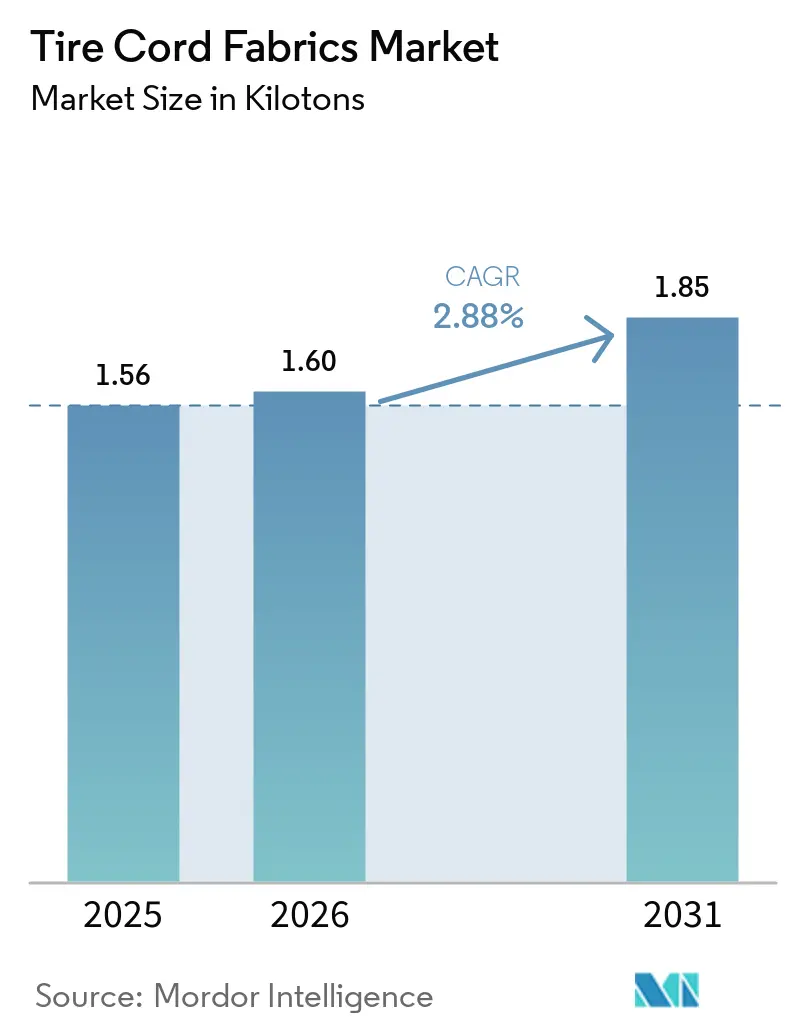
| Market Volume (2026) | 1.60 kilotons |
| Market Volume (2031) | 1.85 kilotons |
| Growth Rate (2026 - 2031) | 2.88 % |
| Fastest Growing Market | Middle East and Africa |
| Largest Market | Asia Pacific |
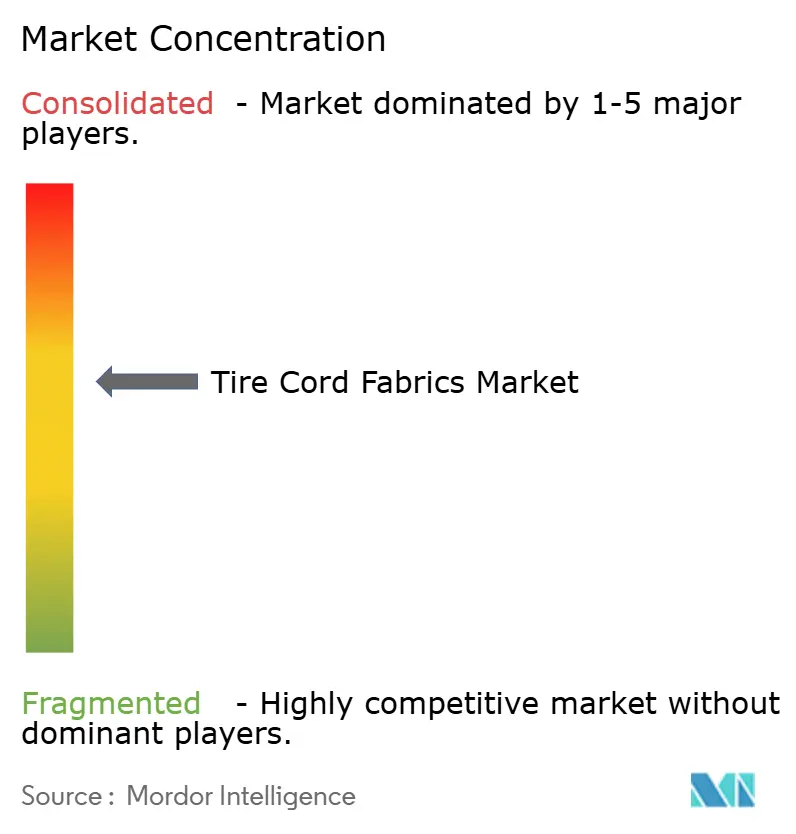
| Market Concentration | Medium |
Major Players *Disclaimer: Major Players sorted in no particular order Image © Mordor Intelligence. Reuse requires attribution under CC BY 4.0. | |
Tire Cord Fabrics Market Analysis by Mordor Intelligence
The Tire Cord Fabrics Market size was valued at 1.56 kilotons in 2025 and estimated to grow from 1.6 kilotons in 2026 to reach 1.85 kilotons by 2031, at a CAGR of 2.88% during the forecast period (2026-2031). This moderate growth reflects rising replacement demand driven by electric-vehicle (EV) adoption, regulatory pressure for lower rolling resistance, and steady expansion of commercial vehicle fleets. Polyester retains dominance because it balances cost and performance, while aramid advances fastest on the back of premium tire applications that require superior heat resistance. Asia-Pacific leads consumption thanks to integrated manufacturing ecosystems and expanding vehicle ownership, whereas the Middle East and Africa records the quickest regional growth as governments invest in automotive capacity. Competitive dynamics favor vertically integrated suppliers that can offer HMLS polyester, hybrid cords, and resorcinol-formaldehyde-free (RFF) adhesion systems that help tire makers meet tightening sustainability rules. Raw-material cost swings, auto-production cycles, and early-stage airless tire concepts temper the near-term growth outlook for the tire cord fabrics market.
Key Report Takeaways
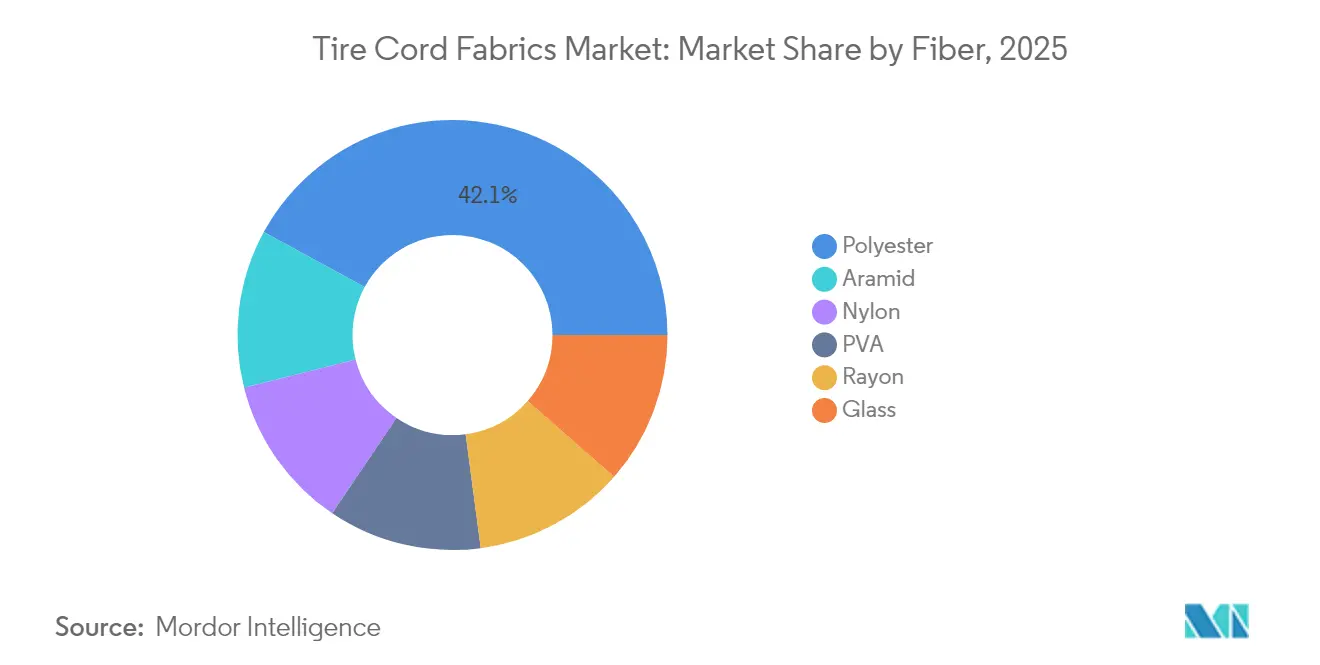
- By fiber, polyester held 42.05% of tire cord fabrics market share in 2025, while aramid is forecast to post a 3.14% CAGR to 2031.
- By tire type, radial construction commanded 67.65% of tire cord fabrics market share in 2025; semi-radial variants are projected to grow at a 3.05% CAGR through 2031.
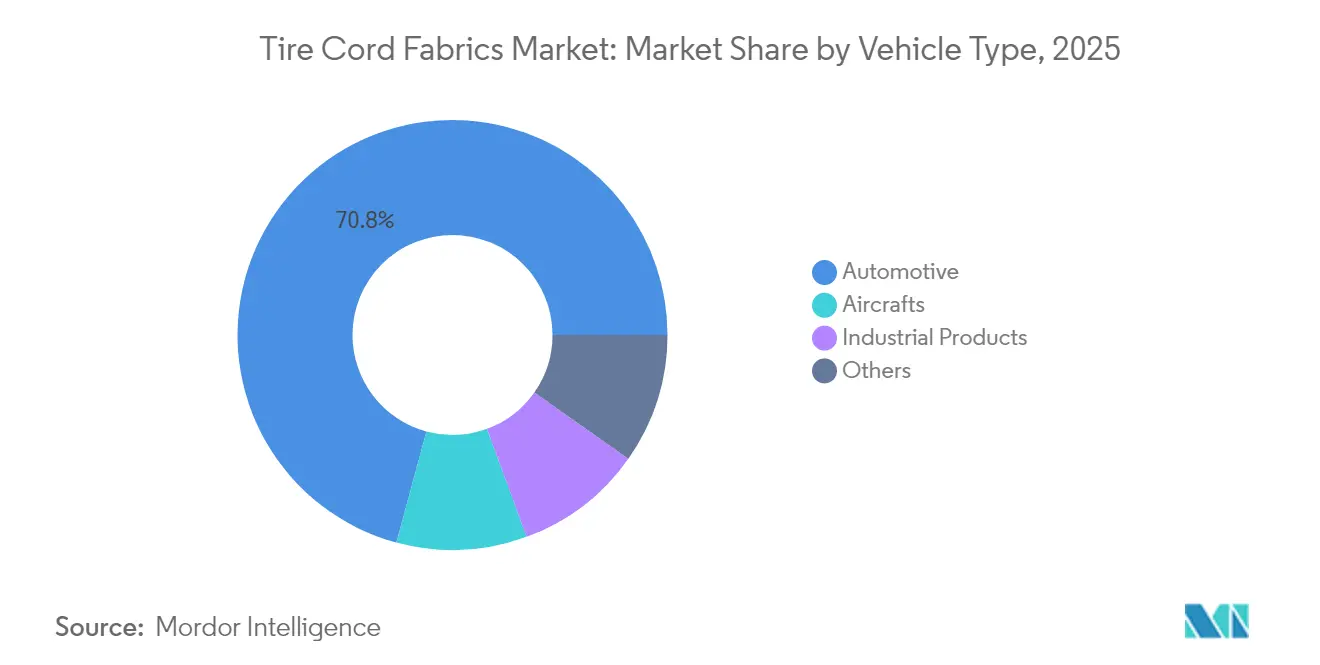
- By vehicle type, automotive applications captured 70.80% of the tire cord fabrics market size in 2025, whereas aircraft tires are expected to expand at a 3.08% CAGR to 2031.
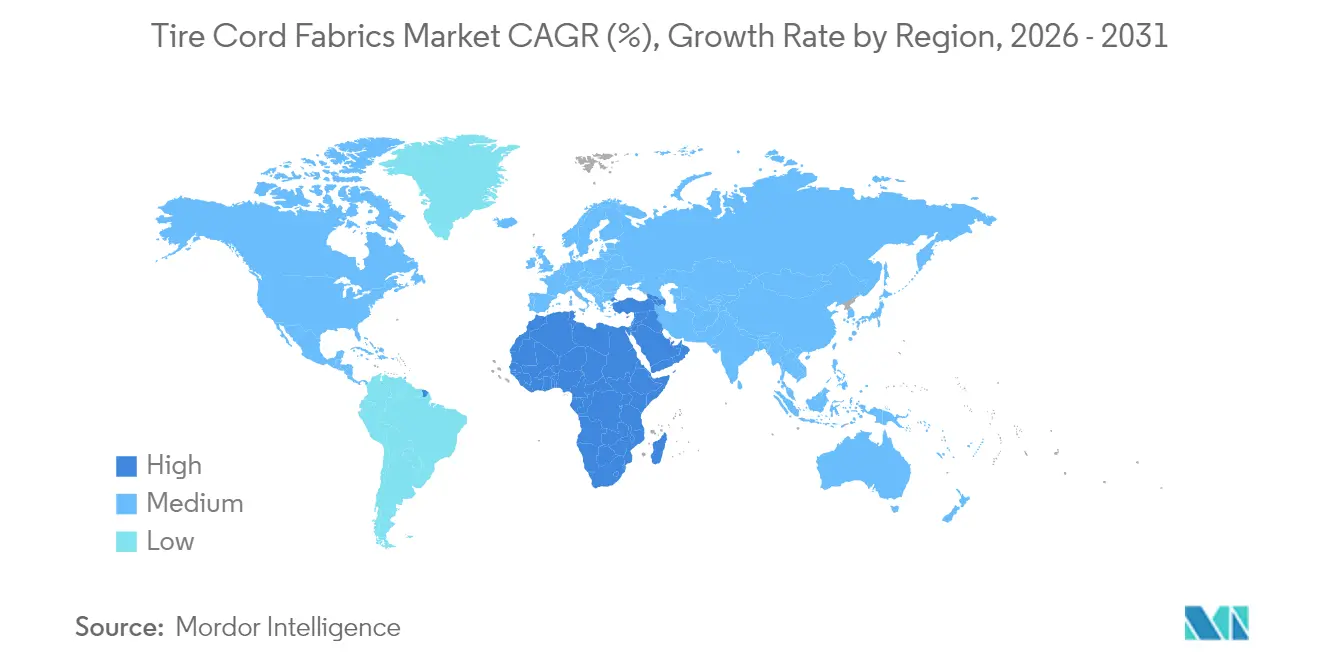
- By geography, Asia-Pacific led with 48.10% revenue share in 2025, while the Middle-East and Africa region is poised for the fastest 2.96% CAGR to 2031.
Note: Market size and forecast figures in this report are generated using Mordor Intelligence’s proprietary estimation framework, updated with the latest available data and insights as of 2026.
Market Trends and Insights
Drivers Impact Analysis of Tire Cord Fabrics Market*
| Driver | (~) % Impact on CAGR Forecast | Geographic Relevance | Impact Timeline |
|---|---|---|---|
| Rising global vehicle production and parc expansion | +0.8% | Global (APAC strongest) | Medium term (2-4 years) |
| Rapid radial-tire adoption in emerging markets | +0.6% | APAC core, MEA spill-over | Long term (≥ 4 years) |
| Higher EV-related tire-replacement frequency | +0.5% | North America and Europe, spreading to APAC | Short term (≤ 2 years) |
| Lightweight HMLS and hybrid-cord demand for lower rolling resistance | +0.4% | Global premium focus | Medium term (2-4 years) |
| Adoption of RFF “green” adhesion chemistries | +0.2% | EU-led, global adoption | Long term (≥ 4 years) |
| Source: Mordor Intelligence | |||
Rising Global Vehicle Production and Parc Expansion
Industry-wide vehicle output recovery is driving bulk orders for reinforcement textiles as tire factories rebuild inventories that ran down during recent supply-chain disruptions. Heavy-duty trucks, buses, and trailers consume greater quantities of cord fabric per tire than passenger cars, magnifying demand gains. A steadily expanding global vehicle parc sustains replacement volumes, especially in emerging economies where ownership rates continue to climb despite macroeconomic headwinds. Electrification programs in logistics fleets add incremental pull because electric trucks require stiffer carcasses and higher cord density. Parallel capacity additions at leading tire makers create a synchronized upswing that underpins medium-term growth for the tire cord fabrics market.
Rapid Radial-Tire Adoption in Emerging Markets
Across India and Southeast Asia, bias-ply tires are giving way to radial designs that need roughly 40% more cord fabric per unit. Government fuel-efficiency mandates and user demand for longer service life accelerate the changeover. Farm-equipment segments amplify the effect because IF and VF radial technologies require stronger carcasses built with high-tensile cords. The conversion progresses through 2030, producing a durable volume tailwind that compensates for mature demand profiles in North America and Europe. Suppliers capable of ramping polyester and nylon output near local tire clusters are best placed to capture this share.
Lightweight HMLS and Hybrid-Cord Demand for Lower Rolling Resistance
Fuel-economy and CO₂-emission regulations push tire makers toward low-rolling-resistance designs. HMLS polyester offers high modulus with minimal shrinkage, cutting energy loss in the sidewall without sacrificing durability. Hybrid constructions that blend polyester with aramid or glass allow engineers to fine-tune stiffness and belt strength for ultra-high-performance tires. As labeling rules tighten in the European Union and other regions, premium technologies migrate into mainstream price tiers, broadening the addressable base for advanced cords[1].
Adoption of RFF “Green” Adhesion Chemistries
Regulators are phasing out formaldehyde emissions, prompting a shift to RFF dips that bond fabric to rubber without traditional resorcinol–formaldehyde resins. Early adopters in Europe and Japan have validated performance parity, and global roll-out accelerates between 2026-2027 as mandatory rules take effect. Cord producers that invested ahead of the curve can command pricing premiums during the transition, reinforcing the competitive importance of sustainable process capabilities[2].
Restraints Impact Analysis of Tire Cord Fabrics Market*
| Restraints | (~) % Impact on CAGR Forecast | Geographic Relevance | Impact Timeline |
|---|---|---|---|
| Petrochemical feedstock price volatility | -0.3% | Global, APAC manufacturing hubs | Short term (≤ 2 years) |
| Cyclical over-/under-capacity in auto production | -0.2% | Global, regionally uneven | Medium term (2-4 years) |
| Rise of airless/non-pneumatic tire concepts | -0.1% | North America and Europe early pilots | Long term (≥ 4 years) |
| Source: Mordor Intelligence | |||
Petrochemical Feedstock Price Volatility
Polyester and nylon rely on paraxylene, adipic acid, and caprolactam, all of which fluctuate with crude-oil cycles. Sudden surges compress margins for cord weavers, while sharp declines discourage upstream investment, creating supply-security risks. China’s dominant position in fiber intermediates means regional outages or trade tensions can translate quickly into global price swings. Although large tire companies can hedge, smaller fabric producers face working-capital stress that may constrain near-term supply.
Cyclical Over-/Under-Capacity in Auto Production
Automotive build rates remain sensitive to GDP shifts, interest rates, and policy incentives. Periods of under-utilized capacity in China and Europe reduce cord fabric pull-through, whereas rapid recoveries can trigger short-lived shortages that push up spot prices. The capital intensity of weaving and dipping lines makes it difficult for suppliers to flex capacity quickly, creating mismatches that ripple through the tire cord fabrics market. Consolidation and regional diversification strategies aim to blunt future shocks.
*Our forecasts treat driver/restraint impacts as directional, not additive. The impact forecasts reflect baseline growth, mix effects, and variable interactions.
Tire Cord Fabrics Market Segment Analysis
By Fiber:
Polyester Dominance with Aramid MomentumPolyester retained 42.05% of tire cord fabrics market share in 2025 owing to its cost-to-performance balance across passenger and commercial tires. The segment’s favorable economics, abundant feedstock, and compatibility with automated weaving underpin its leadership. Aramid, while accounting for a smaller volume base, records a 3.14% CAGR through 2031, powered by EV and ultra-high-performance fitments that demand heat resistance and tensile strength beyond polyester’s ceiling. Nylon tire cord fabrics sustain relevance in bias constructions and specialty off-road tires but confront gradual volume erosion as radial penetration rises. Rayon continues to retreat because of supply constraints and shorter fatigue life, whereas glass and PVA cord niches stay stable in industrial and aircraft applications. Sustainability imperatives encourage trials of bio-derived polyesters and recycled monomer streams, positioning innovators to redefine fiber hierarchies later in the decade.
Polyester’s HMLS grades help leading producers lock in long-term contracts with global tire OEMs, cushioning them against raw-material swings. Aramid suppliers command premium margins and often integrate backward into fiber precursor chemistries to secure supply. Hybrid cords combining polyester with aramid or glass enable tailored stiffness for fine-tuned ride comfort, offering an avenue for differentiated growth.

By Tire Type:
Radial Supremacy with Semi-Radial ResilienceRadial tires accounted for 67.65% of the tire cord fabrics market size in 2025 thanks to superior heat dissipation, tread life, and fuel savings. Mass adoption across passenger cars and on-highway trucks normalized manufacturing economies, narrowing cost gaps to older designs. Even with maturity in developed regions, ongoing radial conversion in agriculture and mining ensures steady incremental demand.
Semi-radial constructions—combining radial belts with bias plies—are expanding at a 3.05% CAGR where fleets value balanced cost and durability, notably in heavy haulage and buses. Bias ply remains entrenched in certain off-road settings that prioritize sidewall toughness and easy repair, but its share continues to edge downward.
By Vehicle Type:
Automotive Bulk under Aircraft UpswingAutomotive applications captured 70.80% of the tire cord fabrics market in 2025, underpinned by steady replacement cycles and rising EV penetration that inflates cord consumption per mile traveled. Light trucks in North America and China prolong the segment’s dominance because they employ larger tires with higher cord counts. Aircraft tires, although small in volume, post the swiftest 3.08% CAGR as global passenger traffic rebounds and defense budgets climb. Aramid-reinforced carcasses that tolerate multiple landings at elevated loads fetch unit prices far above automotive equivalents, lifting market value. Industrial vehicles such as loaders, graders, and port equipment supply a dependable base, while emerging segments, electric scooters, recreational ATVs, and last-mile robot, unlock boutique demand for specialized cords.
Regulatory scrutiny of tire abrasion particulates and microplastics could distort future vehicle-type demand patterns, compelling fabric producers to develop new chemistries that limit fiber shedding. This regulatory tailwind for innovation further differentiates suppliers with strong research and development pipelines within the tire cord fabrics industry.
Geography Analysis
APAC Tire Cord Fabrics Market
Asia-Pacific’s 48.10% share in 2025 reflects production clusters that co-locate petrochemical feedstocks, high-speed weaving mills, and major tire plants. China combines scale with rising competency in HMLS polyester and RFF dipping, while India’s automotive growth adds a deep domestic consumption layer. Southeast Asian economies such as Thailand and Indonesia extend the supply chain with export-oriented tire plants, helping the region anchor the tire cord fabrics market.
MEA Tire Cord Fabrics Market
The Middle East and Africa records a 2.96% CAGR, the fastest worldwide. Governments channel oil revenue into diversification programs that include tire and component production. Saudi Arabia’s industrial zones attract foreign joint ventures, while Morocco leverages trade pacts with the EU and the United States to become a North-African export base. Turkey and South Africa, with established auto sectors, provide additional anchor points for growth.
North America, Europe and LATAM Tire Cord Fabrics Market
North America and Europe remain innovation hubs where regulatory pressure for low-rolling-resistance and sustainable materials drives demand for advanced cord solutions. High adoption of EVs, stringent fuel-economy standards, and early trials of airless tires shape premium specifications that ripple back through global supply chains. Latin America grows steadily on agricultural equipment demand, but currency volatility and economic cycles inject periodic softness. Overall, shifting geographic footprints prompt cord suppliers to balance low-cost manufacturing with proximity to high-spec customers, ensuring the tire cord fabrics market keeps diversifying regionally.
Value Chain Analysis
The tire cord fabrics value chain begins with petrochemical feedstocks and polymer intermediates (polyester chip, nylon 6/66, and aramid precursors), then moves into melt spinning, drawing to high-tenacity yarn, twisting and cabling, and fabric formation (weaving and warping). Finishing through dipping systems follows, where suppliers develop rubber adhesion and fatigue resistance, including conventional RF/RFL and newer RFF-type solutions. The main qualification control points for tire makers cluster around polymer and intermediate availability, yarn-to-cord conversion quality (including tenacity and shrinkage control for HMLS grades), and dip-line capability.
Midstream processing is concentrated among integrated reinforcement specialists that span yarn-to-fabric and dipped-cord capabilities, including Hyosung Advanced Materials, Indorama Ventures, SRF Limited, Kolon Industries, and Kordsa. Downstream demand comes from global tire manufacturers such as Michelin, Bridgestone, Goodyear, and Continental, where co-engineering and joint validation on new carcass and belt constructions shape long-term sourcing. Distribution typically combines direct supply into tire plants with regional warehousing near tire manufacturing clusters, with a stronger focus on closer-to-customer footprints to reduce logistics disruption risk and limit working capital tied up in inventories.
Competitive Landscape
The market landscape is moderately fragmented. Bekaert, Hyosung, Teijin, and Kolon control significant capacity, while a second tier of regional specialists focuses on nylon or rayon niches. Strategic investment clusters around HMLS polyester capacity, RFF dipping lines, and regional diversification to offset trade barriers. Hyosung expanded polyester cord output in Vietnam, aligning supply with Southeast Asian tire exports. Teijin focuses on aramid upgrades to support EV tire programs in Europe. Technology partnerships grow in importance: cord producers are collaborating with rubber-chemistry specialists to co-develop low-energy-cure adhesives, and with recyclers to pilot depolymerization routes for end-of-life cords.
Tire Cord Fabrics Industry Leaders
-
HYOSUNG ADVANCED MATERIALS
-
Indorama Ventures Public Company Limited
-
Kolon Industries Inc.
-
KORDRNA Plus a.s.
-
SRF Limited
- *Disclaimer: Major Players sorted in no particular order
Tire Cord Fabrics Market Companies Covered in this Report
- Beihai Fiberglass
- Bekaert
- Benninger AG
- Century Enka Limited
- Cordenka GmbH & Co KG
- Cordus
- Far Eastern Group
- Firestone Fibers & Textiles
- GÜRİŞ
- HYOSUNG ADVANCED MATERIALS
- Indorama Ventures Public Company Limited
- Kolon Industries Inc.
- KORDRNA Plus a.s.
- Milliken & Company
- Oerlikon Management AG
- SRF Limited
- TEIJIN LIMITED
- TORAY INDUSTRIES, INC
Market Opportunities and Future Outlook
Asset additions and consolidation point to localized supply whitespace for high-performance cords close to fast-growing tire manufacturing hubs. In May 2026, Bekaert completed the acquisition of Bridgestone tire reinforcement manufacturing facilities in Shenyang (China) and Thailand, which expands its rubber reinforcement footprint and indicates continued portfolio reshaping as tire makers focus on core tire production while specialist suppliers add reinforcement capacity nearer to customers.
Localization programs in India and western China create opportunities for suppliers that can deliver qualified HMLS polyester cords and low-emission dipping solutions at scale. HS Hyosung Advanced Materials announced a USD 30 million investment (November 2025) to establish its first polyester tire cord production facility in Nagpur, Maharashtra, with completion planned for 2027, showing how demand for in-country supply and shorter lead times is pulling investment. Higher-spec nylon and hybrid reinforcement demand is also supported through projects such as Shenma Industrial’s PA66 high-performance dipped tire cord plan in China (November 2025, target capacity 26 ktpa). In parallel, collaboration on resorcinol- and formaldehyde-free adhesion technologies (for example, the Continental-Kordsa Cokoon approach referenced in industry coverage) supports product differentiation as tire makers tighten sustainability and material-compliance requirements.
Recent Industry Developments in Tire Cord Fabrics Market
- May 2026: Bekaert completed the acquisition of Bridgestone’s tire reinforcement manufacturing facilities in Shenyang, China, and Thailand. The deal strengthens Bekaert’s Rubber Reinforcement division with additional manufacturing scale in two key tire-export geographies and supports tighter integration with tire makers’ regional supply chains.
- February 2026: HS Hyosung Advanced Materials and Kolon Industries agreed to conclude a four-year patent dispute related to Hybrid Tire Cord (HTC) technology, withdrawing lawsuits in South Korea and the United States. The settlement reduces legal overhang around hybrid-cord IP and creates room for broader technology and customer collaboration in premium reinforcement segments.
- January 2025: Kolon Industries announced a 30 billion won investment to expand tire cord production capacity at its Vietnam plant from 36,000 tons to 57,000 tons annually by relocating equipment from a closed Nanjing, China facility, with operations targeted to begin in January 2027. The approach accelerates capacity availability with lower capex intensity and reinforces Southeast Asia’s role as a supply base for global tire exports.
Tire Cord Fabrics Market Report Scope and Research Methodology
Market Definition and Coverage
For this study, the tire cord fabrics market covers reinforcement fabrics used inside tires to provide strength, dimensional stability, and durability, measured at the material supply level across the global value chain.
Scope exclusions: Finished tires are excluded, and we also exclude bead wire and rubber compounds that are not sold or specified as tire cord fabric inputs.
Segments Covered in This Report
- By Fiber
- Nylon
- Polyester
- Rayon
- Aramid
- Glass
- PVA
- By Tire Type
- Bias / Diagonal
- Semi-Radial
- Radial
- By Vehicle Type
- Automotive
- Aircrafts
- Industrial Products
- Others
- By Geography
- Asia-Pacific
- China
- India
- Japan
- South Korea
- ASEAN Countries
- Rest of Asia-Pacific
- North America
- United States
- Canada
- Mexico
- Europe
- Germany
- United Kingdom
- France
- Italy
- Russia
- Nordic Countries
- Rest of Europe
- South America
- Brazil
- Argentina
- Rest of South America
- Middle-East and Africa
- Saudi Arabia
- Turkey
- South Africa
- Rest of Middle-East and Africa
- Asia-Pacific
Data Sources, Market Sizing, and Validation
Desk Research
Desk work started by mapping tire production and replacement demand to likely cord consumption, then cross-checking against fiber and industrial textile indicators. We referenced public sources such as the International Organization of Motor Vehicle Manufacturers (OICA), the US International Trade Commission trade data, UN Comtrade, the US Bureau of Labor Statistics (for selected input price movements), and technical publications through channels such as NIST and open academic journals that discuss tire reinforcement materials.
We also reviewed annual reports, investor presentations, and sustainability disclosures to understand capacity additions, product mix, and geographic exposure for key suppliers. In parallel, a paid subscription for company financials and intelligence was used to standardize revenue splits, ownership changes, and facility footprints, and a paid patent database was used to sense where material innovation is most active. The sources listed here are illustrative, and many other public documents and datasets were referred to for collection, validation, and clarification.
Primary Interviews and Surveys
Primary discussions were used to validate how much cord fabric is typically consumed per tire type, and how that changes with radialization, EV-related tire specifications, and shifts across fiber choices. We spoke with cord fabric producers, fiber suppliers, tire manufacturers, and downstream technical stakeholders across major producing and consuming regions, then used those inputs to close gaps left by public data and to confirm practical pricing and utilization assumptions.
Distribution of primary research fieldwork respondents
| Company type | Respondent position | Region |
|---|---|---|
| Top tier: 37% | CXOs: 19% | APAC: 50% |
| Mid tier: 41% | Functional/Unit leaders: 38% | EMEA: 29% |
| Smaller Players: 22% | Managers: 43% | Americas: 21% |
Market-Sizing & Forecasting
Our sizing logic starts with a top-down rebuild of demand, where vehicle parc, tire production volumes, and replacement cycles are translated into tire build by category and then into cord fabric consumption using typical material intensity factors. The totals are checked with selective bottom-up approximations, such as sampled supplier capacity and utilization discussions, a price per ton sanity check from channel conversations, and a limited roll-up of reported industrial textile volumes where disclosures allow it.
Key inputs used in the model include global and regional tire production trends, the mix shift between radial and bias tires, average cord weight per tire by vehicle class, fiber mix changes (polyester, nylon, rayon, aramid, and others), and import and export flows for reinforcement fabrics and related yarns. When a data series was missing for a smaller country, we filled the gap using proxy indicators like vehicle output and tire trade, then normalized the result using expert feedback so it stayed realistic.
For forecasting, scenario analysis was applied because demand responds to visible drivers, including vehicle production cycles, replacement demand resilience, and tire specification changes linked to rolling resistance and EV load ratings. Assumptions were finalized only after expert ranges converged and the year-to-year trend lines appeared consistent with industry signals.
Data Validation & Update Cycle
Validation was done through multiple cross-checks so the final number is not dependent on one dataset. Analysts compared modeled totals against independent signals such as tire output trends, cord-related trade movements, and supplier commentary on capacity utilization, then reviewed outliers until the reason was clearly documented.
Before sign-off, the work goes through step-by-step internal review of inputs, calculations, and unit consistency, followed by a final variance check against recent developments. The report is refreshed annually, and interim updates are triggered when material events occur, such as major capacity expansions, disruptions in fiber supply, or large shifts in tire manufacturing footprints. Right before delivery, we do a quick final scan so clients receive the most current view available.
Mordor Intelligence's Tire Cord Fabrics Market Size Measured Against Other Published Estimates
It is common to see different published market sizes for tire cord fabrics because studies can use different units, boundaries, and timing for what is counted. Differences also show up when one estimate is built from tire output signals and another leans more on supplier revenue splits or broad industrial textile totals.
Tire production trends, trade movements for reinforcement materials, and the disclosed capacity and utilization signals are the checks that keep Mordor Intelligence's estimate anchored to physical consumption of tire cord fabrics in tons (rather than mixing in adjacent technical textiles or finished tire values).
Benchmark comparison
| Source | Market Size | Gaps in Research Methodology |
|---|---|---|
| Mordor Intelligence | USD 1.60 B (2026) | |
| Industry Media A | USD 5.18 B (2022) | This figure is reported in revenue terms and commonly blends cord fabrics with broader reinforcement textiles, and it also uses an earlier base year that is not aligned to the volume-first scope used here. |
| Global Publisher B | USD 5.86 B (2024) | The estimate appears to rely on a wider product and pricing basket, which can pull in fibers, yarns, and converted goods beyond tire cord fabrics, and the price assumptions are not clearly traceable to ton-based demand. |
Overall, the spread is mainly explained by unit choice and boundary choices, not by a disagreement on end demand direction. When sizing is kept tied to tire build, replacement patterns, and material intensity per tire, the resulting market total stays easier to audit and to update as new production and trade data becomes available.
Key Questions Answered in the Report
What is the current volume of the tire cord fabrics market?
The market stands at 1.6 kilotons in 2026 and is projected to reach 1.85 kilotons by 2031.
Which fiber type leads demand?
Polyester leads with 42.05% share, thanks to its cost-performance balance and compatibility with high-speed weaving.
Why are EVs important for cord fabric suppliers?
EV tires wear faster and require cords with higher heat resistance, lifting both replacement frequency and demand for premium fibers such as aramid.
Which region is growing fastest?
The Middle East and Africa is forecast to grow at 2.96% CAGR through 2031 due to industrial diversification and infrastructure spending.
How are sustainability rules influencing product development?
Regulations are accelerating the shift to RFF adhesion chemistries and recycled or bio-based fibers, rewarding suppliers that invest early in green processes.