
Polymer Coated Fabric Market Size and Share
Market Overview
| Study Period | 2021 - 2031 |
|---|---|
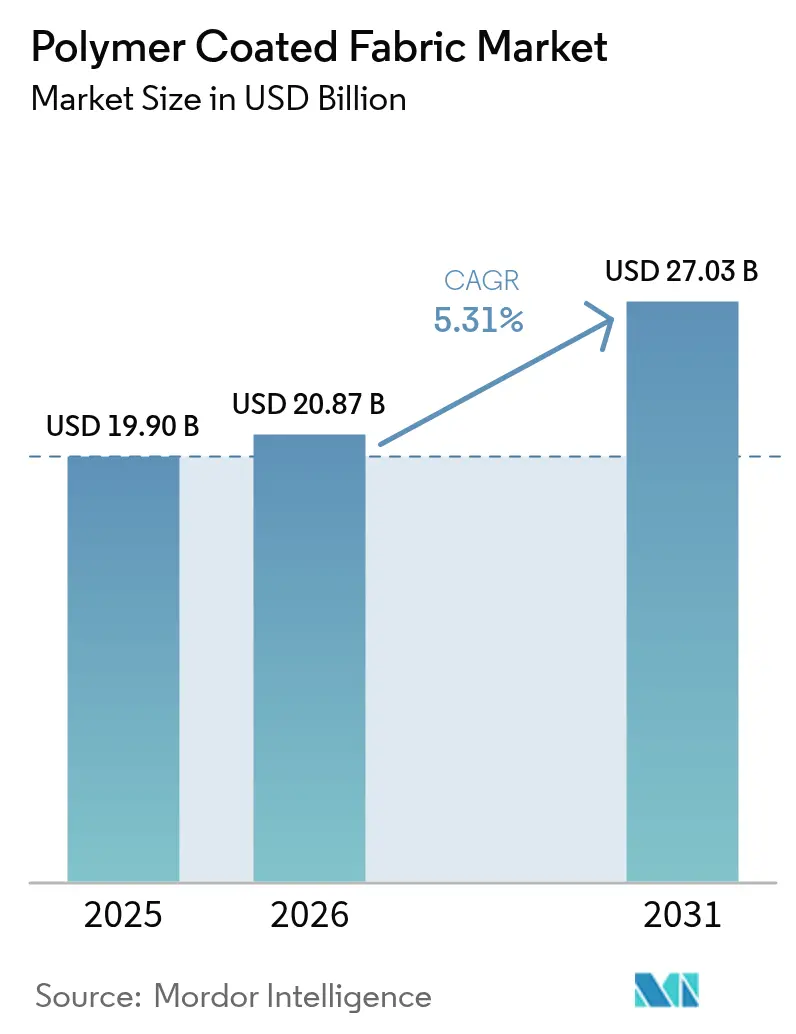
| Market Size (2026) | USD 20.87 Billion |
| Market Size (2031) | USD 27.03 Billion |
| Growth Rate (2026 - 2031) | 5.31 % |
| Fastest Growing Market | Asia Pacific |
| Largest Market | Asia Pacific |
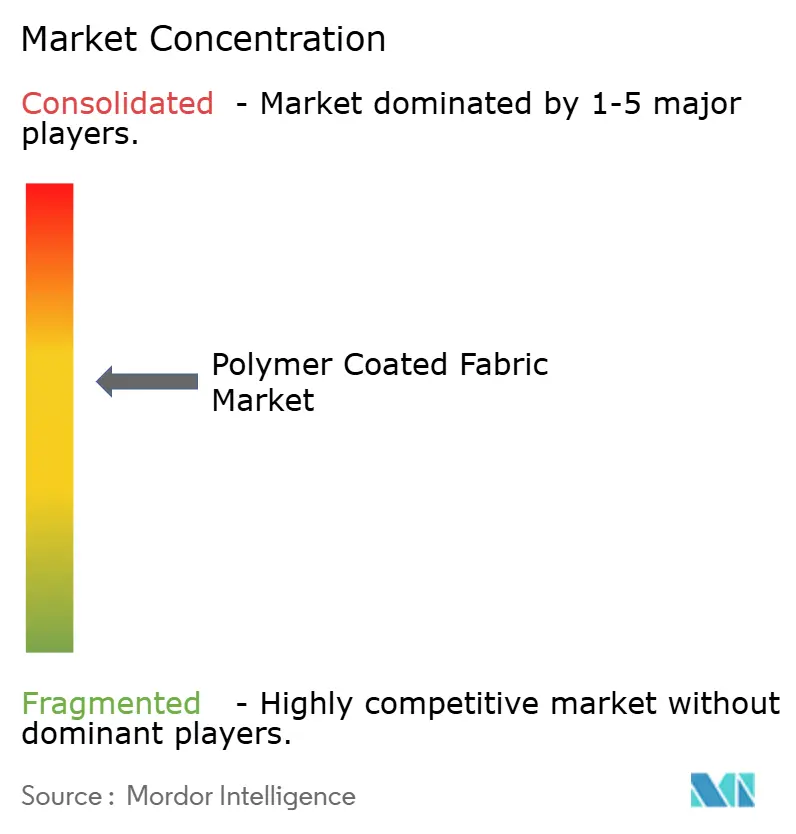
| Market Concentration | Medium |
Major Players *Disclaimer: Major Players sorted in no particular order Image © Mordor Intelligence. Reuse requires attribution under CC BY 4.0. | |
Polymer Coated Fabric Market Analysis by Mordor Intelligence
The Polymer Coated Fabric Market size is projected to grow from USD 19.90 billion in 2025 to USD 20.87 billion in 2026, and reach USD 27.03 billion by 2031, growing at a CAGR of 5.31% from 2026 to 2031. Automakers are accelerating the shift to lightweight polyurethane interior panels that cut vehicle mass by as much as 15%, a change that supports increasingly stringent global fuel-economy and emissions rules. Growing climate-resilience mandates are steering architects toward tensile membrane structures, where PTFE- and PVC-coated fabrics deliver 25-year service lives under hurricane-level wind loads. Hospital procurement teams are adopting antimicrobial polyurethane furnishings that reduce surface bacterial counts by 99.9% within two hours, a strategy that helps lower hospital-acquired infection rates. Meanwhile, smart-fabric prototypes that embed conductive polymer threads are positioning the polymer coated fabrics market for future demand in biometric monitoring and structural-health sensing applications.
Key Report Takeaways
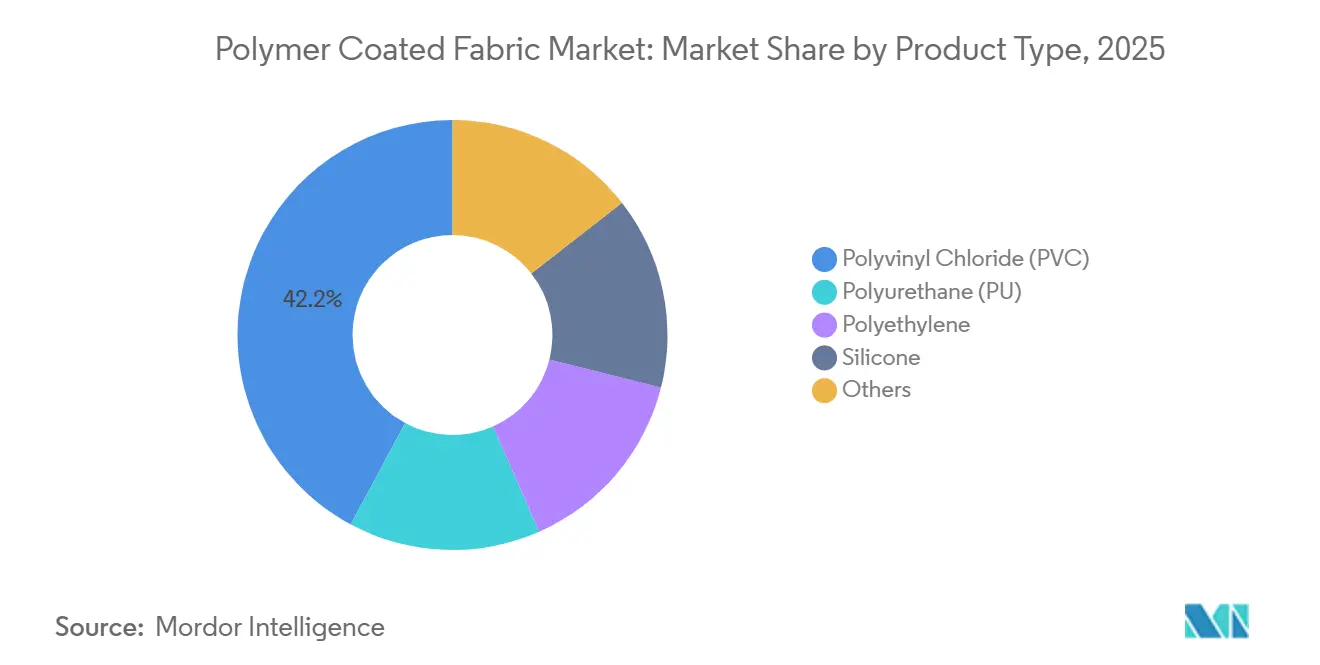
- By product type, polyvinyl chloride captured 42.15% of polymer coated fabrics market share in 2025, while polyurethane is advancing at a 6.12% CAGR through 2031.
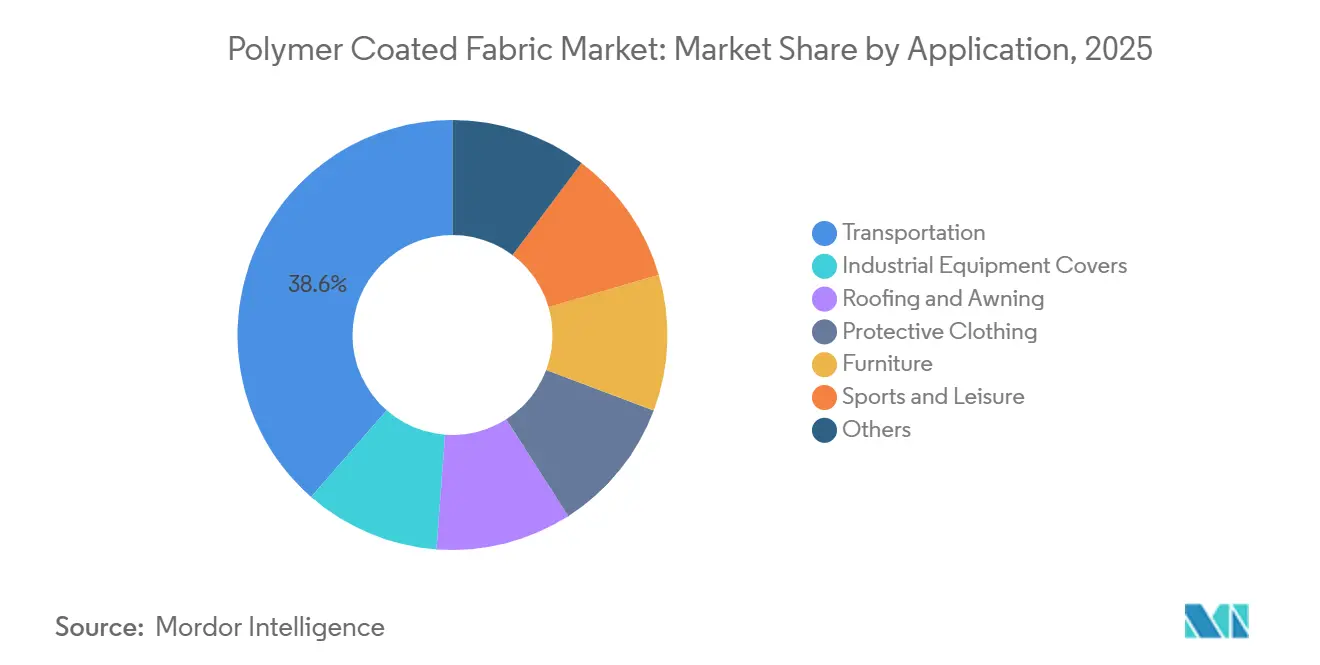
- By application, transportation led with a 38.59% revenue share in 2025; protective clothing is forecast to expand at a 6.27% CAGR through 2031.
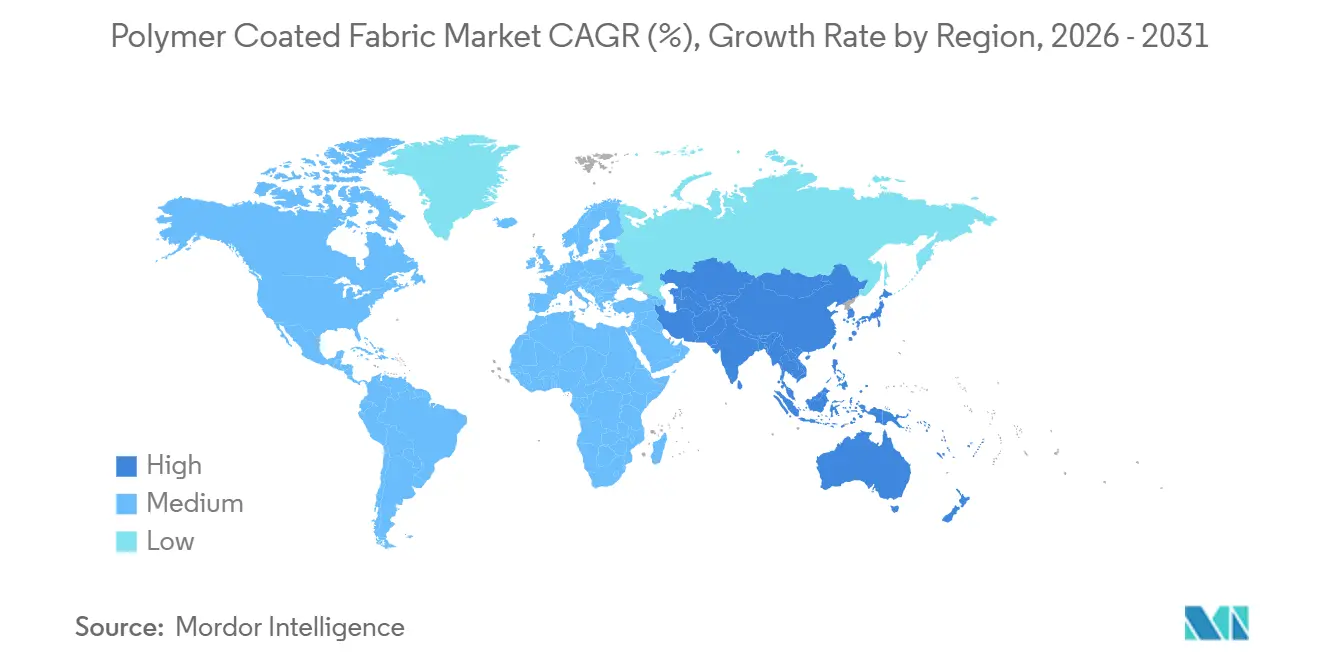
- By geography, Asia-Pacific accounted for 46.42% of 2025 revenue, and the region is projected to progress at a 5.98% CAGR to 2031.
Note: Market size and forecast figures in this report are generated using Mordor Intelligence’s proprietary estimation framework, updated with the latest available data and insights as of 2026.
Market Trends and Insights
Drivers Impact Analysis of Polymer Coated Fabric Market*
| Drivers | (~) % Impact on CAGR Forecast | Geographic Relevance | Impact Timeline |
|---|---|---|---|
| Lightweight and Sustainable Interior Materials Demand | +1.4% | Global, led by North America and the European Union | Medium term (2-4 years) |
| Climate-Resilient Tensile Structures Boom | +1.2% | Asia-Pacific core, spill-over to Middle East and Africa | Long term (≥ 4 years) |
| Antimicrobial Healthcare Furnishings Adoption | +0.9% | North America, Western Europe, Japan | Short term (≤ 2 years) |
| Sensor-Embedded Smart Fabrics Integration | +0.7% | North America, Germany, South Korea | Long term (≥ 4 years) |
| Flexible Photovoltaic Back-Sheet Investments | +0.6% | China leading; Europe and North America following | Long term (≥ 4 years) |
| Source: Mordor Intelligence | |||
Lightweight and Sustainable Interior Materials Demand
Automotive OEMs are replacing traditional vinyl and leather with polyurethane-coated textiles that lower door-panel and seat-cover weight by up to 15%, a shift aligned with U.S. CAFE targets of 49 miles per gallon by 2026. Water-based polyurethane systems remove N-methyl-2-pyrrolidone, cutting volatile-organic-compound emissions by 95% and enabling compliance with ISO 12219-1 cabin-air standards. European automakers increasingly specify bio-attributed polyols sourced from waste cooking oil or castor beans, achieving 20-30% renewable-carbon content while maintaining tensile strengths above 25 MPa. Furniture manufacturers are adopting analogous chemistries to satisfy California Proposition 65 disclosure rules and the European Union Furniture and Furnishings regulations on flame retardancy. Closed-loop recycling lines that reclaim polyester scrim from end-of-life seat covers are emerging, lowering virgin-fiber use by up to 40% and reinforcing circular-economy goals[1]European Joint Research Centre, “Durability of Tensile Membranes,” jrc.ec.europa.eu.
Climate-Resilient Tensile Structures Boom
PTFE-coated glass and PVC-coated polyester membranes now headline designs for stadium roofs, airport halls, and outdoor canopies in cyclone-prone regions because they resist wind loads above 200 km/h without tearing. A Joint Research Centre field study confirmed that PTFE membranes in coastal Qatar retained 98% of initial tensile strength after 15 years, outperforming metallic cladding that corroded in fewer than eight. Self-cleaning titanium-dioxide topcoats slash maintenance costs by 30% through photocatalytic degradation of organic dirt. Saudi Arabia has earmarked USD 2.1 billion for shaded walkways in Riyadh and Jeddah by 2028, embedding fabric structures in national adaptation plans. Similar solutions are gaining traction in sub-Saharan infrastructure projects where relocatable membranes deliver a 50% cost advantage over fixed concrete shelters.
Antimicrobial Healthcare Furnishings Adoption
Silver-ion-infused polyurethane fabrics achieve 3-log reductions of MRSA within 120 minutes, versus 24 hours on untreated surfaces, spurring hospital demand. The U.S. FDA’s 2024 textile guidance requires antimicrobial claims to pass ISO 20743 tests for six pathogens, a rule that consolidates supply toward converters with in-house microbiology labs. Co-polymerized quaternary-ammonium backings now survive more than 200 industrial washing cycles at 75 °C without performance loss. Japan and Germany have extended the technology to wheelchairs and bed rails to meet national infection-control standards stipulating disinfection intervals no longer than four hours in the flu season. Metro operators in Singapore and Hong Kong have pilot-tested antimicrobial seat covers, cutting cleaning labor costs by 20% and improving rider confidence.
Sensor-Embedded Smart Fabrics Integration
Conductive threads based on polyaniline or polypyrrole survive 10,000 flex cycles while relaying strain, temperature, or biometric signals. Industrial gloves incorporating these threads change color when exposed to hazardous chemicals, and RFID-enabled truck tarpaulins record temperature and humidity for cold-chain compliance. Thermoplastic-polyurethane encapsulation adds 15-20% weight and complicates recycling, as mixed-material streams are often rejected by mechanical recyclers. The IEC is drafting the 63203 series to secure data transmitted by wearable textiles, addressing cybersecurity risks. Field trials by Germany’s Federal Institute for Occupational Safety and Health showed sensor-equipped safety vests cut emergency-response times by four minutes when accelerometers detected worker falls.
Restraints Impact Analysis of Polymer Coated Fabric Market*
| Restraints | (~) % Impact on CAGR Forecast | Geographic Relevance | Impact Timeline |
|---|---|---|---|
| Crude-Derived Polymer Price Volatility | -0.8% | Global | Short term (≤ 2 years) |
| Environmental Scrutiny of PVC and Phthalates | -0.6% | European Union and North America | Medium term (2-4 years) |
| Microplastic-Release Regulations Tighten | -0.5% | European Union leading, North America pending | Medium term (2-4 years) |
| Source: Mordor Intelligence | |||
Crude-Derived Polymer Price Volatility
Brent crude averaged USD 70–90 per barrel through 2025, lifting ethylene and propylene feedstock costs that make up 60–70% of PVC pricing. Mid-sized European converters locked into quarterly supply contracts saw margin squeeze when Q2 2025 spot prices jumped 12%, forcing three-week production stoppages until markets normalized. Polyurethane raw-material inputs such as MDI follow similar trends because benzene prices track oil with a three-month lag. Some Asian converters have acquired minority stakes in polyol plants to secure volumes and pricing, while smaller firms resort to toll-coating models that cap profit potential at 8–10% of finished-fabric value. Vertical integration is therefore becoming a critical hedge against raw-material swings.
Environmental Scrutiny of PVC and Phthalates
The European Chemicals Agency’s 2024 REACH Annex XVII amendment banned four ortho-phthalates at contents above 0.1%, prompting wholesale reformulation of PVC coatings[2]European Chemicals Agency, “Annex XVII Phthalates Restriction,” echa.europa.eu. Alternatives such as diisononyl phthalate face pending SVHC classification, adding future uncertainty. Retrofitting a single mixing line to handle bio-based plasticizers costs USD 5–8 million and raises variable costs by 25–30% because vegetable-oil adipates exhibit lower thermal stability above 180 °C. U.S. states, including California, replicate the restrictions under Safer Consumer Products regulations, obliging global suppliers to manage region-specific recipes. Disposal remains problematic because uncontrolled incineration of PVC releases hydrochloric acid and dioxins unless EN 1948-rated scrubbers are installed.
*Our forecasts treat driver/restraint impacts as directional, not additive. The impact forecasts reflect baseline growth, mix effects, and variable interactions.
Polymer Coated Fabric Market Segment Analysis
By Product Type:
Water-Based PU Challenges PVC Cost LeadershipPVC accounted for 42.15% of polymer polymer-coated fabrics market revenue in 2025, owing to resin prices that run 30–40% below polyurethane and built-in flame retardancy that satisfies NFPA 701 without extra additives. Water-based polyurethane is capturing share fastest at a 6.12% CAGR to 2031 because automotive and furniture OEMs demand soft-touch surfaces that meet South Coast AQMD Rule 1168 limits on volatile organic compounds. These chemistries also help converters sidestep vapor-recovery investments equal to 15% of plant capital.
Polyethylene coatings cater to chemical-inertness niches such as agricultural silage covers, while silicone systems dominate high-temperature uses like exhaust-insulation blankets because they remain stable above 250 °C. Fluoropolymer dispersions and bio-based polyesters populate the “Others” category, each serving specialty demand for extreme chemical resistance or cradle-to-grave certification. Historical data show the product-type hierarchy grew at roughly 4.8% per year from 2020-2025, but momentum is accelerating as auto production rebounds and public-works spending returns. Stricter European public-procurement rules that grant 30% weighting to ISO 14001 certification continue to nudge customers toward polyurethane solutions with documented recycling pathways.



By Application:
Protective Clothing Outpaces Transportation GrowthTransportation consumed 38.59% of polymer coated fabrics market demand in 2025, comprising automotive seating, commercial-vehicle tarpaulins, and rail-car interiors tied to the forecast 89 million light-vehicle builds in 2026. Protective clothing is expanding more quickly at a 6.27% CAGR as employers procure NFPA 1994-compliant splash suits that demonstrate liquid-penetration resistance below 1 g/m²-hr under ASTM F903 protocols. The polymer coated fabrics market share for protective clothing is set to climb to 15% by 2031 as regulatory updates tighten chemical-safety thresholds for first responders and industrial workers.
Industrial equipment covers are witnessing rising demand, primarily shielding CNC machinery in Southeast Asian electronics hubs where ISO 14644-1 Class 7 cleanliness is mandatory. Roofing and awning membranes are profiting from the tensile-architecture boom, while furniture upholstery transitions toward water-based polyurethane to meet Greenguard Gold limits of 220 µg/m³ total VOC emissions. Demand from the sports and leisure segment is fueled by elevated outdoor recreation spending in North America and Europe.
Geography Analysis
APAC Polymer Coated Fabric Market
Asia-Pacific dominated the polymer coated fabrics market with a 46.42% share in 2025 and is projected to maintain a 5.98% CAGR through 2031. China alone produced 27 million motor vehicles in 2025 and hosts more than 800,000 tons/year of coated-fabric capacity concentrated in Jiangsu and Zhejiang, where feedstock proximity lowers logistics overhead by up to 15% . India’s National Infrastructure Pipeline earmarks USD 1.4 trillion through 2030, stimulating domestic demand and export growth to the Middle East and Africa.
North America and Europe Polymer Coated Fabric Market
North America accounted for a significant market share in 2025. Automotive seating absorbed 180,000 tons of polyurethane coated fabric, and federal infrastructure spending of USD 110 billion through 2026 is spurring uptake in geotextiles and temporary shelters. Europe’s market growth is driven by lightweight requirements under the 55% transport-emission-reduction goal in the European Green Deal, pushing OEMs toward polyurethane solutions with certified carbon footprints.
MEA and South America Polymer Coated Fabric Market
South America plus the Middle East and Africa are witnessing a considerable rise in demand for polymer coated fabrics. Brazil’s farm-sector demand for silage covers and the Gulf Cooperation Council’s construction pipeline—particularly stadium roofs and transit hubs—are the main growth drivers. Historically, geographic expansion lagged during pandemic disruptions, but normalization of supply chains and resumption of infrastructure projects underpin the 5.31% global forecast growth rate to 2031.

Regulatory Landscape
Regulation affecting polymer coated fabrics is tightening around chemical content, indoor-air emissions, and performance verification. In the European Union, REACH restrictions continue to drive reformulation, including the 2024 REACH Annex XVII amendment restricting four ortho-phthalates above 0.1% in articles, which has direct implications for PVC-coated upholstery and contract seating. Microplastic-related requirements are also becoming more operational for manufacturers and industrial users, with REACH Annex XVII Entry 78 introducing reporting obligations for intentionally added synthetic polymer microparticles starting 31 May 2026.
Standards development is also shaping qualifying tests and product specifications across end uses. ISO and CEN updates such as ISO 7617-1:2024 (PVC-coated knitted fabrics) and EN ISO 2411:2024 (adhesion strength testing for flexible composites) provide more harmonized acceptance criteria for coated fabrics sold into regulated environments, while ISO 7617-2:2026 adds a dedicated PVC-coated woven fabric specification for upholstery. In parallel, regulatory focus on substances of concern and product transparency in the EU is increasing pressure for traceability across coating formulations and substrate layers, especially for technical textiles used in transportation, interiors, and protective applications.
Value Chain Analysis
The polymer coated fabric value chain begins with upstream petrochemical and specialty chemical inputs (PVC, polyurethane dispersions, silicone systems, plasticizers, stabilizers, pigments, and functional additives) and textile substrates (polyester, nylon, glass, and specialty scrims). These inputs feed compounders and formulators, then coaters and laminators using processes such as knife coating (over roll/table/air), transfer coating, extrusion coating, and heat or adhesive lamination, followed by curing, embossing/printing, and slitting. Trade bodies such as the Coated Fabrics and Film Association (CFFA) support industry test methods and performance certifications that help converters qualify materials for healthcare, transportation, and industrial end uses.
Downstream, coated fabrics move through converters and distributors to OEMs and fabricators in transportation interiors and covers, architectural membranes, protective clothing, furniture, and industrial equipment covers. Compliance to flame, abrasion, adhesion, and chemical resistance requirements is validated against referenced methods, commonly ASTM and AATCC families, alongside ISO/CEN methods for adhesion. Key pinch points include consistent raw-material supply and formulation control, especially across PVC plasticizer and solvent/VOC transitions, and the need for in-house or partner testing capacity to substantiate antimicrobial, fire, and durability claims. Vertical integration across compounding, weaving, and coating remains a core lever for managing quality, lead times, and regulatory-driven recipe complexity across regions.
Competitive Landscape
The polymer coated fabrics market is moderately fragmented. Vertically integrated players leverage in-house resin compounding, weaving, and coating to secure margins, meet 48-hour just-in-time windows for automotive clients, and run coating lines above 85% utilization. Scale participants chase commodity volumes in truck tarpaulins and entry-level upholstery, whereas specialty converters command gross margins up to 50% in antimicrobial healthcare fabrics and aerospace grades.
Circular-economy models are nascent but advancing: European pilot programs now shred end-of-life automotive seat covers, recover polyester scrim, and feed the reclaimed fiber back into new substrates, cutting virgin-fiber expense by 25% while supporting pending EU Ecodesign rules. Digital inkjet printing is also gaining favor, slashing setup costs by 60% and enabling profitable production runs as small as 500 linear meters. Disruptors focused on bio-based alternatives—such as mycelium or algae-derived polyols—face scale-up and feedstock-variability hurdles but continue to file patents, including a 2024 co-extrusion method that bonds recycled-polyester scrim to thermoplastic polyurethane in one pass, boosting peel strength to 12 N/cm.
Polymer Coated Fabric Industry Leaders
Sioen Industries NV
Serge Ferrari Group
Saint-Gobain
Trelleborg AB
Continental AG
- *Disclaimer: Major Players sorted in no particular order
Polymer Coated Fabric Market Companies Covered in this Report
- Continental AG
- Freudenberg Performance Materials Holding GmbH
- Heytex Gruppe
- OMNOVA North America Inc.
- MICHELIN
- Saint-Gobain
- Seaman Corporation
- Serge Ferrari Group
- Sioen Industries NV
- SPRADLING INTERNATIONAL GmbH
- SRF Limited
- Trelleborg AB

Market Opportunities and Future Outlook
A near-term whitespace is opening around compliant replacement chemistries and multifunctional performance packages as restrictions and customer specifications narrow the usable additive set in PVC and polyurethane systems. Product-side activity supports this shift: in April 2026, Elkem Silicones launched BLUESIL TCS 7544, a two-component silicone coating positioned for architectural textiles targeting EN 13501-1 Euroclass A1/A2 fire classifications. The product aligns with demand for higher fire performance in public buildings and tensile structures. At the same time, fluorine-free approaches are moving from concept to published validation, including May 2026 research on fluorine-free waterborne polyurethane water-repellent coatings, reflecting a workable pathway for customers replacing fluorinated repellents in protective and outdoor applications.
Another opportunity area is smart and functional coated textiles that combine sensing or conductivity with durability and washability requirements demanded by medical and industrial users. In April 2026, Covestro, FILK Freiberg, and OUT e.V. disclosed development of a flexible conductive smart textile system using Impranil polyurethane dispersions and carbon nanotubes, highlighting a supplier-led approach that can be adapted for healthcare wearables and other monitored surfaces. Manufacturing-side whitespace is also visible in integrated, multi-layer processing that reduces changeovers and improves consistency for complex composites. Machinery developments such as BG Plast highlighting integrated extrusion coating and lamination capabilities point to capacity and capability upgrades supporting multilayer TPU, PVC, and EVA structures for transportation, construction, and industrial covers.
Recent Industry Developments in Polymer Coated Fabric Market
- June 2026: Saint-Gobain completed the divestment of its HKO business, including its French subsidiary Deltec, to a fund managed by DUBAG Group. The transaction reshapes Saint-Gobain's exposure to high-temperature industrial insulation textiles and signals continued portfolio tightening around core materials positions.
- April 2026: SergeFerrari Group announced continued optimization of its industrial footprint, including plans to shut down high-tenacity PET yarn spinning operations at the Tersuisse site in Emmenbrucke, Switzerland. The move changes the group’s upstream yarn sourcing strategy and can influence cost structure and supply-chain configuration for coated fabric lines reliant on high-performance polyester inputs.
- July 2025: Sioen Industries agreed to acquire Contender Sailcloth, creating Sioen Sailcloth Technologies to expand sailcloth innovation and manufacturing capabilities. The acquisition strengthens Sioen's position in specialty coated and technical textile applications where performance differentiation and vertical know-how are key purchasing criteria.


Polymer Coated Fabric Market Report Scope and Research Methodology
Market Definition and Coverage
For this methodology, the polymer coated fabric market includes fabrics where a polymer layer is applied to a textile substrate to improve performance, such as durability, weather resistance, chemical resistance, and cleanability, and then sold into end-use applications.
Scope exclusions: Uncoated technical textiles, polymer films and sheets sold without a fabric substrate, and resin sales that do not translate into coated fabric output are excluded.
Segments Covered in This Report
- By Product Type
- Polyvinyl Chloride (PVC)
- Polyurethane (PU)
- Polyethylene
- Silicone
- Others
- By Application
- Transportation
- Industrial Equipment Covers
- Roofing and Awning
- Protective Clothing
- Furniture
- Sports and Leisure
- Others
- By Geography
- Asia-Pacific
- China
- India
- Japan
- South Korea
- Rest of Asia-Pacific
- North America
- United States
- Canada
- Mexico
- Europe
- Germany
- United Kingdom
- France
- Italy
- Rest of Europe
- South America
- Brazil
- Argentina
- Rest of South America
- Middle East and Africa
- Saudi Arabia
- South Africa
- Rest of Middle East and Africa
- Asia-Pacific
Data Sources, Market Sizing, and Validation
Desk Research
Desk work started with mapping the value chain from polymer raw materials to coated fabric converters and then to end users such as transportation, protective clothing, and building envelope uses. We relied on public and official sources for anchor signals, such as USITC trade statistics, UN Comtrade, the US Census Bureau manufacturing datasets, Eurostat industrial and trade series, and standards and guidance published by groups such as ISO and ASTM.
To keep assumptions realistic, we also reviewed company annual reports, investor presentations, and press releases to understand capacity additions, regional production footprints, and mix changes across polymer types. Patent databases were used to identify where coating chemistries and performance specs are shifting, and shipment-level import-export databases were selectively referenced to sanity check regional trade flows where public tables were too high level. The sources listed here are not exhaustive, and additional public documents and data tables were used for data collection, cross-checking, and clarification.
Primary Interviews and Surveys
Primary work focused on validating real demand drivers and pricing behavior across major regions, since coated fabric demand can shift with construction cycles and auto build rates. We spoke with stakeholders across the chain, including raw material participants, coated fabric producers, distributors, and procurement or engineering contacts from key end-use industries, and then used their inputs to confirm utilization, mix, and typical contract terms.
Distribution of primary research fieldwork respondents
| Company type | Respondent position | Region |
|---|---|---|
| Top tier: 27% | CXOs: 18% | APAC: 39% |
| Mid tier: 55% | Functional/Unit leaders: 30% | EMEA: 34% |
| Smaller Players: 18% | Managers: 52% | Americas: 27% |
Market-Sizing & Forecasting
The sizing model starts from a top-down build where production and trade indicators are used to reconstruct the coated fabric demand pool by region, and then it is translated into value using typical application-level price bands. To keep totals grounded, results are corroborated with selective bottom-up approximations, such as sampling coated fabric output for key end uses and checking implied average selling prices against channel feedback.
Key inputs used in the model include polymer mix share (PVC, PU, polyethylene, silicone), coated fabric usage intensity in transportation interiors and protective wear, construction activity signals tied to roofing, awnings, and tensile structures, and regional import-export movements for coated textile products. Where direct volume visibility is patchy, gaps were filled with proxy ratios (for example, coating weight and substrate mix assumptions) that were tested in interviews and adjusted when they produced unrealistic price or growth patterns.
For forecasting, scenario analysis was applied around end-use demand cycles, followed by smoothing of the resulting trajectories to avoid one-off spikes driving the full period trend. Assumptions on mix shift toward higher-value coatings and the pace of price normalization were reviewed with industry contacts so the outlook stays practical rather than purely curve-fitted.
Data Validation & Update Cycle
Before finalizing the numbers, outputs are checked against independent signals like regional trade balances, capacity announcements, and end-use activity indicators, and then any large variances are investigated. When something looks inconsistent, such as a sudden share jump for a polymer type or an implied price that does not match market feedback, we revisit the assumption and, if needed, re-contact sources for clarification.
A second analyst review is performed to confirm the logic, the math, and the link between drivers and results, and then the final view is signed off. Reports are refreshed on an annual cycle, with interim updates when material events occur, and a last-pass check is completed before delivery so clients receive the most current view available.
Mordor Intelligence's Polymer Coated Fabric Market Size Measured Against Other Published Estimates
Published market sizes for polymer coated fabric can differ even when the topic name looks similar, because boundaries are often drawn differently and pricing logic is not always consistent. The spread usually comes from what gets counted as a coated fabric product, how end uses are grouped, and which year and currency timing is used for conversion.
By tracking polymer-type mix, application-level price bands, and cross-checking trade signals, Mordor Intelligence keeps the 2026 value tied to coated textile output sold into defined end uses, which also prevents adjacent items like uncoated technical textiles or standalone films from being added into the total.
Benchmark comparison
| Source | Market Size | Gaps in Research Methodology |
|---|---|---|
| Mordor Intelligence | USD 20.87 B (2026) | |
| Global Consultancy A | USD 23.96 B (2025) | Uses a different base year and may apply a broader product boundary that blends polymer coated fabrics with wider coated textile categories, which can raise totals when pricing is averaged across mixed specifications. |
| Industry Blog B | USD 24.00 B (2025) | Appears to lean on a long-horizon forecast narrative with limited visibility into application-level pricing and mix shifts, and the currency timing assumptions are not clearly shown, which can change the reported USD value. |
Taken together, the comparison shows that year selection and what is included as a coated fabric product are the two largest drivers of the gap. Our approach stays traceable because the total is built from clear demand signals, checked with practical price ranges, and reviewed for outliers before the final number is published.


Key Questions Answered in the Report
What is the projected value of the polymer coated fabrics market in 2031?
The market is forecast to reach USD 27.03 billion by 2031.
Which product type is growing fastest through 2031?
Water-based polyurethane coatings are advancing at a 6.12% CAGR.
Why are antimicrobial coated fabrics in demand?
They cut surface bacterial loads by 99.9% within two hours, helping lower infection rates in healthcare settings.
What region holds the largest share of demand?
Asia-Pacific led with 46.42% of global revenue in 2025 and is set to maintain leadership.
How is regulation affecting PVC use?
REACH Annex XVII phthalate restrictions and potential DINP classification are driving reformulation and higher compliance costs.
What role do smart fabrics play in future growth?
Sensor-embedded coated fabrics promise new revenue streams in biometric monitoring and structural-health applications once washability and data-security hurdles are cleared.
Page last updated on:


 Your data is secure and never sold or shared.


