
Polyester Tire Cord Fabrics Market Size and Share
Market Overview
| Study Period | 2021 - 2031 |
|---|---|
| Market Volume (2026) | 764.49 kilotons |
| Market Volume (2031) | 891.43 kilotons |
| Growth Rate (2026 - 2031) | 3.12 % |
| Fastest Growing Market | Asia Pacific |
| Largest Market | Asia Pacific |
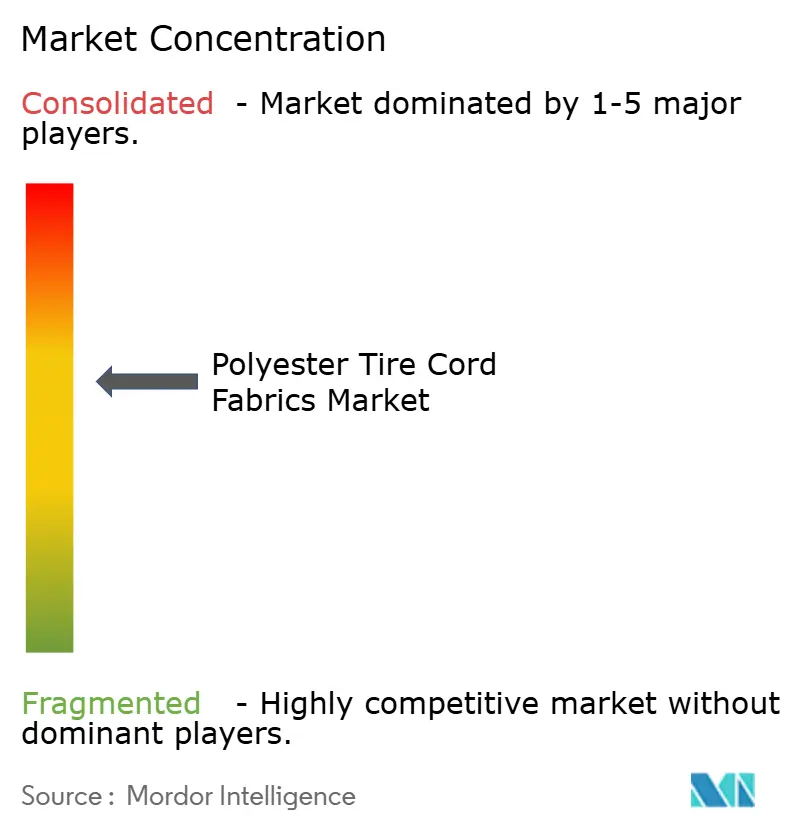
| Market Concentration | Medium |
Major Players *Disclaimer: Major Players sorted in no particular order Image © Mordor Intelligence. Reuse requires attribution under CC BY 4.0. | |
Polyester Tire Cord Fabrics Market Analysis by Mordor Intelligence
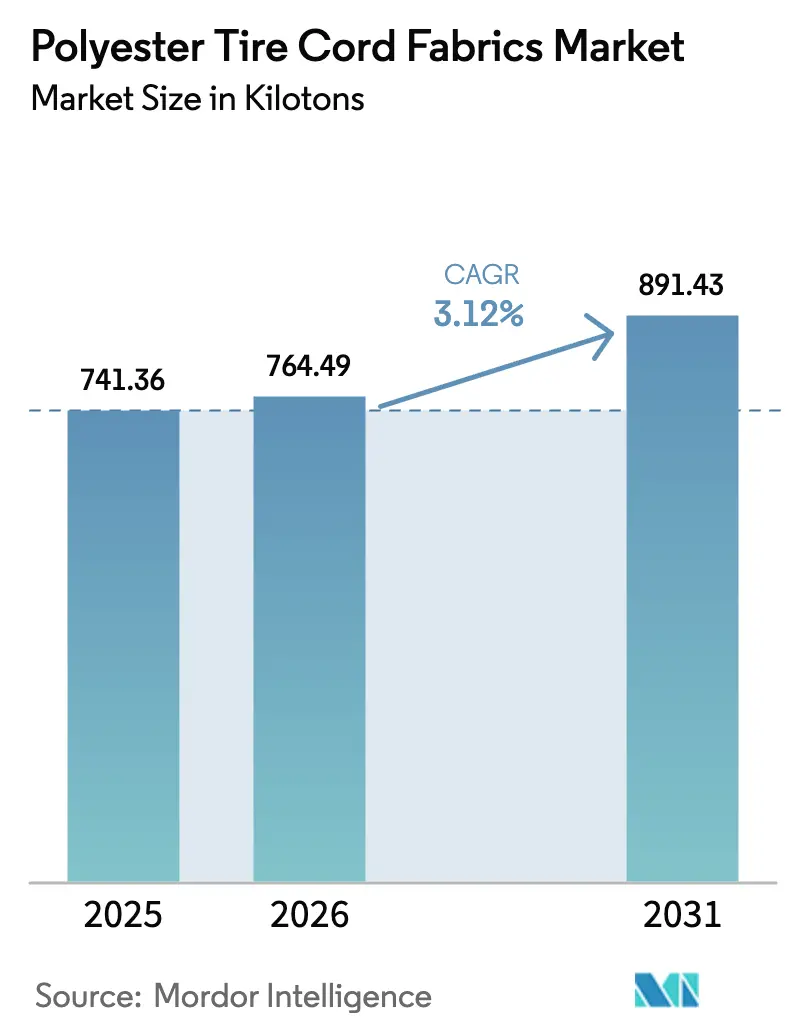
The Polyester Tire Cord Fabrics Market size was valued at 741.36 kilotons in 2025 and is estimated to grow from 764.49 kilotons in 2026 to reach 891.43 kilotons by 2031, at a CAGR of 3.12% during the forecast period (2026-2031). Demand growth highlights a structural shift toward radial tire construction, tighter supply-demand dynamics, and increasing sustainability requirements. Radial tires accounted for 58.22% of the market volume in 2025, with a projected CAGR of 4.15% through 2031. This growth is driving changes in product mix and yarn specifications as automakers transition to high-modulus, low-shrinkage (HMLS) polyethylene terephthalate carcasses, which reduce weight without compromising burst strength. The electrification of commercial vehicles further accelerates this trend, as reducing tire weight offsets the 400-kilogram battery weight in medium-duty trucks. High capacity utilization, nearing 100% for leading cord producers, has bolstered pricing power for integrated suppliers managing polymerization, spinning, and dipping processes. Additionally, formaldehyde restrictions in Europe and the United States, set to take effect in 2027, are necessitating adhesive reformulations, thereby widening the technological gap between tier-one multinationals and smaller regional converters.
Key Report Takeaways
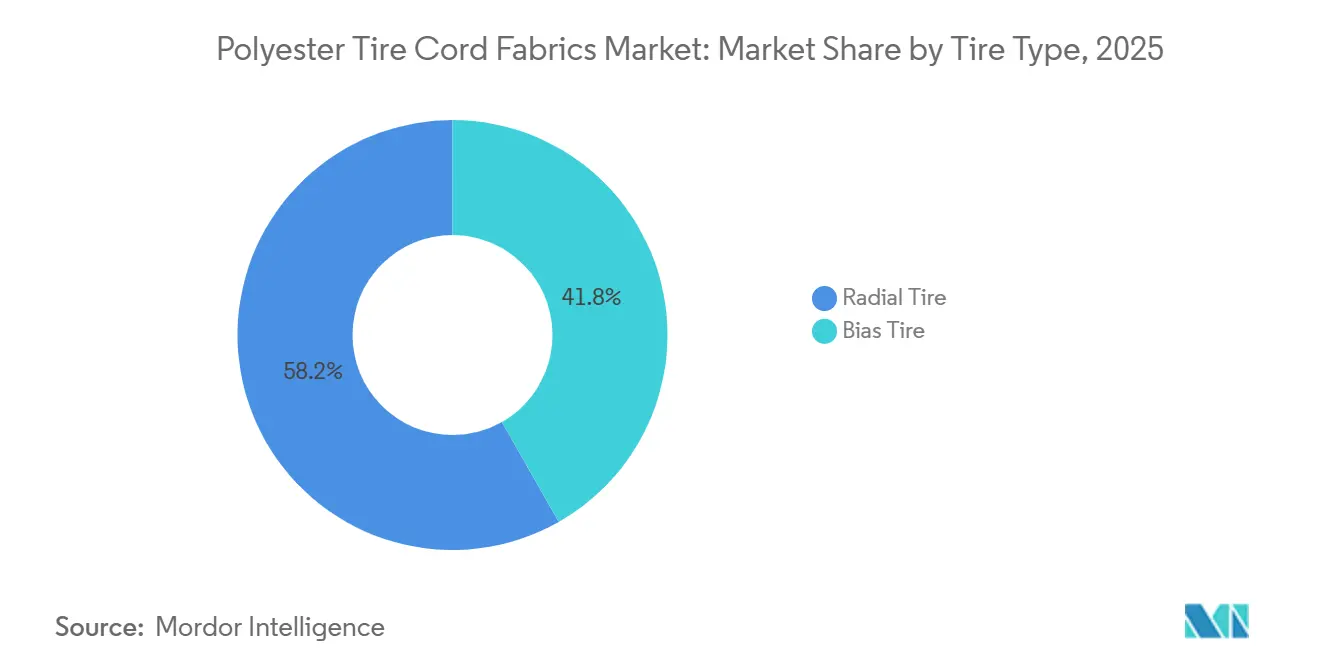
- By tire type, radial tire led with 58.22% share of the polyester tire cord fabrics market size in 2025 and is advancing at a 4.15% CAGR through 2031.
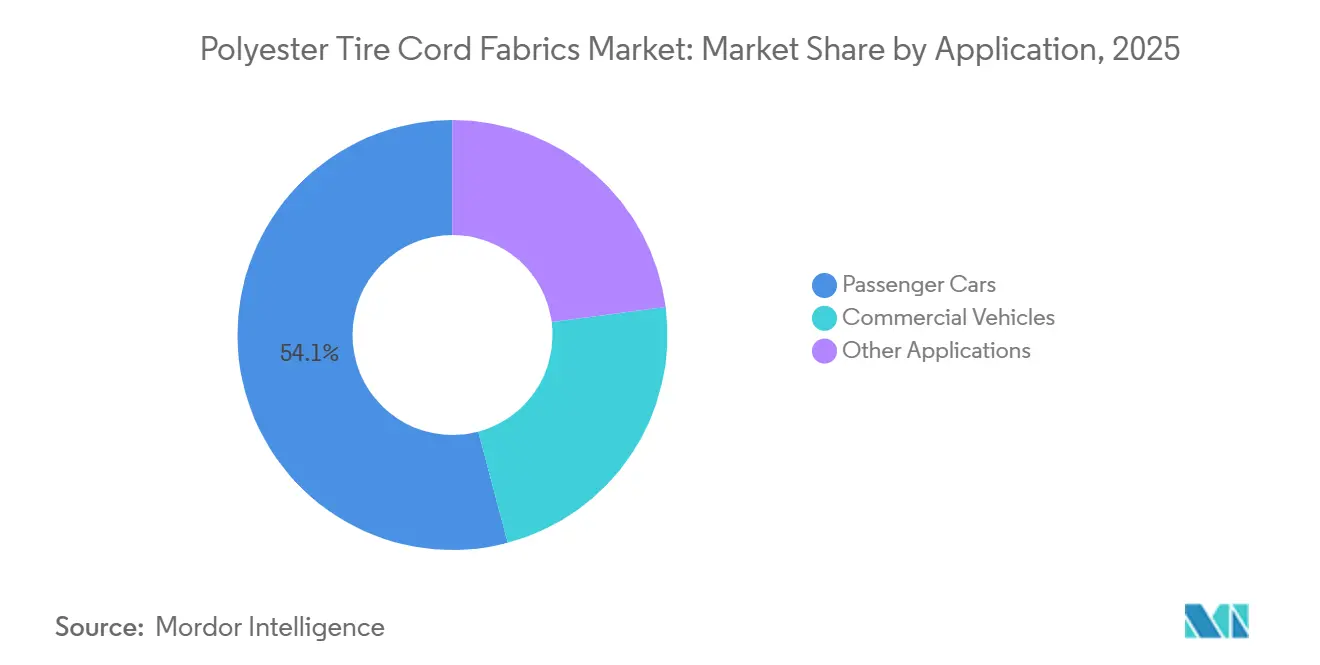
- By application, passenger cars led with 54.14% share of the polyester tire cord fabrics market size in 2025, while commercial vehicles are advancing at a 4.56% CAGR through 2031.
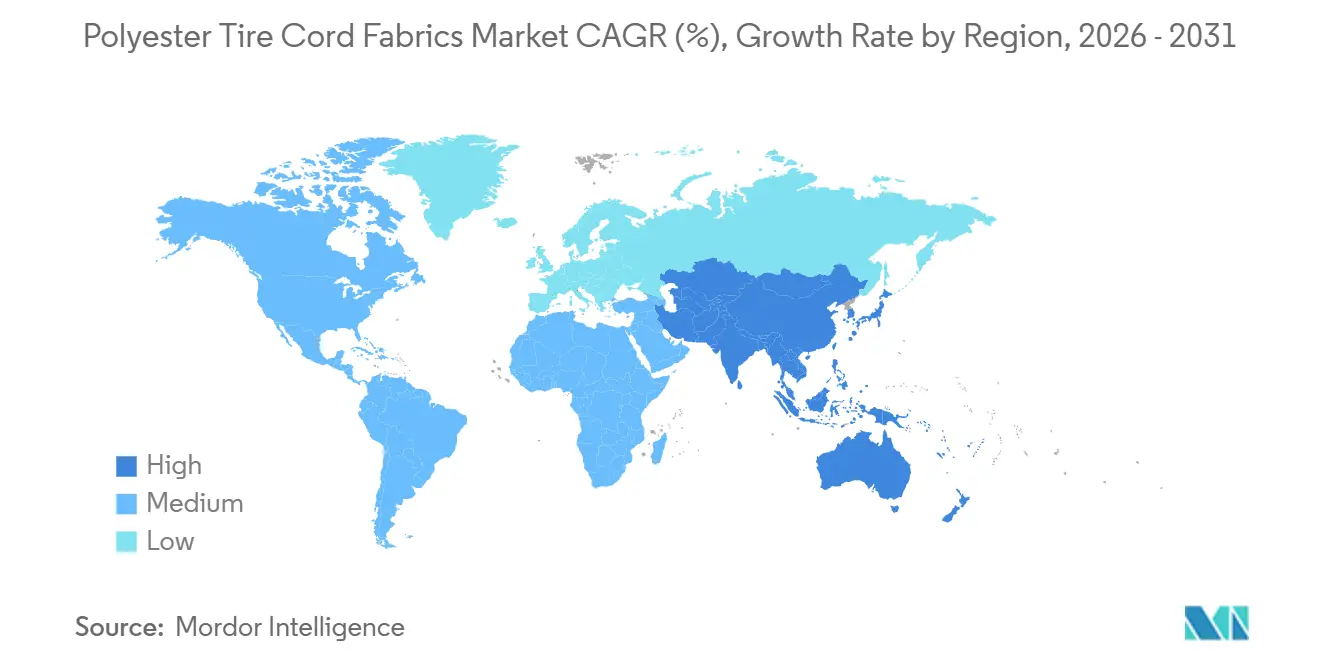
- By geography, Asia-Pacific accounted for 49.18% of the polyester tire cord fabrics market size in 2025 and is growing at a 3.99% CAGR through 2031.
Note: Market size and forecast figures in this report are generated using Mordor Intelligence’s proprietary estimation framework, updated with the latest available data and insights as of 2026.
Market Trends and Insights
Drivers Impact Analysis of Polyester Tire Cord Fabrics Market*
| Driver | (~) % Impact on CAGR Forecast | Geographic Relevance | Impact Timeline |
|---|---|---|---|
| Surging radial-tire penetration, especially across Asia-Pacific | +1.2% | Asia-Pacific core, spillover to Middle-East and Africa | Medium term (2–4 years) |
| Rapid OEM migration to high-tenacity HMLS PET yarns | +0.9% | Global, led by China, India, ASEAN | Short term (≤ 2 years) |
| Accelerating EV output requiring low-rolling-resistance carcasses | +0.7% | North America, Europe, China | Medium term (2–4 years) |
| Tier-1 tire makers' shift toward rPET/bio-PET cords | +0.4% | Europe, North America, Japan, South Korea | Long term (≥ 4 years) |
| Energy savings from eliminating post-cure inflation steps | +0.3% | Global, early adoption in Asia-Pacific | Medium term (2–4 years) |
| Source: Mordor Intelligence | |||
Surging Radial-Tire Penetration, Especially Across Asia-Pacific
Radial tires accounted for over 75% of global production in 2025, with Asia-Pacific driving this transition as Chinese manufacturers expand overseas capacity by 388.7 million units. While bias-ply tires remain preferred in specific off-the-road applications, their production is declining at an annual rate of -3.1%, shifting polyester demand toward radial tires, which require up to 20% more reinforcement per unit. Investments such as Zhongce's RMB 5.4 billion facility and Sailun's 30 million radial tire production lines necessitate dedicated cord-dipping infrastructure. Additionally, India's enforcement of IS 15627 radial certification has boosted domestic radial tire production by 12% in 2025.
Rapid OEM Migration to High-Tenacity HMLS PET Yarns
Automotive manufacturers are increasingly adopting high-modulus low-shrinkage (HMLS) PET yarns with ≥ 8.5 g/den tenacity and ≤ 3.5% shrinkage at 177°C to replace heavier steel belts. Oerlikon's 2024 Suzhou expansion and Kordsa's USD 18 million Izmit production line are designed to meet these specifications. Reducing unsprung mass by one kilogram improves electric vehicle (EV) driving range by approximately 0.2%. Hyosung estimates that a 400 kg EV battery necessitates 10–20% more cord per vehicle.
Accelerating EV Output Requiring Low-Rolling-Resistance Carcasses
Global EV production exceeded 14 million units in 2025, with 85% of output concentrated in China, Europe, and North America. Polyester cords reduce hysteresis by 6.8% compared to nylon 6, lowering rolling-resistance coefficients and extending real-world driving range by up to 6%. Bio-based cords, featured in the iON tire developed by Hyosung and SK Chemicals, achieve 23% lifecycle CO₂ savings while maintaining durability standards.
Tier-1 Tire Makers’ Shift Toward rPET/bio-PET Cords
The EU Corporate Sustainability Reporting Directive and California SB 253 are accelerating the adoption of recycled-content materials. However, the tire-grade rPET supply faces a shortfall of 40,000–50,000 tons annually. Indorama's ISCC PLUS-certified Kaiping facility addresses this by blending 30–40% rPET with virgin polymer, reducing lifecycle carbon emissions by 25%. A pilot project involving CARBIOS, Indorama, and Michelin aims to process 10,000 tons of textile waste annually by 2028.
Restraints Impact Analysis of Polyester Tire Cord Fabrics Market*
| Restraint | (~) % Impact on CAGR Forecast | Geographic Relevance | Impact Timeline |
|---|---|---|---|
| Tightening formaldehyde limits on RFL adhesives in United States and European Union | -0.6% | North America, Europe | Short term (≤ 2 years) |
| Performance gap versus aramid cords in ultra-high-speed tires | -0.3% | Global, concentrated in premium passenger-car segment | Medium term (2–4 years) |
| Limited global rPET supply suitable for tire-grade yarn spinning | -0.2% | Global, acute in Europe and North America | Long term (≥ 4 years) |
| Source: Mordor Intelligence | |||
Tightening Formaldehyde Limits on RFL Adhesives in United States and European Union
Regulation 2023/1464 limits in-cabin formaldehyde levels to 0.062 mg/m³ starting August 2027, while the U.S. EPA's 2024 TSCA evaluation identifies formaldehyde as an unreasonable risk in tire-cord dipping processes[1]European Commission, “Regulation 2023/1464 on Formaldehyde Emissions,” eur-lex.europa.eu. Although Michelin's Resicare technology demonstrates compliance feasibility, retrofitting each dipping line costs USD 2–4 million and requires up to 18 months for OEM validation.
Performance Gap Versus Aramid Cords in Ultra-High-Speed Tires
Polyester cords are prone to fatigue failure under ±15% cyclic strain due to aminolysis, whereas aramid fibers maintain their modulus above 200°C, making them essential for Z-rated ultra-high-speed tires. Hybrid constructions can reduce material costs by 20–25% compared to all-aramid designs but introduce additional complexity due to the need for parallel dipping lines.
*Our forecasts treat driver/restraint impacts as directional, not additive. The impact forecasts reflect baseline growth, mix effects, and variable interactions.
Polyester Tire Cord Fabrics Market Segment Analysis
By Tire Type:
Radial Tire Drives Volume and InnovationRadial tire accounted for 58.22% of the 2025 volume and is projected to grow at a CAGR of 4.15% through 2031. This growth is positively impacting the polyester tire cord fabrics market, as radial carcasses combined with belt packages require 15–20% more reinforcement compared to bias carcasses. Bias tire applications remain relevant only in scenarios where extreme sidewall flexibility outweighs the benefits of improved fuel efficiency.
Zero-degree cap plies, wound above the steel-belt package, have become standard in V-rated products. However, polyester's lower modulus limits its use to carcass plies. High-modulus low-shrinkage (HMLS) copolymers with shrinkage below 2.5% are addressing this limitation and, importantly, eliminate the need for energy-intensive post-cure inflation processes.


By Application:
Commercial Vehicles Accelerate Despite Smaller BasePassenger cars constituted 54.14% of the 2025 consumption, but commercial vehicles are experiencing faster growth, with a projected CAGR of 4.56% through 2031. This trend is driven by the increased replacement frequency of tires in electrified fleets. While high gross weights have traditionally favored nylon 6 carcasses, urban delivery vans operating below 100 km/h are increasingly adopting polyester to reduce rolling resistance.
Despite this shift, aramid and nylon remain critical for long-haul heavy-duty applications. Facilities such as Zhejiang Hailide’s 18,000-ton Vietnam plant and Hyosung’s India plant are designed to produce customized blends. These blends incorporate polyester for lower-stress zones and aramid for shoulder plies, ensuring a balanced material portfolio for mixed tire architectures.

Geography Analysis
APAC, LATAM and Africa Polyester Tire Cord Fabrics Market
Asia-Pacific accounted for 49.18% of the 2025 volume and is projected to grow at a 3.99% CAGR through 2031. This growth is driven by Chinese tire manufacturers expanding overseas into Southeast Asia, Latin America, and North Africa. Domestic expansions, such as Zhongce's addition of 25 million units and Sailun's 30 million units, further strengthen the region's dominance. Additionally, India's increasing adoption of radial passenger-car tires and Hyosung's Maharashtra plant, with a capacity of 1,500 tons per month, position South Asia as an emerging supply hub. Kolon Industries' debottlenecking in Vietnam and Toray's hybrid-cord production line in Thailand are expanding the polyester tire cord fabrics market across ASEAN.
North America and Europe Polyester Tire Cord Fabrics Market
North America and Europe maintain profitability through premium tire programs and stringent formaldehyde regulations, which drive demand for advanced adhesive chemistries. Kordsa's USD 20 million expansion in North America and a USD 7 million investment in Turkish steel-cord production highlight strategic moves to capitalize on these high-margin opportunities.
EMEA and South America Polyester Tire Cord Fabrics Market
South America, and Middle-East and Africa contribute to the remaining market share. Brazil's 70 million-unit tire industry benefits from Mercosur tariffs that promote local cord procurement. Meanwhile, Saudi Arabia's Vision 2030 initiative, targeting 300,000 vehicles annually, is expected to increase regional polyester demand by up to 5,400 tons. Turkey leverages its customs-union access to the EU and Kordsa's high-modulus yarn line to serve both European and Middle-Eastern original equipment manufacturers (OEMs).

Competitive Landscape
The supplier base is moderately concentrated. Bekaert's EUR 60 million acquisition of Bridgestone's Shenyang[2]Bekaert, “Acquisition of Bridgestone Tire Cord Assets,” bekaert.com and Rayong plants, along with offtake contracts securing 80% of capacity through 2031, has reduced spot availability and supported unit margins. Capacity expansions are primarily concentrated in Asia-Pacific to meet growing regional demand. Sustainability-focused investments, such as Indorama's ISCC PLUS certification and Michelin's Resicare adhesive, are helping differentiate offerings in mature markets.
Technological competition is centered on high-modulus low-shrinkage (HMLS) yarns, nylon-like copolymers that eliminate the need for post-cure inflation, and chemical recycling methods that restore virgin-equivalent properties. Patent activity for shrinkage-controlled copolymers is dominated by companies like Hyosung, Kolon, and Toray, creating significant entry barriers. Compliance with ISO 1421 and ASTM D885 performance standards, along with the 2027 formaldehyde ceiling, further increases the cost of entry for smaller market players.
Polyester Tire Cord Fabrics Industry Leaders
HYOSUNG
Kordsa Teknik Tekstil A.S.
Kolon Industries Inc.
Indorama Ventures Public Company Limited
TORAY INDUSTRIES, INC.
- *Disclaimer: Major Players sorted in no particular order
Polyester Tire Cord Fabrics Market Companies Covered in this Report
- Bekaert
- Century Enka Limited
- CORDENKA GmbH & Co. KG
- Far Eastern New Century Corporation
- Firestone Fibers & Textiles
- FORMOSA TAFFETA CO., LTD.
- HYOSUNG
- Indorama Ventures Public Company Limited
- Jiangsu Taiji Industry New Materials Co., Ltd.
- Junma Group
- Kolon Industries Inc.
- KORDÁRNA Plus a.s.
- Kordsa Teknik Tekstil A.S.
- Madura Industrial Textiles Ltd.
- Shandong Helon Polytex Chemical Fibre
- SRF Limited
- TEIJIN FRONTIER (U.S.A.), INC.
- TORAY INDUSTRIES, INC.
- Zhejiang Hailide New Material Co., Ltd.

Recent Industry Developments in Polyester Tire Cord Fabrics Market
- February 2026: Indorama Ventures Public Company Limited showcased bio-based and recycled PET solutions for tire cord fabrics. These solutions were aimed at reducing greenhouse gas emissions while maintaining safety and performance standards.
- January 2025: Kolon Industries Inc. allocated USD 20.5 million to increase tire cord production in Vietnam. This initiative aimed to raise the annual production capacity at its Vietnam factory from 36,000 tons to 57,000 tons.


Global Polyester Tire Cord Fabrics Market Report Scope
Polyester tire cord fabrics are a class of reinforcing materials produced from superior-quality yarns. It is manufactured through various processes, including polymerization, extraction, drying, and melt spinning to produce tire yarn, as well as the preparation of cord from tire yarn by twisting and plying. Polyester tire cord fabrics are incorporated into the production process to reinforce all types of radial and bias tires, including medium-, heavy-duty, and light commercial tires.
The Polyester Tire Cord Fabrics Market is segmented by tire type, application, and geography. By tire type, the market is segmented into radial tire and bias tire. By application, the market is segmented into passenger cars, commercial vehicles, and other applications. The report also covers the market size and forecasts for polyester tire cord fabrics in 18 countries across major regions. For each segment, the market sizing and forecasts have been done on the basis of volume (tons).
| Radial Tire |
| Bias Tire |
| Passenger Cars |
| Commercial Vehicles |
| Other Applications |
| Asia-Pacific | China |
| India | |
| Japan | |
| South Korea | |
| ASEAN Countries | |
| Rest of Asia-Pacific | |
| North America | United States |
| Canada | |
| Mexico | |
| Europe | Germany |
| United Kingdom | |
| France | |
| Italy | |
| Spain | |
| Turkey | |
| Russia | |
| NORDIC Countries | |
| Rest of Europe | |
| South America | Brazil |
| Argentina | |
| Rest of South America | |
| Middle-East and Africa | Saudi Arabia |
| South Africa | |
| Rest of Middle-East and Africa |
| By Tire Type | Radial Tire | |
| Bias Tire | ||
| By Application | Passenger Cars | |
| Commercial Vehicles | ||
| Other Applications | ||
| By Geography | Asia-Pacific | China |
| India | ||
| Japan | ||
| South Korea | ||
| ASEAN Countries | ||
| Rest of Asia-Pacific | ||
| North America | United States | |
| Canada | ||
| Mexico | ||
| Europe | Germany | |
| United Kingdom | ||
| France | ||
| Italy | ||
| Spain | ||
| Turkey | ||
| Russia | ||
| NORDIC Countries | ||
| Rest of Europe | ||
| South America | Brazil | |
| Argentina | ||
| Rest of South America | ||
| Middle-East and Africa | Saudi Arabia | |
| South Africa | ||
| Rest of Middle-East and Africa | ||


Key Questions Answered in the Report
How large is the polyester tire cord fabrics market?
The polyester tire cord fabrics market stands at 764.49 kilotons in 2026 and is projected to reach 891.43 kilotons by 2031.
What is driving higher polyester usage in electric-vehicle tires?
Polyester’s lower hysteresis reduces rolling resistance, improving EV range by up to 6%, and battery weight requires stronger, lighter carcasses that HMLS yarns deliver.
How will formaldehyde limits affect tire-cord producers?
New U.S. and EU rules effective in 2027 force converters to shift to resorcinol-free adhesives, raising retrofit costs and favoring suppliers with proprietary chemistries like Michelin’s Resicare.
Is recycled PET available in sufficient quality for tire cords?
Only partly mechanical recycling lowers intrinsic viscosity, so most tire-grade yarns still blend 70% virgin polymer, and EU mandates may widen the shortfall without chemical-recycling scale-up.
Page last updated on:


 Your data is secure and never sold or shared.


