
Market Overview
| Study Period | 2020 - 2031 |
|---|---|
| Forecast Data Period | 2026 - 2031 |
| Base Year Market Size (2025) | USD 17.74 Billion |
| Market Size (2026) | USD 19.68 Billion |
| Market Size (2031) | USD 33.08 Billion |
| Growth Rate (2026 - 2031) | 10.95 % |
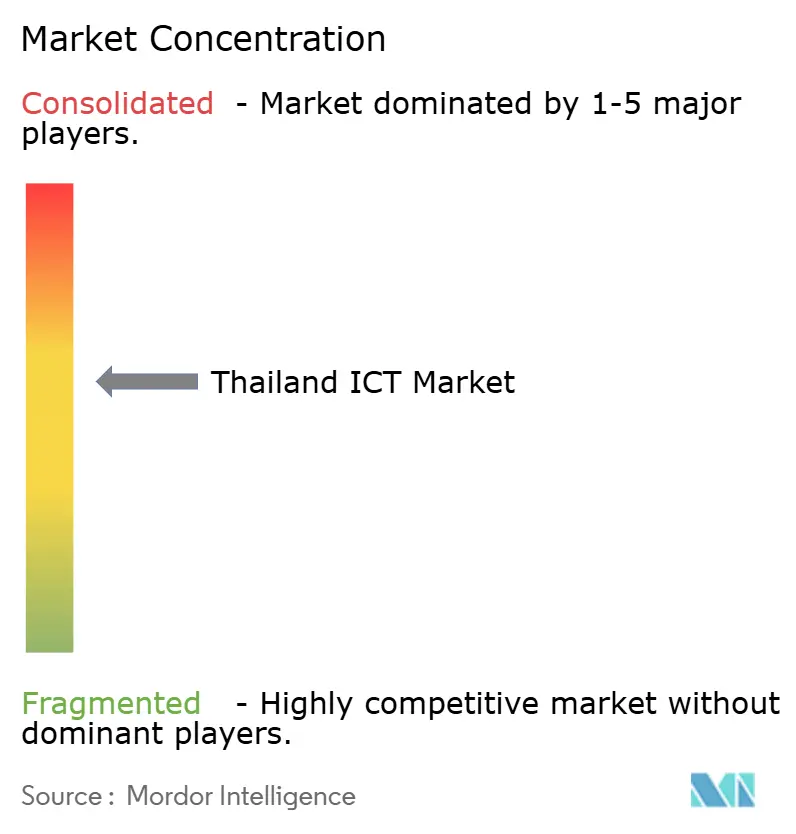
| Market Concentration | Medium |
Major Players *Disclaimer: Major Players sorted in no particular order Image © Mordor Intelligence. Reuse requires attribution under CC BY 4.0. | |
Thailand ICT Market Analysis by Mordor Intelligence
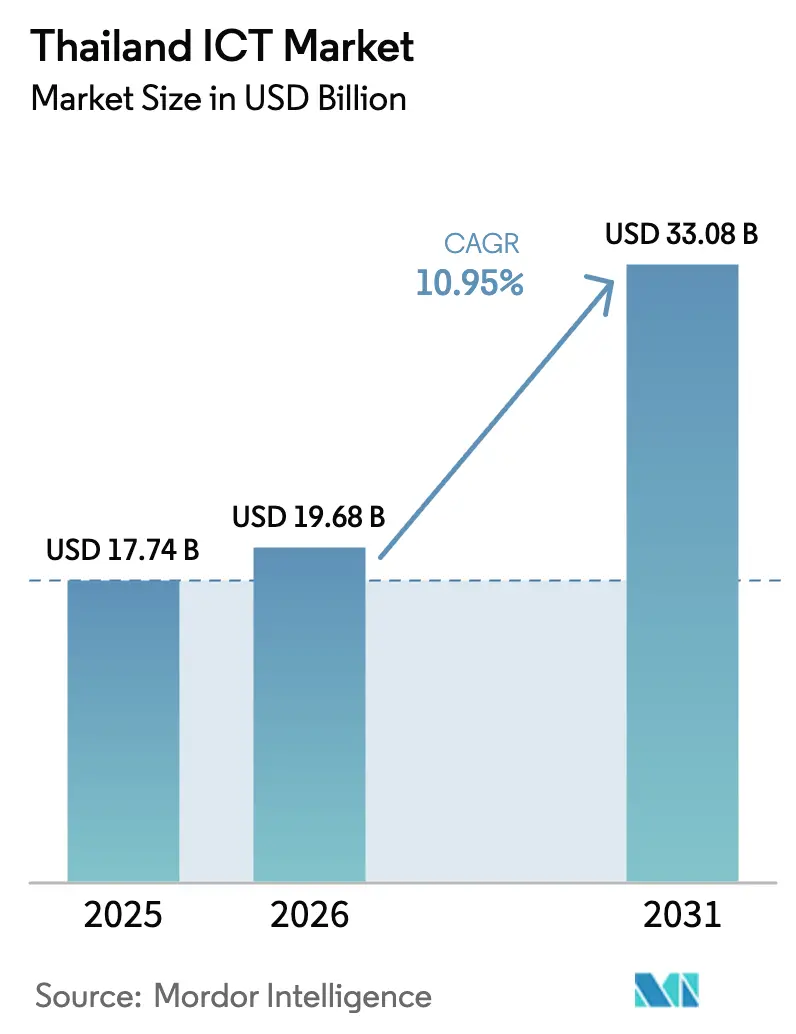
The Thailand ICT market size is expected to grow from USD 17.74 billion in 2025 to USD 19.68 billion in 2026 and is forecast to reach USD 33.08 billion by 2031 at 10.95% CAGR over 2026-2031. This expansion reflects the country’s push to become a regional digital hub, propelled by nationwide 5G coverage, hyperscale data-center investment, and a government cloud-first mandate. Telecommunications service providers monetize 5G network slicing for industrial IoT, while foreign direct investment exceeding USD 1 billion in AI-ready, liquid-cooled facilities anchors the data-center ecosystem. The Thailand ICT market is also buoyed by Industry 4.0 modernization across the Eastern Economic Corridor, rising demand for cybersecurity services, and virtual-bank licensing that expands fintech infrastructure. At the same time, the market confronts talent shortages and stricter data-localization rules that heighten compliance costs.
Key Report Takeaways
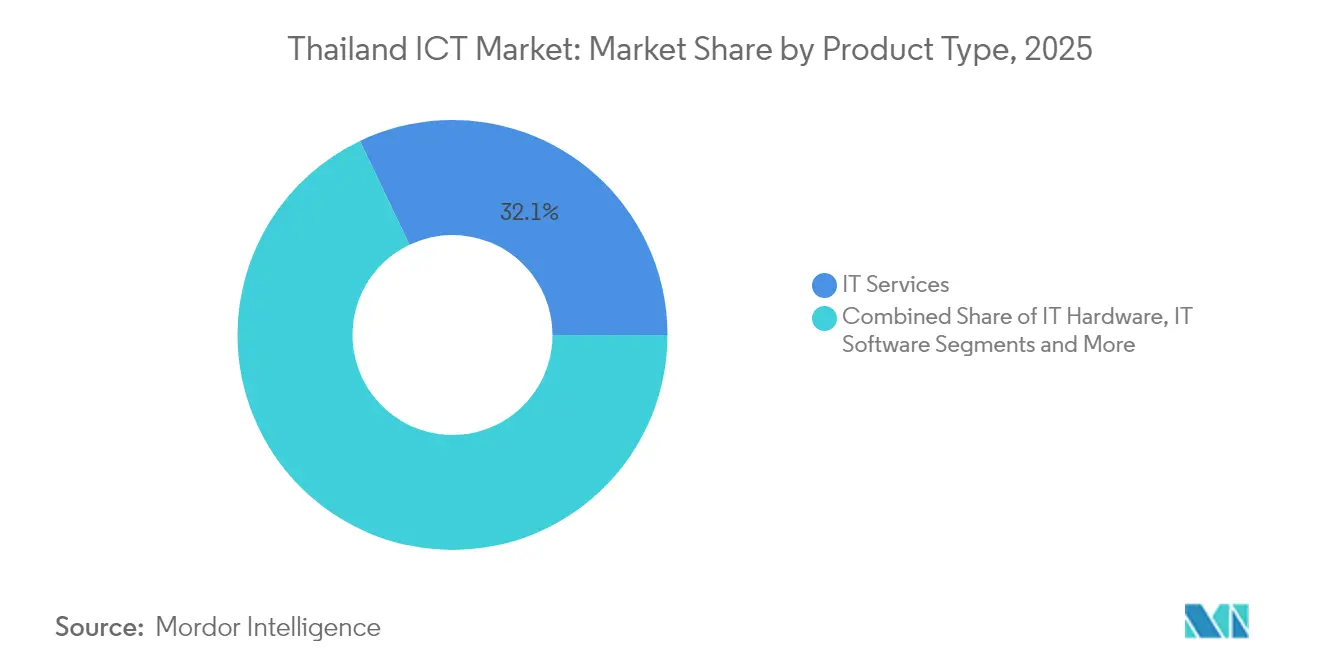
- By product type, IT Services held 32.08% of the Thailand ICT market share in 2025; Cloud Services within this category is projected to grow at an 11.45% CAGR through 2031.
- By enterprise size, Large Enterprises commanded 59.25% of the Thailand ICT market size in 2025, whereas Small and Medium Enterprises are expected to expand at a 12.05% CAGR through 2031.
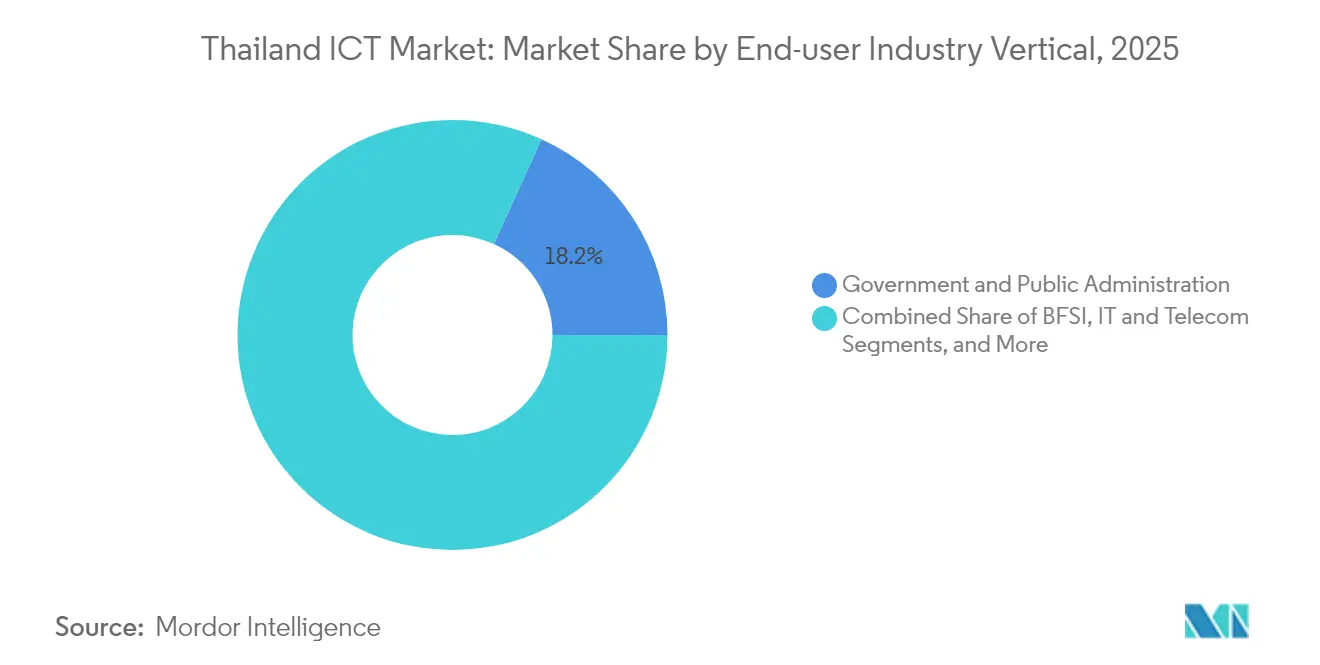
- By end-user vertical, Government and Public Administration captured 18.21% of the Thailand ICT market share in 2025, yet Gaming and Esports is on track for a 12.98% CAGR through 2031.
Note: Market size and forecast figures in this report are generated using Mordor Intelligence’s proprietary estimation framework, updated with the latest available data and insights as of 2026.
Market Trends and Insights
Drivers Impact Analysis of Thailand ICT Market*
| Driver | (~) % Impact on CAGR Forecast | Geographic Relevance | Impact Timeline |
|---|---|---|---|
| Rapid 5G network deployment and subscriber uptake | +2.8% | National, with early gains in Bangkok, Chonburi, Chiang Mai | Short term (≤ 2 years) |
| Government "Cloud-First" policy accelerating adoption | +2.1% | National, concentrated in government agencies and SOEs | Medium term (2-4 years) |
| Enterprise Industry 4.0 digital-transformation surge | +1.9% | Eastern Economic Corridor, Bangkok Metropolitan Region | Medium term (2-4 years) |
| Hyperscale data-center FDI inflows | +1.7% | Bangkok Metropolitan Region, Eastern Economic Corridor | Long term (≥ 4 years) |
| Virtual-bank licensing fuelling fintech infrastructure | +1.4% | National, with concentration in urban centers | Medium term (2-4 years) |
| AI-ready, liquid-cooling data-center hub ambitions | +1.2% | Bangkok Metropolitan Region, Chonburi | Long term (≥ 4 years) |
| Source: Mordor Intelligence | |||
Rapid 5G Network Deployment and Subscriber Uptake
Nationwide 5G roll-out reached 95% population coverage by 2024, enabling edge-computing use cases for predictive maintenance in manufacturing and real-time logistics tracking. Operators deploy network-slicing to offer dedicated throughput for mission-critical applications, unlocking enterprise revenue streams that move beyond consumer voice and data. The National Broadcasting and Telecommunications Commission’s spectrum allocations and infrastructure-sharing rules lower deployment costs for rural areas, accelerating adoption outside Bangkok. Manufacturers in the Eastern Economic Corridor integrate 5G sensors with AI analytics to cut unplanned downtime and boost throughput. Rising 5G handset penetration fuels subscriber migration, pushing average data consumption to double-digit gigabyte levels per user each month.[1]
Government “Cloud-First” Policy Accelerating Adoption
Since 2024, every public-sector agency must justify on-premises procurements as exceptions, prompting ministries to migrate legacy systems onto domestic cloud regions certified under ISO 27001 and the Personal Data Protection Act. The THB 15 billion (USD 0.47 billion) Smart Nation Smart Life program funds shared API gateways and a sovereign large-language-model platform dubbed ThaiLLM hosted in government-approved clouds. State-owned enterprises now publish service catalogs through a single procurement portal, giving private vendors a clear roadmap for integration. The policy has catalyzed similar behavior in regulated industries, with financial institutions benchmarking cloud-security baselines against the government framework. As a result, the Thailand ICT market enjoys a multiplier effect as cloud skills, reference architectures, and procurement templates trickle into the private sector.[2]
Enterprise Industry 4.0 Digital-Transformation Surge
Manufacturers adopt IoT sensors, digital twins, and AI vision systems to raise productivity by up to 30%, aligning with Asia-Pacific Economic Cooperation’s Smart Monodzukuri objectives. Automotive suppliers deploy predictive maintenance to cut unscheduled downtime by 40%, while food processors integrate farm-to-fork traceability dashboards that meet export compliance standards. Government subsidies ease initial setup costs for SMEs, although implementation complexity remains a hurdle. Analytics-driven quality assurance shortens inspection times and reduces scrap rates, directly improving gross margins. The surge in demand for integration services underpins steady growth in the Thailand ICT market, stimulating partner ecosystems of system integrators and device makers.[3]
Hyperscale Data-Center FDI Inflows
Foreign investors commit capital to Bangkok and Chonburi facilities that feature liquid-cooling racks optimized for GPU clusters running AI workloads. STT GDC’s USD 240 million campus and similar deployments by global cloud providers drive a cluster effect in fiber backhaul, renewable-energy supply contracts, and specialized construction services. The Board of Investment grants eight-year tax holidays and permits majority foreign ownership in the Eastern Economic Corridor, narrowing the incentive gap with Singapore and Malaysia. New entrants increase inter-connection density, lowering latency for users and enabling local hosting that meets data-sovereignty rules. These inflows reinforce Thailand’s ambition to position itself as the preferred secondary data-center node for ASEAN enterprises.
Restraints Impact Analysis of Thailand ICT Market*
| Restraint | (~) % Impact on CAGR Forecast | Geographic Relevance | Impact Timeline |
|---|---|---|---|
| Fragmented SME digital-skills and cyber-readiness gap | -1.8% | National, with acute impact in rural and secondary cities | Long term (≥ 4 years) |
| Shortage of advanced ICT talent and rising labor cost | -1.5% | Bangkok Metropolitan Region, Eastern Economic Corridor | Medium term (2-4 years) |
| Stricter data-localization mandates increasing TCO | -1.1% | National, affecting multinational enterprises | Short term (≤ 2 years) |
| Soaring cyber-fraud liability dampening ICT budgets | -0.9% | National, concentrated in financial services and e-commerce | Short term (≤ 2 years) |
| Source: Mordor Intelligence | |||
Fragmented SME Digital-Skills and Cyber-Readiness Gap
Nine in ten Thai SMEs lack formal digital investment plans, and many who do migrate to cloud overlook basic security configurations such as multi-factor authentication or role-based access. Limited awareness of zero-trust frameworks leaves smaller firms exposed to phishing and ransomware that can cripple operations for weeks. Government vouchers under the SME 4.0 program subsidize training and consulting, yet usage remains below 30% because owners prioritize immediate cash-flow concerns. Cyber-insurance premiums climb as underwriters factor in elevated breach frequency among small businesses. Without continuous skills development, the Thailand ICT market risks slower cloud uptake outside the urban core.
Shortage of Advanced ICT Talent and Rising Labor Cost
Demand for AI engineers, cloud architects, and cybersecurity analysts far exceeds domestic supply. Senior professionals command 40-50% salary premiums compared with 2022, eroding cost advantages that once attracted off-shoring contracts to Thailand. Enterprises resort to accelerated reskilling boot camps, while universities expand STEM enrollment but face a multi-year lead time before graduates enter the workforce. The talent crunch hits SMEs hardest, limiting their ability to execute complex digital projects and forcing greater reliance on managed-service providers. Over time, wage inflation could redirect foreign investment to neighboring markets unless talent pipelines scale rapidly.
*Our forecasts treat driver/restraint impacts as directional, not additive. The impact forecasts reflect baseline growth, mix effects, and variable interactions.
Thailand ICT Market Segment Analysis
By Product Type:
Services Integration Drives Market EvolutionIT Services contributed the largest 32.08% slice of the Thailand ICT market share in 2025, led by managed services contracts and multi-cloud migration projects. Telecom operators outsource network operations centers, and manufacturers engage system integrators for predictive-maintenance deployments. Within this umbrella, Cloud Services is forecast to grow at an 11.45% CAGR as enterprises refactor monolithic applications into API-driven microservices. Hardware demand holds steady on the back of 5G radio upgrades and data-center capital expenditure, while cybersecurity outlays accelerate due to persistent threat vectors.
The migration from capex to opex spending reshapes vendor revenue models. PTT Exploration and Production’s move to a cloud-native development platform reduced application release cycles by 480%, illustrating payoffs realized when legacy systems are modernized. Edge-computing appliances proliferate in manufacturing plants to meet low-latency requirements, creating fresh revenue for hardware vendors certified under National Broadcasting and Telecommunications Commission standards. The Thailand ICT market incorporates low-code development tools that empower business analysts to prototype applications, easing pressure on scarce developer talent.

By End-User Enterprise Size:
SME Acceleration Reshapes DemandLarge Enterprises represented 59.25% of the Thailand ICT market size in 2025 thanks to established IT budgets and transformation roadmaps. Yet SMEs are expected to register the fastest 12.05% CAGR through 2031, aided by SaaS platforms that eliminate upfront infrastructure expenses. Subsidized cloud-migration vouchers and turnkey e-commerce packages lower technology adoption barriers for smaller firms.
The democratization of advanced analytics widens the customer base for AI-powered bookkeeping, customer-relationship-management, and inventory control solutions. Digital payment ubiquity further nudges micro-businesses online, enhancing addressable demand for cybersecurity and data-protection services. To serve cost-sensitive SMEs, vendors bundle managed security with productivity suites, striking a balance between functionality and affordability. Consequently, the Thailand ICT market diversifies beyond metropolitan conglomerates into provincial secondary cities.
By End-User Industry Vertical:
Gaming Leads Digital Entertainment SurgeGovernment and Public Administration consumed 18.21% of Thailand ICT market size in 2025, reflecting cloud-first procurement and nationwide e-service rollouts. Yet Gaming and Esports is projected to grow at 12.98% CAGR aided by mobile-first game development, official recognition of esports as a sport, and expanding tournament infrastructure. Cloud gaming reduces hardware barriers, while 5G low-latency connectivity elevates the player experience.
BFSI spends aggressively on core-system modernization and fraud-analytics ahead of virtual-bank launches. Manufacturing digitization anchors Industry 4.0 investments, with electronics exports topping USD 46.2 billion in 2023. Healthcare’s telemedicine uptake persists beyond the pandemic, driving electronic health-record modernization in provincial hospitals. Each vertical stages technology roadmaps suited to sector-specific regulation and competitive dynamics, broadening revenue streams across the Thailand ICT market.
Geography Analysis
The Bangkok Metropolitan Region and the Eastern Economic Corridor jointly generated roughly 69.40% of Thailand ICT market value in 2025, owing to dense fiber infrastructure, proximity to submarine cables, and the presence of multinational headquarters. Bangkok’s colocation campuses achieve sub-5 millisecond intra-city latency, catering to latency-sensitive fintech and gaming workloads. Chonburi’s industrial estates host data-center megaprojects that supply adjacent smart-factory zones with edge-compute capacity.
Government smart-city pilots extend to provincial hubs such as Chiang Mai, where digital-nomad ecosystems stimulate demand for cloud-based collaboration suites. Southern tourist provinces deploy contactless payment and smart-transport systems to elevate visitor experience, yet overall ICT penetration remains below urban centers due to bandwidth constraints. The THB 15 billion (USD 0.47 billion) nationwide infrastructure program aims to close the digital divide through fiber backbone expansion and satellite connectivity for islands and mountainous areas, presenting upside for rural ISP partnerships.
Competitive positioning within ASEAN hinges on maintaining political stability and neutral trade relations. Thailand trails Singapore and Malaysia in submarine-cable density but narrows the gap with projects such as the Asia Direct Cable landing in Rayong. Board of Investment incentives that include eight-year tax holidays and relaxed foreign-ownership caps in special economic zones continue to attract hyperscale commitments. Collectively, these geographic dynamics reinforce sustained expansion of the Thailand ICT market across diverse provinces.
Regulatory Landscape
Thailand ICT regulation is anchored by the Ministry of Digital Economy and Society (MDES) and sector regulators, including the National Broadcasting and Telecommunications Commission (NBTC) for telecom licensing, spectrum and infrastructure rules, alongside the Office of the Personal Data Protection Committee (PDPC) for PDPA compliance, the National Cyber Security Agency (NCSA) for critical information infrastructure security, and the Electronic Transactions Development Agency (ETDA) for digital services governance. Together, these bodies set compliance requirements around network rollout, cloud adoption in regulated sectors, and cross-border data handling as enterprises localize sensitive workloads.
Platform and online commerce rules have tightened, affecting ICT spending on identity, verification, and security tooling. Under the Royal Decree on Digital Platform Service Businesses B.E. 2565 (2022), ETDA has articulated 2026 regulatory priorities covering product and service standards, fair competition, and fraud prevention. A Notification on Additional Measures for Online Marketplace Platforms effective December 31, 2025 requires designated marketplace platforms to strengthen merchant and product verification and operate notice-and-takedown processes. Separately, NCSA website security standards for 2025 require controls such as SSL/TLS and multi-factor authentication for critical sectors, which supports demand for managed security and compliance services across telecommunications and other regulated industries.
Value Chain Analysis
The Thailand ICT value chain runs from global OEMs and software providers to in-country cloud and data-center infrastructure, telecom operators and fiber/backbone providers, and then system integrators and managed service providers (MSPs) serving government, BFSI, manufacturing, and digital-platform customers. Hyperscale and domestic data-center operators provide compute and colocation capacity for cloud services and AI workloads, while national mobile operators monetize 5G coverage and enterprise connectivity through managed services, private networks, and edge deployments for Industry 4.0 estates.
Local channels capture a large share of value by assembling solutions and delivering implementation, migration, and operations. The AWS Asia Pacific (Thailand) Region operates with three Availability Zones and works with Thai partners such as G-Able, True IDC, Yip In Tsoi, and MFEC to deliver migration and managed services. Skills pipelines also support delivery, including AWS training efforts since 2017 and Cisco Networking Academy training that has reached more than 100,000 students. Public-sector digital programs and enabling infrastructure projects, including the National Digital Trade Platform and ETDA initiatives around software-hardware test labs, further pull-through demand for integration, cybersecurity, and compliance-led modernization.
Competitive Landscape
The Thailand ICT market exhibits moderate concentration: top telecom operators Advanced Info Service and True Corporation dominate 5G infrastructure, yet cloud services, cybersecurity, and system integration remain fragmented among global and domestic players. Cloud hyperscalers AWS, Google, and Microsoft anchor local regions to capture growth in regulated workloads, while Chinese providers court cost-sensitive SMEs with aggressive pricing.
Telecom carriers differentiate through AI-enabled network optimization and bundled content to bolster average revenue per user. The True-dtac amalgamation achieved spectrum efficiency and scale advantages without breaching antitrust thresholds, illustrating consolidation trends inside telecom. In IT Services, domestic integrators partner with global software vendors to deliver verticalized solutions for manufacturing, banking, and healthcare.
Competition now centers on platform ecosystems rather than single products. Vendors integrate 5G private networks, edge-computing, and managed security into holistic offerings. The emergence of sovereign AI models sparks alliances between data-center operators and research institutes to secure compute resources. Over the forecast period, white-space opportunities lie in SME-focused SaaS suites, managed detection and response services, and cloud-finops tooling, ensuring vibrant rivalry across the Thailand ICT market.
Thailand ICT Industry Leaders
-
Cisco Systems Inc.
-
IBM Corporation
-
Dell Technologies Inc.
-
Amazon Web Services, Inc.
-
Huawei Technologies Co., Ltd.
- *Disclaimer: Major Players sorted in no particular order
Thailand ICT Market Companies Covered in this Report
- Advanced Info Service Public Company Limited
- True Corporation Public Company Limited
- National Telecom Public Company Limited
- Huawei Technologies Co., Ltd.
- Cisco Systems, Inc.
- International Business Machines Corporation
- Dell Technologies Inc.
- Amazon Web Services, Inc.
- Google LLC
- Microsoft Corporation
- Oracle Corporation
- SAP SE
- Cognizant Technology Solutions Corporation
- Wipro Limited
- Ericsson AB
- Nokia Corporation
- Check Point Software Technologies Ltd.
- Palo Alto Networks, Inc.
- Alibaba Cloud Computing Co., Ltd.
- VMware, Inc.
- Fujitsu Limited
- NEC Corporation
- Accenture plc
- Hewlett Packard Enterprise Company
- Seagate Technology Holdings plc
Market Opportunities and Future Outlook
Cloud migration and AI-ready infrastructure modernization create clear whitespace in Thailand as enterprises balance PDPA-aligned hosting, cyber requirements, and low-latency needs for Industry 4.0 and digital services. AWS provides a tangible wedge for this opportunity, having launched an infrastructure region in Thailand and communicated a long-term investment roadmap of 190 billion baht to support cloud infrastructure and agentic AI adoption. In parallel, telecom and integrator ecosystems increasingly package connectivity, cloud, and managed security into bundled offers that reduce execution risk for customers.
The second opportunity area is physical and ecosystem build-out for digital innovation outside Bangkok, especially in the Eastern Economic Corridor. Thailand Digital Valley in Chonburi positions the site as a hub for designing, testing, and experimenting with advanced digital technology, with a development phase completion milestone scheduled for Q3 2026 that should drive demand for lab environments, secure connectivity, edge infrastructure, and local SI capacity. Enterprise feedback on AI deployment readiness, including infrastructure gaps highlighted by Cisco in Thailand, also reinforces demand for network modernization, observability, and security-by-design services that connect data centers, cloud regions, and industrial sites.
Recent Industry Developments in Thailand ICT Market
- July 2026: Cisco Connect Thailand held on July 1, 2026, in Bangkok. The event represents a direct ICT market engagement in Thailand with relevance to cybersecurity, networking and 5G infrastructure. The initiative strengthens local partner ecosystem and channel-driven growth in Thai enterprise networking solutions.
- June 2026: Metro Connect Co., Ltd., in partnership with IBM (Thailand) Co., Ltd. and SCSi Co., Ltd., held a technical seminar on IBM Storage, Power, and PowerVS in Bangkok. The gathering focuses on direct storage and AI infrastructure in the Thai enterprise IT market. It demonstrates active local adoption of IBM hybrid cloud and storage platforms and supports hyperscale and enterprise data-center uptake in Thailand.
- May 2026: Dell Technologies announced availability of Dell PowerStore Elite for July 2026. The release targets a direct product introduction for AI-ready storage infrastructure in the Thailand market. It positions Dell PowerStore Elite as a regional data-center modernization option supporting AI workloads and enterprise storage upgrades.
Thailand ICT Market Report Scope and Research Methodology
Market Definition and Coverage
For this study, the Thailand ICT market is defined as spending within Thailand on information technology and communications products and services that enable computing, connectivity, and digital operations. Coverage includes enterprise and public sector demand, along with consumer telecom service usage.
Scope exclusions: We exclude consumer electronics not bought for IT use, pure media content value, and ICT spending booked outside Thailand even if the end user is Thai.
Segments Covered in This Report
- By Product Type
- IT Hardware
- Computer Hardware
- Networking Equipment
- Peripherals
- IT Software
- IT Services
- IT Consulting and Implementation
- IT Outsourcing (ITO)
- Business Process Outsourcing (BPO)
- Managed Security Services
- Cloud and Platform Services
- IT Infrastructure
- IT Security/Cybersecurity
- Communication Services
- IT Hardware
- By Enterprise Size
- Small and Medium-sized Enterprises
- Large Enterprises
- By End-user Industry Vertical
- Government and Public Administration
- BFSI
- IT and Telecom
- Energy and Utilities
- Retail, E-commerce, and Logistics
- Manufacturing and Industry 4.0
- Healthcare and Life Sciences
- Oil and Gas
- Gaming and Esports
- Other Verticals
Data Sources, Market Sizing, and Validation
Desk Research
Desk research was used to set the market boundary, build Thailand-specific baselines, and get consistent time series for the model. We mainly relied on public statistics and policy releases that clarify ICT investment direction, plus sector KPIs that can be cross-checked year to year.
Common inputs came from sources such as Thailand's National Statistical Office, the National Broadcasting and Telecommunications Commission, the Ministry of Digital Economy and Society, the Bank of Thailand, and ITU ICT indicators. We also reviewed company filings, investor presentations, association publications, and credible press for price moves and rollout timelines. Where useful, we referenced paid subscriptions for company financials and intelligence, news and financials, patent databases, and shipment-level import and export data to check whether equipment and infrastructure activity matched the spending signal. This list is illustrative only, and we used additional public sources to collect, verify, and clarify data points during the work.
Primary Interviews and Surveys
Primary work focused on validating demand drivers and converting them into practical sizing inputs for Thailand. Published ICT spending splits can differ based on definition, so we used interviews to reconcile what is counted as ICT spend by buyer type and how that spend is booked.
We spoke with a mix of telecom, IT services, cloud and data center ecosystem participants, plus large buyers across regulated and non-regulated industries. These discussions helped tighten assumptions on adoption timing, pricing direction, and budget allocation.
To keep the model realistic, we used these discussions to confirm what is counted as ICT spend by buyer type, how contracts are structured (one-time versus recurring), and what changes when programs move from pilots to scaled deployments across the country.
Distribution of primary research fieldwork respondents
| Company type | Respondent position |
|---|---|
| Top tier: 29% | CXOs: 12% |
| Mid tier: 49% | Functional/Unit leaders: 28% |
| Smaller Players: 22% | Managers: 60% |
Market-Sizing & Forecasting
Sizing starts with a top-down build where national ICT and telecom spending signals are reconstructed into an addressable Thailand demand pool, then mapped into the defined ICT scope. Once that backbone is set, we cross-check it with selective bottom-up approximations, such as sampled price times volume for connectivity lines and direction checks using device and infrastructure shipments. Supplier and channel feedback is then used to adjust totals where the first pass appears off.
Key inputs used in the model include mobile and fixed broadband subscriptions, 5G coverage and traffic growth direction, public sector digital program pace, enterprise cloud and data center buildout timing, and the observed mix shift between capex-heavy infrastructure and recurring managed services. Where a data series is missing for a sub-area, we interpolate using nearby KPIs and validate the implied spend per user or per site against interview ranges.
Forecasts are developed using scenario analysis supported by variable-level views from primary respondents, then smoothed so step changes align with realistic rollout and budget cycles. Final numbers are expressed in USD with consistent conversion timing and clear year labels, which makes the series easier to replicate and review.
Data Validation & Update Cycle
Validation is done by triangulating the model output against independent indicators, including telecom service revenue direction, macro ICT investment signals, and Thailand-specific adoption milestones that can be observed in public releases. When variances appear, we recheck assumptions, and we trigger follow-up outreach to confirm whether the change is structural or temporary.
Before sign-off, the work goes through multi-step analyst reviews that look for break points, unusual price or volume jumps, and internal consistency across the time series. Reports are refreshed annually, with interim updates when material events occur, and a final pre-delivery check is completed so clients receive the latest updated view.
Mordor Intelligence's Thailand Ict Market Size Versus Other Published Estimates
Published ICT market values for Thailand can look far apart because authors do not always count the same spend items, and some include adjacent digital economy categories that sit outside core ICT. Differences also come from how telecom service revenue is treated, whether enterprise IT is counted at invoiced value or at end-user spend, and how exchange rates are applied for USD reporting.
The table shows a noticeable spread, and in Mordor Intelligence's model the total is built from Thailand-only spend across IT hardware, software, services, infrastructure, IT security, and communication services. This avoids blending in wider digital content and non-ICT device value that can inflate totals in some publications.
Benchmark comparison
| Source | Market Size | Gaps in Research Methodology |
|---|---|---|
| Mordor Intelligence | USD 17.74 B (2025) | |
| Industry Association A | USD 21.00 B (2024) | Uses a telecom market value view for 2024 and may not fully reconcile overlaps with IT services and enterprise ICT categories, which can shift totals when stacked into one number. |
| Trade Journal B | USD 19.84 B (2024) | Represents an ICT spending headline for end-2024 and can mix different price bases and category splits, with limited visibility on how currency conversion timing and scope exclusions were handled. |
Looking across these figures, the main takeaway is that scope boundaries and timing choices explain most of the gap more than pure demand disagreement. By anchoring the model to observable Thailand KPIs and then stress-testing the implied spend per user and per enterprise with interviews, the estimate stays traceable to clear inputs and repeatable steps.
Key Questions Answered in the Report
What is the projected value of the Thailand ICT market in 2031?
It is expected to reach USD 33.08 billion, expanding at an 10.95% CAGR.
Which segment holds the largest share of technology spending in Thailand?
IT Services leads with 32.08% of Thailand ICT market share in 2025.
Why are hybrid deployments gaining traction among Thai enterprises?
Hybrid models balance data-sovereignty compliance with access to cloud innovation and are forecast to grow at a 12.3% CAGR.
How does 5G influence industrial digitalization in Thailand?
Nationwide 5G enables IoT-driven predictive maintenance and edge analytics, accelerating Industry 4.0 adoption.
Which vertical is the fastest-growing user of ICT solutions?
Gaming and Esports is set for a 12.98% CAGR through 2031 as mobile gaming and cloud gaming expand.