
Thailand CRM Market Size and Share
Market Overview
| Study Period | 2020 - 2031 |
|---|---|
| Forecast Data Period | 2026 - 2031 |
| Base Year Market Size (2025) | USD 176.55 Million |
| Market Size (2026) | USD 197.6 Million |
| Market Size (2031) | USD 346.52 Million |
| Growth Rate (2026 - 2031) | 11.90 % |
| Market Concentration | Medium |
Major Players *Disclaimer: Major Players sorted in no particular order Image © Mordor Intelligence. Reuse requires attribution under CC BY 4.0. | |
Thailand CRM Market Analysis by Mordor Intelligence
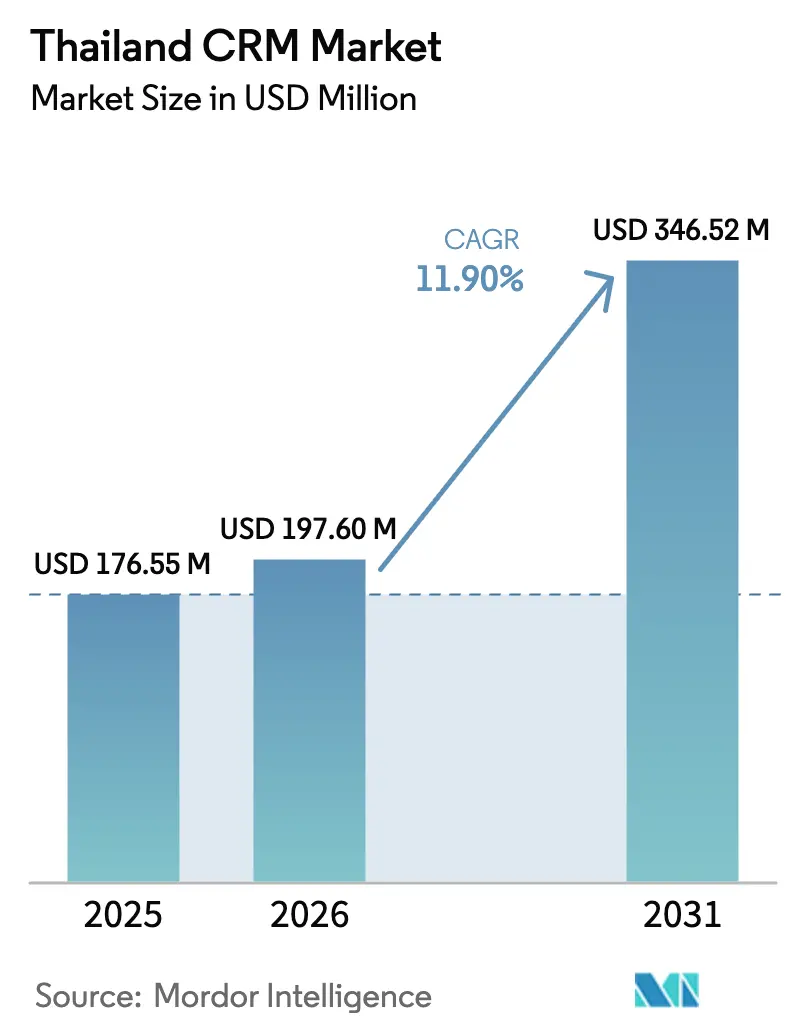
The Thailand CRM market size is expected to grow from USD 176.55 million in 2025 to USD 197.6 million in 2026 and is forecast to reach USD 346.52 million by 2031 at 11.90% CAGR over 2026-2031. Strong government backing through Thailand 4.0, mandatory PDPA compliance, and soaring Line Official Account (OA) usage are accelerating enterprise spending on cloud-native customer-relationship platforms. Rapid SME cloud migration, large-scale investments by BFSI incumbents, and social-commerce integration needs continue to anchor demand. Competition is intensifying as global vendors launch local data centers while domestic specialists leverage Thai-language functionality and deep cultural insight. Structural headwinds, talent shortages, legacy ERP constraints, and patchy regional broadband temper growth yet simultaneously create service opportunities for managed-integration providers. Overall, the Thailand CRM market shows a clear trajectory toward data-driven, AI-powered engagement as enterprises seek scalable platforms that balance compliance with omnichannel agility.
Key Report Takeaways
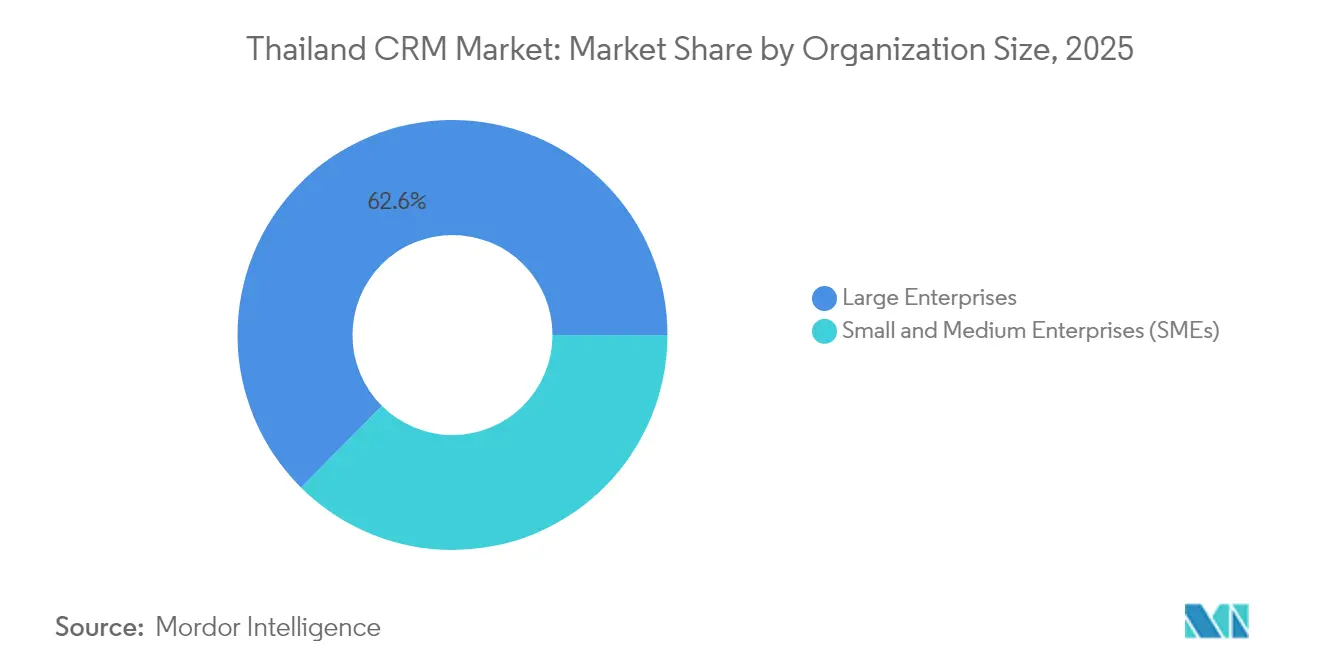
- By organization size, large enterprises held 62.55% of the Thailand CRM market share in 2025, while SMEs are expanding at a 12.68% CAGR through 2031.
- By deployment mode, cloud accounted for 62.20% of the Thailand CRM market size in 2025, and hybrid solutions are set to grow fastest at a 13.05% CAGR to 2031.
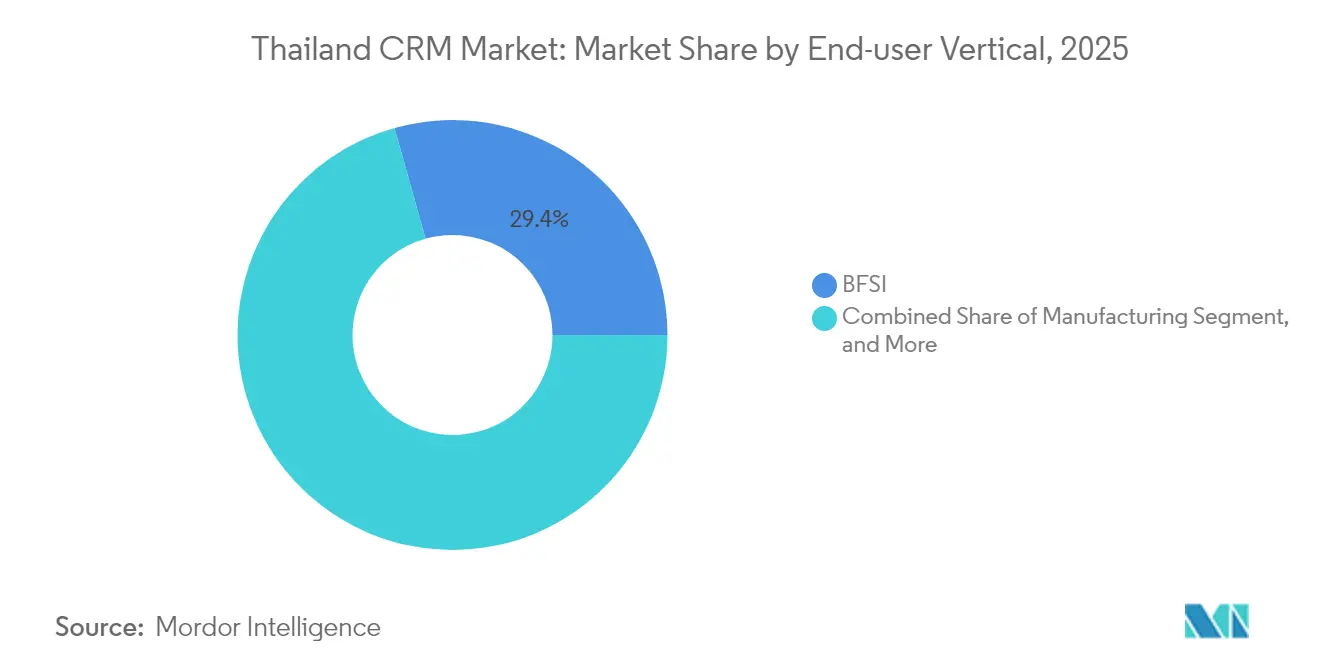
- By end-user vertical, BFSI led with 29.35% revenue share of the Thailand CRM market in 2025; retail and e-logistics are projected to climb at a 13.46% CAGR through 2031.
- By CRM function, Salesforce automation captured 36.05% of the Thailand CRM market size in 2025, whereas analytics and reporting are advancing at a 13.28% CAGR to 2031.
- By region, Bangkok and the Central regions commanded 48.10% of the Thailand CRM market share in 2025; the Eastern Economic Corridor is registering the highest 13.39% CAGR toward 2031.
Note: Market size and forecast figures in this report are generated using Mordor Intelligence’s proprietary estimation framework, updated with the latest available data and insights as of 2026.
Thailand CRM Market Trends and Insights
Drivers Impact Analysis*
| Driver | (~) % Impact on CAGR Forecast | Geographic Relevance | Impact Timeline |
|---|---|---|---|
| Rapid adoption of cloud-based CRM among Thai SMEs | +2.1% | National, concentrated in Bangkok and EEC | Medium term (2-4 years) |
| Government's Thailand 4.0 digital-transformation push | +1.8% | National, with priority zones in EEC and innovation districts | Long term (≥ 4 years) |
| Mobile-first consumer behaviour driving omnichannel CRM | +1.6% | National, strongest in urban centers | Short term (≤ 2 years) |
| Surge in Line OA social-commerce integrations | +1.4% | National, particularly strong in retail hubs | Short term (≤ 2 years) |
| Thai-language NLP chatbots unlocking analytics value | +1.2% | National, with early adoption in BFSI and retail | Medium term (2-4 years) |
| Loyalty-as-a-Service uptake with tourism rebound | +0.9% | Tourism-concentrated regions, Bangkok, Southern Thailand | Medium term (2-4 years) |
| Source: Mordor Intelligence | |||


Rapid adoption of cloud-based CRM among Thai SMEs
Soft-loan programs offering 1% interest and locally hosted hyperscale infrastructure have combined to remove historic cost and data-sovereignty barriers for small firms.[1]Bangkok Post, “SMEs Lag Behind in Using AI, Robotics,” bangkokpost.com Thai vendors such as Zanroo and Choco CRM provide native language interfaces and templated workflows that slash implementation time. The result is a decisive shift away from on-premise installations toward subscription-based platforms that deliver predictable cash-flow benefits and automatic feature updates. As cloud penetration rises, vendors offering bundled managed services gain traction among SMEs with minimal in-house IT resources.
Government’s Thailand 4.0 digital-transformation push
Policies under Thailand 4.0 embed digital-first standards across public procurement, e-government, and new virtual-bank licensing, compelling private firms to match service-delivery benchmarks. Enterprises integrating CRM platforms now view compliance with government digital expectations as table stakes for bidding on contracts and maintaining competitive relevance. Long-term stimulus funding and regulatory clarity ensure durable market momentum even during broader economic cycles.
Mobile-first consumer behavior driving omnichannel CRM
Line’s near-universal reach continues to reshape customer-journey expectations that require real-time integration across chat, mobile payments, and location-based offers.[2]klink.cloud, “Line App in Thailand: Key to Successful Omnichannel Customer Support,” klink.cloud Businesses now demand CRM suites that consolidate social and physical-store touchpoints to deliver consistent service and mitigate churn. Failure to unify interactions across Line, voice, email, and QR-code payments risks immediate customer attrition, elevating omnichannel orchestration from an optional feature to a core requirement.
Surge in Line OA social-commerce integrations
Line OA has emerged as Thailand’s pre-eminent social-commerce channel, enabling integrated messaging, payments, and inventory visibility inside one app. Retailers like Central Group restructured workflows around real-time Line data, driving adoption of CRM platforms capable of ingesting transaction streams and supporting individualized promotions. Enterprises lacking Line OA connectivity are increasingly excluded from Thailand’s digital commerce landscape.
Restraints Impact Analysis*
| Restraint | (~) % Impact on CAGR Forecast | Geographic Relevance | Impact Timeline |
|---|---|---|---|
| Scarcity of skilled CRM implementation consultants | -1.8% | National, most acute outside Bangkok | Long term (≥ 4 years) |
| Data-privacy compliance burden after PDPA enforcement | -1.2% | National, with varying enforcement intensity | Medium term (2-4 years) |
| Legacy Thai-script ERP systems with limited API support | -0.9% | National, concentrated in traditional industries | Long term (≥ 4 years) |
| Patchy broadband outside Bangkok hurting SaaS uptime | -0.7% | Regional, primarily Northern and Northeastern Thailand | Medium term (2-4 years) |
| Source: Mordor Intelligence | |||
Scarcity of skilled CRM implementation consultants
The talent pool remains shallow: local consultancies average fewer than 10 certified specialists, extending deployment cycles and inflating project costs.[3]Salesforce AppExchange, “CRM-C: Thai and International CRM Consultant,” salesforce.com Offshore firms bridge gaps yet face cultural and language barriers, compelling many enterprises to adopt vendor-managed services that raise long-run operating expenses.
Data-privacy compliance burden after PDPA enforcement
PDPA’s stringent consent, audit, and data-residency rules mandate extensive re-engineering of CRM workflows and add certification costs, especially for SMEs. Implementation schedules often slip while legal teams interpret sector-specific guidance, delaying revenue realization and feature roll-outs.
*Our forecasts treat driver/restraint impacts as directional, not additive. The impact forecasts reflect baseline growth, mix effects, and variable interactions.
Segment Analysis
By Organization Size: SME cloud migration accelerates
The Thailand CRM market size for large enterprises remained dominant at USD 110.42 million in 2025, yet SMEs are forecast to contribute the bulk of incremental revenue through 2031. Government soft-loan schemes and low-cost cloud subscriptions are shrinking adoption barriers. Vendors targeting SMEs emphasize template-driven setups, Thai-language UIs, and bundled compliance modules, positioning themselves for double-digit expansion. As SMEs graduate from basic contact management to analytics modules, upselling opportunities expand throughout the forecast.
Local suppliers like Choco CRM bundle pre-built Line OA connectors and PDPA consent tools, allowing SMEs to deploy functional systems within weeks. International vendors respond by establishing tier-two pricing tiers and self-service app stores. This democratization fuels geographic diffusion beyond Bangkok, reinforcing the Thailand CRM market’s long-run diversification.


By Deployment Mode: Hybrid models gain momentum
Cloud installations lead, but concerns over latency-sensitive operations, legacy data synchronization, and regulatory mandates are driving hybrid architectures. Banking, aviation, and logistics players increasingly combine on-premise analytics engines with cloud-based engagement layers to balance control with scalability. Hybrid’s 13.05% CAGR underscores its role as the bridge strategy for firms undertaking phased modernization.
Case in point, Bangkok Airways moved ERP workloads to AWS while retaining certain customer-service databases on-premise for real-time operational continuity. Such dual-stack environments catalyze demand for integration middleware and API-first CRM suites.
By End-user Vertical: Retail digitization drives growth
While BFSI commands the largest spend, retail and e-logistics clock the fastest CAGR due to omnichannel imperatives and social-commerce growth. Inventory-aware engagement, in-chat checkout, and AI-driven recommendation engines are critical differentiators in this sector. Logistics providers adopt CRM to manage shippers, riders, and end consumers in one platform, boosting last-mile transparency.
Manufacturing modernizes through direct-to-consumer channels, necessitating warranty and service modules. Government agencies embrace citizen-service CRMs, replicating private-sector best practices and reinforcing platform credibility across the Thailand CRM market.
By CRM Function: Analytics capabilities expand
Sales-force automation remains foundational, but analytics and reporting are now the prime budget priority. Enterprises seek behavioral segmentation, churn prediction, and marketing ROI dashboards that transform raw interaction data into actionable insight. SAS’s USD 1 billion global AI outlay is mirrored locally as vendors embed predictive models pre-trained on Thai datasets.
Marketing-automation modules capitalize on Line OA APIs to trigger personalized offers, while service-desk functions converge with chatbots for first-contact resolution. Together, they reinforce platform stickiness and expand average subscription revenue per user across the Thailand CRM market.
Geography Analysis
Bangkok and Central Thailand anchor nearly half of current spending due to cluster effects among banks, multinationals, and state agencies. Flagship deployments such as Siam Commercial Bank’s omnichannel revamp serve as proof points that spur cross-industry imitation. Depth of local integrators and high-availability broadband sustain shorter implementation cycles and richer partner ecosystems.
The Eastern Economic Corridor is evolving into a digital-manufacturing hotspot. Dedicated incentive packages, trade-zone status, and new hyperscale cloud availability underpin CRM uptake across auto, electronics, and logistics clusters. Real-time supply-chain visibility tied to customer portals becomes essential for export compliance and after-sales differentiation.
Tourism-heavy Southern Thailand and agriculture-driven Northern provinces advance through loyalty platforms and rural-commerce initiatives, respectively. Government e-service roll-outs, such as provincial one-stop citizen apps, expand CRM adoption beyond commercial entities, reinforcing market resiliency across diverse economic bases.
Regulatory Landscape
Thailand’s CRM deployments are shaped by data-protection compliance and evolving rules for digital platforms. The Personal Data Protection Act (PDPA) requirements around consent, auditability, and personal-data handling influence CRM design decisions such as consent capture, retention, and customer-preference management. In parallel, the Electronic Transactions Development Agency (ETDA) enforces the Royal Decree on the Operation of Digital Platform Service Businesses B.E. 2565 (2022), which requires digital platform service businesses meeting defined thresholds, including more than 5,000 monthly users, to notify ETDA via its business notification system. This is a relevant consideration for CRM-linked engagement layers connected to consumer-facing platforms.
Security and government cloud procurement also affect CRM architecture, particularly for regulated and public-sector users. The Cybersecurity Act B.E. 2562 (2019) established the National Cybersecurity Committee, reinforcing governance expectations for systems processing sensitive customer data. For government-adjacent CRM use cases, the Digital Government Development Agency (DGA) Cloud-First guidance and the G-Cloud framework steer procurement toward approved cloud services and standardized controls, shaping vendor selection, hosting location decisions, and the compliance documentation required from CRM providers and implementation partners.
Value Chain Analysis
The Thailand CRM value chain starts with global software vendors offering core CRM platforms and packaged modules (sales, marketing, service, and analytics), alongside domestic specialists that differentiate through Thai-language UX, local workflow templates, and connectors for high-usage channels such as Line Official Account. Hyperscale and local cloud infrastructure underpin SaaS CRM delivery, while data residency and compliance needs push in-country hosting and local partnership models for global providers. Government digital infrastructure also plays an indirect role by supporting compliant hosting and service procurement, with the Government Data Center and Cloud service (GDCC) used to standardize public-sector digital systems.
Implementation and value realization are handled by systems integrators, consulting partners, and managed service providers that localize solutions and link CRM with ERP, contact centers, data warehouses, and digital commerce. Local and regional partners such as Yokogawa Votiva Solutions (Thailand) and Hitachi Solutions deliver Microsoft Dynamics 365 implementation capabilities, covering integration, customization, and operational support. Channel partners and ISVs extend CRM with industry accelerators, API and middleware integration, and chatbot or analytics components, while enterprises in BFSI, retail and e-logistics, manufacturing, and government increasingly require omnichannel orchestration and compliance-by-design delivery.
Competitive Landscape
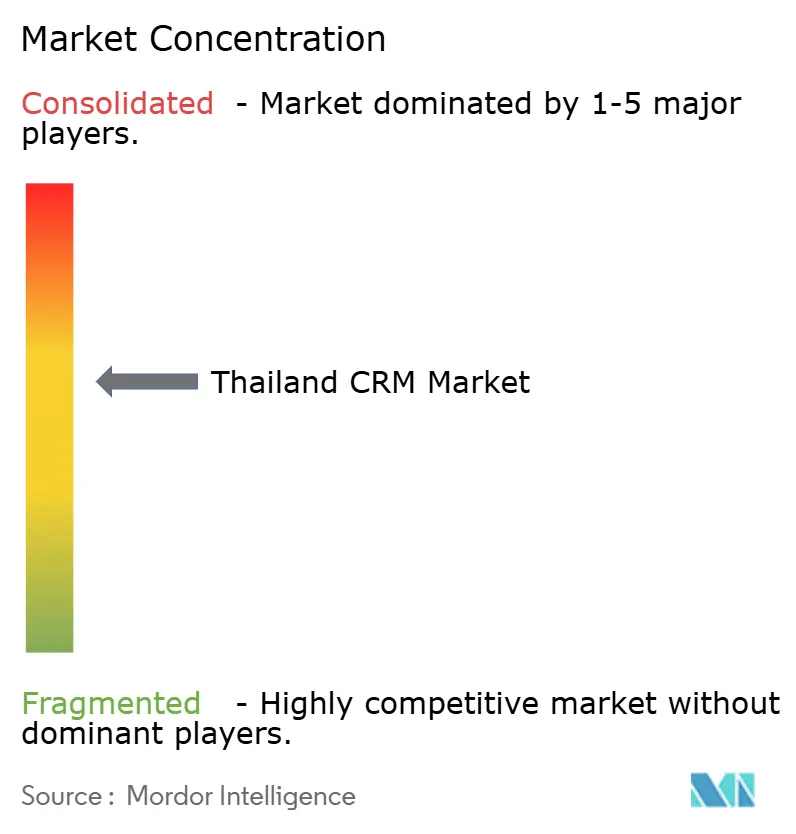
The Thailand CRM market is moderately fragmented. Global suites such as Salesforce, Microsoft Dynamics, and Oracle secure enterprise accounts via breadth of functionality and compliance certifications. Oracle’s Thai data center partnership grants an edge on data-residency questions.[4]Oracle, “AIS Selects Oracle Alloy,” oracle.com
Domestic innovators Zanroo, Choco CRM, and Buzzebees win SME deals through Thai-language UX, Line OA plug-ins, and rapid-deployment templates. Mid-tier foreign providers (HubSpot, Zoho, Freshworks) target cost-sensitive mid-market users with freemium entry tiers.
AI feature depth, hybrid-deployment flexibility, and vertical accelerators are now decisive differentiators. A shortage of certified consultants elevates managed-service offerings and drives vendor investment in low-code configuration tools. As PDPA enforcement intensifies, platforms boasting built-in consent orchestration gain preference.
Thailand CRM Industry Leaders
Salesforce Inc.
Microsoft Corporation
Oracle Corporation
SAP SE
IBM Corporation
- *Disclaimer: Major Players sorted in no particular order

Market Opportunities and Future Outlook
A key whitespace in Thailand CRM is compliance-by-design modernization and integration services, particularly where PDPA obligations and legacy Thai-script ERP constraints slow down CRM rollout. This supports demand for packaged consent management, audit-ready data governance, and integration tooling that can connect cloud CRM with on-premise data stores in hybrid architectures. There is also opportunity in public-sector and regulated-industry CRM workloads aligned with the Digital Government Development Agency (DGA) Cloud-First guidance and G-Cloud procurement frameworks, favoring vendors and partners that can deliver documentation, controls mapping, and locally hosted deployments.
AI-enabled customer engagement is another active area, tied to national digital programs and enterprise execution. Thailand’s National AI Strategy and Action Plan (2022-2027) prioritizes infrastructure and sector pilots, supporting adoption of AI-infused CRM functions such as intelligent service, agent assist, and analytics. On the supply side, the GDCC Marketplace includes SaaS and AI chatbot services, which lowers procurement friction for standardized modules. Global cloud capacity investments, including Microsoft’s commitment of more than USD 1 billion (2026-2028) for cloud and AI data center infrastructure in Thailand, also supports local compute availability for CRM analytics and generative AI workloads. Alongside Thailand 4.0 and depa’s digital economy master plan priorities, including MSME cloud and AI adoption incentives, these factors create room for CRM platform expansion, local-language enablement, and managed services beyond Bangkok-centric delivery hubs.
Recent Industry Developments
- April 2026: Microsoft announced analytics driven Thailand AI and cloud infrastructure investment path. The AI and cloud data center expansion strengthens local capacity for enterprise cloud and analytics workloads and supports AI powered services across Thai industries. The move anchors sovereign data hosting and enables CRM and AI enabled services across Thai enterprises.
- April 2026: Salesforce announced that IEAT and Bumrungrad International Hospital adopt Agentforce AI platform for investor inquiries. The deployment provides a direct CRM and agent oriented platform in government and healthcare sectors. The initiative accelerates local language AI CRM adoption and strengthens agentic enterprise capabilities in healthcare and industrial sectors.
- April 2026: Salesforce announced that the Industrial Estate Authority of Thailand and Bumrungrad International Hospital have adopted the Agentforce AI platform to automate investor inquiries and enhance service experiences. The collaboration demonstrates a tangible expansion of AI driven customer engagement in public and healthcare settings. The action strengthens service experiences for investors and patients alike, expanding AI powered CRM reach in key sectors.


Research Methodology Framework and Report Scope
Market Definition and Coverage
For this methodology, the Thailand CRM market covers spending by organizations in Thailand on customer relationship management software and related platform modules that support sales, marketing, service, and customer analytics, across cloud and on-premise deployments.
Scope exclusions: We exclude general ERP, standalone contact center hardware, pure digital advertising tools, and custom IT services that are not sold as CRM software or CRM platform subscriptions.
Segmentation Overview
- By Organization Size
- Small and Medium Enterprises (SMEs)
- Large Enterprises
- By Deployment Mode
- Cloud
- On-premise
- Hybrid
- By End-user Vertical
- BFSI
- Retail and E-logistics
- Manufacturing
- Services (IT, BPO, etc.)
- Government and Public-Sector
- Other End-user Verticals
- By CRM Function
- Sales Force Automation
- Marketing Automation
- Customer Service and Support
- Analytics and Reporting
Data Sources, Market Sizing, and Validation
Desk Research
Desk work started with building a clean view of Thailand demand drivers that typically move CRM budgets, before any modeling was locked. We reviewed public digital economy and ICT indicators, and then aligned them with CRM adoption signals across key buyer groups like BFSI, retail, and services.
Common public sources used include official statistics and policy releases such as Thailand's National Statistical Office, Bank of Thailand, Thailand Board of Investment updates, ETDA digital economy publications, and telecom and spectrum notes from NBTC, followed by company annual reports, investor presentations, and trusted press coverage. Where needed, we also used paid database subscriptions for company financials and intelligence, news and financials, and patent databases to sanity check product direction and enterprise software investment cycles. This list is not exhaustive, and other public sources were also referred to for data collection, validation, and research clarification.
Primary Interviews and Surveys
Primary work focused on validating what drives actual CRM purchase decisions in Thailand, which were then used to correct desk assumptions on deployment mix and spending intensity. We spoke with a mix of software buyers, implementation partners, and domain specialists, and the discussions helped clarify how contracts are commonly structured in practice (subscription versus add-on modules), typical migration timing from on-premise to cloud, and how budgeting behavior changes by company size.
Distribution of primary research fieldwork respondents
| Company type | Respondent position |
|---|---|
| Top tier: 28% | CXOs: 13% |
| Mid tier: 57% | Functional/Unit leaders: 41% |
| Smaller Players: 15% | Managers: 46% |
Market-Sizing & Forecasting
Sizing was built using a blended approach so the totals stay practical and traceable. A top-down view was first constructed by mapping Thailand enterprise software spend patterns and then narrowing it to CRM using adoption and module mix signals, after which selective bottom-up checks were applied using sampled vendor pricing ranges, channel feedback, and typical user counts to adjust the overall value.
Key inputs in the model included cloud versus on-premise shift rates, average subscription pricing trends (including tiering by users and add-on modules), CRM penetration among SMEs versus large enterprises, CRM use tied to social and messaging-led customer engagement, and compliance-driven data handling requirements that influence deployment choices. When certain vertical level splits were not directly observable, gaps were handled by applying conservative share ranges agreed in interviews, and then stress tested so that the implied spend per customer account stayed realistic.
For forecasting, we used scenario analysis supported by short historical trend fitting. The baseline case was anchored on expected digital transformation funding, hiring and productivity constraints, and the speed of cloud migration. Results were reviewed with experts so that the final curve did not overreact to one-off project cycles and instead reflected repeatable subscription behavior.
Data Validation & Update Cycle
Validation was done through cross-checks that connect the final market value to independent signals, such as enterprise software budget direction, cloud adoption indicators, and observed contract and pricing norms shared by interviewees. Large variances triggered a second pass, where assumptions were re-tested and, if needed, respondents were re-contacted to clarify what was included in their stated spend.
Before sign-off, the model is reviewed in steps by analysts who did not build the first draft, so obvious errors and inconsistent splits get caught early. Reports are refreshed annually, and interim updates are added when material events change assumptions, such as policy changes, major pricing moves, or sharp currency shifts. Right before delivery, a fresh review is completed so clients receive the latest updated view.
Mordor Intelligence's Thailand Crm Market Size Versus Other Published Estimates
Published market values for Thailand CRM often differ because each publisher makes its own choices on what counts as CRM, which year is treated as the base, and how cloud subscription price changes are carried forward. Differences also show up when some estimates include adjacent tools like contact center suites or marketing spend, which can inflate the total even if buyers do not classify it as CRM.
The spread is mainly explained by three items: scope, pricing logic, and refresh timing. Some estimates treat implementation and customization services as part of the CRM market, while others count only software and subscriptions, and this alone can shift totals by tens of millions in a smaller country market. It also matters whether annual contract value is normalized for discounts and multi-year deals, and whether exchange rate timing is consistent across the year, with the software-only, Thailand-only scope being applied consistently at the end of the sizing chain by Mordor Intelligence.
Benchmark comparison
| Source | Market Size | Gaps in Research Methodology |
|---|---|---|
| Mordor Intelligence | USD 176.55 M (2025) | |
| Industry Research Publisher A | USD 182.72 M (2025) | Uses a broader packaged definition that can blend CRM with nearby customer engagement tools, and the longer forecast horizon tends to assume faster price and seat expansion without showing intermediate validation checks. |
| Industry Research Publisher B | USD 157.38 M (2024) | Anchors on an earlier base year and can understate current subscription value by not fully capturing cloud migration step-ups and add-on module attachment that drive higher annual contract values. |
Overall, the table shows that most gaps come from what is included around CRM, plus how contract pricing and base years are handled. By keeping the model tied to observable adoption signals and interview-tested pricing ranges, the estimate stays easier to replicate and audit when assumptions change year to year.


Key Questions Answered in the Report
What is the 2026 value of the Thailand CRM market?
The market is valued at USD 197.6 million in 2026.
How fast is the Thailand CRM market expected to grow?
It is projected to expand at a 11.90% CAGR from 2026 to 2031.
Which deployment mode is growing fastest?
Hybrid deployments are rising at a 13.05% CAGR through 2031.
Which region shows the highest growth rate?
The Eastern Economic Corridor is advancing at a 13.39% CAGR.
Why are SMEs rapidly adopting CRM platforms?
Government soft-loan incentives, low-cost cloud subscriptions, and Thai-language solutions have reduced entry barriers.
Page last updated on:





