
Thailand Construction Equipment Market Size and Share
Market Overview
| Study Period | 2019 - 2031 |
|---|---|
| Forecast Data Period | 2026 - 2031 |
| Base Year Market Size (2025) | USD 1.25 Billion |
| Market Size (2026) | USD 1.31 Billion |
| Market Size (2031) | USD 1.65 Billion |
| Growth Rate (2026 - 2031) | 4.75 % |
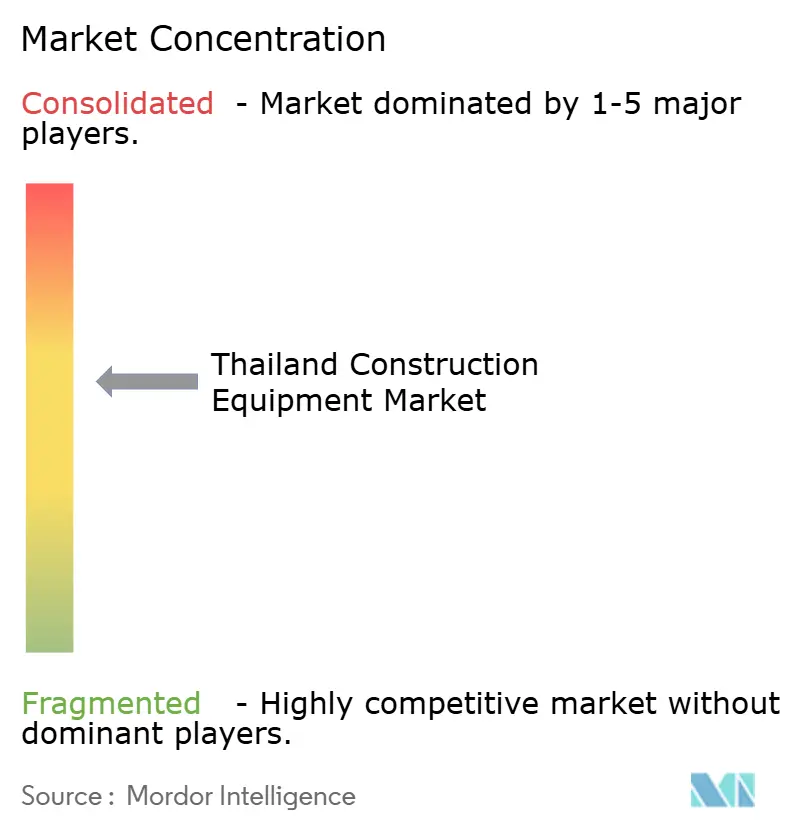
| Market Concentration | Medium |
Major Players *Disclaimer: Major Players sorted in no particular order Image © Mordor Intelligence. Reuse requires attribution under CC BY 4.0. | |
Thailand Construction Equipment Market Analysis by Mordor Intelligence
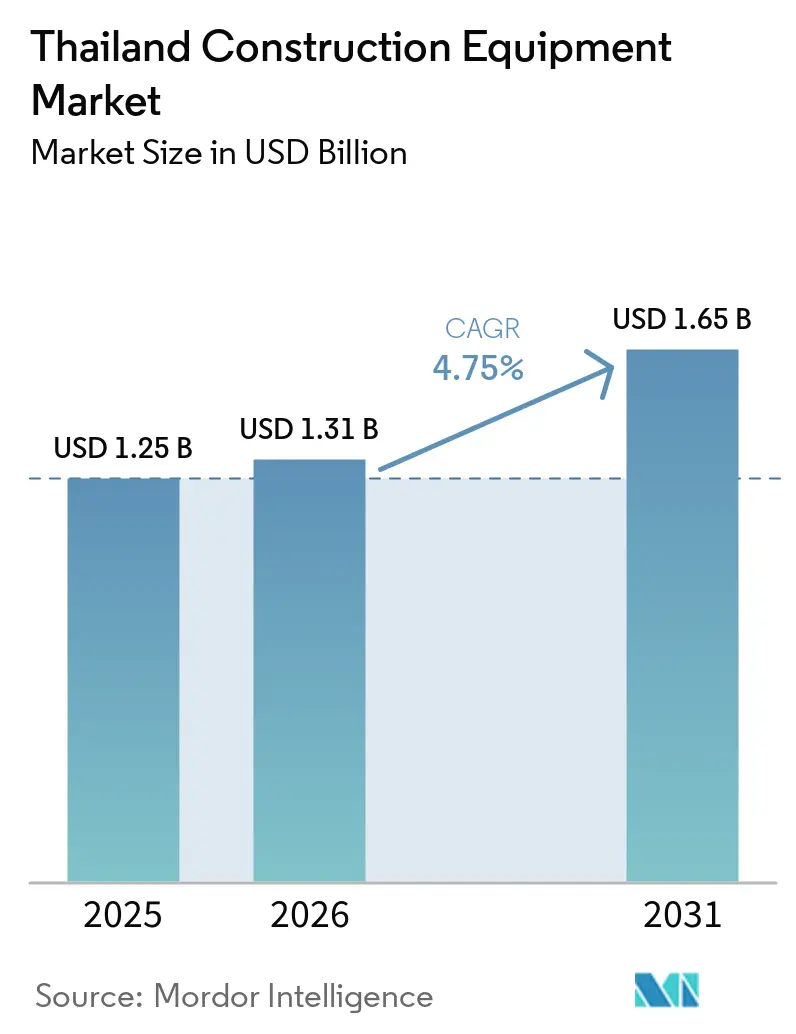
The Thailand Construction Equipment Market size is projected to expand from USD 1.25 billion in 2025 and USD 1.31 billion in 2026 to USD 1.65 billion by 2031, registering a CAGR of 4.75% between 2026 to 2031. As Phase 2 of the Eastern Economic Corridor (EEC) allocates significant investments to transport, port, and airport projects through the coming years, contractors are shifting their capital expenditures. They're now favoring high-tonnage excavators, telescopic handlers, and GPS-enabled cranes. Additionally, public-private partnership (PPP) concessions, valued at substantial amounts, are steering preferences towards wheel loaders and motor graders. These choices not only expedite project timelines but also align with fuel-efficiency mandates. With SME borrowing costs remaining high and a significant operator shortfall widening, there's a noticeable uptick in rental penetration. This trend is further bolstered by the allure of pay-per-hour fleet models. Meanwhile, Bangkok's push for cleaner air is spurring initial trials of battery-electric excavators. Despite a scarcity of charging points, this move signals a shift for the segment, moving it past mere demonstrations.
Key Report Takeaways
- By machinery type, excavators led with 47.16% of the Thailand construction equipment market share in 2025, whereas loaders and backhoes are projected to grow fastest at 4.77% CAGR through 2031.
- By propulsion, internal-combustion equipment accounted for 88.71% of 2025 revenue, but electric and hybrid models will grow at a 4.88% CAGR over 2026-2031.
- By power output, the 101-200 HP band accounted for 56.65% of the Thailand construction equipment market size in 2025, while sub-100 HP machines are poised to expand at a 4.91% CAGR.
- By end-user, infrastructure accounted for 42.27% of spending in 2025; energy and utilities will grow fastest, with a 4.79% CAGR to 2031.
- By application, earth-moving accounted for 48.71% of activity in 2025 in the thailand construction equipment market, yet lifting and hoisting is expected to increase at a 4.85% CAGR during the forecast window.
- By region, the thailand construction equipment market in the Bangkok Metropolitan Area accounted for 35.45% of the 2025 demand, while Northeastern Thailand is forecast to grow at a 4.83% CAGR through 2031.
Note: Market size and forecast figures in this report are generated using Mordor Intelligence’s proprietary estimation framework, updated with the latest available data and insights as of 2026.
Market Trends and Insights
Drivers Impact Analysis of Thailand Construction Equipment Market*
| Driver | (~) % Impact on CAGR Forecast | Geographic Relevance | Impact Timeline |
|---|---|---|---|
| Surge in Megaprojects Under Eastern Economic Corridor | +1.3% | EEC provinces (Chonburi, Rayong, Chachoengsao), spillover to Bangkok Metropolitan Area | Medium term (2-4 years) |
| Public-Private Partnerships Accelerating Infrastructure Roll-Outs | +1.1% | National, with concentration in Bangkok, Central Thailand, and Southern Thailand | Medium term (2-4 years) |
| Tourism-Led Rebound in Commercial and Hospitality Construction | +0.8% | Bangkok Metropolitan Area, Southern Thailand (Phuket, Krabi, Surat Thani) | Short term (≤ 2 years) |
| Renewable-Energy Build-Out Lifting Demand for Cranes and Earth-Moving Gear | +0.7% | National, with early concentration in Central and Northeastern Thailand dam sites | Long term (≥ 4 years) |
| Localization of EV Supply-Chain Plants Requiring Green-Field Factory Construction | +0.6% | EEC core (Rayong, Chonburi), emerging in Northern Thailand (Chiang Mai industrial zones) | Medium term (2-4 years) |
| Rapid Adoption of Machine-Control & BIM-Integrated Equipment to Cut Project Over-Runs | +0.3% | Bangkok Metropolitan Area, EEC provinces, pilot adoption in Central Thailand | Long term (≥ 4 years) |
| Source: Mordor Intelligence | |||
Surge in Megaprojects Under Eastern Economic Corridor
Several EEC Phase 2 projects, valued at a significant amount, are driving demand for medium- to large-excavators, lattice-boom crawler cranes, and amphibious pile drivers. Important infrastructure developments, including an aviation hub expansion, a port upgrade, and a high-speed rail corridor connecting multiple airports, are operating at fleet capacities well above pre-pandemic levels. Contractors are increasingly favoring telematics-enabled machines that transmit utilization data to lenders and insurers, enabling notable reductions in financing costs. In certain regions, secondary leasing markets have emerged, allowing smaller contractors to sub-lease idle equipment and capitalize on additional project opportunities. Japanese OEMs are incorporating predictive-maintenance subscriptions into long-term service contracts, ensuring steady aftermarket revenue and extending equipment's operational lifespan, supporting the thailand construction equipment market.
Public-Private Partnerships Accelerating Infrastructure Roll-Outs
The Ministry of Transport has unveiled a significant public-private partnership (PPP) docket encompassing numerous projects. In addition, additional funding has been allocated for several new initiatives set to launch in the near future. Key motorways operating under a build-operate-transfer model impose emissions ceilings, promoting the use of fuel-efficient graders and compactors. The ambitious Southern Land Bridge, a significant infrastructure project, is set to deploy a substantial number of heavy machines, with operations expected to commence later in the decade. Embedded in PPP contracts are provisions for liquidated damages in the event of schedule delays. This has spurred the adoption of BIM-integrated machinery, which ensures real-time compliance tracking. In response to the capital demands of primary concession bids, smaller firms are strategically shifting towards subcontracting niche roles and pursuing short-term rentals in the thailand construction equipment market.
Tourism-Led Rebound in Commercial and Hospitality Construction
By the mid-term, the target for international arrivals is set to increase significantly, driving a substantial revival of hotel pipelines nationwide. In the capital city, a notable number of keys are being commissioned, while a major tourist destination is planning to add a considerable number of rooms across multiple properties over the next few years. With a resurgence in hospitality capital expenditure projected for the near future, there is a growing demand for compact excavators, tower cranes, and rough-terrain forklifts, all designed to meet advanced emissions standards. Global hotel chains are increasingly adopting battery-electric mini-excavators for landscaping purposes. This shift enables rental fleets with compliant assets to charge a premium during high-demand periods. Additionally, green-certification scorecards are becoming critical in tender evaluations, favoring contractors whose fleets meet established sustainability thresholds such as LEED or EDGE.
Renewable-Energy Build-Out Lifting Demand for Cranes and Earth-Moving Gear
Gulf Energy, with its numerous solar farms generating significant capacity, is placing orders for amphibious cranes and GPS-guided rammers designed for floating platforms. This comes alongside a large-scale solar and battery energy storage system tranche, financed by the Asian Development Bank. Meanwhile, EGAT's ambitious floating-solar initiative, spanning multiple dams, is turning to modular pontoons and low-ground-pressure excavators to ensure shoreline stabilization. A hybrid array that began operations recently has set a new engineering benchmark. Original Equipment Manufacturers (OEMs) are now looking to replicate this success at other reservoirs. With the Ministry of Energy pushing for a substantial renewable share in the grid within the next decade, contractors are seeing a clear demand trajectory. This clarity is driving them to make bulk orders and establish framework agreements for specialized fleets.
Restraints Impact Analysis of Thailand Construction Equipment Market*
| Restraint | (~) % Impact on CAGR Forecast | Geographic Relevance | Impact Timeline |
|---|---|---|---|
| Construction-Input Inflation Squeezing Contractor CAPEX | -0.8% | National, with acute impact in Northeastern and Southern Thailand | Short term (≤ 2 years) |
| Skilled-Operator Shortages | -0.7% | National, especially in Bangkok and EEC provinces | Medium term (2-4 years) |
| High Import Duties and Sparse Charging Infra | -0.5% | National, with higher barriers in Central and Northern Thailand | Long term (≥ 4 years) |
| Tight Credit Conditions for SMEs Slowing Fleet Renewal Cycles | -0.4% | National, with pronounced effects on provincial contractors | Medium term (2-4 years) |
| Source: Mordor Intelligence | |||
Construction-Input Inflation Squeezing Contractor CAPEX
In 2024, Thailand's construction cost index rose moderately, driven by ongoing inflationary pressures on steel, cement, and diesel. Labor costs also rose significantly, further squeezing subcontractors' already tight margins. As a result, smaller builders are postponing fleet upgrades, turning instead to used equipment from EEC surplus inventories. While government price caps have been implemented, their impact is limited, leaving project budgets vulnerable to fluctuations in global commodity prices. Without a return to price stability or a rise in escalator clauses, sales of new equipment to micro-contractors are expected to remain subdued in the thailand construction equipment market.
Skilled-Operator Shortages Pushing Renters Over Buyers
A workforce that's aging and a sluggish uptake in vocational training have resulted in a significant operator gap for heavy machinery. While the importation of foreign labor helps address this shortfall, challenges such as language barriers and certification issues diminish overall efficiency. To counteract potential downtime risks, rental houses are now pairing certified operators with their leases, catering to the needs of primary contractors. Original Equipment Manufacturers (OEMs) are investing in simulators and e-learning platforms, yet the country's capacity still lags behind demand, particularly for advanced telematics platforms in the thailand construction equipment market.
*Our forecasts treat driver/restraint impacts as directional, not additive. The impact forecasts reflect baseline growth, mix effects, and variable interactions.
Thailand Construction Equipment Market Segment Analysis
By Machinery Type:
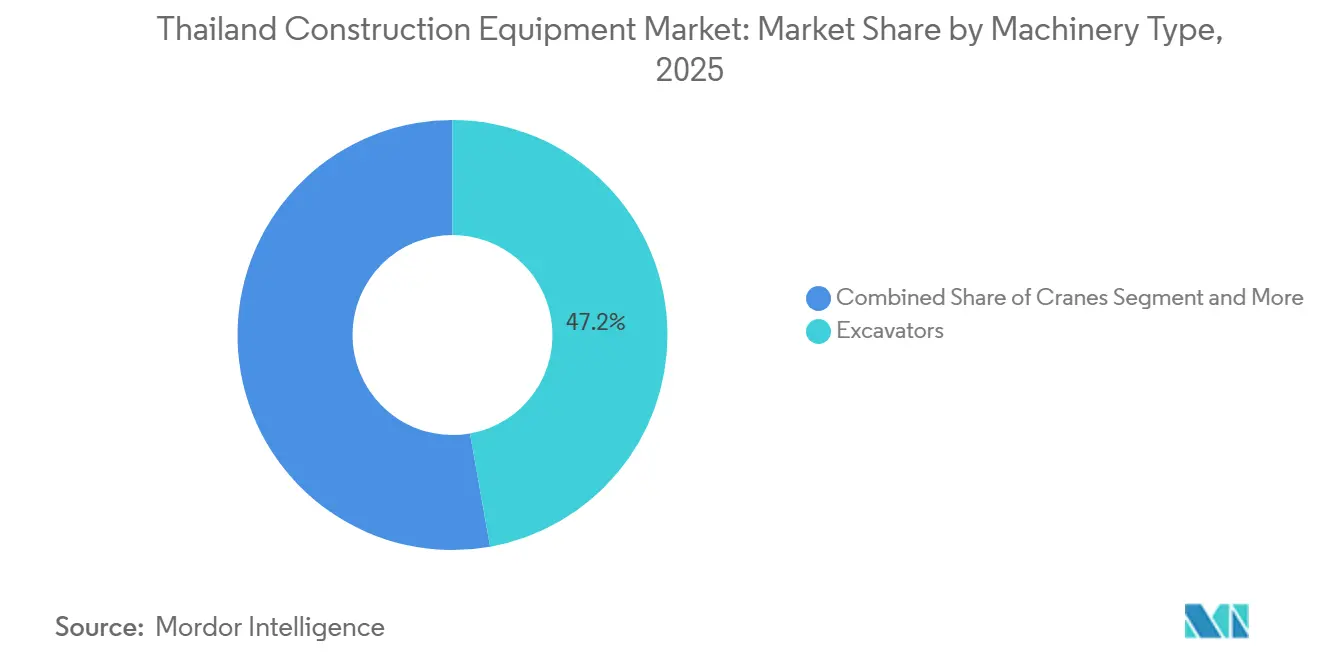
Excavators Hold Value, Loaders Set PaceExcavators accounted for 47.16% of the Thailand construction equipment market share in 2025, reflecting their indispensable role in pile foundations and trenching across the EEC megaproject lattice. This segment alone accounted for nearly half of Thailand's construction equipment market, driven by a procurement surge for the three-airport high-speed rail and the U-Tapao aviation hub. Chinese brands gained volume with minimal price discounts, but Japanese incumbents defended margins through advanced telematics and five-year service pacts.
Loaders and backhoes are forecast to register a 4.77% CAGR through 2031 as provincial roadworks, irrigation canals, and agriprocessing complexes demand multi-function machines that toggle between earth-moving and material-handling roles. Rental yards diversify into skid-steer and articulated loaders to serve smallholder cooperatives, modernizing cassava logistics. Telescopic handlers and motor graders, although smaller in volume, are increasingly deployed on PPP motorway sites where cross-slope precision is prioritized.

By Propulsion:
ICE Dominates, Electric Picks MomentumInternal combustion engines retained 88.71% of revenue in 2025, underpinned by diesel’s national availability and the absence of universal charging. Nevertheless, electric and hybrid units are predicted to outpace, expanding at a 4.88% CAGR through 2031 and lifting the Thailand construction equipment market size in the low-carbon segment. Luxury hotel chains and corporate headquarters in Bangkok contractually require battery-electric mini-excavators for LEED credits, enabling OEMs to trial lithium-iron-phosphate packs rated for humid environments.
Hybrid drivetrains marry diesel generators to battery buffers on cranes, cutting idle emissions by nearly 30% on congested sites. ICE will stay entrenched in quarrying and mining until fast-swap battery skids reach 300 kWh capacities. Government waivers on excise for zero-emission machinery narrow the total cost of ownership, but uptake remains gated by range constraints and resale liquidity uncertainties.
By Power Output:
Mid-Range Leads, Compact Equipment SurgesMachines in the 101-200 HP envelope dominated the Thailand construction equipment market with 56.65% of the market share in 2025, as this horsepower bracket spans commercial mid-rises, arterial road restorations, and port expansion bulkworks. OEMs spotlight fuel-mapping software that optimizes torque curves, claiming diesel savings in Bangkok stop-start cycles.
Sub-100 HP equipment will climb at a brisk 4.91% CAGR by 2031, propelled by Northeast agricultural mechanization grants that subsidize mini-backhoes and skid steers for cassava and sugarcane handling. Compact track loaders now feature quick-coupler hydraulics, allowing farmers to switch from pallet forks to trench buckets within minutes. Units over 200 HP serve mining and mass earthworks, supporting demand for thailand mining equipment, but face slower volume growth as telematics reveal excess idle time, steering contractors toward multi-shift scheduling instead of new purchases.
By End-User:
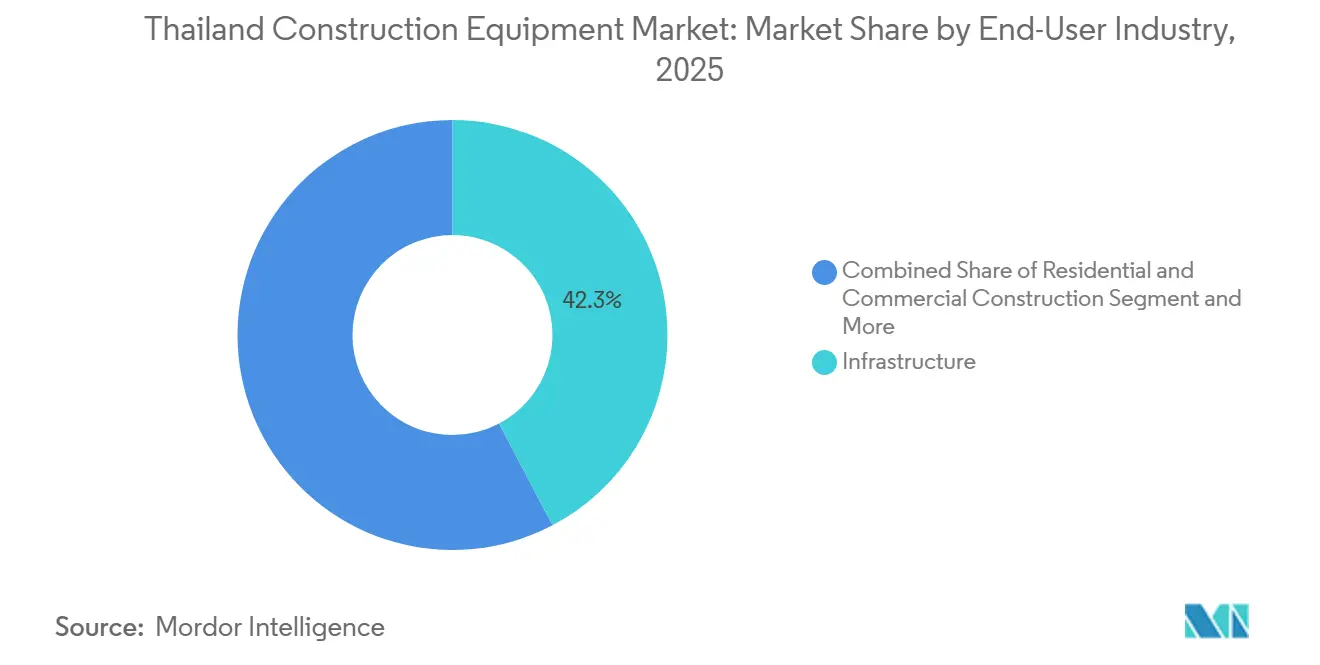
Infrastructure Remains Core, Energy & Utilities AccelerateInfrastructure schemes accounted for 42.27% of outlays in 2025, a share that anchors the Thailand construction equipment industry, as PPP motorways, double-track railways, and port deepening collectively span more than 3,000 km. Concessionaires prioritize burn-rate predictability and select machines with dealer-backed uptime-guarantee clauses.
Energy and utilities, led by solar and battery-energy-storage system clusters, will grow fastest at a 4.79% CAGR through 2031, incrementally expanding the Thailand construction equipment market. Floating-solar installations require amphibious cranes and low-ground-pressure dozers, niches that reward OEMs investing in purpose-built models. Residential and commercial real estate benefits from the tourism rebound, yet office take-up remains cautious amid hybrid work norms.
By Application:
Earth-Moving Dominant, Lifting & Hoisting RisingEarth-moving captured 48.71% of 2025 activity, mirroring the deep-cut profiles of runway, motorway, and rail embankments. Machine-control levelling systems now integrate with drone topography feeds, truncating survey-to-dig cycles to a minimum.
Lifting and hoisting will expand at a 4.85% CAGR as condominium towers in Chonburi and Rayong demand tower cranes with anti-collision sensors mandated by the Department of Industrial Works. Renewable arrays and EV part depots further boost orders for rough-terrain forklifts and telehandlers equipped with 14-meter booms. Material handling, demolition, and tunnelling applications each add incremental slices, supported by specialty attachments that convert standard excavators into versatile platforms.
Geography Analysis
Bangkok Metropolitan Area delivered 35.45% of 2025 demand, cementing its position as the single largest consumer within the Thailand construction equipment market [1]. Projects such as the Orange Line extension and mixed-use skyscrapers in Ratchathewi are pushing contractors to lease battery-electric mini-loaders and Stage V-compliant cranes to meet urban emissions codes. Land scarcity spurs vertical builds, elongating crane deployment cycles, and favoring OEMs offering rapid mast-height reconfiguration kits.
Northeastern Thailand is the fastest climber, projected to grow at a 4.83% CAGR through 2031, as cassava processing, sugarcane logistics, and irrigation revamps unlock backhoe-loader and grader procurement in Khon Kaen, Udon Thani, and Nakhon Ratchasima. Provincial governments allocate matching grants for agricultural mechanization, helping cushion farmer cooperatives from up-front capital costs. Rental firms locate mobile depots along Highway 2 to slash equipment delivery lead times to under 24 hours, a critical differentiator during harvest peaks.
Central Thailand maintains steady momentum as a logistics and manufacturing hub, bolstered by warehouse clusters near Ayutthaya and Saraburi, where forklifts and automated storage solutions are gaining traction. Northern Thailand taps industrial estates in Chiang Mai and Lamphun, albeit from a smaller base, emphasizing compact excavators suitable for mountainous terrain. Southern Thailand benefits from dual-track railways and resort refurbishments in Phuket, channeling orders for compactors and truck-mounted concrete pumps. Regional disparities in permitting speeds, skilled-labor pools, and grid reliability shape contractors' fleet deployment calculus.
Regulatory Landscape
Thailand’s construction equipment regulatory environment is shaped by safety, product standards, and administrative compliance. Workplace safety and machinery use are governed by the Occupational Safety, Health and Environment Act B.E. 2554 (2011) and supporting Ministerial Regulation B.E. 2552 (2009), which are commonly referenced for requirements covering machinery and lifting equipment on jobsites. On the product side, the Industrial Product Standards Council under the Ministry of Industry oversees equipment standards under the Industrial Products Standards Act framework, affecting compliance expectations for manufacturers, importers, and distributors operating in Thailand.
A notable 2026 administrative shift is the Facilitation of Licensing and Public Services Consideration Act B.E. 2569 (2026), which introduced a super license concept and strengthened mandatory e-filing for business licensing and public services workflows. For equipment OEMs and dealers, these changes increase the importance of digital readiness in importation, registration, and permitting processes. In parallel, Thailand’s Board of Investment (BOI) incentive structure influences localization decisions, with incentive eligibility linked to local content thresholds for machinery assembly, steering some manufacturers toward qualifying domestic suppliers and expanding in-country operations.
Value Chain Analysis
Thailand’s construction equipment value chain is anchored in a mix of imported machines and locally supported distribution, with dealer networks and service capability acting as key differentiators in contractor purchasing decisions. Global and regional OEMs typically route equipment into Thailand via authorized distributors that manage sales, financing support, operator training, and field service, then monetize the installed base through parts and maintenance contracts. Industry coordination and capability-building are supported by bodies such as the Thai Machinery Association (TMA), which facilitates collaboration among industry, government, and academia.
On the supply side, localization has become more relevant as some manufacturers maintain assembly footprints in Thailand and work to qualify domestic suppliers for selected components (such as hydraulics and cabs) to align with BOI incentive criteria. Downstream, contractors increasingly rely on rental houses and fleet-management intermediaries to manage utilization and capital constraints, expanding the role of rental, pay-per-hour offerings, and telematics-enabled maintenance in the ecosystem. This shifts value capture toward uptime guarantees, faster parts availability, and digital tools that connect machine data with project controls and financing requirements.
Competitive Landscape
The Thailand construction equipment market hosts a moderately concentrated field where Caterpillar, Komatsu, and Hitachi preserve entrenched dealer reach and command parts availability within 24-hour windows [2]. Their combined dominance is challenged by SANY and XCMG, whose service centers doubled between 2024 and 2026, leveraging 48-hour parts guarantees and price undercuts to penetrate provincial highway tenders [3]. Japanese and Korean brands, including Kobelco, Hyundai, and Doosan, are pivoting toward telematics-rich offerings that promise higher uptime through predictive analytics.
Strategic maneuvers center on digital ecosystem plays. In 2025, Komatsu inked a Bangkok pilot with a telecom provider to stream high-resolution machine data over private 5G, slicing latency to sub-50 milliseconds for autonomous-grade control. SANY counters by bundling one-year operator-training vouchers with each excavator sale, tackling the skills drought head-on. Volvo CE appointed CHAIRATCHAKARN as its new distributor in January 2025, expanding showroom clusters into the Eastern Seaboard corridor.
Rental penetration breached in metropolitan Bangkok during 2025, spawning software platforms that algorithmically match idle inventory with last-minute project spikes. These marketplaces monetize utilization gaps and pressure OEMs to design rental-ready iterations emphasizing quick coupling, vandal-proof telematics, and transportability within 12-ton slide-bed truck limits. Regulatory pulls such as mandatory BIM submission elevate digital compliance services, creating subscription revenue for tech-forward dealers.
Thailand Construction Equipment Industry Leaders
-
Caterpillar Inc.
-
SANY Group
-
Komatsu Ltd.
-
Hitachi Construction Machinery Co., Ltd.
-
Kobelco Construction Machinery Co. Ltd.
- *Disclaimer: Major Players sorted in no particular order
Thailand Construction Equipment Market Companies Covered in this Report
- Caterpillar Inc.
- Komatsu Ltd.
- Hitachi Construction Machinery Co. Ltd.
- Kobelco Construction Machinery Co. Ltd.
- SANY Group
- XCMG Group
- Zoomlion Heavy Industry Science & Technology Co. Ltd.
- Hyundai Construction Equipment Co. Ltd.
- Liebherr Group
- CNH Industrial N.V.
- JC Bamford Excavators Ltd (JCB)
- Volvo Construction Equipment
- Doosan Bobcat
- Wirtgen Group (John Deere)
- Yanmar Holdings Co. Ltd.
- Takeuchi Mfg. Co. Ltd.
- Kubota Corporation
- Sumitomo Construction Machinery Co. Ltd.
- Terex Corporation
- Manitowoc Company Inc.
Market Opportunities and Future Outlook
Active megaproject execution under the Eastern Economic Corridor (EEC) and the national PPP docket creates whitespace for OEMs and rental fleets that can supply high-tonnage earthmoving, lifting, and road-building equipment with strong uptime support. Equipment packages that integrate telematics, machine control, and BIM-compatible reporting align with contractor needs on schedule-sensitive infrastructure works where compliance tracking and delay penalties are embedded in contracts. The market’s growing acceptance of utilization data for financing and insurance decisions also supports dealer-led offerings that bundle connectivity, predictive maintenance, and guaranteed service response.
Localization and capability expansion are another opportunity area tied to Thailand’s investment promotion environment. BOI incentives linked to local content thresholds encourage manufacturers to deepen in-country assembly and supplier qualification, shortening lead times and improving parts availability for fleets operating across Bangkok and EEC provinces. In parallel, cleaner-air actions in Bangkok and sustainability requirements in commercial projects create a practical entry point for electric or hybrid machines in compact segments and for low-idle solutions on cranes and compactors, with adoption supported by rental-led trials and contractor preference for compliant equipment on urban sites.
Recent Industry Developments in Thailand Construction Equipment Market
- July 2026: Hangcha Group Manufacturing (Thailand) opened its first self-owned overseas manufacturing base in Chonburi, a 35,000 sqm site for forklifts, aerial work platforms, and telehandlers. The launch expands NEV and automation-enabled product offerings in Thailand and signals a shift toward domestic production of heavy-usage equipment. The move strengthens regional supply chains and export capability for local customers.
- June 2026: XCMG Group entered a procurement agreement with OCR Company for 300 new energy heavy trucks in Bangkok; the first 100 units were delivered. The adoption of electric heavy trucks accelerates NEV integration into Thai construction and logistics fleets. The partnership enhances XCMG and OCR market penetration through an established distribution and service network.
- March 2026: Caterpillar (ITD collaboration) deployed a latest-generation CAT smart excavator with Intelligent Machine Control System for the U-Tapao International Airport Runway 2 project. The project demonstrates high-tech machinery use in a major Thai infrastructure program and supports premium equipment demand and digital integration across the sector.
Thailand Construction Equipment Market Report Scope and Research Methodology
Market Definition and Coverage
For this study, the market covers the value of construction equipment demand in Thailand used across building and civil works activity, including purchases and fleet additions that support active project execution.
Scope exclusions: used equipment resale between end users and purely consumer-grade tools are excluded from this market sizing.
Segments Covered in This Report
- By Machinery Type
- Cranes
- Telescopic Handlers
- Excavators
- Loaders & Backhoe
- Motor Graders
- Other Machinery Types
- By Propulsion
- Internal Combustion Engine
- Electric & Hybrid
- By Power Output
- Below 100 HP
- 101 - 200 HP
- Above 200 HP
- By End-user
- Infrastructure
- Residential and Commercial Construction
- Mining and Industrial
- Agriculture
- Energy and Utilities
- By Application
- Earth-moving
- Material Handling
- Road Construction
- Lifting & Hoisting
- By Region
- Bangkok Metropolitan Area
- Central Thailand
- Northern Thailand
- Northeastern Thailand
- Southern Thailand
Data Sources, Market Sizing, and Validation
Desk Research
Desk research is used to set the outside boundaries of demand and to anchor the model to real construction activity in Thailand. We start by mapping construction output, infrastructure plans, and the broader equipment import and manufacturing footprint using public sources such as the National Statistical Office of Thailand, the Bank of Thailand, the Ministry of Transport, and Board of Investment (BOI) announcements.
To connect macro activity to equipment demand, we also review non-paywalled customs and trade statistics, procurement and tender disclosures, and technical publications that describe typical fleet utilization by equipment class. Company filings, investor presentations, dealer updates, and reputed press are used to cross-check equipment mix shifts and price direction over time. Where available, paid subscriptions are used selectively for company financials and intelligence, patent checks, and shipment-level import and export context. The desk research sources referenced here are illustrative and not exhaustive, and many other public documents and datasets were also used for data collection, validation, and research clarification.
Primary Interviews and Surveys
Primary work is used to pressure-test assumptions that are not fully visible in published statistics, especially pricing, replacement timing, and utilization by job type. We validate the demand pool through discussions with contractors, rental fleet operators, distributors, and service teams, and then we re-check inputs across Thailand to avoid a Bangkok-only view.
Distribution of primary research fieldwork respondents
| Company type | Respondent position |
|---|---|
| Top tier: 36% | CXOs: 18% |
| Mid tier: 42% | Functional/Unit leaders: 36% |
| Smaller Players: 22% | Managers: 46% |
Market-Sizing & Forecasting
Market sizing is built by linking Thailand construction activity to equipment demand using a top-down and bottom-up approach, where construction output direction, project pipeline signals, and import and local supply indicators reconstruct the annual requirement by broad equipment classes. Once the demand pool is formed, it is converted into market value using average selling price ranges checked against channel feedback and observed pricing direction.
To keep totals realistic, results are corroborated with selective bottom-up approximations, such as sampled unit volumes by equipment type multiplied by typical price bands, followed by channel checks on how demand splits between rentals and direct purchases. Inputs that matter most include public infrastructure spending timing, private building starts, equipment utilization and replacement cycles, import mix shifts, and propulsion preference changes, which together explain year-to-year movement.
For forecasting, scenario analysis is used so the model separates a base case from faster or slower project execution outcomes shared by interviewees. If a smaller equipment class has thin public data, the gap is handled by applying conservative penetration and utilization ranges, then revisited during validation before finalizing the series.
Data Validation & Update Cycle
Validation is done in layers so the final number does not depend on one data stream. We compare outputs against independent signals such as construction output trend, import value direction, and stated project rollout timing, and then anomalies are investigated before sign-off.
When variances are seen, assumptions are re-checked through follow-up outreach with relevant respondents, and the model is adjusted only when the change can be explained through a clear driver like pricing, utilization, or project delays. Reports refresh annually, with interim updates triggered by material events that can shift demand, and a fresh review pass is completed before delivery so clients receive the latest updated view.
Mordor Intelligence's Thailand Construction Equipment Market Estimate Compared With Other Published Estimates
Published market sizes for Thailand construction equipment often do not match because the counted item list can vary, and the timing of the base year and currency conversion can also shift the reported value. Differences in whether the number reflects equipment revenue, unit demand, or a broader project-linked spend pool can further widen the spread.
The table points to a clear gap that mainly comes from scope and pricing logic, not from a completely different view of Thailand construction activity. Some estimates fold in adjacent categories like industrial handling equipment or add aftermarket revenue, while others apply faster ASP uplift without re-checking utilization and replacement timing when project schedules move.
Benchmark comparison
| Source | Market Size | Gaps in Research Methodology |
|---|---|---|
| Mordor Intelligence | USD 1.25 B (2025) | |
| Industry Publisher A | USD 1.86 B (2023) | This figure appears to use a broader equipment basket and an earlier base year, which can raise totals when industrial handling adjacencies and additional revenue streams are included in the headline. |
| Consultancy Brief B | USD 2.87 B (2030) | The projection looks higher partly due to a stronger assumed demand acceleration and faster ASP progression, with limited visible cross-checks against utilization and replacement cycles during execution delays. |
The table shows a meaningful spread, and under Mordor Intelligence's scope only construction equipment tied to Thailand jobsite demand is counted, with price bands and replacement cycles re-validated through channel feedback before the forecast is extended. This keeps the result traceable to a defined demand pool and repeatable inputs, which helps planning teams reconcile year-to-year changes.
Key Questions Answered in the Report
How large will Thailand’s construction equipment sector be by 2031?
The Thailand construction equipment market size is projected to reach USD 1.65 billion by 2031, expanding from USD 1.31 billion in 2026 at a 4.75% CAGR.
Which machinery type commands the most sales?
Excavators led with 47.16% of 2025 revenue, fueled by deep-foundation needs across EEC and PPP megaprojects.
What segment is growing fastest?
Loaders and backhoes are forecast to rise at a 4.77% CAGR through 2031, reflecting demand for multi-function machines on provincial road and agrilogistics sites.
Where is regional growth highest?
Northeastern provinces are expected to post a 4.83% CAGR, supported by irrigation modernization and cassava-processing investments.
How quickly are electric machines penetrating?
Electric and hybrid equipment is predicted to advance at a 4.88% CAGR as Bangkok clean-air rules and hotel sustainability mandates multiply pilot deployments.
What financing trends dominate equipment procurement?
Rising SME lending rates and operator shortages are accelerating rental and pay-per-use models, pushing rental penetration beyond 50% in Bangkok.