
Thailand Digital Workplace Market Size and Share
Market Overview
| Study Period | 2020 - 2031 |
|---|---|
| Forecast Data Period | 2026 - 2031 |
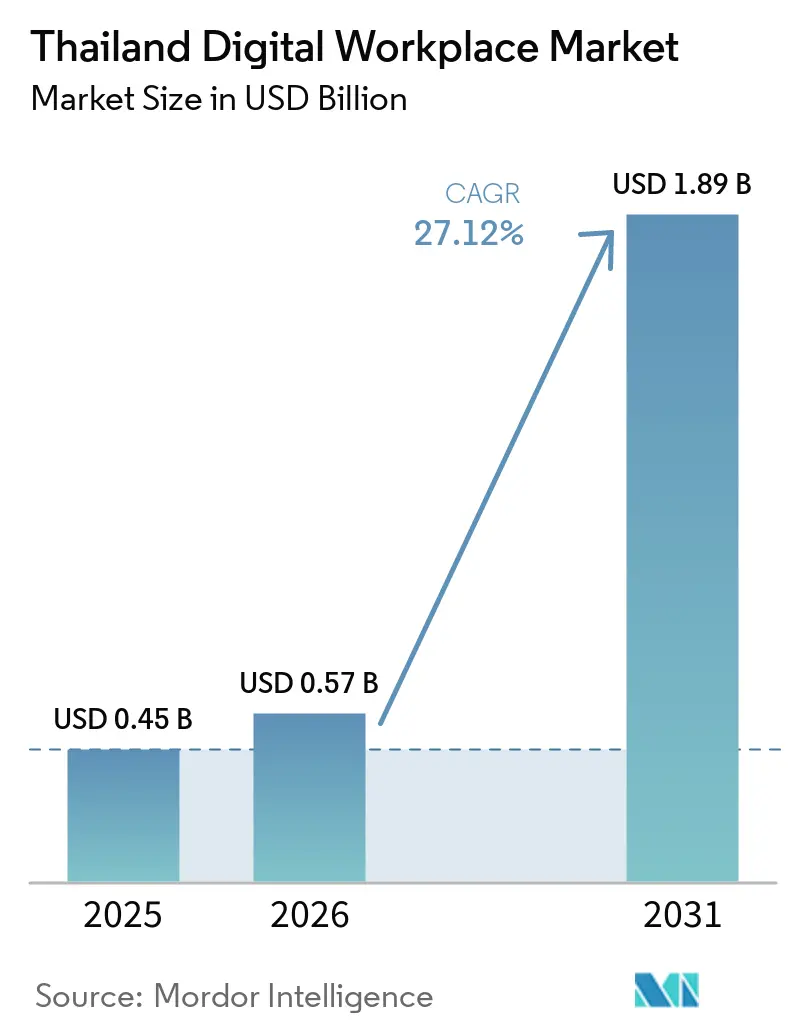
| Base Year Market Size (2025) | USD 0.45 Billion |
| Market Size (2026) | USD 0.57 Billion |
| Market Size (2031) | USD 1.89 Billion |
| Growth Rate (2026 - 2031) | 27.12 % |
| Market Concentration | Medium |
Major Players *Disclaimer: Major Players sorted in no particular order Image © Mordor Intelligence. Reuse requires attribution under CC BY 4.0. | |
Thailand Digital Workplace Market Analysis by Mordor Intelligence
The Thailand digital workplace market size was valued at USD 0.45 billion in 2025 and estimated to grow from USD 0.57 billion in 2026 to reach USD 1.89 billion by 2031, at a CAGR of 27.12% during the forecast period (2026-2031). The Thailand digital workplace market is expanding on the back of large cloud infrastructure commitments from Amazon Web Services, Google Cloud, and Microsoft, which are reducing long-standing barriers around latency, resilience, and local data handling. Hybrid work has moved from an informal practice to a formal operating model in many Thai organizations, which is pushing companies to standardize collaboration, endpoint, and employee experience platforms. Public sector digitization is also widening the addressable base for the Thailand digital workplace market because ministries, hospitals, and state-linked institutions now require digital tools that can support daily workflows at scale. Competition remains layered, with global workplace suite vendors strongest in large enterprises and domestic telecom-led providers gaining traction with smaller firms through bundled services and local support. Growth opportunities remain broad, but procurement speed is still affected by PDPA-related reviews, legacy application complexity, and the shortage of digital talent needed to roll out and manage new workplace tools.
Key Report Takeaways
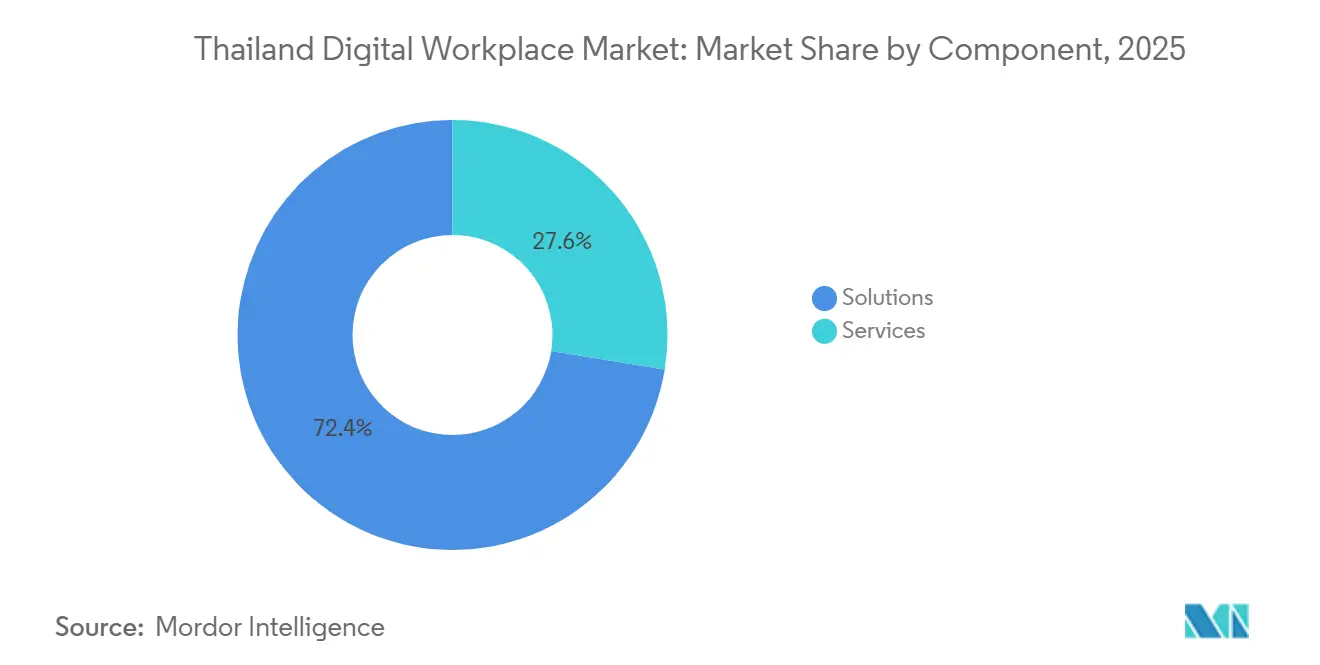
- By component, solutions accounted for 72.43% of the Thailand digital workplace market size in 2025, while the input indicates stronger migration and change-management demand within services without providing a separate component CAGR.
- By deployment mode, cloud held 69.27% of the Thailand digital workplace market share in 2025 and is projected to expand at a 21.99% CAGR through 2031.
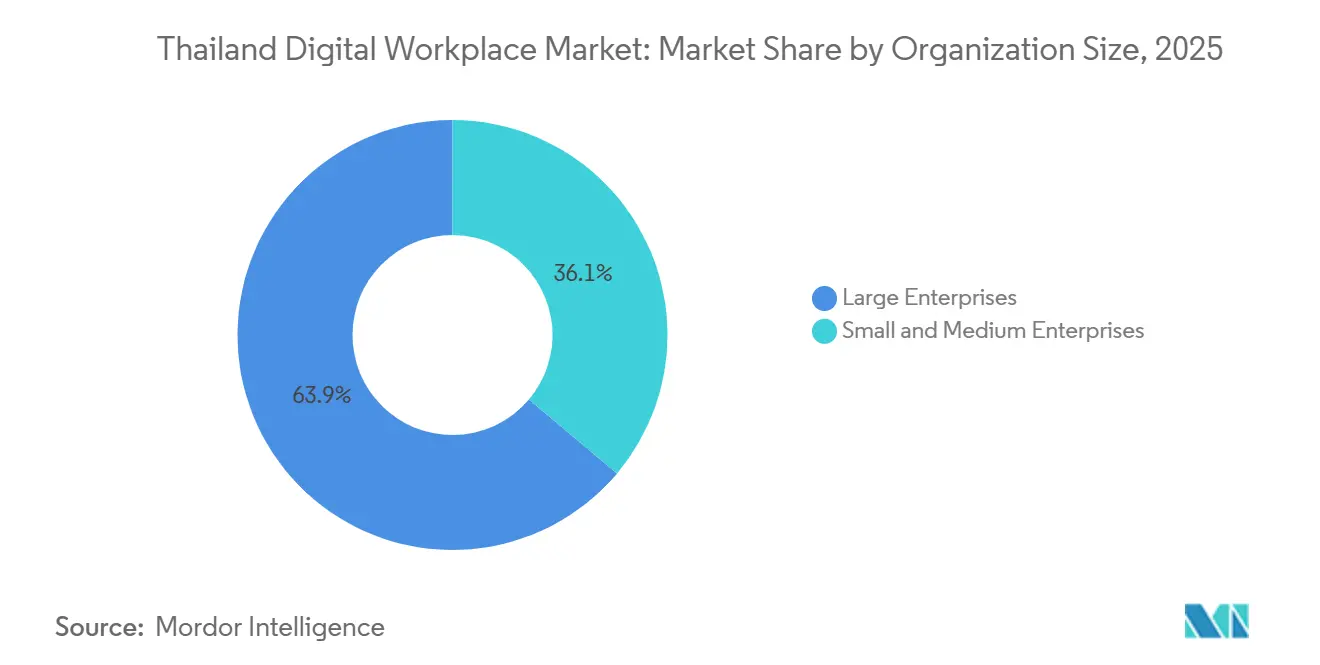
- By organization size, large enterprises held 63.86% of the market in 2025, while SMEs are expected to expand at a 22.26% CAGR through 2031.
- By end-user industry, manufacturing accounted for 29.54% of the Thailand digital workplace market size in 2025, while healthcare is projected to advance at a 22.34% CAGR through 2031.
Note: Market size and forecast figures in this report are generated using Mordor Intelligence’s proprietary estimation framework, updated with the latest available data and insights as of January 2026.
Thailand Digital Workplace Market Trends and Insights
Drivers Impact Analysis*
| Driver | (~) % Impact on CAGR Forecast | Geographic Relevance | Impact Timeline |
|---|---|---|---|
| Rising Hybrid Work Standardization In Thai Enterprises | +5.2% | National, Bangkok metro as primary early adopter | Short term (≤ 2 years) |
| Cloud-First Workplace Refresh Cycles In Bangkok-Focused Enterprises | +4.9% | Bangkok and Eastern Economic Corridor | Medium term (2-4 years) |
| Public Sector Digitization And Thailand 4.0 Programs | +3.8% | National | Medium term (2-4 years) |
| AI-Ready Collaboration And Employee Experience Demand | +3.5% | National, urban concentration in Bangkok and Chiang Mai | Medium term (2-4 years) |
| Cross-Platform Migration Pressure From Legacy Messaging And Endpoint Tools | +2.6% | Bangkok and Chiang Mai enterprise clusters | Short term (≤ 2 years) |
| Sector-Specific Compliance And Auditability Requirements | +2.1% | National, concentrated in BFSI, healthcare, and government | Long term (≥ 4 years) |
| Source: Mordor Intelligence | |||
Rising Hybrid Work Standardization In Thai Enterprises
Hybrid work in Thailand has moved beyond a temporary arrangement and has become part of formal workforce policy in many organizations, which is creating a clear buying trigger for the Thailand digital workplace market. A 2025 survey of 702 Thai employers found that part-time permanent roles in large organizations rose from 20% to 42%, while contract part-time roles increased from 19% to 28%, which shows that flexible work structures are becoming embedded in the labor market. This shift means employers can no longer depend on informal tool use and now need unified platforms that support communication, device control, and workflow continuity across office and remote settings. Microsoft’s Work Trend Index 2025 reported that 68% of Thai organizations had already started implementing AI agents to automate business processes, which places the workplace platform closer to an operating layer than a basic communication layer.[1] Cathcart Technology also reported that 31% of Thai technology professionals preferred a 2-day onsite and 3-day remote pattern in 2025, which reinforces the need for stable digital workspace infrastructure across locations.
Cloud-First Workplace Refresh Cycles In Bangkok-Focused Enterprises
Bangkok’s enterprise base is moving through a workplace refresh cycle that is closely tied to cloud migration, and this is strengthening demand in the Thailand digital workplace market.[2] The launch of in-country cloud capacity by Amazon Web Services and Google Cloud, together with Microsoft’s announced infrastructure investment, has reduced earlier concerns around latency and local data handling for enterprise workloads. Krungsri accelerated its cloud migration timeline by more than 50% through generative AI work with AWS, which shows that workplace modernization is now happening alongside core infrastructure change rather than after it. Google Cloud stated that Thai organizations migrating to its platform can cut unplanned downtime by over 50% and optimize technology spending by over 20% on average, which gives finance teams a direct case for broader platform renewal. As a result, many companies that have completed an initial cloud move are now in position to replace older collaboration, endpoint, and virtual desktop tools with more integrated platforms.
Public Sector Digitization And Thailand 4.0 Programs
Government-led digitization is creating a durable demand base for the Thailand digital workplace market because public institutions are modernizing internal operations and citizen-facing services at the same time. Thailand’s 20-year National Digital Economy and Society Development Plan continues to support cloud platforms, digital identity, and integrated public data systems, all of which require employee-facing digital tools to function at scale.[3] Research published in Frontiers in Political Science in 2026, based on 305 Thai public sector organizations, found that institutional pressure and government mandates are among the strongest predictors of smart government technology adoption. The Mor Prom Super App connected more than 902 hospitals and served around 26 million users by January 2026, which means healthcare staff across the country now depend on digital workflows that need stable workplace infrastructure behind them. This policy push also reaches private organizations because businesses that interact with digital public systems increasingly need compatible internal tools, processes, and data practices to keep those links working smoothly.
AI-Ready Collaboration And Employee Experience Demand
Thai enterprises are raising their expectations for collaboration platforms because AI features are becoming part of daily workflow decisions in the Thailand digital workplace market. PwC Thailand reported that 72% of Thai workers used AI in their jobs in 2025, compared with 54% globally, while daily generative AI use increased from 17% in 2024 to 24% in 2025. Microsoft also reported that 90% of Thai business leaders were confident they would deploy AI agents as team members within 12 to 18 months, which is shifting platform evaluations toward native AI integration instead of add-on features. This has started to shorten replacement cycles for older workplace platforms because buyers now want automated meeting summaries, task routing, service support, and knowledge access in one environment. The remaining gap between broad AI awareness and deeper workflow integration gives vendors with mature AI-ready architectures a clearer opening in the Thailand digital workplace market.
Restraints Impact Analysis*
| Restraint | (~) % Impact on CAGR Forecast | Geographic Relevance | Impact Timeline |
|---|---|---|---|
| PDPA-Driven Security Review Delays | -2.7% | National | Medium term (2-4 years) |
| Fragmented Legacy Application Estates | -2.3% | National, more severe in upcountry enterprises | Long term (≥ 4 years) |
| SME Budget Sensitivity for Multi-Tool Suites | -1.8% | National, particularly provincial SMEs | Short term (≤ 2 years) |
| Shortage of Workplace Modernization Skills and Change Managers | -1.4% | National, more severe outside Bangkok | Long term (≥ 4 years) |
| Source: Mordor Intelligence | |||
PDPA-Driven Security Review Delays
Thailand’s PDPA continues to slow platform procurement when workplace tools handle employee monitoring data, attendance records, communication logs, or analytics outputs. Employers need to map each type of employee data to a lawful basis for collection and use, which adds legal and operational review work before a full deployment can proceed. Notifications on ROPA exemptions issued in January 2025 gave smaller firms some relief, but they did not remove the broader need for cross-functional compliance checks when organizations assess AI-enabled workplace tools. The PDPA Master Plan 2024-2027 signals that Thailand is still tightening its data protection framework rather than moving into a lighter enforcement phase. This keeps deployment speed uneven across the Thailand digital workplace market and can push buyers toward smaller point solutions instead of broad suite rollouts.
Fragmented Legacy Application Estates
Many Thai enterprises still operate across old messaging systems, first-generation collaboration software, and legacy telephony assets, which makes full workplace standardization harder than headline cloud adoption figures suggest. DEPA reported in April 2025 that most Thai industrial enterprises remained at an Industry 2.0 maturity level, which indicates that digital tools are still being added into basic operations rather than run as unified workflows. A SAP and TDRI white paper published in May 2025 also noted that only 2% of Thai manufacturers had fully reached Industry 4.0 standards, which highlights the distance many firms still need to cover before advanced workplace platforms can scale cleanly. The result is a long stretch of API work, data cleanup, migration testing, and staff retraining before organizations can consolidate tools under a single operating model. This slows adoption in the Thailand digital workplace market, but it also favors vendors and partners that can reduce migration friction and support phased modernization.
*Our forecasts treat driver/restraint impacts as directional, not additive. The impact forecasts reflect baseline growth, mix effects, and variable interactions.
Segment Analysis
By Component: Solutions Architecture Drives Over Two-Thirds Of Spending
Solutions held 72.43% of the Thailand digital workplace market in 2025, which shows that enterprises are putting more of their budgets into software-defined workplace architecture than into stand-alone service delivery. This lead reflects the shift toward integrated communication, endpoint, workflow, and employee experience platforms that can be deployed across hybrid work settings. Unified communication and collaboration tools are moving fastest within the solutions-based because companies are trying to consolidate separate voice, messaging, and meeting products into fewer environments. Local cloud capacity has supported this change because it removes a major reason for keeping fragmented tool stacks in place. In financial services, the Kasikorn Business-Technology Group's deployment of high-availability data center networking with Huawei shows how institutions are building the underlying backbone needed for cloud-delivered desktop and workforce continuity models.
The services segment remains smaller, but its role is growing as the Thailand digital workplace industry moves from initial adoption into migration, change management, compliance readiness, and optimization work. Professional services demand is rising because buyers often need help linking workplace platforms to legacy applications, security frameworks, and business process rules. Large integrators such as Accenture, IBM, Wipro, TCS, and Infosys are positioned around this layer because the work now reaches beyond tool deployment and into operating model redesign. Workflow automation and knowledge management tools are also moving up the priority list because organizations that have already deployed core collaboration platforms are now trying to improve process flow and information access across teams. At the same time, the Thailand digital workplace industry still leaves room for focused solutions that address specific workflow gaps in manufacturing, HR, or service operations without requiring a full suite replacement.
By Deployment Mode: Cloud Dominance Accelerates With In-Country Data Infrastructure
Cloud was the leading deployment model in the Thailand digital workplace market in 2025 with a 69.27% share, and the cloud in the Thailand digital workplace market size is projected to grow at a 21.99% CAGR through 2031. This position has become stronger because local hyperscale infrastructure now gives Thai enterprises access to global-grade cloud performance with local hosting options. Google Cloud’s Bangkok region includes three availability zones and integration with the TalayLink subsea cable, which supports low-latency collaboration and virtual desktop workloads across Southeast Asia. Amazon Web Services also launched the AWS Asia Pacific (Thailand) Region as part of a long-term infrastructure commitment, which gives enterprises another local path for hosting workplace applications and data. These moves support a broader replacement cycle in which older hybrid or on-premises collaboration tools are being reconsidered as companies modernize their infrastructure base.
On-premises deployment still matters in regulated settings where organizations want stricter control over selected HR, communications, or monitoring data before they move further into cloud-based workplace operations. Hybrid architecture remains relevant because it lets companies keep sensitive control points on internal systems while running analytics, collaboration, and workflow tools in the cloud. This pattern is visible in manufacturing and utilities where shop-floor operations and operational continuity needs do not always line up with a full cloud-only move. Domestic cloud options are also shaping some buyer decisions because locally governed infrastructure can reduce hesitation in public sector and state-adjacent accounts. As a result, cloud leads clearly, but deployment choice in the Thailand digital workplace market is still influenced by security posture, operating complexity, and the pace of internal change.
By Organization Size: SMEs Emerge As The Next Expansion Frontier
SMEs are projected to grow at a 22.26% CAGR from 2026 to 2031, while large enterprises held 63.86% of the Thailand digital workplace market in 2025. Large organizations still account for most spending because they have stronger procurement structures, deeper IT budgets, and more urgent needs to standardize distributed work across large employee bases. Even so, the Thailand digital workplace market is moving into a new phase where smaller firms are becoming the main expansion frontier as vendors lower prices and implementation barriers. Programs aimed at accelerating SME digital adoption are helping address hesitation around return on investment and digital readiness, which has kept many smaller firms in partial adoption mode. This is making cloud email, messaging, basic collaboration, and lightweight workflow tools a more realistic entry point for companies that previously viewed enterprise-grade workplace platforms as out of reach.
SME growth is not uniform across the country, and that matters for how the Thailand digital workplace market develops over the next few years. Firms in Bangkok and the Eastern Economic Corridor are more likely to move toward fuller suites, while many provincial businesses are still starting with individual tools and limited-service bundles. PDPA compliance is also becoming a purchase trigger for smaller companies because ad hoc messaging and document practices can expose them to new legal and operating risks. This has increased the value of out-of-the-box compliance settings, local support, and simpler onboarding models in the SME segment. It also explains why telecom-led channels and managed bundles are gaining ground faster than direct enterprise-style sales motions in this part of the Thailand digital workplace market.
By End-User Industry: Manufacturing Commands Share As Healthcare Accelerates
Manufacturing held 29.54% of the Thailand digital workplace market in 2025, which made it the largest end-user vertical by current spending. The sector’s position reflects its scale in Thailand’s export economy and its central role in national industrial digitization plans. At the same time, manufacturing maturity is still uneven because DEPA reported that most Thai industrial enterprises remained at Industry 2.0, and SAP with TDRI noted that only 2% of manufacturers had fully transitioned to Industry 4.0 standards. This means current spending is still tied more to workforce scale than to deep workplace platform penetration. BFSI remains another important source of demand, and Krungsri’s cloud migration work with AWS shows how financial institutions are linking workplace modernization with automation, analytics, and process redesign.
Healthcare is the fastest-growing vertical, and healthcare in the Thailand digital workplace market size is projected to rise at a 22.34% CAGR through 2031. The Mor Prom Super App connected more than 902 hospitals by January 2026 and served around 26 million users, which has expanded the need for structured digital workflows among healthcare personnel nationwide. The February 2026 partnership between DataOne Asia and InterSystems adds another layer to this shift because it aims to connect hospitals and insurers through automated e-claims and interoperable data workflows. Government and public sector, education, retail, energy and utilities, legal services, and IT and telecommunications remain smaller in current share, but each is moving through workplace modernization at its own pace. This keeps the Thailand digital workplace market broad-based, even though manufacturing and healthcare are the clearest anchors in the present cycle.
Geography Analysis
Bangkok accounts for the majority of current activity in the Thailand digital workplace market because the capital concentrates large enterprises, financial institutions, ministries, and major technology buyers. Most of the country’s largest conglomerates and banks run their headquarters from Bangkok, which makes the city the first destination for enterprise-wide workplace modernization. JLL’s 2025 workplace survey, reported by IT Brief Asia, found that 76% of organizations in Bangkok supported hybrid work models, which points to sustained demand for collaboration and endpoint platforms in the capital. The same survey found that 40% of Bangkok firms allocated at least 10% of office space to wellness and collaborative environments, which signals that physical workplace redesign is increasingly linked to digital workplace investment. The cloud region launches and infrastructure commitments from Amazon Web Services, Google Cloud, and Microsoft have also centered on Bangkok, which has accelerated renewal planning for enterprise communication, management, and workflow systems.
The Eastern Economic Corridor is the next major demand cluster in the Thailand digital workplace market because it combines advanced manufacturing, automotive operations, and industrial technology programs across distributed sites. This corridor needs workplace tools that can connect head offices, engineering teams, production staff, and external partners across separate locations. Bosch’s Hemaraj smart factory is a good example of this operating model because it links manufacturing and R&D functions that depend on connected digital workflows. The area’s investment promotion status also brings in multinational companies that already use global workplace standards and need local implementation and support capacity, which is widening the addressable base beyond Bangkok alone.
Regional cities such as Chiang Mai, Khon Kaen, and Phuket represent an earlier but growing demand layer for the Thailand digital workplace market as SMEs and local enterprises build digital maturity. Skills development efforts outside Bangkok are important because workplace platform adoption in provincial areas depends as much on user capability as on product availability. As more organizations in these cities shift from basic communication tools to managed suites, regional demand should become more visible in total spending. Thailand is also competing with Vietnam, Indonesia, and the Philippines for digital hub status in Southeast Asia, which is keeping policy and infrastructure support high. With a 27.12% CAGR from 2026 to 2031, the Thailand digital workplace market remains one of the faster-growing country markets in the subregion, even though larger demand pools will continue to exist elsewhere in ASEAN.
Competitive Landscape
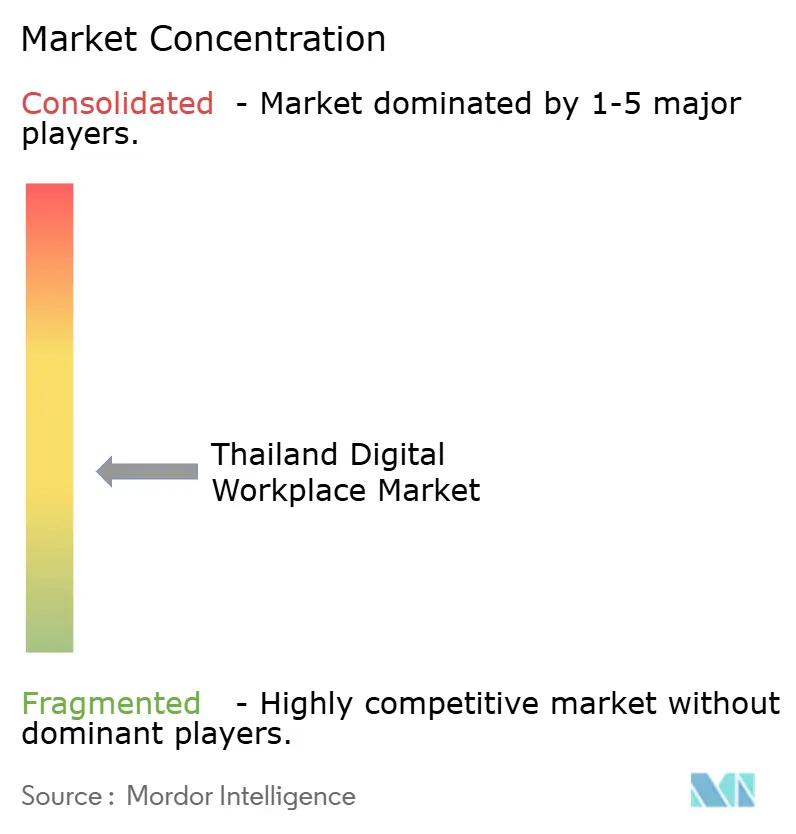
The Thailand digital workplace market is moderately concentrated at the top and fragmented across the mid-market and SME tiers. Global suite vendors remain strongest in large enterprises because they can combine collaboration, endpoint management, employee experience, and AI capabilities into one licensing structure. Their position has improved further as local cloud infrastructure has reduced earlier objections tied to latency and data handling. Competition at the top is moving away from basic feature comparison and toward ecosystem depth, partner coverage, AI readiness, and integration strength. Cisco and ServiceNow’s April 2025 partnership is a clear example because it combined Cisco AI Defense with ServiceNow SecOps to support AI risk management and governance inside enterprise workflows.
The biggest open space sits below the top tier of the Thailand digital workplace market, especially among provincial firms and upcountry enterprises that want local support, Thai-language implementation, and simpler buying models. A second opening exists where industrial operations need workplace tools that can connect to machine data, production processes, and supply chain visibility rather than stop at office collaboration. IBM and ServiceNow expanded their collaboration in June 2026 to address legacy application modernization and AI-ready data access, which aligns closely with the needs of organizations trying to move from fragmented estates into more integrated workplace environments. Domestic carriers such as AIS Business and True Corporation are also shaping competition because they bundle global software with managed services, local implementation, and compliance guidance. This model fits the SME segment well because it reduces procurement friction and shifts part of the operating burden to a trusted local provider.
System integrators remain important in the Thailand digital workplace market because many deployments still depend on application migration, identity alignment, data preparation, and adoption management across business units. That gives firms such as IBM, Accenture, Wipro, TCS, and Infosys a supporting role even when the software platform itself comes from a hyperscaler or collaboration suite vendor. Buyers are also becoming more selective about AI claims, which means vendors that offer native AI workflows are in a stronger position than those relying on lighter bolt-on features. The result is a market where leadership is visible in enterprise accounts, but broad-based fragmentation still defines the overall competitive structure of the Thailand digital workplace market.
Thailand Digital Workplace Industry Leaders
-
Microsoft Corporation
-
Google LLC
-
Cisco Systems, Inc.
-
Amazon Web Services, Inc.
-
AIS Business
- *Disclaimer: Major Players sorted in no particular order
Recent Industry Developments
- June 2026: IBM and ServiceNow expanded their strategic collaboration to address two core barriers to enterprise AI at scale in Thailand and globally, legacy application modernization and AI-ready data governance. Joint solutions combining IBM's watsonx capabilities with ServiceNow's AI Platform are expected to be commercially available in the second half of 2026, targeting autonomous IT operations, regulatory compliance workflows, and finance-and-procurement automation against SAP and Oracle ERP backbones.
- March 2026: Microsoft announced a USD 1+ billion investment in Thailand's cloud and AI infrastructure, effective 2026 to 2028, reinforced by a partnership with the Ministry of Labour to certify 150,000 workers and provide over 280 AI courses in Thai through the Department of Skill Development's online training platform. The announcement also included a USTDA-supported grant of USD 950,000 alongside USD 250,000 in Azure credits for Thai AI startup Ai-ssistance.
- March 2026: True Corporation signed a national MOU with the Ministry of Public Health to accelerate Thailand's healthcare digital transformation, leveraging 5G and AI to expand the Mohpromt Super App, currently serving approximately 26 million users, and to enhance digital capabilities for healthcare personnel through data analytics and cybersecurity training.
- February 2026: DataOne Asia (Thailand) and InterSystems announced a strategic partnership to build an AI-ready data bridge connecting Thai hospitals and insurance companies, enabling automated e-claims, seamless data interoperability, and next-generation healthcare digital infrastructure, supporting Thailand's Ministry of Public Health mandate to unify fragmented health data systems.
Thailand Digital Workplace Market Report Scope
The Thailand Digital Workplace Market refers to the market for digital tools, platforms, and services that enable employees in Thailand to communicate, collaborate, and work effectively across office, remote, and hybrid environments. It includes cloud-based productivity suites, collaboration software, unified communications, employee experience platforms, and endpoint management solutions.
The Thailand Digital Workplace Market Report is Segmented by Component (Solutions and Services), Deployment Mode (Cloud, On-Premises, and Hybrid), Organization Size (Large Enterprises and Small and Medium-Sized Enterprises), End-User Industry (IT and Telecommunications, BFSI, Healthcare, Manufacturing, Retail, Government and Public Sector, Education, Energy and Utilities, and Legal and Professional Services). The Market Forecasts are Provided in Terms of Value (USD).
| Solutions | Unified Communication and Collaboration |
| Unified Endpoint Management | |
| Enterprise Mobility and Management | |
| Employee Experience Platforms and Intranet | |
| Workflow Automation and Knowledge Management | |
| Virtual Desktop Infrastructure and Cloud PC | |
| Services |
| Cloud |
| On-Premises |
| Hybrid |
| Large Enterprises |
| Small and Medium-Sized Enterprises |
| IT and Telecommunications |
| BFSI |
| Healthcare |
| Manufacturing |
| Retail |
| Government and Public Sector |
| Education |
| Energy and Utilities |
| Legal and Professional Services |
| Other End-User Industries |
| By Component | Solutions | Unified Communication and Collaboration |
| Unified Endpoint Management | ||
| Enterprise Mobility and Management | ||
| Employee Experience Platforms and Intranet | ||
| Workflow Automation and Knowledge Management | ||
| Virtual Desktop Infrastructure and Cloud PC | ||
| Services | ||
| Deployment Mode | Cloud | |
| On-Premises | ||
| Hybrid | ||
| Organization Size | Large Enterprises | |
| Small and Medium-Sized Enterprises | ||
| End-User Industry | IT and Telecommunications | |
| BFSI | ||
| Healthcare | ||
| Manufacturing | ||
| Retail | ||
| Government and Public Sector | ||
| Education | ||
| Energy and Utilities | ||
| Legal and Professional Services | ||
| Other End-User Industries |
Key Questions Answered in the Report
What is the Thailand digital workplace market size in 2026?
The Thailand digital workplace market stands at USD 0.57 billion in 2026 and is projected to reach USD 1.89 billion by 2031 at a 27.12% CAGR.
Which component leads spending in Thailand digital workplace solutions?
Solutions led the market with a 72.43% share in 2025, showing that software platforms account for most current spending.
Why is cloud deployment expanding so quickly in Thailand?
Cloud held 69.27% share in 2025 and is projected to grow at 21.99% CAGR, supported by local infrastructure investments from AWS, Google Cloud, and Microsoft.
Which business size segment is growing the fastest?
SMEs are the fastest-growing segment with a projected 22.26% CAGR from 2026 to 2031, even though large enterprises still held 63.86% share in 2025.
Which end-user group is largest and which is growing the fastest?
Manufacturing held the largest share at 29.54% in 2025, while healthcare is projected to grow the fastest at a 22.34% CAGR through 2031.
What are the main issues slowing adoption of digital workplace platforms in Thailand?
The main constraints are PDPA-related review delays, fragmented legacy systems, SME budget sensitivity, and the shortage of modernization and change-management skills.