
Vietnam Digital Workplace Market Size and Share
Market Overview
| Study Period | 2020 - 2031 |
|---|---|
| Forecast Data Period | 2026 - 2031 |
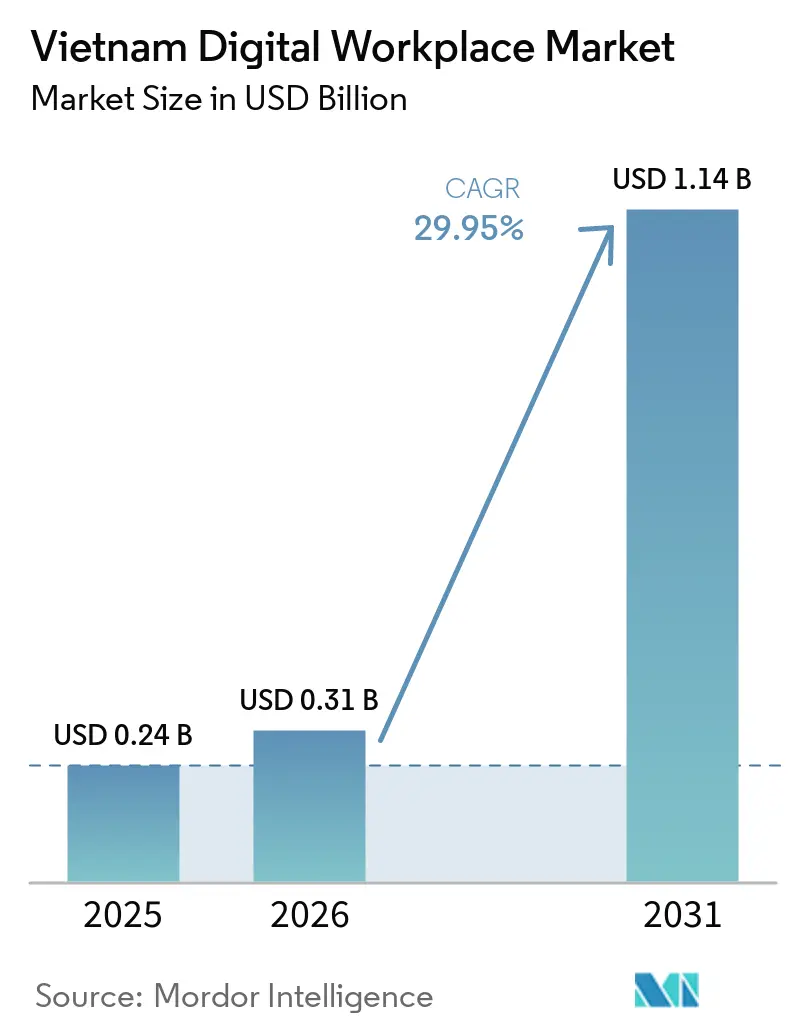
| Base Year Market Size (2025) | USD 0.24 Billion |
| Market Size (2026) | USD 0.31 Billion |
| Market Size (2031) | USD 1.14 Billion |
| Growth Rate (2026 - 2031) | 29.95 % |
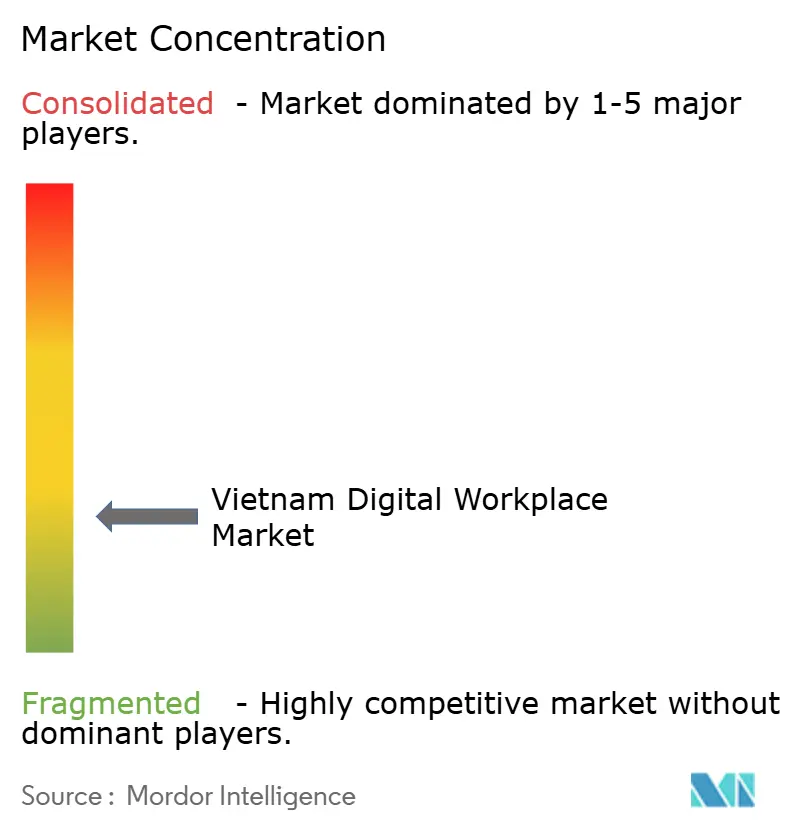
| Market Concentration | Low |
Major Players *Disclaimer: Major Players sorted in no particular order Image © Mordor Intelligence. Reuse requires attribution under CC BY 4.0. | |
Vietnam Digital Workplace Market Analysis by Mordor Intelligence
The Vietnam digital workplace market size was valued at USD 0.24 billion in 2025 and is projected to reach USD 1.14 billion by 2031, growing at a CAGR of 29.95% during 2026-2031. The Vietnam digital workplace market is expanding as Resolution No. 57-NQ/TW pushed digital transformation higher on enterprise and public-sector agendas and made workplace modernization part of a broader national shift. Demand is also being supported by Vietnam’s digital economy, which reached USD 72.1 billion in 2025 and strengthened the base for wider use of cloud productivity tools, collaboration software, and AI-supported workflows. Spending remains concentrated in Hanoi and Ho Chi Minh City because these cities host the largest enterprise clusters and continue to lead formal digital readiness indicators. The Vietnam digital workplace market also shows a clear split in competitive roles, with global platform vendors shaping product demand while Vietnamese integrators capture implementation, localization, and managed-service work. The next phase of the Vietnam digital workplace market is likely to come from SMEs and public institutions that still remain early in adoption, even as skills shortages, integration complexity, and cost pressure continue to slow deployment speed.
Key Report Takeaways
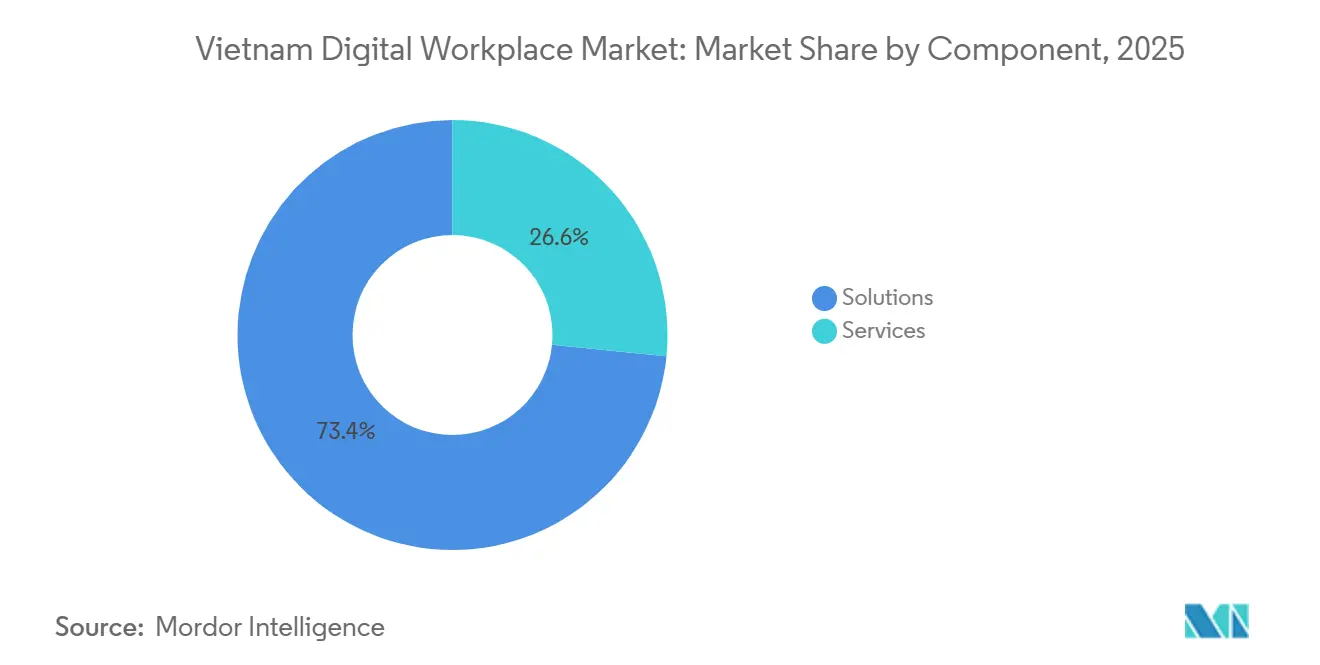
- By component, solutions held 73.43% of revenue of the Vietnam Digital Workplace Market in 2025, and is projected to expand at a 30.12% CAGR through 2031.
- By deployment mode, cloud accounted for 70.27% of the Vietnam digital workplace market size in 2025 and is projected to expand at a 30.29% CAGR through 2031.
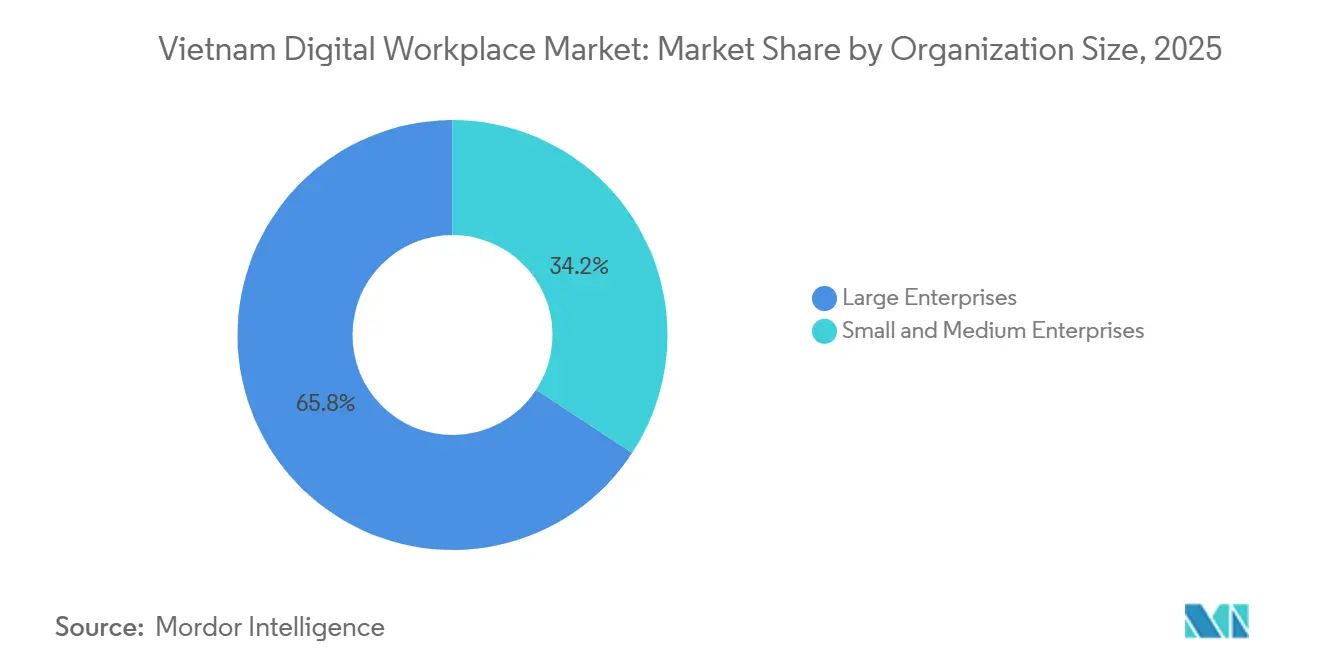
- By organization size, large enterprises held 65.77% of the Vietnam digital workplace market share in 2025, while SMEs are projected to record the highest CAGR at 30.11% through 2031.
- By end-user industry, manufacturing accounted for 32.74% of the Vietnam digital workplace market size in 2025, while healthcare is projected to advance at a 30.34% CAGR through 2031.
Note: Market size and forecast figures in this report are generated using Mordor Intelligence’s proprietary estimation framework, updated with the latest available data and insights as of January 2026.
Vietnam Digital Workplace Market Trends and Insights
Drivers Impact Analysis*
| Driver | (~) % Impact on CAGR Forecast | Geographic Relevance | Impact Timeline |
|---|---|---|---|
| Rapid Enterprise Digitization in Ho Chi Minh City and Hanoi | +7.5% | Ho Chi Minh City and Hanoi, with spillover to Da Nang and Binh Duong | Short term (≤ 2 years) |
| Hybrid Work Normalization Across Knowledge-Heavy Sectors | +6.2% | National, concentrated in Hanoi and Ho Chi Minh City | Short term (≤ 2 years) |
| Cloud-First Workplace Modernization by Multinationals and Large Local Firms | +5.8% | Global, with strongest demand in APAC and Ho Chi Minh City industrial corridors | Medium term (2-4 years) |
| Rising Security and Compliance Pressure for Managed Endpoints and Identity Control | +4.6% | National, with early compliance adoption in Hanoi government cluster and Ho Chi Minh City financial district | Medium term (2-4 years) |
| AI-Enabled Productivity, Search, and Automation Inside Collaboration Suites | +4.2% | National, with APAC spillover to Singapore and Japan operations | Medium term (2-4 years) |
| Rising Demand for Virtual Desktops and Secure Remote Access in Regulated Roles | +3.8% | National, with concentration in banking, healthcare, and government sectors | Long term (≥ 4 years) |
| Source: Mordor Intelligence | |||
Rapid Enterprise Digitization in Ho Chi Minh City and Hanoi
Ho Chi Minh City and Hanoi continue to set the pace for enterprise workplace modernization in the Vietnam digital workplace market because they contain the country’s largest concentration of business activity. Together, these 2 cities housed more than 50% of Vietnam’s enterprises, which gives them a clear lead in software adoption, procurement scale, and systems integration depth.[1] They also led the 2025 Vietnam eBusiness Index, with Hanoi scoring 74.7 points and Ho Chi Minh City scoring 73.5 points, which shows stronger readiness for digital business operations than the rest of the country. The policy push became more concrete when Hanoi’s Department of Science and Technology co-hosted a 2025 workshop with Microsoft Vietnam focused on Microsoft 365 and Copilot adoption in the public sector.[2] As these 2 cities keep setting enterprise standards, nearby industrial centers are likely to face stronger pressure from domestic and foreign parent organizations to follow the same workplace architecture.
Hybrid Work Normalization Across Knowledge-Heavy Sectors
Hybrid work is now a lasting operating model in the Vietnam digital workplace market, especially across technology, finance, marketing, and media roles that rely on digital coordination. ManpowerGroup’s 2026 employment outlook showed strong hiring intent in Vietnam, with 63% of employers planning to increase headcount, which supports continued demand for collaboration, communication, and employee experience tools. A 2026 study by Reeracoen and Rakuten Insight found that 74% of Vietnamese workers wanted hybrid arrangements while only 51% had access, leaving a large flexibility gap for employers to address. Research published in Humanities and Social Sciences Communications also found that foreign-owned and domestic firms in Vietnam manage hybrid work differently, which points to varied demand for governance, workflow, and policy-management features inside workplace platforms. This pattern keeps the Vietnam digital workplace market tied not only to hiring growth but also to the gap between worker expectations and the tools currently available inside local organizations.
Cloud-First Workplace Modernization by Multinationals and Large Local Firms
Cloud-led modernization has become a central growth engine in the Vietnam digital workplace market because multinational companies increasingly deploy standardized workplace stacks when they expand in the country. Vietnam’s National Cloud Program targets universal cloud adoption for government agencies by 2030 and expects 70% of private businesses to use cloud services from domestic providers, which creates a policy-backed floor for future demand. Large local firms are also building delivery strength around this shift, and FPT said in February 2026 that it had 1,500 Microsoft-certified engineers and more than 3,000 Microsoft certifications globally. That scale matters because the Vietnam digital workplace market depends on local implementation depth as much as software licenses, especially when enterprises want integration, migration, and ongoing support in one package. As cloud adoption rises, firms that can combine platform deployment with localization and managed services should remain well placed in the Vietnam digital workplace market.
Rising Security and Compliance Pressure for Managed Endpoints and Identity Control
Security and compliance requirements are pushing endpoint management and identity control higher on enterprise spending lists in the Vietnam digital workplace market. Vietnam’s Data Law framework widened the scope of regulated digital data and introduced more formal treatment of important and core data, which raised the compliance burden for enterprises operating distributed workforces.[3] Decree No. 165/2025/ND-CP, which took effect on July 1, 2025, added local storage and cross-border transfer requirements that directly affect workplace deployments built on cloud platforms. The Cybersecurity Law 2025, effective July 1, 2026, further extended localization obligations to foreign service providers operating in Vietnam. These legal shifts are making the Vietnam digital workplace market more favorable for vendors that can deliver compliant endpoint, access, and identity controls without forcing customers into long redesign cycles.
Restraints Impact Analysis*
| Restraint | (~) % Impact on CAGR Forecast | Geographic Relevance | Impact Timeline |
|---|---|---|---|
| Skills Gaps in Workplace Transformation and Admin Tooling | -2.8% | National, most acute in Tier 2 cities outside Hanoi and Ho Chi Minh City | Short term (≤ 2 years) |
| Integration Friction With Legacy ERP, HR, and Document Systems | -2.4% | National, with highest exposure in manufacturing and public sector | Medium term (2-4 years) |
| Cost Sensitivity Among SMEs for Multi-Vendor Digital Workplace Stacks | -1.9% | National, concentrated in SME clusters across industrial zones | Short term (≤ 2 years) |
| Data Residency, Sovereignty, and Procurement Complexity for Foreign Vendors | -1.7% | National, with enforcement risk highest in Ho Chi Minh City’s financial and government sectors | Medium term (2-4 years) |
| Source: Mordor Intelligence | |||
Skills Gaps in Workplace Transformation and Admin Tooling
Skills gaps remain a clear brake on the Vietnam digital workplace market because many organizations can buy platforms faster than they can manage or optimize them. The pressure is strongest outside Hanoi and Ho Chi Minh City, where specialist administrators, workplace architects, and integration staff remain less available than in the 2 major metro areas. This makes many deployments more dependent on outside service partners, which raises costs and can slow adoption in firms with tighter budgets. The government acknowledged the issue in its 2026-2030 SME digital transformation project, which aims to support 300,000 firms and build a network of at least 500 professional consultants for digital and AI adoption. Until internal skills become more evenly distributed, the Vietnam digital workplace market is likely to see uneven usage depth between large-city enterprises and provincial adopters.
Integration Friction With Legacy ERP, HR, and Document Systems
Integration with older enterprise systems remains a structural challenge for the Vietnam digital workplace market, especially in manufacturing, banking, and public-sector environments. A 2025 study of Vietnamese listed companies identified integration capability as one of the 5 most significant barriers to cloud adoption, alongside security and legal uncertainty. In practice, this means workplace tools are often judged not only on features but also on how well they connect with payroll, ERP, records, and approval systems already embedded in daily operations. The issue is especially visible in manufacturing, which held 32.74% of end-user demand in 2025 and often relies on workflow systems built around production planning and local process customization. Vendors that shorten the integration burden through pre-built connectors and stronger deployment services should continue to gain ground in the Vietnam digital workplace market.
*Our forecasts treat driver/restraint impacts as directional, not additive. The impact forecasts reflect baseline growth, mix effects, and variable interactions.
Segment Analysis
By Component: Solutions Dominate While Services Create Durable Upsell Pathways
Solutions captured 73.43% of the Vietnam digital workplace market share in 2025 and is projected to grow at 30.12% CAGR through 2031, which showed a clear enterprise preference for integrated platforms instead of fragmented point tools. In the Vietnam digital workplace market, unified communication and collaboration and unified endpoint management drew the broadest deployments because buyers wanted fewer vendors and lower administrative complexity. Demand also remained strong for workflow automation and knowledge management tools as enterprises looked for better search, task routing, and internal content access inside the same environment. Microsoft Vietnam’s 2025 Work Trend Index said that 65% of Vietnamese organizations were already using AI agents to fully automate specific workflows, compared with 46% globally, which supports continued demand for automation layers inside workplace suites This kept the Vietnam digital workplace market centered on solutions that can combine communication, device control, and workflow support in one operating layer.
Services remained smaller in revenue share, but they played a strategic role in the Vietnam digital workplace industry because implementation, integration, and managed support often determined how much long-term value a client received after purchase. The Vietnam digital workplace market continued to reward firms that could turn one-time software projects into recurring support relationships tied to user adoption and system performance. Meta’s shutdown of Workplace on September 1, 2025 created a direct migration event in internal communications, and FPT responded by launching its own intranet platform, FPT Place, for its 85,000-member workforce. In January 2026, Kingsoft Office and FPT also signed an agreement to localize WPS 365 for Vietnam and expand enterprise workplace delivery. These moves show why service-led localization remains an important part of the Vietnam digital workplace market and why the services layer can shape future solution choice.
By Deployment Mode: Cloud Is Both Dominant and the Fastest-Expanding Option
Cloud held 70.27% of the Vietnam digital workplace market size in 2025 and is projected to grow at a 30.29% CAGR through 2031, which keeps it as the largest and fastest-expanding deployment mode. This reflects a clear shift in the Vietnam digital workplace market toward hosted platforms that support distributed workforces, easier updates, and lower infrastructure management needs. Multinational companies have reinforced this direction because many of them have already standardized workplace tools across regional entities and want Vietnam teams to operate in the same environment. The policy backdrop also supports cloud adoption, with the national cloud agenda encouraging both public-sector use and broader private-sector participation. As a result, the Vietnam digital workplace market is seeing cloud move from a preferred option to a default architecture for many large organizations.
On-premises deployments still matter in the Vietnam digital workplace market for ministries, state-linked institutions, and other users that remain cautious about data exposure and long-standing infrastructure change. Hybrid setups also retain importance because many organizations still need to connect older systems with newer cloud collaboration layers rather than replace everything at once. A 2025 study in Humanities and Social Sciences Communications identified security concerns and integration challenges as major barriers to full cloud migration among Vietnamese enterprises. That finding helps explain why the Vietnam digital workplace industry continues to support mixed deployment models even while cloud leads overall growth. It also suggests that suppliers able to manage both migration and coexistence should remain better positioned than vendors focused on a single deployment path.
By Organization Size: Large Enterprises Lead Today While SMEs Drive The Expansion Phase
Large enterprises held 65.77% of the Vietnam digital workplace market share in 2025, which reflected their stronger budgets, formal procurement cycles, and greater need for enterprise-wide governance. In the Vietnam digital workplace market, this group includes multinational subsidiaries, state-owned enterprises, and domestic conglomerates that typically buy across multiple modules rather than adopt a single point solution. Large enterprise demand is especially visible in IT and telecom, banking, and manufacturing, where established relationships with Microsoft, Cisco, and Google have already shaped platform choice and rollout models. These buyers also rely more heavily on certified implementation partners, which reinforces the role of local service ecosystems in long-cycle deployments. That combination kept large enterprises at the center of current spending in the Vietnam digital workplace market even before broader SME demand begins to scale.
SMEs are projected to grow at a 30.11% CAGR through 2031, making them the most important expansion pool for the Vietnam digital workplace market over the forecast period. The government’s 2026-2030 program to support 300,000 SMEs in digital and AI adoption should help convert interest into actual purchases by lowering capability and planning barriers. This part of the Vietnam digital workplace market remains more price-sensitive, more likely to prefer simpler bundles, and less willing to take on long implementation projects with multiple vendors. That makes ease of deployment, training support, and manageable operating cost more important than deep feature breadth for many smaller buyers. As SME adoption deepens, suppliers that win early trust and keep migration friction low may hold an advantage when this cohort becomes a larger share of the Vietnam digital workplace market.
By End-User Industry: Manufacturing Anchors Revenue While Healthcare Builds Acceleration
Manufacturing accounted for 32.74% of the Vietnam digital workplace market size in 2025, which made it the largest end-user segment by revenue. This position reflects Vietnam’s export-oriented industrial base and the continuing influence of foreign-invested manufacturers that expect local operations to align with global collaboration and device-management standards. In the Vietnam digital workplace market, manufacturing buyers often need systems that work across headquarters, local plants, suppliers, and compliance teams without disrupting existing production workflows. That need has made unified communication, endpoint management, and secure access tools especially important in factory-linked environments. Manufacturing therefore remains the main revenue anchor for the Vietnam digital workplace market even as other sectors begin to accelerate from smaller bases.
Manufacturing accounted for 32.74% of the Vietnam digital workplace market size in 2025, which made it the largest end-user segment by revenue. This position reflects Vietnam’s export-oriented industrial base and the continuing influence of foreign-invested manufacturers that expect local operations to align with global collaboration and device-management standards. In the Vietnam digital workplace market, manufacturing buyers often need systems that work across headquarters, local plants, suppliers, and compliance teams without disrupting existing production workflows. That need has made unified communication, endpoint management, and secure access tools especially important in factory-linked environments. Manufacturing, remains the main revenue anchor for the Vietnam digital workplace market even as other sectors begi thereforen to accelerate from smaller bases.
Geography Analysis
Ho Chi Minh City and Hanoi remained the main centers of demand in the Vietnam digital workplace market because together they housed more than 50% of the country’s enterprises. That enterprise concentration helps explain why much of the Vietnam digital workplace market share is tied to these 2 cities rather than to smaller provincial locations. The 2025 Vietnam eBusiness Index also placed Hanoi first at 74.7 points and Ho Chi Minh City second at 73.5 points, confirming their lead in digital readiness. Hanoi’s role is shaped by its position as the political and administrative center, which makes public-sector modernization an important source of demand. This was visible in 2025 when the city’s Department of Science and Technology worked with Microsoft Vietnam on a formal program around Microsoft 365 and Copilot adoption.
Ho Chi Minh City plays a different role in the Vietnam digital workplace market because it combines enterprise headquarters demand with industrial and foreign-invested manufacturing activity. Companies operating there often need workplace systems that can match regional standards used in Singapore, Japan, and South Korea, which keeps demand focused on interoperable cloud platforms and scalable management tools. Da Nang is also becoming more visible as a delivery and services base rather than only a secondary demand center. FPT expanded its offshore development footprint there after opening a center in July 2025, which showed that higher-skill workplace and transformation work is spreading beyond the 2 largest metro areas. Industrial corridors such as Binh Duong, Dong Nai, and Hung Yen are adding to the Vietnam digital workplace market as factories adopt collaboration and endpoint tools required by foreign parent companies.
The wider geography of the Vietnam digital workplace market is also shaped by Vietnam’s fast-rising digital economy and its role inside regional digital trade. The country’s digital economy grew at 19% a year between 2020 and 2025, which gave platform vendors a strong reason to invest attention and delivery capacity in Vietnam. VietnamPlus also reported that ASEAN’s digital economy agreement process was expected to improve cross-border data flows, which matters for multinational deployments that span neighboring markets. These factors indicate that the Vietnam digital workplace market is moving from a single-country deployment destination toward a more active place in regional digital operating models.
Competitive Landscape
The Vietnam digital workplace market remains moderately fragmented because global platform vendors lead in core software categories while many Vietnamese firms compete in implementation, support, localization, and managed services. Microsoft, Google, and Cisco hold strong positions in collaboration and productivity environments, but their reach in the Vietnam digital workplace market is reinforced by local delivery partners rather than by direct selling alone. Microsoft said its Vietnam partner network included 1,200 partners employing around 100,000 people in 2025, with 70% of them classified as small and medium-sized businesses. That distributed structure gives the Vietnam digital workplace market a deep implementation layer that is difficult for new foreign entrants to match quickly. It also means vendor success depends not only on product strength but also on channel depth, training capacity, and the ability to support users after deployment.
Competition in the Vietnam digital workplace market is increasingly shifting toward AI support, workflow automation, and enterprise search rather than basic communication features alone. FPT strengthened its position in this environment when it was recognized in the Gartner Market Guide for Microsoft 365 Implementation and Support Services 2026 and highlighted its certified engineering base in a February 2026 release. FPT also launched FPT Place in September 2025 after Meta shut down Workplace, which gave it a direct opening in intranet and employee communication use cases. In January 2026, Kingsoft Office and FPT signed a partnership to localize WPS 365 for Vietnam, which showed a broader push to offer office productivity alternatives with local delivery support. These moves show how the Vietnam digital workplace market is becoming more competitive at the solution layer and not only at the infrastructure layer.
Local challengers are also finding space in the Vietnam digital workplace market by focusing on Vietnamese-language workflows, domestic support, and price points better suited to mid-sized buyers. Viettel IDC has used the VMware transition period to position itself as a migration and infrastructure advisor for enterprises reassessing legacy environments. Smaller Vietnamese providers such as 1Office, GapoWork, and ASOFT add further pricing pressure in the mid-market because they can compete on localization and simpler adoption paths. This keeps the Vietnam digital workplace market open to several vendor types rather than allowing one small group of companies to dominate all layers of demand. It also explains why the current structure of the Vietnam digital workplace market still favors execution quality and local fit as much as brand scale.
Vietnam Digital Workplace Industry Leaders
-
Microsoft Corporation
-
Cisco Systems, Inc.
-
Zoom Communications, Inc.
-
Google LLC
-
ServiceNow
- *Disclaimer: Major Players sorted in no particular order
Recent Industry Developments
- June 2026: FPT and C.P. Vietnam kicked off 6 strategic AI transformation programs across C.P. Vietnam's integrated Feed-Farm-Food value chain, following an agreement signed at the Thailand-Vietnam Business Forum on June 8, 2026. This represents FPT's first large-scale AI deployment in Vietnam's agribusiness sector, directly affecting employee workflow automation and knowledge management tools.
- May 2026: Viettel Group and Petrolimex signed a strategic cooperation agreement on May 25, 2026, covering digital infrastructure, AI/IoT deployment in smart station management, and the use of Viettel's cloud services for system security and availability across Petrolimex's operations, extending Viettel's digital workplace reach into state-owned enterprise field operations.
- April 2026: FPT signed an agreement with Chugoku Electric Power Group, one of Japan's ten largest regional utilities, to provide Microsoft 365 licenses and workplace transformation services, building on a pilot launched in late 2024. The deal was supported by FPT's offshore development center established in Da Nang in July 2025.
- January 2026: Kingsoft Office and FPT signed a strategic MOU on January 9, 2026, to localize WPS 365 for the Vietnamese market, jointly develop enterprise workplace solutions, and expand global delivery capabilities, introducing an alternative office productivity suite to the Vietnamese enterprise market.
Vietnam Digital Workplace Market Report Scope
The Vietnam Digital Workplace Market refers to the market for digital tools, platforms, and services that enable employees in Vietnam to communicate, collaborate, and work effectively across office, remote, and hybrid environments. It includes cloud-based productivity suites, collaboration software, unified communications, employee experience platforms, and endpoint management solutions.
The Vietnam Digital Workplace Market Report is Segmented by Component (Solutions and Services), Deployment Mode (Cloud, On-Premises, and Hybrid), Organization Size (Large Enterprises and Small and Medium-Sized Enterprises), End-User Industry (IT and Telecommunications, BFSI, Healthcare, Manufacturing, Retail, Government and Public Sector, Education, Energy and Utilities, and Legal and Professional Services). The Market Forecasts are Provided in Terms of Value (USD).
| Solutions | Unified Communication and Collaboration |
| Unified Endpoint Management | |
| Enterprise Mobility and Management | |
| Employee Experience Platforms and Intranet | |
| Workflow Automation and Knowledge Management | |
| Virtual Desktop Infrastructure and Cloud PC | |
| Services |
| Cloud |
| On-premises |
| Hybrid |
| Large Enterprises |
| Small and Medium-sized Enterprises |
| Information Technology and Telecommunications |
| Banking, Financial Services, and Insurance |
| Healthcare |
| Manufacturing |
| Retail |
| Government and Public Sector |
| Education |
| Energy and Utilities |
| Legal and Professional Services |
| Other End-user Industries |
| By Component | Solutions | Unified Communication and Collaboration |
| Unified Endpoint Management | ||
| Enterprise Mobility and Management | ||
| Employee Experience Platforms and Intranet | ||
| Workflow Automation and Knowledge Management | ||
| Virtual Desktop Infrastructure and Cloud PC | ||
| Services | ||
| By Deployment Mode | Cloud | |
| On-premises | ||
| Hybrid | ||
| By Organization Size | Large Enterprises | |
| Small and Medium-sized Enterprises | ||
| By End-user Industry | Information Technology and Telecommunications | |
| Banking, Financial Services, and Insurance | ||
| Healthcare | ||
| Manufacturing | ||
| Retail | ||
| Government and Public Sector | ||
| Education | ||
| Energy and Utilities | ||
| Legal and Professional Services | ||
| Other End-user Industries |
Key Questions Answered in the Report
What is the Vietnam digital workplace market size in 2025 and 2031?
The Vietnam digital workplace market was valued at USD 0.24 billion in 2025 and is projected to reach USD 1.14 billion by 2031, with a CAGR of 29.95% during 2026-2031.
What is driving growth in Vietnam's digital workplace ecosystem?
Growth is being supported by national digital transformation policy, a USD 72.1 billion digital economy in 2025, rising cloud adoption, and wider use of collaboration and automation platforms.
Which deployment mode leads workplace software adoption in Vietnam?
Cloud leads by a wide margin, holding 70.27% share in 2025 and posting the fastest projected CAGR at 30.29% through 2031.
Which customer group offers the biggest expansion opportunity?
SMEs offer the strongest expansion opportunity because they are projected to grow at a 30.11% CAGR through 2031, even though large enterprises still held 65.77% share in 2025.
Which end-user sector spends the most on digital workplace tools in Vietnam?
Manufacturing led spending with 32.74% share in 2025 because export-oriented operations and foreign-invested factories need standardized collaboration and endpoint systems.
Which end-user sector is growing fastest in workplace modernization?
Healthcare is the fastest-growing end-user segment, with a projected CAGR of 30.34% through 2031 as administrative and clinical digitization gains pace.