
Thailand Data Center Construction Market Size and Share
Market Overview
| Study Period | 2020 - 2031 |
|---|---|
| Forecast Data Period | 2026 - 2031 |
| Base Year Market Size (2025) | USD 0.87 Billion |
| Market Size (2026) | USD 0.94 Billion |
| Market Size (2031) | USD 1.49 Billion |
| Growth Rate (2026 - 2031) | 9.49 % |
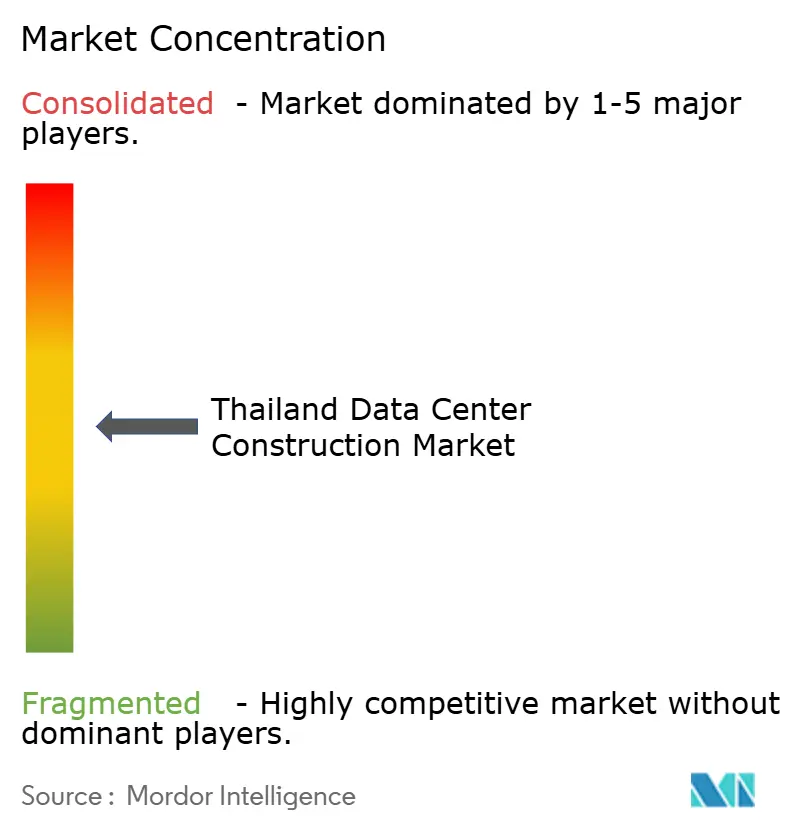
| Market Concentration | Medium |
Major Players *Disclaimer: Major Players sorted in no particular order Image © Mordor Intelligence. Reuse requires attribution under CC BY 4.0. | |
Thailand Data Center Construction Market Analysis by Mordor Intelligence
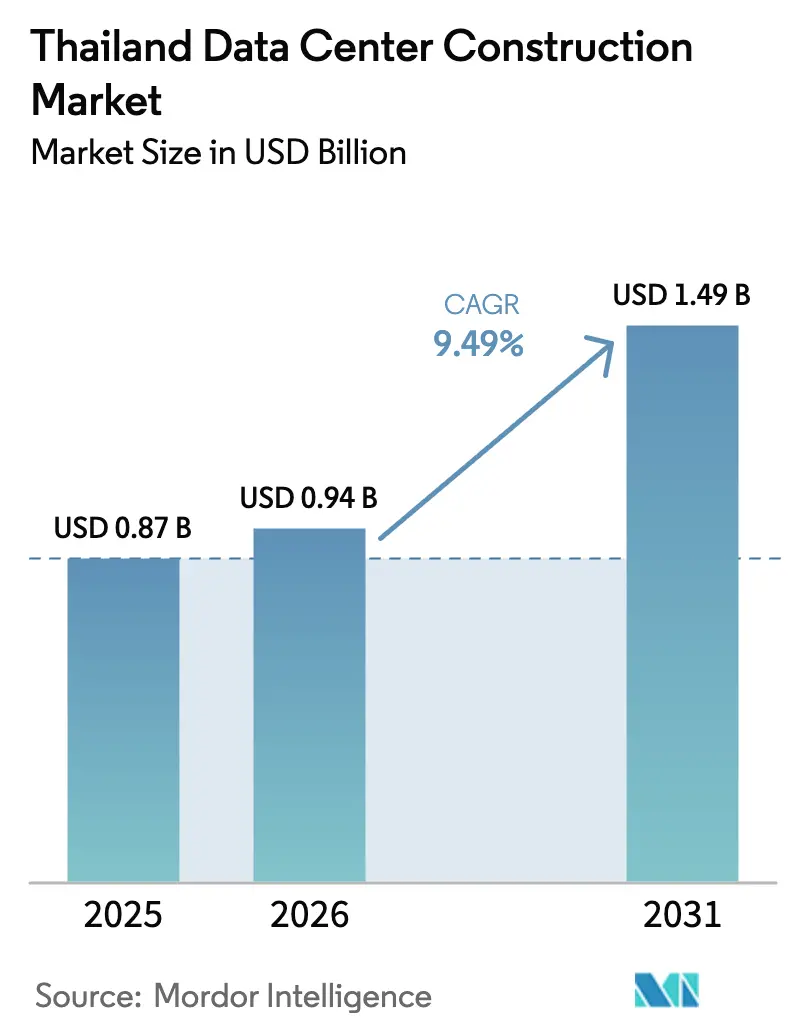
The Thailand data center construction market size is expected to increase from USD 0.87 billion in 2025 to USD 0.94 billion in 2026 and reach USD 1.49 billion by 2031, growing at a CAGR of 9.49% over 2026-2031. The current expansion reflects cloud‐provider moves to diversify away from saturated Singapore and high-cost Tokyo, the Eastern Economic Corridor’s (EEC) fifteen-year tax holidays, and a dense subsea-cable network that positions the country within one hop of ASEAN’s 680 million consumers. Ongoing enforcement of the Personal Data Protection Act, fast-tracked permitting under the Thailand FastPass program, and a government-approved pipeline of eighty data-center and cloud projects valued at THB 480 billion are further accelerating construction. Electrical systems still command the largest slice of capital budgets, yet liquid-cooling retrofits, modular mechanical systems, and GPU-dense rack designs are rapidly pulling spend toward cooling. Competitive rivalry is intensifying as established colocation operators defend share against hyperscaler captive builds and REIT-backed newcomers, while headline risks around premium electricity tariffs and lengthy 115 kV grid approvals threaten schedules and margins.
Key Report Takeaways
- By tier type, Tier 3 facilities led with 56.43% of Thailand data center construction market share in 2025, while Tier 4 builds are on track for a 10.32% CAGR through 2031.
- By data-center size, large-format facilities held 54.54% of Thailand data center construction market share in 2025, whereas hyperscale campuses are forecast to rise at a 10.64% CAGR through 2031.
- By data-center type, colocation environments accounted for 55.88% share in 2025, and hyperscaler or cloud-service-provider projects are advancing at a 10.87% CAGR to 2031.
- By infrastructure component, electrical systems captured 39.12% share in 2025, yet mechanical infrastructure is expected to expand at a 10.98% CAGR between 2026 and 2031.
Note: Market size and forecast figures in this report are generated using Mordor Intelligence’s proprietary estimation framework, updated with the latest available data and insights as of January 2026.
Market Trends and Insights
Drivers Impact Analysis of Thailand Data Center Construction Market*
| Driver | (~) % Impact on CAGR Forecast | Geographic Relevance | Impact Timeline |
|---|---|---|---|
| Intensified Cloud-Service Build-Outs by Hyperscalers | +2.8% | National, concentrated in Chonburi, Rayong, and Samut Prakan industrial estates | Medium term (2-4 years) |
| Government Incentives for Eastern Economic Corridor Digital Corridors | +2.1% | Eastern Economic Corridor provinces (Chonburi, Rayong, Chachoengsao), spillover to Bangkok periphery | Long term (≥4 years) |
| Growth in OTT Video Traffic and Edge-Node Demand | +1.5% | National, with urban concentration in Bangkok Metropolitan Region | Short term (≤2 years) |
| Accelerating Liquidity in REIT-Backed Data-Center Real-Estate | +1.2% | National, favoring EEC industrial zones with utility access | Medium term (2-4 years) |
| Mandatory Data-Sovereignty Compliance (PDPA) | +1.0% | National, cross-border data transfer constraints affecting multinational enterprises | Short term (≤2 years) |
| Emerging Quantum-Ready Power and Cooling Standards | +0.9% | National, early adoption in hyperscale and Tier 4 facilities | Long term (≥4 years) |
| Source: Mordor Intelligence | |||
Intensified Cloud-Service Build-Outs by Hyperscalers
A multibillion-dollar wave of captive infrastructure is reshaping the Thailand data center construction market as Amazon Web Services, Google Cloud, and Microsoft Azure commit to local regions that must meet sovereign-cloud and renewable-energy mandates. The Board of Investment approved USD 2.7 billion in new data center projects in March 2025, including a 300 MW campus in Rayong by Beijing Haoyang, confirming the pull-through effect of hyperscaler anchor tenants. Chonburi and Rayong have emerged as core nodes thanks to land availability, proximity to submarine-cable landing sites, and direct power-purchase pilots that shave 10-15% off grid tariffs.[1] Liquid-cooling adoption is quickening in tandem because hyperscalers favor 100 kW-per-rack densities for AI training.[2] Competition for megawatt-scale sites is now spilling into secondary EEC plots as prime parcels sell out.
Government Incentives for Eastern Economic Corridor Digital Corridors
Fifteen-year tax holidays, duty-free imports of IT equipment, and streamlined land-ownership rights underpin the EEC policy package, removing much of the fiscal drag that historically pushed developers into neighboring Malaysia or Vietnam. Digital Park Thailand supplies dark fiber to submarine cable systems and enables qualifying data centers to procure up to 50 MW of renewable power at rates below commercial tariffs. The FastPass framework compresses permitting from eighteen to six months, a critical advantage for hyperscale builds that stage civil, electrical, and mechanical work concurrently. WHA Corporation disclosed land sales of 180 acres to a single data-center customer in 1Q 2025, underscoring sustained appetite for EEC plots. Collectively, these incentives add more than two percentage points to forecast CAGR.
Growth in OTT Video Traffic and Edge-Node Demand
Nationwide internet penetration topped 85% in 2024, and 96% of users stream video, prompting content-delivery networks to cache media closer to subscribers.[3] Colocation providers are therefore deploying micro-data centers in Chiang Mai, Phuket, and Hat Yai to cut backhaul latency. Concurrent 5G roll-outs, exceeding 30,000 base stations by mid-2025, intensify the need for distributed compute fabric that can handle real-time analytics. GPU-ready modular enclosures from Schneider Electric and Delta Electronics are gaining traction because they ship with integrated cooling and can be craned into urban rooftops or mall basements. This edge surge keeps Thailand data center construction market activity buoyant even outside the EEC core.
Mandatory Data-Sovereignty Compliance (PDPA)
Full enforcement of the Personal Data Protection Act in March 2024 compels enterprises to host sensitive Thai citizen data onshore or face fines up to THB 5 million, pushing multinational banks and hospitals into domestic colocation suites. Bangkok Bank and Siam Commercial Bank migrated core systems to PDPA-compliant facilities in 2025, locking in multi-year leases that underpin utilization. The Act’s extraterritorial reach forces regional SaaS vendors to place edge nodes locally, advancing the Thailand data center construction market as firms race to secure space that meets ISO 27001 and PCI DSS requirements. Many mid-tier providers seek Tier III certification to monetize this compliance premium.
Restraints Impact Analysis of Thailand Data Center Construction Market*
| Restraint | (~) % Impact on CAGR Forecast | Geographic Relevance | Impact Timeline |
|---|---|---|---|
| Premium Electricity Tariffs versus Regional Peers | -1.8% | National, acute for facilities outside Direct PPA eligibility | Medium term (2-4 years) |
| Lengthy 115 kV Grid-Connection Approval Cycles | -1.3% | National, concentrated in metro Bangkok and EEC industrial zones | Short term (≤2 years) |
| Rising Land Prices in Metro Bangkok | -0.7% | Bangkok Metropolitan Region, Samut Prakan, Pathum Thani | Medium term (2-4 years) |
| Shortage of Uptime-Tier-Accredited Engineers | -0.5% | National, with acute gaps in Tier III and IV facilities | Long term (≥4 years) |
| Source: Mordor Intelligence | |||
Premium Electricity Tariffs versus Regional Peers
Commercial tariffs averaged THB 4.20 per kWh in 2025, roughly 15-20% higher than Malaysia or Vietnam, driving up total cost of ownership for GPU clusters that draw continuous high loads. EGAT’s direct power-purchase pilot lets qualifying facilities lock in renewable energy at discounts, but the 2 GW program supports fewer than forty large sites, advantaging hyperscalers and leaving mid-tier colocation firms on standard rates. Developers are now exploring on-site solar–plus-battery systems to shave peak demand, though capex adds payback risk. Unless the 2024 Power Development Plan’s 10 GW renewable expansion is accelerated, high tariffs may curb small-format builds.
Lengthy 115 kV Grid-Connection Approval Cycles
A multi-agency sign-off process involving EGAT, the Metropolitan Electricity Authority, and the Provincial Electricity Authority means that energizing lines larger than 20 MW can take 12-18 months. STT GDC’s 24 MW Bangkok 2 project waited 14 months for substation allocation, pushing mechanical handover close to target commissioning. Developers stockpile diesel generators and batteries to guarantee Tier III uptime during the lag but incur 8-12% higher electrical capex. The FastPass scheme promises utility coordination, yet effective relief hinges on synchronizing BOI incentives with regulator capacity planning.
*Our forecasts treat driver/restraint impacts as directional, not additive. The impact forecasts reflect baseline growth, mix effects, and variable interactions.
Thailand Data Center Construction Market Segment Analysis
By Tier Type:
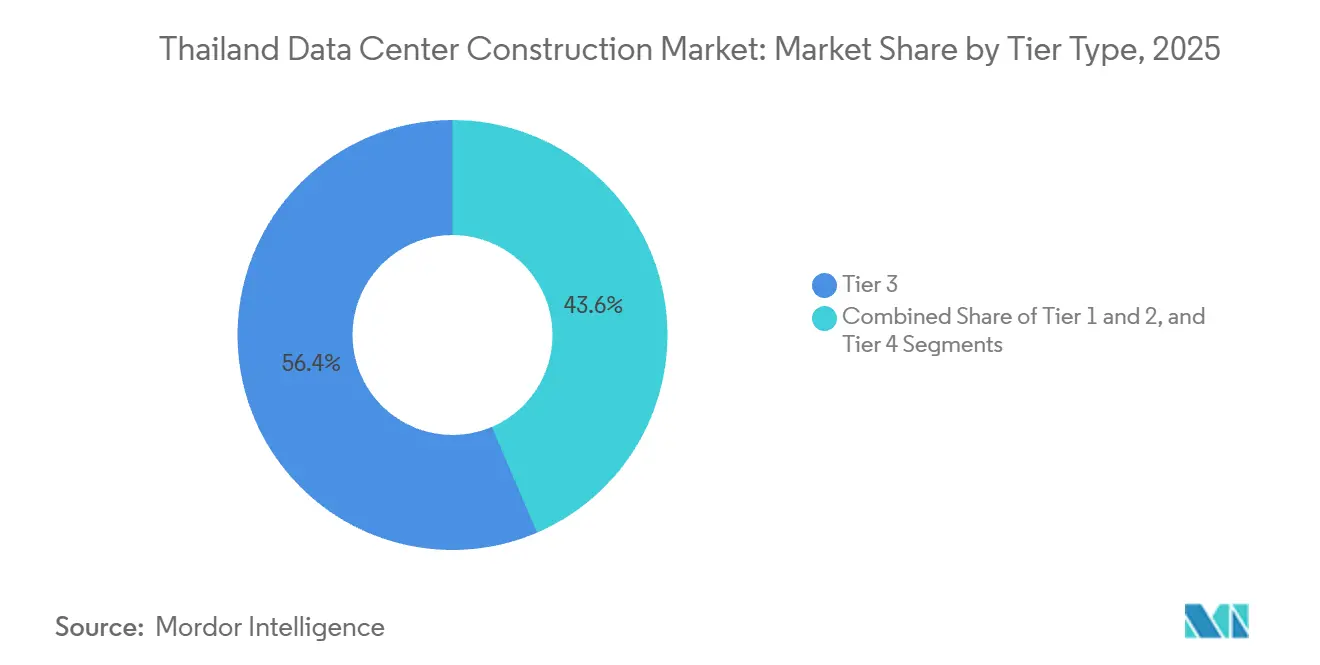
Tier 4 Gains as AI Workloads Demand RedundancyTier 3 installations controlled 56.43% of Thailand data center construction market in 2025, offering enterprises 99.982% service-level agreements without Tier 4’s costlier fault tolerance. Hyperscalers, however, are driving a 10.32% CAGR in Tier 4 builds by insisting on N + N power and cooling to host AI training models at densities that breach 30 kW per rack. SUPERNAP Thailand’s Tier IV Chonburi campus became one of Southeast Asia’s only fault-tolerant sites in 2024, giving operators a blueprint for GPU-ready design. Liquid-cooling retrofits such as the 100 kW-per-rack system deployed by STT GDC in April 2025 further bolster Tier 4 economics by boosting power-usage effectiveness from 1.6 to 1.2.
Tier 1 and Tier 2 footprints, once popular with small enterprises, are declining as workloads consolidate into higher-tier colocation suites. Operators that cannot finance Tier 3 upgrades face acquisition or exit. The investment tilt toward Tier 4 elevates mechanical complexity, encouraging partnership with specialist engineering firms that can certify fault tolerance under Uptime Institute protocols. Over the forecast window, Tier 3 will still anchor the Thailand data center construction market size, but Tier 4 is set to outgrow every other tier as AI adoption accelerates.

By Data Center Size:
Hyperscale Builds Reshape Capacity MixLarge-format facilities (10-50 MW) represented 54.54% of 2025 spending, yet the hyperscale segment, defined as campuses topping 50 MW, is moving at a 10.64% CAGR. Amazon Web Services and Google Cloud have each earmarked multiyear investments exceeding USD 1 billion for hyperscale regions, while Beijing Haoyang’s 300 MW Rayong plan will dwarf existing Thai footprints once completed. The Thailand data center construction market size for hyperscale projects is set to overtake large-format colocation by 2029 if all announced capacity materializes. Modular construction and prefabricated power rooms from Schneider Electric let developers shave deployment cycles by 6 months, a competitive edge when anchor tenants require first-rack delivery within 24 months.
Medium-format (5-10 MW) facilities lag because enterprises either leapfrog directly into public cloud or consolidate workloads into shared 20 MW colocation halls. Small (sub-5 MW) sites now skew toward edge computing and disaster recovery, particularly in Chiang Mai and Phuket, where regional consumer bases justify local caching. Nonetheless, the Thailand data center construction market retains a place for micro-facilities tied to 5G towers and retail hubs, keeping supply chains diverse.
By Data Center Type:
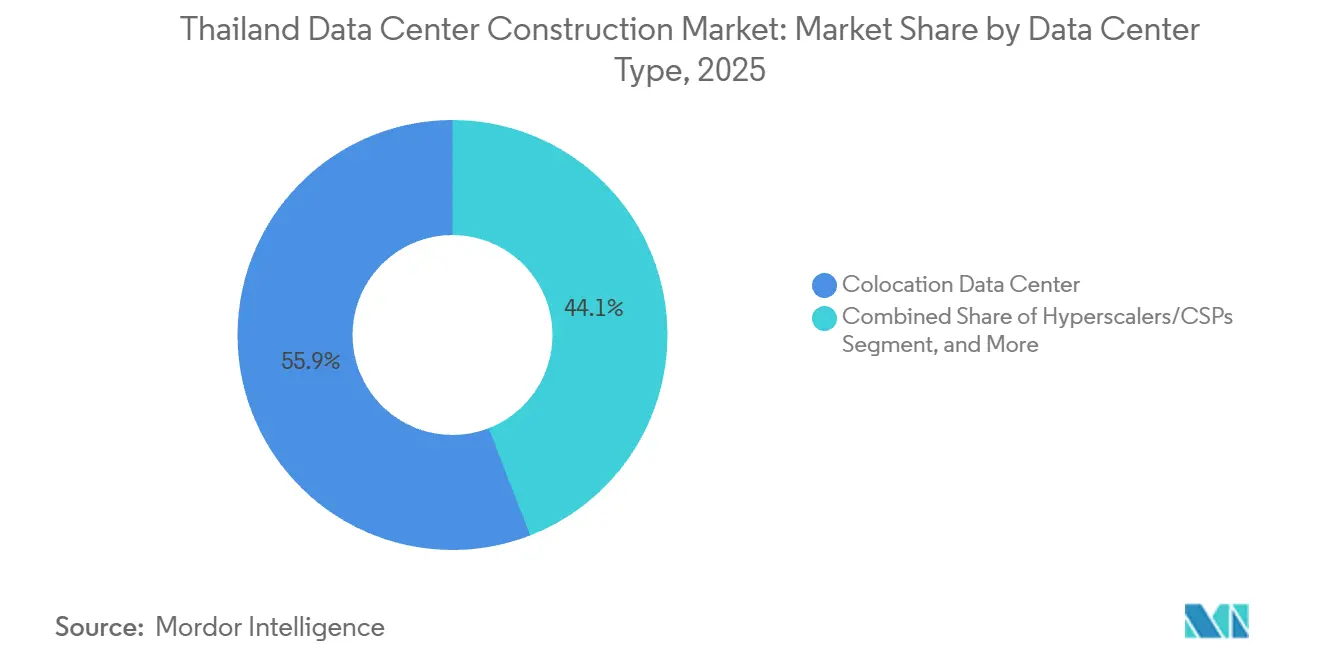
Colocation Retains Lead as Hyperscalers Build Captive CapacityColocation held 55.88% share in 2025, serving enterprises that prefer operating-expenditure models over ground-up builds. True IDC alone operates more than 49 MW across Bangkok sites and secured a USD 560 million loan in November 2025 to add a 102.6 MW Rayong campus, signaling lender confidence in continued enterprise demand. However, the Thailand data center construction market faces structural bifurcation as hyperscalers erect captive campuses for sovereign-cloud use-cases, bypassing colocation providers for mission-critical AI workloads.
Edge and enterprise facilities, although fragmented, remain crucial for latency-sensitive logistics and retail applications. Containerized builds from Delta Electronics compress civil works to a few weeks, letting retailers place 500 kW pods near distribution hubs. Going forward, colocation operators are layering liquid-cooling and AI-as-a-service offerings to avoid disintermediation and retain wallet share among banks, insurers, and healthcare networks.
By Infrastructure:
Mechanical Spend Surges on Liquid-Cooling AdoptionElectrical systems commanded 39.12% of 2025 budgets because 115 kV substations, N + N UPS chains, and diesel gensets remain prerequisites for Tier III compliance. Nevertheless, mechanical outlays are climbing at 10.98% CAGR as direct-to-chip and rear-door liquid coolers enable 100 kW racks that keep pace with GPU roadmaps. STT GDC’s Bangkok 1 retrofit reduced operating PUE from 1.6 to 1.2, cutting annual energy spend 25% and paying back incremental capex inside four years.
Modular mechanical skids slash onsite installation time, a vital benefit because Thailand data center construction market timelines are squeezing under hyperscaler pressure. General construction is shifting to tilt-up concrete and steel frame modules, while service-line design, commissioning, and maintenance command higher margins as engineering complexity mounts. The mechanical emphasis will continue as GPU roadmaps double thermal design power by 2028.
Geography Analysis
The EEC provinces of Chonburi, Rayong, and Chachoengsao are absorbing the bulk of Thailand data center construction market activity, buoyed by fifteen-year tax holidays, duty-free imports, and direct-power-purchase pilots that together cut total project cost by up to 20%. Proximity to the AAG, AAE-1, and MCT cable landing stations lets hyperscalers deliver sub-30 millisecond round-trip latency to Singapore and Ho Chi Minh City, a compelling operational advantage for multinational tenants. Land parcels remain comparatively abundant, though recent transactions show rapid price appreciation as developers race to secure sites before 2027.
Metro Bangkok still hosts over half of the installed IT load because financial services and telecom cores demand sub-5 millisecond response times to the city’s central business district. Yet rising land prices, congested substations, and a twelve-month average wait for building permits are nudging new entrants outward. Grid scarcity compels developers to over-provision diesel backup in Bangkok and Samut Prakan, adding 10% to electrical capex. Many operators, therefore, pre-lease in Rayong while keeping edge pods downtown for latency-critical workloads.
Secondary cities such as Chiang Mai, Phuket, and Hat Yai now attract edge and enterprise-class builds under 5 MW. Retailers, OTT platforms, and logistics providers are placing containerized data centers near regional distribution hubs to trim backhaul costs. These micro-nodes anchor future demand for high-capacity fiber loops and set the stage for a distributed compute layer that complements hyperscale hubs along the EEC. Collectively, geography diversification helps sustain the Thailand data center construction market across varied economic zones.
Regulatory Landscape
Thailand data center construction is shaped by investment promotion, data protection, and utility permitting. The Personal Data Protection Act (PDPA) has been enforced since March 2024, reinforcing onshore hosting and compliance-led facility upgrades (commonly aligned to ISO/IEC 27001 and payment security standards for regulated workloads). On the investment side, the Thailand Board of Investment (BOI) remains a primary gatekeeper for large projects through promotion privileges that can also influence land and structure options for foreign-invested developers.
In June 2026, BOI updated its data center promotion framework through new or updated announcements (including Sor. 9/2568, Por. 3/2569, and Sor. 2/2569), adding tighter pre-conditions and performance requirements such as a Thailand Benefit Enhancement Plan and pre-application power supply confirmation tied to the Energy Regulatory Commission (ERC). The policy direction also places more weight on energy efficiency and certification (for example, PUE and information-security benchmarks) when allocating incentives, while sector oversight discussion includes NBTC consideration around telecom business classification that could affect licensing and ownership structures for certain data center business models.
Competitive Landscape
The Thailand data center construction market is moderately fragmented. STT GDC Thailand, True IDC, and SUPERNAP Thailand maintain leadership through Tier III and Tier IV certifications, early adoption of liquid cooling, and anchor-tenant contracts with banks and global SaaS vendors. Technology differentiation is emerging as the decisive wedge; STT GDC’s direct-to-chip system and True IDC’s AI Hyperscale Data Center cater to GPU workloads that legacy air-cooled halls cannot safely host.
Construction contractors such as Thai Kajima, Thai Obayashi, and Syntec pivoted into data-center specialization to offset slowing commercial real-estate demand. Syntec’s THB 455 million Osprey facility employed tilt-up panels, reducing build time to 10 months. Supplier ecosystems expanded in parallel, with Schneider Electric and Delta Electronics delivering prefab power rooms and integrated cooling racks that shrink site work.
REIT-backed entrants like INETREIT inject long-dated capital, enabling bulk land purchases and multi-phase campus rollouts that smaller private players cannot match. Regulatory compliance further segments the field: facilities carrying ISO 27001, PCI DSS, and Uptime Institute stamps command 10-15% rental premiums and enjoy lower churn because PDPA rules lock tenants into certified sites. As a result, mid-tier operators lacking the balance sheet to upgrade toward Tier III standards face acquisition or gradual market exit.
Thailand Data Center Construction Industry Leaders
-
Syntec Construction PCL
-
Frasers Property (Thailand) PCL
-
WHA Corporation PCL
-
STT GDC Thailand Co., Ltd
-
NTT Global Data Centers (Thailand) Ltd
- *Disclaimer: Major Players sorted in no particular order
Thailand Data Center Construction Market Companies Covered in this Report
- Aurecon Group Pty Ltd
- AECOM (Thailand) Ltd
- Princeton Digital Group
- Syntec Construction PCL
- Central Pattana PCL
- Thai Kajima Co., Ltd
- Thai Obayashi Corp. Ltd
- PPS Group PCL
- Frasers Property (Thailand) PCL
- WHA Corporation PCL
- STT GDC Thailand Co., Ltd
- NTT Global Data Centers (Thailand) Ltd
- True Internet Data Center Co., Ltd
- SUPERNAP (Thailand) Co., Ltd
- CAT Telecom PLC (National Telecom)
- GULF INNO Infrastructure Co., Ltd
- Huawei Technologies (Thailand) Co., Ltd
- Schneider Electric (Thailand) Ltd
- Delta Electronics (Thailand) PCL
Read Analysis of Thailand Data Center Construction Companies
Market Opportunities and Future Outlook
A key opportunity is the build-out of campus-ready, utility-provisioned land in the Eastern Economic Corridor (EEC) that can reduce schedule risk from power availability and permitting. Frasers Property Thailand disclosed a large industrial land acquisition in Chonburi in February 2026 with a sizeable portion earmarked for data center development, while WHA Corporation has been studying a data center-focused industrial estate concept in the EEC. For construction and design supply chains, this expands the addressable pipeline for civil works, substations, modular MEP, and commissioning services aligned to Tier III and IV requirements.
A second opportunity involves compliance- and efficiency-led retrofit and specification upgrades, particularly around power and cooling. BOI incentive criteria have been tightened to place more emphasis on measurable efficiency and recognized security controls, which requires operators pursuing promoted status to reflect those requirements in engineering choices such as cooling architecture, monitoring, and resiliency design. At the market level, the government has also highlighted a sizable approved pipeline of data center and cloud projects under fast-tracked permitting, creating room for vendors that can deliver standardized, repeatable builds (prefabricated power rooms, modular mechanical skids, and liquid-cooling capable fit-outs) across both EEC hubs and Bangkok-adjacent nodes.
Recent Industry Developments in Thailand Data Center Construction Market
- June 2026: WHA Corporation PCL announced that CEO Pajongwit Pongsivapai confirmed a feasibility study for a new data center focused industrial estate in the Eastern Economic Corridor. The study points to industrial land specialization for data center use and could lead to large-scale land deals and campus deployments that influence Thai data center supply-demand dynamics.
- June 2026: WHA Corporation PCL announced a feasibility study for a data center focused industrial estate with plans to ink land sale deals for 100 200 rai with data center clients in Q2 Q3 2026. Direct data center estate development activity expands WHA's role in dedicated estates and could reshape land-use planning and utility-demand in the Thai market.
- February 2026: Frasers Property Thailand announced the acquisition of a 2,200 rai industrial site in Chonburi with 30 40% earmarked for data center development. This strengthens the supply of industrial sites suitable for large-scale data centers in Thailand.
Thailand Data Center Construction Market Report Scope and Research Methodology
Market Definition and Coverage
This market covers spending tied to building and fitting out data centers in Thailand, from civil works through installation of core electrical and mechanical systems, as well as supporting site and safety infrastructure that enables facilities to operate.
Scope exclusions: We exclude ongoing colocation service revenue, routine facility operations and maintenance, and most IT hardware purchases that are not part of the construction and fit out contract value.
Segments Covered in This Report
- By Tier Type
- Tier 1 and 2
- Tier 3
- Tier 4
- By Data Center Size
- Small
- Medium
- Large
- Hyperscale
- By Data Center Type
- Colocation Data Center
- Hyperscalers/Cloud Service Provider (CSPs)
- Enterprise and Edge Data Center
- By Infrastructure
- Electrical Infrastructure
- Power Distribution Solution
- Power Backup Solutions
- Mechanical Infrastructure
- Cooling Systems
- Racks and Cabinets
- Servers and Storage
- Other Mechanical Infrastructure
- General Construction
- Services - Design and Consulting, Integration, Support and Maintenance
- Electrical Infrastructure
Data Sources, Market Sizing, and Validation
Desk Research
Desk research was used to map Thailand specific demand signals and then translate them into construction spend. We relied on public sources that help confirm the pipeline of new capacity and constraints, such as Thailand Board of Investment announcements, National Broadcasting and Telecommunications Commission releases on connectivity and telecom trends, and electricity system and tariff information published by the Energy Policy and Planning Office and the Electricity Generating Authority of Thailand.
To ground cost and activity assumptions, we also referenced customs and trade statistics, building and safety guidance that can affect design choices, and peer reviewed publications on data center power and cooling efficiency. Company filings, investor presentations, project press coverage, and a paid subscription for company financials and news helped verify timelines and identify which build types were being executed locally. These desk research sources are illustrative, and we also used other public references for cross checks and clarification.
Primary Interviews and Surveys
Primary work focused on interviews and short surveys with owners, engineering and construction participants, equipment-focused integrators, and local specialists who track active projects in Thailand. We used these conversations to validate typical build schedules, quantify fit out intensity by tier, and understand how power availability and permitting timelines are shaping which projects move from announcement to actual spend.
Distribution of primary research fieldwork respondents
| Company type | Respondent position |
|---|---|
| Top tier: 31% | CXOs: 14% |
| Mid tier: 54% | Functional/Unit leaders: 40% |
| Smaller Players: 15% | Managers: 46% |
Market-Sizing & Forecasting
Sizing starts with a top-down build where the Thailand demand pool is reconstructed using the known and expected addition of data center capacity, which is then translated into construction value through per MW and per square foot cost ranges. The model is then corroborated with selective bottom-up approximations, where sampled project budgets, channel checks on major equipment packages, and typical fit out mixes are rolled up to test whether totals remain realistic.
Key inputs include the active and announced MW pipeline, tier-driven redundancy levels that change electrical and mechanical intensity, average build timelines that shift spend into the right year, local construction cost inflation, and power and grid readiness indicators that influence project slippage. When a project has limited disclosure, we fill gaps using analog projects of similar size and tier, and then adjust using interview feedback on Thailand specific cost and scheduling patterns. For forecasting, scenario analysis was used around commissioning delays and phased build outs, with assumptions aligned to what experts consider deliverable in the next few years.
Data Validation & Update Cycle
Outputs are checked against independent signals such as changes in planned IT load, reported facility expansions, and the observable pace of new site announcements moving into contracting. Large variances trigger a step back review of the cost per MW bands, timeline shifting, and the implied share of retrofits versus new builds before the final numbers are signed off.
Reports are refreshed annually, and interim updates are made when major projects, policy changes, or power availability conditions materially change the outlook. Before delivery, we run a fresh validation pass, and any new contradictions found in the latest public releases are resolved through quick re-contacts and model edits.
Mordor Intelligence's Thailand Data Center Construction Market Sizing Compared With Other Published Estimates
Published values for this market often differ because the line between construction value and the wider data center investment story is not drawn the same way each time. Differences also show up when sources treat announced projects as fully funded in the near term, or when they rely on regional cost benchmarks instead of Thailand specific build economics.
The gaps typically come from what is counted inside construction, how per MW costs are escalated year to year, and how schedule slippage is handled when grid connection and permits take longer than planned. Currency timing also matters because multi year projects can be converted at different points, which changes the reported USD totals even when the local cost base is similar.
Benchmark comparison
| Source | Market Size | Gaps in Research Methodology |
|---|---|---|
| Mordor Intelligence | USD 0.87 B (2025) | |
| Industry Property Advisor A | USD 7.80 B (2024) | Counts multi-year investment intentions across 2024 to 2027, and the figure can include land, financing, and broader program spend rather than construction delivered within a single year. |
| Capital Markets Brief B | USD 1.48 B (2024) | Uses a one-year digital infrastructure investment view, where data centers may be bundled with adjacent infrastructure and where project timing is not always shifted for permitting and power connection delays. |
The table shows a wide spread mainly because some sources report multi-year investment pools or broader infrastructure baskets, and in Mordor Intelligence's model the value is restricted to Thailand data center construction and fit out spend recognized in the specific year, with timelines shifted when build milestones slip. This keeps the estimate traceable to a clear pipeline and repeatable cost logic, which helps decision makers compare years without mixing scopes.
Key Questions Answered in the Report
What is the forecast value of the Thailand data center construction market by 2031?
The Thailand data center construction market is projected to reach USD 1.49 billion by 2031, supported by a 9.49% CAGR.
Which tier category is growing the fastest within Thai data-center builds?
Tier 4 facilities are advancing at a 10.32% CAGR because hyperscalers require full fault tolerance for AI workloads.
How do government incentives influence site selection?
Fifteen-year tax holidays and direct renewable power access in the EEC reduce total project cost by up to 20%, making Chonburi and Rayong preferred locations.
Why are electricity tariffs a restraint for developers?
Commercial tariffs average THB 4.20 per kWh, roughly 15-20% higher than Malaysia or Vietnam, eroding cost competitiveness unless projects qualify for discounted direct PPAs.
What technology shift is shaping mechanical spending?
Direct-to-chip liquid cooling supports 100 kW-per-rack densities, lowering PUE to 1.2 and driving mechanical infrastructure growth at nearly 11% CAGR.
- Data Center Power Market Power systems worldwide, split by component, tier and facility size.
- Artificial Intelligence (AI) Data Center Market AI facilities worldwide, split by facility type, component and tier.
- Thailand Data Center Power Market Power systems in Thailand, split by component, facility type and facility size.
- Thailand Data Center Rack Market Racks in Thailand, split by rack size, rack height and rack type.
- Thailand Hyperscale Data Center Market Thailand hyperscale sites, split by data centre type, component and tier.
- South Korea Data Center Power Market South Korea power systems, split by facility size and tier.
- China Data Center GPU Market GPUs in China, split by deployment type, gpu type and interconnect.